The laughter stopped the moment Claire Bennett moved the battered rifle case behind her leg and Lieutenant Mason Grant’s hand closed on empty air. Until then, twelve SEAL trainees had been enjoying the confrontation from beneath the firing-line awning at Naval Base Coronado. Mason had called her a wandering civilian, mocked her faded tactical clothes, and suggested she had accidentally brought her husband’s equipment onto his range. Claire had answered every insult without raising her voice.
“Civilians carrying their husband’s junk don’t belong on my range,” Mason said.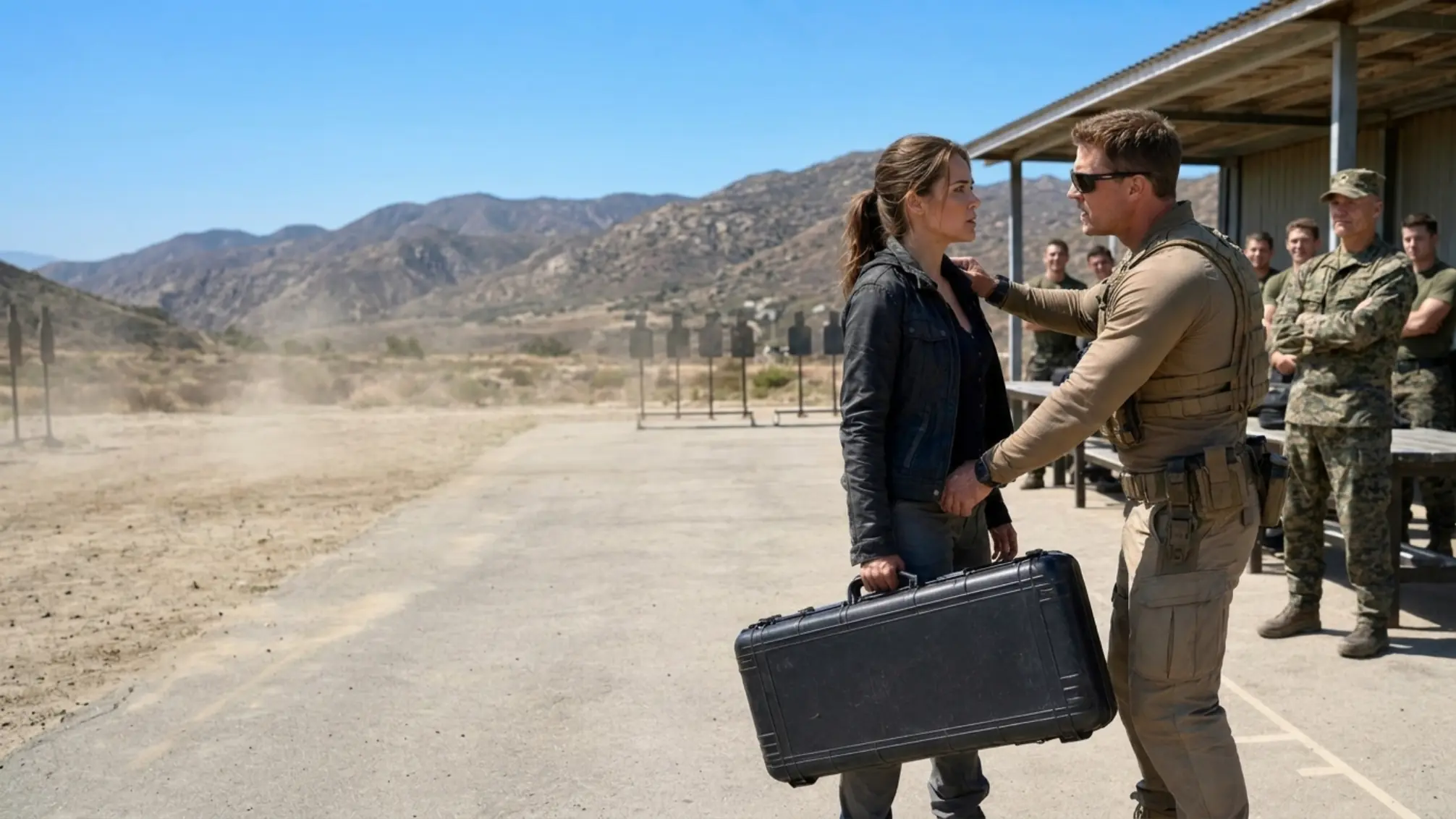
Claire’s hazel eyes remained steady. “It was never your range.”
Mason removed his sunglasses slowly. “Open that case now—or I’ll drag you off this base.”
Claire rested one hand on the metal latches. “Go ahead. Then ask your Master Chief why he just stood at attention.”
Every trainee turned.
Master Chief Owen Mercer had stepped away from the awning and straightened his shoulders. The clipboard he had been holding now hung forgotten at his side. His weathered face had lost color as he stared at the faint silver insignia engraved near the corner of Claire’s rifle case: a raven above a fractured trident.
Mason glanced at him. “Master Chief?”
Owen ignored the lieutenant. His eyes remained fixed on Claire.
“Ma’am,” he said carefully, “where did you get that case?”
Claire looked at him for the first time. “A place called Sable Ridge.”
The clipboard slipped from Owen’s hand and struck the concrete.
Several trainees exchanged confused looks. Sable Ridge did not appear on any official training map, deployment record, or public history. To them, it sounded like another remote range or forgotten military site.
To Owen Mercer, it was the place where seven men entered a mountain valley and only six returned without assistance.
He took two steps forward.
“Raven Six?” he asked.
Claire’s expression changed only slightly. “That name was retired.”
Owen came to attention.
The trainees stopped smiling.
Mason looked between them, irritation replacing confidence. “Would somebody explain what is happening?”
Owen’s voice became hard. “Remove your hand from her shoulder, Lieutenant.”
Mason seemed not to realize he was still gripping Claire’s jacket. He released her but remained in front of the table.
“She entered an active range without visible authorization,” he said. “I am enforcing security.”
“You never asked for her authorization,” Owen replied. “You mocked her clothes, insulted her, and tried to seize a controlled weapons case.”
“She has no badge.”
Claire reached into the inner pocket of her tactical jacket and removed a black identification wallet. She opened it just long enough for Owen and Mason to see the seal inside.
Mason’s confidence faltered.
The credentials identified Claire as a senior technical investigator assigned jointly to Naval Special Warfare Command and the Department of Defense Inspector General. Beneath her current title appeared a second designation, partially redacted, followed by the words Former Operational Precision Specialist.
Mason recovered quickly. “Those credentials still do not authorize an unannounced weapon on my line.”
Claire closed the wallet. “Rear Admiral Ward authorized my arrival at 0600.”
“No one informed me.”
“That was deliberate.”
Silence settled across the range.
Claire placed the rifle case on the empty shooting table. Its exterior was scarred from years of transport, with one corner repaired by a strip of black metal and two replacement latches that did not match. The engraved raven was so faded that only someone who already knew the symbol would recognize it.
Mason folded his arms. “If you’re conducting an inspection, you could have entered through command like everyone else.”
“I did.”
“You came through the side gate.”
“I entered through the gate listed in your security plan as unmonitored between 0545 and 0615.”
Mason’s eyes narrowed.
Claire continued. “The guard station was empty. The camera above the vehicle barrier was pointed nine degrees away from the access lane. Three ammunition lockers behind your maintenance building were unsecured, and one trainee carried a live sidearm into the equipment bay without challenge.”
The trainees beneath the awning stopped looking entertained.
Mason turned toward them. “Who?”
Claire answered before anyone moved. “Petty Officer Harris. Left side of the second row.”
A sandy-haired trainee instinctively touched his hip.
Mason stared at him, then back at Claire. “You were watching us.”
“I was assessing your range.”
“You deliberately concealed your identity.”
“I wore ordinary clothes and carried authorized equipment. You supplied the humiliation yourself.”
Owen stepped beside the shooting table. “Why is the Sable Ridge rifle here?”
Claire studied the old case beneath her hand.
“Because three trainees have reported unexplained optic movement during qualification. Two were ordered to continue shooting. One was injured when a round struck a steel support instead of the target.”
The trainees looked toward Mason.
He gave a dismissive shake of his head. “The injury resulted from poor trigger discipline. The investigation was completed.”
“No,” Claire said. “Your report was completed.”
“You are questioning my judgment on my range?”
“I’m questioning why the serial numbers in your report don’t match the rifles in your armory.”
The words landed heavily.
Owen’s head turned toward Mason. “What serial numbers?”
Mason’s jaw tightened. “Administrative transcription errors.”
“Sixteen errors?” Claire asked. “All involving weapons supplied by the same contractor?”
The lieutenant stepped closer. “You have no idea how many systems pass through this range.”
“I know exactly how many passed through during the last fourteen months.”
She released the first latch.
The metal snapped open.
Owen moved instinctively nearer, while Mason remained on the opposite side of the table. Claire opened the second latch and lifted the lid.
Inside rested a precision rifle unlike the standard weapons issued at the range. Its dark finish had faded along the stock and receiver where hands had gripped it through years of hard use. The optic was older than the systems currently being tested, and several components carried hand-engraved markings instead of factory labels.
A narrow compartment beneath the barrel held notebooks, sealed data drives, and a weathered photograph.
Owen saw the photograph first.
Six exhausted men stood beside a damaged aircraft in a rocky valley. Their uniforms were torn, their faces streaked with dust and blood. Claire stood behind them holding the same rifle, her hair shorter and her expression harder.
Owen was one of the six.
Mason stared at the image. “She was attached to your team?”
Owen looked at Claire. “She was the reason my team came home.”
No one beneath the awning moved.
Twelve years earlier, Owen’s unit had been trapped beyond a compromised extraction route during a mission whose details remained classified. Enemy fire controlled the only path toward the aircraft. Communications had failed, the team’s designated marksman was wounded, and the remaining men had less than twenty minutes before hostile reinforcements reached the valley.
Claire had been assigned as a weapons-development specialist, not an assault operator. Yet when the marksman fell, she took his rifle, moved alone across exposed ground, and created the opening that allowed the unit to reach the aircraft.
The weapon failed after the third shot.
Claire rebuilt part of the firing mechanism behind a rock using a field tool, wire from a damaged radio, and a spring removed from an equipment pouch. She continued firing until every surviving man reached cover.
The rifle in the battered case was the replacement system she later designed around everything that had failed that day.
The raven insignia belonged to the classified development team.
Mason looked at Claire differently now, though resentment remained stronger than respect. “That was more than a decade ago.”
“Yes.”
“Old combat stories don’t prove anything about my equipment program.”
“They prove she understands the weapon you copied,” Owen said.
Claire lifted one of the sealed drives from the case.
“The rifles your trainees are using contain a mounting system derived from my original design. The contractor changed two internal dimensions to avoid paying licensing costs. Under repeated recoil, the mount shifts enough to move the optic without producing visible exterior damage.”
Mason scoffed. “That claim was reviewed and rejected.”
“By you.”
“By qualified personnel.”
“Your brother-in-law owns twenty-eight percent of the contracting company.”
The lieutenant’s face went still.
Several trainees reacted quietly.
Owen stepped closer to him. “Is that true?”
Mason looked toward Claire. “My family connections were disclosed.”
“Not in the procurement record,” she replied. “Not in the safety review. And not in the report blaming Petty Officer Ortiz for the round that struck the target frame.”
“That trainee ignored instructions.”
“He reported the optic drifting twice.”
“He lacked confidence.”
“He showed you the loosened mount.”
Mason slammed one hand against the table. “You weren’t there.”
Claire removed a small tablet from the case and placed it beside the rifle. A video appeared on the screen.
Petty Officer Liam Ortiz stood at the same firing line six weeks earlier, holding an issued rifle while speaking to Mason. The recording had been captured by a maintenance camera aimed toward the target-control equipment.
“The zero moved again, sir,” Liam said in the video. “Four inches left after ten rounds.”
Mason’s recorded voice answered. “Your fundamentals moved. Continue firing.”
“I checked the mount.”
“Fire the qualification.”
The video shifted forward. Liam fired. The round struck the edge of a steel support, sending fragments backward into the line. One fragment cut through his cheek and damaged his left eye.
The image stopped.
Mason looked toward the trainees. “That recording was obtained without authorization.”
Claire’s voice remained cold. “A man nearly lost his sight, and you’re worried about the camera.”
“He made the shot.”
“You forced him to use equipment you knew was defective.”
“I knew no such thing.”
Claire removed a printed message from the case.
The document showed Mason communicating with his brother-in-law three days before the accident.
Another mount failed after sustained fire. Keep it internal until the next contract payment clears. I can control the reports here.
Owen read the message twice.
“You knew.”
Mason’s gaze moved toward the trainees, searching for support. “Messages can be fabricated.”
“The Inspector General recovered it from the contractor’s server,” Claire said. “Along with bank records showing that you received $180,000 through a consulting company registered in Nevada.”
The range became completely silent.
Mason took one step backward. “If you had evidence, I would already be under investigation.”
“You are.”
“Then why send you alone?”
“To observe whether you would recognize a controlled visitor, follow security procedure, and protect government property.”
Claire looked at the hand he had used to grab her shoulder.
“You failed all three before I opened the case.”
Mason’s face reddened. “You provoked this.”
“No. I arrived quietly. You needed an audience.”
Owen looked toward the command building. “Where is Admiral Ward?”
A line of dark government vehicles appeared beyond the range gate.
Claire closed the tablet. “Two minutes away.”
Mason turned sharply toward the trainees. “Everyone clear the line. Return all weapons and report to barracks.”
No one moved.
“That is a direct order!”
Owen’s voice cut through his. “Range remains locked.”
“You do not countermand me.”
“I do when an officer under investigation tries to scatter witnesses.”
Mason reached toward the radio on his vest.
Claire placed one hand over it.
His eyes flashed with anger. “Remove your hand.”
“Your communications privileges were suspended at 0600. The radio connects only to the investigative channel.”
Mason pulled it free anyway and pressed the transmit button.
“Range control, this is Lieutenant Grant. I have an unauthorized civilian interfering with an active training operation.”
A woman answered immediately.
“Lieutenant Grant, this is Rear Admiral Helen Ward. Remain where you are.”
Several trainees straightened.
Mason released the button slowly.
The vehicles stopped near the awning. Rear Admiral Ward stepped from the first, followed by Naval Criminal Investigative Service agents and two uniformed legal officers. She was in her late fifties, silver-haired, and known throughout the command for speaking quietly only when she was most angry.
She approached the firing line and looked first at Claire, then at Owen, and finally at Mason.
“Lieutenant, surrender your range credentials and sidearm.”
Mason remained still. “Admiral, this inspection has been conducted through deception.”
“Yes.”
“You authorized her to enter without notification?”
“Yes.”
“You allowed her to bring an unregistered weapon?”
Ward glanced at the rifle. “That weapon is registered at a classification level above your access.”
Mason swallowed.
“This is retaliation,” he said. “I challenged unsafe conduct, and now an old operator with personal connections is accusing me of corruption.”
Claire reached into the case and removed a small sealed evidence bag.
Inside was a cracked optic mount from Liam Ortiz’s rifle.
“The fracture pattern matches fourteen other failed mounts,” she explained. “Each one was removed after a trainee complained. None appears in your maintenance reports.”
Ward looked toward Mason. “Where are the other mounts?”
He did not answer.
An NCIS agent spoke. “We recovered eleven from a locked cabinet in Lieutenant Grant’s private office. Three were shipped to the contractor two days after the Ortiz injury.”
Mason’s shoulders lowered slightly.
The admiral continued. “You accepted undisclosed payments, concealed safety failures, falsified qualification records, and ordered personnel to keep using defective equipment.”
“I protected the program.”
“You protected a contract.”
“We needed the rifles. Canceling the program would have delayed readiness for a year.”
Claire looked toward the trainees. “How many injured men equal one year of readiness?”
Mason pointed at her. “You think one classified mission makes you understand command?”
“No,” Claire replied. “Watching commanders sacrifice people to protect themselves taught me that.”
The admiral nodded toward the agents.
They removed Mason’s sidearm, radio, and credentials. He was not handcuffed immediately, but two investigators remained beside him.
As they prepared to escort him away, Mason looked at the rifle.
“You came here planning to embarrass me.”
Claire shook her head. “I came here hoping the reports were wrong.”
He looked toward Owen. “You stood there and let this happen.”
Owen’s expression stayed hard. “I stood there long enough to learn whether you would protect the line or your ego.”
The agents led Mason toward the vehicles.
None of the trainees laughed.
Rear Admiral Ward turned toward Claire. “The issued weapons are secured. We need an independent demonstration for the procurement board this afternoon.”
Claire looked down at the old rifle.
“I’m not here to perform.”
“No,” Ward said. “You’re here because no one else can prove the difference between the original system and the compromised copy as clearly as you can.”
Owen approached the shooting table.
“One lane,” he said.
Claire looked toward the distant steel targets.
That was all she had requested when she arrived.
The range was cleared and reset. Investigators placed one issued rifle and Claire’s older system on adjacent tables. Engineers attached monitoring equipment while the trainees watched from behind the safety line.
Claire removed her tactical jacket, checked the rifle, and settled behind it with movements so controlled that the entire range seemed to quiet around her. The wind had strengthened, moving unevenly across the open ground toward the distant mountains.
The target stood more than a thousand yards away.
Mason had mocked the worn rifle case because its exterior looked outdated. He had judged Claire’s clothes, lack of visible rank, and quiet manner for the same reason. He understood value only when it announced itself loudly enough to protect his ego.
Claire waited.
Then she fired once.
The distant steel target rang.
No second adjustment.
No theatrical pause.
One shot.
Owen came to attention again.
This time, every trainee joined him.
Claire rose and cleared the rifle. “At ease.”
The men relaxed, but nobody spoke.
Petty Officer Harris finally looked toward the issued weapon on the adjacent table. “What happens to the program now?”
“The contract is suspended,” Admiral Ward said. “Every rifle will be inspected, every qualification affected by the defective mounts will be reviewed, and every trainee pressured into silence will be interviewed independently.”
Another trainee raised his hand slightly. “What happens to Lieutenant Grant?”
“That depends on the investigation and military court.”
Claire closed the rifle case.
Owen remained beside her after the others began returning equipment.
“I thought you disappeared after Sable Ridge,” he said.
“I tried.”
“You never answered my letters.”
“I didn’t know what to say.”
“You could have said you were alive.”
Claire looked toward the photograph inside the case. “Some people weren’t.”
Owen understood.
The seventh man at Sable Ridge had been Claire’s older brother, a communications officer killed while restoring the signal that brought their extraction aircraft into the valley. She designed the replacement rifle partly because the first weapon’s failure had cost them time they never recovered.
For years, she blamed herself.
Eventually, she returned to weapons development because preventing another failure was the only way she knew to carry grief without allowing it to consume her.
Owen touched the repaired corner of the case. “Your brother saved us too.”
“I know.”
“Do you believe it?”
Claire closed the lid. “Some days.”
The investigation lasted nine months. Mason Grant was charged with bribery, falsification of military records, obstruction, misuse of authority, and reckless endangerment. His brother-in-law’s company lost the contract and faced federal prosecution for concealing known defects.
Liam Ortiz received corrective surgery and regained most of the sight in his injured eye. His qualification record was restored, and the report blaming him was removed permanently.
The trainees who had laughed at Claire were not punished for laughing. Owen believed humiliation corrected very little unless it taught someone what to do differently.
Instead, he required each man to attend the independent safety interviews and explain why none had challenged Mason when he touched an unbadged visitor, insulted her, and tried to seize controlled equipment without following procedure.
Their answers sounded similar.
They laughed because their lieutenant laughed.
They remained silent because everyone else remained silent.
They assumed confidence meant authority and authority meant correctness.
Months later, Claire returned to the Coronado range as director of a new weapons-integrity program. She wore the same faded tactical jacket and carried the same battered black case.
No escort met her at the gate.
None was needed.
The guard checked her identification respectfully, verified the equipment record, and opened the barrier only after completing every required step.
Owen waited near the first shooting lane.
“Still think this isn’t my range?” he asked.
Claire placed the case on the table.
“It isn’t.”
“Whose is it?”
She looked toward the trainees checking one another’s equipment before firing.
“It belongs to the people willing to stop the line when something is wrong.”
Owen smiled.
The rifle case still looked old. Its corners remained scarred, its handles worn, and the silver raven nearly invisible beneath years of damage.
Mason had seen junk.
The trainees had seen a civilian who did not belong.
Owen had seen the symbol of the woman who once stood alone on exposed ground and refused to let his team die.
And when Claire Bennett fired one round across the Coronado range, the target’s distant ring did more than prove she could still shoot.
It exposed the difference between a person who demanded respect—and one who had earned it long before anyone knew her name.