Rain poured across the empty city street in long silver lines, blurring the headlights of passing cars and turning the pavement into a dark mirror.
It was a cold November evening in Pittsburgh, Pennsylvania, the kind of evening when people walked quickly with their shoulders raised and their faces hidden beneath hoods, scarves, and umbrellas.
Cars rushed past without slowing down. Tires hissed through puddles. Streetlights glowed softly through the rain, their reflections trembling across the wet road.
At the bus stop on Liberty Avenue, eight people stood waiting.
Most of them kept their heads lowered. A man in a gray suit stared at his phone beneath a black umbrella. A college student with headphones leaned against the shelter wall, scrolling through messages.
A woman carrying grocery bags stood near the curb, sighing every few minutes as if the rain had personally offended her. Two teenagers whispered and laughed near the back of the shelter, dry under their hoodies.
And near the end of the bench, half outside the protection of the shelter roof, sat an elderly woman.
Her name was Margaret Ellis.
She was seventy-eight years old, small, thin, and soaked through. Her gray coat had once been a good one, but now it hung heavily from her shoulders, dark with rain.
Her white hair clung to her forehead in wet strands. Her hands trembled from the cold while she hugged herself tightly, trying to keep whatever warmth remained inside her body.
People saw her.
They all saw her.
But seeing did not mean stopping.
The man in the suit glanced once, then looked back at his phone. The college student turned his music up louder. The teenagers stared for a second and then looked away.
The woman with groceries shifted farther under the shelter, keeping her bags dry, telling herself the old woman was probably fine, probably waiting for someone, probably none of her business.
That was how the world often worked.
Everyone noticed suffering.
Almost nobody wanted to be responsible for it.
Standing near the signpost with his mother was a little boy named Elijah Carter.
He was nine years old, small for his age, with dark brown eyes, a round face, and an oversized blue jacket that had belonged to his older cousin before it became his. The sleeves were too long, and the zipper stuck halfway up, but Elijah loved it because his mother said it made him look like a little explorer.
His mother, Denise Carter, held a tired hand over his shoulder while balancing a plastic folder against her chest to keep it from getting wet. She worked two jobs, mornings at a laundromat and evenings cleaning offices downtown.
That night, she had picked Elijah up from his after-school program late because a bus had broken down earlier. Now they were both tired, hungry, and waiting for the number 41 bus home.
“Elijah, stay close,” Denise said.
“I am,” he answered.
But his eyes were not on the road.
They were on the old woman.
He watched the way she tried to hide her shaking hands beneath her arms. He watched the way rain slipped from the edge of the shelter roof and landed on her shoulder.
He watched the way she smiled weakly at no one, as if practicing being all right in case someone asked.
But no one asked.
For a moment, Elijah hesitated.
His mother had taught him not to talk to strangers unless she was nearby. She had taught him that the city could be kind, but it could also be dangerous. She had taught him that children needed caution because not every adult deserved trust.
Still, she had also taught him something else.
She had taught him to hold doors open for older people. She had taught him to say yes, ma’am and no, sir. She had taught him that if someone dropped something, you picked it up. If someone cried, you did not laugh. If someone was cold and you had warmth to spare, you shared what you could.
Elijah looked down at his jacket.
Then back at Margaret.
Her lips were almost blue.
He pulled gently away from his mother’s hand.
“Elijah,” Denise said, noticing immediately. “Where are you going?”
He pointed toward the bench.
“She’s cold.”
Denise followed his gaze.
For the first time, she truly looked at the elderly woman.
Not glanced.
Looked.
Her expression changed.
“Elijah, wait.”
But he had already taken three small steps forward.
He stopped in front of Margaret, rain dripping from the ends of his sleeves. The old woman did not notice him at first. She was looking down at her shoes, as if concentrating on keeping herself upright.
Elijah swallowed.
Then, softly, with more kindness than fear in his small voice, he asked, “Ma’am, are you cold?”
Margaret looked up slowly.
For a second, she seemed startled, as if she had forgotten anyone could speak to her. Her pale blue eyes met his. Then she forced a weak smile through the rain.
“I’m okay, sweetheart,” she whispered.
But she clearly was not.
Elijah knew it.
Everyone at the bus stop knew it too, though most of them looked away again because the truth made them uncomfortable.
Elijah glanced back at his mother.
Denise stood frozen, watching him. Her face held worry, but also something else, something proud and afraid at the same time.
Elijah looked down at his oversized jacket.
It was the warmest thing he owned.
His mother had bought it secondhand at a church sale two months earlier. She had been so happy when she found it because winter was coming and Elijah had outgrown last year’s coat. He remembered how she had held it up, checking the zipper, inspecting the sleeves, making sure it would last.
He knew they did not have extra money for another one.
He knew his mother would worry.
But he also knew the old woman was shaking.
Without another word, Elijah pulled his arms from the sleeves. The cold struck him immediately through his thin school shirt. He shivered, but he kept going. Carefully, he lifted the jacket and stepped closer to Margaret.
She looked confused.
“What are you doing?”
“You need it more,” Elijah said.
Then he wrapped the jacket gently around her shoulders.
The bus stop fell silent.
Not quiet.
Silent.
The man in the suit looked up from his phone. The college student pulled one headphone away from his ear. The woman with groceries stopped adjusting her bags. The teenagers stopped whispering.
Rain continued falling behind them.
Cars passed in bright streaks of white and red.
Margaret froze completely.
Her trembling hands rose slowly and touched the jacket around her shoulders. The sleeves hung loose against her sides. The fabric was still warm from Elijah’s body.
Her eyes filled with tears so quickly that they spilled before she could hide them.
“Oh,” she whispered.
Elijah stood in front of her in only his thin shirt, trying not to shake too obviously.
“It’s okay,” he said. “It’s big anyway.”
Margaret pressed the jacket closer.
For a moment, she could not speak.
Then, through a voice breaking apart with emotion, she whispered, “My grandson used to do that.”
Elijah tilted his head.
“He gave you his jacket?”
Margaret nodded.
“Every time he thought I was cold. Even when he was little.” She smiled, but the smile broke at the edges. “He would say, ‘Grandma, you forgot to take care of yourself again.’”
The shame that moved through the bus stop was almost visible.
The people who had ignored her moments earlier slowly lowered their eyes. The man in the suit slipped his phone into his pocket. The college student removed both headphones. The woman with grocery bags looked down at the dry umbrella hooked over her arm, then at Margaret’s soaked coat.
Denise rushed forward and placed her own scarf around Elijah’s shoulders.
“Baby, you can’t stand in the rain with no jacket.”
“She was colder,” Elijah said.
Denise looked at Margaret.
The old woman stared up at her with tears still running down her face.
“I’m sorry,” Margaret whispered. “I didn’t mean to take his coat.”
Denise’s face softened.
“You didn’t take it. He gave it.”
Elijah shivered.
Denise pulled him close, rubbing his arms.
The man in the gray suit suddenly stepped forward, holding his umbrella.
“Here,” he said awkwardly. “Use this.”
He moved the umbrella over Margaret and Elijah, though his own shoulder immediately got wet.
The woman with grocery bags took a small packet of tissues from her purse and handed them to Margaret.
“I’m sorry,” she said quietly. “I should have asked sooner.”
The college student opened his backpack and pulled out a sweatshirt.
“It’s clean,” he said. “I was going to the gym, but you can wrap it over your lap.”
One of the teenagers muttered, “We got hand warmers.”
The other quickly dug into his hoodie pocket and produced two small packets.
“My dad makes me carry them when it gets cold,” he said, embarrassed. “You shake them.”
He activated them and placed them in Margaret’s hands.
Just minutes earlier, Margaret had been invisible.
Now everyone was moving around her.
Not perfectly.
Not smoothly.
But sincerely.
Elijah watched it all with wide eyes. He had not meant to make everyone feel bad. He had only meant to make one old woman warmer.
A city bus slowly pulled up beside them, brakes sighing as it stopped at the curb. The door opened with a hiss.
The driver, Mr. Raymond Brooks, leaned slightly forward and looked through the windshield at the scene outside.
He had been driving city buses for twenty-three years. He had seen fights, arguments, lost children, drunk men, tired nurses, late workers, and people whose lives seemed to fit inside one plastic bag. He had learned not to be surprised by much.
But the sight before him made him pause.
A little boy stood in the rain wearing only a thin shirt and his mother’s scarf while an elderly woman sat wrapped in his oversized jacket. Around them, strangers who had ignored her now held umbrellas, tissues, hand warmers, and shame.
Raymond looked at Elijah.
Then at Margaret.
Then he quietly whispered to himself, “Kindness still exists.”
He opened the door wider.
“Everybody getting on?”
The group moved slowly. The man in the suit helped Margaret stand. Denise kept one arm around Elijah. The college student carried Margaret’s wet purse. The woman with groceries insisted Margaret board first.
Margaret stepped onto the bus carefully, one hand on the rail.
Raymond looked at her.
“You all right, ma’am?”
She tried to smile.
“I am now.”
Elijah climbed on behind her.
Raymond looked at his thin shirt and frowned.
“You the young man who gave up his coat?”
Elijah nodded.
“Yes, sir.”
Raymond reached behind his seat and pulled out an old fleece jacket from his driver’s bag.
“Then take this till you get home.”
Elijah looked at his mother.
Denise nodded, eyes wet.
“Say thank you.”
“Thank you,” Elijah said.
Raymond handed it to him.
“No, son. Thank you.”
The words warmed Elijah more than the fleece.
The passengers settled into their seats, but the bus did not feel like it usually did. Normally, people sat in separate worlds, each behind a phone, a window, a worry, or a silence. That night, they kept looking toward Margaret and Elijah as if something fragile had been placed among them and everyone wanted to protect it.
Denise sat with Elijah near the front. Margaret sat across from them, still wrapped in the oversized blue jacket. The man in the suit stood nearby, though several seats were open. The college student stood too, holding the pole with one hand and Margaret’s purse with the other.
Raymond pulled away from the curb.
For several blocks, no one spoke.
Then Elijah asked, “What’s your grandson’s name?”
Margaret looked at him.
Her face changed.
“Joshua,” she said.
“Where is he?”
The question came with a child’s innocence, but the adults around them felt its danger.
Margaret looked down at the hand warmers in her palms.
“He passed away three years ago.”
Elijah’s face fell.
“I’m sorry.”
“Thank you, sweetheart.”
Denise reached for Elijah’s hand.
Margaret continued softly, as if once the door opened, the story needed to come out.
“Joshua was twenty-two. He was studying to be a nurse. He said the world needed more men who knew how to be gentle.” She smiled through tears. “He used to meet me at bus stops when I worked late. I cleaned offices downtown after my husband died. Joshua didn’t like me waiting alone, so he would come with his big coat and his crooked smile.”
The bus was silent again.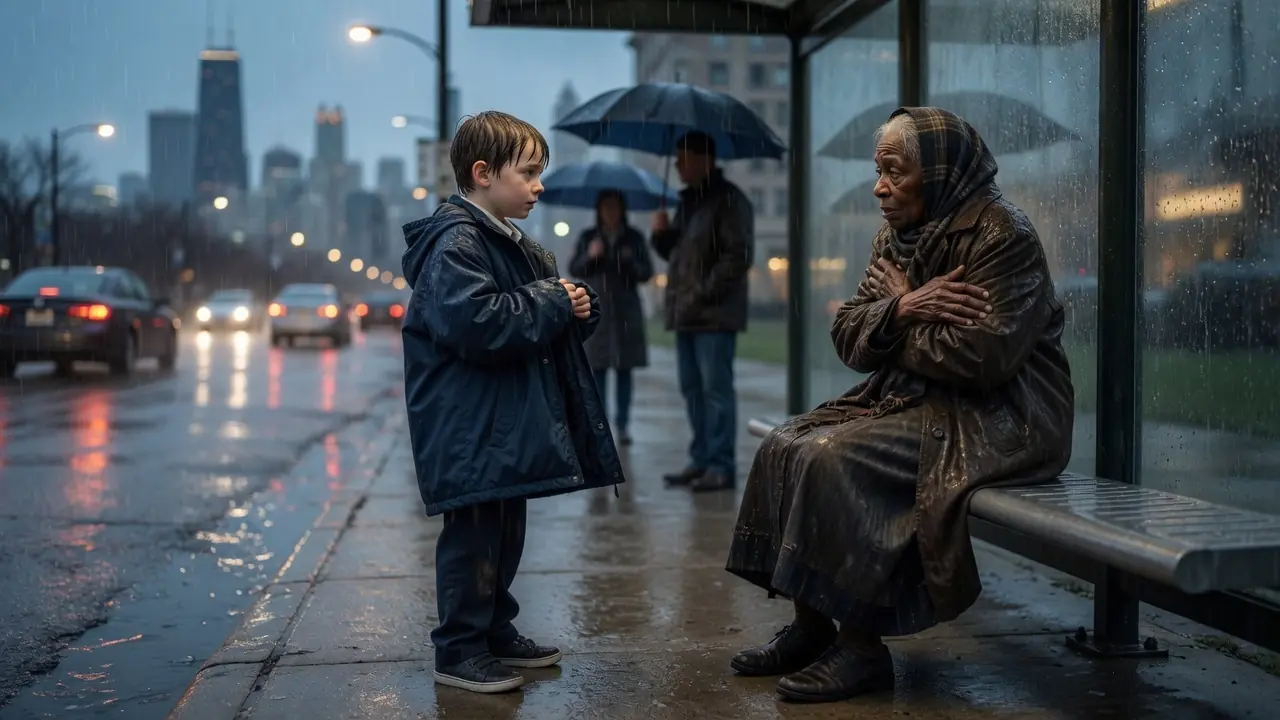
Raymond listened while driving, his eyes flicking toward the mirror.
“After he died,” Margaret said, “I stopped going out much. Today was his birthday. I went to the church where his memorial plaque is. I stayed too long. Then I missed my first bus, and the rain started.”
Her voice shook.
“I thought I could manage. I used to manage everything.”
Denise’s eyes filled.
“We all tell ourselves that,” she said quietly.
Margaret looked at her.
“You understand?”
Denise gave a tired smile.
“More than I wish I did.”
Elijah looked between them.
His young mind did not understand all the layers of grief and pride, but he understood enough. He understood that Margaret had been alone. He understood that Joshua had loved her. He understood that giving someone a jacket could make them remember being loved.
He slid off his seat and stood in the aisle, holding onto the pole.
“You can keep my jacket until you get home,” he said.
Margaret touched the blue fabric again.
“I can’t take your winter coat.”
“It’s okay,” he said. “You can give it back later.”
Denise started to speak, then stopped.
Because she saw what Elijah was doing.
He was not giving the jacket away.
He was making sure Margaret had a reason to see them again.
Margaret understood too.
Fresh tears gathered in her eyes.
“All right,” she whispered. “I’ll give it back later.”
The man in the suit cleared his throat.
“Where do you live, ma’am?”
Margaret stiffened slightly.
Not every question from a stranger is safe.
The man seemed to realize it at once.
“I’m sorry,” he said. “I only meant, do you have far to go?”
Raymond spoke from the driver’s seat.
“Mrs. Ellis gets off near Stanton Avenue. I know her stop.”
Margaret looked surprised.
“You remember me?”
Raymond smiled into the mirror.
“You used to ride my morning route every Tuesday. You always carried a brown lunch bag and thanked me twice.”
Margaret pressed a hand over her mouth.
“I didn’t think anyone noticed.”
Raymond’s voice softened.
“Drivers notice more than people think.”
When the bus reached Stanton Avenue, Raymond pulled over and kept the doors closed for a moment.
The rain had weakened, but it was still falling.
Margaret stood slowly.
The man in the suit raised his umbrella again.
“I’ll walk her to the building,” he said.
Denise stood.
“We can too.”
Raymond opened the door.
“I’m waiting right here until she’s inside.”
No one complained.
No one said they were late.
A few minutes ago, they had all been separate people with separate lives. Now they watched as Margaret stepped down from the bus wrapped in Elijah’s jacket, escorted by strangers under umbrellas through the soft rain.
Her apartment building was small and old, with a flickering light above the entrance. She reached the door and turned back.
Elijah waved from the bus steps.
Margaret lifted one trembling hand.
Then she went inside.
Only when the lobby light showed her safely beyond the glass did Raymond close the bus doors.
Denise sat down again, holding Elijah close.
“You scared me,” she whispered.
“I’m sorry.”
“I’m not mad.” She kissed the top of his head. “I just need you warm too.”
“He needed to be kind,” Raymond said from the front.
Denise looked up.
The driver’s eyes met hers in the mirror.
“World’s hard enough,” he said. “Can’t scold the boy for bringing softness into it.”
Elijah smiled sleepily.
By the time he and Denise reached their stop, the rain had turned into a mist. Raymond refused to take their fare.
Denise protested.
He shook his head.
“Already paid.”
“With what?”
Raymond nodded toward Elijah.
“That jacket.”
Denise did not argue after that.
The next morning, Elijah woke to sunlight on his face.
For a moment, he had forgotten about the bus stop, the rain, the old woman, and the blue jacket. Then he sat up quickly.
“My coat!”
Denise came into the room holding a mug of coffee.
“Good morning to you too.”
“Mom, Mrs. Ellis has my coat.”
“I know.”
“What if she needs it today?”
Denise smiled.
“Then I hope she wears it.”
Elijah thought about that.
“Can we check on her?”
Denise looked at her son.
She had planned to spend the day catching up on laundry, grocery shopping, and rest that never really came. But Elijah’s face was serious, and she knew this mattered to him.
“All right,” she said. “After breakfast.”
They bought a small loaf of banana bread from the corner bakery with money Denise had set aside for bus fare. Then they rode to Stanton Avenue.
Margaret’s building smelled faintly of old carpet, cabbage soup, and radiator heat. A man in the lobby pointed them to apartment 2B when Denise asked politely for Mrs. Ellis.
Elijah knocked.
For a few seconds, nothing happened.
Then the door opened.
Margaret stood there wearing a dry sweater, her hair neatly pinned, and Elijah’s oversized blue jacket folded carefully over one arm.
Her face lit up when she saw him.
“Elijah.”
He smiled.
“You remembered my name.”
“I could never forget it.”
Denise held up the banana bread.
“We wanted to check on you.”
Margaret’s eyes filled again, but this time the tears did not look so painful.
“Come in,” she said.
Her apartment was small, tidy, and full of photographs. Some were old black-and-white pictures of Margaret and her late husband. Some showed a young man with kind eyes and a crooked smile.
Joshua.
Elijah walked to the shelf and looked at one picture of Joshua wearing a graduation gown.
“He looks nice,” Elijah said.
“He was,” Margaret answered.
She made tea while Denise and Elijah sat at the small kitchen table. The blue jacket rested between them, folded with care.
“I washed it,” Margaret said. “And mended the pocket. There was a little tear.”
Elijah picked it up.
The pocket had been stitched neatly with blue thread.
“Thank you.”
“No,” Margaret said softly. “Thank you.”
Denise looked around the apartment.
“Do you have family nearby?”
Margaret poured tea.
“My daughter lives in Ohio. We speak sometimes, but she has her own children, her own troubles. After Joshua died, I suppose I became difficult to visit.”
“You shouldn’t have to say that,” Denise said.
Margaret smiled sadly.
“Old people learn to excuse other people’s absence. It hurts less if we give it a polite name.”
The words settled heavily at the table.
Elijah did not understand them fully, but Denise did.
She reached across and touched Margaret’s hand.
“You don’t have to excuse ours. We can visit.”
Margaret stared at her.
“You barely know me.”
“Elijah knows you enough to worry.”
Margaret looked at the boy.
He was spreading butter carefully on a slice of banana bread, concentrating like the task mattered deeply.
“My grandson used to sit right there,” she whispered.
Elijah looked up.
“Can I sit here again?”
Margaret laughed through tears.
“Yes, sweetheart. You can.”
That was how it began.
A jacket in the rain became a Saturday visit.
A Saturday visit became dinner once a month.
Dinner became phone calls.
Phone calls became Denise checking on Margaret during storms and Margaret helping Elijah with reading assignments because she had once been a school secretary and still believed children should learn to write thank-you notes properly.
By December, Elijah had a new winter coat through a donation program at school. He insisted Margaret keep the blue one.
“It looks better on you,” he said.
“It hangs to my knees.”
“That means it’s extra warm.”
Margaret kept it on a hook near her front door.
Sometimes she touched the sleeve before leaving the apartment.
Not because she needed the coat every day.
Because it reminded her that love could return in unfamiliar shapes.
The people from the bus stop did not forget either.
The man in the gray suit was named David Nolan. He worked in an insurance office and had spent years convincing himself he was too busy to notice strangers. The night at the bus stop unsettled him. Two weeks later, he began volunteering once a month with a senior meal delivery program.
The college student, Serena Park, wrote an essay for her social work class about bystander silence. She did not make herself the hero in it. She wrote honestly about how she had looked away until a child showed her what courage looked like.
The teenager who gave the hand warmers started carrying extra packs in winter and handing them out downtown, pretending it was no big deal.
Raymond, the bus driver, kept an extra fleece jacket behind his seat from then on.
And at the Liberty Avenue bus stop, someone eventually installed a small weatherproof donation box filled with gloves, scarves, and hand warmers. No one officially took credit. People simply began using it.
A handwritten note on the inside of the lid read:
Take warmth if you need it. Leave warmth if you can.
One year later, on another rainy November evening, Elijah and Denise stood at the same bus stop with Margaret between them.
This time, Margaret had an umbrella.
This time, Elijah wore a proper coat.
This time, no one was pretending not to see her.
The city still moved fast around them. Cars still rushed through puddles. People still hurried beneath umbrellas. The world was not suddenly perfect because one boy had given away a jacket.
But something had changed in their small corner of it.
Margaret looked down at Elijah.
“Do you know what today is?”
He thought carefully.
“Joshua’s birthday?”
She nodded.
Elijah looked at the rain.
“Are you sad?”
“Yes,” Margaret said. “But not only sad.”
“What else?”
She smiled.
“Grateful.”
“For Joshua?”
“For Joshua. For you. For your mother. For the night I thought I was alone and found out I was wrong.”
Elijah slipped his hand into hers.
Margaret’s fingers closed gently around his.
A bus pulled up, and Raymond was driving again. He opened the door and grinned when he saw them.
“Well, if it isn’t the gentleman with the famous jacket.”
Elijah laughed.
“It wasn’t famous.”
Raymond shook his head.
“Son, around here it is.”
They climbed aboard together.
Margaret sat by the window. Elijah sat beside her. Denise sat across from them, watching her son talk animatedly about school, dinosaurs, and how he wanted to be a bus driver or maybe a doctor or maybe both.
Margaret listened as if every word was a gift.
Outside, rain streaked the windows and city lights blurred into gold.
Inside, the bus felt warm.
Years later, Elijah would remember that first night clearly.
He would remember the cold rain on his arms after giving away his jacket. He would remember the old woman’s trembling hands touching the sleeves. He would remember the silence that fell over the bus stop when everyone realized a child had done what adults were too afraid or too busy to do.
But most of all, he would remember what his mother told him when they got home.
Denise had wrapped him in a blanket, warmed soup on the stove, and sat beside him at the kitchen table.
“You did a beautiful thing,” she said.
“I was scared you’d be mad about the jacket.”
“I was worried about you,” she answered. “But I’m proud of your heart.”
Elijah looked down at his hands.
“Everybody saw her. Nobody helped.”
Denise’s face grew sad.
“I know.”
“Why?”
She was quiet for a moment.
“Because sometimes grown-ups teach themselves not to feel too much. They think it protects them. But really, it just makes the world colder.”
Elijah thought about Margaret shivering in the rain.
“I don’t want to be like that.”
Denise touched his cheek.
“Then don’t be.”
He never forgot.
And neither did the people at that bus stop.
Because on a cold rainy evening in Pittsburgh, while cars rushed past and strangers lowered their eyes, the smallest person there carried the biggest heart. A little boy saw an old woman shivering and decided that kindness did not need permission, wealth, age, or applause.
It only needed someone willing to act.
Beneath the cold rain and the dark city sky, one oversized blue jacket became more than cloth.
It became warmth.
It became shame.
It became memory.
It became the beginning of a family neither Elijah nor Margaret knew they needed.
And somehow, after that night, the bus stop no longer felt lonely at all.