“You dragged home broken hoses from half the town and turned your granddaddy’s garden into a trash heap, little girl.”
Mr. Harlan stood beside the white fence with both hands hooked into his belt, staring at the crooked network of cracked green, yellow, and black hoses stretched across the dying vegetable rows. Seven-year-old Emma Grace Carter stood opposite him beneath a wide tan cowboy hat, her light-brown hair divided into two neat braids and a brown bandana tied around her neck. Her oversized denim shirt and loose blue jeans made her look even smaller against the sunburned field, but her warm brown eyes held a stubbornness no adult in Pine Hollow had expected.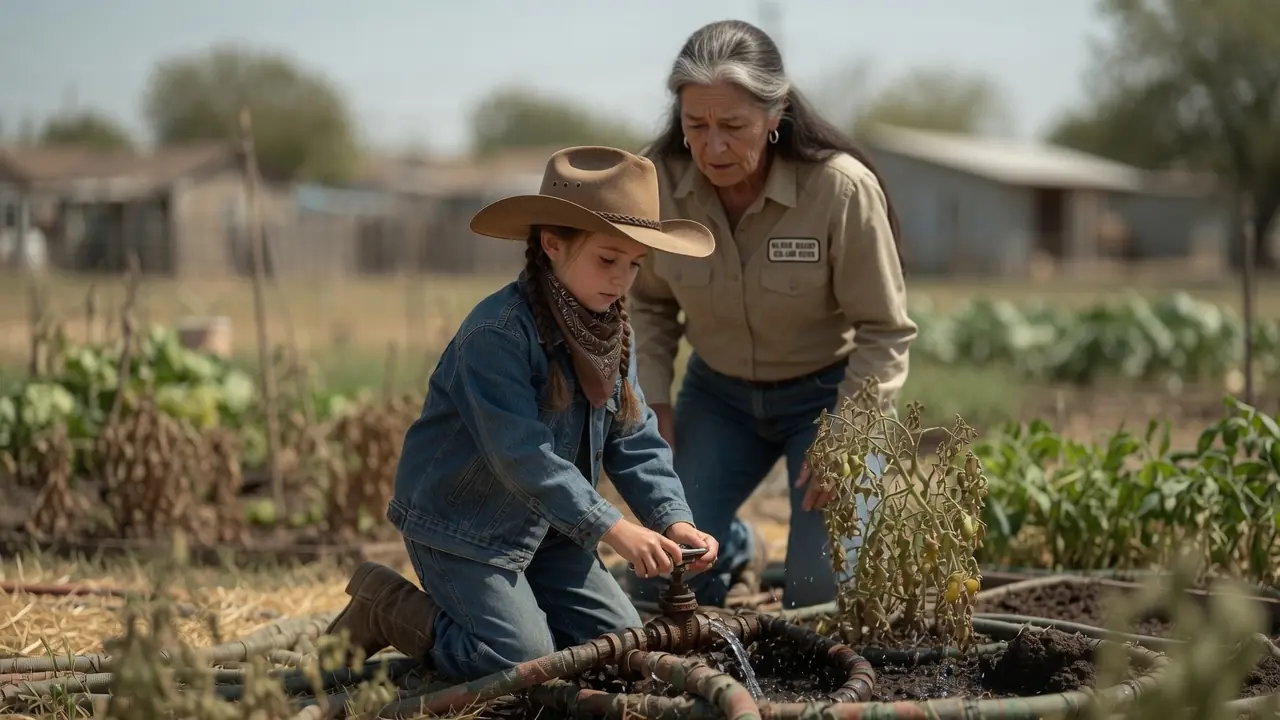
“You called it trash because none of you believed this land was worth saving,” Emma Grace said.
Mr. Harlan pointed toward the hoses. “In one minute, I’m tearing every piece of this mess out of my soil.”
Emma Grace wrapped both hands around the rusted water valve. “Then stand there and laugh one last time—because when I turn this handle, this dead garden speaks for me.”
The Carter farm sat on sixty acres of flat Texas land that had belonged to Emma Grace’s family for four generations. Her great-grandfather had raised cattle there, her grandfather Earl had planted vegetables, and her father Daniel had spent the last ten years trying to keep both traditions alive. That summer, however, the past seemed ready to end. The rain stopped in May, the pond shrank into cracked mud, and the afternoon wind carried dust across fields where green plants should have stood.
Daniel Carter did not complain loudly when trouble came. He simply became quieter, rising before sunrise and returning after dark with deeper lines around his tired eyes. His tomato plants wilted by midmorning, the bean vines had stopped producing, and the peppers were dropping blossoms before fruit could form. If the family failed to deliver enough vegetables to the county cooperative, they would lose the contract that paid their mortgage.
Emma Grace heard her parents discussing it one night after they believed she had gone to bed. Her mother, Rachel, placed the overdue electricity bill beside a stack of farm invoices and asked whether they could afford a commercial drip-irrigation system. Daniel shook his head and said even the cheapest equipment cost more than the farm had earned that month. They could purchase seed for autumn or irrigation for summer, but not both.
Grandpa Earl sat at the far end of the table, his weathered hands wrapped around a coffee cup. At seventy-two, he moved slowly and spoke only after other people had exhausted themselves. He had farmed through dry seasons before, but even he looked worried. When Daniel said they might have to sell the vegetable acreage, Earl’s eyes moved toward the dark window as though he could already see the family’s history leaving.
Emma Grace returned to bed without making a sound.
The solution did not arrive as an idea formed perfectly inside her head. It began three mornings later when she carried water to the chickens and noticed a wet circle beneath the outdoor faucet. One of the old hoses had a tiny crack near its connector, allowing water to drip slowly into the dirt. Every blade of grass around that leak remained thick and green, while the rest of the yard had turned brown.
Emma Grace crouched and pressed her fingers into the soil. Beneath the leak, the earth was cool and damp several inches deep. Ten feet away, where the sprinkler sprayed in broad arcs, the surface was already dry. The sprinkler looked more powerful, but much of its water vanished into the hot air or landed beyond the plants.
“Grandpa,” she asked at breakfast, “why is the grass beside the broken hose greener than the grass beside the sprinkler?”
Earl stopped stirring sugar into his coffee. “Because the sprinkler waters everything it passes. That leak waters one place slowly enough for the ground to drink.”
“Is slow better?”
“Sometimes slow is the only way not to waste what little you have.”
Emma Grace carried those words with her through the day. She watched Rachel water the flowerpots, and she saw half the water run across the porch before entering the soil. She watched condensation collect beneath the chicken trough and keep one patch of weeds alive. She began noticing that tiny drops often lasted longer than large splashes.
The town library occupied two rooms beside the volunteer fire station. Emma Grace visited after school and asked the librarian for books about watering plants without sprinklers. Mrs. Price found three gardening guides and an old university booklet showing a drip-irrigation system. The diagrams displayed narrow tubes with tiny openings that delivered water directly beside plant roots.
The professional systems were made from special tubing, filters, valves, and pressure regulators. Emma Grace copied the diagrams into a notebook anyway. She did not understand every measurement, but she understood the idea. Water did not need to fly through the air if it could travel quietly along the ground.
Broken garden hoses existed everywhere in Pine Hollow.
Mr. Henderson had one split down the middle after leaving it outside through winter. Mrs. Pruitt owned two with crushed connectors, and old Mr. Webb had driven his tractor over a yellow hose until it leaked from six different places. Most families stored damaged hoses behind barns or dropped them beside trash cans because replacements were cheaper than repairs.
Emma Grace started collecting them before anyone knew what she intended to build.
At six one morning, Mr. Henderson found her lifting a cracked green hose from beside his garbage bin. She wore her cowboy hat, denim clothes, and little brown boots, with one end of the hose coiled over her shoulder. He leaned against his porch rail and laughed.
“That thing is split open, sweetheart.”
“I know.”
“It won’t carry water.”
“It already carried water for years.”
He frowned because the answer did not explain anything. “Take it if you want it.”
By the end of the week, eleven damaged hoses lay behind the Carter barn. Neighbors began talking after seeing Emma Grace walking home with coils larger than her body. Some called her the hose collector, while others said grief over the dying farm had made the child strange.
Mr. Harlan laughed louder than anyone.
He owned the adjoining property and served as a volunteer member of the local water committee. His fields were larger than Daniel’s, and his powerful irrigation equipment drew heavily from the shared well. Harlan believed the Carter farm would fail before his own, allowing him to purchase the land cheaply and expand his cattle pasture.
“You planning to build a rubber fence?” he asked when Emma Grace dragged home her eighth hose.
“No.”
“A giant snake?”
“No.”
“Then what are you doing?”
“Fixing the part nobody noticed.”
Harlan repeated that answer at the feed store until grown men laughed over their coffee. Emma Grace heard about it from her sixteen-year-old brother, Tucker, who asked whether she wanted help moving the hoses somewhere people could not see them. She refused because hiding the materials would not make the idea work. She needed space, sunlight, and access to the garden rows.
Grandpa Earl watched without interfering. He gave Emma Grace several old brass connectors, a small hand drill, and a box of rusted hose clamps from his workshop. When she asked whether he believed her system would work, he answered honestly.
“I believe you saw something the rest of us missed.”
“That isn’t the same.”
“No. Belief comes after testing.”
Emma Grace spread the hoses behind the barn and connected them end to end. She used bicycle tubing to cover the largest splits and wire to tighten the connections. Along sections without natural cracks, she heated a sewing needle over a candle and made tiny holes at measured intervals.
Her first design looked beautiful in the notebook.
In the garden, it failed instantly.
The moment she turned the faucet, one taped connection burst apart. Water sprayed sideways across the row, another hose jumped from the pressure, and a damaged section split wider until mud covered Emma Grace from her hat to her boots. Tucker happened to enter the garden carrying chicken feed and laughed before seeing tears gather in her eyes.
“Well,” he said awkwardly, “at least the dry season is over in that one spot.”
Emma Grace shut off the valve and sat in the mud. The hoses looked exactly like the useless trash everyone said they were. Her notebook diagrams had not included mismatched diameters, loose connectors, or water pressure strong enough to tear through old rubber. For several minutes, she wanted to leave everything where it had fallen.
At dinner, Emma Grace said almost nothing.
Daniel noticed the mud behind her ears and asked what happened. She shrugged and pushed beans around her plate. Rachel looked toward Earl, but the old farmer waited until everyone else had stopped trying to make conversation.
“My first irrigation ditch flooded the lower pasture,” he said.
Emma Grace looked up.
“I was seventeen and thought I understood water. Your great-grandfather lost half an acre of corn because I cut the channel too deep.”
“What did he do?”
“Made me rebuild it.”
“Was he angry?”
“Very.”
Emma Grace lowered her eyes. “Everyone already thinks mine is stupid.”
“People laugh when they cannot see what something might become.” Earl leaned toward her. “Failure means the first design was wrong. It doesn’t mean the idea was.”
The next morning, Tucker found his sister behind the barn before sunrise. She had separated every failed connection and placed the pieces by size. Without apologizing for laughing, he sat beside her and offered to cut short sections of rigid plastic pipe into internal sleeves. The pipe allowed the hose ends to slide over something solid before being tightened with clamps.
The second system held together longer.
Water reached the first two rows, but pressure weakened before reaching the last section. Several holes near the faucet released too much water, leaving little for the far end. Emma Grace shut the valve before the garden flooded and returned to her notebook.
She drew arrows showing where the flow decreased.
Earl explained that water followed the easiest path. If the first holes were too large, they stole pressure from everything beyond them. Emma Grace replaced the damaged opening sections with stronger hose, made smaller holes near the beginning, and slightly larger ones toward the end.
Her third attempt took four more days.
This time, the patched hoses lay beneath a thin layer of straw mulch along the base of each tomato and bean row. Emma Grace turned the valve slowly. Water entered the first line with a quiet hiss, moved through every connection, and began dripping from the tiny openings.
There were no sprays.
No hoses jumped.
No joints separated.
Drop by drop, the water disappeared directly into the soil around the roots. Emma Grace knelt beside the farthest tomato plant and waited. After several minutes, the dark circle of moisture reached it too.
“It works,” Tucker whispered.
Emma Grace touched the damp earth. “Not yet.”
She knew one successful test did not prove the design could save anything. For two weeks, she ran the system early each morning and again near sunset. She measured how long the water took to reach each row, tightened leaking joints, and moved holes that dripped between plants rather than beside them.
The difference appeared slowly.
Tomato leaves that had curled inward began opening again. Bean vines thickened, pepper plants stopped dropping blossoms, and the soil beneath the mulch stayed cool through the afternoon. The section watered by sprinklers remained dry and stressed, even though Daniel used more water there.
One evening, Daniel entered the garden after work and stopped between the rows.
He pressed a hand into the earth beside a tomato plant. Moisture remained nearly four inches below the surface. He followed the patched hose with his eyes until he found Emma Grace kneeling at the valve.
“You built this?”
She nodded.
“With broken hoses?”
“They already had some holes. I only decided where the rest should go.”
Daniel looked toward the commercial sprinkler rotating across another section of the field. Water glittered in the air, beautiful and wasteful. He shut it off.
The family expanded Emma Grace’s system across the most valuable vegetable rows. Tucker collected additional hoses, Daniel helped install a basic pressure regulator made from inexpensive parts, and Rachel recorded water use. The homemade drip lines required less than half the water previously used by the sprinklers.
Then Mr. Harlan discovered that the Carter family had extended one line near the shared boundary.
He arrived furious, accusing Emma Grace of turning the garden into a dump and claiming the patched hoses violated community water rules. In reality, he feared the Carter farm might survive long enough to keep the land he hoped to purchase. He filed a formal complaint and announced that he would remove the system himself if the committee failed to act.
That confrontation brought half the town to the white fence.
“Clear this garbage out,” Harlan ordered. “Broken hoses don’t become farm equipment because a child lays them beside vegetables.”
Emma Grace stood beside the valve while Daniel watched from the garden entrance. He wanted to defend her, but Earl touched his arm and shook his head. This was her work, and she deserved to explain it.
“The garden uses less water now,” Emma Grace said.
“That’s a child’s guess.”
Rachel stepped forward holding a notebook. “We measured every gallon.”
Harlan barely glanced at her. “I’m tearing it out before she contaminates the shared line.”
“You touch her system,” Daniel warned, “and you answer for damaging our property.”
Harlan smiled. “Property? This is trash.”
Emma Grace looked directly at him. “Then stand there and laugh one last time.”
She opened the valve.
The water traveled silently through the crooked lines. Nothing sprayed into the air. Small dark circles formed beneath the mulch beside every plant, while the dry paths between rows remained untouched.
County inspector Maria Lopez arrived twenty minutes later to investigate Harlan’s complaint. She examined the faucet connection, checked for contamination risks, measured pressure, and dug beside several plants. The soil under Emma Grace’s lines remained damp, while unwatered ground nearby was dry and hot.
Maria compared Rachel’s water records.
The Carter system used forty-six percent less water than the former sprinklers. It did not draw from Harlan’s property, damage the shared line, or violate any agricultural rule. The materials looked crude, but the design functioned as low-cost drip irrigation.
Harlan folded his arms. “It won’t survive harvest.”
Maria stood. “Then harvest will test it.”
The drought worsened through August.
Harlan’s irrigation pond became too shallow to pump reliably. His squash vines collapsed, and his tomato crop developed cracked fruit after irregular watering. He had spent money forcing water across entire fields but lost much of it to evaporation and runoff.
The Carter garden continued receiving small, steady amounts.
Emma Grace checked the system twice daily. She repaired splits with spare tubing, cleared holes blocked by sediment, and buried exposed sections beneath fresh mulch. The hoses were ugly, but the plants remained alive.
Harvest day arrived beneath a cloudless sky.
The cooperative truck was scheduled for noon, and neighbors gathered near the garden because the argument had become local legend. Harlan stood at the fence with the stiff expression of a man hoping someone else’s failure might protect his pride.
Daniel lifted the first tomato crate onto the truck.
Then came another.
And another.
The tomatoes were deep red and heavy. Bean pods filled baskets, peppers remained firm, and squash plants that should have died weeks earlier produced enough to exceed the cooperative contract.
The final weight surpassed the Carter family’s previous two harvests.
Mr. Henderson stared at a section of green hose he had thrown away months before. “That was mine.”
Emma Grace nodded.
“It had a split six inches long.”
“I used that part near the end where I needed more water.”
Mrs. Pruitt examined another connector. “How does something broken save a crop?”
Emma Grace brushed dirt from her hands. “It wasn’t broken everywhere.”
No one laughed.
Harlan remained by the fence until Maria handed him the final water report. His own farm had used nearly twice as much water per productive acre and harvested less than half the vegetables. He read the numbers twice before looking at Emma Grace.
“You got lucky.”
Earl stepped forward. “Luck doesn’t fail three times and rebuild itself.”
Harlan’s face reddened, but he had no answer.
During the following week, neighbors began visiting the Carter farm with broken hoses coiled in their trucks. Old Mr. Webb asked Emma Grace to help build a line for his surviving bean patch. Mrs. Pruitt brought a notebook and wrote down every instruction.
Emma Grace did not demand apologies.
She charged nothing for showing families how to build their own systems, but she required adults to help rather than expecting a child to do the work. Tucker cut connectors, Daniel installed filters, and Rachel created a simple guide explaining pressure, spacing, and safe water use.
Even Harlan returned.
He arrived one evening without his committee badge and placed three damaged hoses beside the barn. His own winter vegetable contract depended on planting within two weeks, but the pond would not recover before then.
“I need one of those systems,” he said.
Emma Grace looked at him. “You threatened to tear mine out.”
“I was wrong.”
“You called Grandpa’s garden a trash heap.”
Harlan removed his hat. “I was wrong about that too.”
Emma Grace considered him for several seconds. “You have to build it yourself.”
“I don’t know how.”
“I didn’t either.”
Harlan spent the following Saturday working beside the girl he had humiliated. His first connection leaked, and Emma Grace made him take it apart instead of fixing it for him. By sunset, he had completed one short line.
The system was not beautiful.
It worked.
A year later, Pine Hollow’s community garden installed a larger drip network made partly from recycled hose and partly from donated tubing. The town created a collection point for damaged garden supplies instead of sending everything directly to the landfill. Emma Grace’s design was adapted with proper filters and pressure controls, but the central lesson remained unchanged.
Broken did not always mean useless.
The cooperative honored Emma Grace at its autumn meeting. She stood on a wooden stage beneath her tan cowboy hat while farmers twice her height applauded. Daniel cried openly, Rachel held Earl’s hand, and Tucker told everyone he had always known the system would work.
Emma Grace allowed him the lie.
After the ceremony, she returned to the garden with Grandpa Earl. The original hoses still lay beneath the mulch, faded further by sun and dirt. Tomato vines climbed above them, heavy with another season’s fruit.
“Was it really the hoses that saved the farm?” Emma Grace asked.
Earl sat beside her on the fence. “The hoses carried the water.”
“That isn’t what I asked.”
He smiled. “No. The farm survived because you noticed what everyone else ignored, and because failing once didn’t embarrass you enough to quit.”
Emma Grace looked across the green rows.
The town had seen garbage.
She had seen a path for water.
Her first system burst, her second leaked, and her third became the difference between losing the farm and delivering the strongest harvest of Daniel Carter’s life.
The broken hoses had not changed.
They still carried cracks, faded rubber, and the marks of years spent in other people’s gardens.
Only their purpose had changed.
And sometimes, Emma Grace learned, that was all a broken thing needed—someone patient enough to give it one more job.