The late afternoon sun hung low over Route 66, turning the desert sky into layers of orange, gold, and dusty rose.
At the edge of a small roadside diner in Seligman, Arizona, the old highway stretched out in both directions like a memory that refused to end. Cars passed now and then, their tires whispering over warm asphalt.
A faded motel sign blinked lazily across the road. Beyond it, low hills sat purple in the distance, and the wide desert seemed to hold its breath as evening approached.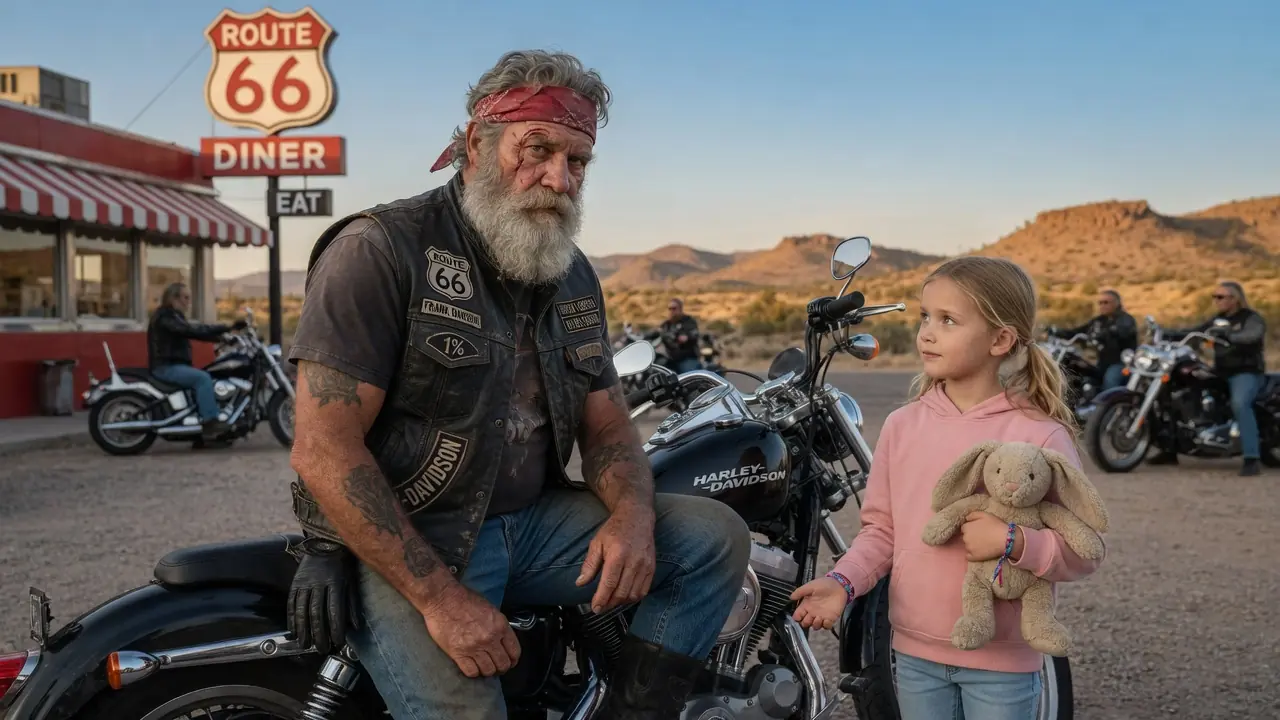
The diner was called The Copper Star.
It had red vinyl booths, silver stools at the counter, a jukebox that only worked when it felt generous, and a hand-painted sign near the cash register that read, Pie fixes what coffee cannot.
Travelers came through for burgers, milkshakes, gas station directions, and old Route 66 photographs. Truckers came in for strong coffee and quiet. Families came in because the place looked like something they wanted to remember, even if they had never been there before.
But that evening, most people inside the diner were watching the man outside.
He sat alone near the far end of the parking lot, beside a black Harley-Davidson motorcycle that looked as weathered as he did. The bike was heavy, low, and polished in places where hands had touched it often. A small silver bell hung beneath the frame. On the back fender, in fading white letters, was one word.
Butterfly.
The man’s name was Raymond Cole, though almost nobody on the road called him that anymore.
To most riders, he was Bear.
The name fit him. He was broad across the shoulders, thick through the arms, with a gray beard that reached his chest and eyes the color of dark coffee left too long on the burner. His hands were large, scarred from tools, engines, rope, road, and years of holding on too tightly to things that life kept trying to take from him.
He wore a worn black leather vest over a faded denim shirt. The vest had been patched and repaired so many times it looked less like clothing and more like a map of the miles behind him. Around his head was a faded red bandana, sun-bleached at the edges. His boots were dusty. His face was lined deeply, not just from age, but from weather, silence, and grief.
Bear had been riding since he was sixteen.
At sixty-four, he still rode as if the road were the only place that knew how to carry him without asking questions.
That day, he had ridden nearly three hundred miles.
He had not planned to stop at The Copper Star. He had not planned anything anymore, not really. Planning meant imagining the future, and Bear had not trusted the future in a long time.
He stopped only because the sun was falling, his hands were stiff from the handlebars, and the anniversary was coming.
Not today.
Tomorrow.
But grief did not wait politely for the correct date. It arrived early whenever it wanted, sat down heavily beside a man, and made itself at home.
Bear had ordered one black coffee and half a slice of apple pie.
He had eaten three bites.
Then he had stepped outside because the diner had gotten too warm, too bright, too full of people laughing like the world was still allowed to be gentle.
Now he sat beside his Harley with one boot planted on the ground and one hand resting on the bike seat. He stared toward the horizon without seeing it.
Inside the diner, two younger bikers from a small touring group stood near the window.
One of them, a man named Travis with a shaved head and a long beard braided at the chin, lowered his voice.
“Bear’s bad tonight.”
The other rider, a woman named June with silver rings on every finger, nodded.
“Tomorrow’s the day, isn’t it?”
Travis looked down.
“Yeah.”
No one said more.
Everybody in their riding circle knew enough not to speak of Bear’s daughter unless Bear spoke first.
And Bear almost never did.
Her name had been Lily.
Lily Rose Cole.
She had been eight years old when the world took her from him.
She had loved butterflies more than anything.
Butterfly stickers.
Butterfly hair clips.
Butterfly pajamas.
Butterfly drawings taped to the refrigerator.
For one full summer, she had worn plastic butterfly wings from a costume shop nearly every day, even to the grocery store. She had told strangers she was not a girl pretending to be a butterfly. She was a butterfly pretending to be a girl.
Bear had called her Daddy’s butterfly.
She had called him her big old bear.
That was before.
Everything in Bear’s life had divided itself into before and after.
Before, he had laughed loudly.
Before, he had fixed pancakes shaped like animals and failed at most of them.
Before, he had danced in the kitchen with his daughter standing on his boots.
Before, he had believed a man could be tough enough to protect what mattered.
After, he learned toughness had limits.
After, he stopped going into toy aisles.
After, he gave away the little purple bicycle in the garage because he could not bear the sight of it leaning against the wall.
After, he kept riding because stillness made the absence louder.
Nobody had seen Bear cry since the day he came home without Lily.
Not once.
He had sat through memorial rides dry-eyed. He had stood under gray skies while others wept. He had accepted hugs with a stiff nod and walked away before anyone could see his hands shake.
He did not cry because if he started, he was afraid he would never stop.
That evening, as the sky deepened over Route 66, a small girl inside The Copper Star watched him through the window.
Her name was Emily Walker.
She was six years old, though she liked to say six and a half because the half mattered to her. She had soft blonde hair that fell just below her shoulders, though one side was always slightly messier because she tucked it behind her ear when she was thinking. She wore a pink hoodie with tiny white stars on the sleeves, denim shorts over striped leggings, and red sneakers with one loose shoelace her mother kept reminding her to tie.
In her arms, she held a stuffed bunny named Mr. Hop.
Mr. Hop had been loved almost bald around one ear.
Emily had a small round face, serious blue eyes, and the kind of heart that noticed loneliness before it noticed danger.
She was sitting in a booth with her mother, Grace Walker, waiting for grilled cheese and tomato soup. Grace was thirty-one, tired in the way young widows are tired when they are trying to be both gentle and strong every hour of the day. She had brown hair tied back in a loose ponytail and a face that looked softer when she smiled, which she tried to do often for Emily’s sake.
Across from Emily sat an empty place.
Grace did not put a plate there anymore, but Emily still noticed.
Her father, Daniel Walker, had been gone for eleven months.
Daniel had loved butterflies too, though not in the same way Lily Cole had.
He had been a park ranger in northern Arizona, the kind of man who could identify birds by sound, trees by bark, and butterflies by the way they moved in the air. He had taught Emily that monarch butterflies traveled farther than anyone expected something so delicate could travel. He told her that small wings could still be brave wings.
When Daniel passed, Grace had told Emily something that had begun as comfort and become family truth.
“Sometimes butterflies are angels saying hello.”
Emily believed this completely.
If a butterfly landed near the porch, it was Daddy checking in.
If one crossed the windshield on a highway drive, Daddy was traveling with them.
If Emily saw a butterfly on a book, a shirt, a sticker, or a necklace, she would whisper, “Hi, Daddy,” as naturally as breathing.
That afternoon, before they left Flagstaff, Emily had made a bracelet in the back seat of the car while Grace drove.
It was woven from bright strings of blue, yellow, pink, and white. The knots were uneven, and one end was longer than the other. In the middle, tied with careful determination, was a tiny butterfly charm from an old craft kit Daniel had bought her the winter before he passed.
Emily had made the bracelet for herself at first.
Then, when they stopped at The Copper Star, she saw the biker sitting alone beside his motorcycle.
And something changed.
She watched him through the window for several minutes.
Grace noticed.
“Sweetheart,” she said gently, “your soup is coming.”
Emily did not look away.
“That man is sad.”
Grace glanced out the window.
She saw Bear sitting near the Harley, his wide shoulders hunched slightly forward, his hands folded loosely, his eyes on the distance.
“He may just be resting,” Grace said.
Emily shook her head.
“No. He is lonely.”
Grace felt a familiar ache open in her chest.
Children could be wrong about many things. Where shoes belonged. How much syrup was reasonable. Whether bedtime was necessary.
But Emily was rarely wrong about loneliness.
Grace looked toward the man again. At first glance, he seemed like exactly the kind of person a mother should not encourage her little girl to approach. Huge, weathered, tattooed, leather vest, motorcycle, hard face. But there was something in the way he sat apart from everyone that made Grace hesitate.
Emily looked down at the bracelet in her lap.
Then at the man.
Then back at the bracelet.
“Mommy,” she said, “can I give him this?”
Grace’s first instinct was no.
It was the safe answer.
The practical answer.
The answer a mother gives when the world has already proven it can take too much.
But Emily was looking at her with the kind of solemn certainty Daniel used to call her “little soul face,” the expression she wore when kindness had become less of an idea and more of a mission.
Grace looked around.
There were other bikers nearby. Some inside. Some outside. None seemed threatening. Several were watching Bear with quiet concern.
Grace said, “I’ll come with you.”
Emily shook her head.
“I can do it.”
Grace’s stomach tightened.
“Emily.”
“He needs somebody to not be scared of him,” Emily said.
That stopped Grace.
She looked at her daughter, then at the old biker.
Grace thought of Daniel.
She thought of all the times people had stepped carefully around her grief, as if sadness made her contagious. She thought of how many times a small act from a stranger had helped her make it through another hour.
A woman at the pharmacy who remembered Daniel’s name.
A neighbor who left soup and did not ring the bell.
A cashier who smiled at Emily’s butterfly stickers and said, “Those are beautiful,” instead of looking away.
Kindness had kept them alive in pieces.
Grace took a breath.
“All right,” she said. “But I’ll stand near the door. You do not go past the parking line, and if I call you, you come back.”
Emily nodded seriously.
“Okay.”
She slid out of the booth, clutching Mr. Hop in one arm and the bracelet in her tiny hand.
The bell above the diner door gave a soft jingle as she stepped outside.
The evening air was warm from the day but cooling fast. The smell of rain-damp dust, gasoline, fried onions, and desert grass floated together in the parking lot. The sunset had turned the chrome of the parked motorcycles into streaks of fire.
Bear did not notice her at first.
He was looking west, where the road disappeared into the glow.
Emily walked slowly.
Not because she was afraid, but because she had learned from her father that animals and sad people both needed slow approaches.
She stopped a few feet from him.
“Mister?”
Bear blinked once and turned his head.
For a second, he did not understand what he was seeing.
A small blonde girl in a pink hoodie stood in front of him, holding a stuffed bunny against her chest. Her eyes were wide but not frightened. Her hair caught the last light of the sun. In one tiny fist, she held something hidden.
Bear’s throat tightened before she even spoke again.
“You look lonely,” she said shyly.
The words were so simple, so direct, that Bear did not know what to do with them.
He gave an awkward smile, the kind a man gives when he has forgotten how smiles work.
“I’m all right, little lady.”
Emily considered this.
Then she shook her head.
“No, you’re not.”
A few feet away, Travis and June had gone completely still. Grace stood just outside the diner door, one hand pressed to her own chest.
Bear looked toward Grace briefly, checking for permission without quite knowing he was doing it.
Grace gave a small nod.
Emily stepped closer.
“I made something,” she said.
“For me?”
“Yes.”
Bear’s brow furrowed.
“Why?”
Emily opened her small hand.
The bracelet lay across her palm, bright and uneven, a little crooked, beautiful in the way only handmade things can be. The butterfly charm dangled from the center, catching the sunset.
Bear stared at it.
He did not reach for it at first.
Emily took his large wrist gently, with the trust of a child who had not yet learned that some people would not know how to receive gentleness. She wrapped the bracelet around his wrist, struggled with the knot, frowned at it, tried again, then pulled the string tight.
“There,” she said.
The colorful bracelet sat against Bear’s weathered skin, bright as a small piece of summer.
His voice came out rougher than before.
“Why are you giving this to me?”
Emily hugged Mr. Hop and looked down at her shoes.
“Because lonely people need somebody too.”
The parking lot fell silent.
The words moved through everyone who heard them. Through Grace, whose eyes filled instantly. Through June, who turned her face toward the diner window. Through Travis, who swallowed hard and looked at the sky.
Bear looked at the bracelet.
He tried to smile.
He almost managed it.
Then he saw the charm.
The tiny butterfly.
His hand began to shake.
Not much.
Just enough.
Enough that the charm flickered in the amber light.
“Butterflies,” he whispered.
Emily’s face brightened.
“My daddy loved butterflies too,” she said. “Mommy says they’re angels saying hello.”
Bear stopped breathing for a moment.
The world changed shape around him.
The parking lot disappeared.
The diner disappeared.
The roar of the highway faded.
All he could see was a little girl in plastic butterfly wings running barefoot across his old backyard, shouting, “Catch me, Daddy! I’m too fast because I have wings!”
He saw Lily at five, sticking butterfly stickers all over his toolbox.
He saw her at six, asleep on the couch with a butterfly book open on her chest.
He saw her at seven, holding a monarch on her finger and whispering, “Don’t be scared. My daddy looks scary too, but he’s nice.”
He saw her at eight, smiling at him from the back of his motorcycle in the driveway, wearing a helmet too big for her head, promising she would ride with him “for real” when she was older.
Then he saw the empty years after.
The untouched bedroom.
The silent garage.
The rides that never went anywhere except away.
Nobody in the parking lot moved.
Bear looked down at the butterfly charm, and for the first time in years, he did not have the strength to push the grief back into its locked room.
Tears filled his coffee-colored eyes.
He tried to turn away.
The old instinct came fast.
Hide it.
Swallow it.
Look tough.
Look anywhere else.
But before he could, Emily stepped forward and wrapped both arms around him.
Her small hands pressed against his leather vest. Mr. Hop was squished between them. Her cheek rested against his side because she was too short to reach his chest properly.
“You can borrow some of my hugs,” she whispered.
Something inside Bear broke.
Not the kind of breaking that destroys.
The kind that opens.
His large hand hovered in the air for a second, uncertain, trembling, almost afraid to touch something so small and kind. Then he lowered it gently onto Emily’s back.
A sound came from him then.
Low.
Painful.
Human.
He bent forward, one arm around the little girl, his other hand covering his eyes, and cried for the first time since the day Lily left the world.
Not politely.
Not quietly enough to pretend it was anything else.
He cried like a father who had carried the weight too long.
He cried for the daughter who had called herself Daddy’s butterfly.
He cried for the birthday parties missed, the school years never reached, the hugs never given, the voice he could no longer hear except in memory.
He cried because a stranger’s child had looked at him and seen not a frightening biker, not an old man in leather, not a hard face beside a motorcycle, but a lonely person who needed somebody.
Grace covered her mouth.
Inside the diner, the waitress behind the counter stopped wiping a glass and simply stood there, tears in her own eyes.
Nearby, the other bikers stood beside their motorcycles in stunned silence.
No one laughed.
No one looked away with embarrassment.
They gave Bear the dignity of witnessing without interrupting.
After a long while, Bear drew in a shaky breath.
Emily did not let go until he did.
When she finally stepped back, Bear wiped his face with the heel of his hand and looked at her as if she had just handed him something precious and dangerous.
“What’s your name?” he asked.
“Emily.”
Bear’s face softened painfully.
“That’s a pretty name.”
“What’s yours?”
“Raymond,” he said. Then, after a pause, “But my friends call me Bear.”
Emily studied him.
“You are big like a bear.”
“I’ve been told.”
“But not scary.”
The corner of his mouth moved.
“No?”
She shook her head.
“You’re just sad.”
The honesty of it made him laugh once through the last of his tears.
Grace approached slowly then.
“I’m sorry,” she said gently. “I hope she didn’t bother you.”
Bear stood.
He was a large man, and Grace instinctively straightened, but his face held no threat. Only gratitude so deep it seemed to leave him unsteady.
“No, ma’am,” he said. “She didn’t bother me.”
He looked at Emily.
“She helped me.”
Grace’s eyes filled again.
“She does that sometimes.”
Bear looked down at the bracelet.
“My daughter loved butterflies,” he said.
Grace’s expression changed.
She understood before he said more.
“Her name was Lily,” Bear continued. “She used to call herself Daddy’s butterfly.”
Emily looked up at him with solemn wonder.
“Then maybe she said hello.”
Bear closed his eyes.
A tear slipped down into his beard.
“Maybe she did.”
For several seconds, the three of them stood beside the Harley in the sunset.
A grieving biker.
A widowed mother.
A little girl holding a stuffed bunny.
And somewhere between them, two people who were gone but not entirely absent.
Grace invited Bear to sit with them inside.
He almost refused.
That was habit too.
Refuse kindness before it asked anything of you.
Stay alone before anyone had the chance to leave.
But Emily took his hand, the one wearing the bracelet, and tugged gently.
“We have soup,” she said. “And grilled cheese. You can sit with us if you want. You don’t have to talk if your feelings are too big.”
Bear stared at her.
Then looked at Grace.
Grace smiled softly.
“That’s something her father used to say.”
Bear took one breath.
Then another.
“All right,” he said. “But only if I pay.”
Emily nodded.
“You can pay for fries.”
“That sounds fair.”
They went inside.
The diner changed when Bear entered with Emily holding his hand.
The other bikers watched him, but no one spoke. That was their kindness. They understood that some moments were too fragile to be handled with jokes or questions.
Grace slid into the booth first. Emily climbed in beside her, then patted the seat across from them.
Bear looked at the booth as if it were too small to hold what he was carrying.
Then he sat.
The waitress, whose name was Marla, came over with a coffee pot.
“Fresh cup, Bear?”
He nodded.
“Thanks.”
Marla glanced at Emily.
“And for you?”
“Chocolate milk, please.”
“With whipped cream?”
Emily looked at Grace.
Grace sighed in defeat.
“Since apparently we are adopting bikers tonight, yes.”
Bear huffed a laugh.
It surprised him again.
Laughter felt strange in his chest. Rusty. Unused.
Emily set Mr. Hop on the table.
“This is Mr. Hop,” she told Bear.
Bear leaned slightly forward with grave respect.
“Pleasure to meet you, sir.”
Emily giggled.
That sound struck him almost as hard as the butterfly charm had.
Lily had giggled like that when something delighted her unexpectedly.
Bear gripped his coffee cup with both hands.
Grace noticed.
She did not ask if he was okay. She had learned after Daniel passed that okay was often too blunt a word for grief. Instead, she said, “Emily’s father used to collect butterfly field guides.”
Bear looked at her.
“He did?”
Grace nodded.
“Daniel was a park ranger. He knew the names of everything. Birds, flowers, insects, cloud shapes. At least, he claimed he knew cloud shapes. I think sometimes he made those up.”
Emily shook her head.
“No, he didn’t.”
Grace smiled.
“Of course. My mistake.”
Bear looked at Emily.
“You miss him?”
Emily nodded.
“Every day. But sometimes I tell Mommy when I’m only missing him a little, and sometimes when I’m missing him a big amount.”
Bear swallowed.
“What kind of day is today?”
Emily thought seriously.
“A medium-big amount.”
Grace reached across and touched her daughter’s hand.
Bear looked down at his bracelet.
“I’ve had a big amount day for a long time,” he said.
Emily nodded as if this made perfect sense.
“That’s why you needed the bracelet.”
June and Travis eventually came to the booth, moving carefully, as if approaching a wild animal that had finally stopped hurting long enough to breathe.
“You good, Bear?” Travis asked softly.
Bear looked up.
His eyes were red, but his voice was steady.
“No.”
Travis nodded.
Then Bear added, “But I’m better than I was.”
June’s face softened.
She looked at Emily.
“You made that bracelet?”
“Yes.”
“It’s beautiful.”
Emily beamed.
“It has a butterfly.”
“I saw that.”
June looked at Bear’s wrist, then at Bear.
“Lily would’ve liked it.”
Bear’s breath caught.
For a moment, everyone was still.
Then Bear nodded.
“Yeah,” he said. “She would’ve loved it.”
The sentence was small, but to the riders who knew him, it was enormous.
Bear had said Lily’s name.
In public.
Without walking away.
That night, the touring group stayed at a motel down the road, but Bear remained at The Copper Star until closing. He sat with Grace and Emily, talking in fragments at first, then in longer pieces.
He told them about Lily’s butterfly wings.
Emily laughed so hard at that story she nearly spilled her chocolate milk.
He told them how Lily once put stickers on his motorcycle and insisted they were upgrades.
He did not tell the hardest parts. Not yet. Maybe not ever. But he told enough that Lily became a person in the room instead of only a sorrow in his chest.
Grace told him about Daniel.
How he burned toast every morning but made perfect campfire potatoes.
How he proposed to her during a rainstorm because he said sunshine made people too confident.
How he taught Emily that butterflies were brave because they looked delicate but traveled impossible distances.
Bear listened.
Not because he was polite.
Because he understood that speaking the names of the gone was sometimes the only way to keep them from disappearing twice.
At closing, Grace stood and helped Emily into her pink hoodie.
Bear walked them to their car.
The night had cooled. Stars had begun appearing over the desert, bright and sharp. Route 66 was quieter now, the neon signs humming softly, the world settling into darkness.
Emily turned to Bear.
“You can keep the bracelet forever.”
His hand moved instinctively over it.
“I was planning to.”
“If it breaks, Mommy can help make another one.”
Grace laughed softly.
“I can?”
“You know knots.”
“I know some knots.”
Bear crouched carefully until he was closer to Emily’s height.
He looked enormous even crouched, but Emily did not step back.
“I want to give you something too,” he said.
He reached into the pocket of his leather vest and pulled out a small silver pin shaped like a motorcycle wing. It was old, smooth at the edges from years of being carried.
“This was on my first riding jacket,” he said. “I kept it a long time. You don’t have to wear it. Might poke you. But you can keep it somewhere safe.”
Grace opened her mouth, about to object to such a personal gift, but stopped when she saw Bear’s face.
Emily took the pin with both hands.
“Is it important?”
“Yes.”
“Then I’ll take care of it.”
“I believe you.”
Emily hugged him again.
This time, Bear hugged her back without hesitation.
When Grace and Emily drove away, Bear stood beside his motorcycle long after their taillights disappeared.
Travis came up beside him.
“You all right to ride?”
Bear looked down at the bracelet.
The butterfly charm rested against his wrist.
“No,” he said honestly.
Then he looked toward the stars.
“But I think I’m all right to stay still tonight.”
Travis nodded.
“I’ll tell the others.”
Bear did something then he had not done in years.
He called home.
Not a house.
He had sold the house after Lily passed.
Home, for him, had become a small storage unit outside Kingman where he kept the few things he had never been able to throw away. Lily’s drawings. Her butterfly stickers. Her plastic wings. The little helmet he had bought too early because he had imagined future rides that never came.
The next morning, Bear rode there alone.
He opened the metal door and stood in the dim light for a long time.
The box marked LILY sat where it always had.
For years, he had not been able to open it.
That morning, wearing a child’s friendship bracelet on one wrist, he knelt and lifted the lid.
The first thing he saw was a page covered in butterfly drawings.
Purple.
Blue.
Yellow.
One large red butterfly with a crooked smile.
At the bottom, in Lily’s uneven handwriting, were the words:
Daddy’s butterfly flies with him.
Bear sat on the concrete floor and cried again.
This time, he did not fight it.
A week later, a package arrived at Grace Walker’s small house in Flagstaff.
Inside was a wooden box, polished carefully. On the lid, burned into the wood by hand, was a butterfly.
Emily opened it with great seriousness.
Inside was a note and a bundle of butterfly stickers, old but carefully preserved, along with a small photograph of Lily Cole wearing plastic wings and grinning at the camera.
Grace read the note aloud.
Dear Emily,
These belonged to my daughter Lily. She loved butterflies more than anyone I ever knew.
I think she would want another brave girl to have some of them.
Thank you for seeing me when I was trying very hard not to be seen.
Thank you for the bracelet.
I still wear it.
Your friend,
Bear
Emily touched the photograph gently.
“She looks happy.”
Grace nodded, wiping her eyes.
“Yes, sweetheart. She does.”
Emily placed the motorcycle wing pin inside the wooden box beside Lily’s photo.
Then she added one of her own new butterfly stickers.
“For both daddies,” she said.
Grace kissed the top of her head.
Months passed.
Bear did not become a different man overnight. Grief did not work that way. He still had hard mornings. He still rode alone sometimes because the road remained one of the few places where his thoughts could stretch out without walls. He still missed Lily with a force that could steal the breath from him without warning.
But he stopped pretending her name was too dangerous to say.
He told stories now.
Small ones at first.
Then more.
At diners and gas stations, when someone noticed the butterfly charm on his bracelet, he would touch it and say, “A little girl gave me that on Route 66.”
If they asked about the butterfly, he would sometimes say, “My daughter loved them.”
Sometimes that was all.
Sometimes he said more.
The other riders noticed the change.
Bear still looked like Bear. Gray beard, leather vest, heavy boots, quiet stare. But there was a little more room around him now. A little less distance. He came inside when people invited him instead of standing outside beside the bikes. He answered messages. He laughed more often, though still not easily.
And once every few months, when his rides took him near Flagstaff, he stopped at a park where Grace and Emily met him for lunch.
The first time, Grace worried it might feel strange.
It did not.
Emily ran toward him with Mr. Hop under one arm and a new bracelet in her pocket because the old one had begun to fray.
Bear pretended to examine the new bracelet like a serious piece of equipment.
“Good workmanship,” he said.
Emily nodded.
“I’m better at knots now.”
“I can tell.”
Grace watched them and felt a warmth that was not quite happiness and not quite sadness. It was the place where both could sit together without pushing each other away.
Daniel was still gone.
Lily was still gone.
Nothing about that became untrue.
But on a picnic table beneath desert cottonwoods, a little girl, her widowed mother, and an old biker found a way to carry the missing without being crushed by it.
One spring afternoon, nearly a year after the evening at The Copper Star, Emily saw a butterfly land on Bear’s motorcycle.
It was small and pale yellow, resting for only a few seconds on the black leather seat before lifting into the air.
Emily gasped.
“Bear! Look!”
Bear turned just in time to see it rise.
For a moment, his face went still.
Then he smiled.
Not sadly.
Not fully happily either.
But peacefully.
“Hi, Lily,” he whispered.
Emily smiled beside him.
“Hi, Daddy,” she whispered too.
Grace stood behind them with her hands folded, letting the moment be whatever it needed to be.
The butterfly crossed the parking lot, lifted above the road, and disappeared into sunlight.
Bear looked down at the bracelet on his wrist.
The original one was kept safe now, tucked inside his vest pocket on long rides. The newer one Emily had made rested in its place, bright against his weathered skin.
He had once believed toughness meant surviving without breaking.
Now he knew better.
Sometimes toughness meant allowing the right kindness to reach you.
Sometimes it meant saying the name.
Sometimes it meant letting a child hug you in a parking lot while everyone watched your grief come apart.
Years later, people still told the story along that stretch of Route 66.
They told it at The Copper Star Diner, where Marla kept a framed photograph behind the counter of Bear, Emily, and Grace standing beside the Harley at sunset. They told it among riders who had known the old Bear before the bracelet and after. They told it to travelers who noticed the butterfly charm on his wrist and asked why a man like him wore something so colorful.
Bear always answered differently, depending on the day.
Sometimes he said, “A friend made it.”
Sometimes he said, “A little girl thought I looked lonely.”
Sometimes, when the listener seemed like someone who needed the whole truth, he said, “It reminded me that love doesn’t disappear just because the person does.”
The toughest man on Route 66 never became soft.
That was not the right word.
He became open.
There is a difference.
Soft things collapse under weight.
Open things let light in.
And on the night when the sunset painted the sky orange and gold, when a little girl in a pink hoodie crossed a parking lot with a stuffed bunny and a handmade bracelet, Raymond “Bear” Cole learned that even the loneliest road can still lead back to someone.
Not always the person you lost.
Not always the life you had.
But sometimes, if grace is kind and the world leaves one small door unlocked, it leads to a child who sees your sadness and decides it deserves a bracelet.
It leads to a butterfly charm trembling against an old biker’s wrist.
It leads to the first kind words anyone has spoken to you in years.
And it leads, slowly, painfully, beautifully, back toward the living.