Walter Ellison almost missed the folded napkin when he swept the counter after closing.
That was the first thing that stayed with him from that night.
Not the rain, though it had beaten against the windows hard enough to make the old glass tremble.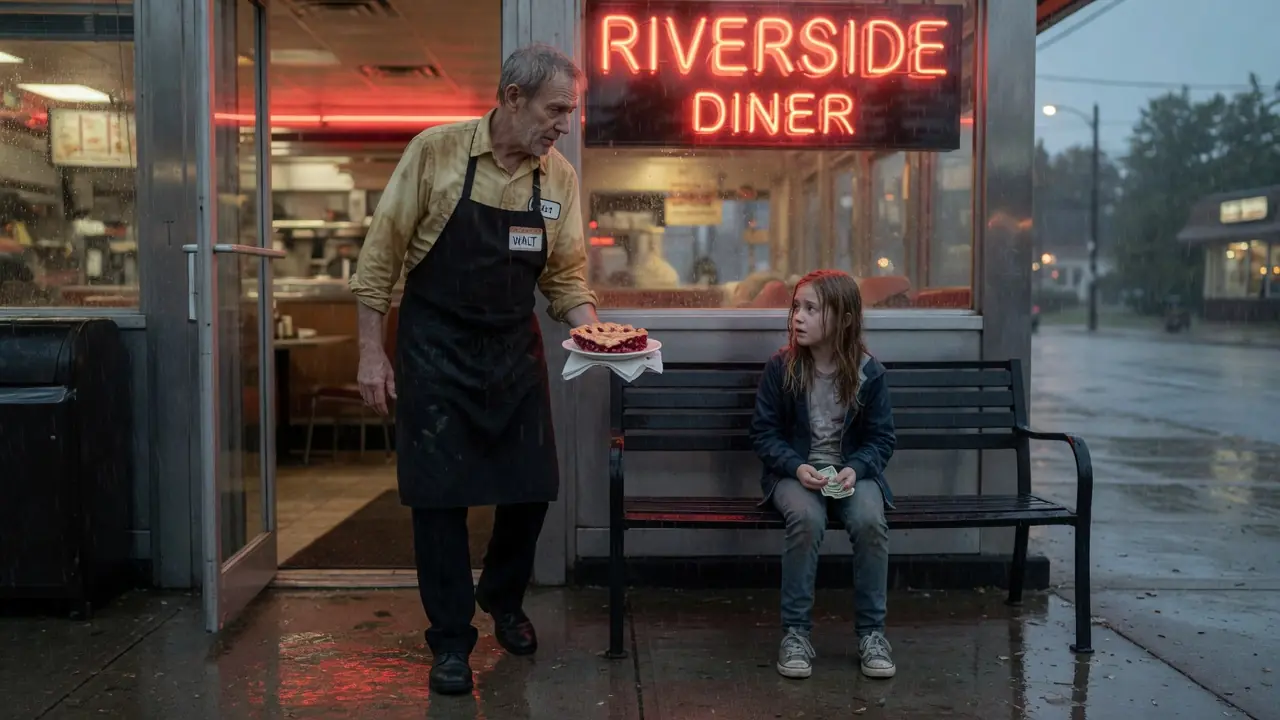
Not the cold, though it had crept under the door and wrapped itself around his ankles until the diner felt less like a building and more like a tired old boat taking on weather.
Not even the little girl’s face at first.
It was the napkin.
A cheap white paper napkin from the dispenser by the register, folded twice, tucked partly beneath the edge of the sugar caddy as if she had wanted him to find it but had been too shy to leave it in the open.
Walter almost brushed it into the trash with the crumbs.
Then he saw the drawing.
The second thing that stayed with him was how the little girl had stood just inside the door of the Riverside Diner, rain dripping from her sleeves onto the worn linoleum, staring at the pie case as if it contained something holy.
The third was the promise she made in a voice so small it barely reached across the empty booths.
One day, I’m going to come back with a car so big it blocks the street, and I’m going to make sure this place never closes.
Walter had smiled then.
Not because he believed her.
Because children who were hungry and cold deserved to be allowed one impossible promise.
It was a Thursday in late October, the kind of night when the rain came sideways off Lake Erie and found every crack in every old building along the riverfront.
The neon sign outside buzzed and flickered, casting a tired red glow across the wet street. Half the letters worked only when they felt like it. Some nights the sign read RIVERSIDE DINER. Some nights it read RIVE SIDE DIN R. Walter had once joked that the missing letters had retired before he did.
Inside, the air smelled of burnt coffee, grilled onions, old grease, and the sharp lemon cleaner Walter used on the tables every night. The jukebox in the corner had been unplugged for years, but the low hum of the refrigerator and the occasional tick of the cooling grill kept the place from feeling completely dead.
Walter was sixty-three that year, thin in the way men get when they have stood on their feet for thirty-five years.
His white shirt had yellowed at the collar despite every washing. His black pants had been repaired twice at the pocket. The name tag pinned above his heart read simply WALT in letters that had started to peel.
He had buried his wife, Ruth, twelve years earlier.
They had never had children.
For a while after she passed, people told him that the loneliness would change shape. They said time would soften it, that routine would help, that the world would continue whether he wanted it to or not.
They were right about the world continuing.
They were wrong about the loneliness.
It did not soften.
It became organized.
It learned where to sit.
In the mornings, it waited beside the coffee maker.
At lunchtime, it sat in the empty stool at the far end of the counter.
At night, it rode home with Walter in silence and followed him into the little apartment above the closed pharmacy, where Ruth’s blue robe still hung on the back of the bedroom door because he had never found the courage to move it.
The Riverside Diner became both his job and the only thing that still expected him to show up every morning.
The place was old, stubborn, and unfashionable. Its booths were cracked red vinyl. Its counter stools squeaked. Its menu had not changed much since 1978.
Meatloaf.
Mashed potatoes.
Cherry pie.
Eggs any way you wanted them.
Coffee strong enough to argue with.
Walter liked that about it.
Trendy places came and went. Riverside endured. It fed dockworkers, nurses after night shifts, widowers, cab drivers, college kids too broke for anything better, and old men who stretched one cup of coffee across two hours because they had nowhere warmer to be.
Walter understood people like that.
He was one.
That Thursday night had been slow from the beginning.
By nine o’clock, only three customers remained. A truck driver with a plate of fries. A woman in scrubs drinking black coffee with both hands wrapped around the mug. Arthur Thompson at the far end of the counter, where he had sat nearly every morning and many evenings for years.
Arthur was older than Walter by maybe a decade, with silver hair, a worn fedora, and eyes that always looked as if they were searching for someone in every reflection.
He ordered the same thing almost every time.
Two eggs over easy if it was morning.
Black coffee if it was night.
He rarely spoke more than a few sentences, but he was not unfriendly. Just distant. Walter had once asked him whether he had family nearby. Arthur looked toward the window and said, “Not anymore.”
Walter had not asked again.
By ten, the truck driver had left.
By ten thirty, the nurse had gone back into the rain.
Arthur finished his coffee, placed exact change beside the cup, and touched the brim of his hat before leaving.
“Night, Walt.”
“Night, Arthur. Watch the puddles.”
Arthur gave a faint smile.
“At my age, I watch everything.”
Then he was gone too.
Walter was about to lock the front door when he saw the little girl.
She stood just beyond the glass, small and uncertain beneath the flickering red glow of the sign. The rain had flattened her light brown hair to her cheeks. Her jacket was too thin for the weather, faded purple with one missing button. One shoe had a hole near the toe, and she tried to hide it by standing with that foot slightly behind the other.
She did not come all the way in at first.
She only stood there, staring.
Not at Walter.
At the pie case.
The last two slices of cherry pie sat under a scratched plastic dome, their filling shining dark red beneath the counter light.
The wind pushed the door open again.
The bell above it gave a single tired ring.
Walter looked at her through the narrow space between door and frame.
“You all right, kid?”
He kept his voice low so he would not startle her.
She nodded without looking at him.
Her eyes stayed on the pie.
“Hungry?” he tried again.
This time she glanced up.
Her face was pale from the cold, and there were dark smudges under her eyes that no child that age should have. She looked eight, maybe nine, though hunger and worry can make a child look both younger and older at the same time.
She reached into her pocket and pulled out two crumpled dollar bills and some change. She counted it carefully in her palm, touching each coin with one finger as if the numbers might change if she looked long enough.
“I can pay,” she said.
Walter came around the end of the counter.
He moved slowly, the way he always did with people who looked ready to run.
“What’s your name?”
“Mia.”
“That’s a nice name. You got a last name to go with it?”
She hesitated.
“Thompson.”
Walter nodded like that was all the information he needed.
“Well, Mia Thompson, the kitchen’s closed, but I haven’t eaten my dinner yet. Meatloaf and mashed potatoes. Too much food for one person anyway. You want to help me finish it?”
She stared at him as if he had offered her something dangerous.
“I don’t take charity.”
The words sounded rehearsed.
Not proud exactly.
Practiced.
Like something an adult had taught her to say when the world tried to make her feel small.
“It’s not charity,” Walter said. “It’s leftovers. And I hate eating alone.”
She looked uncertain.
Walter turned as if the matter had already been settled.
He went back into the kitchen, plated the meatloaf that was supposed to be his dinner, added an extra scoop of potatoes, warmed the gravy, and cut one of the cherry pie slices in half. Then he looked at the pie, sighed, and cut a bigger piece.
He poured a glass of milk and carried everything to the booth nearest the old radiator that still worked.
The vinyl seat was cracked, but it was the warmest spot in the room.
Mia slid into the booth without taking off her jacket.
Walter noticed that immediately.
Children kept their coats on indoors for two reasons.
Either they expected to leave fast, or they were still cold enough not to trust warmth.
He set the plate in front of her.
“Careful. Gravy’s hot.”
She nodded.
At first, she ate slowly, as if she expected someone to take the plate away.
Then hunger won.
She ate faster, but carefully, trying not to make noise. She used the side of her fork to press the potatoes into the gravy. She took small bites of meatloaf, chewed quickly, and watched Walter between bites like she was waiting for a rule to change.
Walter sat across from her in the booth facing the street and pretended to read the newspaper he had already read twice.
He did not stare.
Hungry people deserved the dignity of not being watched too closely.
When she finished the meatloaf, he pushed the pie toward her.
“I can’t pay for pie,” she said.
“Pie’s on the house tonight. Cook burned one earlier and we had to cut around it. Shame to waste it.”
“There’s no burned part.”
“I cut well.”
She looked at him for a long moment.
Then she picked up the fork.
They sat in silence while the rain hammered the big front windows. Outside, a semi truck hissed past on the wet road. Inside, the only sounds were the scrape of her fork and the soft tick of the wall clock above the register.
When the pie was gone, Mia wiped her mouth with a paper napkin and stared at the blank side of it for a while.
Then she asked, “Do you have a pencil?”
Walter found one behind the counter, the kind with the diner’s name printed on it in fading blue letters.
She took it and began to draw on the napkin.
Her tongue stuck out a little from the corner of her mouth while she concentrated. She bent low over the table, shielding the napkin with one hand as if the drawing might escape if anyone saw it too soon.
Walter kept pretending to read.
After a few minutes, she pushed the napkin across the table.
It was a simple drawing, done in careful lines.
The long counter.
The booths.
A stick-figure man with a name tag standing behind the register.
A smaller stick-figure girl sitting in a booth.
Above them she had drawn a big yellow sun, even though it was night outside and the rain showed no sign of stopping.
At the bottom, in letters that slanted uphill, she had written:
For Walt. Thank you. Mia.
Then, smaller, almost as an afterthought:
One day I’m going to come back with a car so big it blocks the street and I’m going to make sure this place never closes.
Walter looked at the drawing for a long time.
Something tight and old moved in his chest.
“That’s a fine picture,” he said quietly.
She shrugged like it was nothing, but her cheeks had gone pink.
“I have to go,” she said. “My mom’s waiting in the car. She’s not feeling good.”
Walter looked toward the window.
He could not see any car clearly through the rain, only blurred reflections and passing headlights.
He did not ask why they were out so late.
He did not ask why her mother had not come inside.
He did not ask why a child with holes in her shoes was buying food alone with crumpled bills on a school night.
Some questions did not need answers when the answer was already standing in front of you, soaked and tired.
He packed the rest of the pie into a small cardboard box, added two dinner rolls, a scoop of meatloaf in foil, and a couple of apples from the basket by the register.
“For your mom,” he said.
Mia took the box with both hands.
For a second, she looked as if she might cry. But she swallowed it down the way children do when they have already learned that tears do not change much.
“One day,” she said again, “I’m going to pay you back. I promise.”
Walter smiled.
“You don’t owe me anything, kid.”
She shook her head.
“Yes, I do. And when I come back, it’s going to be in a big car. You’ll see.”
Then she slipped out the door and disappeared into the rain.
Walter stood at the window for a long time after she was gone, the napkin drawing still in his hand. A dark sedan sat half a block away beneath a broken streetlight. He saw the passenger door open briefly. The little girl climbed in, holding the box carefully against her chest.
Then the car pulled away into the wet red glow of the neon sign.
Walter folded the napkin carefully and put it in the breast pocket of his shirt, right over his heart.
The next morning, he thought about calling someone.
A school.
A shelter.
The police.
But he had no address, no license plate, no proof of anything except a hungry child and a sick mother in a car. He asked around quietly for days, then weeks. No one knew a Mia Thompson. No one had seen a woman and child sleeping near the river. No one had answers.
After a month, life resumed its old rhythm.
Coffee.
Orders.
Rain.
Loneliness.
Arthur Thompson came in every morning, drank his coffee, stared at the door, and left exact change.
Walter sometimes thought about asking whether he knew the girl. Same last name, after all. But Thompson was common enough, and Arthur already carried so much sorrow in his silence that Walter could not bring himself to hand him a new ghost without reason.
So he kept the napkin.
Every time he washed that shirt, he moved it carefully to another pocket. When the ink began to fade, he pressed it flat inside a plastic sleeve he found in the office. Eventually, he tucked it into his wallet, behind Ruth’s photograph.
He did not know why.
Maybe because Mia had promised to return.
Maybe because, after years of serving people who forgot him the moment they walked out, it felt strange to be remembered by anyone.
Fifteen years passed.
The Riverside Diner changed around him the way old buildings do when no one has the money to stop time.
The management company that bought the building put in new menus with words like “artisanal” and “elevated comfort classics,” though the meatloaf still came from the same recipe and the coffee still tasted burnt by noon. They raised prices. They lowered portions. They replaced the old paper placemats with laminated ones that curled at the edges.
Regulars stopped coming as often.
The vinyl on the booths was patched with silver duct tape in three places. The neon sign outside lost more letters. The roof leaked over the back hallway. The landlord stopped answering repair requests unless water reached the dining room.
Walter was seventy-eight now.
His knees hurt every morning and his back hurt every night. His fingers had stiffened with arthritis. He moved slower, though he still moved with pride. He still came in four days a week because the small paycheck and the routine were the only things holding the shape of his days together.
The new manager, Kevin Sloane, was thirty-two and wore shirts too tight across the shoulders. He spent most of his shifts in the office talking about optimization, development potential, and how nostalgia was not a business model.
Walter disliked him immediately but politely.
Kevin had started talking about selling the building to developers who wanted to put up luxury apartments.
“There’s no future in a diner like this,” Kevin said one afternoon, tapping a pen against a folder. “The land is worth more than the business.”
Walter looked out at the counter where Arthur Thompson sat with his coffee.
“To some people, maybe.”
Kevin sighed.
“Walt, you’ve been here forever. I respect that. But forever is not a lease strategy.”
There were already papers on the desk in the back office.
Numbers.
Deadlines.
A demolition clause.
Walter had seen enough to know the truth.
The Riverside Diner was nearly finished.
He told himself he had no right to grieve a building. Buildings ended. Businesses closed. Time moved on. But every time he wiped the counter at night, he felt as if he were touching the hand of an old friend who had fallen ill.
One rainy Thursday evening in November, the same kind of rain that had fallen the night Mia first walked in, Walter was the last one left.
He had sent the young cook home early because business had been slow. Kevin had gone to meet a developer. Arthur had come in at seven, ordered coffee, sat for an hour, then left without finishing it.
The lights were half off, the way Walter liked them when he closed. The pie case was empty. The grill was cooling. The old refrigerator hummed in the back like a stubborn heart.
Walter was wiping the counter for the third time when he heard the soft chime of the bell above the door.
He looked up.
A woman stood just inside, shaking rain from a dark wool coat.
She was in her early twenties, tall, with light brown hair pulled back neatly. Everything about her looked expensive but not flashy. The kind of quiet money that did not need to announce itself. Her boots were polished but practical. Her leather bag looked handmade. Her face was composed, but her eyes moved through the room with a strange, hungry tenderness.
She scanned the empty diner.
The booths.
The counter.
The pie case.
The radiator booth.
Then her eyes found Walter behind the counter.
For a moment, neither of them moved.
Then she took one step forward, and the remaining ceiling lights caught her face fully.
Walter felt the air leave his lungs.
The eyes were the same.
“Mia?” he said.
The name came out rough, half question, half memory.
She smiled.
It was the same small, careful smile from fifteen years earlier, only older now and carrying things he could not name.
“You still remember,” she said.
Her voice cracked on the last word.
Walter came around the counter without thinking, the rag still in his hand.
She met him halfway and hugged him before he could decide whether that was allowed. She was taller than him now. Her coat smelled faintly of rain and something clean and expensive.
When she pulled back, her eyes were wet.
“I told you I’d come back.”
Walter looked past her through the front windows.
Parked at the curb was a dark SUV, sleek and new, its headlights still on, wipers moving steadily. It was big enough to block half the street if she had wanted it to.
“You kept your promise about the car,” he said, trying to keep his voice steady.
Mia laughed, and the sound was half sob.
“I kept a lot of promises.”
They sat in the same booth by the radiator.
Walter brought coffee because he did not know what else to do with his hands. Mia touched the tabletop as if confirming it was real.
“I remembered this crack,” she said, tracing a line in the laminate.
“I remember telling Kevin to fix it five years ago.”
“Who’s Kevin?”
“The man currently trying to turn this place into apartments.”
Mia’s face changed.
“Yes,” she said softly. “I know.”
Walter looked at her.
She reached into her bag and pulled out a folder, but she did not open it yet.
First, she told him everything.
Her mother had been sick that night. Pneumonia that had turned dangerous because they could not afford a doctor. They had been living in the car for three weeks after leaving a dangerous situation and finding nowhere stable to land.
The meal Walter gave Mia had been the first real food either of them had eaten in two days.
“Mom tried to make me give her the pie,” Mia said, smiling through tears. “I told her you said it was for both of us and that diner men know pie rules.”
Walter laughed softly.
“Diner men do.”
Her mother recovered, barely.
They found a shelter in Toledo, then a transitional apartment. Her mother worked as a cleaner during the day and went to night school until she became a licensed practical nurse. For years, she carried Walter’s name like a prayer.
“She never forgot you,” Mia said. “She used to say, ‘The man at the diner helped us when we looked like nobody’s problem.’”
Walter looked down.
“I didn’t do much.”
“You fed us.”
“That’s what diners are for.”
Mia’s eyes filled again.
“That’s what she said.”
Her mother’s name was Elena.
Elena Thompson.
She had died five years earlier from complications connected to the illness that had almost taken her on that rainy night. Before she passed, she made Mia promise to find the man at the diner.
“She told me there are people who change your life with a check, and there are people who change it with a plate of food,” Mia said. “She said never forget the second kind.”
Mia went to college on scholarships and part-time jobs. She studied business first, then urban planning, then real estate development after realizing how often people used the word “progress” as an excuse to erase the places that held poor families together.
“I started a company after college,” she said. “Small at first. We bought old buildings nobody wanted and restored them. Laundromats, corner stores, diners, hardware shops. Places people called outdated because they didn’t understand what those places meant.”
She opened the folder and slid it across the table.
“I also started a foundation in my mother’s name. We help small businesses that are about to disappear.”
Walter stared at the papers.
His eyes moved slowly over the words.
Purchase agreement.
Riverside property.
Full acquisition.
Development cancellation.
Historic preservation grant.
His hands began to shake.
“I bought the building,” Mia said simply.
Walter looked up.
“The developers were going to close in three weeks,” she continued. “They won’t now. The diner is safe.”
The room seemed to tilt around him.
Mia placed another document on top.
“And I paid the outstanding debts tied to the property. The back rent, the repair liens, the taxes Kevin’s management company kept using as an excuse not to fix anything.”
Walter tried to speak.
Nothing came.
“You don’t have to work here anymore unless you want to,” Mia said. “But if you do want to stay, the diner is yours to help run. With a salary. Real benefits. And a staff that doesn’t leave a seventy-eight-year-old man closing alone in a storm.”
Walter stared at her.
“I gave you meatloaf.”
Mia’s face softened.
“No,” she said. “You gave me proof that someone still saw us. That was enough to keep my mother alive long enough to raise me. And it was enough to make me want to spend my life making sure other people get seen too.”
They sat with that for a while.
The rain kept falling.
The old radiator clanked and hissed beside them like it was trying not to cry.
Then the bell above the door rang again.
Arthur Thompson stepped inside, shaking water from his worn fedora.
He was in his late seventies, maybe early eighties now, with a lined face and careful eyes. He had been coming to the diner every morning for nearly eighteen years. Same stool. Same black coffee. Same quiet stare toward the door.
He stopped when he saw them.
His gaze went from Walter to Mia and back again.
Something in his expression shifted, like a man who had been waiting a very long time for a lock to finally turn.
Mia looked at him politely.
Arthur took off his hat slowly.
His hands were not steady.
“Forgive me,” he said, voice rough. “But your name... did I hear Walt say Mia Thompson?”
Mia went still.
“Yes.”
Arthur closed his eyes for a second, as if the words had struck him physically.
“My daughter’s name was Elena Thompson,” he said. “She would have been about your mother’s age.”
The diner went very quiet.
Even the rain seemed to soften against the windows.
Mia’s face emptied of color.
“My mother’s name was Elena,” she whispered.
Arthur made a sound that was not quite a word.
He reached into his coat with trembling fingers and pulled out an old photograph protected in a plastic sleeve. A teenage girl with light brown hair and the same eyes smiled out from a faded color snapshot. She was standing in front of a Christmas tree, one hand resting on her stomach in a way that suggested she already knew a secret.
Mia took one look and covered her mouth.
Walter felt the pieces slide into place with the slow, inevitable weight of something that had been waiting decades to be understood.
Years ago, long before Mia came in, a scared pregnant girl had entered the Riverside Diner late one night.
Walter remembered her now.
She had been no older than eighteen, maybe nineteen. Her coat was too big. Her face was bruised with exhaustion rather than violence. She had asked for coffee and counted coins the same way Mia had years later. Walter had given her the last plate of meatloaf and enough cash for a bus ticket after she said she needed to reach an aunt in another state.
She had never told him her name.
He had never asked.
That girl had been Elena Thompson.
And the child she carried had grown up to be the young woman sitting in the booth.
Arthur looked at Walter with eyes that had been searching for decades.
“You fed her,” he said.
It was not a question.
Walter nodded once.
“I fed her. And then I fed her daughter. And I never knew.”
Arthur sat heavily on the nearest stool.
“My daughter ran away,” he said. “Her stepmother told me she left because she hated us. That she wanted nothing to do with the family. I believed it too long. By the time I found out there had been lies, Elena was gone.”
His voice broke.
“I looked for her for twenty years. Someone told me once they had seen a pregnant girl near this corner. I started coming here because of that. Every morning. I kept thinking if I sat here long enough, maybe she would walk through the door.”
Mia rose from the booth.
For a few seconds, she seemed unable to move.
Then she crossed the room and stood before the old man.
Arthur looked up at her, terrified now. Not of rejection exactly, but of hope after too many years without it.
Mia reached for the photograph.
“My mother kept a necklace,” she whispered. “A little gold locket. She said it belonged to her father, but she never told me his name. She said it hurt too much.”
Arthur’s hand shook as he reached beneath his collar and pulled out a chain.
At the end hung a small empty locket, identical in shape.
“I gave Elena one half,” he whispered. “I kept the other.”
Mia began to cry.
Arthur covered his face with one hand.
“I didn’t know,” he said. “I didn’t know about you. I didn’t know she had a child.”
Mia stepped forward and put her arms around him.
Arthur broke.
Not loudly.
Not dramatically.
He folded into the hug like a man whose body had finally been given permission to stop carrying a twenty-year weight alone.
For a long time, the only sounds in the diner were the rain, the radiator, and two people crying quietly against each other.
Walter stayed where he was.
Giving them the moment.
His hand went to his shirt pocket by habit, though the old napkin was no longer there. He had moved it years ago to his wallet for safety. Now he took it out carefully and unfolded the plastic sleeve.
The ink was faded.
The sun was still there.
The stick-figure man.
The little girl.
The promise.
When Mia finally looked up, Walter placed it on the counter.
She stared at it.
“You kept it?”
Walter shrugged, but his eyes were wet.
“Best payment I ever got.”
Mia reached out and touched the plastic sleeve as if it were something sacred.
Then she took Walter’s hand and pulled him gently toward Arthur.
“You’re part of this,” she said, voice thick. “You always were.”
Arthur nodded, wiping his face with a handkerchief that had seen better decades.
“You kept my daughter alive long enough to have this one,” he said. “And then you kept this one alive long enough to find me.”
Walter had no words.
He simply sat with them while the rain continued and the old diner, for the first time in years, felt less like a place about to disappear and more like a place that had been waiting.
Three weeks later, the Riverside Diner reopened under new ownership.
The sign outside had been restored to full neon brightness.
THE RIVERSIDE DINER.
The vinyl booths had been re-covered in the original shade of red. The counter had been polished but not replaced. The cracked tabletop by the radiator had been repaired carefully, with the line still faintly visible because Mia said some scars belonged to the story. The menu returned to meatloaf, cherry pie, eggs over easy, black coffee, grilled cheese, and soup that tasted like somebody had stayed long enough to care.
A small brass plaque was mounted on the wall beside the booth nearest the radiator.
It read:
No meal is too small when someone is hungry for kindness.
Walter still worked four days a week, though Mia and Arthur both told him he did not have to. He claimed he only came in to make sure the young staff did not ruin the coffee. Everyone knew he came because the diner was home.
Arthur came every morning at seven.
At first, he sat alone at the counter out of habit. Then Mia began joining him on Thursday evenings. Then Sunday afternoons. Then, whenever her schedule allowed, she sat beside him while he told her stories of Elena as a little girl.
How Elena loved drawing birds.
How she hated peas.
How she once hid under the church piano during a Christmas recital because she refused to sing.
Mia brought her mother’s locket one evening, and Arthur held it for almost ten minutes without speaking.
Walter poured coffee and pretended not to watch.
Mia’s foundation moved into the small office above the diner. She used the space to manage restoration projects for other small businesses on the edge of disappearing. A tailor shop in Cleveland. A bakery in Toledo. A laundromat in Erie. A corner grocery run by a seventy-year-old man who still carried bags to cars.
She named the program The Napkin Promise.
Walter told her that was too sentimental.
Mia told him he had no vote.
He liked that.
The folded napkin was framed and hung behind the register, beside a photograph of Elena as a young woman, a photograph of Arthur on opening week, and a new picture of Walter, Mia, and Arthur standing in front of the restored sign.
On rainy nights, people came in just to see it.
Some ordered coffee.
Some left donations.
Some wrote their own notes on napkins and tucked them into a glass jar near the register.
Thank you for feeding my brother when he was short on cash.
This place reminds me of my grandmother.
Paid for the next person’s pie.
My dad used to bring me here.
One night, months after the reopening, Walter closed late.
The rain had returned, cold and slanted off the lake. The neon sign glowed full and steady. Mia’s dark SUV waited outside, large enough to block half the street, though she had parked properly because, as Walter reminded her often, promises were not excuses for bad parking.
Arthur sat in his usual place with coffee.
Mia sat beside him, reading through foundation paperwork.
Walter wiped the counter.
The bell above the door rang.
A young mother came in holding the hand of a little boy in a thin jacket. Her eyes went first to the prices on the menu, then to the pie case, then to the door behind her as if she were deciding whether to retreat before anyone noticed she did not have enough.
Walter saw the look.
He had seen it many times.
He came around the counter slowly.
“You all right?” he asked.
The woman swallowed.
“We were just looking.”
Mia looked up.
Arthur looked toward Walter.
Walter smiled at the little boy.
“Well,” he said, “the kitchen’s closed, but I haven’t eaten my dinner yet. Too much food for one person anyway. You want to help me finish it?”
Mia’s eyes filled immediately.
Arthur lowered his head.
The little boy looked at his mother.
His mother looked at Walter with the exhausted suspicion of someone life had trained not to trust kindness too quickly.
“I don’t take charity,” she said softly.
Walter nodded.
“Good. I don’t serve it.”
He pointed toward the booth by the radiator.
“I serve leftovers. And pie rules are complicated, but we’ll explain them as we go.”
Mia laughed through her tears.
The mother hesitated.
Then she led her son to the warm booth.
Walter went into the kitchen.
Mia rose to help.
Arthur reached for the napkin jar and pulled out a clean white square. He placed it on the counter with a pencil beside it.
Just in case.
Years later, people would tell the story of the Riverside Diner in different ways.
Some would say it was about a little girl who promised to return in a car big enough to block the street.
Some would say it was about a lonely waiter who fed two generations without knowing it.
Some would say it was about a grandfather who sat at the same counter for eighteen years, waiting for a daughter who would never return, only to find her child instead.
Mia always said it was about a plate of meatloaf.
Walter always corrected her.
“It was a good plate of meatloaf.”
But in truth, they both knew it was about something larger.
It was about the strange mathematics of kindness.
How one meal could become a memory.
How one memory could become a promise.
How one promise could become a company, a foundation, a restored sign, a reunited family, and a warm booth waiting for the next hungry person who came in from the rain.
Walter Ellison almost missed the folded napkin that night.
He did not miss the child.
And because he did not miss the child, fifteen years later, a young woman came back with a car big enough to block the street, a folder thick enough to save the diner, and a heart large enough to bring home everyone who had been waiting.
The Riverside Diner remained standing.
Not because it was profitable.
Not because it was modern.
Not because developers failed to notice the land.
It remained because, on a rainy night when a little girl had almost nothing, an old waiter treated her like she still had a future.
And sometimes, that is enough to make the future come back.