The moment a child stops running and starts whispering, every decent adult within earshot has already been called to answer.
Madison Walker did not know the man under the black leather vest.
On any other day, she might have crossed the street to avoid him. He was tall enough to block the gray daylight spilling across the parking lot, with rain clinging to his beard and silver water sliding off the shoulders of his worn biker jacket.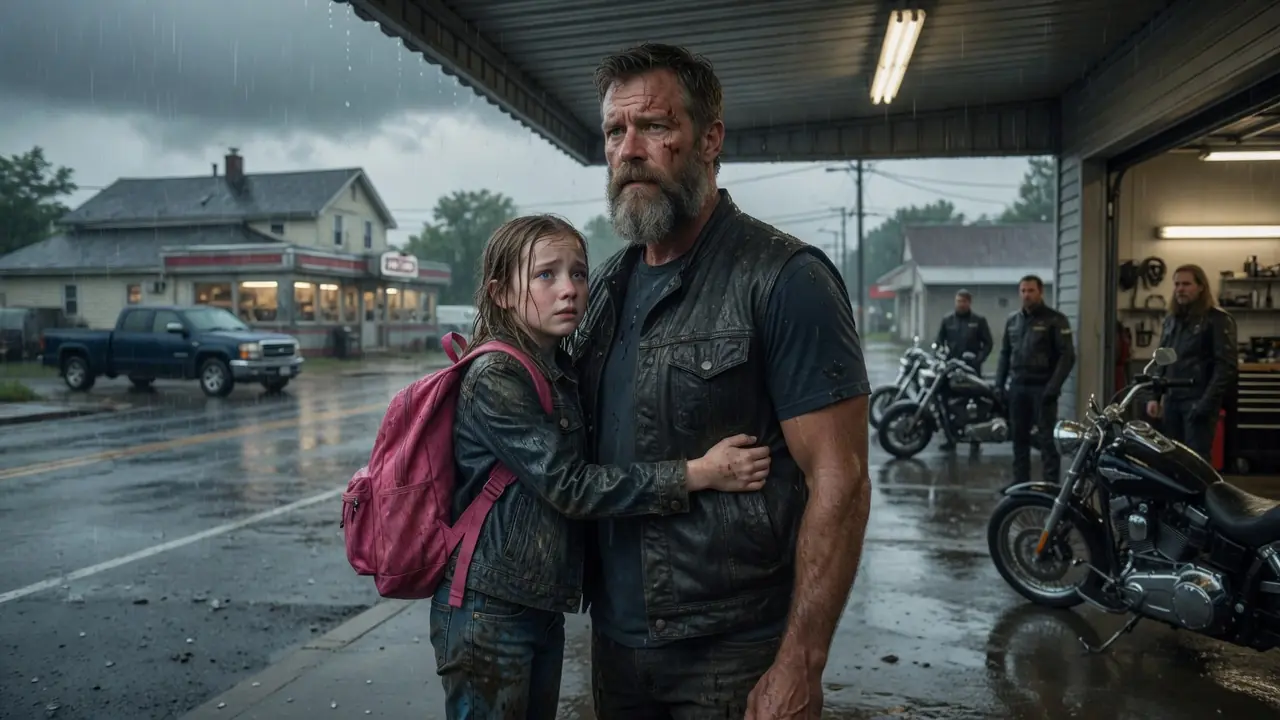
His motorcycle stood beside him like a sleeping animal, chrome dulled by the storm, its engine ticking softly as it cooled beneath the awning of Mercer’s Auto Repair.
Two other bikers stood near the shop window, drinking gas station coffee from paper cups while they waited out the rain. Their patches were dark against wet leather. Their boots left muddy half-moons on the concrete.
But Maddie had run out of choices three blocks ago.
Her sneakers slapped through puddles. Her pink backpack bounced crookedly against one shoulder. Her breath came in small, frightened bursts that disappeared in the cold rain before she could hear herself breathe.
Behind her, a dark blue pickup rolled slowly along the curb.
Never close enough to touch her.
Never far enough to be innocent.
It had followed her past the school fence, past the closed flower shop, past the crosswalk where the signal blinked red even though no cars were coming. Each time Maddie turned her head, the truck was still there, windshield wipers sweeping back and forth like patient hands.
At first, she told herself she was imagining it.
Her mother, Rebecca, always said fear could be useful, but fear could also grow teeth in your mind if you fed it too much. So Maddie tried to be reasonable. She walked faster but not too fast. She shifted her backpack. She pretended to look at a window display in the closed bakery, hoping the truck would pass.
It did not pass.
It slowed.
When she crossed to the other side of the street by the pharmacy, the truck turned at the next corner and found her again.
That was when her stomach went cold.
The passenger window lowered two inches.
Just enough for a man’s voice to come through.
“Madison.”
Her name did not sound like her name in his mouth.
It sounded like a hook.
Maddie’s legs almost stopped working. She looked straight ahead and kept walking. The truck eased along the curb beside her, tires hissing through rainwater.
“Your mom asked me to pick you up,” the man called. “Come on, sweetheart. You are getting soaked.”
Maddie’s hand tightened around the strap of her backpack.
Her mother had rules.
Not many, but the serious ones were carved deep.
Never get in a car unless the adult knows the password.
Never let a grown-up make you feel rude for staying safe.
Run to lights, people, cameras, open businesses.
If your stomach says something is wrong, listen before you explain it away.
Maddie turned her face toward the truck without stopping.
“What is the password?”
There was a pause.
Not long.
But long enough.
The man laughed softly.
“Adults do not need passwords when they are helping.”
That was when she ran.
She ran past the bakery, past the mailbox, past the little alley beside Mrs. Bell’s diner. She heard the truck engine rise behind her, not speeding exactly, but following. Rain hit her face, cold and sharp. Her lungs burned. Her shoes slipped twice on wet pavement, but she did not fall.
Mercer’s Auto Repair appeared through the rain like a place she had never noticed before and somehow had always been looking for.
The sign was old and blue. One corner had rust around the screws. The garage doors were open halfway, and yellow shop light spilled onto the wet concrete. Three grown men stood beneath the awning, all in leather, all big enough to scare her on any other day.
But there were lights.
There were people.
There was a business door.
There were cameras above the entrance.
Maddie ran harder.
By the time she reached the garage, rain had soaked through her denim jacket and glued strands of pale brown hair to her cheeks. Her chest hurt. Her throat was tight. She skidded across the slick concrete and almost slammed into the nearest biker.
Caleb “Iron” Mercer turned when he heard her shoes.
He had the kind of face people remembered for the wrong reasons first. A scar over one eyebrow. Gray in his beard. Eyes that looked as if they had seen too many roads and not all of them kindly. His hands were broad, oil-stained, and scarred across the knuckles.
Maddie did not see any of that.
She saw a grown man standing in the light near an open business with other adults close enough to hear her.
She grabbed the edge of his sleeve with both trembling hands and pulled herself behind him, like his shadow could hide her from the whole world.
Caleb looked down.
Whatever hard thought had been sitting behind his eyes vanished.
“Easy, sweetheart,” he said, his voice low enough not to scare her. “What happened?”
Maddie swallowed.
The words came out smaller than breath.
“He’s following me.”
Caleb did not spin around.
He did not shout.
He did not make the mistake of turning a terrified child into a scene.
He simply shifted one step to the left, placing his broad frame between Maddie and the parking lot, then lifted his eyes toward the street.
The blue pickup had stopped at the far edge of the diner across the road, headlights glowing through the rain.
For one long second, nobody moved.
Then the driver leaned forward, and through the water-streaked windshield, Caleb saw the man smile.
Caleb kept his shoulders square to the rain and his voice calm because panic had a way of spreading faster than fire when a child was already scared.
“Madison,” she whispered. “But my mom calls me Maddie.”
“All right, Maddie. My name is Caleb Mercer. You are standing outside my shop, and you are not in trouble.”
The words landed harder than he expected.
The little girl’s fingers loosened from his sleeve just enough for him to feel how badly they were shaking.
To Caleb’s right, Wade Patterson set his coffee down on the windowsill. Wade was six feet tall, thick through the shoulders, with a shaved head and a beard that made him look meaner than he was. His jaw tightened as he followed Caleb’s stare across the street.
“Iron,” Wade muttered, using the nickname only men from the road still used. “Want me to go ask him what he thinks he’s doing?”
Caleb raised one hand.
Not sharp.
Not dramatic.
Just enough to stop him.
“No. Nobody goes near him yet.”
Wade looked ready to argue, but Caleb’s eyes said what his mouth did not.
This was not about pride.
This was not about looking tough in front of a stranger.
There was a frightened child between them and a man in a truck, and the first job was not to scare anybody.
The first job was to keep her safe.
The other biker under the awning, Raymond Ortiz, had gone completely still. Raymond rarely wasted words. He had been a mechanic, a truck driver, a bouncer, and finally Caleb’s most reliable shop hand. He looked toward the truck, then toward the security cameras, and began noticing details without being asked.
Caleb lowered himself just enough so Maddie did not have to stare up at a giant in leather.
“Where is your mom, honey?”
“At the laundromat on Birch Street,” Maddie said. “She works the day shift. School let us out early because a pipe broke near the cafeteria, and I was supposed to wait by the front office, but I thought I could walk because it is only six blocks.”
Her voice broke on the last words, like she had already decided the whole thing was her fault.
Caleb shook his head slowly.
“You made the best choice you could once something felt wrong. That matters.”
Behind him, the pickup’s engine idled under the sound of rain striking the diner roof across the road. The driver had not stepped out. He had not left either.
That bothered Caleb more than a loud threat would have.
A guilty man sometimes ran.
A confident one waited to see who would blink first.
“Do you know him?” Caleb asked.
Maddie pulled her wet backpack closer to her chest.
“I saw him before. He came into where my mom works. He talked to her when she was folding towels. She told him she was busy.”
Caleb nodded as if every word had weight.
Because it did.
“Did he tell you to get in the truck?”
Maddie’s eyes filled, but she held herself together.
“He said my mom asked him to pick me up, but she would never do that. She has a password.”
Wade’s face changed.
Raymond stopped moving completely.
Caleb felt a cold line settle through his chest that had nothing to do with the rain.
“What password?” he asked gently. “Not the word itself. Just tell me if he knew it.”
Maddie shook her head fast.
“He said adults do not need passwords when they are helping.”
Caleb looked at Wade.
“Call 911. Tell them we have a minor who believes she was followed by an adult male in a dark blue pickup outside Mercer’s Auto Repair on County Route 12. Tell them the child is safe inside the business.”
Wade already had his phone out before Caleb finished.
Caleb opened the glass door behind him and held it wide, stepping aside so Maddie could enter first.
“Come on in where it is dry. We have cameras, a landline, and too much bad coffee.”
The attempt at humor barely touched her face, but it gave her something normal to hold on to.
Inside, the garage smelled of motor oil, rubber, old coffee, and the faint cinnamon air freshener Mrs. Bell from the diner had given Caleb last Christmas. Fluorescent lights buzzed overhead. A wall clock ticked above the parts counter. A radio near the back bay played an old rock station at low volume until Raymond reached over and turned it off.
Everything was ordinary.
Caleb knew ordinary could be a kind of medicine.
He pointed to a chair near the office window, far from the door but not hidden.
“You can sit there. Nobody is taking you anywhere.”
Maddie lowered herself into the chair, shoes dripping onto the floor mat.
Raymond moved to the front window and quietly read the pickup’s license plate aloud while Wade repeated it to the dispatcher. He did not point his phone at Maddie. He aimed it toward the window, keeping the child out of frame.
Caleb picked up the shop phone and slid it across the counter.
“Do you know your mom’s number?”
Maddie nodded and recited it from memory, each digit careful, like she was building a bridge one board at a time.
Caleb dialed and put the call on speaker.
It rang twice.
Then a woman answered, breathless from work and worry she did not yet understand.
“Rebecca Walker speaking.”
Caleb kept his voice even.
“Ma’am, this is Caleb Mercer at Mercer’s Auto Repair. Your daughter Maddie is here with us. She is safe.”
For half a second, the only sound was rain tapping the windows.
Then Rebecca’s voice came smaller.
“Is there a man with a blue truck?”
Maddie looked up sharply.
Caleb’s hand tightened around the phone.
Outside, across the street, the pickup’s headlights blinked once through the rain, and the driver finally opened his door.
Rebecca’s question changed the room without raising a single voice.
Maddie went still in the chair.
Wade stopped speaking for a heartbeat, even though the dispatcher was still on the line.
Caleb felt every old instinct in his body wake up at once.
There was a time when he would have walked straight into the rain and let his size do the talking. But that time belonged to a younger man who confused control with protection.
This was different.
A little girl was safe because she had trusted the right door, and Caleb would not turn that trust into chaos.
He looked through the office window as the man from the pickup stepped onto the wet pavement. One hand raised like he was approaching a neighbor’s porch instead of a locked business with cameras in the corners.
He wore a tan work jacket, clean boots, and an expression that had probably worked on people who did not want trouble.
“Rebecca,” Caleb said into the speaker phone, keeping his voice steady, “do not hang up. The police have been called. Maddie is inside my shop. The doors are locked. I need you to tell me who this man is without saying anything that could put you or your daughter at risk.”
On the other end, Rebecca took a breath that sounded like it hurt.
“His name is Darren Pike. He used to come into the laundromat. I told him several times I was not interested in talking outside work. Then he started showing up near our apartment.”
Maddie stared at the phone, pale beneath the damp strands of hair.
“Mom,” she said, her voice small but urgent, “I used the password rule. He did not know it.”
Rebecca made a sound that was almost a sob and almost a prayer.
“You did exactly right, baby. You did exactly what we practiced.”
Caleb absorbed that like a nail driven into old wood.
A mother had prepared her child for danger, and the child had listened.
Now the adults had to be worthy of that courage.
Outside, Darren Pike crossed half the parking lot before stopping beneath the edge of the awning. Rain ran down the brim of his cap. He smiled through the glass and pointed toward Maddie as if she were a misplaced grocery bag.
“Hey there,” he called, voice muffled by the door. “She got confused. I know her mother.”
Caleb did not move toward the door.
He did not unlock it.
He did not invite the man closer.
“Wade,” he said quietly, “tell the dispatcher the subject is at the front entrance now.”
Wade repeated it word for word.
Raymond stood at the window, phone lowered but camera running, careful to keep Maddie out of the frame.
Caleb turned to Maddie again and crouched several feet away so she could see his hands and choose whether to look at him.
“You are doing good,” he said. “I am going to ask you three things. You can answer only what you know.”
She nodded.
“Did your mom say Darren could pick you up today?”
“No.”
“Did he know the family password?”
“No.”
“Did he keep following after you changed direction?”
Maddie nodded.
“I crossed to the other sidewalk by the pharmacy. He turned too.”
Caleb nodded once, not because he liked the answers, but because they were clear.
“That is enough for right now.”
Darren knocked on the glass with two fingers.
Light.
Polite.
The kind of knock that pretended it had not frightened anyone.
“Come on, man. You are making this weird. Her mom knows me.”
Caleb finally faced him fully, his reflection dark in the glass beside the man’s rain-streaked smile.
“Then you can wait for Officer Brooks and explain it to her.”
The smile thinned.
“I am just trying to help.”
“So are we,” Caleb said. “From inside a locked building with her mother on the phone and emergency services on the way.”
For the first time, Darren’s eyes shifted past Caleb toward the security camera above the parts counter.
It was a tiny movement, barely more than a flicker.
But Caleb saw it.
Men who believed they were innocent looked at children.
Men who feared evidence looked at cameras.
Maddie saw it too, and her small shoulders lifted with one shaky breath.
The room did not feel safe because Caleb was big or because bikers stood nearby.
It felt safe because every adult inside had chosen patience over performance.
Rebecca’s voice came through the phone again, trembling but stronger now.
“Maddie, stay where you are. I am coming with my supervisor. Do not go outside.”
“I will not,” Maddie said.
Then, after a pause, she looked at Caleb.
“I thought nobody would believe me because he sounded so normal.”
Caleb’s face softened in a way Wade had rarely seen.
“A person can sound normal and still be wrong,” he said. “That is why we listen to what happened, not just how somebody sounds.”
Outside, Darren stepped back from the door, his hand dropping to his side.
In the distance, beneath the rain and traffic, the first faint rise of a siren moved toward County Route 12.
Darren heard it too.
His polite expression disappeared, and for one brief second, Caleb saw the truth under it.
Not anger.
Not fear of bikers.
Fear of being seen clearly.
The siren pulled something old out of Caleb that he had spent years trying to bury. Not fear exactly, and not regret in the ordinary sense, but the kind of memory that arrived with the weight of a hand on the back of your neck.
He watched Darren Pike stand in the rain outside the shop, no longer smiling, no longer pretending this was a misunderstanding.
And for a moment, Caleb was not forty-six years old inside Mercer’s Auto Repair.
He was twenty-two again, standing in his mother’s kitchen while his younger sister, Grace, tried to explain why a man from the grocery store kept appearing near their house.
Caleb had been tired that day.
Impatient.
Full of the careless certainty young men sometimes mistake for wisdom.
Grace had been seventeen, quiet and serious, with paint under her fingernails from an art class she loved. She stood near the fridge with her arms wrapped around herself and said the man had been at the bus stop again. Then outside the grocery store. Then near the high school parking lot.
Caleb remembered leaning against the counter and saying, “Gracie, small towns are small. People run into people.”
He had not meant to hurt her.
That was the worst part.
He had meant to calm her down.
But comfort that dismisses danger is not protection. It is convenience dressed in a gentle voice.
He remembered the way Grace’s face had closed after that. Not angry. Smaller. As if his doubt had made the room less safe.
Nothing terrible happened that night or the next.
But the weeks that followed taught Caleb a lesson he never forgot. Grace changed her routes. Their mother started checking windows twice. A neighbor finally reported the same man lingering near the school parking lot, and only then did everyone take the pattern seriously.
Caleb apologized later.
More than once.
Grace forgave him.
Mostly.
But apologies could not give back the first moment when his sister had needed to be believed and he had chosen comfort over attention.
Now, inside the warm glow of the shop lights, Maddie Walker sat wrapped in damp silence, and Caleb knew life had handed him the same test in a different coat.
This time, he would not fail it.
Outside, Darren lifted his hand and pointed toward the phone in Caleb’s hand, then made a rolling motion, like he was asking Caleb to hurry up and stop wasting everybody’s time.
Caleb did not answer the gesture.
He stepped back from the window and looked at Raymond.
“Make sure the side door is locked.”
Raymond nodded and crossed the shop without rushing.
Rushing made people scared.
Calm made them listen.
Wade stayed on the line with emergency services, repeating what he saw in a steady voice.
“Adult male outside front entrance. Dark blue pickup across from the diner. Child inside and safe. Mother contacted and on her way.”
Maddie listened to the words as if they were ropes tied around solid posts.
Each detail made the floor feel a little firmer beneath her feet.
Caleb took a clean towel from a shelf and placed it on the edge of the counter near her.
Not in her lap.
Not over her shoulders.
Giving her the choice.
“Your mom is coming,” he said. “Officer Brooks is close. Nobody in this room is going to ask you to go outside.”
Maddie picked up the towel and pressed it around her hands.
“He said my mom was being difficult,” she whispered. “He said I could help make things easier if I just got in.”
Caleb felt Wade look at him, but he kept his eyes on Maddie.
Soft.
Level.
“That was not your job,” Caleb said. “Children are not responsible for managing grown-up feelings.”
She blinked at that like no one had ever arranged the words in that order before.
“But he knew where we live.”
“Then the adults are going to handle that too.”
The answer was simple.
Almost plain.
But it moved through the room with more strength than any threat could have.
The siren grew louder, then faded slightly as a police cruiser turned off the main road. Darren heard it clearly now. He glanced once toward his truck, once toward the shop camera, and then his expression changed again, becoming wounded, offended, rehearsed.
He stepped closer to the glass just as Officer Hannah Brooks pulled into the lot, blue lights washing over the rain-slick pavement.
Officer Brooks got out with one hand raised.
Not reaching for anything.
Not escalating.
Just taking command by being calm.
Her dark rain jacket shone under the gray daylight, and her voice carried clearly across the parking lot.
“Sir, stay where you are.”
Darren turned toward her with the same polite face he had tried on Caleb.
“Officer, this is a misunderstanding. I know the family.”
Caleb watched through the window as Officer Brooks looked past Darren, through the glass, to where Maddie sat inside.
She did not wave the child out.
She did not ask her to explain in front of the man who scared her.
She simply nodded once, a quiet promise from one safe adult to another.
Then her eyes moved to Caleb, to Wade on the phone, to the camera above the counter, and finally back to Darren.
The rain kept falling, steady and silver, but something had shifted.
Darren was no longer standing alone with a child’s word trapped under his.
He was standing in front of witnesses, a mother on speaker phone, a locked business, a running camera, and a little girl who had been believed before it was too late.
Officer Brooks did not bring Maddie outside.
Caleb respected her for it before she said a single word.
Too many adults thought truth had to be dragged into the open to become real. Officer Brooks understood something Caleb had learned the hard way. A scared child should not have to stand in front of the person who frightened her just to be believed.
Through the rain-streaked glass, Caleb watched the officer speak to Darren in a calm, professional tone, keeping him near the front of his truck and away from the shop entrance.
Darren kept pointing toward the building, then toward his own chest, as if repeating that he was harmless might make it true.
Inside, the air felt warmer now, though Maddie still held the towel around her hands like it was the only thing keeping them from shaking apart.
Rebecca remained on speaker phone, her breathing tight and uneven as she hurried toward the shop with her supervisor driving.
“Maddie,” Caleb said gently, staying several feet away, “Officer Brooks may need to ask you what happened, but she is going to do it in here, away from him. You do not have to be perfect. You just have to tell what you remember.”
Maddie looked at the window, then quickly looked away when Darren turned his head.
“What if I say it wrong?”
Caleb reached for a notepad beside the register and tore off a clean sheet.
He drew five small lines down the page, simple as a grocery list.
“Then we make it easier. Who, where, when, what happened, and how you felt. That is all. You do not need fancy words for the truth.”
Maddie watched the pencil move, her breathing slowing with each line.
“Who was Darren Pike,” Caleb said softly. “Where was outside school, then Maple Avenue, then here. When was after early dismissal, around noon. What happened was he followed you and said your mom sent him, but he did not know the password. How you felt was scared enough to run to adults.”
He turned the paper toward her but did not push it into her hands.
“Does that sound right?”
Maddie nodded.
For the first time since she had entered the shop, she seemed to sit inside the facts instead of drowning beneath them.
Raymond stepped away from the window and spoke quietly.
“Camera caught her coming from the east sidewalk. The truck slowed behind her before she crossed into the lot.”
Caleb looked at Maddie.
“That means the building remembers too.”
Her eyes lifted.
“Buildings can remember?”
“Cameras can,” he said. “And sometimes that helps people tell the truth when they are tired or scared.”
Wade gave the dispatcher another update, then looked toward the back of the shop as the rumble of motorcycles rolled faintly through the rain.
A few more riders from Caleb’s charity run had turned into the lot, probably looking for shelter and coffee, unaware they were arriving in the middle of something.
Caleb spoke before any of them could crowd the front.
“Keep it quiet. Child inside. Police outside. Nobody makes this bigger than it needs to be.”
The men stopped at once.
Leather.
Boots.
Gray beards.
Rainwater dripping onto concrete.
All of it could have looked intimidating from the street, but inside the shop they moved with careful restraint. One man closed the bay door halfway to block the wind. Another stood by the coffee machine and turned the volume down on the old radio. A third, a retired school bus driver named Frank Ellis, took one look at Maddie and quietly set a wrapped granola bar on the counter, then backed away without expecting thanks.
Maddie stared at the bikers, confused by their silence.
Caleb saw the question in her face and answered it.
“Loud is not the same as strong,” he said. “Sometimes strong means making room for somebody else to breathe.”
Outside, Officer Brooks glanced toward the arriving riders, then back at Caleb through the glass.
Caleb gave one small nod, letting her know the room was under control.
Maddie pulled Caleb’s leather jacket from the chair beside her and wrapped it around her shoulders by choice this time. It was far too big, heavy with rain at the edges and smelling faintly of road dust and motor oil, but she tucked her chin into it as if it were a blanket from home.
Then she looked at the notepad again and whispered, “Who? Where? When? What happened? How I felt.”
Caleb nodded.
“That is right.”
At that moment, Rebecca Walker’s voice broke through the speaker phone. Closer now, filled with breath and rain and a mother’s fear turning into purpose.
“I see the lights. I am here.”
Maddie stood so fast the chair legs squeaked, but Caleb gently raised a hand toward the locked door.
“Wait for Officer Brooks to bring her in,” he said. “Safe steps, one at a time.”
Maddie froze.
Then nodded.
Outside, Rebecca came running across the lot in a blue laundromat apron, her supervisor holding an umbrella over both of them. Rebecca’s hair had escaped its clip. Her sneakers splashed through puddles. Her face was pale with the kind of fear that made everything except her child disappear.
Darren turned his head toward her, and for one second his face changed again, as if the story he had prepared no longer fit the room he had walked into.
Rebecca did not go to him.
She went straight to Officer Brooks, pointed to the shop, and said something Caleb could not hear through the glass.
He did not need to hear it.
A moment later, Officer Brooks opened the door herself.
Maddie moved forward under the oversized leather jacket, not as a lost child anymore, but as a little girl walking toward the mother who had taught her how to survive.
Rebecca reached Maddie just inside the doorway.
The sound she made was not loud, but it seemed to pull every heart in the garage toward them. She dropped to her knees on the rubber floor mat, rain dripping from her hair and blue laundromat apron, and opened her arms only after Maddie stepped forward first.
Then the little girl folded into her mother so completely that Caleb had to look away for a second.
Some moments were too private for a room full of strangers, even when those strangers had helped make the moment possible.
Officer Brooks closed the door behind them and stood near the entrance, creating a quiet barrier between the family and the rain-soaked parking lot.
Outside, Darren Pike was speaking faster now, his hands moving in small, frustrated circles as another patrol car turned into the lot. Blue lights washed over the wet pavement, over the diner windows, over the row of motorcycles that had gathered without meaning to become part of the story.
The newer riders stood beneath the awning in silence, boots planted, shoulders square.
They did not surround anyone.
They did not show off.
They simply refused to let confusion take over.
Darren looked at them and tried to use their presence as a weapon.
“See?” he called toward Officer Brooks, his voice carrying through the rain. “This is what I mean. You are going to believe them over me? A bunch of bikers?”
Caleb heard it through the glass.
So did Maddie.
Her face tightened against Rebecca’s shoulder.
Before any rider could answer, Caleb opened the inner office door and stepped into the main shop, his voice low but firm.
“Nobody responds to that. Nobody gives him a scene.”
Wade’s jaw flexed, but he nodded.
Raymond lowered his phone slightly, still recording the public scene outside while keeping the child out of view.
Frank Ellis moved another chair near Rebecca without saying a word, then returned to the coffee counter.
Officer Brooks glanced back at Caleb, and there was brief understanding between them.
Calm was doing more work than anger ever could.
She guided Rebecca and Maddie toward the office, away from the front windows.
“Mrs. Walker, I am going to speak with you and Madison in a minute, but first I want you both to take a breath. She is safe. You are here. We are going to handle this one step at a time.”
Rebecca nodded, wiping rain and tears from her face with the same trembling hand.
“I reported him before,” she said, not to defend herself, but because the truth had been waiting too long. “Twice. He never touched us. He never said enough in front of anyone. People kept telling me maybe he was lonely. Maybe I misunderstood.”
Maddie pulled back just enough to look at her mother.
“I did not misunderstand today.”
Rebecca held her tighter.
“No, baby. You did not.”
The words seemed to steady the room.
Caleb had seen engines come apart from one loose bolt. Families come apart from one ignored warning. People come apart because nobody believed the first small sentence.
Now he watched a mother choose belief without hesitation, and it felt like a repair beginning in real time.
Outside, Darren took a step toward the side of his truck.
Not running.
Not yet.
But shifting his weight like a man searching for an exit.
One of the riders near the awning, a former delivery driver named Paul Reeves, quietly read the plate number again and pointed toward the security camera mounted above the garage bay.
“North camera has the truck from the street,” Paul said. “South camera has the sidewalk.”
Caleb nodded.
“Tell Officer Brooks, not the crowd.”
Paul did exactly that, walking slowly with his hands visible, speaking from a respectful distance.
It was the kind of discipline nobody expected from men in soaked leather with old road names stitched to their vests.
That was what made the moment powerful.
They were not there to frighten Darren.
They were there to make sure Maddie did not have to be brave alone anymore.
Officer Brooks returned to the front, listened to Paul, then looked at the cameras, the phones, the witnesses, the mother, and the child.
Darren tried one more time, smoothing his face into concern.
“I was only trying to help. She looked lost.”
Caleb finally spoke from inside the open shop door.
Not loud.
Not threatening.
Just clear enough for the rain to carry it.
“Then you should have called the police, not asked her to get in your truck.”
Darren’s mouth opened, but no answer came.
For the first time all day, his normal voice could not cover the shape of what he had done.
The second patrol car stopped behind his pickup, blocking nothing dramatically, simply making it clear that leaving would now require permission.
Maddie watched from the office doorway under Caleb’s oversized jacket, her small hand wrapped in Rebecca’s.
The rain kept falling, but the fear that had chased her for six blocks had finally run out of road.
Officer Brooks stepped into the office with a small recorder in one hand and patience in her face that made the room feel less like a police station and more like a place where a child could breathe.
She did not stand over Maddie.
She pulled a chair near the corner, sat low, and placed the recorder on the desk where everyone could see it.
“Madison,” she said, “I am going to ask a few questions. Your mom can stay right beside you. Mr. Mercer can stay near the door if that helps, but nobody is going to answer for you. Your words matter.”
Maddie looked at Caleb, then at Rebecca, then down at the oversized leather jacket wrapped around her shoulders.
“Can he stay?”
Caleb waited for Rebecca’s nod before moving one step closer. He remained by the wall, not between mother and daughter, not inside the center of the moment.
Officer Brooks began with easy things.
Maddie’s full name.
Her age.
Her school.
What time dismissal happened.
Maddie’s voice shook at first, but the notepad on the desk helped.
Who.
Where.
When.
What happened.
How I felt.
She touched each line with one finger as she spoke.
“I was outside school after the pipe broke. I walked toward Maple Avenue. The blue truck went slow behind me. I crossed near the pharmacy. It turned too. He said my mom wanted him to pick me up. But he did not know the password. He said grown-ups do not need passwords. I got scared, so I ran to the garage because there were people and lights.”
Rebecca closed her eyes, and tears slipped down her cheeks, but she did not interrupt.
That mattered.
Maddie needed to hear herself finish.
Officer Brooks nodded, not with surprise but with respect.
“You did the right thing,” she said. “Every step.”
Outside, the rain softened from a hard drumming to a steady whisper, and the sound of radios moved through the front of the shop as another officer reviewed the security footage with Raymond.
The cameras had caught more than anyone expected.
Darren’s truck first appeared on the east camera at 12:07, moving slowly behind Maddie.
At 12:09, she crossed to the other side of the street.
The truck turned at the next corner and appeared again.
At 12:11, Maddie broke into a run.
At 12:12, she reached Caleb beneath the awning.
The building remembered clearly.
So did the diner.
Mrs. Bell, the owner, came across under a yellow raincoat and told Officer Brooks her own outside camera had caught Darren parking across the road and waiting with his engine running.
Bit by bit, the story stopped being one frightened child against one confident adult.
It became a pattern with timestamps, witnesses, license plates, and a mother who had warned before anyone wanted to listen.
Darren saw the shift happening from beside his truck.
His shoulders dropped first.
Then his voice changed.
The offended neighbor routine faded, and something restless took its place.
When Officer Brooks stepped outside to speak with him again, he glanced toward the open street beyond the second patrol car, measuring distance, rain, timing.
Caleb saw it from the shop window.
So did Officer Brooks.
“Mr. Pike,” she said calmly, “we are not finished here.”
Darren gave a quick laugh that did not sound natural.
“I do not have to stand in the rain for this nonsense.”
He took two fast steps toward the driver’s door.
No one shouted.
No biker charged forward.
Officer Brooks simply spoke into her shoulder radio, and the officer near the second cruiser moved to the front of the truck.
Paul Reeves read the plate number aloud again, though everyone already had it.
Darren stopped with his hand inches from the door handle, suddenly aware that every exit he thought he had was now covered by procedure, not force.
That was the real turn.
The rain, the cameras, the witnesses, the calm voices, the little girl’s careful words, all of it had become stronger than fear.
Maddie watched from inside the office, pressed close to Rebecca.
“Is he leaving?” she whispered.
Caleb looked at the scene outside, then back at her.
“Not without answering some questions.”
Officer Brooks guided Darren away from the truck and toward the covered side of the diner, where another officer waited.
No drama.
No spectacle.
Just the quiet weight of accountability settling over a man who had counted on silence.
Rebecca kissed the top of Maddie’s head, her hand trembling in her daughter’s wet hair.
“You remembered the password rule,” she whispered. “You ran to people. You stayed where there were lights.”
Maddie leaned into her.
“I thought my legs were going to stop.”
Caleb’s throat tightened, but his voice stayed steady.
“Courage is not legs that never shake,” he said. “Courage is running anyway when something inside you knows you should.”
Maddie looked at him for a long second.
Then down at the leather jacket around her shoulders.
Outside, the blue lights kept turning in the rain, but inside the shop, the storm had lost its power.
Officer Brooks did not make Maddie repeat the story more than she needed to.
Once was enough for the child.
The rest belonged to the adults, the cameras, the timestamps, the patrol radios, and the careful notes being taken beneath the gray afternoon rain.
Darren Pike stood under the edge of the diner awning now, no longer near his truck, no longer close to the shop door, no longer able to turn his clean jacket and calm voice into a shield.
His words still moved quickly, but they had nowhere useful to land.
Every time he tried to sound helpful, the facts answered for Maddie.
The school had released students early.
Rebecca had not sent anyone to pick her up.
Darren did not know the family password.
The truck had followed the same turns Maddie described.
The camera at Mercer’s Auto Repair had seen it.
The diner camera had seen it.
Mrs. Bell had seen enough to come outside in the rain with her yellow coat zipped to her chin and tell the officer, “That child was running like she meant it.”
Inside the office, Maddie sat between Rebecca and the wall, still wearing Caleb’s jacket like a tent made of black leather.
The sleeves covered her hands.
The collar nearly touched her chin.
It should have made her look smaller, but somehow it did the opposite.
She looked protected.
She looked believed.
Caleb stood near the doorway with his arms folded loosely, careful not to crowd the room. He had spent most of his life being judged by the patch on his back, the scars on his hands, the low thunder of motorcycles arriving before people saw the men riding them.
He knew what it meant to be misunderstood.
But he also knew this was not about him.
And that mattered more than anything.
This was about a girl learning that her fear deserved respect before it became proof.
Officer Brooks came back in after speaking with the other officers, rain shining on her shoulders.
She looked first at Rebecca.
“We are going to document everything, including your earlier reports. I also want to give you information about a protective order and victim services. You are not alone in this.”
Rebecca nodded, exhausted but upright, one arm wrapped around Maddie.
“I kept thinking I had to wait until something worse happened.”
Officer Brooks shook her head gently.
“Patterns matter. Fear matters. A child saying no matters.”
Those words settled into the room like sunlight through clouds.
Maddie looked up.
“So I was allowed to run?”
Caleb answered before he could stop himself, his voice rough but kind.
“You were allowed to run the second your stomach told you something was wrong.”
Officer Brooks nodded.
“And you were allowed to ask strangers for help because you chose a public place, an open business, and adults who could call your mother and emergency services. That was smart.”
Maddie looked down at her wet sneakers.
“I thought I was being rude.”
Rebecca pressed a kiss into her hair.
“Being safe is never rude.”
Outside, the riders remained under the awning and beside the half-closed garage bay, quiet as fence posts in the rain.
No one celebrated.
No one acted like heroes.
Frank poured coffee for Mrs. Bell.
Paul gave Officer Brooks the camera file on a flash drive.
Wade helped move a delivery truck so Rebecca’s supervisor could pull closer to the door.
Small things.
Human things.
The kind of things a town remembered long after the flashing lights were gone.
When Officer Brooks asked Maddie if she wanted to add anything else, the child took a long breath.
Her voice was still thin, but it no longer broke.
“I want people to know that when kids say someone is scaring them, they might not have all the right words yet.”
The office went completely still.
Caleb felt the sentence hit him in a place older than the day, older than the rain, older than the shop.
He thought of Grace in their mother’s kitchen and wished somebody had said those words back then.
Officer Brooks wrote it down carefully.
Rebecca covered her mouth, not to hide from the truth, but to hold herself together while her daughter spoke it.
Maddie slipped one arm out of Caleb’s jacket and reached into the pocket where her fingers found an old receipt and the stub of a carpenter’s pencil. She turned the notepad toward herself, wrote slowly, then folded the paper once.
When Caleb stepped closer to take the jacket back, she handed him the note first.
The letters were uneven, the pencil marks dark from pressure.
Thank you for believing me.
Caleb looked at the note for a long moment.
Then he tucked it into the inside pocket of his vest like it weighed more than gold.
“Thank you for telling the truth,” he said.
Outside, as Darren Pike was guided toward the patrol car for further questioning, the men people had feared all morning stood in the rain and made a path wide enough for a mother and daughter to walk through without lowering their eyes.
By late afternoon, the rain had softened into a silver mist, and Mercer’s Auto Repair looked almost ordinary again.
The patrol cars were gone.
The diner lights glowed warm across the road.
Water dripped from the awning in steady little beats, and the row of motorcycles outside stood shining and still, as if they too understood that the loudest part of the day had never been the engines.
It had been a child’s whisper.
Rebecca Walker sat in the passenger seat of her supervisor’s car with Maddie beside her, wrapped now in a dry blanket from the emergency kit Officer Brooks had left behind.
Before they pulled away, Maddie lowered the window two inches and looked back at Caleb.
She did not say much.
She only lifted her hand, small and pale against the gray light.
Caleb lifted his in return.
Sometimes gratitude was too big for a sentence.
Sometimes a wave was all a person could carry without falling apart.
That night, after the last motorcycle had rolled away and the shop was quiet, Caleb stood alone behind the counter. The rain had stopped. The street outside shone under the parking lot lights. The smell of wet leather and coffee still hung in the air.
He took Maddie’s note from his vest pocket and unfolded it again.
Thank you for believing me.
Five words.
He read them until they blurred.
Then he called his sister.
Grace answered on the fourth ring.
“Caleb?”
He had not called this late in months.
“You okay?”
He leaned one hand against the counter and stared at the note.
“I need to tell you something.”
Grace went quiet.
Caleb took a breath.
“A little girl ran into the shop today. A man was following her. She said she was scared, and we believed her.”
Grace did not speak for a moment.
Then softly, “Good.”
Caleb closed his eyes.
“I thought about you.”
“I figured.”
“I should have believed you faster back then.”
“You were young.”
“That is not an excuse.”
“No,” Grace said. “But I forgave you a long time ago.”
“I know. I just... today I understood it different.”
Grace’s voice softened.
“Then do something with that understanding.”
The next morning, the town began talking.
Not in the way Caleb expected.
People did not talk about a fight because there had not been one.
They did not talk about revenge because no one had taken any.
They talked about the security footage Mrs. Bell gave police, the phone call Rebecca stayed on, the password rule Maddie remembered, and the strange, unforgettable sight of bikers in black leather standing quietly in the rain while a mother and daughter walked between them without fear.
By noon, the principal from Maddie’s school called Mercer’s Auto Repair.
By three, Officer Brooks called too.
By the end of the week, Caleb found himself standing in the school gym beneath bright lights, more nervous than he had ever been on any highway.
The gym was filled with folding chairs, paper cups of lemonade, parents in work uniforms, teachers with clipboards, and children sitting cross-legged on the polished floor.
Beside Caleb stood Officer Brooks, Rebecca Walker, Mrs. Bell from the diner, and half a dozen riders who looked entirely out of place beneath basketball banners and posters about kindness.
But when Maddie walked in holding her mother’s hand, the room quieted for the right reason.
Not because people felt sorry for her.
Because they understood she had something to teach them.
Officer Brooks spoke first about safe places, trusted adults, family passwords, public businesses, cameras, and calling emergency services.
Rebecca spoke about listening when a child says someone makes them uncomfortable, even if the story is incomplete, even if the child does not know how to explain the feeling yet.
Then Maddie stood beside her mother and read from a paper with both hands.
“When I was scared, I thought maybe I was wrong because grown-ups usually know what they are doing,” she said. “But my mom taught me that my body can know danger before my mouth knows the right words. I ran because I remembered. I want other kids to remember too.”
Several parents cried quietly.
A few teachers did too.
Caleb did not plan to speak.
He had written nothing down.
But when Maddie looked at him from the front row, still brave, still a little shy, he stepped forward.
The microphone looked too small in his hand.
“Most of my life,” Caleb said, his voice rough in the gymnasium speakers, “people saw the leather before they saw the man. Some days, that is on me. Other days, it is on them.”
A few people shifted.
He continued.
“But a child in danger does not need perfect people. A child needs present people. Calm people. Adults who will stop what they are doing and listen the first time.”
The room stayed quiet.
Caleb reached into the inside pocket of his vest and touched the folded note Maddie had given him, though he did not take it out.
Some things were meant to be carried, not displayed.
“Strength,” he said, “is not making somebody afraid of you. Strength is helping somebody feel safe beside you.”
That sentence traveled through the room slowly.
It stayed there.
In the weeks that followed, Mercer’s Auto Repair became one of six official Safe Stop locations in town, along with Mrs. Bell’s diner, the pharmacy, the library, the fire station, and the grocery store on Maple Avenue.
The stickers were simple and bright.
SAFE STOP
Kids Can Ask For Help Here
We Call Your Guardian
We Call Emergency Services
We Believe First
Caleb insisted on the last line.
The school board debated the wording for twenty minutes.
Caleb did not move.
Officer Brooks backed him.
Rebecca backed him.
Mrs. Bell said if anyone removed that line from her diner window, she would tape it up herself in lipstick.
The line stayed.
Maddie returned to school.
Rebecca changed her work schedule with help from her supervisor. The laundromat owner, embarrassed that she had not taken Rebecca’s earlier concerns more seriously, adjusted shifts and installed a brighter camera near the front entrance.
Officer Brooks followed the case through the proper channels. Darren Pike’s story changed three times in one week, which was three times too many. The earlier reports Rebecca had made were reopened and connected properly.
No one pretended it was simple.
But for once, it was not buried.
Caleb, who had once believed his past had made him useful only for hard roads and broken engines, learned that a man could spend years building walls and still become a doorway when it mattered.
Months later, on the first clear Saturday after spring arrived, Maddie and Rebecca walked past Mercer’s Auto Repair while Caleb was rolling a repaired motorcycle into the sun.
The sky was blue.
The pavement was dry.
The shop doors were open.
Maddie waved.
Then she pointed proudly to the Safe Stop sticker on the garage window.
Caleb smiled, the kind of smile that changed his whole face.
Rebecca raised a hand too.
There was still caution in her. That would take time. But there was also something steadier now, a faith not in the world being safe, but in there being people willing to help make it safer.
Maddie stepped closer to the window and read the sticker again.
We Believe First.
She looked at Caleb.
“Do kids really come here?”
“Two so far,” Caleb said. “One got lost after piano lessons. One needed to call his grandma because his ride forgot him.”
“Did you give them bad coffee?”
“No. I gave them water. I only punish adults with the coffee.”
Maddie laughed.
It was the first time Caleb had heard her laugh.
The sound stayed with him longer than the rain had.
Later that afternoon, he took Maddie’s note from his vest pocket, unfolded it carefully, and placed it in a small frame behind the counter, low enough that he could see it when he sat at the desk, but not so public that strangers would ask too many questions.
Thank you for believing me.
Under it, he placed another small card.
Listen first.
Years passed, and the story became part of the town.
Not in the sensational way people expected.
Not with dramatic retellings or exaggerated danger.
It became a practical story.
A school assembly story.
A parent meeting story.
A sticker-in-the-window story.
A story mothers told daughters and fathers told sons when teaching them family passwords, safe businesses, and the difference between being polite and being safe.
People stopped asking why a little girl had run to a biker.
They started asking how many children might be saved if more adults simply believed them the first time.
And Caleb Mercer, who had spent years thinking his road name meant iron because of strength, finally understood that iron was not only for striking, blocking, or enduring.
Iron could be a hinge.
A lock.
A frame around a door.
Something strong enough to hold open a safe place until the frightened person made it inside.
That was what Maddie had needed in the rain.
Not a hero.
Not a fight.
Not thunder.
Just a door that opened.
A voice that stayed calm.
Adults who did not ask her to prove fear before they protected her.
The day she stopped running and started whispering, every decent adult within earshot had been called to answer.
And for once, they did.