A 17-year-old girl sits alone in a rain-soaked diner at two in the morning, hiding bruises she has carried for years. The one man dangerous enough to notice is an outlaw biker who swore he would never save anyone again.
But tonight, the storm outside Black Hollow, Montana, is not the only thing closing in. Somewhere on that frozen highway, a monster is already driving toward her. By dawn, fifteen motorcycles will line up outside this diner like a wall between her and everything she has ever feared.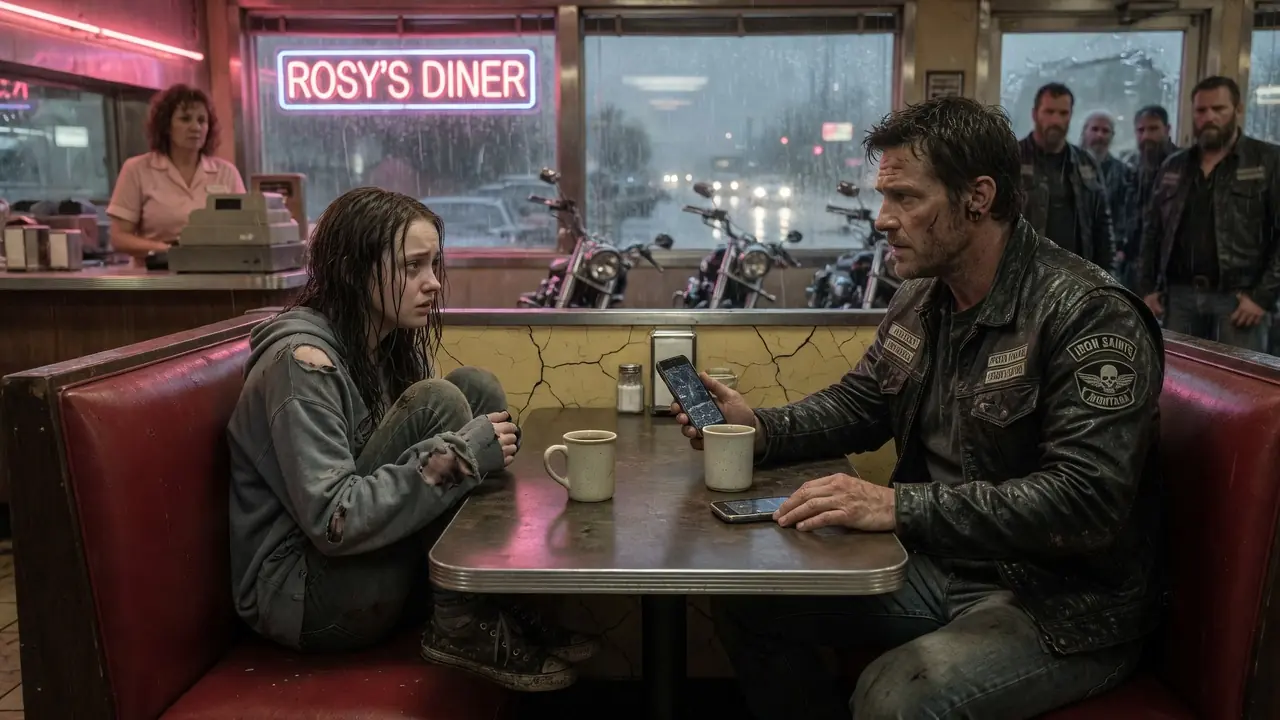
This is a story about broken people, chosen family, and the kind of redemption that rides on two wheels through the coldest night of your life.
The rain did not fall in Black Hollow, Montana.
It attacked.
It came sideways off the Bitterroot Range like something personal, like the sky had a grudge against every living thing foolish enough to still be breathing in this forgotten stretch of highway between nowhere and nothing. It was the kind of rain that turned asphalt into black mirrors and made headlights look like the eyes of animals you could not name. It was the kind of rain that made you feel like the whole world had been wiped clean of people, and all that was left was you, your mistakes, and the sound of water hitting glass.
It was 1:47 in the morning, a Tuesday, or maybe a Wednesday, the kind of hour where days blurred into each other and time only mattered to people who still had somewhere to be.
Rosy’s Diner sat on the edge of Route 93 like a wound that refused to heal. The building was old. Not charming old, not rustic old, just old. The neon sign above the door buzzed and flickered, throwing sick pink light across the wet parking lot in stuttering bursts. Half the letters had burned out years ago, so now it just read “O Y.” Like even the building had given up on being whole.
The windows were fogged. The linoleum inside was cracked and yellowed. The ceiling fan above the counter turned so slowly it seemed like it was thinking about stopping. Everything in the place smelled like burnt coffee, old grease, and the kind of loneliness that soaks into walls and never leaves.
There were four people inside.
A cook no one had ever seen smile. A waitress named Donna, who was fifty-three, divorced twice, and moved through the diner like a woman who had stopped expecting anything good from any room she walked into. A man at the counter. And a girl in the corner booth.
The girl was the reason this story exists.
Ellie Mercer was seventeen years old, five foot four, and weighed maybe one hundred and ten pounds soaking wet, which tonight she was. Her dark hair clung to her face in wet strings. Her hoodie was two sizes too big, gray, with a tear along the left shoulder she had tried to fix with a safety pin that had already come undone.
Her jeans were muddy at the knees. Her sneakers were the cheap kind you get from the discount rack, the ones that fall apart after three months. Hers were well past that deadline.
She sat with her back pressed into the corner of the booth like she was trying to disappear into the vinyl, knees pulled up, hands wrapped around a glass of Coke she had not touched. The ice had melted twenty minutes ago.
She had not noticed.
Every time headlights swept across the parking lot, her whole body flinched. Not a big flinch, not the kind most people would catch, just a tightening. Shoulders pulling inward, fingers pressing harder against the glass, breath going shallow for half a second before she forced it back to normal.
It was the flinch of someone who had learned a long time ago that light usually came right before something bad.
She was not waiting for anyone.
She was hiding from someone.
There is a difference between those two things that most people are lucky enough to never learn.
Donna had tried talking to her once, about an hour earlier. She walked over with a coffee pot she was not offering and said, “You okay, sweetheart?”
The girl had looked up with eyes that were dry but somehow still looked like they had been crying for years.
“I’m fine.”
Donna, who had heard that exact lie in that exact tone from her own mouth more times than she could count, had nodded slowly and walked away. Because sometimes “I’m fine” is not an answer. It is a door being closed in your face by someone who is drowning on the other side.
Two stools down from the center of the counter, a man sat drinking black coffee like it was the only thing keeping his hands from doing something else.
His name was Ryder Cain, and he looked exactly like the kind of man your mother warned you about and your father pretended did not exist.
He was thirty-eight, six foot two, built like someone who had spent years carrying things heavier than weight: guilt, memory, the kind of grief that settles into your skeleton and becomes part of how you move. His face was angular, hard-lined, weathered by wind and road and time in a way that made him look older than he was from some angles and dangerously sharp from others.
A scar ran from just below his left ear down to the corner of his jaw. Not a clean scar, not a surgical scar. The kind that comes from something that was trying to end you and almost succeeded.
His knuckles were scarred, too, thick and white across the ridges. The kind of hands that had hit things and been hit by things and had long ago stopped keeping track of which was which.
He wore a black leather jacket, not the fashionable kind, the real kind, the kind that smelled like rain and exhaust and years of highway. The back of it carried a patch: a faded gray skull with wings stitched above the words Iron Saints MC, and below them, Montana.
His jeans were dark, his boots were heavy, and his eyes were the color of creek water in January. Gray, cold, and deep enough to hide things in.
Ryder Cain was an ex-Marine. Two tours in a desert he still could not talk about. He had come home to a country that handed him a folded flag, a prescription for pills that made his dreams louder, and a “thank you for your service” that tasted like ashes every time someone said it.
He had tried the normal route. The job. The apartment. The girlfriend who left when she realized that the man who came home was not the same man who had shipped out.
He tried therapy once. He sat in a clean white room across from a man with soft hands and a degree on the wall, and he said fourteen words in fifty minutes.
The therapist said he had avoidant tendencies.
Ryder said the therapist had never watched his best friend die on a dirt road six thousand miles from anywhere that mattered.
He never went back.
The Iron Saints found him, or maybe he found them. It did not matter. What mattered was that, for the first time since he had come home, he was around men who understood that silence was not emptiness.
It was survival.
Men who had their own scars, their own nightmares, their own reasons for riding highways at three in the morning instead of lying in beds that felt too safe to trust.
The club was not a fraternity. It was not just a gang of loud engines and leather. It was a collection of men who had been broken by various machines: war, poverty, abuse, systems that chewed people up and spit them out with nothing but trauma and a Social Security number. They had decided to be broken together rather than alone.
That was the whole philosophy.
You ride. You show up. You protect what is yours. And when one of you is drowning, the rest do not call for help.
They jump in.
Ryder had not spoken to anyone in the diner. He had been sitting there for forty minutes, gloves still on, coffee going cold, watching the rain without seeing it.
He was thinking about his sister.
He was always thinking about his sister.
Her name had been Lily. She had been fifteen the last time he saw her alive.
He did not talk about Lily. Not to the club, not to anyone. But she lived in every silence he carried, every flinch he noticed in other people, every bruise-shaped shadow he could not stop scanning for.
She was the reason he sat with his back to the wall in every room. She was the reason he never slept past four in the morning. She was the reason his hands tightened around the coffee mug now as something in his peripheral vision snagged like a fishhook in his chest.
The girl in the corner booth had reached for her Coke. Her sleeve slid back just an inch. Just for a second.
But a second was enough.
The bruises around her wrist were dark. Not fresh dark, but layered dark. The kind that came from being grabbed in the same place over and over so many times that the skin forgot what its natural color was supposed to be. Purple underneath, yellow-green around the edges, and beneath all of it, a faint ring of older marks that had healed but left shadows.
This was not an accident.
This was not a fall.
This was a pattern. A signature.
Someone’s hand had been wrapping around that wrist like a vise, regularly, deliberately, for a long time.
Ryder’s coffee mug stopped halfway to his mouth.
The diner sounds — the hiss of the griddle, the rattle of the ceiling fan, the tiny country song leaking from the ancient jukebox in the corner — faded to static. His vision tunneled.
For a moment, he was not in the diner anymore.
He was standing in a hallway in a house in Butte, Montana, fourteen years ago, watching a man he was supposed to call his stepfather drag his fifteen-year-old sister by the wrist into a bedroom while their mother sat on the couch pretending the television was louder than the screaming.
He blinked.
The diner came back. The rain came back. The girl was tugging her sleeve down.
Quick, practiced, automatic.
A movement she had done a thousand times before. A movement that had become muscle memory. The body’s version of a lie it tells so often it forgets its line.
She did not look up. She did not know he had seen.
But he had.
Something in Ryder Cain’s chest that had been locked in a cage for fourteen years shifted, pressed against the bars, and opened its eyes.
He did not move right away.
That was the thing about Ryder. He never reacted fast on the surface. Everything happened underneath first. His jaw set. His breathing slowed. His eyes tracked the girl’s movements with the quiet, methodical focus of a man who had spent years reading danger in landscapes.
He watched how she held her body, the way her shoulders curved inward like armor, the way her eyes swept the door every thirty seconds, the way she made herself physically smaller in the booth as if she could shrink below the threshold of someone’s attention.
He watched and he recognized.
Not suspected.
Recognized.
Because the body keeps a record the mouth will not speak. Ryder Cain had learned to read that record a long time ago in a language he wished he had never needed to learn.
He set the mug down quietly, pulled a five-dollar bill from his jacket, and left it on the counter beside the coffee.
Then he stood slowly, not because he was hesitant, but because sudden movements in a room with a frightened person are their own kind of violence. He knew that, too.
He walked to the booth, not directly. He took the long way, past the jukebox, past the window, approaching from an angle where she could see him coming the entire time.
When he reached the edge of her table, he stopped. His hands were visible, shoulders loose, making himself as unthreatening as a six-foot-two man in a leather jacket covered in motorcycle club patches could possibly make himself.
“You don’t have to talk,” he said.
His voice was low and rough, like gravel stirred at the bottom of a riverbed.
“But I need to ask you one thing, and I need you to answer it honest.”
Ellie’s eyes shot up.
Cornered-animal wide.
Her hand moved instinctively to cover her wrist.
“Are you safe tonight?”
Three words.
That was all.
He did not say, “What happened?” He did not say, “Who did this?” He did not say, “Let me help.”
He asked the only question that mattered to someone in that booth at that hour.
Are you safe tonight?
Not tomorrow. Not in general.
Tonight.
Ellie stared at him. She stared at the scar on his jaw. She stared at the patches on his jacket. She stared at his hands, which were big and rough and scarred and absolutely still.
Something happened in her face.
A crack.
A fracture.
The kind that does not show in the skin, but shows in the eyes when a wall that has been holding for years develops its first fault line.
Her chin trembled. She pressed her lips together hard enough to turn them white.
Then she shook her head.
Just once.
Just barely.
But it was enough.
No.
She was not safe tonight.
Ryder pulled out the chair across from her and sat down.
He did not reach for her. He did not lean in. He sat with his hands flat on the table, palms down, where she could see them, and he let the silence hold the space between them like something fragile they were both being careful not to break.
Outside, the rain picked up. Somewhere on Route 93, an eighteen-wheeler blasted its horn into the void. Inside Rosy’s Diner, Donna refilled a coffee pot no one had asked for and watched the biker and the girl from behind the counter with an expression that lived somewhere between worry and hope.
“My name’s Ryder,” he said after a while. “I’m not going to ask you anything you don’t want to answer. But I’m going to sit here until you tell me what you need. And if what you need is for me to leave, I’ll leave. No questions.”
Ellie swallowed. Her eyes were glassy but dry, the eyes of someone who had cried so many times that the tears had become unreliable, showing up for small things and disappearing entirely for the big ones.
“He’ll come looking for me,” she said.
Her voice was small.
Not weak.
Small.
The voice of someone who had learned to take up as little space as possible, including auditory space.
“Who?”
“My stepfather.”
Ryder’s expression did not change, but beneath the table, his right hand closed into a fist so tight that the scar tissue across his knuckles stretched white. He held it for three seconds. Then he opened it slowly, like he was making a choice.
“Does he know where you are?”
“He knows I come here sometimes when it gets…”
She stopped and looked at the table.
“When it gets bad.”
“Is tonight bad?”
She almost laughed. It came out as a sound closer to a gasp, the kind of sound you make when someone asks if the ocean is wet.
“Tonight is the worst it’s ever been.”
She did not elaborate.
She did not need to.
The bruises on her wrist were a sentence. The way she flinched at headlights was a paragraph. The fact that she was sitting in a diner at two in the morning in the rain, alone, seventeen years old with nowhere else to go — that was the whole story.
Ryder looked at her for a long moment.
In that moment, something passed between them that neither of them could have named. Not trust, not yet, but something before trust. Something like recognition. The way two people who have been through the same fire can look at each other and know without words that they are standing on the same scorched ground.
“Okay,” he said.
The way he said it — low, steady, final — made it sound less like a word and more like a door locking behind them both.
He pulled his phone from his jacket pocket. It was old, cracked across the screen, held together by a case that had seen better decades.
He scrolled to a name, pressed call, and held it to his ear while the rain hammered the window beside them.
It rang three times.
“Ghost,” Ryder said, just the name. “I need you at Rosy’s. Bring who you trust, and bring it quiet.”
He hung up, put the phone away, and looked at Ellie.
“Some people are going to come here,” he said. “They’re going to look rough. They’re going to sound rough. But they’re the safest people you’ll meet tonight. I need you to believe that.”
Ellie searched his face. Whatever she found there, or did not find there — because sometimes the absence of a lie is more convincing than the presence of a promise — made her nod.
Twenty-six minutes later, the first headlight cut through the parking lot.
Then another.
Then another.
Then the sound.
Low, guttural, unmistakable.
Not car engines. Not truck engines.
Harleys.
The kind of sound that does not just fill a space, but claims it, vibrating through the floor and the walls and the fillings in your teeth. The kind of sound that tells you something is arriving that does not care whether you are ready for it or not.
They came out of the rain like ghosts made of chrome and leather.
One by one, motorcycles swung into the parking lot of Rosy’s Diner. Kickstands dropped onto wet asphalt. Engines died in sequence like a heartbeat slowing down.
Seven.
Nine.
Twelve.
Fifteen.
Fifteen motorcycles parked in a row beneath the broken neon sign, rainwater streaming off leather seats and chrome exhaust pipes, headlights going dark one at a time until the parking lot was nothing but the tick, tick, tick of cooling engines and the smell of exhaust mixing with rain.
Ellie watched from the window.
Her eyes were enormous.
They came inside without urgency. No shouting, no dramatic entrance, just the sound of heavy boots on wet tile. One after another, steady as a metronome.
The diner filled with the creak of leather, the drip of rain off jackets, the smell of tobacco and motor oil and cold highway air.
They were big men, most of them. Not all. Some were lean, wiry, built like fencing wire. But they all carried themselves the same way, with the quiet, deliberate weight of men who had been through things civilian language did not have words for.
Ghost was the first through the door.
He was the club’s vice president, a man in his late forties with a shaved head, a gray beard trimmed close, and eyes that looked like they had been designed by someone who wanted to make a color that meant don’t. He wore a denim vest over his leather jacket, patches covering every inch, and he moved with the unhurried calm of a man who had decided a long time ago that nothing in the world was worth running toward or away from.
He spotted Ryder, nodded once, then scanned the room.
Long enough to see.
Short enough not to threaten.
Behind him came Deacon, tall, Black, early fifties, built like a man who had spent twenty years working with his hands and another ten making sure those hands stayed controlled. He was the club’s sergeant-at-arms, which meant he was responsible for discipline, security, and the general guarantee that when the Iron Saints said something was handled, it was handled.
Deacon did not say much.
He did not need to.
His presence was a sentence that did not require punctuation.
Then came Saint, the club’s medic. His real name was Marcus Webb, former Navy corpsman, a man who had spent two years patching together Marines in places the news did not talk about and had come home with steady hands and a prescription for nightmares.
He was the gentlest man in the club. Soft-spoken, patient, the kind of man who could set a broken bone while telling you about his daughter’s school play and make you believe for a moment that the world was a place where both things could exist at the same time.
Then the others: Hatchet, Coyote, Drifter, Boon.
Names that were not born but earned. Each one a small story of survival or stubbornness or both.
They filed in and filled the booths, the counter stools, the standing space near the door, and within five minutes, Rosy’s Diner — a place that usually held loneliness and burnt coffee and not much else — felt like a fortress.
Donna stood behind the counter, coffee pot in hand, watching fifteen outlaw bikers settle into her diner at two-thirty in the morning.
For reasons she would never fully understand, she felt safer than she had in years.
Ryder stood and walked to where Ghost leaned against the counter.
“The girl,” Ryder said, low enough that only Ghost could hear.
“I see her.”
“Stepfather. Bruises are layered. This has been going on a long time.”
Ghost’s jaw worked. He looked at the coffee in front of him, then at Ryder.
“You sure about this?”
“I’m sure.”
“This isn’t a bar fight, Ryder. This is a kid. There are systems for this. Social workers. Cops.”
Ryder’s eyes went flat. Not angry. Empty. The way a room looks after someone has taken everything out of it.
“I called the county sheriff’s office about a kid three years ago,” Ryder said. “You know what happened.”
Ghost was quiet.
“Nothing happened,” Ryder said. “That’s what happened. Nothing. A report got filed. A social worker made a visit that was announced two days in advance. The house was clean when she got there. The kid had long sleeves on. The case was closed in six weeks. Four months later, that kid was in the hospital with serious injuries, and the stepfather was out on bail by Thursday.”
He was not talking about Ellie.
They both knew that.
He was talking about a case from three years ago that had ended badly. A kid named Tommy Voss, thirteen years old, who had finally been removed from the home, but only after the damage was so severe that removal was just another word for too late.
And underneath that, buried deeper than either man would say aloud, he was talking about Lily.
He was always talking about Lily.
Ghost nodded slowly. Not agreement. Acknowledgment. The nod of a man who understood that the system works like a net. It catches some things, and the rest falls through, and the things that fall through are people.
“What do you need?”
“I need her somewhere safe tonight. Somewhere he can’t find her. And I need to know who this man is before the sun comes up.”
Ghost turned to the room. He did not raise his voice.
He did not have to.
“Deacon. Saint. Coyote. On me.”
The three men materialized beside him like they had been waiting for exactly those words.
Ghost spoke in short, quiet sentences. Deacon’s face hardened. Saint’s face softened. Coyote, a wiry man in his thirties with quick eyes and a nervous energy that disguised a mind like a steel trap, pulled out his phone and started typing.
Within ten minutes, they had a plan.
Saint would take Ellie to a motel called the Pine Ridge, twenty miles outside of town, a place the club had used before as a safe house for women and children leaving bad situations. It was not fancy. It was clean. It was quiet. The owner, a retired Marine named Dale Hobson, owed the Iron Saints more favors than he could count, asked no questions, and kept no records.
Deacon would ride escort.
Coyote would run background on Wade Mercer. Employment, criminal history, known associates, property records, everything that existed in the digital world about a man who hid a child behind closed doors and smiled at neighbors over the fence.
And Ryder would stay.
Because Ryder always stayed.
That was his particular curse. The inability to walk away from a burning building even when he had been burned before, even when the fire was the kind that left marks on the inside where no one could see them.
He walked back to Ellie’s booth and sat down across from her again. The diner had changed around them. It was full now, loud with the low murmur of men talking, the scrape of chairs, the clink of coffee cups.
But the booth felt like a separate country, a small island in the middle of all that noise, where the only language spoken was the one between two people who understood damage.
“These men,” Ryder said, nodding toward the room. “They’re my family. Not by blood. By choice. And tonight, if you’ll let them, they’re going to make sure you’re safe.”
Ellie’s eyes moved across the room. She saw leather, scars, tattoos, faces that looked like they had been assembled from spare parts by someone who valued function over beauty. She saw men who looked dangerous.
And she saw something else, something underneath the surface.
In the way Saint smiled at Donna when she refilled his coffee. In the way Deacon stood near the door with his arms crossed, not like a bouncer, but like a guard dog. In the way Ghost spoke to his men with his hand on their shoulders like a father.
“Why?” she whispered. “You don’t even know me.”
Ryder looked at the table.
For a long time, he was quiet.
When he spoke, his voice was rougher than before, like something inside him was scraping against something else.
“Because somebody should have done this for someone I loved. And nobody did.”
He did not say who. He did not say when.
Ellie did not ask.
She heard something in those words that was bigger and older and heavier than explanation. She knew, the way you know things at seventeen when the world has already taught you its worst lessons, that some doors stay closed for a reason.
Saint approached the booth. He crouched beside Ellie, bringing himself to her eye level, and his voice was the calmest thing in the room.
“Hey, I’m Marcus. People here call me Saint, but Marcus is fine. I’m going to take you somewhere you can sleep tonight. Warm bed. Locked door. No one knows where you are. Does that sound okay?”
Ellie looked at Ryder.
Ryder nodded once.
“Okay,” she whispered.
They moved through the diner in a formation that looked casual but was not.
Deacon went first, scanning the parking lot through the window before stepping outside. Saint walked beside Ellie, close enough to shield, but not so close that she would feel crowded. Ryder brought up the rear, hands in his pockets, eyes everywhere.
Outside, the rain had softened to a steady drizzle. The neon sign buzzed overhead, casting broken pink light across the row of motorcycles.
Ellie stopped at the edge of the sidewalk and stared at them. All that chrome, all that leather, all those machines lined up in the dark like sleeping animals.
“I’ve never been on a motorcycle,” she said.
Saint pulled a blanket from one of the saddlebags and draped it around her shoulders.
“You’re riding in Deacon’s truck tonight. Motorcycle lessons are for days when it’s not trying to drown us.”
She almost smiled.
Almost.
It was the ghost of a smile, the memory of one. Like her face remembered the shape but had forgotten the feeling.
They loaded her into the truck, a black Chevy Silverado that smelled like gun oil, pine air freshener, and old maps. Deacon got behind the wheel. Saint sat in the back beside Ellie.
As the truck pulled out of the parking lot, Ellie pressed her forehead against the cold window and watched the diner shrink behind them. Behind it stood the row of motorcycles, and on the sidewalk in front of them, the silhouette of a man in a leather jacket standing alone in the rain, watching them go.
Ryder did not move until the truck’s taillights disappeared around the bend.
Then he stood there for another five minutes, rain soaking through his jacket, dripping off his jaw, pooling in the creases of his boots.
He stood there because he needed the cold. He needed the discomfort. He needed something physical to anchor him to the present so his mind would not drift back to that hallway in Butte, to that closed bedroom door, to the sound of his sister crying through the wall while he was twelve years old and too small, too scared, too powerless to stop it.
He had been powerless then.
He was not powerless now.
When he finally walked back inside, Ghost was waiting at the counter with a fresh cup of coffee and a look on his face that said he already knew where this was headed.
“Coyote’s got something,” Ghost said.
Ryder sat.
He did not touch the coffee.
“Talk.”
“Wade Mercer, forty-four. Married Ellie’s mother, Karen, six years ago. Karen Mercer died three years ago. Car accident. Single vehicle. Wet road. Blood alcohol was zero. Clean by all accounts.”
“And by unclean accounts?”
Ghost slid his phone across the counter.
On the screen was a photo: a man with a thick neck, small eyes, and the kind of smile designed to work at barbecues and parent-teacher conferences and fall apart completely behind closed doors.
Wade Mercer looked like every monster that had ever hidden behind a lawn mower and a firm handshake.
Unremarkable.
That was the horror of it.
Completely, perfectly unremarkable.
“No criminal record,” Ghost continued. “One DUI eight years ago, pled down. Works at the grain elevator on Route 12. Coaches Little League on Saturdays. Goes to the community center on Thursdays.”
“Of course he does.”
“Two complaints filed with Child Protective Services in the last eighteen months. Both closed. Insufficient evidence.”
Ryder stared at the photo. His expression was impossible to read. Flat. Controlled. The face of a man who had trained himself to keep the war inside.
But his eyes moved with something that looked like calculation, and beneath that, something that looked like fury being held underwater by force of will.
“Where does he live?”
“Farmhouse, edge of town. Rural route. Half a mile from the nearest neighbor. Isolated.”
“Of course it is.”
Ghost leaned in. “Ryder, what are we doing here?”
“We’re making sure that girl doesn’t go back to that house.”
“And if the system—”
“The system had eighteen months and two complaints and a dead mother, and it did nothing. How many more months does she get, Ghost? How many more bruises? How many more two-in-the-morning runs to a diner in the rain before one night she doesn’t make it to the diner?”
The silence between them was heavy enough to bend the counter.
Ghost looked at his coffee, looked at Ryder, looked at the fifteen men filling the diner behind them. Men who had all, in one way or another, been failed by systems that were supposed to protect them. Men who had found each other precisely because the safety nets of the normal world had holes big enough to fall through. Men who understood in their bones that sometimes the only thing standing between a person and the abyss is another person who refuses to look away.
“Okay,” Ghost said.
Like Ryder before him, the word sounded less like agreement and more like the sound of something beginning that could not be stopped.
Outside Rosy’s Diner, the rain kept falling on Black Hollow, Montana. The neon sign kept flickering. The highway kept stretching into darkness in both directions, empty and endless and indifferent to everything happening beneath its surface.
Twenty miles away, in a motel room with the door locked and the blinds drawn, Ellie Mercer lay on a bed that was not hers, wrapped in a blanket that smelled like someone else’s laundry detergent, staring at the ceiling while Saint sat in a chair by the door, reading a paperback with the patience of a man who had spent whole nights watching over people who could not watch over themselves.
She did not sleep.
She did not cry.
She just lay there listening to the rain on the roof, thinking about the man in the diner who had asked her a question no one had ever asked her before.
Are you safe tonight?
Three words.
For the first time in three years, the answer was not a lie.
But safety, she knew, was temporary. It was a motel room. It was a locked door. It was a stranger with kind eyes in a leather jacket.
It was not a solution.
It was a pause, a breath between waves.
Because somewhere back in Black Hollow, in a farmhouse at the end of a rural road where the nearest neighbor was half a mile away, Wade Mercer was awake. He was sitting in the kitchen with the lights off, drinking whiskey from a glass he kept refilling, staring at the empty chair where Ellie usually sat.
His phone was on the table. He had called her six times.
She had not answered.
The seventh time, he did not call.
He texted four words.
You know what happens.
Outside, the rain kept falling.
Somewhere on a dark highway, engines were cooling.
In a diner that smelled like burnt coffee and old sorrow, an outlaw biker sat alone at the counter staring at a photograph of a monster, planning something that would either save a girl’s life or burn his own to the ground.
The night was far from over, and what was coming with the dawn would be worse than anything the storm had brought.
The coffee at Rosy’s Diner had gone from bad to poisonous somewhere around four in the morning, but Ryder Cain kept drinking it anyway because the bitterness gave his mouth something to do besides say the things building pressure behind his teeth.
The diner had emptied to five men.
Ghost at the counter beside him. Coyote in the corner booth with his laptop open and the blue light carving shadows into his face. Hatchet by the door with his arms crossed and his eyes on the parking lot. Boon at the far end of the counter, asleep sitting up, chin on his chest, snoring softly into the collar of his jacket.
The rest of the Iron Saints had gone home or to the clubhouse, a converted warehouse on the south end of town that smelled like engine grease, stale beer, and the particular kind of brotherhood that does not need a roof to exist, but appreciates one when it is raining.
Coyote closed his laptop.
The sound was soft, but it hit the room like a gunshot because everyone had been waiting for it.
“Got something,” Coyote said.
He did not stand. He just turned the laptop around on the table so the screen faced the counter.
“And you’re not going to like it.”
Ryder walked over. Ghost followed. Hatchet stayed at the door, but tilted his head like a dog hearing a frequency only he could catch.
On the screen was a county records page: property filings, tax records, the kind of dry bureaucratic data most people would never look at twice.
Coyote pointed to a line halfway down.
“Wade Mercer doesn’t just own the farmhouse. He owns the twelve acres around it. Bought it six years ago, right after he married Karen Mercer. Paid cash. Ninety-two thousand dollars.”
“A grain elevator worker pays ninety-two grand in cash,” Ghost said.
It was not a question.
“It gets better.” Coyote scrolled down. “Karen Mercer had a life insurance policy. Two hundred thousand dollars. Beneficiary was Ellie until Karen died. Then Wade petitioned to have himself named as guardian and changed the beneficiary to himself. Payout was processed fourteen months ago.”
Ryder’s hand was on the back of Coyote’s chair. His knuckles were white.
“There’s more,” Coyote said, and his voice dropped half a register, the way it always did when he found something that made the bottom fall out. “Karen Mercer’s car accident. Single vehicle. Wet road. I pulled the accident report from county records. Responding officer was a deputy named Dale Purcell. Investigation was closed in eleven days.”
“Eleven days.”
“No toxicology beyond basic blood alcohol. No mechanical inspection of the vehicle. No witness canvass.”
“Who signed off on it?”
“Sheriff’s office. Incident review was handled internally.” Coyote paused and looked at Ryder with eyes that were careful and hard at the same time. “Dale Purcell. I looked him up. He left the sheriff’s department eight months after Karen’s accident. Know where he went?”
“Tell me.”
“Private security. Works for a company called Ridgeline Solutions out of Missoula. But here’s the thing. I can’t find Ridgeline Solutions anywhere. No website. No business filings. No reviews. Just a P.O. box and a registered agent who also happens to be the attorney for—”
He pointed at the screen.
“Mercer Grain and Feed, which is the parent entity that holds the deed to Wade Mercer’s farmhouse.”
The silence in the diner developed teeth.
Ghost leaned back from the screen and rubbed his face with both hands, the way a man does when he can see the shape of something ugly forming but is not ready to say its name out loud.
“You’re telling me the man who investigated Karen Mercer’s death now works for a shell company connected to Wade Mercer.”
“I’m telling you what the records say. What it means is above my pay grade.”
Ryder straightened. His face had gone past anger into something colder. Something that looked like stone polished by years of water running over it.
Smooth.
Hard.
Completely without warmth.
“It means Ellie’s mother didn’t die in an accident,” he said. “And the man who made sure no one asked questions got paid for his silence.”
“We don’t know that,” Ghost said.
Firm, not arguing. Anchoring.
Ghost’s job in the club had always been to stand at the edge of the cliff and hold the rope while other men leaned over it.
“What we know is there are connections. Connections aren’t proof. And we’re not cops.”
“No,” Ryder said. “We’re not.”
He turned to face him.
“That’s the point.”
Something shifted in the air between them. It was subtle, a tightening, a recalibration. The kind of shift that happens between two men who trust each other completely but are about to disagree on something that matters.
“What are you saying, Ryder?”
“I’m saying that girl has been hurt for years. Her mother is dead under circumstances that stink. The investigation was buried. The man who buried it is on Wade Mercer’s payroll. I’m saying the system already had its chance. Two CPS complaints, a closed investigation, an eleven-day accident review. The system looked at this and shrugged.”
“And what do you want to do that the system won’t?”
Ryder did not answer right away. He walked to the window and stared out at the parking lot, where the rain had finally stopped, but the asphalt was still black and wet and reflecting the neon sign in broken pink fragments.
His reflection in the glass looked like a stranger.
Older. Harder. A man shaped by all the things he had not been able to stop.
“I want to go to that farmhouse,” he said. “And I want Wade Mercer to understand that the world he’s been living in, the one where he does whatever he wants behind closed doors and nobody comes, is over.”
Ghost stood up from his stool slowly, the way men stand when they are about to say something that costs them.
“Ryder, I need you to hear me. Not as your VP. As your friend.”
He walked to the window and stood beside him, both of them looking out at the same darkness.
“You’re not seeing Ellie right now. You’re seeing Lily.”
The name landed like a brick thrown through glass.
Ryder’s whole body changed. His shoulders locked. His jaw set so hard the muscle in his cheek jumped twice. His breathing went shallow, quick, controlled. The breathing of a man pulling himself back from an edge.
“Don’t,” he said.
One word. A wall.
“I have to. Because if you go to that farmhouse running on what happened to your sister instead of what is happening to that girl, you’re going to make decisions that can’t be undone. I’m not going to let you destroy yourself for a ghost, Ryder. I’m not.”
Ryder turned from the window and faced Ghost. For a moment, the two men stood close enough that the distance between them was not measured in inches, but in years.
Years of riding together. Bleeding together. Burying friends together. Holding each other upright in parking lots at three in the morning when the nightmares got so bad that being alone felt like drowning.
“Lily was fifteen,” Ryder said.
His voice was barely audible.
“She was fifteen, and she came to me. She came to me and she told me what he was doing, and I…”
He stopped and swallowed. The muscles in his throat moved like he was choking on something that had been lodged there for fourteen years.
“I was eighteen. I was about to ship out. Basic training in two weeks. I told her to hold on. I told her I would come back and fix it. I told her to just… to just hold on.”
Ghost did not move. He did not speak.
The diner was so quiet the tick of the clock above the register sounded like a heartbeat.
“She held on for four months,” Ryder said.
His voice cracked. Not a big crack. A hairline fracture, the kind that runs through a foundation and brings down a building slowly over years from the inside.
“Four months. Then she stopped holding on, and I was six thousand miles away in a desert. They sent a Red Cross message, and I sat in the dirt outside a tent and read that my sister was gone, and the man who did it to her was still breathing in a house I grew up in.”
He closed his eyes, opened them again.
The gray in them had gone darker, like water at the bottom of a well where light does not reach.
“So yeah, Ghost. I see Lily. I see her every time. Every bruise. Every flinch. Every girl sitting alone in a diner at two in the morning because her home is the most dangerous place she knows. You can call that projection. You can call it unresolved trauma. You can call it whatever the therapists call it.”
He breathed once.
“But I call it the only reason I’m still alive. Because every time I see it, I get a chance to do what I didn’t do fourteen years ago.”
Ghost was quiet for a long time.
Behind them, Coyote had closed his laptop and was staring at his hands. Hatchet had turned to face the wall. Even Boon had stopped snoring.
“Okay,” Ghost said finally. “But we do this smart. We do this the Iron Saints way. We go to that farmhouse. We stand on that porch. We make it clear the girl is under our protection. We do not touch him. We do not threaten him. We let the weight of fifteen men standing in his yard do the talking. If he escalates, if he makes a move, we respond. Not before.”
He looked directly at Ryder.
“If he calls the cops, then he calls the cops. We show them what Coyote found. The accident report, the shell company, the CPS complaints. We hand them a case that any competent investigator would have built two years ago if anyone had bothered to look.”
Ryder studied Ghost’s face, looking for cracks, looking for hesitation.
He found neither.
“Dawn,” Ryder said.
“Dawn,” Ghost confirmed.
They did not shake hands.
They did not need to.
The agreement was made in the space between their eyes, in the shorthand of men who had long ago stopped needing words to make promises.
Ryder turned to Coyote. “Print everything. Every document, every filing, every connection between Purcell and Mercer. I want a paper trail thick enough to choke on.”
Coyote nodded and opened his laptop again.
“Hatchet, call the rest of the club. Full ride at dawn. Formation. Colors.”
Hatchet pulled out his phone.
“And somebody wake Boon up before he drowns in his own snoring.”
Boon jolted upright, blinked, wiped his mouth with the back of his hand, and said, “I was awake.”
Nobody believed him.
Nobody cared.
The next three hours passed the way hours pass before a battle: slowly, weighted, full of small actions that carry enormous significance.
Men cleaned their bikes in the pre-dawn dark. Coyote’s printer at the clubhouse churned out pages. Ryder sat on the back steps of the diner and smoked a cigarette he had bummed from Hatchet, the first cigarette he had had in two years, and watched the eastern sky turn from black to the color of an old bruise.
At 5:30, his phone buzzed.
A text from Saint.
She’s awake. She’s asking for you.
He stared at the message for a long time, then typed back.
Tell her I’ll see her today. Tell her it’s going to be okay.
He sent it. Then he sat there with the phone in his hand, hating himself for the lie, because he did not know if it was going to be okay. He did not know anything except that a seventeen-year-old girl was hiding in a motel room, and a man with blood on his hands was sitting in a farmhouse twenty minutes away.
Somewhere between those two points, the Iron Saints Motorcycle Club was about to insert itself into a situation that could end in justice or disaster, or both.
The line between those things was so thin you could cut yourself on it.
At 6:15, a call came in that nobody expected.
Ryder’s phone rang.
Not Ghost. Not Saint.
The screen showed a number he did not recognize.
He answered.
“Mr. Cain?”
A woman’s voice. Professional. Clipped.
“Who’s this?”
“My name is Patricia Langford. I’m a social worker with the Montana Department of Public Health and Human Services. I’m calling about Ellie Mercer.”
Ryder’s blood went cold.
Not from fear.
From the mathematical precision of the timing.
Ellie had been gone from Wade’s house for less than six hours. The sun was not even up, and already a social worker was calling.
“How did you get this number?”
“Mr. Mercer filed a missing person report at 4:12 this morning. He told the sheriff’s office his stepdaughter left the house after a disagreement, and he’s concerned for her safety. Your name came up in the report.”
“My name?”
“Mr. Mercer told deputies that his stepdaughter has been associating with members of a motorcycle club, and he believes she may have been taken against her will. He specifically named you.”
Ryder stood up from the steps. The cigarette fell from his fingers and hissed out on the wet ground.
“She wasn’t taken. She left.”
“I understand, but Mr. Mercer has filed a custodial interference complaint. He’s Ellie’s legal guardian, and she’s a minor. If you know where she is, you’re legally obligated to—”
“To what? Send her back to the man who has been hurting her for three years?”
Silence on the line.
Then, “Mr. Cain, I understand this is emotional, but I need to follow procedure. If you have evidence of abuse, I need you to bring it to our office so we can—”
“Your office has had two complaints in eighteen months. What happened to those?”
A longer silence.
The kind that has paperwork and liability and career considerations buried inside it.
“I’m not at liberty to discuss previous cases. What I can tell you is that if Ellie is with you, or with anyone associated with your organization, and you do not return her to her legal guardian or bring her to our office by end of business today, law enforcement will be involved.”
“Law enforcement is already involved. They have been for three years. They just haven’t done anything.”
“Mr. Cain—”
“You want Ellie? Come find her. Bring a camera. I want someone to document what her wrists look like. I want someone to ask her what happens in that house when the neighbors aren’t looking. Then I want someone to explain to me how a man can hurt a child for three years and the best the state of Montana can do is call the guy who pulled her out of the fire.”
He hung up.
His hand was shaking.
Not from anger, but from the realization that the ground had just shifted beneath all of them.
Wade Mercer was not going to sit in that farmhouse and wait for dawn. Wade Mercer was already playing offense. He had called the sheriff’s office. He had filed a report. He had named Ryder by name. He had framed the narrative: concerned father, dangerous bikers, vulnerable girl led astray.
By the time the sun came up, the story in Black Hollow would not be about a man who had abused his stepdaughter.
It would be about a motorcycle club that kidnapped a minor.
Ryder walked inside and told Ghost everything, word for word.
Ghost’s face did not change during the telling, but his hands did. They went from resting on the counter to flat against it, fingers spread, pressing down like he was trying to hold the building in place.
“He’s smart,” Ghost said. “Smarter than I wanted him to be.”
“He’s had practice.”
“This is a man who buried an accident investigation and made two CPS complaints disappear. He knows how the machinery works. He’s been inside it for years.”
“Then we need to move faster than the machinery.”
“That’s what I’ve been saying.”
Ghost looked at him hard, the kind of look that strips away everything except the essential question.
“And I’m telling you again, we do this smart. The second we put fifteen bikes on that man’s lawn, we become the story. The media, the sheriff, the social workers, they all look at us and see what Wade wants them to see. Dangerous outlaws. That’s the playbook he’s running. He files the report. He flips the script. Suddenly we’re not the rescue. We’re the threat.”
“So what do you want to do? Wait? File a countercomplaint? Sit in a meeting room with a social worker who already closed two cases on this man?”
“I want to win. And winning doesn’t look like a confrontation on his porch that he can photograph and hand to his lawyer. Winning looks like evidence so clean no one can bury it.”
“The girl is the evidence, Ghost. Her body is the evidence. Every bruise on her is a document the state of Montana has been too lazy or too corrupt to read.”
“Then we get it read. We take her to a hospital. An independent one, not the county clinic. We get a full medical exam. We get photographs. We get a doctor on record. Then we get a lawyer involved, not some public defender, a real one. We hand them Coyote’s research and Ellie’s medical report. We build a wall so high Wade Mercer can’t climb over it, around it, or through it.”
Ryder’s jaw worked.
He wanted the farmhouse.
Every cell in his body wanted the farmhouse.
He wanted to stand on that porch and look that man in the eyes and make him feel what Ellie felt every night: the terror of being trapped with someone stronger who could do whatever he wanted.
He wanted it so badly his teeth ached.
But Ghost was right.
Ryder hated that Ghost was right because being right was complicated and slow and bloodless. The part of him that was still eighteen years old and standing in that hallway in Butte wanted something simpler, something that involved his fists and a man on the ground and the sound of justice being delivered in the only language men like Wade Mercer understood.
“One day,” Ryder said. “We do it your way for one day. Hospital, lawyer, paper trail. But if by sundown that girl is not safe, legally and permanently safe, we go to the farmhouse and we do it my way.”
Ghost held his gaze for five full seconds.
“Deal.”
Dawn broke over Black Hollow like a wound opening, red and raw along the eastern ridge, bleeding color into a sky that had been gray for so long it had forgotten what warmth looked like.
The parking lot of Rosy’s Diner steamed as the morning sun hit the wet asphalt. One by one, Harley engines turned over, coughing and rumbling to life in the cold air.
Fifteen bikes.
Fifteen men.
Fifteen sets of hands that had done hard things and were prepared to do harder ones.
But they were not riding to the farmhouse.
Not yet.
Ryder threw a leg over his bike, a 2003 Heritage Softail black as a bruise, with a scratch along the left saddlebag from a night in Bozeman he did not talk about, and kicked the engine to life.
The vibration climbed through his boots into his legs, into his chest, settling into the hollow space behind his sternum where the anxiety lived. He gripped the handlebars and felt the leather of his gloves creak against chrome.
For a moment, just a moment, the noise inside his head went quiet.
That was the secret of the motorcycle.
Not speed. Not freedom.
Silence.
The engine was so loud it drowned out everything else. Sometimes drowning out everything else was the closest thing to peace a man like Ryder Cain could get.
They rode in formation, two columns staggered, Ghost at the lead, Ryder at his right shoulder.
The road unspooled beneath them like a black ribbon, lined with bare cottonwoods and fences that leaned at angles suggesting the wind in that part of Montana had opinions. The morning air was brutal. Mid-twenties, maybe colder, the kind of cold that does not just touch your skin, but enters it, finds your bones, and reminds you that warmth is a privilege, not a right.
Twenty minutes out, the Pine Ridge Motel appeared on the left. A single-story L-shaped building with peeling green paint and a vacancy sign that was always on because vacancy was the motel’s permanent condition.
Deacon’s truck was parked outside room seven. Saint’s bike was beside it. The curtains were drawn.
Ryder parked, killed the engine, and sat there for a moment with his hands still on the grips, breathing steam into the frozen air.
Ghost pulled up beside him. He did not cut his engine right away. He let it idle, the low rumble filling the silence between them.
“You okay?”
Ryder did not look at him.
“No.”
“Good. Means you’re paying attention.”
He cut the engine.
They walked to room seven.
Ryder knocked. Two knocks. A pause. One knock.
The pattern they used.
The lock clicked.
Saint opened the door.
The room was small, clean, anonymous. Two beds, a television nobody had turned on, a bathroom with a fluorescent light that hummed. Deacon stood in the corner by the window, arms folded, watching the parking lot through a gap in the curtains.
He had not slept. His eyes were bloodshot but focused. The eyes of a man running on discipline instead of rest.
Ellie was sitting on the edge of the far bed. She was wearing the same clothes from last night, the gray hoodie, the muddy jeans, but someone — Saint, probably — had given her a pair of clean socks and a glass of water that sat untouched on the nightstand.
She looked up when Ryder walked in, and something happened in her face that was almost worse than tears.
A flash of relief so raw and so desperate that it made the room feel smaller.
“You came back,” she said, like she had not believed it, like people leaving and not coming back was the most reliable thing in her world.
“I told you I would.”
He pulled the chair from the small desk and sat down across from her, maintaining the same distance he had in the diner. Close enough to be present. Far enough not to crowd.
“How are you?”
She shrugged.
The universal language of teenagers who feel everything and trust nothing.
“Ellie, I need to tell you something, and I need you to listen all the way through before you react. Can you do that?”
Her eyes sharpened. Fear crept back into them like a tide.
“Your stepfather filed a missing person report last night. He told police you were taken against your will.”
The color drained from her face. Not slowly. All at once, like someone had pulled a plug.
“No. No, I left. I walked out. He didn’t… I wasn’t taken. I walked.”
“I know. We know. But he’s flipped it. In the eyes of the law right now, you’re a missing minor, and I’m the guy they’re looking at.”
Ellie’s breathing went fast. Too fast.
Saint took a step closer, his medic instincts firing, but Ryder held up a hand.
“Look at me,” Ryder said.
Calm. Low. The voice he used when things were falling apart and someone needed an anchor.
“We are going to fix this. But I need your help. We’re going to take you to a hospital. Not here, somewhere safe in Missoula. We’re going to get you checked out, everything documented. Every bruise, every mark, on record. Then we’re going to talk to a lawyer. A real one. Someone who knows how to take everything you’ve been living through and turn it into something that can’t be ignored.”
“He’ll find out. If I go to a hospital, he’ll find out.”
“He already knows. The game changed the second he picked up the phone. There’s no hiding anymore. Not for you. Not for him.”
Ellie stared at him. Her hands were shaking, gripping the edge of the mattress, knuckles as white as the sheets.
“You don’t understand,” she whispered. “He’s not just… He doesn’t just hurt me. He knows people. The sheriff. The school counselor. He plays poker with the judge’s clerk every other Thursday. He coaches their kids. He mows their lawns. He’s the nice guy on the block. And I’m the troubled girl who stays out late and doesn’t do her homework.”
Her voice cracked.
“Nobody’s going to believe me over him. They never do.”
Ryder leaned forward, not close, just enough.
“I believe you.”
Three words.
They hit the motel room like a crack splitting open a frozen lake. Small on the surface, catastrophic underneath.
Ellie’s face crumbled. Not into tears, into something worse. Into the expression of someone who has been carrying a weight so heavy for so long that the first moment of someone else reaching for it does not feel like relief.
It feels like collapse.
She pressed her hands over her face and bent forward. The sound she made was not crying. It was the sound of something structural giving way. A support beam that had been holding for years finally splintering under a weight it was never meant to bear.
Saint moved to the bed and sat beside her. He did not touch her. He just sat close, breathing steadily, being the calm in the room the way a wall is the stillness in a storm.
Ryder stood, walked to the window, and stood beside Deacon.
“How long do we have?” Ryder asked quietly.
Deacon’s voice was low, bass-deep, the kind of voice that comes from the chest instead of the throat.
“If he filed at four and the sheriff’s office put it in the system by six, they’ll start active search by noon. Maybe sooner if Mercer pushes it.”
“He’ll push it.”
“Then we need her in a hospital by ten and with a lawyer by two. Coyote already on it. He’s got a contact in Missoula. Family attorney named Reynolds. Woman. Former prosecutor. Handled domestic cases for twelve years before going private. She’s good.”
“How good?”
“Good enough that the county attorney’s office stopped taking cases against her clients because they kept losing.”
Ryder allowed himself one small nod. It was the closest thing to optimism he had felt in twelve hours.
“Get the bikes ready. We ride to Missoula in thirty.”
He turned back to the room.
Ellie was sitting upright again, wiping her face with the sleeve of her hoodie, trying to rebuild the composure that had crumbled minutes ago. She was not succeeding. She was not failing either. She was doing what survivors do: holding on with whatever she had, which was not enough, but had to be.
“Ellie,” Ryder said, “I need to ask you something, and I need the truth. Not because I’m judging you. Because what you tell me next determines what we do and how we do it.”
She looked at him and waited.
“Your mother’s accident three years ago. The car on the wet road.”
He paused, watching her face the way you watch a window during a storm, looking for the first sign of breakage.
“Was it an accident?”
The room stopped.
Everyone in it stopped.
Deacon’s hand, which had been reaching for the curtain, froze. Saint’s breathing went still. Even the fluorescent light in the bathroom seemed to hold its buzz.
Ellie’s expression did not change.
That was the tell.
When a question should shatter someone and their face stays perfectly still, it means the shattering happened a long time ago. What you are looking at now is the rubble pretending to be a building.
“I don’t know,” she said.
Her voice was flat. Detached. The voice of someone reciting a fact they had tried to make clinical so it would not kill them.
“But two weeks before she died, she told me we were leaving. She said she had a plan. She said she had been saving money. She said we were going to her sister’s house in Oregon.”
“Did Wade know?”
“She told him the night before. She told him she was done, and she was taking me, and she was filing for divorce.”
Ellie looked at the wall. Not at anything on the wall, just at the blankness of it.
“The next day, she went to the store. She never came back.”
The silence in that room was the loudest thing Ryder Cain had ever heard.
“Did you tell anyone this?”
“I told the social worker. The first time. The one who came after the first CPS complaint.”
“What happened?”
“She wrote it down. She said she’d look into it. Then the case was closed, and I never heard from her again.”
Ryder looked at Ghost, who had come inside and was standing in the doorway, hearing everything.
Ghost’s face was carved from stone.
But his eyes were furnaces.
“Coyote,” Ghost said into his phone, which was already at his ear, “everything you found about Karen Mercer’s accident. I need a copy for the attorney, and I need you to dig deeper. Medical records, insurance filings, phone records from the week before the accident, everything.”
He lowered the phone and looked at Ryder.
Neither man said a word.
They did not need to.
Because both of them now understood this was no longer a story about a man who hurt his stepdaughter.
This was a story about a man who might have killed his wife when she tried to leave, who had buried the investigation through connections and money, and who had spent three years trapping a seventeen-year-old girl in a house with the ghost of her dead mother and the hands of the man who might have put her there.
Somewhere in Black Hollow, that man was sitting in his kitchen drinking coffee, waiting for the system to deliver his stepdaughter back to him because the system had always delivered before.
But Wade Mercer did not know that the system was no longer the only thing standing between him and the truth.
Fifteen men in leather jackets were riding toward Missoula with a girl who was ready to talk and a file full of evidence that had been buried for three years.
When they got there, they were not going to file a complaint. They were not going to fill out a form. They were not going to wait for a call back.
They were going to hand a former prosecutor a case that smelled like murder.
The clock on Wade Mercer’s careful little world was going to start ticking backward toward the night three years ago when a woman told her husband she was leaving, drove to the store, and never came home.
The only question left was whether they would get there before Wade found them first.
Because at that exact moment, in the farmhouse kitchen at the end of the rural road, Wade Mercer set down his coffee, picked up his phone, and dialed a number he had not used in three years.
“Dale,” he said. “We have a problem.”
Twenty miles away, fifteen Harleys roared to life in the motel parking lot, and the sound rolled across the frozen Montana flatland like a warning from something ancient and unforgiving.
A sound that said, We’re coming.
This time, nobody was closing the case.
The highway between Black Hollow and Missoula stretched for one hundred and twelve miles of nothing: frozen rangeland, barbed wire fences sagging under the weight of ice, and a sky so pale it looked like someone had washed all the color out of it and forgotten to put it back.
The Iron Saints rode that highway in a column so tight and disciplined that the cars pulling over to let them pass looked like they were witnessing something that belonged to a different century. A cavalry movement. A migration. Something old and heavy and deliberate moving across the landscape with a purpose civilians could not read but could feel in their chests when the engines rolled past.
Ryder rode point beside Ghost, his face raw from the cold, his knuckles numb inside his gloves, his mind running calculations he did not want to be running.
The call from Patricia Langford sat in his chest like a splinter, not painful enough to stop him, but impossible to ignore.
Wade Mercer had filed first. Wade Mercer had named him. Wade Mercer was building a cage out of legal language and concerned-father theater, and every mile between Black Hollow and Missoula was a mile closer to the moment when the Iron Saints would have to prove they were something more than what their patches said they were.
Behind him in Deacon’s truck, Ellie sat in the back seat with a blanket around her shoulders and Saint beside her. She had not spoken since they left the motel. She was staring at her phone, not at a screen. The phone was dead. She was staring at the blank glass like it was a window into something only she could see.
The six missed calls from Wade.
The text message.
You know what happens.
Four words that contained an entire childhood of terror compressed into a sentence so small it could fit on a screen and so large it had shaped every breath she had taken for three years.
They reached Missoula at 9:47 a.m. The city sat in its valley like a bruise between mountains, the Clark Fork River running through its center, gray and swollen with snowmelt.
Ryder led the formation through downtown, past coffee shops where college students looked up from their laptops with wide eyes, past a courthouse whose stone steps would matter before the day was over, past a row of law offices on Front Street where the names on the doors were printed in the kind of font that charged four hundred dollars an hour.
They parked outside St. Patrick Hospital. Fifteen Harleys lined up on the street like a barricade, engines ticking in the cold, chrome catching the flat winter light.
People on the sidewalk stopped and stared. A woman pulled her child closer. A man in a business suit crossed to the other side of the street.
The Iron Saints were used to this: the way the world looked at them and saw a threat before it saw anything else. It was the cost of the patch, the cost of being men who looked like the thing society had decided to fear.
Ryder did not care about the staring.
He cared about the girl getting out of the truck on legs that were shaking, wrapped in a blanket that was not hers, walking toward a hospital entrance like she was walking toward a cliff.
“I’ll go in with her,” Saint said. “Medical stuff is my lane. You and Ghost handle the lawyer.”
Ryder nodded. Then he crouched in front of Ellie right there on the sidewalk, his knees on cold concrete so he could look up at her instead of down.
A deliberate choice.
A man his size, with his scars, kneeling on a public street. It was a posture that cost him something, and they both knew it.
“They’re going to ask you questions in there,” he said. “Hard ones. About the bruises, about how long, about who. Every answer you give makes you safer. Not right away, not today, but permanently. Do you understand?”
Ellie nodded. Her jaw was clenched so tight the muscles in her neck stood out like cables.
“I’ll be right here when you come out.”
She looked at him.
Then she did something she had not done before.
She reached out and touched his arm.
Just her fingertips.
Just for a second.
On the leather of his sleeve.
It was not a grab. It was not a hold. It was the lightest possible contact one human being can make with another, and it carried more weight than anything Ryder had felt in fourteen years.
She went inside with Saint. Deacon followed, positioning himself in the hospital lobby like a piece of furniture that happened to weigh two hundred and forty pounds and had eyes tracking every person who walked through the door.
Ryder stood on the sidewalk and watched them go.
Then he turned to Ghost.
“The lawyer.”
“Two blocks west. Reynolds and Associates. Coyote called ahead. She’s expecting us.”
They walked.
Two men in leather jackets and motorcycle boots walking through downtown Missoula at ten in the morning, drawing looks from everyone they passed. Ghost walked with his hands in his pockets, shoulders easy, the picture of controlled calm. Ryder walked like a man using every step to keep from running, either forward into action or backward into the past.
The office of Margaret Reynolds, attorney at law, was on the second floor of a brick building that had been a bank in the 1940s and still carried the architectural authority of a place that had once held other people’s money.
The waiting room was small, carpeted, unremarkable. A receptionist with reading glasses on a chain around her neck looked up when two bikers walked in and did not flinch, which told Ryder everything he needed to know about the kind of clients Margaret Reynolds was used to dealing with.
“Mr. Cain and Mr. Holloway?”
Ghost’s real name was Thomas Holloway. Nobody in the club used it. Hearing it in this clean, carpeted space felt like a foreign language.
“She’s ready for you. Second door on the left.”
Margaret Reynolds was fifty-one years old, five foot six, and built like a woman who had spent three decades standing in front of judges, juries, and opposing counsel and had decided long ago that physical intimidation was irrelevant when you had a brain like a surgical instrument.
Her hair was gray, cut short and practical. Her eyes were brown and sharp and missed absolutely nothing. She wore a navy suit that was expensive without being showy and sat behind a desk organized with the precision of someone who understood that chaos in your workspace meant chaos in your arguments.
She did not stand when they entered. She gestured to two chairs across from her desk and waited until they sat.
“Coyote sent me a summary at six this morning,” she said. No preamble. No pleasantries. “I’ve been reading for three hours. I have questions.”
“Ask.”
“The girl. Ellie Mercer. She’s seventeen. Wade Mercer is her legal guardian. You removed her from the home last night without authorization from any court or agency. Correct?”
“She removed herself. She was already at the diner when I found her.”
“Then you arranged for her to be taken to a motel outside of town for her safety. I understand the reasoning. A judge may not. A seventeen-year-old minor was transported across jurisdictional lines by members of an unincorporated motorcycle club without parental consent or a court order. That’s how it reads on paper.”
“Paper doesn’t show the bruises.”
“No. That’s what the hospital is for.”
She opened a folder on her desk, thick, printed, tabbed with colored flags.
“Coyote’s work. The background research your man did is impressive, but impressive and admissible are two different things. The connection between Dale Purcell and Wade Mercer’s shell company is interesting. It is not evidence. It is a thread. Threads need to be pulled by investigators with subpoena power, not by civilians with laptops.”
“Then get an investigator.”
“I intend to. But first I need standing. I need to be retained as Ellie’s attorney. Ellie is a minor, which means I either need her guardian’s consent, which we obviously don’t have, or I need a court to appoint me through a guardian ad litem proceeding. That takes time.”
“How much time?”
“If I file an emergency petition today, I can get a hearing by Friday. Maybe Thursday, if Judge Caldwell is feeling sympathetic.”
“Thursday? That’s two days.”
“That’s the system, Mr. Cain.”
“The system is how she ended up with those bruises.”
Reynolds looked at him over the folder.
Her expression did not soften, but it changed. A recalibration. The look of a woman who was used to being the smartest person in the room but recognized that intelligence was not the only kind of knowing that mattered.
“I’m not your enemy,” she said. “I’ve handled forty-seven domestic abuse cases involving minors. I’ve won thirty-nine of them. I’ve lost eight. Every one of those eight keeps me awake at night. I don’t take cases I don’t intend to win, and I don’t make promises I can’t keep.”
She tapped the file once.
“So here is what I can tell you. If the medical exam shows what you say it will, and if the girl is willing to testify, and if your man’s research holds up under scrutiny, this is winnable. But it takes days, not hours. In those days, I need Ellie to be somewhere safe, legal, and defensible.”
“She’s safe.”
“She’s in a motel room registered to a retired Marine who has off-the-books arrangements with a motorcycle club. That is not defensible. That is a liability.”
Ghost spoke for the first time.
“What do you need?”
“I need a licensed foster placement or a verified family member willing to take temporary custody. I need it before the sheriff’s office acts on Wade’s missing person report. And I need it today.”
“She doesn’t have family. Her mother’s dead. Her father left before she was born. Her mother had a sister in Oregon, but—”
“Oregon.” Reynolds held up a hand. “Name?”
“We don’t have it.”
“Find it. If there’s a living relative willing to take her, I can file for emergency kinship placement. That gives us legal standing and takes the custodial interference argument off the table.”
Ryder looked at Ghost.
Ghost was already reaching for his phone.
“Coyote. Karen Mercer’s sister lives in Oregon. I need a name, address, and phone number in the next two hours.”
Reynolds stood, walked to the window, and looked down at the street where fifteen motorcycles were parked in a line that made the sidewalk look like a military installation.
“There’s something else,” she said, her back still to them. “Something in Coyote’s file that concerns me.”
“The accident.”
“The accident.”
She turned around.
“If Karen Mercer’s death wasn’t accidental, if there’s any chance Wade Mercer was involved, this isn’t a custody case anymore. It’s a homicide investigation. That changes everything. Jurisdiction, agencies involved, level of danger to the girl, and the level of danger to all of you.”
“We know.”
“Do you? Because right now you’re sitting in my office thinking about how to protect a seventeen-year-old girl from her abusive stepfather. But if Wade Mercer killed his wife and got away with it for three years, then the man you’re dealing with isn’t just an abuser. He’s a killer who has already demonstrated he can manipulate law enforcement, suppress investigations, and eliminate threats. The threat he is looking at right now, the thing standing between him and continued control of his stepdaughter, is you.”
The words settled in the room like smoke.
Heavy. Toxic. Impossible to wave away.
“I need you to understand something,” Reynolds continued. “I will fight this case with everything I have, but I need you alive and out of jail to do it. Which means no farmhouse confrontations. No vigilante rides. No fifteen-bike shows of force on his property. You do that and I lose the case. You lose your freedom. Ellie loses the only people who have ever tried to help her. Are we clear?”
Ryder did not answer right away.
His jaw was working. His hands were gripping the armrests of the chair hard enough to leave impressions in the upholstery.
“Are we clear, Mr. Cain?”
“Clear,” he said.
The word tasted like swallowing glass.
They left the office and walked back toward the hospital.
Halfway there, Ghost’s phone rang. He answered, listened, and stopped walking.
Ryder watched Ghost’s face change.
It was subtle. Ghost was a man who had spent decades controlling his expressions the way a pilot controls an aircraft, with small, precise adjustments that kept everything level even when the instruments were screaming.
But something was happening behind those eyes.
Something that looked like the floor dropping out of an elevator.
Ghost said into the phone, “Then how? Then where is he now?”
He hung up, looked at Ryder, and Ryder knew before Ghost said a word that whatever was coming next was going to shatter something.
“That was Hatchet. He’s been monitoring the police scanner at the clubhouse. Thirty minutes ago, the Black Hollow Sheriff’s Office issued a BOLO for Ellie Mercer, missing endangered minor.”
“We expected that.”
“We didn’t expect this.”
Ghost’s voice dropped. Not for secrecy, but for the weight of what he was about to say.
“The BOLO names you as a person of interest. Not for custodial interference. For suspected kidnapping of a minor.”
The sidewalk tilted.
Not literally, but something in Ryder’s inner ear shifted the way it does when the world rearranges itself around a new and terrible fact.
Kidnapping.
“Wade Mercer went to the sheriff this morning with his attorney. Not a public defender. A private attorney from Great Falls named Victor Ashwood. Ring a bell?”
It did not.
“Coyote ran the name twenty minutes ago. Victor Ashwood has represented clients in three separate cases involving allegations against members of motorcycle clubs. All three cases resulted in convictions, and all three cases were built on the same narrative: vulnerable minor, outlaw biker influence, coerced removal from the home.”
“He’s got a playbook.”
“He’s got more than a playbook. Ashwood is connected to a network of attorneys who specialize in anti-motorcycle-club litigation. They’ve been building cases against clubs across Montana for years. They know the optics. They know the legal pressure points. They know that the second a jury sees a leather jacket and a patch, the presumption of innocence goes out the window.”
Ryder stood on the sidewalk in downtown Missoula, the cold biting through his jacket, the weight of fifteen Harleys lined up behind him suddenly feeling less like protection and more like a target painted across his back.
“So Wade Mercer doesn’t just hurt his stepdaughter and maybe kill his wife,” Ryder said slowly. “He’s got a hired-gun attorney who knows exactly how to weaponize the legal system against a motorcycle club.”
“Correct.”
“And right now, in the eyes of the law, I’m not the man who helped a girl escape her abuser. I’m the outlaw biker who kidnapped a minor.”
“Also correct.”
Ryder laughed.
It was not a laugh. It was the sound a man makes when the absurdity of his situation becomes so extreme that the only response left is the noise your body makes when it cannot decide between fury and despair.
“Where’s the line, Ghost? Where’s the line where protecting someone stops being the right thing and starts being the thing that destroys you?”
“There isn’t one,” Ghost said. “That’s the whole problem.”
They stood there, two men on a sidewalk in the cold, surrounded by a world that had decided they were the villains before they had even had a chance to tell the story.
Ryder’s phone buzzed.
A text from Saint.
Medical exam complete. Documented everything. You need to see this.
They walked into the hospital.
Deacon met them at the lobby entrance. His face was different. Not harder, because Deacon’s face was already as hard as a man’s face could get. But something underneath had shifted. Something in the way he held his shoulders, the way his hands hung at his sides, the way his eyes met Ryder’s with an intensity that went beyond professional concern and into something that looked like barely contained violence.
“Saint’s in the waiting room with Ellie. Third floor. The exam… the doctor wants to talk to you.”
They took the elevator in silence.
The fluorescent light overhead was the kind of white that makes everyone look like they are already dead.
When the doors opened, Saint was standing in the hallway. He was leaning against the wall with his arms crossed and his head tilted back, staring at the ceiling.
His eyes were red.
Saint did not cry.
In two tours as a Navy corpsman, in twelve years as the Iron Saints’ medic, in a lifetime of seeing damage that would break most people, Marcus Webb did not cry.
He came close sometimes. He would excuse himself. He would sit alone in a room or on the back of his bike and breathe through it, then come back with steady hands and a calm voice.
But he did not cry.
He was crying now.
Not sobbing. Not making noise. Just standing in a hospital hallway with tears running down his face, his jaw locked, his hands clenched into fists at his sides. Weeping in the silent, furious way of a man who has seen something that broke through every wall he spent years building.
Ryder stopped walking.
The sight of Saint crying did something to him that nothing else had. Not the bruises. Not the BOLO. Not the kidnapping charge. Because Saint was the steady one. Saint was the anchor.
If Saint was crying in a hospital hallway, then whatever was behind the door at the end of that hallway was worse than anything Ryder had prepared himself for.
“Saint.”
Marcus looked at him, wiped his face with the back of his hand, tried to speak, could not, then tried again.
“It’s not just her wrists, Ryder.”
His voice was barely there, a whisper wrapped in gravel.
“It’s everywhere. Her back. Her ribs. Her…”
He stopped, closed his eyes, opened them.
“She has two healed fractures that were never set by a doctor. Her left fourth rib and her right ulna. Healed wrong. Months old at least. Maybe years. There are burn marks on her shoulder blade. Five of them in a line. Deliberate. Patterned.”
The hallway telescoped.
The walls leaned in. The fluorescent light buzzed louder, filling Ryder’s skull with a frequency that sounded like screaming from very far away.
“The doctor documented everything. Forty-seven photographs. A full written assessment. She’s calling it one of the most severe cases of chronic child abuse she has seen in twenty years of practice.”
Ghost put his hand on the wall. Not leaning. Holding on. His fingers pressed into the plaster like he was trying to push through it.
“Forty-seven photographs,” Ghost repeated.
“Forty-seven.”
Ryder walked past Saint down the hallway. His boots hit the linoleum with the mechanical rhythm of a man who had stopped being a person and become a function. A machine designed for a single purpose, moving toward a single point.
He reached the door of the waiting room, stopped, and put his hand on the frame.
Inside, Ellie was sitting in a plastic chair by the window. She was wearing a hospital gown under a blanket. Her hair was pulled back. Without the oversized hoodie, without the layers she used as armor, she looked smaller.
She looked like what she was.
A child.
A child who had been hurt in ways the English language had words for, but the human heart did not.
She looked up at him, and in her eyes, Ryder saw something he recognized with a clarity that nearly dropped him to his knees.
It was not fear. It was not sadness.
It was the thing that comes after both of those.
The blank, exhausted acceptance of someone who has shown the world their wounds and is waiting with practiced hopelessness for the world to look away.
He did not look away.
He walked into the room and sat in the chair next to her. Not across from her.
Next to her.
For a long time, they just sat there, two people side by side in a hospital waiting room, saying nothing, watching the pale winter light filter through the window and fall across the floor in patterns that did not mean anything but were beautiful anyway.
“Forty-seven,” Ellie said quietly.
She was not asking.
She knew.
“Forty-seven.”
“Is it enough?”
“It’s enough to hang him.”
“Not hang him. I don’t want…”
She stopped and pressed her lips together.
“I just want it to stop. I just want to stop being scared all the time. I want to sleep in a bed without listening for footsteps. I want to eat dinner without watching his hands. I want to walk down a hallway in my own house without calculating how many steps to the back door.”
Her voice was steady.
Too steady.
The steadiness of someone who has rehearsed their own suffering so many times it has become a monologue.
“That’s all I want. I don’t want revenge. I don’t want him to suffer. I just want him to stop.”
Ryder looked at his hands. They were clenched in his lap. He unclenched them slowly, deliberately.
Because what he wanted and what she wanted were two different things.
Right now, her want mattered more than his.
“Then that’s what we do,” he said. “We make it stop.”
His phone buzzed.
Coyote.
He stepped into the hallway to answer.
“Tell me you found the sister.”
“I found the sister. Name is Janet Harlo. Lives in Bend, Oregon. Forty-one years old. Married. Two kids. Works as a school librarian. Clean record. Stable home.”
“Did you talk to her?”
“I did.”
A pause.
The kind of pause that has something complicated trapped inside it.
“She didn’t know.”
“Didn’t know what?”
“Any of it. She didn’t know about the abuse. She didn’t know Karen tried to leave. And she…”
Another pause, longer.
“She didn’t believe Karen’s death was an accident. She said she told the sheriff’s office that. She said she called three times. She said she was told the investigation was closed and there was nothing to pursue.”
“She called three times.”
“Three times. On the third call, she says a deputy told her, and I’m quoting here, ‘Ma’am, your sister drove off a wet road. People do that. I’m sorry for your loss.’ That was the last she heard until I called her thirty minutes ago.”
Ryder leaned against the hallway wall. The plaster was cold against his back.
The fluorescent light above him flickered once, twice, then steadied.
“Will she take Ellie?”
“She’s already packing. She said she’ll drive through the night. She can be in Missoula by tomorrow morning.”
“Tomorrow morning.”
Ryder closed his eyes.
“We need to keep Ellie safe until then. Legally safe, physically safe, everything.”
“There’s one more thing.”
Coyote’s voice changed, dropped into the register Ryder had learned to associate with the moment before bad news becomes catastrophic news.
“I kept digging on Purcell, the former deputy who investigated Karen’s accident. Purcell didn’t just work for Mercer’s shell company after he left the sheriff’s department. He still has connections inside the department. Active connections. I found phone records. Calls between Purcell’s personal cell and a current deputy named Ray Sutter. Dozens of calls over the last two years.”
“And Ray Sutter is?”
“The deputy who responded to both CPS complaints against Wade Mercer.”
The floor dropped.
“The same deputy?”
“The same deputy. Both complaints. Both closures. Same guy. And he’s talking to the former deputy who buried Karen’s accident investigation. Weekly, sometimes more.”
Ryder opened his eyes.
The hallway looked different now. Not physically different, but the way you see a room changes when you realize there is someone in it who wants to hurt you.
“Ghost,” he called.
Not loud. He did not need to be loud.
Ghost appeared from the waiting room doorway in three seconds.
“We have a problem bigger than Wade Mercer.”
He told Ghost everything. The sister, Janet Harlo, already driving. The phone records between Purcell and Deputy Sutter. The same deputy closing both CPS complaints.
Ghost listened the way Ghost always listened: still, focused, absorbing information the way a sponge absorbs water, silently and completely.
When Ryder finished, Ghost was quiet for ten seconds.
Then he said one word.
“Conspiracy.”
“That’s what the lawyer’s going to call it.”
“That’s what it is. This isn’t one man hurting a kid. This is a network. Mercer, Purcell, Sutter, maybe others. They’re insulated. They’re connected. And they’ve been protecting each other for years.”
“Which means when we push, they don’t just push back.”
“They coordinate.”
“Which means the BOLO on you isn’t just a scared stepfather’s complaint. It’s a system defending itself.”
The two men stood in a hospital hallway surrounded by the antiseptic smell of a place designed to heal people and confronted the reality that the thing they were fighting was not a man.
It was a machine.
A small-town machine built on silence and favors and the unspoken agreement that certain people were protected and certain people were disposable.
The seventeen-year-old girl in the next room had spent three years on the disposable side of that equation.
“Call Reynolds,” Ryder said. “Tell her everything. Tell her the scope just changed.”
“I’m already dialing.”
Ryder walked back into the waiting room. Ellie was still by the window. Saint had returned and was sitting across from her, his eyes dry now, but his hands still trembling in his lap.
Deacon stood at the door like a monument.
“Ellie,” Ryder said. “Your aunt Janet in Oregon.”
Ellie’s face did something complicated. A flash of recognition, then confusion, then something that looked like a door opening she had assumed was locked forever.
“Aunt Janet?”
“She’s driving here. She’ll be here by tomorrow morning. She wants to take you in temporarily, legally, as your guardian while we fight this.”
“She…”
Ellie swallowed.
“I haven’t talked to her since Mom’s funeral. Wade said she didn’t want anything to do with me. He said she blamed me for…”
She stopped. Her mouth opened and closed.
“He lied.”
“Yeah.”
“He said she stopped calling.”
“She called three times. The sheriff’s office told her the case was closed.”
Ellie pressed her hands flat against her thighs. Her fingers spread wide, pressing into the fabric of her jeans, the posture of someone trying to hold their body in place while their mind rearranges every memory they have.
Every conversation with Wade about Aunt Janet. Every time he said, “She doesn’t care about you.” Every time he used her isolation as a weapon, cutting off the one family connection she had left, building the walls of her prison not with locks and chains, but with lies so consistent and cruel they became indistinguishable from reality.
“He told me I was alone,” she whispered. “He told me there was nobody.”
“He was wrong.”
“He told me every day. Every single day. You’ve got nobody, Ellie. Nobody but me. You should be grateful.”
Her voice broke. Not cracked.
Broke.
The way a branch breaks when the weight on it finally exceeds what the wood can hold.
“I believed him for three years. I believed him.”
Ryder felt something inside him shift. Not break, not crack, but realign.
The way a bone moves back into place after being set. Painful. Necessary. Correct.
“You’re not alone, Ellie. You were never alone. He just made sure you couldn’t see it.”
She looked at him with eyes filling with tears for the first time since the diner.
Real tears.
The kind that come not from sadness, but from the devastating relief of learning that the world is bigger than the cage you were kept in.
Then Deacon’s phone buzzed.
He answered, listened, and his face went tight.
“Ryder.”
“What?”
“Hatchet just picked up radio traffic on the scanner. Two sheriff’s vehicles dispatched from Black Hollow. Destination Missoula. They’re looking for Ellie and they’re looking for you.”
Ryder stood.
“How long?”
“An hour. Maybe less. They’ve got your description and the plate numbers from three of our bikes. Someone at the motel must have talked.”
The room contracted.
The pale winter light from the window suddenly felt colder. Ellie’s face went white, the bruised white of someone who has spent their life being hunted and recognizes the sound of the hunt starting again.
“If they find her before Janet gets here,” Ghost said from the doorway, “they return her to Wade. Legal guardian. Custodial rights. The BOLO gives them authority.”
“And if they find me?”
“They arrest you. Kidnapping charge. Everything we’ve built — the medical report, the evidence, the attorney — all of it becomes a sideshow to a criminal prosecution against you.”
Ryder looked at Ellie.
Ellie looked at Ryder.
In that look was the same unspoken calculation: the math of two people who understood that the next sixty minutes would determine whether the last twenty-four hours had been a rescue or a trap.
He turned to Ghost. His voice was calm, the calm of a man who has passed through panic and come out the other side into something harder.
“Call Reynolds. Get the emergency petition filed in the next thirty minutes. Get the medical report attached. Get everything Coyote has into the attorney’s hands.”
“And you?”
“I’m getting Ellie out of this hospital before those deputies arrive.”
“Saint drives. Deacon rides escort. We go somewhere they won’t look.”
“Where?”
Ryder looked at the floor, then at the ceiling, then at a point somewhere in the middle distance only he could see.
“The clubhouse.”
Ghost’s expression shifted.
The clubhouse, the Iron Saints compound on the south end of Black Hollow, was the last place anyone would think to look for a girl being protected from the law because it was the first place the law would assume she had been taken against her will.
It was a gamble. It was bringing a lamb into a den the world had already decided was full of wolves.
But it was also the most fortified, most watched, most defended space the Iron Saints had.
Right now, defense was everything.
“That’s a risk,” Ghost said.
“Everything is a risk. The motel was a risk. The hospital was a risk. Sitting in that diner last night and deciding to care was a risk. The whole thing has been a risk since the moment I looked at her wrist and didn’t look away.”
Ghost stared at him for three seconds.
Then he nodded.
“Deacon, get the truck. Saint, clear her discharge. I don’t care what forms need signing. We leave in ten minutes.”
The hallway erupted into controlled motion.
Deacon moved for the elevator. Saint moved for the nurse’s station. Ghost moved for the stairwell, phone already at his ear, Reynolds’s number already dialing.
Ryder stayed in the room with Ellie.
“We have to move,” he said.
“I know.”
She stood. The hospital gown shifted. He saw, for just a moment, the edge of a bruise on her collarbone, the color of a thunderstorm.
Then she pulled the blanket tighter and it disappeared.
“Are you scared?” she asked him.
Not timidly. Directly. The way someone asks a question when the answer matters more than the politeness of not asking.
Ryder looked at her. This girl who had been hurt, lied to, isolated, and caged. This girl who had watched her mother die and been told her aunt did not love her. This girl who had walked through rain to a diner at two in the morning and trusted a stranger with a scar on his jaw and a patch on his back.
This girl was asking him if he was scared.
“Yeah,” he said. “I’m scared.”
“Good.”
She almost smiled. The ghost of one. A flicker.
“Means you’re paying attention.”
She was quoting Ghost. She had heard it at the motel that morning.
The fact that she could take a line from a man she had met eight hours ago and throw it back at the man who started all of this meant something. Not hope exactly, but something standing in the place where hope would eventually grow.
They moved through the hospital at a pace that looked casual and was not. Saint handled the discharge paperwork with the efficiency of a man who had spent years getting people out of bad situations in worse time frames. Deacon had the truck running at the side entrance, engine idling, heat blasting.
Ghost was already on his bike outside, phone between his shoulder and his ear, talking to Reynolds while simultaneously signaling the remaining Iron Saints to mount up.
Ellie climbed into the truck. Saint climbed in beside her. Deacon put it in gear.
Ryder stood on the concrete for one second, just one.
He looked east toward Black Hollow, where two sheriff’s vehicles were right now eating highway at speed, carrying badges and authority and a legal system that had already decided he was the criminal and Wade Mercer was the victim.
He looked west toward the mountains, where the sky was turning the color of steel.
Then he looked at the truck, where through the rear window he could see the back of Ellie’s head: small, dark-haired, fragile, alive.
He got on his bike and kicked the engine.
The Harley roared to life beneath him.
The sound that rolled through the hospital parking lot and across the city of Missoula was not a sound of flight.
It was a sound of commitment.
The sound of a man who had crossed every line, burned every bridge, dismantled every exit, and was now riding straight toward the one thing he had left: a choice that could not be undone, and a girl who could not be abandoned.
The Iron Saints pulled out in formation, chrome flashing, engines thundering. Fifteen bikes and a black truck heading east on Interstate 90, back toward Black Hollow, back toward the town where a monster sat in a farmhouse waiting for the law to bring him back his prisoner.
But this time, they were bringing something Wade Mercer had never planned for.
Forty-seven photographs. A family attorney with a perfect record. A sister driving through the night from Oregon. And the testimony of a girl who had finally, after three years of silence, decided to speak.
The only question was whether they would make it to the clubhouse before the sheriff’s deputies made it to them.
Somewhere on that frozen highway, closing the distance with every mile, two sets of headlights moved toward each other like fists.
They did not make it to the clubhouse.
Forty-seven miles east of Missoula, where Interstate 90 narrows through the Garrison Junction corridor and the mountains press in from both sides like the walls of a hallway getting smaller, Hatchet’s voice crackled through the Bluetooth speaker clipped to Ghost’s handlebar.
“Scanner just lit up. Two units aren’t coming from Black Hollow. They rerouted. They’re on 90 eastbound out of Missoula behind you. Fifteen minutes.”
Ghost’s left hand went up.
Fist closed.
The column slowed, engines dropping from a roar to a growl, and the formation tightened. Bikes pulled closer together like a school of fish sensing a predator in the water.
Ryder pulled alongside Ghost. They did not need to stop. They did not need to discuss. They needed options, and they needed them in the next sixty seconds.
“Exit at Drummond,” Ryder said over the wind. “Highway 1 south takes us through Anaconda. Adds an hour, but puts us off the interstate before they close the gap.”
Ghost shook his head.
“They’ll have our plates flagged. First highway patrol unit that scans us, we’re done.”
“Then what?”
Ghost looked at the road ahead. Then at the rearview mirror on his left handlebar, where the highway stretched back into nothing but gray sky and frozen asphalt.
Then he did something Ryder had only seen him do twice in fifteen years.
He smiled.
Not a happy smile. The kind of smile a man makes when he realizes the situation is so impossible that the only sane response is to stop being sane.
“Boon,” Ghost said into the Bluetooth. “You still have keys to your cousin’s ranch off Highway 1? The one past Philipsburg?”
Boon’s voice came through, still groggy, perpetually half-awake.
“I got keys to everything. Which ranch?”
“The one with the barn that fits twenty trucks.”
“The Cutler place? Yeah. Nobody’s been there since October.”
“We’re going there now.”
The formation banked off the interstate at Drummond. The exit ramp curved downward like a hand guiding them off the main road and into the secondary network of two-lane highways that threaded through western Montana like veins through a body.
Highway 1 south. Past the town of Drummond, which was barely a town: a gas station, a bar, a post office, and a collection of houses that looked like they had been placed there by someone who threw them from a distance. Past fences and fields and the skeletal remains of cottonwoods that had given up on leaves months ago.
Into the kind of landscape where you could disappear if you knew where to look.
The Iron Saints knew where to look.
The Cutler Ranch was twelve miles south of Philipsburg, down a gravel road that did not have a name, only a number: County Road 348. The number was on a post that had been hit by a truck sometime in the last decade and now leaned at forty-five degrees, pointing at the ground like it was giving up on directions entirely.
The property was eighty acres of dead grass and frozen mud, bordered by barbed wire that sagged between posts like an old man’s spine. The barn sat at the center, massive, metal-sided, rust-streaked, big enough to hold farm equipment or cattle or, today, fifteen motorcycles, a black Chevy Silverado, and the collected fury of a brotherhood that had just gone from the highway to the underground.
Boon unlocked the barn with a key attached to a ring that also held a bottle opener, a miniature wrench, and what appeared to be a bullet casing.
The doors swung open on hinges that screamed like they were in pain.
Inside: dirt floor, hay bales stacked against the far wall, a tractor that had not moved since the Clinton administration, and the smell of rust, animal, and cold.
They rolled the bikes in.
Every engine cut.
The silence that followed was enormous.
The kind of silence that only exists in rural Montana in winter, where the nearest human sound is miles away and the only things you can hear are the wind, your own breathing, and the tick, tick, tick of cooling engines.
Deacon pulled the truck inside. Saint helped Ellie out.
She stood in the barn, blanket around her shoulders, hospital discharge papers in her hand, looking at fifteen motorcycles and fifteen men in a space that smelled like a century of agriculture.
She said nothing.
There was nothing to say.
They were fugitives now. Not legally, not yet, but functionally. They were hiding in a barn off a nameless road because the legal system that was supposed to protect a beaten child was instead hunting the people who had pulled her out of the fire.
Ryder walked to the barn door and looked out at the road.
Empty.
The gravel stretched in both directions, white with frost, disappearing into the tree line. No dust clouds. No headlights.
For now, they were invisible.
For now.
Ghost was on the phone with Reynolds before the last engine stopped ticking. He paced the length of the barn, his boots leaving prints in the dirt, his voice low and precise.
Ryder could not hear the words, but he could read Ghost’s body. The way his free hand opened and closed. The way his jaw worked between sentences. The way he stopped pacing twice and pressed his palm against his forehead like he was trying to hold his skull together.
When he hung up, he stood still for five seconds. Then he walked to Ryder.
“Reynolds filed the emergency petition twenty minutes ago. Judge Caldwell’s clerk accepted it. Hearing is set for tomorrow at 9:00 a.m. Missoula courthouse.”
“Tomorrow.”
“Tomorrow. But here’s the problem. Reynolds says if Ellie doesn’t appear in person at that hearing, the petition gets dismissed. If the sheriff’s office finds her before the hearing, they execute the BOLO and return her to Wade. The hearing becomes moot.”
“So we have to keep her hidden until nine tomorrow morning and then walk her into a courthouse that’s being watched by people who want to put me in handcuffs.”
“That’s the situation.”
Ryder looked at the barn, at the men inside it, at the girl sitting on a hay bale with a blanket and a dead phone, and the kind of courage that comes not from strength, but from having already survived the worst thing you can imagine and deciding that surviving it once means you can survive it again.
“What about Janet? The aunt driving?”
“Coyote’s tracking her phone. She left Bend at noon. She’s in eastern Oregon right now, maybe four hours out. She’ll be in Missoula by nightfall.”
“Can Reynolds get her added to the petition?”
“Already done. Janet Harlo is named as the proposed emergency guardian. If the judge grants it, custody transfers immediately. Wade’s guardianship is suspended pending a full investigation.”
If.
The word hung in the air of that barn like a breath that would not dissolve.
Coyote was set up in the corner of the barn, laptop balanced on a hay bale, phone charger running off the truck’s auxiliary power, fingers moving across the keyboard with the focused urgency of a man who understood that every piece of information he found in the next twelve hours was a brick in a wall that either protected Ellie or buried Ryder.
“New development,” Coyote said without looking up. “Purcell, the former deputy. He’s moving.”
“Moving how?”
“His phone pinged a cell tower in Drummond forty minutes ago.”
The barn went quiet.
Not the good kind of quiet.
The kind of quiet that happens when fifteen men simultaneously realize the thing they were running from is not behind them anymore.
It is beside them.
“Drummond,” Ghost repeated.
“We came through Drummond thirty minutes ago.”
“I know.”
“Is he following us?”
“I can’t tell direction from a cell ping. But Drummond is a one-intersection town. There are only two reasons to be there. You live there or you’re passing through. Purcell lives in Missoula.”
Ryder’s hands went into his pockets. His right hand found the shape of his phone. His left hand found nothing and closed around it anyway.
“He’s tracking us.”
“Or he’s tracking Ellie’s phone.”
Every eye in the barn turned to Ellie. She was still sitting on the hay bale. Her dead phone was in her lap.
“It’s off,” she said. “It died last night.”
“Doesn’t matter,” Coyote said. “A phone that’s powered off can still be located in certain ways if the battery isn’t physically removed or if the last location was captured. If Wade or Purcell has access to her phone account, and as her legal guardian Wade absolutely does, they can request location data from the carrier.”
Saint was already moving. He took the phone from Ellie’s lap, popped the case off, and looked at the back.
“No removable battery. Of course.”
Modern phones were sealed. Designed to be found. Designed by people who never imagined that the person doing the finding might be the person the phone’s owner was running from.
“We need to kill it,” Saint said.
“Killing it won’t help,” Coyote said. “The last ping was Drummond. That’s already enough to narrow the search area.”
“Then we need to move it.”
Ryder turned to Boon.
“Your cousin’s place. How far is the nearest town in the opposite direction?”
“Deer Lodge. Twenty miles north.”
“Give me the phone.”
Saint handed it to him.
Ryder walked to the barn door, looked out at the empty road, and whistled. A short, sharp note that cut through the cold air.
Drifter appeared beside him.
Lean. Quiet. Mid-thirties. The kind of man who could ride through a rainstorm and come out the other side looking like he had been sitting in a library.
Drifter’s skill set was simple and invaluable.
He could go anywhere, do anything, and be forgotten by everyone who saw him.
He was the club’s ghost within Ghost’s command.
“Take this phone to Deer Lodge. Don’t turn it on. Just carry it. Leave it somewhere public. Gas station, diner, anywhere with foot traffic. Then come back on a different route.”
Drifter took the phone. He did not ask why.
He did not need to.
He was on his bike and down the gravel road in under a minute, the sound of his engine fading into the distance like a whisper being swallowed by the wind.
“That buys us time,” Ghost said.
“Not much.”
“It buys us enough.”
The afternoon settled over the barn like a weight. The temperature inside was barely warmer than outside. Mid-twenties, cold enough that breath hung visible in the air, and fingers went numb if you did not keep them moving.
Someone found an old wood stove in the corner and got it burning with hay and fence posts. The heat it produced was modest but real, a small circle of warmth that the men gravitated toward like planets orbiting a dim sun.
Ellie sat closest to the stove. Saint had given her his jacket, the one without patches, the one he wore under his vest, a lined denim thing that swallowed her whole. She sat with her knees pulled up, arms wrapped around them, staring into the stove’s open door where the fire cracked and popped and threw orange light across her face.
Ryder sat against the wall ten feet away, watching her.
Not staring.
Watching.
The way a man watches a horizon when he knows something is coming but does not know what.
His phone buzzed.
A number he did not recognize.
He almost did not answer.
Then he did.
“Mr. Cain.”
A man’s voice. Not Purcell. Not Langford. Older, smoother, the kind of voice that had been trained to sound reasonable under all circumstances.
“My name is Victor Ashwood. I represent Wade Mercer.”
Ryder’s blood did not go cold this time. It went hot, fast.
The heat started in his chest and spread outward to his hands, his face, the base of his skull. He had to close his eyes and breathe through it before he trusted himself to speak.
“I know who you are.”
“Good. Then you know I’m calling to offer you a way out of a very difficult situation.”
“I’m listening.”
“You are currently harboring a minor child in violation of a custodial order. You’ve transported her across county lines. You’ve interfered with a lawful guardian’s parental rights. These are serious charges, Mr. Cain. Felony charges. The kind that follow a man for the rest of his life.”
“Is there a point coming, or do you charge by the word?”
A pause.
The kind that cost four hundred dollars an hour.
“The point is this. Mr. Mercer is a reasonable man. He’s a concerned father who wants his daughter home. He’s not interested in pressing charges against you or your associates, provided Ellie is returned to his custody by 6:00 p.m. today. You bring her home, you walk away, and this entire matter disappears. No arrest, no charges, no record. A clean slate.”
Ryder opened his eyes and looked across the barn at Ellie, who was staring into the fire with the blank, exhausted face of a child who had spent her life being bargained over by men who saw her as property.
“You done?”
“I’m offering you freedom, Mr. Cain. I suggest you take it seriously.”
“Let me tell you what I take seriously.”
Ryder’s voice dropped, not to a whisper, but to the low, grinding register that men who have been in combat recognize as the sound someone makes right before they stop talking and start acting.
“I take seriously that your client has been hurting a seventeen-year-old girl for three years. I take seriously that there are forty-seven photographs documenting injuries that include healed fractures and deliberate burn marks. I take seriously that your client’s wife announced she was leaving him and died in a car accident the next day. I take seriously that the deputy who investigated that accident now works for your client’s shell company. I take seriously that the same deputy has been making weekly phone calls to the officer who closed both CPS complaints against your client.”
Silence on the line.
Not the confident silence of a lawyer letting a rant burn itself out. The jagged silence of a man who had just heard something he did not expect to hear.
“I don’t know what you’re talking about.”
“Yeah, you do. In about sixteen hours, a judge is going to know, too. So here’s my counteroffer, counselor. You tell Wade Mercer the girl is gone. She’s not coming back. Not today, not tomorrow, not ever. If he’s smart, if he has any survival instinct left in that rotten little brain, he’ll spend the next sixteen hours packing a bag instead of making phone calls.”
He looked toward Ellie.
“Because what’s coming for him isn’t me. It’s not my club. It’s a courtroom. And in that courtroom, every bruise, every burn, every buried investigation, and every dirty phone call is going to be laid out under fluorescent lights where the whole world can see them. That’s my offer. Take it or don’t.”
He hung up.
His hand was shaking, not from fear, but from the effort of not throwing the phone through the barn wall.
Ghost was beside him, had been beside him the whole time, listening. His face was unreadable, but his eyes were calculating. Running scenarios, weighing variables, measuring the distance between what Ryder had just done and what it was going to cost.
“You just told Wade’s lawyer everything we have.”
“I know.”
“Which means Wade now knows everything we have.”
“I know.”
“Which means he’s going to spend the next sixteen hours not packing a bag, but destroying evidence, coaching witnesses, and coordinating with Purcell and Sutter to make sure the courtroom never sees any of it.”
Ryder looked at Ghost, and in that look was something Ghost had seen before. Not often, not casually, but in the moments that define whether a man is who he claims to be.
It was the look of someone who had stopped calculating and started committing. The look of a man standing at the edge of a cliff, not because he wanted to jump, but because he had realized there was no ground behind him anymore.
“Then we don’t give him sixteen hours.”
“Ryder, listen to me. Reynolds has the petition filed. The hearing is at 9:00 a.m. Janet Harlo will be in Missoula by tonight. The medical report is documented. Coyote’s research is compiled. Everything we need for that courtroom is already in motion.”
“But you’re right. Wade isn’t going to sit still. He’s going to burn it down. The question is whether we let him set the fires or whether we take the match out of his hand.”
“How?”
“We go to the farmhouse.”
The barn went silent.
Not gradually.
Instantly.
Like someone had thrown a switch that killed all sound.
Fifteen men, a girl, and a fire that suddenly sounded very loud.
“You told Reynolds no farmhouse,” Ghost said, quiet and measured, the voice of a man trying to hold a grenade together.
“Reynolds told me no vigilante rides. No shows of force. No confrontation.”
Ryder paused.
“I’m not talking about confrontation. I’m talking about witness.”
“Explain.”
“Wade is going to destroy evidence tonight. Whatever’s in that house — records, documents, anything that connects him to Purcell, to the shell company, to Karen’s death — it’ll be gone by morning. We can’t stop him legally. We don’t have subpoena power. We don’t have a warrant. But we have something else.”
“What?”
“Eyes. Cameras. Fifteen men who can surround that property and document everything that happens. Every car that comes or goes. Every bag of trash carried out. Every file burned. We don’t touch him. We don’t speak to him. We don’t set foot on his property. We stand on a public road and record every move he makes from now until nine a.m.”
Ghost stared at him. The calculation behind his eyes intensified, processing legality, risk, optics, and the probability that fifteen bikers parked on a public road outside a farmhouse at night would be perceived as surveillance rather than intimidation.
“Public road,” Ghost said.
“Public road. Legal distance. Cameras rolling. If he destroys evidence, we document it. If Purcell shows up, we document it. If Sutter shows up in his sheriff’s cruiser, we document a county deputy coordinating with a man accused of child abuse. Tomorrow morning, Reynolds walks into that courtroom with not just forty-seven photographs, but a real-time record of a cover-up in progress.”
The fire cracked. A log shifted. Sparks flew upward and died against the cold metal ceiling.
Ghost looked at Deacon. Deacon’s face was stone, but his eyes were alive, the eyes of a man who had spent his whole life enforcing rules and had just been offered a mission that bent them without breaking them.
“Legal?” Ghost asked.
“Public road,” Deacon said. “No trespassing. No direct contact. Recording from public land is protected. Same thing journalists do at protests. Same thing anyone does with a dash cam.”
“Risky.”
“Everything’s risky. Standing in this barn is risky. But if Wade Mercer spends tonight destroying evidence while fifteen cameras record it, we hand Reynolds a case that no judge in Montana can ignore. And we do it without laying a finger on him.”
Ghost turned to Ellie.
She had been listening to everything. Her face was pale, but focused, the face of someone who had spent years being talked about in rooms she was not supposed to be in and was now, for the first time, present for the decisions being made about her life.
“Ellie, this involves your home. Your stepfather. I need to know if you’re okay with this.”
She looked at the fire, then at Ryder, then at Ghost, then at the fifteen men standing in a barn in the middle of nowhere who had rearranged their lives in the last twenty hours to stand between her and a man who had spent three years making her wish she had never been born.
“He burned my mom’s photo albums,” she said.
Her voice was steady. Not strong, steady. The steadiness of someone who has made a decision and is holding on to it with both hands.
“A month after she died, I came home from school and they were gone. All of them. Every picture of her. He said they were clutter. He said we needed to move on.”
She paused.
“I don’t have a single picture of my mother.”
The barn was silent.
“Document everything,” she said. “I want him to know what it feels like when someone takes things that belong to you.”
It was the hardest sentence Ryder Cain had ever heard a seventeen-year-old say.
They moved at dusk.
The sun dropped behind the mountains like a stone falling into water. Fast. Final. Leaving nothing behind but a bruised sky that faded to black within thirty minutes.
The Iron Saints rolled out of the barn in a column that looked different than it had that morning. Tighter. Quieter.
The energy had changed. It was no longer the broad, defiant energy of a brotherhood riding in formation. It was the focused, contracted energy of men on a specific mission with specific rules and specific stakes.
Ellie stayed at the barn with Saint and Boon. The stove was burning. The truck was gassed. If anything went wrong, if a call came that the plan had collapsed, Saint had instructions to drive her to Missoula directly and deliver her to Reynolds’s office.
No stops. No detours. No matter what was happening on the road behind them.
Ryder stood in front of Ellie before leaving.
He did not say goodbye.
He said, “I’ll see you in the morning.”
She said, “You better.”
In those two exchanges was everything that had built between them in twenty hours. Not a father-daughter bond, not a rescuer-victim dynamic, but something rarer and more fragile: the bond of two people who had looked at each other’s wreckage and decided without ceremony or sentiment to stand in the debris together.
The ride to Black Hollow took ninety minutes in the dark. The temperature had dropped to the teens. Ryder’s face was numb beneath his helmet, his fingers locked around the grips through sheer stubbornness, his thighs burning from the cold that seeped through denim like water through paper.
But he did not feel it. Not really.
The cold was background noise. The foreground was occupied entirely by the image of a farmhouse at the end of a rural road and the man inside it who was at that very moment trying to erase the evidence of what he had done.
They reached Black Hollow at 8:17 p.m.
The town was dead. Streets empty. Storefronts dark. The only light came from the Gas & Go on Route 93 and the neon sign at Rosy’s Diner, which still flickered its broken name into the void like a signal no one was receiving.
They rode through town without stopping, a silent procession of headlights and exhaust. The few people who saw them — a bartender locking up, a teenager at the gas station, an old man walking a dog too small for Montana — watched them pass with expressions that ranged from curiosity to unease.
Wade Mercer’s farmhouse sat at the end of County Road 7, a half mile past the last neighbor, surrounded by twelve acres of flat, frozen land that in summer would have been hayfields, but in January was just white emptiness stretching to the tree line.
The house itself was a two-story structure, white siding gone gray, a porch wrapping around the front, windows lit from inside with the yellow glow of kitchen lights.
A truck sat in the driveway. A sedan sat beside it.
Two vehicles.
Wade lived alone with Ellie.
Two vehicles meant company.
Ghost raised his fist.
The column stopped on the public road fifty yards from the property line. Engines idled. Headlights stayed on, twelve beams cutting through the darkness, pointed at the farmhouse like spotlights on a stage.
Inside the house, a curtain moved.
Someone was watching.
“Cameras,” Ghost said into the Bluetooth. “Every angle. License plates on both vehicles. Nobody, nobody, sets foot past that fence line.”
Phones came out. Cameras activated. Red recording lights blinked to life like small eyes opening in the dark.
Twelve men on twelve motorcycles parked on a public road, recording everything in front of them with the patient, methodical focus of men who had been trained by war, by life, by the accumulation of injustice, to watch and wait and never blink.
Coyote had the sedan’s plates in under a minute.
Registered to Dale Purcell.
Ryder’s jaw tightened.
Purcell was inside.
The former deputy who had buried Karen Mercer’s accident investigation, the man who made weekly calls to Deputy Sutter, was in that house right now with Wade Mercer.
The fact that he was there on this night of all nights told Ryder everything about what was happening behind those lit windows.
They were cleaning house.
Literally and figuratively.
Whatever documents, whatever records, whatever digital evidence connected Wade Mercer to the systematic destruction of his wife’s memory, his stepdaughter’s body, and the investigations that should have stopped him years ago, it was being destroyed right now behind those curtains by two men who had spent three years believing nobody was watching.
They were wrong.
For twenty minutes, nothing happened.
The Harleys idled. The cameras recorded. The farmhouse sat in its circle of yellow light like an island in a sea of black. The only sound was the wind coming off the flats, carrying the smell of frozen earth and dead grass and something that might have been smoke from a fireplace, or might have been something else entirely.
Then the front door opened.
Wade Mercer stepped onto the porch.
He was exactly what the photograph had promised: thick-necked, small-eyed, unremarkable. A man who could disappear into any crowd, any barbecue, any parent-teacher conference, and be remembered by no one.
He was wearing a flannel shirt untucked over jeans and work boots. He stood on his porch looking at twelve motorcycle headlights with an expression that started as confusion and quickly hardened into something meaner.
Behind him in the doorway, a second figure appeared. Taller, thinner, wearing a dark jacket.
Dale Purcell.
He stayed in the shadows of the doorframe, half visible, his face catching the kitchen light in fragments.
Wade stepped to the edge of the porch. His hands were at his sides. His chin was up, the posture of a man who had decided to perform courage rather than feel it.
“This is private property!” he shouted, his voice carrying across the frozen distance, thin and metallic. “You’re trespassing!”
Nobody responded.
Twelve engines idled. Twelve cameras recorded.
The silence from the road was more intimidating than any shout could have been because it was the silence of men who were not there to talk.
“I said, you’re trespassing! I’ll call the sheriff!”
Ghost’s voice came through the Bluetooth, calm as morning.
“Let him.”
Wade stared at the road for another thirty seconds. Then he pulled out his phone, made a call, talked for two minutes, gesturing at the road, his voice carrying in fragments.
“Motorcycles… harassment… my property…”
Then he hung up and went back inside.
Purcell’s shadow disappeared from the doorway.
The door closed.
“Sheriff’s response time to this address is eighteen to twenty-two minutes,” Coyote said through the speaker. “Based on previous call logs.”
“Good,” Ghost said. “That gives us eighteen minutes of uninterrupted recording. When the sheriff arrives, we’re standing on a public road, not trespassing, not threatening, exercising our right to be on a county road with cameras.”
Seven minutes later, something happened that Ryder would remember for the rest of his life.
The back door of the farmhouse opened. A light went on. A floodlight mounted above the rear entrance threw a harsh white cone across the backyard.
In that light, two figures moved.
Wade and Purcell.
They were carrying boxes. Not large boxes. The kind you use for files, documents, the paper trail of a life or the paper trail of a crime.
They carried them from the back door to a spot in the yard where a metal drum sat, the kind farmers use for burning brush. One of the men, Purcell based on the height, opened the first box and began feeding its contents into the drum.
A lighter sparked.
Paper caught.
Fire bloomed in the metal drum, orange and hungry, and smoke rose into the black sky like a signal.
“Are you getting this?” Ryder said.
“Every frame,” Coyote said. “Zoom is maxed. I can see letterheads on the papers.”
They were burning documents.
At 8:47 p.m., on a night when a court petition for emergency custody had been filed against Wade Mercer, the petitioned guardian and a former law enforcement officer connected to his wife’s death investigation were standing in the backyard burning boxes of paperwork while twelve cameras recorded every second from a public road fifty yards away.
Ryder felt something in his chest that he could not name.
It was not triumph. Too bitter for that.
It was not anger. He had passed anger hours ago.
It was the terrible, exhausting clarity of watching a guilty man prove his guilt in real time. The slow-motion confirmation that everything you feared was true and the world you were trying to protect someone from was exactly as broken as you thought it was.
They burned four boxes in twelve minutes.
Then Purcell’s head snapped toward the road.
He had realized the headlights were still there.
He said something to Wade. Wade looked up.
Even from fifty yards away, Ryder could see the change in his body language. The stiffening. The panic. The dawning realization that the men on the road were not there to intimidate.
They were there to watch.
And they had been watching everything.
Wade moved fast. He kicked the burning drum over. Embers scattered across the frozen grass. Purcell grabbed the remaining box and ran inside. The back door slammed shut. The floodlight went off.
But it was too late.
Twelve cameras had captured twelve minutes of two men destroying evidence.
The footage was already being uploaded to Coyote’s encrypted cloud server, duplicated to three backup drives, and forwarded to Margaret Reynolds’s secure email with a subject line that read:
Urgent Video Evidence: Mercer/Purcell. Evidence Destruction in Progress.
Three minutes later, headlights appeared on County Road 7.
A sheriff’s cruiser moving fast, light bar flashing blue and red.
It pulled up to the row of motorcycles and stopped. A door opened. A deputy stepped out.
Ryder recognized the name on the badge before he read it.
He knew.
He already knew.
Deputy Ray Sutter.
The same deputy who had closed both CPS complaints. The same deputy who had weekly phone calls with Dale Purcell. The same deputy who, at this exact moment, was standing on a public road in front of twelve bikers with cameras and had absolutely no idea that every word he was about to say was being recorded from six different angles.
“Evening, gentlemen.”
Sutter’s voice was professional, controlled, the voice of a man who had practiced authority until it fit like a uniform. He was mid-forties, medium build, the kind of physical presence that relied on the badge rather than the body.
“Got a complaint about motorcycles blocking the road and harassing a resident.”
Ghost dismounted slowly, deliberately, the way a man approaches a negotiation he intends to win. He pulled his gloves off one finger at a time and tucked them into his belt.
“Evening, deputy. We’re not blocking anything. Road’s open. We’re parked on the shoulder of a public county road. No obstruction.”
“Mr. Mercer says you’ve been shining lights at his house and making threats.”
“We haven’t spoken a word. Not to Mr. Mercer, not to each other, not to anyone. We’re sitting on motorcycles on a public road. Since when is that a crime?”
Sutter’s eyes moved down the line of bikes, counting, assessing. His hand rested on his belt. Not on his weapon, but near it, in the practiced posture of a man who wanted you to know it was there.
“There’s a BOLO out for a man named Ryder Cain in connection with a missing minor. Would any of you gentlemen be Mr. Cain?”
Silence.
Twelve men on twelve motorcycles. Faces shadowed by helmets and the darkness between headlight beams.
Nobody moved.
Nobody spoke.
“I’ll ask again. Is Ryder Cain present?”
Ghost took a half step forward. Not aggressive. Positioning.
“Deputy, we’re private citizens on a public road. We’re not required to identify ourselves absent reasonable suspicion of a crime. Sitting on a motorcycle isn’t a crime. Being in a motorcycle club isn’t a crime. Recording a public scene from a public road, which for the record is what we’re doing, is a constitutionally protected activity.”
Sutter’s jaw tightened. The professional veneer cracked just slightly. A flash of something underneath that looked less like a lawman doing his job and more like a man protecting something that was not the law.
“I’m going to need you all to disperse now.”
“On what authority? What statute are we violating?”
“I’m issuing a lawful order.”
“A lawful order requires a legal basis. What’s yours?”
Sutter and Ghost stood three feet apart on a frozen road in the dark. Between them was every tension that had been building since Ryder Cain looked at a girl’s wrist in a diner twenty-four hours ago.
The tension between law and justice. Between systems and people. Between the way things are supposed to work and the way they actually work when the people in charge are the ones breaking them.
Sutter’s radio crackled. He reached for it, turned his back to Ghost for half a second, and spoke into it.
When he turned back, something had changed. His posture was stiffer. His hand was closer to his weapon.
“I’ve got backup en route. You have five minutes to leave this road or I’m placing every one of you under arrest for failure to obey a lawful order.”
“Then I suggest you call your backup and explain that you’re about to arrest twelve citizens for exercising their First Amendment rights on camera.”
Ghost held up his phone. The screen was recording.
“Because this footage, along with the footage of the two men inside that house burning documents ten minutes ago, is currently being reviewed by an attorney who will be filing it with the court first thing tomorrow morning, along with phone records showing weekly calls between your personal cell phone and a former deputy named Dale Purcell.”
Sutter’s face went white.
Not metaphorically.
The blood drained from his skin with a speed that was almost clinical. The physiological response of a man who had just heard the sound of his own career, his own freedom, and his own carefully constructed life collapsing like a building being demolished from the foundation up.
“What did you say?”
“You heard me, deputy.”
The road was silent except for idling engines and the wind.
Sutter stood in the crosshairs of twelve cameras and the knowledge that everything he did next would be reviewed, analyzed, and entered into evidence.
His hand, which had been moving toward his weapon, stopped. His fingers opened and closed. His breathing was visible in the cold air, fast and shallow, the breathing of a man whose fight-or-flight response had been activated and who was realizing in real time that neither option led anywhere good.
He took a step back, then another.
He reached his cruiser, opened the door, and sat inside for a full minute. The dome light illuminated his face through the windshield, a face processing the rapid, irreversible implosion of a conspiracy that had held together for three years on the strength of silence and mutual protection, and was now coming apart because a biker in a diner had looked at a girl’s wrist and refused to look away.
The cruiser’s engine started.
The light bar went dark.
Deputy Ray Sutter pulled off County Road 7 and drove into the night without another word.
Ghost watched the taillights disappear. Then he turned to Ryder, who had been sitting on his bike through the entire exchange, silent, recording, his face hidden by shadow and helmet, his heart hammering against his ribs with a force that had nothing to do with fear and everything to do with the realization that they had just stared down the edge of the system.
The system had blinked.
“He’s running,” Ryder said.
“He’s panicking,” Ghost said. “There’s a difference. Panicking men make phone calls. He’s going to call Purcell. Purcell is going to call Wade. In about fifteen minutes, everyone inside that house is going to understand that the evidence they just burned was captured on video and the deputy they were counting on just retreated from a public road on camera.”
“Which means what?”
“Which means cornered men do desperate things.”
As if the night itself had been listening, the front door of the farmhouse opened again.
Wade Mercer stood on the porch for the second time. But he was not shouting this time. He was not performing.
He was holding something at his side, barrel down, tucked against his hip.
A shotgun.
Every camera on the road locked onto it.
Every man on every motorcycle felt the air change. The temperature dropping not from weather, but from the introduction of a variable that turned a surveillance operation into a potential combat zone.
“Nobody moves,” Ghost said through the Bluetooth. His voice was ice. “Cameras stay on. Nobody dismounts. Nobody speaks.”
Wade stood on the porch with the shotgun and twelve headlights illuminating him like a man on trial.
The night held its breath.
Somewhere inside that house, Dale Purcell was either talking him down or winding him up. Somewhere on a highway, Janet Harlo was driving toward Missoula with the legal authority to take Ellie away from this man forever. Somewhere in a barn twenty miles south, a seventeen-year-old girl was sitting by a fire waiting for a phone call that would tell her whether the men who had promised to protect her were still alive.
Ryder Cain sat on his motorcycle in the freezing dark, fifty yards from a man with a shotgun, and thought about Lily.
He thought about the hallway in Butte. He thought about being twelve years old and powerless. He thought about every day since then that he had spent trying to become the opposite of powerless: harder, stronger, more dangerous, more capable. Building himself into a weapon designed to stand between monsters and the people they fed on.
He had spent fourteen years becoming this moment.
The moment was here.
The shotgun was real. The man holding it was real. The choice to stay, to stand, to refuse to abandon the road, even when the road had become the most dangerous place in Montana, was the only choice Ryder had ever been building toward.
He killed his engine, swung his leg over the bike, and stood.
“Ryder,” Ghost’s voice cut in, sharp, a command. “Don’t.”
But Ryder was already walking.
Boots on frozen gravel. Hands visible at his sides. No weapon. No phone. Nothing but a body that had survived two wars, one in a desert and one inside himself, and a pair of eyes locked on the man on the porch with the same gray, cold creek-water focus that had kept him alive in every firefight, every nightmare, every three-in-the-morning hour when the darkness tried to convince him that staying alive was not worth the effort.
He stopped at the fence line.
The property boundary.
The line he had promised Reynolds he would not cross.
Fifty feet separated him from Wade Mercer.
Fifty feet and a shotgun and three years of brutality and a dead woman and a buried investigation and a seventeen-year-old girl’s entire future.
“You want to pull that trigger?” Ryder said.
His voice carried across the frozen yard, steady, low, raw, with something that was not anger and was not calm, but the thing that exists in the space between them.
The controlled fury of a man who has accepted that the next thirty seconds might be his last and has decided those thirty seconds belong to someone else.
“You go through me.”
Wade Mercer stood on his porch, shotgun in his hands, looking at a man who was not moving, not flinching, not giving him anything to react to except the unbearable weight of being seen.
Behind that man stood twelve headlights, twelve cameras, and the accumulated force of a brotherhood that had come not to fight, but to witness.
Witnessing, it turned out, was the most terrifying thing of all.
The shotgun trembled.
Wade’s hands shook. The barrel drifted left, then right, searching for the conviction to do what his fear was telling him to do.
But conviction requires certainty. Certainty requires the belief that you will get away with it.
Standing in twelve beams of light, with twelve cameras recording, and a man at the fence line who looked like he had already died once and come back harder, there was no getting away with anything.
Not tonight.
Not ever again.
The shotgun lowered inch by inch, the barrel dropping like a flag being lowered in surrender until the stock hit the porch floor and Wade Mercer’s hands were empty, his shoulders shaking, the sound he made not crying and not screaming, but something between the two.
The sound of a man whose power had been stripped away completely, publicly, irrevocably, in the lights of twelve motorcycles on a frozen road in the middle of nowhere, Montana.
Ryder Cain stood at that fence line, breathing steam into the night air, his heart slamming against his ribs, his eyes burning from cold, exhaustion, and fourteen years of grief.
He did not cross the line.
He did not touch the man.
He did not say another word.
He turned, walked back to his bike, sat down, put his hands on the grips, and somewhere behind him, the front door of the farmhouse closed for the last time.
The farmhouse door stayed closed. The shotgun stayed on the porch, and the night kept breathing its frozen breath across County Road 7 like nothing had happened.
Like a man had not just aimed a weapon at another man. Like the distance between a pulled trigger and a life ending had not been measured in the trembling of fingers rather than feet. Like the world had not just tilted on its axis and settled into a new configuration where everything that came before was one story and everything that came after was another.
Ryder sat on his bike for eleven minutes without moving.
He knew because he counted.
Not intentionally. His mind, unable to process what his body had just done, defaulted to the only thing it could control: numbers, seconds, breaths, heartbeats. The mechanical rhythm of a man rebooting himself after a system crash.
His hands were still on the grips. His knuckles were white, not from cold, but from the fact that letting go would mean acknowledging that his hands were shaking.
If his hands were shaking, then the wall he had built between himself and the terror of what had just happened would crack.
He was not ready for that crack.
Not yet.
Not there.
Not in front of fifteen men who needed him to be the thing they believed he was.
Ghost pulled his bike beside Ryder’s. He did not speak. He just sat there, engine idling, the low rumble of the Harley filling the space between them like a shared heartbeat.
After a while, a minute, maybe two, Ghost reached over and put his gloved hand on Ryder’s shoulder.
He squeezed once.
Let go.
That was all.
That was enough.
Coyote’s voice came through the Bluetooth.
“Reynolds just confirmed all footage received. She’s adding it to the emergency petition as a supplemental filing. She says, and I’m quoting, ‘This changes everything.’”
“Define everything,” Ghost said.
“She’s calling the state attorney general’s office first thing in the morning. Not the county attorney. The state. She says the Purcell-Sutter connection, combined with the evidence-destruction footage, takes this out of local jurisdiction. She’s requesting a state-level investigation into Karen Mercer’s death, the CPS complaint closures, and what she’s calling systemic obstruction of child protective services by county law enforcement personnel.”
Ryder heard the words and filed them away. He could not feel them yet. The feeling would come later, in a shower, in a bed, in some quiet moment when the adrenaline finally ebbed and the magnitude of what had been set in motion hit him with the force of something that had been falling for a very long time.
“What about tonight?” Ryder asked.
His voice was raw, like he had been screaming, even though he had barely spoken above conversational tone.
“Reynolds says maintain position until midnight. Document any further activity, then pull back. She doesn’t want us here when daylight comes. The optics shift in the morning. At night, we’re surveillance. In daylight, we’re intimidation. She was very specific about the distinction.”
They stayed.
The farmhouse went dark at 10:14 p.m. Every light inside switched off in sequence, starting with the kitchen and ending with a second-floor window that Ryder stared at for a long time because he knew, with the certainty of a man who had mapped damage in every room he ever entered, that it was Ellie’s bedroom.
The room where the bruises happened.
The room where the burn marks were made in a line so deliberate they looked like notation.
The room a seventeen-year-old girl had walked out of for the last time on a rainy night and would never walk into again.
At 11:48 p.m., Purcell’s sedan pulled out of the driveway. It turned north on County Road 7, away from the motorcycles, and disappeared into darkness.
Coyote logged the time, the direction, and the plate number.
Twelve minutes later, Wade’s truck followed.
Same direction.
Same darkness.
The farmhouse sat empty and unlit, a dead building at the end of a dead road. The silence around it was the silence of a place that had finally been abandoned by the people who made it dangerous.
“They’re running,” Ghost said.
“Let them,” Ryder said. “Reynolds will find them. The state will find them. That’s not our job anymore.”
At midnight, the Iron Saints rolled off County Road 7 in formation. Engines rumbled through the dark, headlights carving tunnels in the blackness, and the sound of fifteen motorcycles leaving Wade Mercer’s road was the sound of a siege being lifted.
Not by retreat.
By completion.
They had come to witness.
They had witnessed.
The cameras held the truth now, and truth once recorded cannot be unburned.
They rode south, back to the barn, back to the hay bales and the wood stove and the girl who was waiting.
Ryder did not remember the ride. He would try later and find only fragments: the white line of the road, the red taillight of Ghost’s bike ahead of him, the cold that had stopped being painful and become simply a state of being, like gravity or grief.
His body rode the motorcycle the way his body did most things: out of habit, out of training, out of the stubborn refusal to stop functioning that had kept him alive through two combat tours, fourteen years of nightmares, and one night on a frozen road in Montana that had demanded more of him than any battlefield ever had.
They reached the barn at 1:17 a.m.
Boon had the doors open. The stove was still burning. Saint was in the doorway, silhouetted by firelight, and the look on his face when he saw the column approaching — the relief, the exhaustion, the particular expression of a man who had been sitting alone with a scared child for six hours imagining every possible version of what might be happening to his brothers — was something Ryder would carry for the rest of his life.
Ellie was asleep, curled on a bed of hay bales that Saint had arranged into something approaching a mattress, covered with two blankets and Deacon’s jacket. Her face was slack and peaceful in a way Ryder had never seen before.
Not the tense sleep of someone listening for footsteps. Not the survival sleep of someone keeping one ear open and one hand near the edge of the bed.
Real sleep.
The kind that happens when the body finally, finally believes it is safe enough to let go.
He did not wake her.
He sat against the wall across from her, his back against cold metal, his legs stretched out, his hands in his lap, and watched her sleep the way a sentry watches a perimeter.
Not because he expected danger, but because watching was the only thing left to do, and doing it felt like the most important duty he had ever been given.
Ghost sat beside him, shoulder to shoulder. The wall was cold against their backs. The fire cracked. Somewhere outside, an owl called into the silence with a sound lonelier than any human voice Ryder had ever heard.
“You walked toward a shotgun,” Ghost said quietly.
“Yeah.”
“I told you not to.”
“Yeah.”
“You could have died.”
“I know.”
Ghost was quiet for a long time.
“Was it worth it?”
Ryder looked at Ellie, at the rise and fall of her breathing, at the way her hand curled beneath her chin like a child half her age, at the faint line of a bruise still visible on her wrist above the edge of the blanket.
“Ask me again in twenty years,” he said. “When she’s alive and free, and none of this is the biggest thing in her story anymore. Ask me then.”
Ghost nodded and closed his eyes.
Within five minutes, he was asleep, sitting up, shoulder against Ryder’s, chin on his chest. The posture of a soldier sleeping in a forward position. The posture of a man who trusts the man beside him enough to close his eyes.
Ryder did not sleep.
He sat in that barn with his brothers around him and a sleeping girl across from him, and the weight of everything he had done and everything coming next pressed down on his chest like a hand.
He thought about Lily.
Not the way he usually thought about her: in fragments, in nightmares, in flashbulb images of a hallway and a closed door and a Red Cross message read in the dirt.
He thought about her whole.
Her laugh, which had been loud and sudden and always surprised people who expected a quiet girl. Her habit of drawing on her sneakers with permanent markers until they were more art than shoe. The way she used to follow him around the house when she was small, her hand wrapped around his index finger, trusting him to lead her wherever they were going.
He thought about the last thing she had said to him.
Not help me.
Not save me.
She had said, “It’s okay, Ryder. It’s not your fault.”
She said it on the phone two days before he shipped out. He had carried those words across an ocean and a desert and fourteen years, and they had never once felt true.
They still did not.
Maybe they never would.
But sitting in that barn, looking at a girl who was alive because he had looked at her wrist and not looked away, he felt something shift in the place where those words lived.
Not resolution. Not forgiveness.
Just a small, barely perceptible movement, like a door that had been sealed shut for fourteen years opening one centimeter.
Not enough to walk through.
But enough to let light in.
Dawn came slowly. The eastern sky turned from black to gray to the pale washed-out blue of a winter morning in Montana. Frost covered the gravel road outside the barn. The mountains in the distance were white-capped and indifferent, the way mountains always are, too old and too large to care about the small, desperate dramas of the humans at their feet.
At 6:22 a.m., Coyote’s phone rang. He answered, listened, and walked to Ryder.
“Janet Harlo just crossed the Montana border. She’ll be in Missoula by eight.”
Ryder stood. Every joint in his body ached. His back was a topography of pain from ten hours against a metal wall. His hands were stiff, his eyes gritty, and his face felt like it belonged to a man twenty years older than the one who had walked into Rosy’s Diner two nights ago.
He walked to Ellie, crouched beside her, and touched her shoulder gently, the way you touch something you are afraid of breaking.
“Ellie. Wake up.”
Her eyes opened. Not the sharp, panicked eyes of the diner, but the slow, confused eyes of someone surfacing from a depth she had not expected to reach.
She blinked, looked at him, looked at the barn, looked at the men sleeping against walls and on hay bales around her. Leather jackets creased. Faces slack. The collective exhaustion of a brotherhood that had spent thirty-six hours running on coffee and fury and the stubborn belief that protecting one person was worth risking everything.
“Is it over?” she asked.
“Not yet. But the hard part is.”
“What’s left?”
“A courtroom. A judge. And your aunt Janet, who drove all night from Oregon and is about to walk into a courthouse in Missoula ready to take you home.”
Ellie sat up. The blankets fell away. Deacon’s jacket slid off her shoulders. She was still wearing the hospital gown under Saint’s denim jacket, and she looked exactly like what she was: a child who had been through a war and come out the other side not unscathed, but upright.
“Home,” she said, like she was tasting the word, testing it, checking whether it still meant something after three years of it meaning the opposite.
“Home,” Ryder confirmed.
They drove to Missoula in the early morning light. The truck first, then the bikes. A convoy moving through the Montana countryside at a pace neither fast nor slow, but deliberate, the way people move when they are carrying something fragile and irreplaceable.
The sun climbed above the mountains and threw long shadows across the highway. The air was cold but clean, sharp with pine and frost. For the first time in two days, the sky was clear. Not a cloud in it. Just blue stretching endlessly in every direction, the kind of sky that makes you feel like the world might be larger and more generous than your worst experiences have led you to believe.
They reached Missoula at 8:34 a.m.
The courthouse was a stone building on Broadway, solid and unlovely, the kind of architecture that exists not to inspire, but to endure.
Reynolds was waiting on the steps. She wore the same navy suit, and in her hands was a file now almost two inches thick: medical reports, Coyote’s research, the video footage from County Road 7, phone records, property filings, and the statement of Janet Harlo, who stood beside her.
Janet Harlo was forty-one years old. She had Karen Mercer’s eyes. Brown, warm, the kind that crinkle when they smile and flood when they hurt. She was shorter than Ryder expected, and she was shaking. Not from cold, but from the accumulated tremor of a woman who had driven eleven hours through the night to reach a niece she had been told did not want her, in a courthouse where a man she had suspected of killing her sister was about to face a reckoning three years overdue.
Ellie got out of the truck, stood on the sidewalk, and looked at her aunt.
Neither of them moved for five seconds.
Then Janet made a sound, a single inarticulate syllable that contained her sister’s name and her niece’s name and three years of grief and guilt and helplessness.
Ellie crossed the distance between them in four steps, and they held each other on the courthouse steps with a force that suggested they were trying to compress all the lost time into a single embrace.
Ryder watched from beside his bike.
He did not approach.
This was not his moment. It was the moment that existed because of his moment, but belonged entirely to two people who shared blood and loss and the particular agony of having been separated by a man who understood that isolation was the most effective weapon in his arsenal.
Ghost stood beside him, arms crossed, watching.
“Reynolds says we should stay outside,” Ghost said. “The courtroom doesn’t need leather jackets.”
“I know.”
“She also says the state attorney general’s office opened a preliminary investigation at seven this morning based on the video footage and Coyote’s documentation. They’ve issued a preservation order for all records related to Karen Mercer’s accident. They’ve requested Deputy Sutter’s personnel file.”
“Sutter?”
“Resigned an hour ago. Walked into the sheriff’s office, put his badge on the desk, and walked out without a word.”
Ryder closed his eyes, opened them.
“Purcell?”
“Unknown. His car was found at a gas station in Helena at five a.m. Empty. Engine cold. Coyote thinks he switched vehicles. State patrol is looking.”
“And Wade?”
Ghost was quiet for a moment.
“Wade Mercer was picked up by state troopers at 4:17 a.m. at the Canadian border crossing in Sweetgrass. He had a suitcase, twelve thousand dollars in cash, and a passport issued six weeks ago.”
The information settled into Ryder’s body not as surprise, but as confirmation.
The final piece of a puzzle that had been assembling itself since the moment Coyote found the shell company.
A man who applies for a passport six weeks before his stepdaughter runs away is a man who has been planning his exit for longer than anyone knew. A man who runs for the Canadian border with cash is not a man who expects the system to protect him anymore.
It is a man who knows the system has failed him the way it once served him, completely and irreversibly.
“He’s in custody,” Ghost said. “State custody, not county. Reynolds made sure of that. She didn’t trust the local system to hold him. Based on what we know about Sutter and Purcell, she was right.”
Ryder leaned against his bike. The chrome was cold against his back. The morning sun was weak but present, falling across his face with a warmth that was more symbolic than thermal, the kind of warmth that exists not because it is strong enough to heat you, but because it is there at all.
The hearing lasted forty-seven minutes.
Ryder knew because he stood on the courthouse steps the entire time, smoking a cigarette he had bummed from Hatchet, the second cigarette in two days after two years of not smoking, watching the clock on the bank building across the street tick through the minutes with the slow mechanical precision of a system that, for once, was working the way it was supposed to.
When the doors opened, Reynolds came out first.
Her face was professional, composed, but there was something around her eyes, a brightness, a heat that told Ryder everything before she said a word.
“Emergency custody granted. Janet Harlo is Ellie’s legal guardian effective immediately. Wade Mercer’s parental rights are suspended pending the state investigation.”
She paused and looked at Ryder with the expression of a woman who had spent thirty years inside the legal system and had just been reminded that sometimes the catalyst for justice comes from outside it.
“The judge reviewed the video footage. He reviewed the medical report. He reviewed the phone records between Sutter and Purcell. He used the word unconscionable. Three times.”
Ryder nodded. The cigarette was burning in his fingers, forgotten, the ash growing long and curling downward in the still morning air.
“What about the kidnapping charge?”
“Dropped. The county attorney reviewed the filing this morning, saw the supplemental evidence, and withdrew it. You’re clear, Mr. Cain. Completely.”
He should have felt relief. He knew that.
The appropriate emotional response to learning you are no longer facing felony charges is relief. A loosening of the chest. A release of tension. The feeling of a weight being lifted.
But what Ryder felt was not relief.
It was emptiness.
The vast, echoing emptiness that follows the departure of a thing you have been carrying for so long that its weight had become part of your posture. Without it, you do not know how to stand.
Ellie came out of the courthouse holding Janet’s hand. She was still wearing Saint’s jacket. Her face was different. Not transformed, not glowing, nothing as neat as that.
Just different.
The jaw was less clenched. The shoulders were a centimeter lower. The eyes, which had spent two days scanning every room for threats, were resting.
Not vacant. Not relaxed.
Resting.
The way a muscle rests after being flexed for three years.
She saw Ryder on the steps, let go of Janet’s hand, and walked to him.
They stood facing each other on the courthouse steps in the winter morning sunlight, and neither of them spoke for a long time.
There was too much to say, and no language precise enough to say it.
The English language has thousands of words for love and loss and gratitude and pain. None of them were adequate for what existed between a thirty-eight-year-old outlaw biker with a dead sister and a seventeen-year-old girl with burn marks on her shoulder blade who had found each other in a diner at two in the morning and had, through some combination of stubbornness, courage, and refusal to accept that broken people do not deserve protection, become the most important person in each other’s story.
“I don’t know how to thank you,” Ellie said.
“Don’t,” Ryder said. “You don’t owe me anything. You never did.”
“I know. But I want to say it anyway.”
She paused, looked at his scar, looked at his eyes.
“You told me you didn’t save someone once. Someone you loved.”
Ryder’s throat closed. He nodded once, barely.
“You saved me. You know that, right? I need you to know that. Not just what you did, but that you — specifically, the person you are, the person who sat down in that booth and asked me if I was safe — you saved me. I don’t know if that fixes anything for you. I don’t know if anything fixes anything for anyone. But I needed to say it out loud in front of all these people so you can’t pretend you didn’t hear it.”
She was crying.
Not the silent, repressed tears of the motel room. Real tears. The kind that come with sound and breath and the full-body surrender of someone who has finally found a safe enough place to fall apart.
Ryder looked at the sky, then at the ground, then at the girl in front of him.
Something in his face broke.
Not collapsed. Not crumbled.
Broke the way ice breaks on a river in spring, a crack running from one side to the other, and beneath it, water that has been moving all along, dark and cold and alive, finally visible.
“I heard it,” he said.
His voice was barely there, a whisper with gravel in it.
“I heard it.”
She hugged him.
He did not initiate it.
He did not pull away.
He stood there on the courthouse steps and let a seventeen-year-old girl put her arms around him.
After three seconds, three seconds that felt like the distance between two versions of himself, the one who believed he was beyond saving and the one who was beginning to suspect that might not be true, he put his arms around her, too.
Carefully. Gently.
The way a man holds something he is terrified of breaking, but more terrified of letting go.
Behind them, fifteen bikers stood beside their motorcycles and watched.
Nobody spoke.
Hatchet wiped his eyes with the back of his hand and pretended he was not. Boon blew his nose into a bandana and did not pretend anything. Deacon stood with his arms crossed and his jaw set and his eyes bright with something he would never in a thousand years call tears.
Ghost put his hand over his mouth and held it there.
The sound he was keeping behind his palm was the sound of a man watching his brother find the thing that had been taken from him fourteen years ago. Not his sister, because she was gone and nothing could bring her back, but the belief that he was capable of standing between someone and the dark and making a difference.
The belief that he was not, after all, powerless.
They left the courthouse at 10:15 a.m.
Janet Harlo loaded Ellie into a rental car parked on Broadway. The two of them sat in the front seats for ten minutes before starting the engine. Just sitting. Talking. The words inaudible through the closed windows, but the body language unmistakable.
An aunt leaning toward a niece.
A niece leaning toward an aunt.
Two people rebuilding a connection that a man who had become legally and socially cornered had severed with calculated cruelty and maintained through lies.
Before the car pulled away, Ellie rolled down the window and looked at Ryder, who stood on the sidewalk with his hands in his jacket pockets and his collar turned up against the cold.
“Friday,” she said.
“What about Friday?”
“Aunt Janet says we’ll be staying in Missoula until the investigation is done. Could be weeks. Could be months.”
She paused.
“Rosy’s Diner is an hour and a half from here. I looked it up.”
“I know how far it is.”
“I’m just saying, if someone happened to be at Rosy’s on a Friday night, drinking bad coffee, sitting at the counter, I might happen to be there, too.”
Ryder looked at her, and for the first time in two days, for the first time in longer than that if he was honest, longer than he could remember, he smiled.
Not a big smile. Not a movie smile. A small, cracked, imperfect thing that lived more in his eyes than his mouth and lasted maybe three seconds before the weight of who he was and what he had been through pulled it back below the surface.
But it was there.
It existed.
Ellie saw it and smiled back.
The two smiles that passed between them on that sidewalk in Missoula were not the smiles of people who had been fixed.
They were the smiles of people who had been found.
“Friday,” Ryder said.
The car pulled away. He watched it go. The taillights turned the corner onto Higgins Avenue and disappeared, and the sidewalk was empty, and the morning was cold, and the world was exactly as broken and indifferent as it had been forty-eight hours ago.
Nothing had changed except everything.
Ghost walked up beside him and stood there. Two men on a sidewalk in the cold.
“You okay?”
“No.”
“Good. Means you’re paying attention.”
Ryder almost laughed. Almost. It came out as a breath through his nose, the ghost of a sound, the afterimage of humor in a man who had spent two days in a place where humor did not live.
“Let’s go home,” Ghost said.
They mounted up.
Fifteen engines turned over in the winter morning, the sound rolling down Broadway like thunder moving in reverse.
Not arriving.
Departing.
Not threatening.
Resolving.
The deep mechanical growl of machines and men that had come to a place for a reason and were leaving because the reason was done.
Pedestrians stopped. Cars yielded. A kid on the corner pointed and said something to his mother. His mother said something back. Neither of them knew the story behind the leather and chrome.
That was fine.
The story did not need an audience.
It needed to be lived.
And it had been.
They rode back to Black Hollow in formation. The highway unspooled beneath them, and the mountains stood on either side like walls of a corridor leading somewhere not marked on any map. The sun climbed higher, the frost melted, the road dried, and the world, for one brief hour, looked like a place where things could be okay.
Three weeks later, snow was falling on Black Hollow, Montana.
Not the aggressive horizontal snow of a storm, but the quiet vertical kind. Fat flakes drifting straight down through windless air like the sky was letting go of something gently. The kind of snow that makes the world look like a photograph someone softened with their thumb.
Rosy’s Diner sat on Route 93 with its broken neon sign buzzing in the dusk, casting pink light across the parking lot where a row of motorcycles was parked in a line that had become, over the past three Fridays, a fixture.
Donna had stopped being surprised by them. She had started keeping a pot of strong coffee going on Friday evenings, the kind she usually only made for morning truckers, because the bikers drank it like water and tipped like men who understood that a woman working the late shift at a roadside diner was doing a harder job than most people would ever appreciate.
Inside, the diner was warm. The ceiling fan still turned too slowly. The jukebox still played songs that were old when the building was new. The linoleum was still cracked.
Nothing had changed about the place.
Everything had changed about what happened inside it.
Ellie Mercer sat in the corner booth. The same booth. The same seat. The same view of the parking lot through the fogged window.
But she was not hiding.
She was not scanning headlights. She was not pulling her sleeves down over her wrists.
She was eating a cheeseburger with one hand and doing homework with the other, a biology textbook open beside her plate. She wore a sweater that fit her properly. Her hair was clean. The bruises on her wrist had faded to the color of old parchment, still there if you knew where to look, but no longer the first thing you saw.
Two stools down from the center of the counter, Ryder Cain sat drinking black coffee. The mug was warm in his hands. The coffee was terrible. He drank it anyway.
He looked different, not dramatically. Ryder Cain was never going to look like a man who slept eight hours a night and had a retirement plan. The scar was still there. The knuckles were still rough. The eyes were still the color of creek water in January.
But something had shifted behind those eyes.
A settling. A recalibration. The look of a man who was still carrying weight, but had finally, after years of carrying it alone, allowed other hands to help.
The Iron Saints filled the diner around them.
Ghost at the counter with the newspaper he was pretending to read. Deacon by the door, arms crossed, watching the parking lot out of habit rather than necessity. Saint in the booth behind Ellie, reading a paperback, a different one than the motel. He went through them fast, and occasionally looked up to check on her the way a medic checks a patient who is healing but not yet healed.
Coyote sat in the far corner with his laptop. Always with the laptop, always finding something, always pulling at threads the rest of the world had decided were not worth tugging. Boon sat at the end of the counter, not asleep for once, talking to Donna about something that was making her laugh.
Actually laugh.
The kind that comes from the belly and surprises the person making it.
Hatchet was feeding quarters into the jukebox. Drifter was outside, leaning against his bike, smoking in the snow, watching the highway with the quiet, patient attention of a man who found peace in distances.
Nobody was talking about Wade Mercer.
There was nothing left to say.
The state investigation had widened in the three weeks since the hearing. Purcell had been found in a motel in Billings and was cooperating with investigators in exchange for considerations that Reynolds said would likely keep him out of prison but end any future in law enforcement or private security.
Sutter had hired a lawyer and was not cooperating, which Reynolds said was a mistake he would eventually regret.
Wade Mercer was in state custody, denied bail, facing charges that had expanded from child abuse to include evidence tampering, obstruction of justice, and, as of last week, suspicion of vehicular homicide in connection with the death of Karen Mercer.
A forensic re-examination of the vehicle, the kind the original investigation had never bothered to perform, had found that the brake lines had been cut.
Not worn. Not degraded.
Cut.
With a tool that left marks consistent with the wire cutters found in Wade Mercer’s tool shed during the execution of a search warrant Reynolds had obtained forty-eight hours after the hearing.
Karen Mercer had not driven off a wet road.
She had been murdered.
The man who murdered her had spent three years raising her daughter in the house where he had planned it, sleeping in the bed they had shared, sitting at the table where she had told him she was leaving, and hurting the child she had tried to take with her.
Ellie knew.
Reynolds had told her with Janet present, in a room at the attorney’s office designed for exactly this kind of conversation. Soft chairs. Tissues. A window that looked out on trees instead of walls.
Ellie had sat very still while the words were spoken.
When Reynolds finished, Ellie said one thing.
“I already knew.”
Not the specifics. Not the brake lines.
But the truth underneath the specifics.
The truth that her mother had not just died. That her mother had been taken. That the man who tucked her in at night, on the nights he was not hurting her, was the same man who had made sure her mother never came home from the store.
She had known the way children always know, the way the body knows things the mind refuses to name.
She had carried that knowing for three years alone in a house with a dead woman’s ghost and a living man’s hands. The weight of it had bent her but not broken her.
Now, sitting in a diner eating a cheeseburger and studying mitosis, she was slowly, carefully, one Friday at a time, learning what it felt like to set that weight down.
Ryder watched her from the counter.
Not staring.
Just aware.
The way you are aware of a sound that used to mean danger and now means something else.
The sound of her turning a page.
The sound of her asking Donna for more ketchup.
The sound of her existing in this diner on this night, alive and safe and doing something as ordinary and miraculous as homework.
He thought about Lily.
He always would.
That was the truth he had accepted. Not in the barn, not on the courthouse steps, but sometime in the three weeks after, in the quiet hours between midnight and dawn when the house was dark and the nightmares came, and he lay in his bed and let them come instead of fighting them.
Lily was not a wound that would heal.
She was a wound that would scar.
The scar would be visible for the rest of his life. Some days it would ache. Some days it would not. Neither of those things meant he was okay or not okay.
It just meant he was alive.
Being alive meant carrying things.
Carrying things was not the same as being crushed by them.
It had taken him fourteen years, one night in a diner, and one girl with bruises on her wrist to learn the difference.
Donna refilled his coffee without being asked. He nodded his thanks.
She paused, coffee pot in hand, and looked at him with an expression that was neither pity nor admiration, but something in between. The look of a woman who had seen a lot of people sit at that counter over a lot of years and recognized in this particular man, on this particular night, something that had not been there before.
She did not name it.
She did not need to.
She just refilled the coffee and moved on because that is what people do in diners in small towns in Montana. They keep the coffee coming and let the silence do the talking.
Outside, the snow kept falling. The neon sign kept buzzing. The Harleys in the parking lot collected a thin white layer that made them look softer than they were.
Dangerous machines dressed in something gentle.
The way the men who rode them were dangerous people dressed in something that, if you looked closely enough, if you sat in the right diner on the right Friday night and watched the way they moved around a seventeen-year-old girl like a perimeter made of loyalty, looked a lot like love.
Ellie closed her textbook, looked up, and caught Ryder’s eye across the room.
She did not wave.
She did not smile.
She just looked at him.
He looked back.
In that look, across a diner, across thirty feet of cracked linoleum, in the space between two lives that had intersected at the exact moment they needed to, was everything.
The booth. The rain. The wrist. The question. The motel. The hospital. The barn. The road. The shotgun. The courthouse. The car pulling away. The Friday nights. The snow.
Everything.
Ryder picked up his coffee, drank it, and set it down.
The mug was empty but warm, like a life that had been drained of everything it once held and was now slowly being filled with something new.
Not the same thing. Never the same thing.
But something.
And something, after fourteen years of nothing, was enough.
The jukebox changed songs. Hatchet had picked something slow and old, a country ballad about a man driving through rain, which was either ironic or perfect, or both.
The music filled the diner with the kind of sound that does not demand attention, but rewards it.
The bikers drank their coffee. The snow fell outside. The neon sign buzzed its broken name into the night.
R O Y.
Somewhere in a courthouse filing cabinet in Missoula, forty-seven photographs sat in a folder that would eventually be entered into evidence at a trial that would eventually result in a conviction that would eventually put Wade Mercer in a place where he could never touch anyone again.
But that was the future.
For the first time in a very long time, the future could wait.
Because right now, in this moment, in this diner, a girl was doing her homework and a man was drinking his coffee. Fifteen motorcycles were parked outside in the snow.
None of it was perfect.
All of it was real.
And real, it turned out, was the only thing that had ever mattered.
The engines would start again. The road would call. The Iron Saints would ride out of Black Hollow the way they always did, loud, together, trailing exhaust and reputation, carrying the particular kind of myth that attaches to men who live outside the lines but never outside their own code.
Ryder Cain would ride with them, his hands on the grips, his face in the wind, his sister’s memory in his chest, and a new scar over the old one.
The scar of a night when he walked toward a shotgun and did not die.
The scar of a girl who said, “You saved me,” on a courthouse step and meant it.
The scar of a man who finally learned that redemption is not a destination you arrive at, but a road you ride every day in the cold, in the dark, with the people who choose to ride beside you.
But that was later.
Right now, the coffee was warm, the snow was falling, the diner was full, and the girl was safe.
And that was enough.
That was everything.
That was the whole story.