Daniel Mercer noticed the little girl before he noticed the ribbon.
She stood beside his polished black touring motorcycle in the gravel lot outside Mel’s Diner, rising onto the toes of her worn brown shoes as she carefully looped a strip of pink fabric around the left mirror. Her pale-yellow blouse fluttered in the afternoon breeze, and a small red bow held back part of her long light-brown hair. She looked no older than eight, but the concentration on her face belonged to someone performing a task too important to get wrong.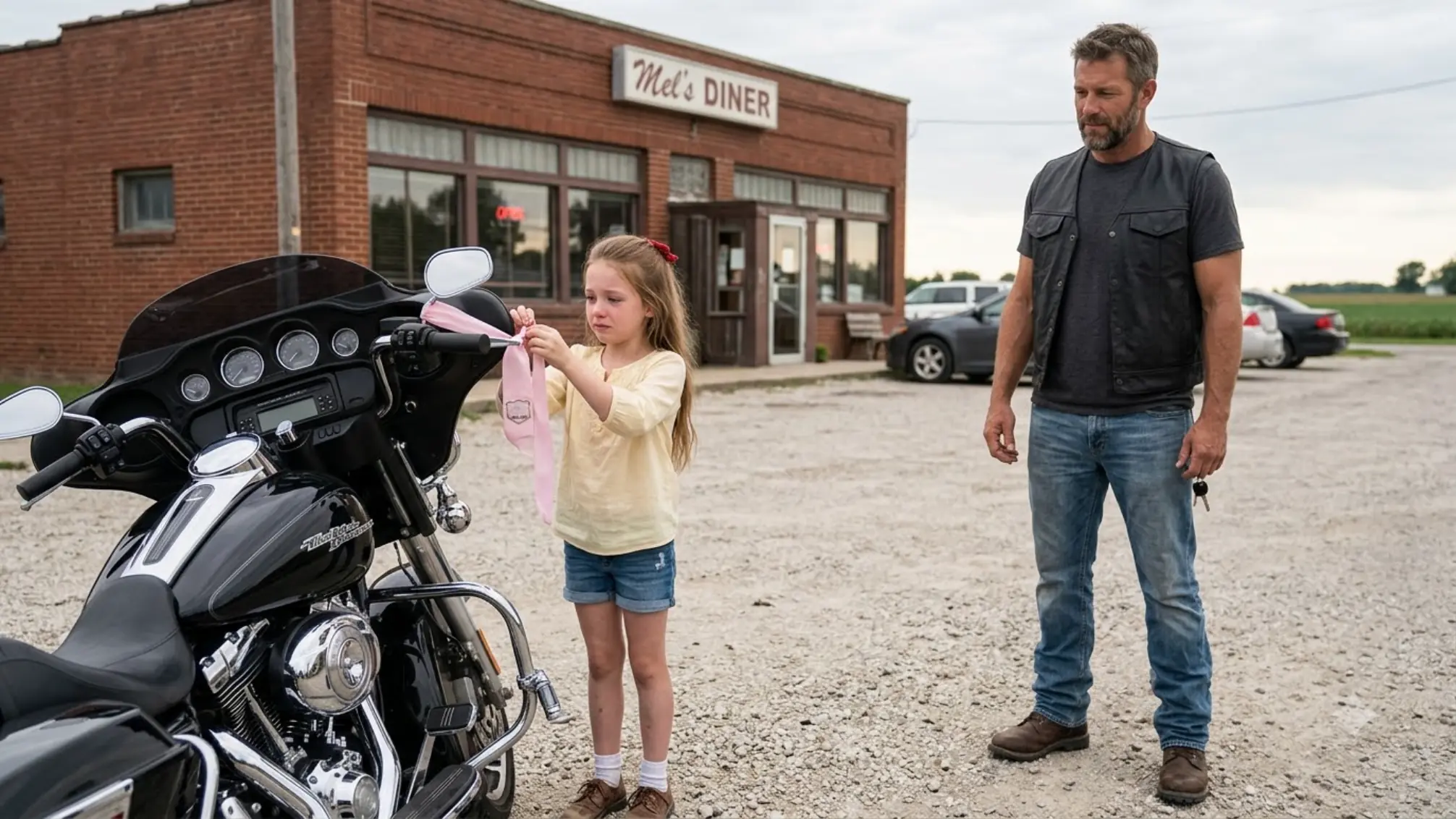
Daniel stopped several feet behind her.
He was forty-four, tall and broad-shouldered, with lightly tanned skin, kind blue-gray eyes, short salt-and-pepper hair, and a rugged beard. His faded jeans and brown riding boots were dusted from the highway, while a black leather vest rested over his charcoal shirt. The patches on the vest identified him as president of the Iron Harbor Riders, though the child seemed more interested in the motorcycle than the man approaching it.
“Why are you tying that ribbon to my mirror, sweetheart?” Daniel asked gently.
The girl’s hands froze.
She turned slowly, keeping one hand around the ribbon as though afraid he might remove it. Her blue eyes were wet, but she lifted her chin with quiet determination.
“My dad said bikers never leave a child alone.”
Daniel’s expression softened.
He walked closer but stopped at a respectful distance.
“Is someone leaving you alone today?”
The girl looked toward the empty road beyond the diner.
“Mom says we have to leave tonight,” she whispered. “But I hoped Dad’s brothers might still find me.”
The words landed heavily.
Daniel crouched beside the motorcycle so they were closer to the same height. Up close, he saw that the ribbon was not ordinary fabric. A faded emblem had been stitched near one end—a black lighthouse surrounded by silver wings.
It was the old symbol of the Iron Harbor Riders.
Daniel reached toward it but waited until the girl nodded before touching the fabric.
“Where did you get this?”
“It was in my dad’s jacket.”
“What was your father’s name?”
“Michael Cole.”
Daniel’s fingers went still.
For several seconds, the sounds around Mel’s Diner seemed to disappear. The passing cars, the hum of the neon sign, and the clatter from the kitchen faded beneath the name.
Michael Cole had ridden with Iron Harbor for nine years.
The club called him Lantern because he never allowed anyone to remain lost for long. If a rider broke down after midnight, Michael arrived with tools. If a family needed food, he left grocery bags on the porch without signing his name. When younger members became angry, Michael listened until they remembered what kind of men they wanted to be.
He had died three years earlier after a delivery truck crossed the center line on a rain-covered highway.
Daniel had attended the funeral with eighty-seven riders.
He remembered Michael’s widow standing beneath a black umbrella with a small girl holding her hand. The child had been five then, too young to understand why hundreds of adults spoke softly whenever they looked at her.
“Your name is Emma,” Daniel said.
The girl’s eyes widened.
“You knew my dad?”
“He was my brother.”
“You’re not his real brother.”
“No.” Daniel smiled sadly. “But sometimes people become family because they choose to keep showing up.”
Emma looked toward the pink ribbon.
“He told me if I ever needed help and couldn’t find anyone, I should tie this to a biker’s mirror.”
Daniel remembered the ribbon tradition.
Years earlier, Iron Harbor members carried narrow pink strips during a fundraiser for children receiving cancer treatment. Michael later told Emma that the ribbon meant a child needed someone strong to stop, listen, and help.
Daniel had assumed it was simply something kind Michael said to comfort his daughter.
Michael had meant it as a promise.
The diner door opened.
A woman hurried into the parking lot with fear across her face.
“Emma!”
The girl turned.
Her mother, Sarah Cole, rushed toward them wearing a faded blue blouse, dark jeans, and white sneakers. At thirty-five, Sarah still had the delicate features Daniel remembered from the funeral, but exhaustion had settled around her eyes. She grabbed Emma gently by both shoulders and checked her as if expecting to find an injury.
“I told you to wait inside.”
“I only came out for a minute.”
“You cannot walk away without telling me.”
“I found Dad’s brother.”
Sarah looked up at Daniel.
Recognition came slowly.
“Daniel Mercer?”
He stood.
“Yes.”
She looked at his vest and then at the ribbon tied to the mirror.
“Oh, Emma.”
“I wanted them to find us,” the girl said.
Sarah closed her eyes.
When she opened them again, embarrassment and fear had replaced surprise.
“I’m sorry. She found the ribbon while we were packing.”
Daniel looked toward the diner.
“Are you moving?”
Sarah placed one arm around her daughter.
“We’re handling it.”
“Tonight?”
“We have until six.”
Emma looked at Daniel.
“They’re taking our house.”
Sarah’s face tightened.
“Emma, please.”
Daniel did not press immediately. He had learned that helping someone did not begin by taking control of their story. He gestured toward the diner.
“Can I buy you both something to eat?”
“We don’t need charity.”
“I didn’t say charity. I said lunch.”
Emma looked hopefully at her mother.
Sarah hesitated, then nodded.
Inside, they took a booth near the window. Emma ordered grilled cheese and tomato soup, while Sarah asked only for coffee. Daniel ordered pie but barely touched it.
He waited until Emma was focused on dipping her sandwich into the soup.
“What happened to the house?” he asked quietly.
Sarah wrapped both hands around the coffee cup.
“After Michael died, the insurance covered most of the mortgage. I took over the remaining payments and kept working at the county clinic.”
“You were a medical receptionist.”
“I still am. Or I was.”
She explained that the clinic changed ownership six months earlier. Several employees lost their jobs, including Sarah. She found temporary work at a pharmacy, but the hours were irregular and the pay was lower.
Then the heating system failed during winter.
Repairs cost nearly everything she had saved.
Sarah missed two mortgage payments. The lender offered a short repayment plan, but late fees and legal costs grew quickly. By the time she found stable work at a dental office in another town, the foreclosure process had already advanced.
Daniel frowned.
“Where are you going tonight?”
“My sister has a small apartment in Cedar Falls. Emma and I can stay there for a while.”
“That’s almost three hours away.”
“Yes.”
“What about your furniture?”
“I rented a small trailer.”
Emma looked up.
“It has a broken light.”
Sarah forced a smile.
“We’re fixing it.”
Daniel’s phone felt heavy in his pocket.
Iron Harbor had a family assistance fund created after Michael’s death. The riders contributed during events, emergency repairs, and charity runs. Sarah had received help during the first year, but she gradually stopped attending gatherings.
Daniel assumed she wanted distance from the grief.
He never realized she had become too embarrassed to ask again.
“Why didn’t you call us?” he asked.
Sarah looked through the window.
“Because you already did enough.”
“That isn’t your decision alone.”
“You raised money after the funeral. You fixed the roof. You brought meals for months.”
“We promised Michael.”
“And I couldn’t become the widow who kept appearing whenever another bill arrived.”
Daniel leaned forward.
“You think Michael would have measured how many times you were allowed to need help?”
Sarah did not answer.
Emma spoke softly.
“Mom said Dad’s friends had their own families.”
Daniel looked at her.
“We do.”
“Then they’re busy.”
“Family is what keeps people busy.”
Sarah wiped quickly beneath one eye.
“We’re not asking anyone to save us.”
Daniel nodded.
“Then don’t ask.”
She looked at him.
“Let us decide what keeping our promise means.”
Outside the diner, Daniel photographed the ribbon tied to his mirror. He sent the image to a private group used by Iron Harbor’s regional chapters.
Beneath it, he wrote only four sentences.
Michael Cole’s daughter tied Lantern’s ribbon to my bike.
Sarah and Emma are losing their home at six tonight.
They need help moving safely to Cedar Falls.
Who can ride?
The first reply arrived in twelve seconds.
On my way.
Then another.
Bringing my truck.
I have boxes.
I can repair the trailer lights.
Lantern never left me stranded. Tell his girl we’re coming.
Daniel put the phone away before Sarah could ask what he had done.
They drove to the Cole house after lunch. It was a small white farmhouse outside town, surrounded by fields Michael had once rented to a neighboring farmer. A weathered porch stretched across the front, and several cardboard boxes sat beneath the windows.
The rented trailer waited beside Sarah’s old SUV.
One brake light was broken.
Its tires were dangerously worn.
Daniel crouched beside the nearest one.
“This trailer isn’t making it to Cedar Falls.”
“It’s the only one I could afford.”
“It may not survive the highway.”
Sarah folded her arms.
“We have to be gone by six.”
A black pickup turned onto the driveway.
Behind it came two motorcycles.
Then another truck.
Sarah looked at Daniel.
“What did you do?”
“I told the family where Emma was.”
The first rider removed his helmet.
Walter “Bear” Nolan had ridden beside Michael for most of those nine years. He was sixty-three now, with a gray beard extending across his chest and knees that complained whenever he climbed stairs. Yet he crossed the driveway faster than Daniel had seen him move in years.
Emma stood on the porch.
Bear stopped in front of her.
For a moment, neither spoke.
Then he lowered himself onto one knee and opened his arms.
Emma ran into them.
Bear held her tightly, his large hands trembling against her back.
“I’m sorry we took so long to find you,” he whispered.
More riders arrived.
They came in groups of three, five, and ten. Some rode motorcycles. Others drove pickups, vans, and flatbed trailers. A woman named Lisa Grant brought empty moving boxes from her hardware store. Two mechanics inspected Sarah’s SUV. A restaurant owner arrived with food and cold drinks.
No one waited for instructions.
They remembered Michael’s house.
They remembered where the heavy furniture stood, which tools belonged in the barn, and how Sarah liked the dishes wrapped. Riders who had not known Michael personally followed those who did.
By three o’clock, thirty-seven motorcycles lined the road.
By four, there were ninety.
Neighbors stood along their fences watching leather-vested men and women carry furniture carefully from the house. No one shouted or treated the move like a spectacle. They worked with the quiet coordination of people who understood that Sarah was not losing objects.
She was leaving the last home she had shared with her husband.
Emma stayed beside Daniel’s motorcycle.
The pink ribbon moved gently in the breeze.
A young rider named Mateo approached her with a small toolbox.
“Your father taught me how to fix my first bike,” he said.
Emma studied him.
“Was he patient?”
“No.”
She looked surprised.
Mateo smiled.
“He made me take the engine apart three times because I kept pretending I understood it.”
“Did you learn?”
“Yes.”
“Then maybe he was patient.”
Mateo laughed softly.
“Maybe.”
Inside the house, Sarah stood in the empty living room. Marks remained on the wall where family photographs had hung. The couch was gone, and the hardwood floor carried pale rectangles where furniture had protected it from sunlight.
Daniel stopped beside her.
“You okay?”
“No.”
“That’s allowed.”
She looked toward the window.
“I thought leaving quietly would make it easier.”
“Did it?”
“I didn’t want Emma to see me fail.”
Daniel turned toward her.
“Losing a job isn’t failure.”
“Losing her house feels like it.”
“You kept her safe for three years after losing Michael. You kept food on the table, worked every job you could find, and found another place before the locks changed.”
Sarah shook her head.
“Michael would have found a way to keep it.”
“Michael would have called us the first week.”
A reluctant smile appeared through her tears.
“He would have called Bear.”
“Then Bear would have told everyone.”
“He was terrible at secrets.”
“The worst.”
Sarah looked down.
“Is this really just about helping us move?”
Daniel knew what she was asking.
The number of riders had become too large for a simple move. Calls passed between chapters across Iowa, Missouri, Illinois, and Minnesota. Every rider who heard about the ribbon wanted to honor Michael.
But Daniel had also received a message from Iron Harbor’s legal adviser.
The foreclosure had not yet transferred full ownership. The bank scheduled the sale for the following week, but a reinstatement amount remained possible until midnight.
The amount was large.
Not impossible.
Daniel showed Sarah the message.
She read it twice.
“No.”
“We have enough in the family assistance fund to stop the sale.”
“That fund helps injured riders and families with emergencies.”
“You are a rider’s family in an emergency.”
“It’s too much money.”
“Michael helped create that fund.”
Sarah looked at him.
“What?”
Daniel nodded.
“The first fundraiser was his idea. He said nobody should have to choose between pride and keeping a roof over their children.”
She covered her mouth.
“He never told me.”
“He didn’t think doing good required a press release.”
The reinstatement amount included missed payments, fees, and legal expenses. Iron Harbor could cover most of it, but not all.
The remaining difference vanished as riders began making personal contributions.
Twenty dollars.
Fifty.
One hundred.
A retired rider donated the money he had saved for a fishing trip. A mechanic gave an entire week’s pay. Lisa contacted a local charity that matched part of the amount.
By five o’clock, they were less than two thousand dollars short.
Sarah stood on the porch looking at the motorcycles stretching down the road.
“How many people are here?” she asked.
Daniel checked the count being maintained by the road captain.
“One hundred sixty-eight.”
“All because Emma tied a ribbon?”
“No.”
“Then why?”
“Because Michael stopped for them first.”
The stories came one after another.
Michael had driven four hours to retrieve Bear after an engine failure.
He had paid Mateo’s rent without telling the club.
He sat beside Lisa in the hospital when her brother was injured.
He repaired a stranger’s wheelchair ramp after seeing the damaged boards during a charity delivery.
Michael had spent years leaving pieces of himself in other people’s lives. Now those people were returning them to his daughter.
At 5:24, two buses approached from the county road.
Behind them came dozens of motorcycles.
The final group had traveled from Chicago after receiving the message shortly after noon. Their road captain was a woman named Nora Hayes, who carried a small metal tin beneath her vest.
She parked, walked to Emma, and placed the tin in the child’s hands.
“Your father gave me this years ago,” Nora said.
Inside was a silver lighter engraved with the lighthouse emblem.
“I don’t smoke anymore,” she explained. “But I kept it because he stayed with me during the worst night of my life. He told me light doesn’t have to be big to show someone the road.”
Emma held it carefully.
“What happened that night?”
“I had decided nobody needed me.”
“Dad needed you?”
“He convinced me that my children did.”
Nora looked toward the house.
“I wanted you to know your father didn’t only fix motorcycles.”
The count reached two hundred twenty-two riders at 5:41.
The final donation closed the remaining gap.
Daniel called the lender with Sarah beside him. Iron Harbor’s attorney joined the call and transferred the reinstatement funds into the required account. The representative confirmed that the foreclosure action would be suspended once the payment cleared.
Sarah gripped the porch railing.
“Does that mean we can stay?”
The attorney’s voice came through Daniel’s speaker.
“It means the sale is stopped. The missed amount is current. We still need to restructure the future payments based on your new job, but you are not losing the house tonight.”
Emma looked from Daniel to her mother.
“We don’t have to leave?”
Sarah fell to her knees and pulled her daughter into her arms.
“No, baby.”
The riders surrounding the property became completely silent.
Emma began crying first.
Sarah followed.
Bear turned away and pretended to examine the road.
Daniel looked at the motorcycle mirror where the pink ribbon remained tied.
The moving boxes did not return inside immediately. Sarah needed time to believe the house truly remained hers. The riders waited, ate sandwiches, repaired the trailer anyway, and sat in small groups across the yard.
Near sunset, Emma walked to Daniel.
“You said bikers keep showing up.”
“We try.”
“Will they leave now?”
“Eventually.”
“Will they come back?”
Daniel smiled.
“Try stopping them.”
The following morning, the riders formed two long lines along the county road. Not because Sarah was leaving, but because Emma had asked to ride past the cemetery where Michael was buried.
She sat inside Bear’s pickup with her mother, holding the pink ribbon and the engraved lighter. Daniel led on his motorcycle.
Two hundred twenty-two bikes followed.
The procession moved slowly through town. People stepped outside stores and houses, drawn by the deep rolling sound of engines. Some assumed it was a funeral until they saw Emma waving from the truck window.
At the cemetery, the riders parked along the gravel lane.
Emma walked between the headstones holding her mother’s hand. She stopped before Michael’s grave and placed the pink ribbon across the top.
“We found them, Dad,” she whispered.
Daniel stood several feet behind her with Bear and Nora.
Sarah knelt beside the grave.
“You kept your promise,” she said.
Emma shook her head.
“No. They kept his.”
The story spread through local newspapers and motorcycle communities. Reporters focused on the number of riders, but Daniel refused to describe the gathering as a rescue performed by heroes.
“No one saved Sarah and Emma alone,” he explained. “A child asked for help. People listened. That should not be extraordinary.”
Iron Harbor helped Sarah renegotiate the remaining mortgage into a sustainable payment plan. The dental office increased her hours after learning she had nearly lost her home. Riders repaired the heating system properly, repainted the porch, and replaced the aging roof the following spring.
They never arrived without calling.
Except Bear.
Bear insisted family did not need appointments, though Sarah eventually trained him to text first.
Emma kept the ribbon tradition.
Whenever Iron Harbor held a charity ride for children, pink ribbons appeared on every motorcycle mirror. Riders received a simple instruction: if a child tied one on your bike, stop and listen before doing anything else.
Years later, Emma became old enough to understand that two hundred twenty-two people had not arrived because leather vests made them brave.
They came because her father had made kindness a habit.
At sixteen, she learned to ride on a small motorcycle Daniel restored with parts from Michael’s workshop. Sarah watched nervously from the driveway while Bear gave contradictory advice and Daniel repeatedly told him to be quiet.
Before Emma started the engine, she tied a faded pink ribbon to the mirror.
Daniel noticed.
“You still carry that?”
“Always.”
“You don’t need to use it today.”
“I know.”
“Then why tie it?”
Emma looked toward the house her mother had nearly lost.
“Because sometimes the ribbon doesn’t mean I’m alone.”
“What does it mean?”
“It means I remember who came.”
She pulled on her helmet.
The engine started softly.
Daniel rode beside her during the first slow trip down the road. Behind them waited a smaller group than the one that had gathered years earlier, but enough motorcycles still stood in the driveway to make Sarah shake her head.
Emma did not need two hundred twenty-two riders every day.
She only needed to know they would answer.
On the afternoon she tied the first ribbon to Daniel’s mirror, she believed her father’s brothers had forgotten her. She did not understand that grief had separated people who all thought the others needed space.
The pink fabric repaired that silence.
It called them back.
Michael Cole had once told his daughter that bikers never left a child alone. He could not know how many engines would answer when she finally tested that promise.
Two hundred twenty-two riders came for Emma.
Not because she belonged to a powerful club.
Because one little girl stood beside a motorcycle, tied a ribbon with trembling hands, and trusted that someone kind would stop.