The late-afternoon sun stretched long golden shadows across the parking lot of a roadside diner just off Highway 40. Inside, families occupied red vinyl booths while the smell of fried chicken, biscuits, and fresh coffee drifted through the warm room. Plates clinked, children whispered over milkshakes, and an old country song played softly above the counter.
Then the motorcycles arrived.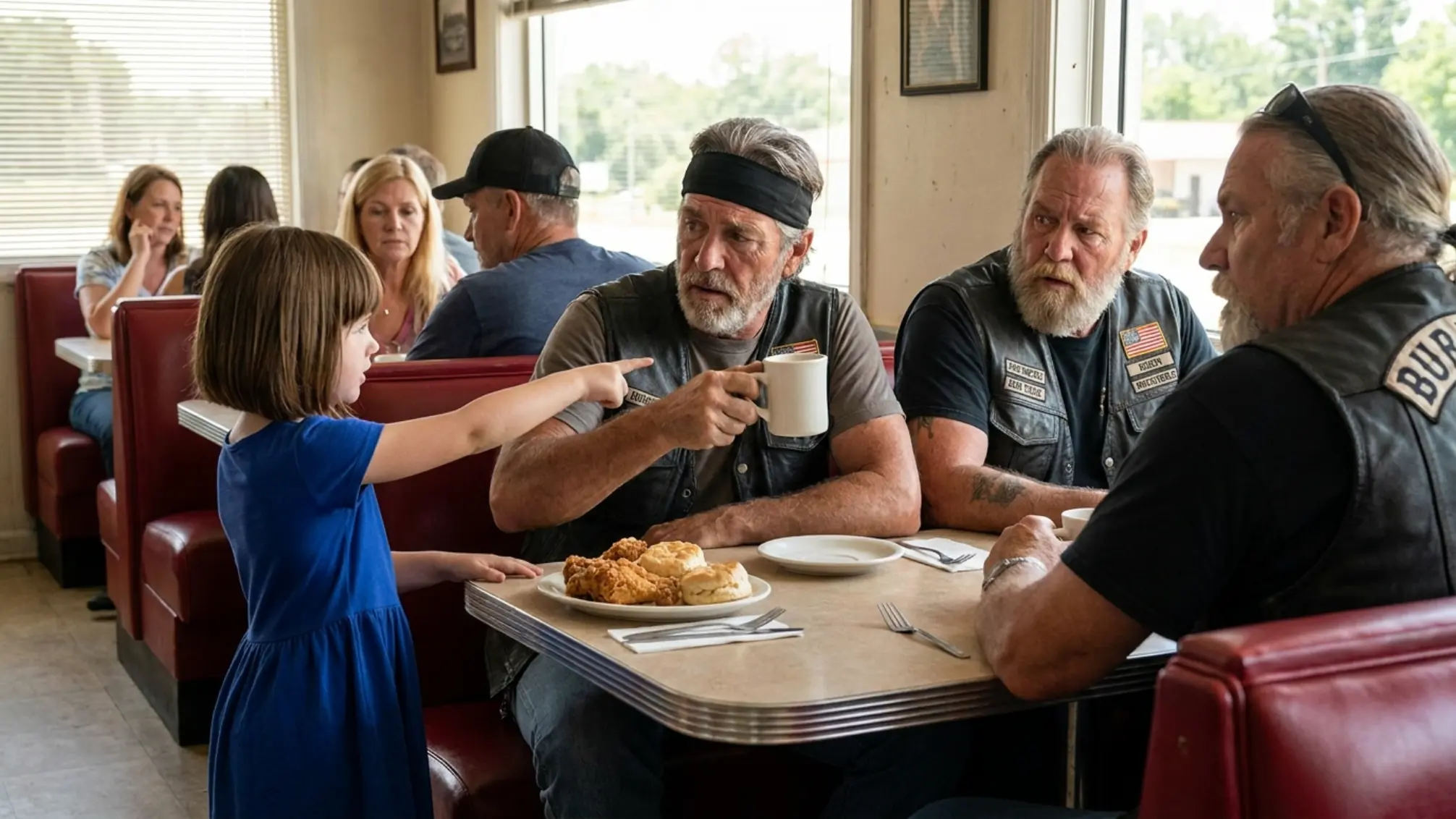
The sound began as a distant rumble and grew until the diner windows vibrated in their frames. Conversations stopped. Forks paused halfway to mouths as six enormous motorcycles rolled into the parking lot, chrome flashing beneath the sinking sun.
The riders dismounted with the practiced movements of men who had spent decades on the road. Their weathered faces, tattooed arms, heavy boots, and black leather vests created an immediate wave of unease inside the diner. Several parents drew their children closer, while the hostess tightened her grip on the menus in her hands.
At the front of the group walked Connor Riley, though almost nobody called him Connor anymore.
On the road, he was known as Ghost.
He was fifty-eight, broad-shouldered, with swept-back brown hair streaked heavily with gray and a thick salt-and-pepper beard. A black headband crossed his forehead, and the sleeveless leather vest over his dark shirt carried faded patches from thousands of miles and more losses than he cared to count.
Ghost noticed the fear in the room the moment he entered.
He was accustomed to it.
People saw the leather first, then the tattoos, then the size of the men walking beside him. They rarely waited long enough to discover that the riders had spent that morning delivering supplies to a family whose house had burned down.
Ghost did not blame the diners for their caution. Some reputations were earned, others inherited, and a few simply clung to a man until he stopped trying to remove them.
The hostess approached with a professional smile that trembled at its edges.
“Welcome,” she said. “How many?”
“Six,” Ghost replied gently. “A booth near the back is fine.”
His calm voice seemed to surprise her.
She guided the men toward two neighboring booths. Ghost sat facing the room, as he always did, while two of his oldest companions joined him at the first table.
To his right sat Ray “Iron” Maddox, a bald, muscular man with a scar cutting diagonally across one cheek. To his left sat Samuel Knox, a broad gray-bearded rider whose white hair was held back by a black headband.
They ordered black coffee and whatever food the kitchen could serve quickly.
The room gradually resumed its conversations, though voices remained lower than before. Customers continued glancing toward the bikers, careful not to hold eye contact for too long.
Only one person watched them without fear.
Seven-year-old Emma Chen sat in a booth across the diner with her grandmother. She had fair skin, wide blue eyes, and a neat brown bob that curved beneath her chin. Her bright royal-blue dress made her look like a splash of summer color against the dark red seat.
Emma had barely touched the fried chicken on her plate.
Her attention remained fixed on Ghost’s exposed forearm.
There, among several older tattoos, was the image of a phoenix rising through orange flames, its wings wrapped partly in broken chains. The ink had faded with time, but the pattern remained intricate and unmistakable.
Emma had seen the same bird before.
Not on television.
Not in a book.
On her mother’s shoulder.
“Sit down, sweetheart,” her grandmother whispered when Emma slid toward the edge of the booth.
“I just need to ask him something.”
“You do not need to ask that man anything.”
“But Grandma—”
“Emma.”
The girl stared at the phoenix again.
Her mother, Lisa, kept her tattoo hidden beneath sleeves and nursing uniforms. Emma had seen it only once, two summers earlier, when Lisa was changing after swimming.
When Emma asked about it, her mother pulled on a shirt quickly and said the tattoo belonged to a life she had left behind.
She refused to explain more.
Now the same burning bird rested on the arm of a stranger.
Before her grandmother could stop her, Emma slipped from the booth.
“Emma, come back here.”
The little girl crossed the diner.
Several customers noticed and went silent again. Emma’s grandmother rose halfway from her seat, her face draining of color as her granddaughter walked directly toward three intimidating men.
Emma stopped beside Ghost’s table.
Ray saw her first.
His eyes shifted toward the child, and Samuel followed his gaze. Their conversation stopped.
Ghost turned slowly.
Emma barely reached the table’s edge, but she stood straight and looked into his eyes as though approaching strangers in leather vests was the most ordinary thing in the world.
“Hello, sir,” she said.
Ghost glanced around, wondering whether she had mistaken him for someone else.
“Hello, sweetheart.”
Emma pointed toward his forearm.
“My mother has a phoenix exactly like yours.”
Ghost’s expression froze.
Ray’s coffee cup stopped an inch above the table. Samuel leaned forward, his eyes fixed on the child.
Across the diner, Emma’s grandmother covered her mouth.
Ghost looked down at the tattoo.
The phoenix was not merely decorative. Twelve riders had received versions of it nearly two decades earlier after surviving a night that changed them all.
Only one woman had worn the design on her shoulder.
Ghost slowly set down his coffee.
“What is your mother’s name, sweetheart?”
“Lisa Chen.”
The tension in his face softened for only an instant.
Emma continued proudly, “But her name used to be Lisa Martinez before she married my father.”
Ray released a quiet breath.
Samuel whispered, “Firebird.”
Ghost’s eyes returned to Emma’s face.
He noticed the shape of her eyebrows, the slight dimple in her left cheek, and the fearless way she held his gaze.
He had seen those things before.
Fifteen years earlier.
“Does your mother work at a hospital?” he asked.
Emma nodded eagerly. “She’s a nurse. She helps people at night, and Grandma watches me until she comes home.”
“Does she still have dark curly hair?”
“Yes, but she straightens it sometimes.”
Ghost looked away briefly.
For years, he had wondered what happened to Lisa Martinez after she left the riders without a farewell. Some believed she had moved west. Others thought she wanted every trace of her old life erased.
Ghost knew only that she had made him promise not to follow.
Emma leaned closer.
“She cries whenever I ask her about the road.”
The words entered Ghost like a blade.
He rested both hands on the table, keeping his voice gentle.
“What does she say?”
“She says some people were her family before I was born. She says they saved her when she was lost, but she had to leave them so she could become my mom.”
Ghost swallowed.
Ray stared down at his coffee. Samuel rubbed one thumb across the edge of the table, his weathered face suddenly heavy with memory.
Emma’s grandmother hurried toward them.
“I am so sorry,” she said, taking the girl’s shoulder. “Emma does not understand when she is being inappropriate.”
Ghost raised one hand, but not threateningly.
“She hasn’t done anything wrong.”
The older woman pulled Emma closer. “We should return to our table.”
Ghost studied her face.
“You must be Mrs. Chen.”
Her expression hardened. “How do you know that?”
“Emma told me her mother’s name.”
The grandmother’s eyes moved toward his tattoo, then toward the men around him.
Recognition did not reach her, but resentment did.
“You knew Lisa.”
Ghost nodded.
“A long time ago.”
Mrs. Chen’s grip tightened on Emma’s shoulder.
“You people were the reason she nearly ruined her life.”
The diner went silent for the third time.
Ghost did not defend himself immediately.
Mrs. Chen continued, her voice low but sharp. “She disappeared for two years. She came home angry, covered in tattoos, and unwilling to tell us where she had been. It took years for her to become stable again.”
Ray shifted uncomfortably, but Ghost remained still.
“You have every right to be angry,” he said.
“That is not an apology.”
“No. It’s the truth.”
Mrs. Chen looked prepared to leave, but Ghost’s next words stopped her.
“Your daughter saved three lives while she rode with us.”
The grandmother stared at him.
Ghost gestured toward the empty seat beside the booth.
“You do not have to sit down, but please let me tell you what she never did.”
Mrs. Chen remained standing.
Emma, however, looked up at her grandmother with pleading eyes.
“Please.”
The older woman reluctantly released the child’s shoulder but stayed close enough to pull her away if necessary.
Ghost leaned back.
“Lisa came to us when she was twenty-two,” he began. “She was frightened, furious, and convinced she had nowhere else to go.”
Mrs. Chen’s eyes narrowed. “She had a home.”
“She did not believe she could return to it.”
“That was her choice.”
“Yes.”
Ghost did not argue.
“Lisa called herself Firebird because she wanted to believe a person could burn down one life and rise into another. She was reckless at first. Too brave for her own good. But underneath all that anger was a woman who could not walk away when somebody needed help.”
Emma climbed onto the empty edge of the booth.
Mrs. Chen started to stop her, then changed her mind.
Ghost looked at the little girl.
“Your mother once pulled a man from a burning motorcycle wreck.”
Emma’s eyes widened.
“Really?”
“We were riding through Arizona when another rider lost control on loose gravel. His fuel tank ruptured. Before the rest of us stopped, your mother was already running through the flames.”
Ray touched the scar across his cheek.
“That man was me,” he said.
Emma turned toward him.
“You?”
Ray nodded. “I would not be sitting here without her.”
Ghost continued. “Another time, one of our brothers lost his wife and decided he did not want to live anymore. Lisa stayed with him for eleven hours. She refused to leave until he handed her the weapon.”
Samuel looked toward the window.
“That was my younger brother,” he said quietly. “He is still alive. He has grandchildren now.”
Mrs. Chen’s expression began to change.
Ghost lowered his voice.
“The third life belonged to a six-year-old girl with leukemia. Lisa learned she was a match and donated bone marrow without telling anyone except the doctor. She spent weeks recovering and insisted we never make a fuss.”
Emma looked toward her grandmother. “Mom saved a little girl?”
Mrs. Chen’s eyes were moist now, though she blinked quickly.
“She never told me.”
“She was not proud of every choice she made with us,” Ghost said. “But she should have been proud of that.”
For several moments, nobody spoke.
The waitress arrived with the bikers’ meals, noticed the tension, and placed the plates down carefully before retreating.
Emma pointed toward the phoenix again.
“Why did Mom get that tattoo?”
Ghost studied the image.
“Because twelve of us survived a very difficult year. We lost people we loved. We made mistakes. We hurt each other. The phoenix reminded us that we could choose what came next.”
“Were you one of her brothers?”
The question cracked something in Ghost’s expression.
“Maybe,” he said. “Once.”
“Do you miss her?”
Ghost glanced toward Ray and Samuel.
“Every day.”
Mrs. Chen looked at him more carefully now.
“If you cared so much, why did you let her disappear?”
Ghost’s gaze dropped.
“Because I was the one who told her to leave.”
Emma frowned. “Why?”
“Because your mother wanted a home, a family, and a life where she did not have to wonder whether the people she loved would return safely every night. The road could not promise her that.”
Mrs. Chen’s voice softened despite herself. “She listened to you?”
“Eventually.”
Ghost remembered their final conversation with painful clarity.
Lisa stood beside her motorcycle outside a desert motel at dawn. Her dark curls were tangled by the wind, and tears streaked the dust on her cheeks.
She accused him of throwing her away.
He told her he was setting her free.
Lisa said the riders were the only family who had ever accepted her as she was. Ghost reminded her that acceptance did not mean keeping someone trapped in a life they had outgrown.
In the end, he made her promise to leave without looking back.
Ghost believed she would return after a few weeks.
She never did.
“I thought she hated me,” he admitted.
Emma shook her head. “Mom doesn’t hate you.”
“How do you know?”
“She keeps an old picture in a box under her bed.”
Mrs. Chen looked down sharply. “Emma.”
“It has Mom on a motorcycle with three men. One of them looks like him, only younger.”
Ghost reached into the inner pocket of his vest.
He removed a faded photograph protected inside a clear sleeve.
Emma leaned closer.
The picture showed a younger Ghost beside a black motorcycle. Lisa Martinez stood next to him wearing a leather jacket, her curly hair flying in the wind and a fearless grin across her face.
Ray and Samuel appeared behind them.
Emma gasped. “That’s the picture.”
Ghost held it carefully between both hands.
“She kept one?”
Emma nodded. “She looks at it when she thinks I’m asleep.”
Ghost’s jaw tightened as emotion rose in his face.
He slid the photograph back into the vest and removed a business card.
“This is my number.”
He placed it on the table before Mrs. Chen.
“I would like to speak with Lisa, but only if she chooses to call. I will not appear at her home or her hospital. I will not disturb the life she built.”
Mrs. Chen stared at the card.
Ghost continued, “Tell her the phoenix rises from the ashes.”
Emma grinned. “That sounds cool.”
“She’ll understand it.”
Mrs. Chen picked up the card with trembling fingers.
“You truly mean her no harm?”
Ghost looked directly at her.
“Lisa Martinez was family. Lisa Chen still is, even if she never wants to see us again.”
Emma slid down from the booth.
“Will you tell me stories about when my mom rode motorcycles?”
Ghost’s face softened.
“Only if she says it’s all right.”
The girl hugged him before anyone could react.
Ghost’s arms remained frozen for a second. Then he gently rested one hand against her back.
When Emma stepped away, his eyes were wet.
Mrs. Chen led her toward their booth.
The bikers finished eating quietly.
The diner’s atmosphere had changed. Customers no longer stared with suspicion. A few glanced toward Ghost with curiosity, while an elderly man near the counter gave him a small nod.
When the riders stood to leave, Ghost placed enough money on the table to cover every meal in their section.
He paused beside Emma’s booth.
“Take care of your mother,” he told her.
“I do.”
“I believe you.”
Outside, the motorcycles started one after another. Emma pressed both hands against the diner window as the men rode into the fading light.
Ghost looked back once.
The little girl waved.
He raised one hand before disappearing down the highway.
That evening, Lisa Chen returned home after a twelve-hour shift at St. Matthew’s Hospital.
At thirty-seven, she had become known as one of the emergency department’s calmest nurses. She could steady frightened families, comfort injured children, and make difficult decisions without allowing panic to control her.
But when she entered her mother’s house and saw the expression waiting for her, calmness abandoned her.
“What happened?”
Mrs. Chen stood in the kitchen holding the business card.
Emma rushed from the hallway.
“Mom, I met your biker brothers.”
Lisa stopped moving.
The keys slipped from her hand and struck the floor.
“What did you say?”
“A man had your bird tattoo,” Emma explained. “His name is Ghost. He showed me your picture.”
Lisa’s face turned white.
Her hand rose instinctively toward her left shoulder, where the phoenix remained hidden beneath her navy scrubs.
“Connor was here?”
Her voice barely carried across the room.
Mrs. Chen held out the card.
“He said to tell you the phoenix rises from the ashes.”
Lisa took it.
The embossed name read:
Connor Riley
Desert Riders Community Foundation
Beneath it was a telephone number.
Lisa lowered herself into a chair.
For fifteen years, she had tried to divide her life into two clean sections.
Before Emma.
After Emma.
Before nursing.
After nursing.
Before she became dependable, respectable, and safe.
After she stopped being Firebird.
But the tattoo had never disappeared, and neither had the memories.
Her mother sat across from her.
“He told me what you did.”
Lisa stared at the card.
“What did he say?”
“That you pulled a man from a burning wreck. That you prevented another from taking his own life. That you donated bone marrow to a child.”
Lisa’s eyes filled with tears.
“Mom—”
“Why didn’t you tell me?”
“Because you hated that part of my life.”
“I hated what I imagined.”
“You never asked what actually happened.”
Mrs. Chen absorbed the accusation in silence.
Lisa covered her face with both hands.
“When I came home, I was ashamed. Not of them. Of myself. I had frightened you, disappeared, and made choices I could not explain. I thought the only way to become the daughter you wanted was to bury every person I had been.”
Emma climbed onto her lap.
“Were you bad?”
Lisa pulled the girl close.
“No, baby. I was lost.”
“Did Ghost find you?”
Lisa glanced at the business card.
“In a way.”
Mrs. Chen’s voice became quiet. “He said he told you to leave.”
A sad smile touched Lisa’s mouth.
“Connor knew before I did that I wanted a different life.”
She remembered the morning Ghost stood between her and the open highway.
Lisa had been twenty-two, stubborn, angry, and terrified that returning home meant admitting failure. Ghost told her leaving was not surrender. He told her courage sometimes meant walking away from the only family that understood her.
She accused him of not loving her enough to ask her to stay.
He said he loved her enough not to.
“I hated him for months,” Lisa whispered. “Then I realized he had given me permission to become someone new.”
Mrs. Chen reached across the table and touched her daughter’s hand.
“I thought they had taken you away from us.”
“They were the people who kept me alive until I was ready to come home.”
Emma leaned against her mother’s chest.
“Are you going to call him?”
Lisa looked at the number.
“I don’t know.”
That night, after Emma fell asleep, Lisa carried the business card into her kitchen. She placed it beside her phone, then walked away.
Five minutes later, she returned.
She poured coffee she did not drink. She opened the refrigerator without seeing anything inside. Finally, she went to her bedroom and pulled an old wooden box from beneath the bed.
Inside lay several objects from the life she had hidden.
A folded bandanna.
A silver ring engraved with a phoenix.
A photograph of four riders beside a desert highway.
And a letter Ghost had written the day she left.
Lisa unfolded it.
Firebird, the road gave you back to yourself. Do not confuse gratitude with obligation. You are allowed to want more than survival. Build something the road cannot give you. And when you do, do not apologize for leaving us behind.
She pressed the letter against her lips.
Then she dialed.
The phone rang twice.
“This is Ghost.”
Lisa closed her eyes.
“The phoenix remembers,” she whispered. “Even after the ashes scatter.”
Silence answered her.
Then Ghost released a rough, broken breath.
“Firebird.”
The old name nearly undid her.
“I cannot believe it’s you,” he said.
“I heard you met my daughter.”
“She is braver than most men I know.”
“She gets that from me.”
Ghost laughed softly.
It was the same laugh she remembered from desert camps, gas stations at dawn, and long nights beneath open skies.
They talked for three hours.
At first, they moved cautiously around the past. Ghost told her who had married, who had retired, and who had died. Lisa told him about nursing school, her failed marriage, and raising Emma with help from her mother.
Then the barriers fell.
They remembered the wreck that nearly killed Ray. They remembered Samuel’s younger brother sitting on a motel floor while Lisa refused to leave him. They remembered the little girl in the hospital whose mother cried when Lisa agreed to donate marrow.
Ghost confessed that he had driven to Lisa’s hometown twice during the year after she left.
He never approached the house.
“I thought seeing me would pull you backward,” he said.
“You could have called.”
“You made me promise not to.”
“I was angry.”
“I knew.”
“You always listened at the worst possible time.”
“That kept me alive.”
Near midnight, Lisa asked the question she had carried for fifteen years.
“Why did you never replace my patch?”
Ghost became quiet.
“Because some places in a family are not vacancies.”
Lisa wiped tears from her face.
A week later, Ghost, Ray, and Samuel came to dinner.
Mrs. Chen opened the door with visible nervousness, but she invited them inside. The three enormous men looked almost comical standing in the small suburban entryway carrying flowers, a bakery pie, and a gift wrapped in bright paper for Emma.
Lisa waited in the living room.
For several seconds, she and Ghost only stared at each other.
Time had changed them both.
His beard had grayed. Lines deepened around his eyes. Lisa’s dark hair was shorter, and the leather jacket he remembered had been replaced by a soft blue blouse.
Yet Ghost recognized her immediately.
“Firebird.”
Lisa crossed the room and wrapped her arms around him.
Ghost held her as though protecting something returned after a lifetime.
Ray looked away to hide his tears. Samuel made no attempt to hide his.
Emma watched from the stairs, smiling.
During dinner, the bikers told stories Lisa had never shared. They described her racing thunderstorms through New Mexico, repairing a motorcycle with borrowed tools, and standing between two furious men twice her size until they stopped fighting.
Emma listened with shining eyes.
“My mom did all that?”
Ghost nodded. “Your mother was a legend.”
Lisa groaned. “Do not encourage her.”
After dinner, Ghost gave Emma the wrapped package.
Inside was a child-sized denim jacket. A small embroidered phoenix appeared on the back, surrounded not by fire and chains but by flowers.
Emma hugged it.
“Does this make me a biker?”
“It makes you the daughter of one.”
Lisa watched Ghost kneel beside the girl.
“Your mother is one of the bravest people I have ever known,” he told Emma. “Not because she rode fast or stood up to dangerous men. She was brave because she knew when to build a different life.”
Emma looked toward Lisa.
“Mom says she was lost.”
Ghost smiled. “She was finding the road home.”
Mrs. Chen stood near the kitchen doorway, listening.
Before the men left, she approached Ghost.
“I judged all of you without knowing what you had done for her.”
Ghost shook his head. “You saw your daughter hurting. You wanted someone to blame.”
“I blamed the wrong people.”
“We were not saints.”
“No,” she said. “But you were her family.”
Ghost glanced toward Lisa.
“We still are, when she wants us.”
Lisa took her mother’s hand.
“I want both.”
Outside, the three motorcycles waited beneath the porch light.
Ghost embraced Lisa one final time.
“You built the life you wanted.”
“I did.”
“Are you happy?”
Lisa looked through the doorway at Emma wearing her phoenix jacket while her grandmother adjusted the sleeves.
“Yes.”
Ghost nodded, though an old sadness remained in his eyes.
Lisa touched his arm.
“You did not lose me, Connor.”
He looked at her.
“You helped me become someone who could come back.”
The riders mounted their motorcycles.
Emma and Lisa stood on the porch as the engines started. Mrs. Chen joined them, one arm around her daughter and the other resting on her granddaughter’s shoulder.
The motorcycles disappeared into the darkness.
But the connection did not disappear again.
In the months that followed, Ghost’s community foundation partnered with Lisa’s hospital to support children injured in accidents. Ray began visiting trauma patients recovering from burns. Samuel volunteered with a crisis-support group for families facing grief.
Lisa never returned permanently to the road.
She did not need to.
She occasionally joined the riders for charity events, wearing a simple leather jacket over her clothes. Her phoenix tattoo was no longer hidden out of shame.
Emma loved hearing people call her mother Firebird.
Years later, when asked why she had approached three frightening strangers in a diner, Emma always gave the same answer.
“They were not strangers. I recognized my mother’s story on his arm.”
A child’s innocent observation had done what fifteen years of regret could not.
It connected a nurse to the fearless young woman she once had been.
It allowed a mother to understand the daughter she had misjudged.
And it reminded an aging biker that the family he believed he had lost had never truly forgotten him.
The phoenix tattoo was not a mark of Lisa’s worst years.
It was proof that she had survived them.
She had risen from one life, built another, and finally understood that she did not have to destroy her past to deserve her future.
She could be Lisa and Firebird.
The nurse and the rider.
The mother who created a safe home and the young woman who once found freedom on an open highway.
The road had not defined her.
But it had helped lead her home.