The afternoon had been quiet until the motorcycles arrived.
Four Harley engines rolled down the suburban street with enough force to make windows tremble and curtains shift. Neighbors who had been watering lawns or carrying groceries stopped to watch as the riders slowed near a faded apartment complex. At the edge of the sidewalk, however, six-year-old Mira Parker did not run inside.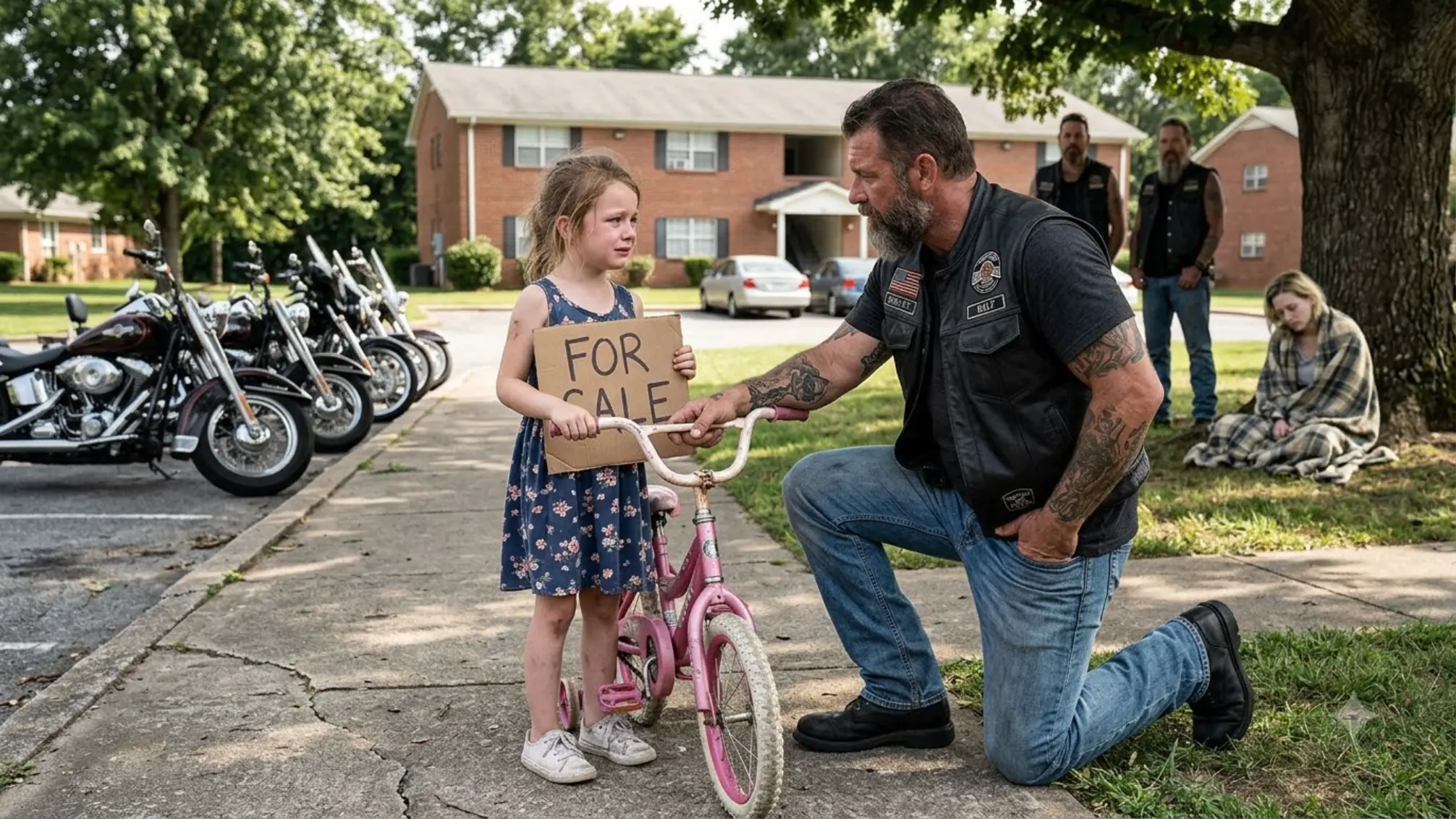
She stood beside a tiny pink bicycle.
A white plastic basket was attached to the handlebars, one training wheel sat slightly crooked, and faded ribbons fluttered from the grips. Mira wore a navy-blue floral dress that had been washed so many times the flowers were beginning to disappear. Her light-brown hair was tangled around her face, and both hands held a piece of cardboard with two carefully written words.
FOR SALE.
The first biker slowed.
His name was Ryder Mason, though most of the men riding with him called him Wolf. At forty-eight, Ryder had broad shoulders, tattooed arms, a salt-and-pepper beard, and the kind of weathered face that often caused strangers to move out of his way before he had said anything.
He shut off his motorcycle.
The three riders behind him did the same.
Mira looked toward them but did not move.
Ryder climbed from his bike and approached slowly.
“Selling your bicycle?”
Mira nodded.
“How much?”
She looked down at the cardboard sign.
“I don’t know.”
Ryder crouched until their eyes were level.
“You don’t know what you want for it?”
Her small fingers tightened around the sign.
“Enough for food.”
Behind Ryder, Tank, Viper, and Mason Cole stopped smiling.
Ryder looked at the bicycle again.
It was not new.
The seat had a tear near one corner.
One pedal was scratched.
But judging by the way Mira kept glancing at it, Ryder suspected it was the most valuable thing she owned.
“Food for you?”
Mira shook her head.
“For Mommy.”
Ryder’s expression changed.
“Where is your mom?”
Mira pointed toward a large tree beside the apartment building.
A woman sat beneath it wrapped in an old blanket.
Even from the sidewalk, Ryder could see how pale she looked.
Mira lowered her voice.
“Mommy hasn’t eaten in two days.”
Tank muttered something under his breath.
Ryder slowly turned back toward Mira.
For several seconds he said nothing.
Then he rested one large hand on the bicycle handlebar.
“No, sweetheart.”
Mira’s face fell.
“You don’t want it?”
“That isn’t what I said.”
He carefully folded her fingers back around the handlebars.
“You keep your bike.”
“But I need money.”
“A little girl shouldn’t have to sell her happiness to buy her mother dinner.”
Mira’s eyes filled.
“But I don’t have anything else to give.”
Ryder felt those words somewhere deep in his chest.
His own son, Michael, had once owned a red bicycle.
Michael had been eleven when Ryder bought it secondhand and rebuilt it in his garage. The boy had ridden it until the tires were nearly bald.
Michael never reached adulthood.
Ryder had spent years avoiding children’s bicycles after that.
Now he looked at Mira.
“Then give me one thing instead.”
She wiped one eye.
“What?”
“Go hug your mom and tell her she doesn’t have to carry this alone anymore.”
Mira stared at him.
Ryder removed his wallet.
He gave her several bills.
Her eyes widened.
“I can’t.”
“Yes, you can.”
“That’s too much.”
“Then buy too much food.”
Tank laughed softly behind him.
Mira still looked uncertain.
Ryder pointed toward the tree.
“Go.”
She dropped the sign.
Then she ran.
The pink bicycle remained standing on the sidewalk as Mira crossed the grass and threw both arms around her mother.
The woman jerked awake.
Ryder saw Mira place the money in her hand.
Then the mother looked toward the bikers.
Fear crossed her face immediately.
Ryder understood.
Four tattooed men had just arrived beside her child.
He raised both hands slightly.
“No trouble.”
The woman tried standing.
Her knees nearly failed.
Ryder moved instinctively, but stopped several feet away so he would not frighten her.
Mira held her mother’s arm.
“Mommy, he bought food.”
The woman looked at the money.
Then at the bicycle.
“You sold it?”
“No.”
Mira smiled.
“He said I’m keeping it.”
The woman’s eyes filled.
Ryder approached slowly.
“I’m Ryder.”
“Clara.”
Her voice was weak.
“Clara Parker.”
“You sick?”
She shook her head.
“Just tired.”
“When did you eat?”
Clara looked away.
Mira answered.
“Tuesday.”
It was Thursday.
Ryder’s jaw tightened.
Tank walked toward the motorcycles.
“I’ll get food.”
Viper followed.
“Me too.”
Ryder looked toward Clara.
“You live here?”
Clara glanced toward the apartment building.
“Not anymore.”
That answer explained the blanket.
The cardboard box beside the tree.
The plastic grocery bags containing clothes.
Ryder sat on the grass several feet away.
“What happened?”
Clara hesitated.
“You don’t owe me the story.”
She studied him.
“Then why ask?”
“Because somebody reduced your life to a woman sitting under a tree while her six-year-old tries selling her bicycle.”
His voice remained gentle.
“I’d like to know how.”
Clara looked toward Mira.
For weeks she had swallowed the story because explaining it made the failure feel more permanent.
That afternoon, perhaps because Ryder had already seen the worst part, she finally spoke.
She had worked at a catering company for five years.
The owner was Charles Hensley, a wealthy businessman whose photograph appeared regularly in local newspapers beside charity checks and community awards.
When business slowed, Hensley reduced staff.
Clara was one of the employees dismissed.
“I asked him for two weeks.”
Ryder frowned.
“Two weeks?”
“So I could find something else.”
“What’d he say?”
Clara looked toward the ground.
“That people like me were replaceable.”
Ryder’s expression hardened.
Mira climbed into her mother’s lap.
Clara continued.
Without the paycheck, rent fell behind.
She applied everywhere.
Restaurants.
Grocery stores.
Cleaning services.
Anything.
But the apartment manager would not wait.
They were evicted three days earlier.
A friend allowed them one night on her couch.
Then her landlord objected.
Since then, Clara and Mira had been moving between public places, trying not to look homeless long enough to find another solution.
“Why haven’t you eaten?”
Clara smiled weakly.
“Mira has.”
Ryder understood.
Every small amount of money had gone toward feeding the child.
“You have family?”
“No one who can help.”
Tank and Viper returned carrying bags from a nearby diner.
They had purchased enough food for ten people.
Mira’s eyes widened when Tank removed sandwiches, soup, fruit, juice, and two slices of pie.
Clara immediately protested.
“This is too much.”
Tank shrugged.
“I’m a large man.”
Mira giggled.
Clara ate slowly.
Too slowly.
Ryder recognized the deliberate pace of someone embarrassed by hunger.
He turned away occasionally so she would not feel watched.
When she finished half the soup, color began returning to her face.
Mira ate beside her.
For several minutes nobody discussed Hensley.
Then Mason Cole picked up the cardboard sign.
FOR SALE.
He stared at it.
“A six-year-old wrote this?”
Clara closed her eyes.
“She woke up before me.”
Mira looked worried.
“I wanted to help.”
Clara pulled her close.
“You did nothing wrong.”
Ryder took the sign from Mason.
“Can I borrow this?”
Mira frowned.
“Why?”
“Because somebody else needs to see it.”
Clara immediately understood.
“No.”
Ryder looked at her.
“Please don’t cause trouble.”
“We’re not.”
“You don’t know Hensley.”
“No.”
Ryder stood.
“But I know men who confuse money with permission to stop seeing people.”
Clara shook her head.
“I don’t want revenge.”
“Neither do I.”
He held up the sign.
“I want him to understand what happened after he called you replaceable.”
The four bikers left Mira and Clara with food, cash, and the phone number of a women’s shelter Viper’s sister had contacted.
Then they rode downtown.
Hensley Catering occupied part of a polished glass building that looked as though hardship had never entered through its doors.
The receptionist stared when four bikers walked into the lobby.
“Can I help you?”
“Charles Hensley.”
“Do you have an appointment?”
Ryder placed Mira’s cardboard sign on the counter.
“No.”
The receptionist looked at it.
Her expression shifted.
“What is this?”
“Something your boss should see.”
Minutes later, Hensley appeared.
He was fifty-two, impeccably dressed, silver-haired, and irritated before Ryder said a word.
“What exactly is this?”
Ryder held out the cardboard sign.
Hensley stared.
“FOR SALE?”
“That belonged to the six-year-old daughter of a woman you fired.”
Hensley’s face remained blank.
“I employ hundreds of people.”
“Clara Parker.”
Recognition appeared.
“Clara.”
“You remember her.”
“She was laid off.”
“She asked you for two weeks.”
Hensley’s jaw tightened.
“Gentlemen, staffing decisions are not public matters.”
Ryder placed the sign against Hensley’s desk.
“Your staffing decision became public when her daughter stood beside a sidewalk trying to sell her bicycle because her mother hadn’t eaten in two days.”
Hensley looked at the sign again.
For the first time, discomfort replaced irritation.
“That cannot possibly be my responsibility.”
Ryder nodded slowly.
“No.”
Hensley looked surprised.
“You’re right.”
Ryder leaned forward.
“You didn’t create every problem in Clara’s life.”
The room stayed quiet.
“But you looked at someone who had worked for you five years, heard her say she needed fourteen days to keep her family above water, and decided she was replaceable.”
Hensley crossed his arms.
“Businesses cannot operate emotionally.”
“Neither can children.”
Ryder tapped the sign.
“But one of them ended up doing business on a sidewalk.”
Tank stepped forward.
“No threats, Mr. Hensley.”
Hensley looked toward him.
“No intimidation.”
Tank pointed toward the cardboard.
“That does enough talking.”
Hensley glanced through the glass walls of his office.
Employees were watching.
The same employees who had probably heard him speak about values, community, and responsibility.
“Is Clara asking for her job back?”
Ryder shook his head.
“She didn’t ask us for anything.”
“Then what do you want?”
“That depends.”
“On what?”
“Whether the man who puts his face on charity advertisements actually believes any of them.”
Hensley stared.
Ryder lowered his voice.
“You don’t get to buy forgiveness.”
He turned toward the door.
“But you do get a chance to stop making this worse.”
They left the sign on his desk.
No broken furniture.
No threats.
No shouting.
Just four men walking away while Hensley stared at two words written by a child.
FOR SALE.
That evening, Ryder returned to the tree.
Clara was no longer sitting beneath it.
Viper’s sister had arranged a temporary room at a family shelter.
Mira came running across the parking lot when she saw the motorcycles.
“My bike!”
It was beside her.
Ryder laughed.
“Looks like nobody stole it.”
Mira hugged the handlebars.
Clara approached.
“You went to Hensley.”
“Yes.”
“What happened?”
“We talked.”
“Ryder.”
“That’s all.”
She studied him.
“You scared him?”
“No.”
Tank called from behind Ryder.
“We’re naturally intimidating.”
Clara laughed.
It was the first genuine laugh Ryder had heard from her.
Then her phone rang.
She looked at the screen.
Her expression changed.
“Hensley Catering.”
Ryder said nothing.
Clara answered.
The conversation lasted five minutes.
When she hung up, tears were running down her face.
“He offered my job back.”
Mira smiled.
Clara shook her head.
“I told him I need to think.”
Ryder nodded.
“Good.”
“You don’t think I should take it?”
“I think you should decide when you’re not hungry and scared.”
That sentence stayed with her.
Hensley did more than offer the job.
Whether guilt, fear of public embarrassment, or genuine reflection motivated him, Ryder never knew.
The company created a temporary assistance fund for employees affected by layoffs.
Several workers were rehired.
Hensley paid for three months of transitional housing for Clara and Mira.
Clara accepted the housing.
She did not immediately return to the company.
Instead, she found work at another catering business whose owner interviewed her after hearing about her five years of experience.
Within two months she became a shift supervisor.
Mira entered first grade.
Her pink bicycle came with her to the new apartment.
Ryder and his brothers remained part of their lives.
Not constantly.
Not intrusively.
Sometimes they stopped by with groceries.
Sometimes Mira insisted Ryder repair something on the bicycle that was not actually broken.
“You sure the bell needs fixing?”
“It sounds wrong.”
Ryder rang it.
Perfect.
He looked at her.
“What’s wrong with it?”
“It needs to be louder.”
“Of course.”
He installed a ridiculous chrome bell that could probably be heard from two blocks away.
Mira adored it.
Clara watched from the porch.
“You spoil her.”
Ryder glanced over.
“She tried selling her bicycle to feed you. I think she earned a loud bell.”
Clara became quiet.
Months later, Hensley contacted Clara personally.
He asked whether she would meet him.
She agreed on one condition.
No cameras.
No public relations staff.
They met in a small coffee shop.
Hensley looked older than she remembered.
“I owe you an apology.”
Clara waited.
“I said you were replaceable.”
“Yes.”
“I was wrong.”
Clara folded her hands.
“You were wrong before you saw the sign.”
He looked down.
“I know.”
That mattered.
Clara did not forgive him instantly.
Forgiveness was not a switch.
But she accepted the apology.
Hensley asked what he could do differently.
Clara told him.
“Learn who works for you before they’re standing in your office begging for two weeks.”
He listened.
“Emergency assistance shouldn’t require someone becoming homeless first.”
He nodded.
“And stop putting your face on charity checks if your own employees are afraid to tell you they can’t buy groceries.”
That one hurt.
He accepted it.
A year later, Clara was still working for the new company.
She had saved enough for a modest emergency fund.
Her apartment was small but comfortable.
Mira had a bedroom with pale-blue walls, a shelf full of books, and a hook near the door where her bicycle helmet hung.
On a Saturday afternoon, motorcycles rumbled into the parking lot.
Mira ran outside.
“Ryder!”
He climbed off his bike carrying something.
A cardboard frame.
Inside it was the original sign.
FOR SALE.
Mira frowned.
“You kept it?”
“For a while.”
“Why?”
Ryder crouched.
“Because this little sign changed some grown-up minds.”
Mira looked toward her bicycle.
“Can we throw it away now?”
Ryder smiled.
“That’s exactly what I hoped you’d say.”
Clara brought out a small trash bin.
Mira tore the cardboard in half.
Then again.
She dropped the pieces inside.
Ryder watched.
“Feel better?”
Mira nodded.
“I’m never selling my bike.”
“Excellent policy.”
Clara looked toward Ryder.
“You know what she told her teacher last week?”
Mira groaned.
“Mom.”
Clara smiled.
“They had to write about someone who helped them.”
Ryder immediately looked uncomfortable.
“I don’t like where this is going.”
“She wrote about four bikers.”
Tank, standing nearby, puffed out his chest.
“Finally, proper recognition.”
Clara laughed.
“But she didn’t write that you gave her money.”
Ryder looked at Mira.
“What did you write?”
Mira shuffled one sneaker against the pavement.
“That you told me I could keep something I loved.”
Ryder stopped smiling.
His eyes suddenly burned.
Mira stepped closer.
“And that you helped Mommy when everybody else kept walking past.”
Ryder looked away.
Clara understood why.
Somewhere inside the hardened biker still lived the father who had lost a son and believed that part of his heart had closed permanently.
Mira reached for his hand.
Ryder looked down.
“Something wrong, Wolf?”
Tank called.
Ryder cleared his throat.
“Dust.”
“There’s no dust.”
“Shut up, Tank.”
Everyone laughed.
Mira squeezed Ryder’s fingers.
The pink bicycle stood beside them.
It was still scratched.
Still inexpensive.
Still slightly crooked.
But it had never really been about the bicycle.
It was about a six-year-old child believing love meant giving away the only thing she owned.
It was about a mother who believed losing her job meant she had failed her daughter.
It was about four rough-looking strangers understanding that helping someone did not require owning their pain or demanding gratitude afterward.
And it was about a wealthy businessman discovering that the word replaceable sounded very different when written beside the consequences.
Ryder had never bought Mira’s bicycle.
He had refused.
Instead, he helped make sure she could remain a child long enough to ride it.
And for Mira Parker, that was worth far more than anything anyone could have paid.