She was eleven years old, barefoot in the November cold, standing at the gate of a dying farm with nothing but the clothes on her back and a question that would shatter a broken man’s heart.
“Sir, can you give me work?”
Ethan Holloway had buried a wife, lost a son to silence, and survived five winters alone on land that no longer seemed to want him.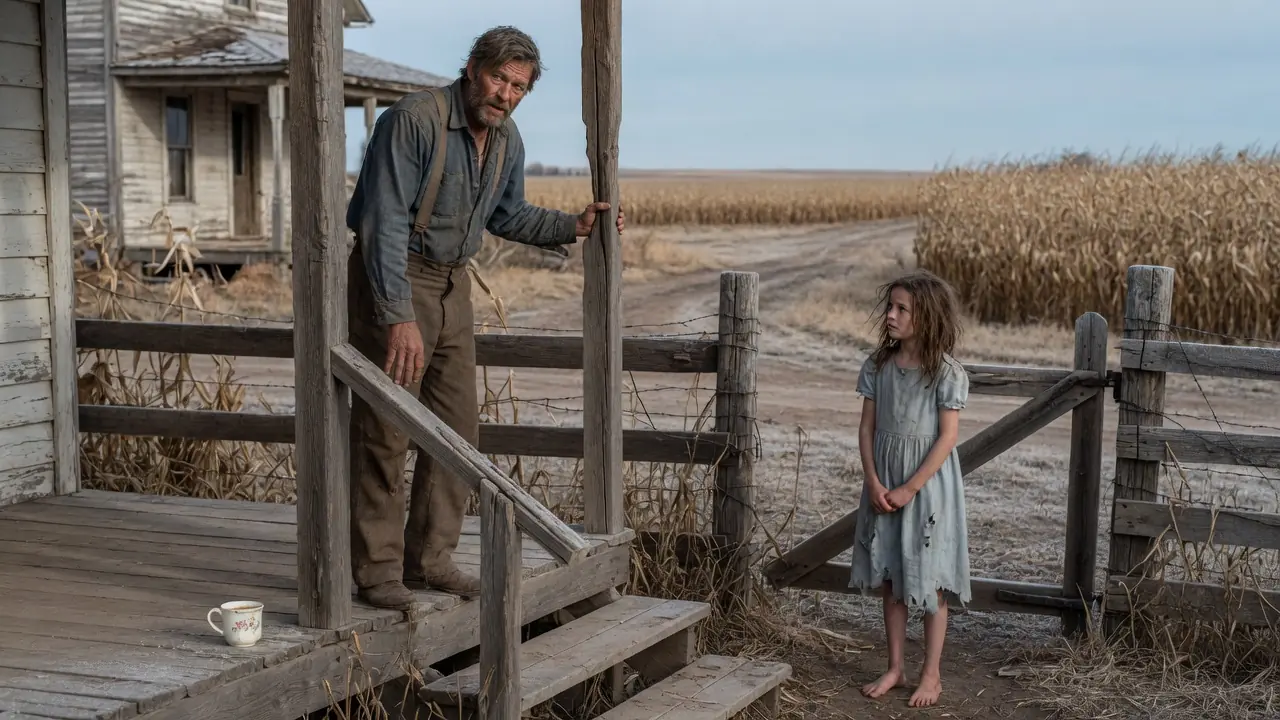
He had convinced himself he had nothing left to offer the world. But when Clara Wells appeared that morning, thin as a whisper and brave as thunder, she did not ask for his pity.
She asked for his faith.
That made all the difference.
The gate had been broken for three years.
Ethan Holloway stood on the sagging porch of his farmhouse, coffee cup in his calloused hand, and stared at the thing like it was an old argument he had never won. The wood had splintered where the latch used to be. Wire held it upright now, rusted and stubborn, just functional enough to mark the edge of his land, but not proud enough to keep anything out or in.
November wind swept across the Nebraska prairie, rattling the dry husks of corn he had never bothered to harvest. The sky hung low and gray, pressing down like the lid of a burial vault.
Fifty-three years old, and Ethan felt every one of them in his bones, in the permanent stoop of his shoulders, in the silence that had become the only language he spoke fluently.
He did not expect company.
He never did.
So when the figure appeared at the end of his long dirt road, Ethan’s first instinct was irritation. Probably someone lost and looking for the main highway, or worse, a preacher come to save his soul with platitudes and a leather-bound book.
He set his cup on the porch rail and waited, squinting against the pale light.
The figure grew closer.
Small.
Moving slow.
Not a preacher.
A child.
Ethan’s chest tightened. His hand went to the porch post, gripping it hard enough that splinters bit into his palm.
Children did not wander out here. There was nothing for miles but failing farms and forgotten people. The nearest town, Miller’s Crossing, was eight miles east, and even that was barely a town anymore, just a post office, a mercantile, and a saloon that opened at noon and closed when the last drunk went home.
The child stopped at his gate.
A girl.
Thin enough that the wind seemed to move through her rather than around her. Her dress was pale blue cotton, too light for the season and torn along the hem. Her hair hung in dark tangles past her shoulders. No coat. No shoes.
Her feet were caked in dust and streaked with something darker.
Mud maybe.
Or dried blood.
Ethan’s stomach turned.
She stood there for a long moment, hands folded in front of her like she was waiting for permission to exist. Then, slowly, she lifted her head and looked directly at him.
Her eyes were gray, clear, and unflinching.
“Sir,” she called out, her voice thin but steady. “Can you give me work?”
Ethan blinked.
Of all the things he had expected, tears, begging, desperation, this was not it.
“What?”
His voice came out rougher than he intended, unused and sharp.
The girl did not flinch.
“I can work,” she said again, louder this time. “I can clean. I can cook. I can mend. I don’t eat much, and I don’t need pay. Just...”
She paused and swallowed hard.
“Just a place to sleep and something to do.”
Ethan felt his jaw tighten.
He did not want this.
He did not want the complication, the questions, the weight of another person’s suffering pressing against his ribs. He had worked hard to build his life down to nothing, to strip away everything that could hurt him.
And here this girl was, barefoot and shaking, asking him to care.
“Where’s your family?” he asked.
Her gaze dropped to the dirt.
“Gone.”
“Gone where?”
“Just gone.”
The wind picked up, and Ethan watched her sway slightly, like a sapling that had not quite rooted yet.
She was cold. He could see it in the way her arms wrapped tighter around herself, in the faint shiver that ran through her shoulders.
He should tell her to go. Point her toward town. Let someone else deal with it.
But his feet did not move.
“How old are you?”
“Eleven.”
“And you walked here?”
“Yes, sir.”
“From where?”
She hesitated.
“Everywhere.”
Ethan exhaled hard through his nose, the sound somewhere between a sigh and a curse.
He looked past her down the empty road, half expecting to see someone coming after her, a father, a brother, someone with a claim. But there was nothing. Just wind and dust and the low groan of his broken gate swinging slightly on its wire hinge.
“What’s your name?” he asked finally.
“Clara. Clara Wells.”
“Clara.”
He tasted the name, let it sit heavy on his tongue.
“I don’t need help.”
Her chin lifted slightly.
“Everyone needs help, sir.”
Something in her tone, not defiant, not pleading, just plain and true, made his chest ache in a way he had not felt in years. It was the kind of ache that came before tears, before breaking.
And Ethan Holloway had promised himself he would not break again.
He turned away, gripping the porch rail.
“There’s a church in Miller’s Crossing. You’d do better there.”
“I already tried the church.”
He glanced back.
“They said they’d pray for me,” she said, her voice flat, emptied of hope. “But they didn’t have room.”
Ethan’s mouth twisted.
Of course they did not.
He stood there, caught between the instinct to retreat into his house and bolt the door, and something older, deeper, something his wife, Anna, used to call his damnable conscience.
Anna.
He could almost hear her voice, soft and insistent.
You’re not this man, Ethan. You’re better than this.
But Anna had been wrong.
He was not better. He had proven that five years ago when their son Daniel had walked off this land and never looked back. Proven it again when Anna got sick and he could not save her. Could not do a single thing but watch her fade.
He was exactly the man he appeared to be.
Hollowed out.
Barely functional.
Surviving on habit and spite.
And yet Clara Wells stood at his gate, eleven years old and barefoot, asking not for charity, but for purpose.
“All right,” he heard himself say.
Her head snapped up.
“Come on then.”
He gestured toward the house, his voice gruff.
“You can stay tonight. Just tonight. We’ll figure the rest out in the morning.”
For the first time, something like hope flickered across her face, brief, cautious, fragile as lamplight.
She pushed the gate open, wire scraping against wood, and walked up the long dirt path toward him.
As she climbed the porch steps, Ethan got a better look at her.
Bruises on her arms, old and yellowing. A cut above her left eyebrow, scabbed over. Her feet were blistered and raw. She smelled like road dust and sweat and something sour, hunger maybe, or sickness.
She stopped in front of him, small and impossibly brave.
“Thank you, sir.”
Ethan grunted, turning toward the door.
“Don’t thank me yet.”
Inside, the house was exactly what it looked like from the outside, neglected, functional, stripped of warmth. The kitchen table was cluttered with dirty dishes Ethan had not bothered to wash. The floor needed sweeping. The stove was cold.
A single chair sat by the fireplace, surrounded by books he no longer read and a bottle of whiskey he had been nursing for the better part of a month.
Clara stood just inside the doorway, taking it all in with those steady gray eyes.
“Sit,” Ethan said, nodding toward the table.
She obeyed, lowering herself carefully into a chair like she was not sure it would hold her.
He moved to the stove, stirring the coals back to life and setting a pot of water to boil. There was not much, some dried beans, a heel of bread, and a bit of salted pork, but it was enough.
He worked in silence, aware of her watching him and hating how self-conscious it made him feel.
“When’s the last time you ate?” he asked without turning around.
“Two days ago.”
His hand stilled on the spoon.
“Two days.”
He forced himself to keep moving, ladling beans into a chipped bowl and setting it in front of her along with the bread.
“Eat slow,” he said. “Or you’ll be sick.”
Clara nodded and picked up the spoon, her hands shaking slightly. She took one bite, then another, chewing carefully, deliberately.
Tears slipped down her cheeks, silent and unchecked.
Ethan looked away, his throat tight.
He poured himself coffee, real coffee this time, hot and bitter, and sat across from her, letting the silence settle.
Outside, the wind rattled the shutters.
Inside, the stove crackled.
Clara ate, and Ethan tried not to notice the way her shoulders gradually relaxed, the way color slowly returned to her face.
When she had finished, she set the spoon down and wiped her eyes with the back of her hand.
“Thank you,” she said again, softer this time.
Ethan grunted.
“You said you can work?”
“Yes, sir.”
“What kind of work?”
“Anything.”
She straightened slightly, determination hardening her voice.
“I’ve cooked and cleaned for my mama since I was seven. I can mend clothes, churn butter, tend a garden. I’m strong. I don’t complain.”
“Where’s your mama now?”
Clara’s face went very still.
“She died last spring.”
“And your father?”
“Never knew him.”
Ethan nodded slowly, pieces falling into place.
“So you’ve been on your own since then?”
“Mostly.”
She hesitated.
“There was an aunt for a while in Omaha. But she... she didn’t want me either.”
The casual way she said it, like being unwanted was just another fact of life, like weather or seasons, made Ethan’s chest hurt all over again.
“Why come here?” he asked. “Why my farm?”
Clara looked down at her hands.
“I saw the gate. It’s broken, but it’s still standing. I thought maybe...”
She trailed off, then tried again.
“I thought maybe you’d understand.”
“Understand what?”
She met his eyes, and for a moment he saw something far older than eleven looking back at him.
“What it’s like to keep going when everything’s falling apart.”
The words hit him like a fist to the gut.
He stood abruptly, the chair scraping loud against the floor.
“You can sleep in the back room,” he said, his voice tight. “There’s a bed. It’s not much, but it’s clean enough.”
Clara rose carefully, like she was afraid sudden movement might break the fragile thread of his generosity.
“Thank you, sir.”
“Stop calling me that.”
She blinked.
“What should I call you?”
“Ethan.”
He turned toward the hallway, not trusting himself to look at her.
“Just Ethan.”
The back room had been Daniel’s once.
Ethan had not set foot in it since the day his son left, twenty-two years old and burning with anger, shouting words that still echoed in Ethan’s skull on the bad nights.
“You care more about this dirt than you ever cared about me.”
The door had slammed. The truck had roared to life. Ethan had stood on the porch, fists clenched, pride keeping his mouth shut even as his heart screamed for him to call his boy back.
He had been waiting five years for Daniel to come home.
He was not waiting anymore.
Now he pushed the door open, dust swirling in the dim light.
The bed was still made, the quilt Anna had sewn folded neatly at the foot. A wooden trunk sat against the wall. A single window overlooked the fields.
Clara stepped inside, her eyes wide.
“It’s perfect,” she whispered.
Ethan grunted.
“It’s a room.”
“It’s more than I’ve had in a long time.”
He did not know what to say to that, so he said nothing. He left her there, closing the door softly behind him, and returned to the kitchen.
The fire was dying.
He should stoke it, keep the house warm through the night. Instead, he sank into his chair by the hearth and stared into the fading embers, the whiskey bottle within easy reach.
Just tonight, he had told her.
But as the hours passed and the house settled into darkness, Ethan Holloway knew he had already lied.
Clara awoke before dawn.
For a moment, she did not remember where she was, only that she was warm, and the mattress beneath her did not stink of mildew, and there was no one yelling.
Then memory returned.
The long walk. The broken gate. The man with sad eyes who had given her food.
Ethan.
She sat up slowly, her body aching in a dozen places.
Through the window, the sky was just beginning to lighten, pale gray bleeding into the horizon. She could hear movement in the house. Footsteps, the clatter of a stove door, the low murmur of a man talking to himself.
She dressed quickly, smoothing her hair as best she could, and slipped out into the hallway.
The kitchen smelled like coffee and frying bacon.
Ethan stood at the stove, his back to her, shoulders hunched. He did not turn when she entered, but his voice reached her anyway.
“You’re up early.”
“Yes, sir.”
She corrected herself quickly.
“Ethan. I’m used to it.”
“Sit.”
She did.
He set a plate in front of her. Bacon, eggs, a biscuit, and a cup of milk. Then he took his own plate and sat across from her, eating in silence.
Clara ate slowly, savoring every bite.
The bacon was crispy. The eggs were soft. The biscuit melted on her tongue. She wanted to cry again, but she swallowed it down, afraid that if she started, she would not stop.
When they had finished, Ethan pushed his plate aside and looked at her directly for the first time that morning.
“You meant what you said yesterday about working?”
“Yes.”
“Then we’ll try it. One week. You work, I’ll give you food and a place to sleep. After that, we’ll see.”
Hope flared in her chest, bright and terrifying.
“I won’t let you down.”
“See that you don’t.”
He stood, grabbing his coat from the hook by the door.
“First thing, clean this kitchen. I’ll be in the barn if you need me.”
He left without another word, the door closing firmly behind him.
Clara sat alone in the sudden quiet, her heart pounding.
One week.
She could do a lot in one week.
By noon, the kitchen was unrecognizable.
Clara had scrubbed every surface, washed every dish, and swept the floor until the old wood gleamed. She had found a basket of mending in the corner, shirts with missing buttons, socks with holes, and set to work with needle and thread, her stitches small and precise.
When Ethan came in for lunch, he stopped in the doorway, blinking.
“You did all this?”
Clara looked up from the shirt she was mending.
“Yes. Is it all right?”
He did not answer right away.
He just stood there, taking it in.
The clean table. The organized shelves. The faint smell of soap lingering in the air.
“It’s fine,” he said finally, his voice rough.
She smiled just a little.
That afternoon, she tackled the front room, dusting, sweeping, and folding the blankets that had been left in a heap on the floor.
She found a photograph on the mantle, half hidden behind a stack of books.
A woman with kind eyes and dark hair.
A young man beside her, tall and serious.
“That’s Anna,” Ethan said from behind her.
Clara startled, nearly dropping the frame.
“My wife,” he continued, stepping closer. “She died three years ago.”
“I’m sorry.”
He took the photograph from her hands, his thumb brushing over the glass.
“And that’s Daniel, my son.”
“Where is he?”
“Don’t know.”
Ethan set the frame back on the mantle, his jaw tight.
“Haven’t seen him in five years.”
Clara wanted to ask more, but something in his posture, rigid and closed, told her not to push.
Instead, she said, “They look happy.”
Ethan’s mouth twisted into something that was not quite a smile.
“They were once.”
He turned away, heading back toward the kitchen, and Clara let him go.
The days that followed fell into a rhythm.
Ethan worked the land, what was left of it, mending fences, feeding livestock, clearing brush. Clara worked the house, transforming it piece by piece from a tomb into something that almost resembled a home.
They did not talk much. Ethan was not a man built for conversation, and Clara had learned long ago that silence was safer than words. But there was comfort in the routine, in the simple act of being useful, of waking each morning with purpose.
On the fourth day, Clara found a recipe box tucked away in a cupboard. Inside were dozens of handwritten cards, notes scrawled in looping feminine script.
Anna’s recipes.
That evening, she made stew, rich and savory, thick with vegetables and tender chunks of beef. She set the table carefully, lighting a candle she had found in the pantry.
When Ethan came in, he froze.
“What’s this?”
“Dinner.”
Clara gestured toward the table.
“I found your wife’s recipes. I thought... I thought you might like it.”
For a long moment, he just stood there staring at the table like it was something dangerous.
Then, slowly, he sat.
Clara served him, her hands steady despite the nerves fluttering in her chest. She watched as he took the first bite, as his eyes closed briefly.
“It’s good,” he said, his voice barely above a whisper. “Thank you.”
They ate in silence, but it was different this time.
Softer.
Warmer.
When the meal was finished, Ethan did not retreat to his chair by the fire. Instead, he helped Clara clear the dishes, their movements careful and quiet.
“Your week’s almost up,” he said as he dried the last plate.
Clara’s stomach clenched.
“I know.”
“You’ve worked hard.”
“I’ll keep working as long as you’ll let me.”
Ethan set the plate down, turning to look at her fully.
“Why do you want to stay here, Clara? This place is barely hanging on. I’m barely hanging on.”
She met his gaze, steady and sure.
“Because you didn’t turn me away. Because you’re kind, even when you don’t want to be. And because...”
She hesitated, then pushed forward.
“Because I think maybe you need someone to stay just as much as I need a place to be.”
Ethan’s throat worked. His eyes shone.
He turned away quickly, clearing his throat.
“All right,” he said, his voice rough. “You can stay.”
Clara’s heart soared.
“But,” he continued, holding up a hand, “you have to promise me something.”
“Anything.”
“You have to promise me that if this doesn’t work, if I can’t give you what you need, you’ll tell me. You won’t just disappear.”
Clara nodded, fierce and certain.
“I promise.”
Ethan exhaled, some of the tension leaving his shoulders.
“Good.”
He picked up his coat from the back of the chair.
“Now get some rest. We’ve got work to do tomorrow.”
As he headed toward his room, Clara called after him softly.
“Ethan.”
He paused, glancing back.
“Thank you for letting me stay.”
He did not answer, but the small, almost invisible nod he gave her was enough.
That night, Clara lay in bed staring at the ceiling, her mind racing. She thought about her mother, gentle and tired, worn down by a world that had never been kind. She thought about the aunt in Omaha who had looked at her like she was a burden. She thought about the long, lonely road she had walked, the nights she had spent shivering in barns and under bridges.
And then she thought about Ethan, broken and grieving, but still standing, still trying.
I can help him, she thought.
I can make this place whole again.
It was a big dream for an eleven-year-old girl, but Clara Wells had learned that sometimes the biggest dreams were the only ones worth holding on to.
Outside, the wind whispered through the prairie grass.
Inside, for the first time in a very long time, the house on Ethan Holloway’s failing farm felt like it might just have a future.
The winter came early that year, sweeping across the Nebraska prairie with a vengeance that felt personal.
By mid-December, snow had buried the fields in white silence, and the wind howled through the gaps in the barn like something hungry and desperate. Ethan worked from dawn until his hands went numb, splitting firewood, reinforcing the animal shelters, patching the roof where ice had worked its way under the shingles.
Clara worked beside him when he let her, which was not often.
“You’ll freeze,” he would say, not unkindly, gesturing toward the house. “Go inside where it’s warm.”
But she would shake her head, her small hands already gripping a broom or a bucket.
“I’m fine. I can help.”
And she did.
She cleared paths through the snow. She fed the chickens and collected eggs, her fingers red with cold. She learned to milk the cow, her forehead pressed against the animal’s warm flank, while Ethan stood nearby, offering gruff corrections.
“Steady pressure. Don’t yank. Like this.”
“Better?”
“Better. Keep going.”
The house changed with her presence.
Curtains appeared in the windows, threadbare but clean, salvaged from a trunk in the attic. The stove stayed warm. Meals appeared on the table at regular hours, simple but nourishing. The scent of baking bread began to replace the stale smell of whiskey and neglect.
Ethan noticed.
He could not help but notice.
It unsettled him, the way the house had started to feel alive again. The way he would catch himself listening for Clara’s footsteps in the morning. The soft humming she did while she worked. The way she set his coffee beside his plate without him asking, exactly the way Anna used to.
It felt like betrayal and relief all at once.
One evening, after a particularly brutal day of hauling feed through waist-deep snow, Ethan came inside to find Clara kneeling by the fireplace, feeding logs into the flames. Her dress was damp at the hem. Her hair had escaped its braid, falling in dark waves around her face.
She looked up when he entered and smiled.
It was such a small thing, that smile, tired but genuine, offered freely. It cracked something inside Ethan’s chest that he had been holding together with spit and stubbornness.
He looked away quickly, shrugging off his coat.
“You shouldn’t be doing that,” he muttered. “Fire’s my job.”
“You looked cold,” Clara said simply. “I thought I’d help.”
Ethan grunted, moving toward the kitchen, but as he passed her, he let his hand rest briefly on her shoulder.
Just for a second.
Barely a touch.
“Thank you,” he said quietly.
Clara’s smile widened.
That night, after she had gone to bed, Ethan sat alone by the fire with Anna’s photograph in his hands. He studied his wife’s face, the curve of her mouth, the way her eyes seemed to hold light even in the faded image.
“I don’t know what I’m doing,” he whispered to the empty room. “She’s just a kid, Anna. And I’m no good at this.”
The fire crackled.
The wind moaned outside.
Anna’s photograph offered no answers.
But somewhere deep in Ethan’s chest, beneath the grief and the fear, something shifted.
It was not forgiveness.
Not yet.
But it was permission.
Permission to try.
The days grew shorter. The snow piled higher. And slowly, carefully, Ethan and Clara built something fragile and necessary in the cold heart of winter.
One afternoon in late December, Clara found a box of Christmas decorations in the attic, dusty and forgotten, wrapped in newspaper from years past. She brought it down carefully, setting it on the kitchen table.
“Can we?” she asked, her voice hesitant. “For the house?”
Ethan stared at the box like it might bite him.
He had not celebrated Christmas since Anna died. He had not seen the point.
But Clara was looking at him with those steady gray eyes, patient and hopeful, and he found himself nodding before he could think better of it.
“All right. But nothing fancy.”
Her face lit up.
Together, they strung garland over the mantle. Clara hung Anna’s handmade ornaments on a small pine tree Ethan reluctantly cut from the edge of the property.
She stood back, admiring her work, her hands clasped in front of her.
“It’s beautiful,” she breathed.
Ethan could not quite agree.
The tree was crooked. The ornaments were old and chipped.
But there was something about the way the firelight caught the glass, the way Clara’s face glowed with simple pleasure, that made his throat tight.
“Yeah,” he said roughly. “It’s all right.”
That night, Clara asked the question that had been building between them for weeks.
“Ethan?”
She was sitting at the table mending one of his shirts.
“Can I ask you something?”
He looked up from the ledger he had been pretending to read.
“Depends on the question.”
“Your son, Daniel.”
She kept her eyes on her stitching.
“What happened between you two?”
Ethan’s jaw tightened.
“That’s personal.”
“I know. I’m sorry.”
She set the shirt aside, meeting his gaze.
“It’s just you have his picture on the mantle. You keep his room exactly the way he left it, but you never talk about him. I thought maybe... maybe it might help to talk about it.”
For a long moment, Ethan said nothing.
He considered shutting her down, changing the subject, retreating into the familiar safety of silence. But Clara had shared her pain with him, her mother’s death, her aunt’s rejection, the loneliness that had driven her to his gate.
She had been brave enough to trust him with her brokenness.
Maybe he owed her the same.
“We fought,” he said finally, his voice low. “Five years ago. It was bad.”
Clara waited, patient.
“Daniel wanted to leave. Go to college back east. Study engineering. He was smart. Smarter than me by a mile.”
Ethan’s hands curled into fists on the table.
“But I needed him here. The farm was struggling. Anna was sick. And I thought...”
He broke off, swallowing hard.
“I thought he was being selfish, abandoning us when we needed him most.”
“What did he think?”
“He thought I was trying to trap him. Keep him small.”
Ethan’s voice cracked.
“He said I cared more about this dirt than I ever cared about him. And when I didn’t deny it, when I just stood there too proud to admit he was right, he left.”
“Have you heard from him since?”
“Once. A letter, about six months after he went. Said he was in Chicago working construction. Asked if Anna was doing better.”
Ethan’s face twisted.
“I never wrote back.”
Clara’s expression did not change, but her voice was gentle.
“Why not?”
“Because I was angry and hurt and stupid.”
He looked down at his hands.
“Then Anna died, and I kept thinking Daniel would come home for the funeral. But he didn’t. And I realized he probably didn’t even know she was gone.”
“You could tell him now.”
Ethan laughed, bitter and sharp.
“After five years? What would I even say?”
Clara was quiet for a moment, considering.
Then she said, “You could start with the truth. That you’re sorry. That you miss him. That you were wrong.”
“I don’t know where he is.”
“Chicago’s not that big. You could find out.”
Ethan shook his head, standing abruptly.
“It’s too late, Clara. Some things can’t be fixed.”
“I don’t believe that.”
He turned to face her, frustration and grief warring in his chest.
“You’re eleven years old. What do you know about it?”
Clara stood too, her small frame rigid with conviction.
“I know that my mama died thinking I didn’t love her because I was too scared to tell her. I know that my aunt sent me away before I could apologize for being a burden. And I know that every single day I wish I could go back and say the things I didn’t say.”
Her voice shook but did not break.
“You still have a chance, Ethan. Don’t waste it.”
The silence that followed was heavy and absolute.
Ethan stared at this child, this impossibly brave, impossibly wise child, and felt something in him finally, irreversibly break.
“I’ll think about it,” he said hoarsely.
Clara nodded, satisfied.
“That’s all I’m asking.”
She picked up the mending and returned to her work, as if she had not just reached into Ethan’s chest and rearranged his entire world.
Ethan sank back into his chair, his hands trembling.
He thought about Daniel.
About Chicago.
About five years of silence and all the words he had never said.
And for the first time since his son walked away, Ethan Holloway allowed himself to hope.
Christmas Eve came quiet and cold.
Snow fell in soft, lazy flakes, blanketing the world in stillness. Clara spent the morning baking ginger cookies from Anna’s recipe box, their spiced sweetness filling the house with warmth.
Ethan watched her work, her small hands quick and capable, flour dusting her cheek. She was humming again, some tune he did not recognize, and he found himself smiling despite the ache in his chest.
“You’re good at that,” he said.
Clara glanced up, surprised.
“My mama taught me. She used to say baking was like magic. You put in simple things and something wonderful comes out.”
“She sounds like she was a smart woman.”
“She was.”
Clara’s smile turned sad.
“I miss her.”
“I know you do.”
They worked in companionable silence after that, Clara shaping dough and Ethan pretending to read the week-old newspaper. When the cookies were done, she arranged them on a plate and set them on the table.
“We should save some for tomorrow,” she said. “For Christmas.”
Ethan nodded.
“All right.”
That evening, they sat by the fire, the Christmas tree glowing softly in the corner. Clara was wrapped in one of Anna’s old quilts, her eyes heavy with sleep. Ethan had intended to read, but instead he just watched the flames, his mind turning over Clara’s words from days before.
“Ethan?”
Clara’s voice was drowsy.
“Yeah?”
“Do you think people can have more than one family?”
He frowned.
“What do you mean?”
“Like, I had my mama. And now I have you.”
She shifted beneath the quilt, her eyes still closed.
“Does that mean I’m forgetting her? If I care about someone new?”
Ethan’s throat tightened.
“No, Clara. That’s not how it works.”
“How does it work?”
He thought about Anna, about Daniel, about the way grief and love tangled together until you could not tell where one ended and the other began.
“Love doesn’t replace love,” he said slowly. “It just grows. Gets bigger. Makes room for more people.”
He paused.
“Your mom is still with you. Always will be. But that doesn’t mean you can’t care about new people too.”
Clara’s eyes opened, sleepy and grateful.
“Thank you.”
“For what?”
“For letting me stay. For being my family.”
Ethan’s chest ached.
“You’re welcome.”
She fell asleep soon after, her breathing slow and even.
Ethan carefully lifted her and carried her to her room, tucking the quilt around her shoulders. She did not stir.
He stood in the doorway for a long moment, watching her sleep, and felt the full weight of what he had taken on.
This child who had come to him with nothing, who had asked only for work and a place to be, had become something he had not expected.
She had become his.
Back in the front room, Ethan sat down at the small desk in the corner. He pulled out a sheet of paper and a pen, then stared at the blank page for a long time.
Then slowly, he began to write.
Daniel,
I don’t know if this letter will reach you. I don’t even know if you’ll read it if it does, but I need to say this, and I’ve waited too long already.
I was wrong about everything. About the farm. About you leaving. About the things I said.
You weren’t selfish. You were young and full of dreams, and I tried to kill those dreams because I was scared of losing you. In the end, I lost you anyway.
Your mother died three years ago. I should have told you. I should have found you and brought you home, but I didn’t. I’m sorry for that too.
There’s a girl here now. Her name is Clara. She’s eleven, and she’s got more courage in her little finger than I’ve had in my whole life. She asked me why I never reached out to you, and I didn’t have a good answer. Just pride and fear and stubbornness.
I’m asking you now. If you can find it in yourself to forgive a stubborn old man, come home. Not for me. Not even for the farm. Because life is too short to let the people we love stay lost.
Your father,
Ethan.
He sealed the letter before he could change his mind.
He did not know Daniel’s exact address, but he knew the name of the construction company Daniel had mentioned in that long-ago letter.
It was a start.
In the morning, he would ride into town and send it.
For now, he sat by the dying fire and let himself believe that maybe, just maybe, it was not too late.
Christmas morning dawned clear and bright, the sun glinting off snow so white it hurt to look at.
Clara woke to the smell of coffee and bacon and found Ethan in the kitchen already dressed.
“Merry Christmas,” he said gruffly.
Her face lit up.
“Merry Christmas.”
They ate breakfast together, the warmth of the stove and the food chasing away the winter chill.
Afterward, Clara produced a small package wrapped in brown paper.
“I made you something,” she said shyly. “It’s not much.”
Ethan unwrapped it carefully.
Inside was a handkerchief, plain white cotton with his initials embroidered in the corner in careful, slightly crooked letters.
His throat closed up.
“Clara...”
“I know it’s simple,” she said quickly. “But I wanted you to have something from me.”
Ethan turned the handkerchief over in his hands, his vision blurring.
“It’s perfect. Thank you.”
She beamed.
He reached into his pocket and pulled out a small wooden carving, a horse no bigger than his thumb, carved from a piece of scrap wood. He had worked on it late at night when Clara was asleep, trying to remember the skills his own father had taught him decades ago.
“Here,” he said, handing it to her. “For you.”
Clara’s eyes went wide.
She took the carving gently, tracing the lines with her finger.
“You made this?”
“It’s rough, but I thought, well, you should have something for Christmas.”
“It’s beautiful,” she whispered. “I love it.”
They sat together in the quiet morning light, the weight of their small gifts heavy with meaning.
Outside, the world was cold and hard.
But inside Ethan Holloway’s house, something warm and fragile had taken root.
That afternoon, Ethan rode into Miller’s Crossing.
The town was nearly deserted, most folks keeping to their homes on Christmas Day. But the post office was open, and the clerk, a tired-looking man named Fischer, took Ethan’s letter with a curt nod.
“Chicago?”
Fischer squinted at the address.
“That’ll take a while. Week, maybe more.”
“That’s fine.”
Fischer tucked the letter into the outgoing mail slot.
“Anything else?”
Ethan hesitated.
“You know anyone hiring for rough jobs? Carpentry, that sort of thing?”
Fischer raised an eyebrow.
“Looking for work?”
“Maybe. If the price is right.”
“Talk to Reverend Marsh. Church needs repairs. Roof’s leaking. Steps are rotting. He’s got a small budget, but something.”
Ethan nodded.
“I’ll stop by.”
He found the reverend at the church, a modest white building with peeling paint and a crooked steeple. Marsh was an older man, thin and gray, with kind eyes and a firm handshake.
“Ethan Holloway,” Marsh said, surprised. “Didn’t expect to see you here.”
“Heard you need work done.”
“I do, but I can’t pay much.”
“Don’t need much. Just need to keep busy.”
Marsh studied him for a long moment, then smiled.
“All right. Come by next week. We’ll talk details.”
As Ethan rode back toward the farm, the sky beginning to darken, he felt something unfamiliar settle in his chest.
Purpose.
For the first time in years, he had a reason to get up in the morning that went beyond simple survival.
He had Clara to care for, work to do, and maybe, just maybe, a son to bring home.
The wind picked up, biting and cold, but Ethan barely felt it.
He was already thinking ahead.
Back at the house, Clara had dinner waiting. Roasted chicken, potatoes, carrots glazed with honey. The table was set with Anna’s good dishes, and candles flickered in the center.
“What’s all this?” Ethan asked, hanging up his coat.
“It’s Christmas,” Clara said simply. “It should be special.”
They ate slowly, savoring the meal and the warmth of the fire. Clara told him about the chickens, about the cow who had been stubborn that morning, about the book she had found in the attic and started reading.
Ethan listened, asking questions, letting her voice fill the spaces that had been empty for so long.
When they had finished, Clara helped him clear the dishes.
As they worked side by side, she said quietly, “Did you mail the letter?”
Ethan’s hand stilled in the wash basin.
“I did.”
“Do you think he’ll write back?”
“I don’t know.”
Clara dried a plate, thoughtful.
“But you tried. That’s what matters.”
Ethan looked at her, the small, fierce girl who had appeared at his gate with nothing but hope and grit, and felt his heart swell.
“Yeah,” he said softly. “I tried.”
That night, as the house settled into sleep, Ethan stood at the window of his room, looking out over the snow-covered fields. The moon was bright, casting silver light across the land.
He thought about Daniel somewhere in Chicago, maybe reading his letter, maybe crumpling it up and throwing it away.
He thought about Anna and the way she used to stand at this same window, her hand resting lightly on his shoulder.
And he thought about Clara, asleep in the next room, her small wooden horse clutched in one hand.
The future was uncertain. The farm was still struggling. Winter was far from over.
But for the first time in five years, Ethan Holloway believed that tomorrow might be worth seeing.
He turned away from the window, climbed into bed, and let sleep take him.
Outside, the wind whispered through the prairie grass, carrying with it the promise of spring.
January brought a cold so fierce it felt like the prairie itself was trying to push them back indoors.
The wind carved through every gap in the walls, and even with the stove burning day and night, frost crept across the inside of the windows in delicate, merciless patterns.
Ethan rose before dawn each morning to break ice in the water troughs, his breath clouding white in the predawn darkness. His hands cracked and bled despite the salve Clara made from beeswax and herbs she had found in Anna’s old medicine cabinet.
“You should wear gloves,” she said one morning, watching him wrap his raw knuckles with strips of cloth.
“Can’t feel what I’m doing with gloves on.”
“Can’t feel much with frostbite either.”
He shot her a look, but there was no heat in it.
“When did you get so bossy?”
“When you started being stubborn.”
She handed him a cup of coffee, her expression serious.
“Mama used to say that taking care of yourself isn’t selfish. It’s responsible.”
Ethan took the coffee, the warmth seeping into his damaged hands.
“Your mama was right about a lot of things.”
Clara smiled just a little and returned to the stove, where she was frying eggs and salt pork.
The rhythm of their mornings had become familiar, comfortable even.
Ethan handled the livestock and the heavy outdoor work. Clara managed the house, the cooking, the mending. In the evenings, they would sit by the fire, Ethan reading aloud from books Clara chose, or Clara telling stories about her mother while Ethan listened, his weathered face softening in the firelight.
But beneath the routine, tension hummed like a plucked wire.
Every day, Ethan watched for the mail rider.
Every day, Clara watched Ethan’s face when the rider passed by without stopping.
Three weeks since he had sent the letter to Chicago.
No response.
Ethan told himself he had expected as much. Five years of silence could not be undone with a single letter, no matter how honest. Daniel had every right to ignore him, to let the old man sit with his regrets.
But hope, once planted, was a stubborn weed.
The work on the church started the second week of January.
Reverend Marsh met Ethan at the building early on a Monday morning, his breath steaming in the frigid air.
“Appreciate you taking this on,” Marsh said, gesturing at the sagging roof and rotted steps. “Most folks won’t work in weather like this.”
“Most folks have better sense,” Ethan replied.
But he was already studying the damage, calculating what needed doing first.
They worked out an agreement. Ethan would put in three days a week, dawn to dusk, for enough money to buy feed and supplies through the rest of winter. It was not much, but it was something.
More than that, it was movement.
Progress.
Proof that he was still capable of building instead of just watching things fall apart.
Clara approved immediately.
“It’s good,” she said that evening, ladling stew into his bowl. “You need people, not just me.”
“I’ve got people.”
“You’ve got me and a cow who barely tolerates you.”
She sat across from him, her expression earnest.
“I mean real people. The reverend seems kind.”
“He is.”
“Then it’s settled.”
Ethan almost smiled.
“You sound like you’re in charge here.”
“Someone has to be.”
This time, he did smile, shaking his head.
But as he ate the stew, rich with vegetables from the root cellar and meat he had traded for with a neighbor, he recognized the truth in her words. Clara had given him more than help with the house. She had given him a reason to engage with the world again, to step beyond the narrow borders of his grief.
He was starting to remember what it felt like to be a man instead of a ghost.
The work at the church was brutal in the cold, but Ethan threw himself into it with an intensity that surprised even him. He tore out the rotted steps and rebuilt them with solid oak. He patched the roof, replacing shingles and sealing gaps where rain and snow had infiltrated.
Reverend Marsh worked alongside him when he could, the two men falling into an easy companionship built on shared labor and few words.
On the fourth day, as they were hauling lumber from the supply shed, Marsh asked the question Ethan had been waiting for.
“The girl staying with you, Clara. How’d that come about?”
Ethan kept his eyes on the wood.
“She showed up at my gate back in November. No family, no place to go. Asked if I’d give her work.”
“And you said yes.”
“Eventually.”
Marsh was quiet for a moment, considering.
“That’s good of you, Ethan. A lot of men wouldn’t have taken that on.”
“Wasn’t trying to be good. Just couldn’t turn her away.”
“Sometimes that’s the same thing.”
Ethan grunted, uncomfortable with the praise.
They worked in silence after that, but the reverend’s words stayed with him, settling somewhere deep.
That Sunday, Marsh invited Ethan and Clara to attend services.
Ethan’s first instinct was to refuse. He had not set foot in a church since Anna’s funeral.
But Clara’s hopeful expression stopped him.
“We don’t have to,” she said quickly. “But it might be nice to be around people.”
So they went.
The church was small and drafty despite Ethan’s repairs, filled with maybe twenty souls scattered across the pews, farmers and their families, mostly faces weathered by hard seasons and harder luck.
They turned when Ethan and Clara entered, curiosity plain in their expressions.
Ethan felt Clara’s hand slip into his, her grip tight.
“It’s all right,” he murmured. “We’ll sit in back.”
They settled into the last pew just as Marsh began the service. The reverend’s voice was steady and warm, his sermon simple and direct, something about seeds and faith and the patience required to see things grow.
Ethan listened with half his attention, the other half focused on the people around him.
Mrs. Brennan, whose husband had died last spring.
The Cooper family, struggling to keep their farm afloat.
Old Tom Richter, half deaf and mostly alone.
Broken people, all of them, holding on because there was nothing else to do.
When the service ended, several folks approached to greet them.
Mrs. Brennan clasped Clara’s hands in hers, her eyes bright with tears.
“What a sweet girl,” she said to Ethan. “You’re blessed to have her.”
“Yes, ma’am. I am.”
Tom Richter shook Ethan’s hand with surprising strength.
“Heard you’re fixing up the church. Good work.”
“Just doing what needs doing.”
“Still, it’s good to see you back among the living.”
Ethan did not know what to say to that, so he just nodded.
On the ride home, Clara was quiet, her small face thoughtful.
“What are you thinking about?” Ethan asked.
“Those people. They seemed lonely.”
“Most of them are.”
“Like you were?”
Ethan’s hands tightened on the reins.
“Yeah. Like I was.”
“But you’re not lonely anymore, are you?”
He glanced at her, this child who saw too much and said it too plainly.
“No,” he said. “I’m not.”
Clara smiled and leaned against his arm, her weight slight but solid.
“Good.”
The letter arrived on a Tuesday afternoon in late January.
Ethan was in the barn mending a broken harness when he heard the mail rider’s horse. He forced himself to finish the stitch he was working on before walking outside, refusing to rush, refusing to hope too hard.
The rider handed him a single envelope, postmarked Chicago.
Ethan’s heart stopped.
He stood in the snow, staring at the familiar handwriting.
Daniel’s hand.
Still bold and slanted, exactly as he remembered.
For a long moment, he could not move, could not breathe.
Then slowly, he walked back to the barn and sat down on an overturned crate. His fingers shook as he opened the envelope.
Father,
I got your letter.
I’ve read it maybe a dozen times trying to figure out what to say back. Part of me wants to stay angry. Part of me wants to tear this up and pretend I never heard from you.
But there’s another part, the part that still remembers being a kid on that farm. Still remembers Mom’s laugh and the way you taught me to mend fences. That part won’t let me walk away.
I’m sorry about Mom. I wish I’d known. I wish I’d come home.
You were right about a lot of things in your letter. You were wrong too. We both were. I blamed you for years. Told myself you were too stubborn to love me the way I needed.
But the truth is I was stubborn too. I left and never looked back because it was easier than staying and fighting for us.
I’m not saying I forgive you. Not yet. But I’m willing to try.
I’ll be in Miller’s Crossing on February 10. The train gets in around noon. If you want to talk, meet me at the station.
If you don’t show, I’ll understand.
But I hope you do.
Daniel.
Ethan read the letter three times, his eyes burning. Then he folded it carefully and pressed it against his chest, his breath coming in ragged gasps.
Clara found him there twenty minutes later, still sitting in the cold barn, the letter clutched in his hand.
“Ethan?”
Her voice was soft, worried.
“What happened?”
He looked up at her, his face wet with tears. He did not bother to hide them.
“He wrote back,” he said hoarsely. “Daniel wrote back.”
Clara’s face broke into a radiant smile.
She ran to him, throwing her arms around his neck, and Ethan held her tight.
This child who had believed in second chances when he had given up on them entirely.
“What did he say?” Clara asked, pulling back to look at him.
“He’s coming home February tenth. He wants to talk.”
“That’s wonderful.”
“He’s not ready to forgive me.”
“But he’s willing to try,” Clara said firmly. “That’s what matters.”
Ethan nodded, wiping his eyes roughly.
“I don’t know what to say to him. How to make this right.”
“You’ll figure it out. You always do.”
He wished he had her faith.
But as he stood and walked back toward the house, Clara’s hand in his, he felt something he had not felt in years.
He felt like a father again.
The days leading up to February tenth crawled by with agonizing slowness.
Ethan threw himself into work, finishing the church repairs and starting on projects around his own farm that he had neglected for years. He fixed the gate, replacing the wire with proper hinges. He cleaned out the barn, organizing tools and supplies with meticulous care. He even started sketching plans for expanding the chicken coop come spring.
Clara watched all of this with knowing eyes.
“You’re nervous,” she said one evening as Ethan paced the kitchen, too restless to sit.
“I’m fine.”
“You’ve checked the calendar four times today.”
He stopped, caught.
“I just want to be prepared.”
“For what?”
“For him to be angry. For him to leave again. For...”
Ethan broke off, running a hand through his hair.
“For it to go wrong.”
Clara set down the sock she was darning and looked at him steadily.
“It might. But it might go right too. You won’t know until you try.”
“You sound like Anna.”
“Good. She sounds like she was smart.”
Despite everything, Ethan smiled.
“She was the smartest person I ever knew.”
“Then trust her. And trust Daniel. And trust yourself.”
The simplicity of it, the absolute certainty in Clara’s voice, loosened something in Ethan’s chest.
He crossed to where she sat and rested his hand on her shoulder.
“Thank you,” he said quietly. “For everything.”
Clara reached up and squeezed his hand.
“You gave me a home. It’s the least I can do.”
The night before Daniel was set to arrive, Ethan could not sleep.
He lay in bed staring at the ceiling, his mind running through a thousand different versions of the next day. What he would say. What Daniel might say back. How it would feel to see his son after five years of silence.
Around midnight, he gave up and went to the kitchen.
He was surprised to find Clara there, wrapped in a quilt, a cup of milk warming on the stove.
“Can’t sleep either?” she asked.
“Too much thinking.”
She poured the milk into a cup and handed it to him.
“Want to talk about it?”
Ethan sat across from her, cradling the warm cup.
“What if he takes one look at me and realizes he made a mistake? What if I’ve changed too much or not enough?”
“What if he’s thinking the same thing?”
That stopped him.
He had been so focused on his own fear that he had not considered Daniel might be just as terrified.
“You think he’s scared too?”
“Of course he is. He’s coming back to a place where he wasn’t happy, to see a father he fought with. That takes courage.”
Clara’s voice was gentle.
“But he’s coming. That means something.”
Ethan nodded slowly.
“Yeah. It does.”
They sat together in the quiet kitchen, sharing the silence that had become their own language.
Outside, the wind had died down.
The stars were bright and cold.
Finally, Clara stood, gathering her quilt around her shoulders.
“Get some rest,” she said. “Tomorrow’s important. You’ll need your strength.”
“Clara.”
She turned.
“If this goes badly, if Daniel doesn’t stay, I want you to know that you’re not going anywhere. This is your home, no matter what.”
Her eyes glistened.
“I know. But it won’t go badly. I have a good feeling.”
She padded off to bed, leaving Ethan alone with his thoughts and the cooling cup of milk.
He hoped she was right.
February tenth dawned clear and bitterly cold.
Ethan was up before sunrise, pacing the house like a caged animal. He changed his shirt three times, shaved carefully, then spent twenty minutes staring at his reflection in Anna’s old mirror, trying to see himself through Daniel’s eyes.
He looked old.
Tired.
The lines on his face had deepened, carved by grief and regret. His hair was more gray than brown, but his eyes, when he really looked, were not empty anymore.
Clara had done that.
“You look fine,” Clara said from the doorway, making him jump.
“I look like hell.”
“You look like a man who’s lived. That’s not a bad thing.”
She stepped into the room, smoothing his collar.
“Daniel won’t care what you look like. He’ll care about what you say.”
“That’s what I’m afraid of.”
“Then speak from your heart. Tell him the truth.”
She stepped back, her expression fierce.
“And remember, you’re not the same man you were five years ago. You’re better.”
Ethan’s throat tightened.
He pulled Clara into a quick, hard hug.
“Thank you,” he whispered.
“Go get your son.”
The ride to Miller’s Crossing took just over an hour.
Ethan arrived early, tying his horse outside the small train depot and pacing the platform. A few other folks waited, Mrs. Cooper picking up a package, Tom Richter meeting a nephew from Omaha. They nodded at Ethan, but kept their distance, sensing his tension.
At 11:55, the train whistle sounded in the distance.
Ethan’s heart hammered against his ribs. His palms were sweating despite the cold. He wiped them on his pants and forced himself to stand still as the train pulled into the station, brakes screeching, steam hissing into the frozen air.
Passengers began to disembark.
An elderly couple.
A woman with two small children.
A salesman with a battered case.
And then Daniel.
Ethan would have known him anywhere, even after five years. Taller than he remembered. Broader in the shoulders. His hair was darker, his face leaner. He wore a good wool coat and carried a single bag.
But his eyes, dark brown just like Anna’s, were the same.
They locked onto Ethan immediately.
For a moment, neither of them moved.
The platform might as well have been a canyon, wide and impossible to cross.
Then Daniel took a step forward.
And another.
Until he stood three feet away, close enough that Ethan could see the tension in his jaw and the uncertainty in his expression.
“Father,” Daniel said, his voice deeper than Ethan remembered.
“Son.”
Ethan’s voice broke on the word.
They stood there, two broken men, searching each other’s faces for something.
Forgiveness maybe.
Or just recognition.
Finally, Daniel said, “You look different.”
“So do you.”
“Chicago will do that.”
“Yeah.”
Ethan swallowed hard.
“I’m glad you came.”
“I wasn’t sure I would. Even after I sent the letter, I kept changing my mind.”
Daniel’s grip on his bag tightened.
“But I needed to see if there was anything left to save.”
“Is there?”
Daniel’s eyes were bright, his jaw working.
“I don’t know yet. But I’m here.”
“That’s a start.”
Ethan felt something crack wide open in his chest. Relief and grief and hope all tangled together.
“It’s more than I deserve.”
“Maybe. But Mom would have wanted us to try.”
At the mention of Anna, both men’s faces crumpled slightly.
The wound was still raw, still bleeding.
“I should have told you she died,” Ethan said hoarsely. “Should have found you, brought you home. That’s on me.”
“I should have come back. Should have written more. That’s on me,” Daniel said, his voice rough. “We both failed her.”
“Yeah. We did.”
The admission hung between them, painful and necessary.
Then Daniel said, “Tell me about her. About the end.”
So Ethan did.
Right there on the platform, with the train pulling away and the cold seeping through their coats, he told Daniel everything. About Anna’s illness, the long months of watching her fade, the quiet morning when she finally let go.
He told him about the funeral, about the people who came, about the quilt she had been making for Daniel that never got finished.
Daniel listened, tears streaming down his face, his shoulders shaking.
When Ethan finished, Daniel wiped his eyes roughly and said, “I’m sorry I wasn’t there.”
“So am I.”
They stood in silence for a moment, grief settling around them like snow.
Then Ethan said, “Come on. Let’s go home.”
Daniel hesitated.
“Home?”
“If you’ll have it. Just for a few days. See what you think.”
Ethan’s voice was careful, hopeful.
“There’s someone I want you to meet.”
Daniel frowned, curious.
“Who?”
“You’ll see.”
The ride back to the farm was quiet, both men lost in their own thoughts. Daniel sat stiff in the saddle, his eyes scanning the familiar landscape, the rolling fields, the distant tree line, the road he had traveled a thousand times as a boy.
“It hasn’t changed much,” he said finally.
“No. Still the same struggling patch of dirt.”
Ethan glanced at him.
“Still home, though.”
Daniel did not respond, but something in his expression softened.
When they crested the final hill and the farmhouse came into view, Daniel pulled his horse to a stop.
“The gate,” he said, surprised. “You fixed it.”
“Had to. Got company now.”
Before Daniel could ask what that meant, the front door opened and Clara stepped out onto the porch, her small frame bundled against the cold.
Daniel stared.
“Who’s that?”
“That,” Ethan said, “is Clara.”
Clara stood on the porch watching them approach, her hands clasped in front of her apron, her expression cautious but hopeful. Ethan could see her taking in every detail of Daniel, the way he sat his horse, the set of his shoulders, the guarded look in his eyes.
She was measuring him, this girl who had learned early to read people for survival.
Daniel dismounted slowly, his movements stiff from the cold and the long train ride. He looked at Clara, then at Ethan, confusion playing on his face.
“Father, what’s going on?”
Ethan swung down from his own horse, his boots crunching in the frozen snow.
“Clara’s been staying here since November. She needed a place. I needed help. It worked out.”
Daniel’s eyes narrowed slightly.
“Staying here as in living here?”
“That’s right.”
Before Daniel could respond, Clara descended the porch steps with careful dignity. She stopped a respectful distance away and gave a small, formal nod.
“Mr. Holloway, I’m Clara Wells. It’s an honor to meet you.”
The politeness in her voice, the careful way she held herself, reminded Ethan of the girl who had stood at his gate that first day asking for work with trembling courage.
She was nervous, he realized.
Afraid Daniel might not approve.
Daniel’s expression softened slightly.
“Just Daniel is fine. And the honor’s mine, Miss Wells.”
A smile flickered across Clara’s face.
“Just Clara.”
They stood there in an awkward triangle until Clara broke the silence.
“I’ve made lunch. Chicken soup and fresh bread. You must be hungry after your journey.”
“I am, actually. Thank you.”
She nodded and turned back toward the house, glancing once at Ethan as if seeking reassurance. He gave her a small nod, and she disappeared inside, leaving father and son alone in the yard.
Daniel waited until the door closed before speaking.
“You want to explain this?”
Ethan began unsaddling his horse, his hands working familiar motions.
“Not much to explain. She showed up with nothing. I gave her a place to stay. She’s a good kid.”
“A good kid?”
Daniel’s voice was flat.
“Father, she’s living in my old room, isn’t she?”
Ethan’s hands stilled.
“Your room’s been empty for five years.”
“That’s not an answer.”
“Yes, she’s in your room.”
Ethan turned to face his son.
“You got a problem with that?”
Daniel’s jaw clenched.
“I don’t know yet. I’m just trying to understand. You wouldn’t let me leave without a fight, but you’ll take in a random child?”
The accusation stung because there was truth in it.
Ethan took a breath, choosing his words carefully.
“It’s not the same thing.”
“How is it not?”
“Because Clara didn’t have choices. She was alone, scared, and desperate. You had choices. You had a future. You had...”
Ethan broke off, frustrated.
“I was trying to protect you.”
“By trapping me? By keeping me close?”
Ethan’s voice cracked.
“And I was wrong. I know that now. But don’t punish Clara for my mistakes with you.”
Daniel looked away, his expression conflicted.
The wind picked up, rattling the bare branches of the cottonwood tree by the barn.
Finally, he said, “I’m not punishing anyone. I’m just trying to understand what I’m walking back into.”
“You’re walking into a home that’s trying to heal. That’s all.”
Daniel nodded slowly, something in his face shifting.
“All right. Let’s go inside before we both freeze.”
The house was warm and filled with the rich smell of simmering soup. Clara had set the table with Anna’s good dishes, three places arranged with careful precision. She stood by the stove, ladling soup into bowls, her movements quick and capable.
Ethan watched Daniel take in the changes, the clean floors, the curtains in the windows, the Christmas tree still standing in the corner, its needles browning but its presence still somehow comforting. The photograph of Anna and Daniel was back on the mantle, no longer hidden.
“You’ve done a lot of work,” Daniel said quietly.
“Clara’s done most of it,” Ethan replied. “I just tried not to mess it up.”
They sat down to eat, the silence stretching awkward and heavy. Clara kept her eyes on her bowl, eating with small, careful bites. Daniel ate mechanically, his mind clearly elsewhere. Ethan could not taste anything past the anxiety lodged in his throat.
Finally, Clara spoke.
“Your father talks about you sometimes.”
Daniel looked up, surprised.
“He does?”
“He told me you wanted to be an engineer. That you were the smartest person he knew.”
Her voice was soft but steady.
“He’s very proud of you, even if he doesn’t say it enough.”
Ethan felt heat rise to his face. He had said those things to Clara in quiet moments, never expecting them to be repeated.
Daniel’s expression was unreadable.
“Did he tell you why I left?”
“He said you fought. That he was too stubborn to tell you he was wrong.”
Clara met his eyes directly.
“He said he regretted it every day.”
The silence that followed was absolute.
Ethan stared at his bowl, unable to look at either of them, his heart hammering against his ribs.
Then Daniel said, his voice rough, “I regretted it too.”
Ethan’s head snapped up.
Their eyes met across the table, and for the first time in five years, there was no anger in Daniel’s face, just pain and exhaustion and something that might have been hope.
Clara stood quietly.
“I’ll clean up. You two should talk.”
She gathered the dishes with efficient grace and carried them to the sink, giving them space while remaining close enough to be a steadying presence.
Daniel pushed back from the table and moved to the window. He stood with his hands in his pockets, looking out at the winter landscape.
“I was so angry when I left,” he said finally. “Angry at you for not understanding. Angry at myself for caring what you thought. Angry at this farm for being the thing that stood between us.”
Ethan joined him at the window, standing close but not touching.
“I didn’t know how to let you go. Your mother, she was better at that. Better at understanding that love sometimes means stepping back.”
“She wrote to me,” Daniel said quietly. “Did you know that?”
Ethan froze.
“Once, about a year after I left. She told me you missed me. That you were too proud to say it, but you asked about me every day.”
Ethan’s throat tightened.
“I didn’t know she wrote.”
“She asked me to come home. Not for you. For her.”
Ethan’s voice shook.
“We both failed her in different ways, but punishing ourselves won’t bring her back.”
Daniel sagged forward, and Ethan pulled him into a fierce embrace.
His son, taller than him now, broader, changed by years and distance, clung to him like he had when he was small, and Ethan held on just as tight.
“I’m sorry,” Daniel choked out. “I’m so damn sorry.”
“Me too, son. Me too.”
They stood like that for a long time, crying together, releasing five years of pain and regret. Clara continued washing dishes at the sink, giving them privacy while providing silent support with her presence.
When they finally pulled apart, both men were red-eyed and exhausted, but somehow lighter.
Daniel wiped his face roughly.
“I don’t know if I can stay. I have a job in Chicago. Obligations.”
“I’m not asking you to stay,” Ethan said quickly. “I’m just asking you to be here now. We can figure out the rest later.”
Daniel nodded.
“All right. I can do that.”
Clara turned from the sink, her face hopeful.
“There’s coffee if you’d like some. And I baked apple pie yesterday.”
Despite everything, Daniel smiled.
“Pie sounds good.”
That night, after Clara had gone to bed, Ethan and Daniel sat by the fire with cups of coffee and thick slices of pie. The house was quiet except for the pop and crackle of burning wood.
“She’s remarkable,” Daniel said, nodding toward the hallway where Clara slept. “That girl. The way she carries herself.”
“She’s had to grow up fast.”
“You said she showed up in November with nothing.”
Ethan told him the story.
Clara at the gate, barefoot and brave, asking for work. The weeks that followed, watching her transform the house and slowly transform him. The way she had convinced him to write to Daniel.
“It was her idea,” Ethan admitted. “The letter. I wouldn’t have done it without her pushing me.”
Daniel was quiet for a moment.
“Then I owe her a debt.”
“We both do.”
They sat in comfortable silence, and Ethan marveled at how natural it felt having his son here.
There was still tension. Still wounds that needed healing. But the foundation was there.
They were talking.
They were trying.
“What happens now?” Daniel asked. “With Clara, I mean. Is she staying permanently?”
“If she wants to, I hope she does.”
“And legally? Have you thought about making it official?”
Ethan frowned.
“What do you mean?”
“Adoption. Becoming her legal guardian.”
Daniel set down his coffee cup.
“Because right now, anyone could show up and claim her. An aunt, a distant relative. You’d have no rights.”
The thought sent cold dread through Ethan’s chest.
He had not considered it, but Daniel was right. Clara was safe here, but she was not truly his. Not in any way that mattered to the law.
“I wouldn’t know how to start that process,” Ethan said slowly.
“I could help. I’ve met a few lawyers in Chicago. I could write and ask for advice.”
Daniel’s voice was careful.
“If that’s what you want.”
“It is.”
Ethan met his son’s eyes.
“She’s family. She should be protected as such.”
Daniel nodded, something warm crossing his face.
“Then we’ll figure it out.”
The days that followed developed their own rhythm.
Daniel settled into the house with surprising ease, taking over some of the heavier chores and working alongside Ethan to repair a section of fence that had collapsed under the weight of ice.
Clara watched them work together, and Ethan could see the pleasure in her face at witnessing their cautious reconciliation.
But Daniel also kept his distance emotionally at times, retreating into himself, wrestling with feelings too complex to articulate. Ethan recognized the pattern. It was the same one he had fallen into after Anna died, the instinct to protect yourself by staying numb.
One afternoon, while Ethan was in town buying supplies, Clara found Daniel in the barn sitting on a hay bale and staring at nothing.
“Are you all right?” she asked softly.
Daniel looked up, startled.
“Yeah. Just thinking.”
“About your mother?”
He nodded.
“This barn. I spent so much time here as a kid, learning from my father, working on projects. Mom would bring us lunch and sit with us while we ate.”
His voice was thick.
“I can still see her standing right there by the door, smiling.”
Clara sat down beside him.
“Tell me about her.”
So Daniel did.
He talked about Anna’s kindness, her patience, her quiet strength. How she had taught him to read using books from the library in Miller’s Crossing. How she had always taken his side in arguments with Ethan, then privately helped them both see the other’s perspective. How she had made this hard life feel like an adventure.
Clara listened intently.
When Daniel finished, she said, “She sounds wonderful. I wish I could have met her.”
“She would have loved you.”
Daniel managed a small smile.
“She always wanted more children. A daughter especially.”
“My mama wanted more children too. But it was just me.”
Clara’s expression turned distant.
“Sometimes I think maybe that’s why she held on so tight. Because I was all she had.”
“Did she know before she died that you loved her?”
“I hope so.”
Clara’s voice wavered.
“I told her, but I don’t know if she heard.”
Daniel put an arm around her shoulders, a tentative gesture of comfort.
“She heard. Mothers always hear that part.”
They sat together in the quiet barn, two people bound by loss, finding solace in shared understanding.
When Ethan returned and found them like that, something in his chest settled.
This was what he had hoped for.
Not just reconciliation between him and Daniel, but the building of something new.
A family constructed not from blood alone, but from choice and need and love.
That evening, Daniel made an announcement.
“I need to go back to Chicago next week. I have responsibilities there. A job I can’t just abandon.”
Clara’s face fell, and Ethan felt his stomach clench.
“But,” Daniel continued, looking between them, “I’m not leaving forever. I’ll settle things, give my notice, pack up my apartment, then I’m coming back for good, if you’ll have me.”
Ethan could not speak.
The relief was too overwhelming.
Clara found her voice first.
“You mean it? You’re staying?”
“I mean it.”
Daniel’s voice was firm.
“Chicago was never home. It was just where I went to hide. But I’m done hiding.”
“What about your engineering?” Ethan managed to ask.
“There’s engineering work in Nebraska. Railroads, irrigation projects. I can find something.”
Daniel met his father’s eyes.
“But even if I can’t, I’d rather be here with you. With Clara. Trying to make this work.”
Ethan crossed the room and pulled his son into a hard embrace.
“Welcome home.”
Daniel held on tight.
“It’s good to be back.”
Clara joined the hug, wrapping her small arms around both of them.
For a moment, they stood together, three broken people choosing to become whole.
The week passed too quickly.
Daniel and Ethan worked together each day, repairing what could be fixed and making plans for spring planting. They talked more than they had in years, carefully navigating old wounds while building new bridges. Clara watched over them both, offering encouragement and gentle correction when old patterns of stubbornness emerged.
On Daniel’s last night before returning to Chicago, they had a special dinner. Clara roasted a chicken and made biscuits using the last of the preserves Anna had put up before she died. They ate slowly, savoring both the food and the company.
“I’ve been thinking about something,” Daniel said as Clara served pie for dessert.
“About what we discussed. Making Clara’s place here official.”
Clara looked up, hope and fear mingling in her expression.
“I wrote to a lawyer I know in Chicago,” Daniel continued. “Explained the situation. He said it’s possible to petition for guardianship, especially given Clara’s circumstances. It’ll take time and paperwork, but it can be done.”
Ethan turned to Clara.
“Would you want that? To stay here permanently? To be part of this family legally?”
Clara’s eyes filled with tears.
“You’d do that even though I’m not really yours?”
“You are ours,” Ethan said fiercely. “You’ve been ours since the day you walked through that gate. This would just make it official.”
“But what if...”
Clara’s voice broke.
“What if my aunt comes back or someone else claims me?”
“Then we fight,” Daniel said simply. “Because you’re family, and we protect our family.”
Clara covered her face with her hands and wept.
Ethan moved to her side, kneeling beside her chair.
“Clara, look at me.”
She lowered her hands, her face blotchy and wet.
“You saved my life,” Ethan said quietly. “You came to my gate asking for work, but what you really did was give me a reason to keep living. You brought my son home. You made this house feel like a home again.”
His voice shook.
“So yes, we want to make it official. We want you to be ours, and we want to be yours, if you’ll have us.”
Clara launched herself at him, wrapping her arms around his neck and holding on like she would never let go.
“Yes. Yes, I want that.”
Ethan held her tight, and Daniel joined them, one hand on Clara’s shoulder and one on Ethan’s, completing the circle.
The next morning, Ethan and Clara rode with Daniel to the train station.
The platform was crowded with travelers, and the train sat hissing and groaning, impatient to depart. Daniel embraced Clara first.
“Take care of him while I’m gone. Don’t let him get too stubborn.”
Clara smiled through her tears.
“I won’t.”
Then Daniel turned to Ethan.
“I’ll be back in three weeks, four at most.”
“We’ll be here.”
They gripped each other tight, and when they pulled apart, both men had tears in their eyes.
“Thank you,” Daniel said. “For writing that letter. For giving me a chance.”
“Thank you for taking it.”
The conductor called for boarding.
Daniel grabbed his bag and climbed aboard, finding a window seat. As the train began to move, he raised his hand in farewell, and Ethan and Clara waved back until he disappeared from view.
The ride home was quiet.
Clara leaned against Ethan’s side, and he kept one arm around her shoulders, holding her steady.
“He’ll come back,” she said softly.
“I know he will.”
“I believe you.”
And he did.
For the first time in five years, Ethan Holloway believed in the future, believed in second chances, believed that broken things could be mended if you were willing to try.
When they reached the farm, the gate stood open and waiting. Ethan guided the horse through, and together they headed toward the house, toward home, knowing that soon, very soon, their family would be complete.
That night, as Clara slept peacefully in her room and Ethan sat by the fire, he looked at Anna’s photograph and smiled.
“I think you’d approve,” he whispered to her image. “Of Clara, of Daniel coming home, of all of it.”
The photograph offered no response, but Ethan felt peace settle over him nonetheless.
Outside, the wind had died down. The stars were brilliant in the winter sky. Somewhere in Chicago, Daniel Holloway was packing up his old life and preparing to come home.
Spring was still weeks away, but Ethan could already feel it coming.
The slow thaw.
The promise of new growth.
The chance to plant seeds and watch them flourish.
He had been given a gift he did not deserve.
Two gifts, actually.
A son willing to forgive.
A daughter who had chosen him when she could have chosen anywhere else.
Ethan Holloway was determined not to waste it.
He stoked the fire, checked the doors, and headed to bed.
Tomorrow, there would be work to do. Fences to mend, animals to feed, plans to make for Daniel’s return and Clara’s future.
But tonight, Ethan slept soundly for the first time in years, knowing that his house was no longer empty and his heart was no longer alone.
The question Clara had asked at his gate, “Can you give me work?” had changed everything.
Not because he had given her work, but because he had given her a home.
In return, she had given him back his life.
The three weeks Daniel promised turned into four, and the four stretched toward five.
February gave way to March, and with it came the first tentative signs of spring. Ice melted from the eaves in steady drips. The snow retreated in patches, revealing dead grass and frozen earth beneath. The days grew longer, the sun climbing higher in the pale sky.
Ethan tried not to worry.
Daniel had written twice, brief letters explaining delays with his employer, complications with his apartment lease, details that needed handling before he could leave Chicago for good. The letters were warm, reassuring, full of plans for what they would do when he returned.
But each passing day without him made Ethan’s chest tighten with old fears.
Clara noticed, of course.
She always noticed.
“He’s coming,” she said one morning as Ethan stood at the window, watching the road for the hundredth time. “You have to trust him.”
“I do trust him.”
“Then stop watching that road like it’s going to bring him home faster.”
She set a plate of eggs and bacon in front of him.
“Eat. We have work to do.”
And they did.
Despite the uncertainty, life on the farm continued. Ethan had taken on more repair work in town, helping the Coopers rebuild their collapsed barn, fixing Mrs. Brennan’s sagging porch, even doing some carpentry for the general store. The money was modest but steady, enough to buy seed for spring planting and supplies they would need once Daniel returned.
Clara had transformed into something more than just a helper. She had become the heartbeat of the house.
She kept records of egg production and traded carefully in town. She planned meals around what they had. She repaired clothes, organized the pantry, helped with animals, and still found time each evening to read from the small pile of books Daniel had mailed from Chicago.
The guardianship paperwork sat on Ethan’s desk, a constant reminder of how fragile their situation really was.
One afternoon in mid-March, Reverend Marsh stopped by with news.
Ethan was splitting wood when the reverend’s wagon rolled up the long drive.
“Ethan, got a minute?” Marsh called out.
Ethan buried the axe in the chopping block and wiped his brow.
“Always got time for you, Reverend. What’s on your mind?”
Marsh climbed down from the wagon, his expression troubled.
“Had a visitor in town this morning. Woman from Omaha. Said she was looking for her niece.”
Ethan’s blood turned to ice.
“What did she look like?”
“Thin. Hard-looking. Asked if anyone had seen a young girl, eleven or twelve, dark hair, traveling alone.”
Marsh met Ethan’s eyes.
“I didn’t say anything, but others might have.”
“Clara’s aunt.”
Ethan’s hands clenched into fists.
“She didn’t want Clara when she had her. What does she want now?”
“Don’t know. But you need to be careful. If she’s got legal claim...”
“She doesn’t have a damn thing.”
Ethan’s voice was hard.
“She abandoned that girl. Sent her away like she was garbage.”
“I believe you. But the law might see it different.”
Marsh put a hand on Ethan’s shoulder.
“Get those guardianship papers filed. Soon as you can.”
After the reverend left, Ethan went straight to find Clara.
She was in the chicken coop, scattering feed, humming softly to herself. She looked up when he entered, her smile fading at his expression.
“What’s wrong?”
He told her about the woman in town, watching her face go pale.
“She’s here? In Nebraska? In Miller’s Crossing looking for me?”
Clara’s hands trembled. She set down the feed bucket and wrapped her arms around herself.
“I won’t go back. I can’t.”
Ethan knelt in front of her, taking her cold hands in his.
“You won’t have to. I promise you that.”
“But if she has rights...”
“Then we’ll fight her. We’ll get a lawyer, file those papers, do whatever it takes.”
His voice was fierce.
“You’re not going anywhere, Clara. This is your home. I’m your family, and I will not let anyone take you away.”
Tears spilled down her cheeks.
“What if you can’t stop her?”
“Then I’ll follow wherever she takes you and bring you back. I’ll fight every day until you’re safe.”
Ethan pulled her into a tight embrace.
“You saved me, remember? Now it’s my turn to save you.”
Clara clung to him, her small body shaking with sobs.
Ethan held her until the storm passed, his mind already racing through options.
He needed Daniel.
Needed those legal documents completed and filed.
Needed to move faster than he had been moving.
That night, he wrote to Daniel explaining the situation with an urgency that made his handwriting nearly illegible. He rode into town before dawn to post it, praying it would reach Chicago quickly.
Two days later, the aunt came to the farm.
Ethan saw her from the barn, a woman in her forties, dressed in city clothes that looked out of place against the prairie backdrop. She climbed down from a hired wagon and stood at the gate, studying the house with cold calculation.
Clara was inside baking bread.
Ethan had told her to stay there no matter what.
He walked slowly toward the gate, his expression neutral but his body tense.
“Can I help you?”
The woman’s eyes ran over him with open disdain.
“I’m looking for my niece, Clara Wells. I was told she might be here.”
“And who told you that?”
“Folks in town. Said a farmer took in a girl matching her description.”
She crossed her arms.
“That would be you, I assume.”
“Might be. Who’s asking?”
“Her aunt, Margaret Wells. I have legal rights to that child.”
Ethan kept his voice level.
“Legal rights you didn’t exercise when you sent her away.”
Margaret’s face hardened.
“I had my reasons. But she’s family, and she belongs with me.”
“She belongs where she’s wanted. Where she’s safe.”
“Are you saying I didn’t keep her safe?”
“I’m saying you sent an eleven-year-old girl out into the world alone. She walked for weeks, half starved and scared, before she found her way here.”
Ethan’s voice was cold.
“So no, I’m not saying you didn’t keep her safe. I’m saying you didn’t keep her at all.”
Margaret’s jaw tightened.
“I don’t have to explain myself to you. Now, I’d like to see Clara.”
“No.”
“Excuse me?”
“You heard me. No. You’re not seeing her, and you’re not taking her anywhere.”
Margaret’s expression turned venomous.
“You have no legal authority over that child. I could have the sheriff here by nightfall.”
“Then do it. And while you’re at it, explain to him why you abandoned your niece and only came looking for her once someone else took on the burden of caring for her.”
Ethan stepped closer to the gate.
“What changed, Margaret? Why do you want her now?”
For a moment, something flickered in the woman’s eyes.
Guilt, maybe.
Or shame.
But it was quickly replaced by cold pragmatism.
“That’s none of your concern.”
“It’s every bit my concern. She’s family now.”
“She’s my blood.”
“Blood doesn’t mean a damn thing if you don’t act like family.”
Ethan’s voice was hard as stone.
“Now get off my property.”
Margaret stared at him for a long moment, her face tight with fury.
“This isn’t over. I’ll be back with the law.”
“I’ll be waiting.”
She climbed back into the wagon and left without another word, the wheels kicking up dust as they disappeared down the road.
Ethan stood at the gate, his heart pounding until he was sure she was truly gone.
Then he turned and saw Clara standing on the porch, her face white as chalk.
“You heard,” he said.
She nodded.
“All of it.”
“I meant what I said. She’s not taking you.”
Clara walked toward him slowly, her arms wrapped around herself.
“Why does she want me now? She made it clear I was a burden before.”
“I don’t know. But we’re going to find out.”
Ethan guided her back toward the house.
“And we’re going to stop her.”
That evening, Ethan rode to Reverend Marsh’s house and explained what had happened. Marsh listened gravely, then made a suggestion that surprised Ethan.
“You need witnesses. People who can testify to Clara’s condition when she arrived, to the life you’ve given her here.”
Marsh leaned forward.
“And you need to file those guardianship papers tomorrow. Not next week. Tomorrow.”
“I don’t have all the documents ready.”
“File what you have. Get the process started. Show the court you’re serious about making this legal.”
Marsh’s voice was urgent.
“Because if Margaret Wells comes back with the sheriff, you need to have something official on record. Even if it’s just the start of the process.”
Ethan nodded slowly.
“Can you help with the witnesses?”
“I’ll do better than that. I’ll come with you to the county courthouse. We’ll talk to Judge Morrison together. He’s a fair man, and he knows the law.”
The next morning, Ethan and Marsh rode to the county seat, a full day’s journey. Ethan had left Clara with Mrs. Brennan, who had agreed to keep her safe and hidden if Margaret returned.
Judge Morrison was a stern-faced man in his sixties with sharp eyes and a reputation for no-nonsense jurisprudence. He listened as Ethan explained the situation, Clara’s arrival, her circumstances, and Margaret’s sudden reappearance.
“Do you have any documentation of the aunt’s abandonment?” Morrison asked.
“Just Clara’s word. And the fact that she showed up at my gate half dead from walking across the state.”
Morrison frowned.
“That’s thin. Courts favor blood relatives unless you can prove abuse or neglect.”
“She sent an eleven-year-old away with nothing,” Ethan said, his voice tight. “If that’s not neglect, what is?”
“I’m not disagreeing, but you’ll need more than your testimony.”
Morrison shuffled through the preliminary papers Ethan had brought.
“These are a start, but they’re incomplete. You’ll need character witnesses, proof of Clara’s well-being under your care, and ideally testimony from Clara herself about her treatment by her aunt.”
Marsh spoke up.
“I can provide character testimony for Ethan, and there are others in town who’ve witnessed Clara’s transformation.”
Morrison nodded.
“Good. Get those statements in writing. And Mr. Holloway, I suggest you hire a lawyer. This could get complicated.”
“I don’t have money for a lawyer.”
“Then you’d better find some. Because if Margaret Wells is determined, she’ll come with legal representation, and you’ll be at a disadvantage.”
Morrison softened slightly.
“I’ll expedite the guardianship petition as much as I can, but you need to be prepared for a fight.”
On the ride home, Ethan was silent, his mind churning.
Where would he get money for a lawyer? The farm barely made enough to survive. Even with the extra carpentry work, there was no spare cash for legal fees.
Marsh seemed to read his thoughts.
“I might know someone. A lawyer in Lincoln who does charitable work. Let me write to him.”
“I can’t ask you to.”
“You’re not asking. I’m offering.”
Marsh’s voice was firm.
“Clara deserves protection. We’ll find a way.”
When Ethan returned to Mrs. Brennan’s to collect Clara, he found her sitting at the kitchen table with the older woman, carefully stitching a quilt square. She looked up when he entered, hope and fear mingling in her expression.
“What did the judge say?”
Ethan sat across from her, taking her hands.
“He said we have to fight. But he’s willing to help us do it.”
“What if we lose?”
“We won’t.”
“But what if?”
“Clara.”
He waited until she met his eyes.
“I made you a promise. You’re staying here. Whatever it takes, you’re staying here.”
Mrs. Brennan put a gentle hand on Clara’s shoulder.
“This man fought his way back from the edge of giving up entirely. If he says he’ll fight for you, believe him.”
Clara’s eyes filled with tears, but she nodded.
Three days later, Daniel arrived.
Ethan was in the barn when he heard the wagon. He stepped outside to see his son climbing down, his face grim but determined.
“I got your letter,” Daniel said without preamble. “Caught the first train out.”
Relief flooded through Ethan.
“Thank God you’re here.”
“Where’s Clara?”
“Inside. She’s been terrified.”
Daniel grabbed his bag and strode toward the house.
Clara emerged onto the porch, and when she saw him, her face crumpled. She ran to him, and Daniel swept her up in a fierce hug.
“I’m here,” he said. “And I brought help.”
A second figure stepped down from the wagon, a young man in a neat suit carrying a leather case.
“This is Thomas Whitmore,” Daniel said. “He’s a lawyer, and he’s going to make sure you stay exactly where you belong.”
Whitmore was efficient and thorough.
He spent two days interviewing Clara, Ethan, and witnesses from town. He documented everything: Clara’s condition when she arrived, the work she had done, the life she had built.
He recorded statements from Reverend Marsh, Mrs. Brennan, the Coopers, even old Tom Richter, all testifying to Clara’s well-being and Ethan’s character.
When Margaret Wells returned five days later with the county sheriff, Whitmore was ready.
Margaret stood at the gate with Sheriff Porter, a heavyset man who looked uncomfortable with the entire situation.
“Mr. Holloway,” Porter said, his voice apologetic. “Mrs. Wells has filed a petition for custody of her niece. I’m here to collect the child.”
Ethan stood firm.
“No, sir.”
“I don’t want trouble.”
“Then there won’t be any.”
Whitmore stepped forward, handing Porter a set of documents.
“My client has filed for legal guardianship of Clara Wells. The case is scheduled for hearing before Judge Morrison in two weeks. Until then, the child remains in Mr. Holloway’s custody.”
Porter scanned the papers, then looked at Margaret.
“This appears to be an order.”
“That’s ridiculous,” Margaret snapped. “I’m her blood relative. I have rights.”
“So does Mr. Holloway, as her current legal guardian pending the hearing,” Whitmore said, his voice calm but firm. “If you’d like to challenge that, you’re welcome to appear before Judge Morrison on the appointed date.”
Margaret’s face flushed with anger.
“This is absurd. She’s my niece.”
“A niece you abandoned,” Daniel said, stepping forward. “A niece you sent away when she needed you most.”
“Who are you?”
“Daniel Holloway. Ethan’s son. And I’ll be testifying at that hearing about exactly what kind of home Clara has here.”
Margaret’s eyes narrowed.
“You people have no idea what you’re doing. That girl is troubled, difficult. She’ll turn on you the moment it suits her.”
“That’s a lie.”
Clara’s voice rang out clear and strong from the porch.
She walked forward slowly, her chin lifted.
“I was never trouble. I just wasn’t worth the effort to you.”
Margaret’s expression flickered.
Surprise first.
Then something darker.
Clara continued, her voice steady despite the trembling in her hands.
“You told me I was too much work, too expensive, that you had your own life to live and I didn’t fit into it.”
Tears slid down her face, but her voice never wavered.
“So I left because I knew I wasn’t wanted. But I found people who do want me, who chose me, and I’m not leaving them.”
Silence fell heavy over the yard.
Even Margaret seemed at a loss for words.
Sheriff Porter cleared his throat.
“Mrs. Wells, it appears there’s a legal process in motion. I suggest you retain counsel and present your case to the judge.”
Margaret’s jaw worked, fury radiating from her.
“Fine. I’ll see you in court.”
She looked at Clara, her expression cold.
“And when I win, you’ll remember this moment. Remember that you chose strangers over your own blood.”
“They’re not strangers,” Clara said quietly. “They’re my family.”
Margaret turned and stalked back to the wagon. Sheriff Porter tipped his hat apologetically to Ethan before following.
When they were gone, Clara’s composure finally broke. She collapsed into Ethan’s arms, sobbing, while Daniel and Whitmore stood guard, as if their presence alone could keep the danger at bay.
The two weeks before the hearing were the longest of Ethan’s life.
Whitmore prepared them meticulously, conducting practice questions, anticipating every argument Margaret’s lawyer might make. Clara was the most nervous, afraid her testimony would not be enough.
“Just tell the truth,” Whitmore coached her. “That’s all you need to do. Tell the judge what happened with your aunt and what your life has been like here.”
The day of the hearing, they all traveled to the county seat. Ethan, Daniel, Clara, and Whitmore, with Reverend Marsh and Mrs. Brennan following in a second wagon as witnesses.
The courtroom was small and austere, with wooden benches and high windows that let in pale morning light. Judge Morrison presided from behind a heavy desk, his expression unreadable.
Margaret sat on one side with her lawyer, a slick-looking man named Garrison, who oozed false sympathy. On the other side sat Ethan, Daniel, and Clara, with Whitmore between them and the judge.
Morrison called the proceedings to order.
“This is a hearing to determine guardianship of Clara Wells, a minor child. Mrs. Margaret Wells is petitioning for custody as the child’s blood relative. Mr. Ethan Holloway has filed for legal guardianship. Both parties will present their cases.”
Garrison went first, painting a picture of a grieving aunt who had been forced to make difficult choices after her sister’s death, but who now had the means and desire to provide for her niece.
He implied that Ethan was an unrelated stranger who had taken advantage of a vulnerable child.
Whitmore countered with methodical precision.
He presented Clara’s testimony of abandonment, supported by statements from townspeople who had witnessed her arrival and transformation. He called Reverend Marsh to testify about Ethan’s character and the quality of care Clara received. He entered financial records showing Ethan’s ability to provide for her.
Then it was Clara’s turn to testify.
She sat in the witness chair, small and terrified but resolute. Whitmore guided her through gentle questions about her mother’s death, her time with Margaret, and her journey to the farm.
“Did your aunt ever mistreat you physically?” Whitmore asked.
“No, sir.”
“But she did send you away.”
“Yes, sir.”
Clara’s voice was barely above a whisper.
“She said I was too expensive to keep. That she had her own life to think about.”
“And what did you do?”
“I left. I walked for weeks until I found Mr. Holloway’s farm.”
“Why didn’t you go to the authorities, to a church or an orphanage?”
Clara looked down at her hands.
“Because I was afraid they’d send me back or put me somewhere worse. I just wanted to find a place where I could work, where I could be useful.”
“And did you find that?”
She looked up, her eyes finding Ethan in the gallery.
“Yes, sir. I found a home.”
Garrison cross-examined her aggressively, trying to paint her as ungrateful and manipulative, but Clara held firm, answering each question with simple honesty.
Finally, Judge Morrison called Ethan to testify.
Ethan spoke plainly about Clara’s arrival, her condition, and the work they had done together. He talked about the way she had transformed his household, and if he was being honest, his life.
“Do you love this child, Mr. Holloway?” Morrison asked directly.
Ethan’s throat tightened.
“Yes, sir. Like she was my own daughter.”
“And if I grant guardianship, what kind of life can you offer her?”
“An honest one. A safe one. She’ll have a home, an education, and two people, me and my son, who will protect her and help her grow into whoever she’s meant to be.”
“And what about when she’s grown? What happens then?”
“Then she makes her own choices. Stays or goes as she pleases. But she’ll always have a home with us. Always.”
Morrison was silent for a long moment, studying Ethan’s face.
Then he turned to Margaret.
“Mrs. Wells, I have one question for you. Why now? Why, after sending this child away months ago, do you suddenly want her back?”
Margaret’s lawyer started to object, but Morrison held up a hand.
“I want to hear from Mrs. Wells herself.”
Margaret stood, her face tight.
“She’s my sister’s child. My responsibility.”
“That’s not what I asked. Why now?”
The silence stretched.
Finally, Margaret’s composure cracked.
“Because I heard she’d found a home with a man who has land and means, and I thought...”
She stopped, realizing her mistake.
Morrison’s expression hardened.
“You thought you might benefit from that connection?”
“I... no, that’s not...”
“Mrs. Wells, this court is not a vehicle for your financial gain.”
Morrison’s voice was cold.
“Based on the testimony and evidence presented, it is clear that Clara Wells was abandoned by you and has since found a stable, loving home with Mr. Holloway and his son.”
He turned to Clara.
“Young lady, you’ve shown remarkable courage. The law gives weight to blood relations, but it also recognizes the best interests of the child. And in this case, those interests are clear.”
Morrison brought his gavel down.
“I’m granting full legal guardianship to Ethan Holloway, effective immediately. Mrs. Wells, your petition is denied.”
The courtroom erupted in whispers.
Margaret’s face went white with fury, but Garrison was already pulling her toward the door, knowing they had lost.
Clara burst into tears, and Ethan pulled her into his arms, holding her tight while Daniel wrapped his arms around them both. Reverend Marsh and Mrs. Brennan were crying too, and even Whitmore allowed himself a small, satisfied smile.
Outside the courthouse, as they prepared to ride home, Margaret made one final approach.
“You’ve made a mistake,” she told Clara coldly. “He’ll let you down eventually. They all do.”
Clara looked at her aunt, this woman who was her mother’s sister but had never learned what family really meant, and felt only pity.
“No,” Clara said quietly. “I made the right choice. I’m sorry you can’t see that.”
Margaret turned and walked away without another word.
Clara watched her go without regret.
Spring came in earnest after that, transforming the prairie from brown to green almost overnight.
Ethan, Daniel, and Clara worked the land together, planting crops and making repairs. Daniel had secured a position with the railroad, surveying for new irrigation projects, work that paid well and let him stay close to home.
The guardianship papers arrived in early May, official and binding.
That evening, they celebrated with a special dinner.
Roast beef, potatoes, fresh bread, and a cake Clara had baked in secret.
“To family,” Daniel said, raising his glass.
“To second chances,” Ethan added.
“To home,” Clara finished, her eyes shining.
They clinked glasses and ate and talked late into the night, making plans for the farm’s future and Clara’s education.
Daniel wanted to teach her mathematics and engineering.
Ethan wanted to make sure she learned the land.
Clara wanted to keep the egg business and maybe expand into selling baked goods at the market.
As the fire burned low and Clara dozed in her chair, Ethan looked at his son and saw Anna’s eyes looking back at him.
The same warmth.
The same understanding.
“She’d be proud of us,” Ethan said quietly. “Your mother.”
Daniel nodded.
“She would. Especially of you.”
“I didn’t do this alone.”
“No. But you did the hardest part. You opened the gate.”
Ethan thought back to that November morning when Clara had appeared barefoot and desperate, asking for work. He had been so close to turning her away, so close to letting his grief and pride keep him isolated.
But he had not.
And that one choice had changed everything.
Summer arrived with long days and hard work, but also with laughter and purpose.
The farm began to thrive again under their combined efforts. Clara grew taller, stronger, her confidence blooming like the wildflowers that dotted the prairie. She started attending school in Miller’s Crossing, making friends and excelling in her studies.
One evening in late June, as they sat on the porch watching the sunset paint the sky in shades of orange and gold, Clara asked a question.
“Ethan, when I’m grown, will I have to leave?”
Ethan looked at her, this girl who had become his daughter in every way that mattered.
“Why would you have to leave?”
“Because that’s what grown children do. They go out into the world.”
“Well, they do,” he agreed. “But they also come back if they want to, if they have a reason.”
“Will I have a reason?”
Ethan put his arm around her shoulders.
“I hope so. But whether you stay or go, you’ll always be welcome here. This is your home, Clara. For as long as you want it.”
She leaned against him, and they sat in comfortable silence as the sun sank below the horizon.
A year after Clara first appeared at his gate, Ethan Holloway stood in the same spot, looking out at land that was finally, tentatively prosperous.
The fields were green with growing crops. The barn had been repaired and expanded. The house gleamed with fresh paint.
But more than the physical changes, it was the sound that struck him.
Laughter floated from the kitchen window, where Clara and Daniel were arguing good-naturedly about something. Chickens clucked in the yard. The cow lowed from the barn. The simple, ordinary sounds of a working farm and a living home filled the air.
Ethan had lost so much.
His wife.
Years with his son.
Nearly his own will to live.
But he had gained something too.
A daughter.
A family rebuilt.
A reason to wake up each morning and work toward a future that felt worth seeing.
The gate stood open just as it had that November day.
Ethan walked over and ran his hand along the wood, now solid and strong, the wire long gone. He thought about closing it, securing the farm for the night, but instead he left it open.
Because you never knew when someone might need to walk through.
Someone lost and looking for home.
Someone brave enough to ask a simple question that would change everything.
“Can you give me work?”
Clara had asked for work.
Ethan had given her a family.
In return, she had given him back his life, his son, and his future.
The question at the gate had been answered.
And the answer was home.