In her sixteenth year, she had been through seven foster homes, each one promising forever before sending her back within months.
Too quiet.
Too difficult.
Too damaged.
She had heard all the excuses.
Now she lived at Sunshine Valley Children’s Home in Phoenix, Arizona, a facility that housed forty-two kids. It was crowded, underfunded, and staffed by overworked social workers.
Lily had learned to be invisible here.
Invisible meant safe.
Mrs. Patterson, the home’s director, called Lily into her office on a Tuesday morning. Lily went reluctantly, assuming she was in trouble.
“Lily, sit down,” Mrs. Patterson said, her voice kind but tired. “I want to talk to you about an opportunity. You know we have a community partnership program. Local businesses offer work opportunities to our older children. You’d earn a small allowance, learn skills.”
“I’m sixteen,” Lily said flatly. “That’s not old enough for work.”
“Usually, no. But we’ve had a special request. A local business specifically asked for a younger child to help with light tasks. Sweeping, organizing, simple things.”
Lily’s radar pinged.
Adults who specifically requested children were suspicious.
“What kind of business?”
“A motorcycle repair shop. Devil’s Forge. The owner is Marcus Caldwell. He’s a member of the Nomads Motorcycle Club.”
Lily had seen motorcycles around Phoenix.
Loud.
Intimidating.
Ridden by men covered in leather and tattoos.
The other kids said bikers were dangerous.
“You want me to work for a biker gang?”
“It’s not a gang. It’s a club. Mr. Caldwell has been vetted and background checked. Three afternoons a week after school. You’d earn twenty dollars a week.”
Twenty dollars a week.
Sixteen dollars a month.
Lily could buy books, new shoes.
She could save money.
“What if I say no?”
“Then we find another child. But Lily, you’re smart and capable. This could be good for you.”
“Fine. I’ll try it.”
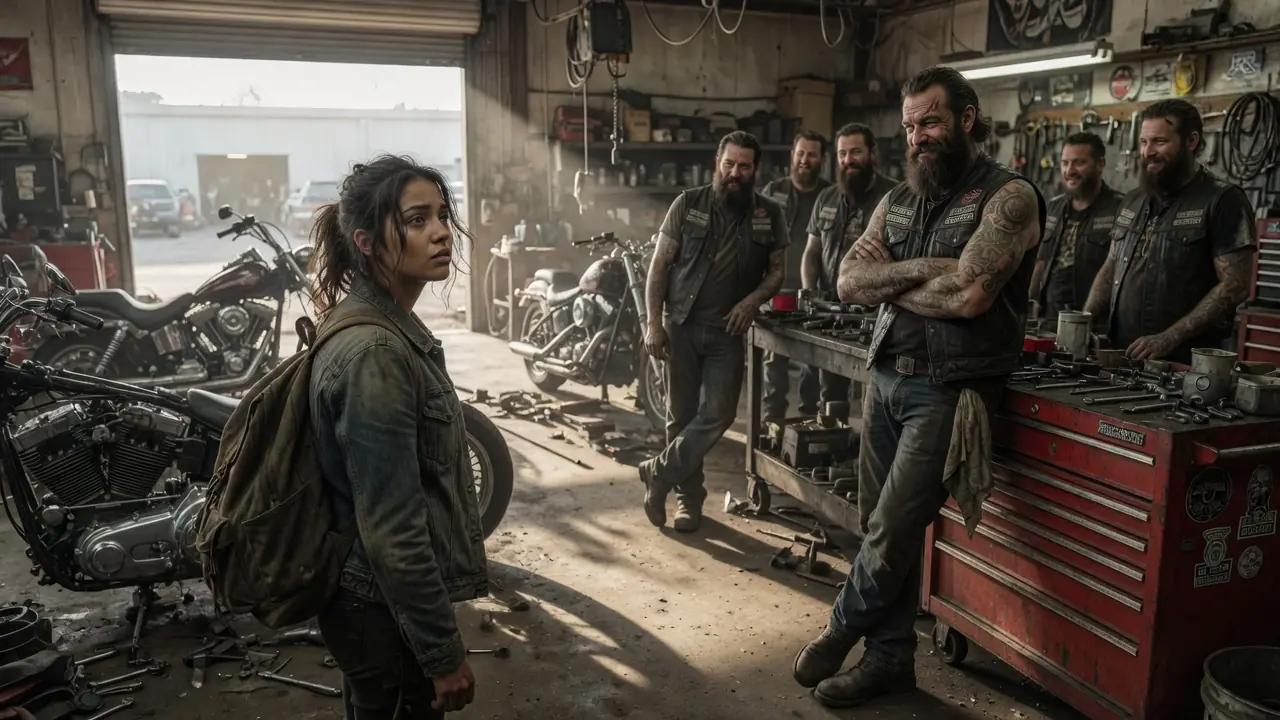
The next afternoon, Lily sat in a van driven by Todd, one of Sunshine Valley’s drivers. They drove through Phoenix’s industrial district to Devil’s Forge, a large garage with bay doors and a hand-painted sign featuring flames and a motorcycle.
Six bikes were parked outside. Men in leather vests moved around the garage, working on motorcycles.
“This is it,” Todd said. “You sure about this, kid? These biker dudes look rough.”
“I’m sure,” Lily said, though she wasn’t.
She grabbed her backpack and climbed out.
As she approached the garage, several men looked up. They were intimidating, big, tattooed, wearing leather vests with patches that said Nomads MC.
One had a beard down to his chest. Another had scars across his face. A third had a prosthetic arm.
“You must be Lily,” a voice said.
An older man approached, maybe fifty, with gray in his hair and beard, arms covered in faded tattoos. His eyes were kind.
“I’m Marcus. People call me Wrench. You’re right on time.”
Lily nodded, not trusting her voice.
“Come on. I’ll show you around.”
Wrench gestured for her to follow.
“Boys, this is Lily. She’s going to be helping out. Lily, these are my brothers. Bear, Snake, Doc, Razer.”
The men nodded.
Bear gave a small wave.
Snake smiled.
Doc said, “Welcome aboard, kid.”
“Your job is simple,” Wrench explained. “We work on bikes all day, which means this place gets messy. Your job is to help keep it organized. Sweep the floors, put tools back, keep the workspace clean. Think you can handle that?”
“Yes, sir,” Lily said quietly.
“Just Wrench is fine. We’re not big on formality.”
He showed her where the broom was, where tools belonged.
“Work at your own pace. If you need help, ask. If anyone makes you uncomfortable, tell me immediately. Got it?”
“Got it.”
“Good. And we’ve got a fridge with drinks and snacks over there. Help yourself whenever you want.”
Lily stared at him, searching for the catch.
Adults didn’t offer things without expecting something in return.
But Wrench just smiled and went back to work.
She grabbed the broom and began sweeping.
The garage was huge, covered in oil stains and metal shavings. As she worked, she observed the men.
They talked easily, teasing, joking, occasionally arguing about fixing things. They swore a lot, but also laughed a lot.
“Lily, you want some water?” Bear called after thirty minutes.
“I have some,” Lily said.
“How about a Coke or juice?”
“I’m okay, thank you.”
Bear exchanged a glance with Wrench, who just shrugged.
At 5:30, Todd returned. Lily had swept the entire garage floor, organized three tool benches, and put away dozens of tools.
Wrench walked her to the van.
“You did good work today, Lily. Real good. See you Thursday.”
“Yes, sir. I mean, Wrench.”
“Good. Hey, Lily. One more thing.”
She turned.
“You’re safe here. I know you don’t believe that yet, but you will. This is a good place. We’re good people. You’ll see.”
Lily didn’t respond.
She had heard that promise seven times before in seven different foster homes.
She climbed into the van and didn’t look back.
Lily returned to Devil’s Forge on Thursday, then Monday. Each time she swept, organized, and stayed quiet while the Nomads worked on motorcycles.
After the first week, Wrench approached her.
“You’re doing great, but do you know anything about tools, like what they’re called?”
Lily shook her head.
“Want to learn?”
She hesitated, then nodded.
For the next hour, Wrench taught her.
“This is a socket wrench. This is a torque wrench. This is a hex key.”
Lily absorbed the information like a sponge. By the end, she could identify twenty different tools.
“You’re a quick learner,” Wrench said, impressed. “How’s school going?”
“Fine,” Lily said automatically.
“You like it?”
Lily shrugged.
School was school. She was good at it, but she didn’t have friends.
“What do you like to read?” Wrench asked, noticing the library book in her backpack.
“Adventure books. Fantasy. Anything with magic.”
“Yeah? Why is that?”
“Because in those books, orphans always turn out to be secretly special. They discover they have powers, or they’re the chosen one. It’s stupid, but it’s nice to pretend.”
Wrench’s expression softened.
“It’s not stupid. Everyone needs to believe they’re special sometimes. You know what I think? I think you are special. You’re smart. You work hard. You don’t complain. That’s rare.”
Lily didn’t know how to respond, so she didn’t.
She went back to sweeping.
Over the following weeks, a routine developed.
Lily would arrive at 3:30, work until 5:30, learning more about tools and motorcycles. The Nomads gradually included her in conversations, asking her opinion on paint colors, letting her help with simple tasks.
Bear started bringing her snacks.
Homemade cookies.
Fruit.
Sandwiches.
“My old lady makes too much. Help us eat it.”
Doc taught her about motorcycle engines, explaining how combustion worked. Lily found it fascinating.
Snake, despite his scary appearance, was the gentlest. He noticed when Lily was tired and would suggest breaks.
He had lost a daughter to leukemia five years ago and recognized trauma in children.
Razer was the holdout, watching Lily with suspicion. Wrench explained that Razer had been abused as a kid and didn’t trust easily.
“Give him time. He’ll come around.”
One Thursday in October, Lily arrived to find the garage decorated with balloons and a cake on the break table.
She froze, immediately suspicious.
“What’s this?” she asked warily.
“It’s for you,” Wrench said. “Mrs. Patterson told me your birthday was last week. You turned sixteenth, right? We wanted to celebrate.”
“I’m already sixteenth. My birthday was in April.”
Wrench consulted a paper.
“Huh. Must have gotten the dates wrong. Oh well, cake’s cake. Come on, kid.”
It was a chocolate cake with vanilla frosting. The Nomads sang “Happy Birthday” off-key, and they gave her presents.
A set of her own tools, kid-sized, but real.
A book about motorcycles.
A Nomads MC T-shirt.
And an envelope containing two hundred dollars.
“What’s this for?” Lily asked, staring at the cash.
“Whatever you want,” Bear said. “Books, clothes, toys. Consider it a signing bonus.”
Lily had never had two hundred dollars.
She had never had a birthday party that wasn’t generic.
She had never had adults who remembered her birthday and cared enough to celebrate.
Something cracked inside her carefully constructed walls.
Not broke.
Just cracked.
“Thank you,” she whispered.
And meant it.
After that, things shifted.
Lily started talking more. She would tell the Nomads about school, about books, about small frustrations.
They listened, really listened, and remembered details.
She started trusting them with small vulnerabilities.
When her shoes fell apart, she told Wrench instead of hiding it. He took her shoe shopping, let her pick out two pairs, and didn’t make her feel bad.
When she got in trouble at school for punching a boy who had called her orphan trash, Doc picked her up from the principal’s office. Instead of yelling, he took her for ice cream.
“Kid was an idiot. But next time, use your words first. Violence is a last resort. Got it?”
“Got it.”
The Nomads were teaching her things foster homes never had.
Not just about motorcycles, but about respect, loyalty, how to handle anger, how to ask for help.
They showed up for her every Monday, Thursday, and Friday without fail.
Three months into her job, Lily asked Wrench the question that had been building.
“Why did you really ask for me?”
Wrench set down his wrench and faced her.
“I had a daughter. Her name was Casey. She’d be sixteentheen now if…”
He paused.
“She died in a car accident ten years ago. Drunk driver. She was sixteenth, your age. After she died, I fell apart. Drinking, fighting, nearly destroyed myself and this club. My brothers pulled me back. Gave me purpose.”
He looked at Lily directly.
“When Mrs. Patterson called asking if we’d take a kid, I almost said no. But then she mentioned you. sixteenth years old, seven failed foster homes, trouble connecting, and something clicked. I thought maybe I can’t save Casey, but maybe I can help this kid. Maybe that’s my redemption.”
Lily nodded slowly.
“You’re using me to feel better about losing your daughter.”
“No,” Wrench said firmly. “I’m giving you what Casey would have wanted me to give. A chance. A place to belong. You’re not replacing her. You’re you, and you matter because of who you are.”
Lily absorbed this.
“What about the others? Why do they care?”
“We’ve all lost something. Bear’s kids won’t talk to him after his divorce. Snake lost his daughter to cancer. Doc lost his arm in Afghanistan and his marriage after. Razer was abused as a kid and spent time in foster care himself.”
Wrench glanced around the garage.
“We’re broken people. We found each other and built something. When you showed up scared and trying so hard to be tough, we saw ourselves. We saw a chance to do for you what someone should have done for us. Show up. Care. Not give up.”
Lily felt tears threaten.
“I’m just a job. When the program ends, I’ll go back to Sunshine Valley, and you’ll forget about me.”
“Is that what you think?”
Wrench looked genuinely hurt.
“Lily, you stopped being just a job about two days after you started. You’re part of this now. You’re one of us, and we don’t forget family.”
“I’m not your family,” Lily said, but her voice wavered.
“Not yet,” Wrench agreed. “But you will be. If you want to be. That’s up to you.”
The holidays approached.
Lily had spent every holiday in institutions or temporary foster homes, watching other people celebrate while she remained an outsider.
This year was different.
The Nomads invited her to Thanksgiving at Bear’s house. His wife, Maria, cooked enough for an army.
Twelve Nomads members showed up with their families. Lily sat at the kids’ table, surrounded by Bear’s grandchildren and other club members’ kids.
They included her in conversations and taught her card games.
She belonged here.
After dinner, Lily found Wrench on the back porch.
“Why did you tell people I’m your kid?”
“Because you are. Maybe not legally yet, but you are.”
“Yet?”
Wrench turned to face her.
“The work program ends in January. After that, you go back to Sunshine Valley full-time. But I’ve been talking with my lawyer and Mrs. Patterson. I want to apply to be your foster parent officially. You’d live with me in my house as part of my family. What do you think?”
Lily’s world tilted.
“You want to foster me? Why? Seven families couldn’t handle me.”
“Seven families didn’t deserve you,” Wrench corrected. “And you’re not damaged. You’re hurt. There’s a difference. Hurt heals with the right care. I want to give you that care. I want to be your dad. Would you want that?”
Lily couldn’t speak.
She nodded, tears finally falling.
Wrench pulled her into a hug, the first real hug she had had in years.
“Then we’ll make it happen. It’ll take time. Paperwork, home studies, interviews. But I’m not going anywhere. Neither are you.”
The process took months.
Social workers visited Wrench’s house. They interviewed him extensively about his past, his finances, his support system.
They interviewed the other Nomads.
They interviewed Lily about what she wanted.
“Do you feel safe with Mr. Caldwell?” the social worker asked.
“Yes.”
“Do you want to live with him?”
“Yes.”
“Why?”
“Because he shows up. Because he doesn’t lie. Because he teaches me things and doesn’t get mad when I make mistakes. Because when I’m with him and the Nomads, I’m not just a case file. I’m Lily, and that matters.”
In March, five months after Lily first walked into Devil’s Forge, the judge approved Wrench as her foster parent.
It would be a trial period, six months, with regular check-ins.
But unless something went wrong, Lily had a home.
Wrench picked her up from Sunshine Valley on a Saturday morning, her belongings fitting in two cardboard boxes.
Mrs. Patterson hugged her goodbye.
“You got lucky, Lily. These are good people. Don’t mess it up.”
“I won’t,” Lily promised.
Wrench’s house was small but comfortable. He had converted his daughter’s old room into Lily’s room.
Fresh paint.
New furniture.
Shelves for books.
Posters on the walls.
“We can change anything you don’t like.”
“It’s perfect,” Lily said.
And meant it.
That first night, Wrench made spaghetti, the only thing he knew how to cook. They ate at the kitchen table, and it felt surreal.
“Rules,” Wrench said after dinner. “One, school comes first. Two, honesty always. If you mess up, tell me. Three, you’re allowed to have feelings. Mad, sad, scared, whatever. Four, the garage is still your space. The Nomads are still your uncles. Five, this is your home. Not temporary. Not conditional. Your home.”
“Got it.”
“Good. Now, your birthday is actually in April, right? What do you want to do for it?”
For the first time in her sixteenth years, Lily had someone asking what she wanted.
“Can we have a party at the garage with the Nomads?”
“Absolutely. Best idea ever.”
Over the following months, Lily adjusted to living with Wrench.
It wasn’t always easy. She had nightmares, moments of testing boundaries, panic attacks when things seemed too good.
But Wrench was patient.
He didn’t yell when she acted out. He didn’t give up when she pushed away.
He just showed up every day, steady and present.
The Nomads became her family.
Bear taught her to cook.
Doc helped with homework.
Snake took her to the library.
Razer, who had finally warmed up, taught her chess.
They attended her school events and made sure she knew she was loved.
Six months into the foster placement, the social worker did her final evaluation.
“This is one of the most successful placements I’ve seen. Lily’s thriving. I’m recommending we move forward with adoption proceedings.”
“I’m interested,” Wrench said immediately.
The adoption was finalized on Lily’s ninth birthday, April 15th, a year and a day after she had first walked into Devil’s Forge.
The judge signed the papers, making her legally Lily May Caldwell, daughter of Marcus Caldwell.
The party at the garage was massive.
Fifty club members showed up. There was barbecue, cake, music, and presents.
Lily wore her Nomads T-shirt proudly.
“Speech!” someone yelled.
Lily climbed onto her workbench.
“A year ago, I thought I’d be in the system forever. But then I got sent to work here, and everything changed. You didn’t see a broken foster kid. You saw me. You taught me that family isn’t about blood. It’s about who shows up, who cares, who doesn’t give up. Thank you for being my family. I’m never going to forget this.”
The garage erupted in cheers.
Wrench hugged his daughter, and for the first time since Casey died, his heart felt whole.
Lily May Caldwell had finally found her forever family, and the Nomads had found their redemption.
Proof that broken people could heal each other, that love came in unexpected forms, and that sometimes the most unlikely families were the strongest ones.
Life, as Lily May Caldwell, took adjustment.
For nine years, she had lived with the certainty that nothing was permanent. Now, everything was supposed to be permanent, and that terrified her.
The nightmares came frequently those first months. She would wake up screaming, convinced she was back at Sunshine Valley.
Wrench would appear within seconds, turning on the light, sitting on her bed until she calmed down.
“I’m here,” he would say every time. “You’re home. You’re safe. I’m not going anywhere.”
Sometimes she would test him, acting out at school, breaking rules, pushing boundaries to see when he would crack.
But Wrench never cracked.
He set consequences for bad behavior, but never threatened to give up on her.
School was another challenge.
Kids knew she had been adopted by that biker guy, and opinions were split.
Some thought it was cool.
Others said her dad was probably a criminal.
When a boy named Tyler started a rumor that Wrench sold drugs, Lily punched him in the cafeteria.
The principal called Wrench.
Lily sat in the office waiting for the lecture about how she had embarrassed him, how maybe this wasn’t working out.
Wrench arrived in his work clothes, grease-stained jeans, Nomads vest.
The principal, Mrs. Henderson, looked uncomfortable.
“Mr. Caldwell, Lily punched another student. This is her second incident. We have a zero-tolerance policy for violence.”
“What did the other kid do?” Wrench asked.
“Excuse me?”
“What did he do to make Lily punch him? Because my daughter doesn’t throw punches for no reason.”
“He made comments about your profession.”
“So he was bullying her about her family, and she defended herself.”
Wrench turned to Lily.
“Was it worth it?”
Lily shrugged.
“He’s been saying stuff for weeks. I told teachers. They don’t do anything.”
“I appreciate you defending me, but you can’t punch everyone who talks trash. You’ll spend your whole life fighting.”
He turned to Mrs. Henderson.
“What’s the punishment?”
“Three-day suspension.”
“Fair enough. Lily, apologize to Mrs. Henderson.”
“I’m sorry,” Lily mumbled.
“And you’ll write an apology letter to Tyler. Not for defending yourself, but for handling it with violence instead of words.”
In the truck ride home, Wrench was quiet until they pulled into the driveway.
“Casey used to say being tough doesn’t mean hitting first. It means not needing to hit at all because you’re so confident in who you are that other people’s opinions don’t matter.”
“Oh.”
“She was smarter than me.”
“I just wanted them to stop talking about you like you’re bad.”
“I know. And I love that you want to protect me. But I’m a grown man. I can handle people’s opinions. Let me worry about me. You worry about being a kid. Deal?”
“Deal.”
The suspension became a turning point.
During those three days home, Wrench took Lily to the garage and taught her advanced mechanical skills. They worked on an engine rebuild together.
“You’re a natural at this,” Wrench said as Lily successfully reassembled a carburetor. “You could be a mechanic someday if you wanted, or an engineer, or whatever you want. Point is, you’re smart and capable. Don’t waste that on punching idiots.”
When Lily returned to school, Tyler approached nervously.
“My mom made me apologize. So, sorry for saying stuff about your dad. But also, I saw the picture you drew in art class of you and your dad working on a motorcycle. It was really good. You looked happy. I was jealous because my dad’s never around, so I said mean things. Sorry.”
Lily studied him, seeing past the bully to the hurt kid.
“My dad says hurt people hurt people. I get it. We’re good.”
Tyler nodded, relief obvious.
And Lily learned that sometimes understanding someone’s pain was more powerful than fighting them.
Fourth grade ended with Lily on the honor roll.
Bear threw her a celebration dinner, the whole Nomads family showing up. Maria made enchiladas and presented Lily with a custom leather jacket.
Child-sized, soft brown leather, with Nomads Princess embroidered on the back.
“You’re one of us,” Bear said. “Official now.”
Lily wore that jacket everywhere.
It became her armor.
Her identity.
Her pride.
Summer brought new adventures.
Wrench taught her to ride a dirt bike. The club organized camping trips where Lily learned to fish and start fires.
Snake taught her woodworking.
Doc taught her first aid.
Razer taught her chess strategy.
But the biggest change came in August, when Wrench sat Lily down.
“I’ve been thinking about something. The house is fine, but it’s small. You’re growing. I’ve been looking at houses. Found one I like. Three bedrooms, big garage, fenced yard. But it’s our decision, not just mine. This is your home, too. Do you want to look at it with me?”
Lily had never been asked her opinion on where she lived.
“You’re asking me?”
“Of course. We’re a team. We make big decisions together.”
They looked at the house that weekend.
A modest ranch-style home in a quiet neighborhood. It had a huge backyard and a bedroom with windows overlooking trees.
“What do you think?” Wrench asked.
“Can I paint my room?”
“Any color you want.”
“Can we get a dog?”
“Absolutely.”
“Then yes. Let’s do it.”
They moved in October.
The Nomads helped load trucks and assemble furniture.
Lily’s room became her sanctuary. Walls painted teal, shelves for books, a desk for homework.
Two weeks after moving in, they went to the animal shelter.
Lily fell in love with a German Shepherd mix named Duke. He was big, goofy, and protective.
“He’s the one,” Lily declared.
Duke came home that day, immediately attaching himself to Lily. He slept in her room and walked with her to the bus stop.
He was her constant companion.
Fifth grade brought new challenges.
Lily was excelling academically but struggling socially. She was different from other kids.
She had a biker dad.
She worked at a motorcycle shop.
She wore a leather jacket with club patches.
“You’ve got friends at the garage,” Wrench said. “That’s enough.”
“But I want friends at school, too. Normal friends.”
“Then find them. But don’t change who you are to fit in. Real friends accept you as you are.”
In November, a new girl arrived.
Emma Rodriguez.
She had just moved from California, knew nobody, and looked uncomfortable. When some boys teased Emma about her accent during lunch, Lily intervened.
“Leave her alone.”
“Why? You going to punch us like you did Tyler?”
“No. But Tyler learned his lesson, and if you’re smart, you’ll learn it faster.”
The boys backed off.
Emma looked at Lily gratefully.
“Thanks. I’m Emma.”
“Lily. You want to sit with me?”
They became inseparable.
Emma loved that Lily’s life was different. She thought the motorcycle shop was the coolest thing ever.
Wrench approved after meeting Emma and her parents, Miguel and Sophia Rodriguez, who owned a bakery downtown.
Emma started spending weekends at Lily’s house and became comfortable at Devil’s Forge.
“Honorary member,” Bear declared.
Having Emma changed everything.
Lily finally had someone at school who understood her, defended her, celebrated her differences.
They were both outsiders, and they built their own world together.
But happiness attracted attention.
In January, a social worker appeared at Devil’s Forge unannounced.
Ms. Thornton, conducting random home checks on adoptive placements.
Ms. Thornton looked at Devil’s Forge with obvious distaste. Wrench, covered in grease and wearing his vest, must have confirmed every stereotype.
“Mr. Caldwell, I’m here for a home inspection. Where’s Lily?”
“At school, where she should be at 2:00 p.m. on a Tuesday.”
“I need to see your home and interview Lily.”
“You’re welcome to do that, but you’ll make an appointment first. You can’t just show up and demand access.”
“I have the legal right.”
“And I have the legal right to refuse unscheduled inspections. Call my lawyer, schedule a time, and we’ll accommodate you.”
Ms. Thornton’s face flushed.
“I’ve read your file. Criminal record. Motorcycle club affiliation. I’m here to ensure Lily’s welfare.”
“My record is minor charges from thirty years ago. My club is legal. But sure. Come do your inspection. You’ll find a happy, healthy, thriving kid.”
The inspection happened three days later.
Ms. Thornton walked through their home with a clipboard. She interviewed Lily at length.
“I love my dad,” Lily said firmly. “I love my home. I love my life, and I don’t appreciate you trying to find problems where there aren’t any.”
Ms. Thornton interviewed Lily’s teachers, who raved about her progress. She interviewed Emma’s parents, who spoke highly of Wrench.
She even interviewed several Nomads members.
Two weeks later, Ms. Thornton filed her report.
Lily Caldwell is thriving in her adoptive home. Marcus Caldwell has provided a stable, loving environment. This placement is successful and should continue without further interference.
Wrench framed the report and hung it in the garage.
“Proof that you can’t judge people by their patches.”
The incident strengthened Lily’s sense of belonging.
She was loved.
She was wanted.
She was home.
Middle school loomed in the fall.
Sixth grade at Roosevelt Middle.
Lily was nervous but excited. Emma would be there, and they had coordinated schedules.
The summer before sixth grade, Wrench expanded Lily’s responsibilities at Devil’s Forge. She wasn’t just sweeping anymore.
She was helping with actual repairs, working alongside Nomads members on customer bikes.
“You’re good with people,” Wrench observed after Lily charmed a difficult customer. “Better than me. I’m too blunt. You’ve got people skills.”
“I learned from watching you,” Lily said. “You’re honest. You don’t oversell. You care more about doing the job right than making money. People respect that.”
“When did you get so wise?”
“I’ve always been wise. You just started listening.”
Wrench laughed, pulling her into a side hug.
“Yeah, you’re right.”
For her eleventh birthday in April, the Nomads threw a massive party at the new house.
Fifty people showed up. Club members, their families, Emma and her family, Lily’s teachers, even Mrs. Patterson from Sunshine Valley.
Bear presented Lily with a custom motorcycle helmet, pink and black with flames.
“For when you’re old enough to ride, which won’t be for several years.”
“I’m getting ideas,” Lily grinned.
Doc gave her a leather-bound journal.
“For writing down your story. You’ve got a hell of a story, kid.”
Snake gave her a hand-carved wooden box with her name engraved.
“For keeping your treasures.”
Razer gave her a chess set made of motorcycle parts.
“So you remember strategy, patience, and always protect your family.”
Wrench’s gift was last.
An envelope containing adoption papers, the originals in a frame, and a letter.
“Read it later when you’re alone.”
That night, Lily opened the letter in her room, Duke sprawled across her feet.
Lily,
Two years ago, you walked into my garage, a scared, tough little girl who had been failed by every adult. You didn’t trust me, but you gave me a chance, and in doing so, you gave me a reason to be better.
You saved me as much as I saved you. Being your dad is the greatest honor of my life.
You’re my daughter forever.
Love, Dad.
Lily cried reading it.
Good tears.
Healing tears.
She tucked the letter into Snake’s treasure box.
Sixth grade started strong.
Lily and Emma navigated middle school together, joining robotics club and the soccer team. Lily discovered she loved soccer.
Wrench came to every game, usually with half the Nomads chapter, cheering embarrassingly loud.
In October, Devil’s Forge celebrated its twentieth anniversary.
Wrench organized a community open house. Free bike inspections, food trucks, live music.
Hundreds of people showed up.
Lily worked the event, giving garage tours and explaining motorcycle basics to curious kids.
Parents watched her, this well-spoken, confident eleven-year-old in a Nomads vest, and reconsidered their assumptions.
“You’re changing minds,” Wrench told her. “People see you smart, happy, healthy, and they realize we’re not what they thought.”
“Good, because you’re not. You’re better.”
The following spring, Lily asked Wrench about her biological parents for the first time.
“Do you know anything about them?”
“I know what was in your file. Your mom was young, sixteen when she had you. She tried but couldn’t handle a baby. Your dad wasn’t in the picture. She surrendered you to the state when you were four months old.”
“Do you think she ever wonders about me?”
“Probably. Giving up a child is hard. She was a kid herself.”
“Do you think I should try to find her?”
Wrench chose his words carefully.
“That’s your choice. If you want to search, I’ll support you. But Lily, no matter what you find or don’t find, it doesn’t change us. You’re my daughter. That’s not biology. That’s choice.”
Lily thought about it for weeks.
Finally, she decided.
“I don’t need to search. Maybe someday I’ll be curious again. But right now, I have everything I need. I have you, the Nomads, Emma, Duke, our home. I have a family. That’s enough.”
“You sure?”
“I’m sure.”
Wrench hugged her tight.
“I’m proud of you every single day.”
Lily May Caldwell was twelve years old and knew three things for certain.
Family is who shows up.
Broken people can heal each other.
And home isn’t a place. It’s the people who love you no matter what.
Four years after walking into Devil’s Forge expecting nothing, she had found everything.
A father who saw her.
Uncles who protected her.
A community that embraced her.
A best friend who understood her.
And a future full of possibility.
She had been told her whole life she was too difficult, too damaged, too much.
But the Nomads had taught her different.
She wasn’t too much.
She was exactly enough.
And she was loved fiercely, completely, permanently.
Devil’s Forge wasn’t just a motorcycle shop.
It was where broken things got fixed.
Bikes.
Hearts.
Lives.
It was where a scared sixteenth-year-old foster kid found a family.
It was where redemption happened daily.
And Lily.
She was living proof that sometimes the most unlikely families are the strongest ones.
That love doesn’t require blood.
That home is built by people who choose to stay.
That second chances are real.
And that happy endings aren’t just for storybooks.
They’re for anyone brave enough to believe in them.