The beautiful American Widow froze over the washbasin, both hands submerged in gray water as the Cowboy’s words settled across the silent Wyoming kitchen. She had arrived that morning expecting one day of work, perhaps two if she scrubbed hard enough and kept her children out of sight. Instead, the handsome American Single Dad stood in the doorway with his hat pressed against one thigh, telling her she was not leaving. She could not decide whether the words were mercy, employment, or another kind of danger.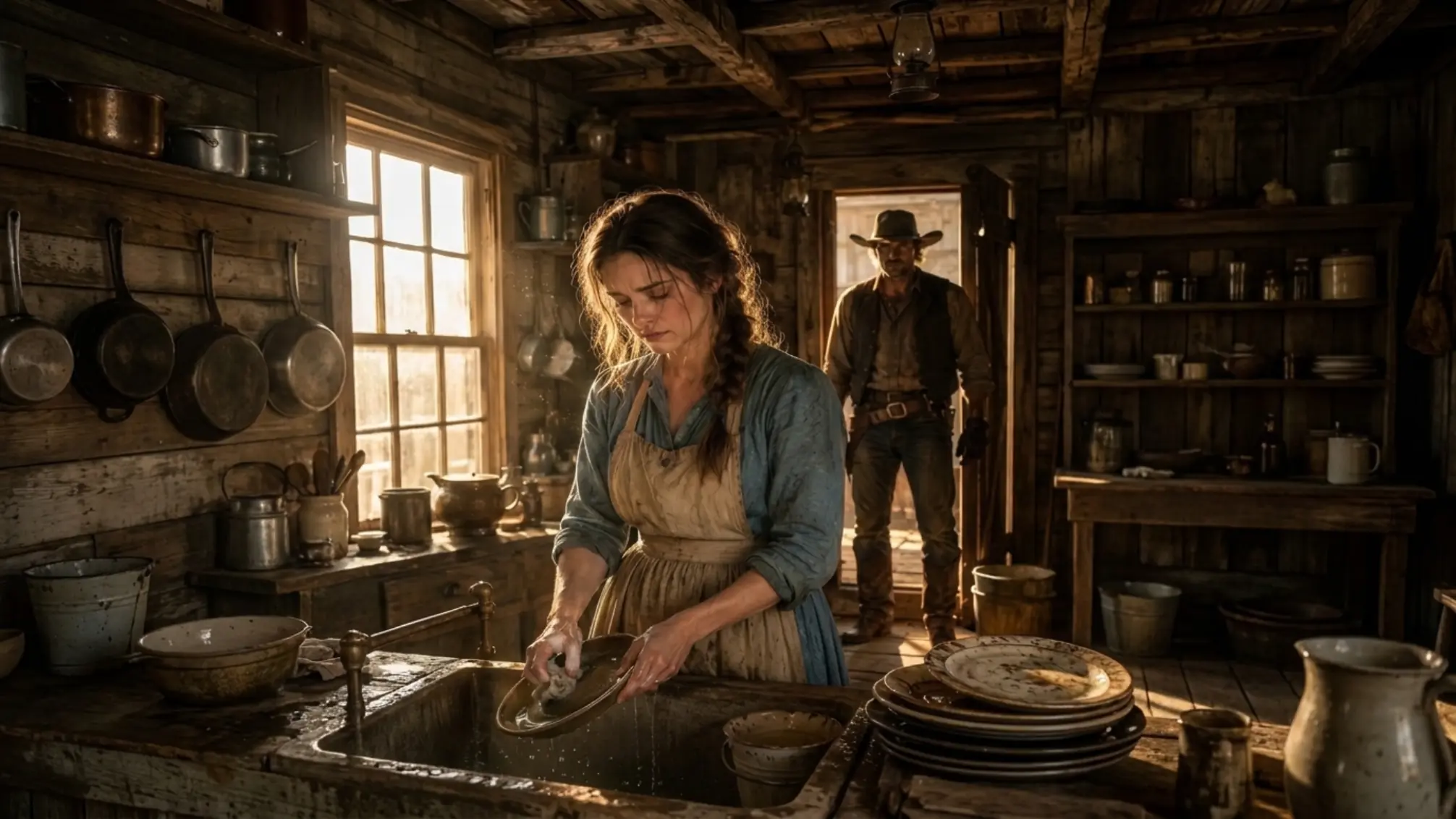
Outside the ranch house, her three daughters waited beneath the shade of a cottonwood tree with the single blanket and wooden trunk that contained everything their family still owned. The oldest was ten and tried to look brave for the younger girls. The middle daughter was seven and watched the ranch windows as if she expected their mother to be sent back outside at any moment. The youngest, only four, slept with her head in her sister’s lap because hunger had exhausted her before noon.
The Widow had not eaten since the previous morning. She had saved the last piece of bread for her daughters and told them she was not hungry, a lie they were becoming old enough to recognize. Her once-elegant blue dress had faded from washing, and her cream apron carried old stains that no amount of scrubbing could remove. Yet even after months of grief, debt, and public humiliation, there was something graceful in the way she stood.
Her husband had died beneath a collapsed timber frame while helping repair a trading post outside town. The owner claimed the accident was the dead man’s fault and refused to pay the wages still owed to the family. The Widow sold their horse first, then the furniture, then the small house her husband had spent seven years building. By the time winter released the Wyoming plains, she and her daughters were sleeping in the storeroom behind a dressmaker’s shop.
The people of Bitter Creek called her proud because she refused to send her daughters away. Several families offered to take one child each, as though separating the sisters were an act of kindness. The Widow always answered the same way.
“My girls have already lost their father. They will not lose one another.”
That refusal turned sympathy into irritation. People who offered help wanted gratitude expressed through obedience, and the Widow would not let poverty make every decision for her. By summer, the dressmaker needed her storeroom back, and the Widow had three days to find another place.
The suggestion of the isolated ranch came from the town’s General Store Owner. He was a broad, wealthy American man with polished boots, a smooth voice, and a habit of watching desperate people calculate how much dignity they could afford. He told the Widow that a lonely ranch owner lived twelve miles north and had no woman in the house.
“He needs cooking and cleaning,” the Store Owner said. “You need a roof. Maybe he will overlook the children if you make yourself useful.”
The laughter of the men near the stove told the Widow what they believed “useful” meant. She ignored them, thanked the Store Owner for the direction, and walked out with her daughters. No wagon was offered, so they crossed the plains on foot.
The ranch appeared near sunset, spread across a valley of tall grass and dark cattle. Its barn was solid, its fences straight, and smoke rose from a stone chimney beside the large log house. The property looked prosperous compared with anything near town, but it carried a loneliness that could be felt before the Widow reached the porch.
The Cowboy answered the door with one hand resting near his belt. He was a tall, ruggedly handsome American man in his early forties, with sun-bronzed skin, intense blue eyes, thick dark hair, and a full beard. His weathered hat shaded a face that had forgotten how to welcome strangers. Behind him stood a handsome nine-year-old American boy with cautious eyes and a wooden horse clutched against his chest.
The Cowboy studied the Widow, then the daughters behind her.
“Town send you?”
“The General Store Owner said you might need help.”
“I need work done. I don’t run a shelter.”
The Widow held his gaze. “Then give me work.”
He asked what she could do.
“Cook. Clean. Sew. Keep accounts. Tend a garden. Care for children. Help with livestock if someone shows me what is needed.”
The Cowboy glanced toward the kitchen, where dirty dishes were stacked beside the basin and several pans sat blackened near the stove. His son had been eating beans directly from a cooking pot. The house was not filthy, but it bore the signs of two males surviving rather than living.
“Start with the dishes,” he said. “We will talk after.”
There was no warm greeting and no promise of supper. He handed her an apron, showed her the pump, and returned outside. Anyone watching might have believed he had reduced a grieving mother to unpaid labor before deciding whether she deserved a meal.
The Widow believed it too.
Still, she tied the apron around her waist and began working. She heated water, scraped dried food from plates, cleaned the basin, and removed grease from pots that had not been properly washed in months. Her hands were cracked from earlier labor, and the hot water burned every small cut, but she never stopped.
The Cowboy returned twice without entering. From the doorway, he watched her scrub while his son sat quietly at the table. The boy had spoken only one sentence since she arrived.
“Do the girls have names?”
The Widow answered gently that they did, but the Cowboy had asked her not to use names while they discussed the arrangement. The boy accepted that and returned to carving the wooden horse.
When the Widow finished the dishes, she swept the floor. After sweeping, she cleaned the stove and reorganized the pantry. She found flour infested with insects, meat stored too close to heat, and enough dried beans to feed the household for months. She did not throw away anything usable.
By the time evening settled across the valley, she had prepared stew, corn cakes, and cooked apples with cinnamon. She carried portions outside to her daughters before placing the remaining food on the ranch table. The Cowboy noticed that her own bowl contained less than anyone else’s.
He pushed half his corn cake onto her plate.
“I can earn my own food,” she said.
“You already did.”
His son ate two bowls of stew. The youngest daughter fell asleep beside the stove, and the older girls helped clear the table without being asked. For one brief hour, the lonely house sounded almost like a home.
Then the Widow asked what he would pay.
The Cowboy leaned back in his chair. “You do not waste time.”
“I cannot afford to.”
He offered meals, use of the small bunkhouse room, and two dollars a week if she cooked, cleaned, and helped his son with lessons. The Widow asked whether her daughters could remain with her.
He looked toward the three girls. “If they respect the animals, stay out of the branding pens, and help where they can.”
“They will.”
“Then they stay.”
Relief almost broke her composure, but she kept her voice steady. “For how long?”
“A week. After that, we decide whether this arrangement works.”
The Widow thanked him, though both understood that one week of shelter could become another cruel ending if he changed his mind.
The next morning, she rose before the ranch bell. She cooked breakfast for the Cowboy, his son, and eight ranch hands who lived in the bunkhouse. The men entered expecting burnt coffee and beans. They stopped when they saw eggs, potatoes, biscuits, and thick gravy covering the table.
One Ranch Hand grinned at the Cowboy. “You finally buy yourself a wife?”
The room fell silent.
The Widow continued pouring coffee.
The Cowboy placed both hands on the table. “She is here to work. You will speak to her with respect or eat outside.”
The Ranch Hand’s smile disappeared. No one challenged the Cowboy again.
During the first week, the Widow transformed the kitchen without spending money. She repaired torn flour sacks, rendered leftover fat into cooking grease, dried herbs beside the window, and began a small vegetable patch behind the house. Her daughters collected eggs, folded laundry, and helped the Cowboy’s son with reading.
The children became friends before either adult expected it. The boy showed the girls how to approach horses without frightening them. The oldest daughter taught him long division, which he hated but needed. The youngest followed him everywhere, calling him “Brother” by the end of the week.
The Cowboy noticed his son laughing again.
The boy’s mother had died of fever four years earlier. Since then, father and son had lived in the same house while protecting separate griefs. The Cowboy could manage cattle, storms, and violent bulls, but he had never learned how to enter the silence surrounding his child.
The Widow never forced the boy to discuss his mother. She simply set an extra place at the table on the anniversary of the woman’s death and allowed him to place a wildflower beside the empty plate. That night, the boy cried against his father’s chest for the first time in years.
The Cowboy extended the Widow’s employment for a month.
“You have not decided whether the arrangement works?” she asked.
“I decided.”
“Then why only a month?”
“Because you look like a woman counting the days until she can leave.”
She lowered her eyes. “I count the days until someone tells us to.”
That answer stayed with him.
The following week, the General Store Owner arrived in a polished wagon. He claimed the Widow owed money for flour, blankets, and rent from the months after her husband’s death. He presented a ledger showing interest charges that had nearly tripled the original debt.
The Widow went pale.
The Cowboy read the figures carefully. “Did she sign this?”
“She took the goods.”
“That was not my question.”
The Store Owner’s smile sharpened. “A widow with three mouths does not get generous terms.”
The Cowboy placed the ledger on the porch rail. “You added interest she never agreed to.”
“Town law allows a merchant to recover losses.”
“There is no such law.”
The Store Owner laughed. “Since when do cattlemen understand contracts?”
The Widow stepped between them. She did not want violence or another debt created in her defense. “How much did I originally owe?”
The Store Owner named a figure one-third of the total.
She asked for six weeks.
“You have had months.”
“I had no wages then.”
The Store Owner looked toward the Cowboy. “She thinks because she washed your plates, she owns protection now.”
The Cowboy’s expression changed.
“She does not need to own anything to deserve protection.”
The Store Owner leaned closer to the Widow. “You will never pay. Women like you always find another man to carry the burden.”
The Cowboy stepped off the porch, forcing the merchant backward without touching him. “Leave the original account. Remove the false interest. She will pay what she owes and not a penny more.”
“And if I refuse?”
“Then every ranch within thirty miles hears how you create debt after customers lose their husbands.”
The Store Owner’s confidence weakened. Ranchers purchased flour, tools, coffee, and feed in large quantities. Losing their business would cost more than exploiting one Widow could earn.
He left the corrected account and drove away furious.
The Widow waited until the wagon disappeared. “You should not have done that.”
“Stopped him from stealing?”
“Made my problem yours.”
The Cowboy looked toward the kitchen where four children were laughing over a badly shaped pie. “Your problems entered my house with you.”
“That does not make them yours.”
“No. Choosing does.”
The Widow worked harder after that, determined to repay the debt without charity. She began baking bread and pies for neighboring ranches. The Cowboy allowed her to use his wagon every Saturday, and his son helped make deliveries.
Within a month, she paid half the corrected debt.
The ranch also began changing in ways neither adult had planned. The hands arrived early for meals and stayed longer at the table. Repairs were completed faster because men were better rested and properly fed. The Widow kept a small notebook of supplies and discovered that the Ranch Foreman was ordering twice as much grain as the cattle consumed.
The missing feed was not being wasted.
It was being sold.
The Foreman had worked for the Cowboy for six years and knew every corner of the property. He had been secretly moving bags of grain to the General Store Owner in exchange for cash. Together, they planned to weaken the ranch until the Cowboy needed a loan, then take control of the northern grazing fields as collateral.
The Widow found the proof in delivery receipts hidden beneath the pantry floorboards. She recognized the Store Owner’s handwriting from her debt ledger. Each false grain order matched a payment listed under a different description.
She brought the papers to the Cowboy late one evening.
He resisted the truth at first.
“The Foreman stood beside me when my wife died.”
“And he began increasing orders three months later.”
“He helped raise my son.”
“He also sold what your son was supposed to inherit.”
The Cowboy read every receipt until the anger in his face became colder than shouting. At dawn, he confronted the Foreman in front of the entire ranch crew.
The Foreman blamed the Widow.
“She has been here a few weeks, and now she poisons you against men who built this place.”
The Cowboy held up the receipts. “She did not write these.”
“She does not belong here.”
The Widow stood beside her daughters, refusing to retreat.
The Foreman pointed toward them. “Four hungry females arrive, and suddenly every decision runs through the kitchen.”
The Cowboy’s son moved in front of the youngest girl.
The Cowboy looked from the children to the Foreman. “That kitchen found the theft the bunkhouse ignored.”
He dismissed the Foreman and ordered him off the property before noon. The other ranch hands searched the storage shed and found additional records proving years of stolen grain, tools, and cattle medicine.
The Cowboy could have lost the ranch without ever understanding why.
That evening, the Widow found him alone at the long table. He looked at the empty chair where the Foreman usually sat.
“I trusted the wrong man,” he said.
“You trusted someone who knew how to appear loyal.”
“And I distrusted you because you looked desperate.”
She sat across from him. “Desperate people can still be dangerous.”
“You were not.”
“You could not know that.”
“No. But I could have listened before deciding.”
The Cowboy transferred responsibility for household supplies and ranch accounts to the Widow. He increased her wages and gave her a portion of every savings her work created. She refused at first, believing it was too generous.
“It is not generosity,” he said. “It is partnership.”
The word frightened her more than employment. Work could end. Partnership asked her to imagine permanence.
Autumn arrived early. The ranch hands repaired fences, stored feed, and prepared the barns for snow. The Widow’s daughters settled into daily life as though they had always belonged there. The oldest wanted to become a teacher. The middle daughter loved horses and could recognize every animal by its hoofprints. The youngest insisted the Cowboy’s son was truly her brother and argued with anyone who disagreed.
One afternoon, the Widow received a letter from relatives in Nebraska. Her late husband’s sister offered the family a room above a bakery and work washing linens. It would be modest but respectable, and the Widow would no longer depend on a rancher who had made no permanent promise.
She packed that night.
The Cowboy found her at the kitchen basin after the children were asleep. Her trunk stood near the door, and the dishes were already clean.
“You are leaving.”
“My relatives offered work.”
“You have work.”
“They offered certainty.”
His jaw tightened. “I pay you every week.”
“A weekly wage is not a home.”
He looked toward the trunk. “Did I treat your daughters poorly?”
“No.”
“My son?”
“You gave all of us more kindness than we expected.”
“Then why?”
The Widow struggled to answer. “Because one day you may marry a proper ranch wife. One without debts, grief, and three daughters. When that happens, we become a complication you once allowed into your kitchen.”
The Cowboy removed his hat.
“I only need one change,” he said. “You stop working like you have to beg for a place here.”
The Widow turned back toward the basin because she could not let him see her face. “I’m not begging. I’m trying to earn one.”
He stepped closer. “A woman holding three girls together by herself doesn’t belong at anyone’s mercy.”
She gripped the edge of the sink. “What are you saying?”
“I am saying the ranch is stronger because of you. My son is happier because of your girls. My accounts are honest because you looked where I did not. And this house stopped feeling like a place where grief came to wait.”
The Widow finally faced him.
He continued before courage failed.
“I cannot promise an easy life. Winters will still be hard, cattle will still break fences, and the roof will leak at the worst time. But I can promise no one will send you or your daughters away from this land while I live.”
She stared at him.
“You are not leaving the ranch.”
The words were not an order. They were the strongest promise he knew how to make.
The Widow’s eyes filled with tears. “As your employee?”
“As the woman I want beside me. In the kitchen, in the ledger, in every decision that belongs to this family.”
“And my daughters?”
“Our daughters, if they will have me.”
The Widow began crying before she could answer.
The youngest daughter appeared in the hallway, awakened by their voices. Behind her stood the other children, listening without shame.
“Does this mean we stay?” the little girl asked.
The Cowboy knelt. “It means I am asking you to.”
She ran into his arms.
By the end of the week, the entire town knew. The General Store Owner told anyone who listened that the Widow had manipulated a lonely rancher into supporting her family. He expected laughter and agreement.
Instead, the ranch hands began telling a different story.
They told how the Widow had uncovered theft that could have destroyed the ranch. Neighboring families described the bread she sold honestly and the debts she paid without asking anyone to erase them. The dressmaker admitted the Widow had worked every night while her daughters slept in the storeroom.
The town that once mocked her began seeing the strength it had chosen to ignore.
The Cowboy and the Widow married before the first snow. There was no expensive ceremony. The children gathered wild flowers, the ranch hands built benches, and the meal was served in the kitchen where she had once washed dishes believing she might be dismissed before sunset.
The Cowboy’s son stood beside his father. The three daughters stood beside their mother, each wearing a ribbon purchased with money the Widow had earned herself.
The General Store Owner did not attend.
Months later, investigators from the territorial banking office reviewed his ledgers after several families reported unauthorized interest charges. They discovered years of altered debts, hidden fees, and coerced property transfers. He lost control of the store and was ordered to return land and money taken through fraudulent accounts.
The Widow received every dollar she had overpaid.
She invested it in expanding the ranch kitchen into a small roadside dining room for travelers, neighboring workers, and families crossing the territory. She hired two struggling American widows from nearby settlements and paid them wages no one could quietly reduce.
The kitchen that once contained only dirty plates became one of the busiest rooms in the county.
The Cowboy continued raising cattle, but every major decision now happened at the long table with his Wife seated beside him. Her daughters inherited equal shares of the ranch with his son, written clearly into the family papers so no future relative could question where they belonged.
Years later, travelers repeated the story incorrectly. They claimed a lonely cowboy rescued a helpless widow by giving her work and refusing to let her leave.
The children always corrected them.
Their mother had not arrived helpless.
She had arrived exhausted, hungry, and almost out of choices—but she brought the courage that held three daughters together, the intelligence that exposed a theft, and the dignity a cruel town had mistaken for pride.
The Cowboy did not give her strength.
He was simply the first man in Bitter Creek wise enough to recognize it.