“Hey, is the SF90 Spider on the floor available today?”
Tucker Maddox looked up, then gave Wendell Ashford a slow scan from head to toe.
“Get out,” Tucker said, flicking his wrist like he was shooing away a stray animal. “You don’t belong in here.”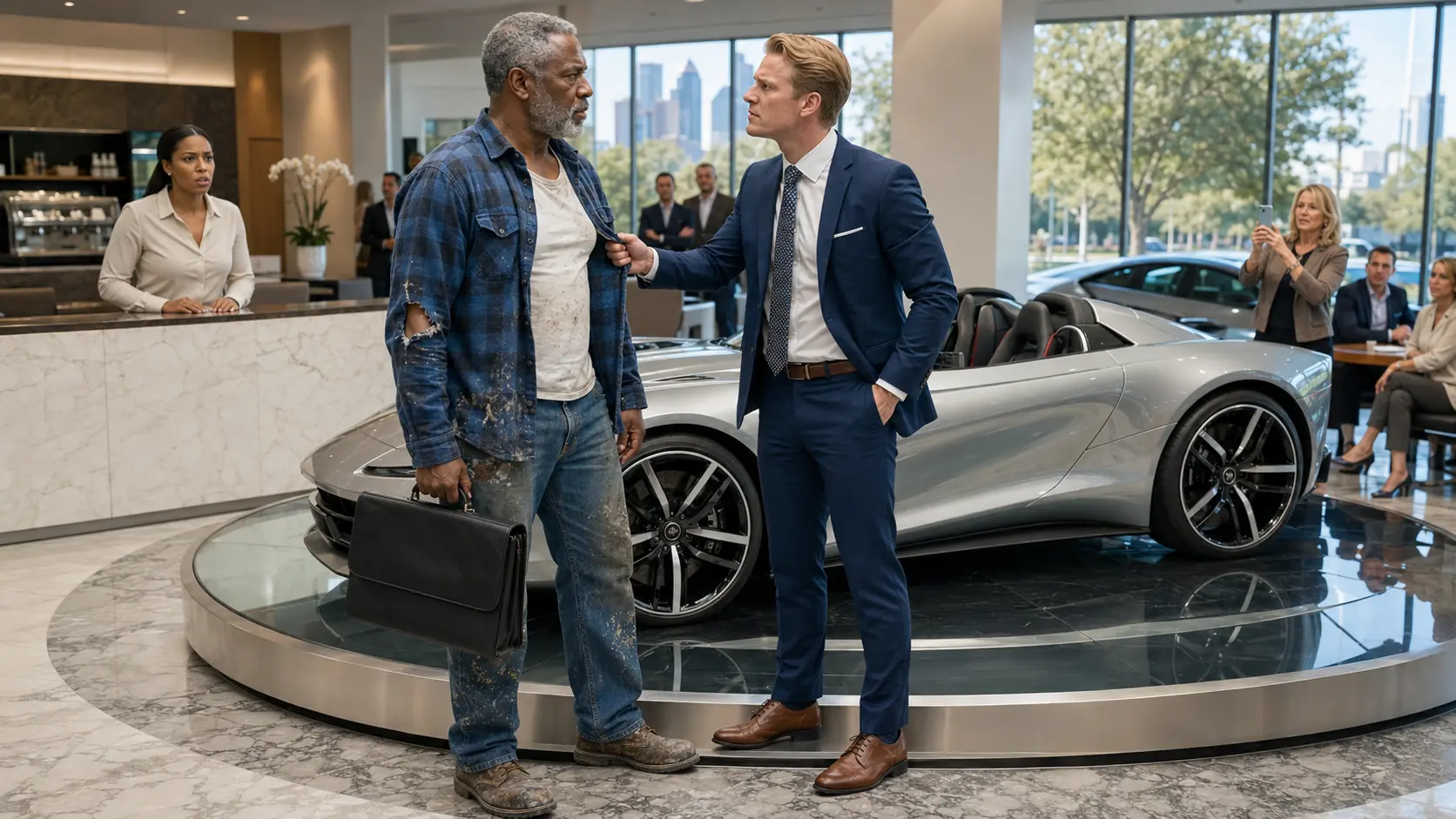
Wendell did not move.
His jaw set.
He took one slow step forward instead of one step back.
“I asked a question.”
Tucker’s smile dropped.
“Are you deaf? Go away.”
“I’m not going anywhere until you answer me.”
Tucker laughed.
Short, sharp, ugly.
He flicked dust off Wendell’s torn sleeve with two fingers, like the fabric itself offended him.
“Available?” Tucker said. “Six hundred twelve thousand dollars. You couldn’t afford it if you sold everything you own.”
Wendell lifted a briefcase onto the counter.
Two clicks.
Tucker’s laugh died mid-breath.
He did not know for sure who the raggedly dressed man in front of him really was.
Six hours before Tucker Maddox made the worst mistake of his life, Wendell Ashford was on his knees in the backyard, pulling a rusted roll of barbed wire from under a rotting fence post.
It was 6:42 on a Saturday morning.
The grass was still wet.
A mockingbird screamed from the magnolia tree near the shed.
Wendell had been out there since 5:30, replacing four sections of fence along the back property line.
He owned eleven acres in Buckhead, old-money land on a quiet street, with neighbors who waved but never visited.
He could have hired a crew.
He did not want a crew.
Saturday mornings were for working with his hands.
They always had been.
The barbed wire snagged on a root.
Wendell pulled harder.
His flannel sleeve caught on a rusted barb and tore clean from the shoulder down to the elbow.
It was a blue-and- shirt he had bought at Walmart for twelve dollars.
The fabric peeled open like a wound.
Underneath, his white undershirt was streaked with gray fence paint and sawdust.
He looked at the tear, shook his head, and kept working.
By 8:15, the fence was done.
Four new posts.
Three coats of sealant on the crossbeams.
Wendell sat on the back steps with a glass of ice water and watched steam rise off the lawn as the sun hit it.
His hands were cracked at the knuckles.
Paint sat under his fingernails.
Sweat had dried white lines on his forearms.
His phone buzzed at 9:15.
“Mr. Ashford, good morning. It’s Marco from Ferrari North America Client Relations.”
Wendell wiped his hands on his jeans before picking up.
Old habit.
Marco could not see his hands.
“Marco, what’s the news?”
“The SF90 Spider Assetto Fiorano in Argento Nürburgring arrived at your Atlanta dealership yesterday. They’re holding it for you. Brendan confirmed personally before he left for the Miami trip.”
Wendell closed his eyes for two seconds.
He had waited five months for this car.
Number nine in the collection.
The first eight Ferraris sat in a climate-controlled garage behind the house.
A LaFerrari.
Two 812 Competiziones.
A Monza SP2.
A Daytona SP3.
And three classics he had restored himself.
Every single one paid in full.
Cash.
No wire.
No financing.
That was how his grandfather did business.
That was how Wendell did business.
“I’ll go this afternoon,” Wendell said.
“Should I call ahead to the dealership? Let them know you’re coming?”
“No need. Brendan knows me. I’ll walk in.”
“Of course, sir. Enjoy the car.”
Wendell hung up and looked down at himself.
Torn flannel.
Paint-streaked jeans.
Sawdust in his hair.
The rational thing was to shower, change, and put on something that matched the price tag of the car he was about to buy.
He thought about it for exactly four seconds.
Then he thought about something else.
He thought about the eight times before.
Every time he had walked in wearing a suit, Brendan had greeted him at the door.
Every time the paperwork had been smooth, the coffee had been fresh, the handshake had been warm.
And every time, Wendell had wondered the same thing.
Would they treat me the same way if I showed up looking like I do right now?
Twelve years of buying Ferraris.
He had never tested that question.
Today felt like the day.
Eleanor was at her Saturday yoga class.
He left a note on the kitchen island.
Gone to pick up the Spider. Back by dinner. Don’t worry about the flannel.
She would know exactly what that meant.
At 1:15, Wendell walked into the garage, passed all nine parking bays, and stopped at the wall safe behind the tool bench.
Combination lock.
The door swung open.
Inside was a leather briefcase.
He had packed it two days ago when Marco first confirmed the delivery date.
Sixty-one bundles of hundred-dollar bills.
Each bundle held ten thousand dollars, sealed with a paper bank band.
Two smaller bundles of one thousand each sat in the corner.
Six hundred twelve thousand dollars total.
He picked up the briefcase.
It was heavier than people expected.
About thirteen pounds of paper and leather.
He put the briefcase on the passenger seat of the F-150.
The truck smelled like pine mulch and motor oil.
He drove south on Peachtree toward the dealership with the windows down.
The torn flannel sleeve flapped in the wind.
At two o’clock, Wendell Ashford parked his pickup truck in the back of the Ferrari of Atlanta lot.
He squeezed between a Bentley Continental and a Porsche Cayenne.
He grabbed the briefcase, stepped out, and walked toward the glass doors.
He did not check his reflection.
He did not fix his hair.
He did not button the torn sleeve.
He just walked in.
The Ferrari of Atlanta showroom was built to make rich people feel richer.
Twenty-foot ceilings.
Italian marble on the welcome desk.
A Rosso Corsa SF90 Spider rotating on a glass platform under pin lights that made the paint look wet.
The air smelled like fresh leather and espresso from the bar near the lounge.
Soft jazz played through hidden ceiling speakers.
Three customers were already inside.
Margaret Cole, a white woman in her fifties, sat at the Roma consultation desk, reviewing test-drive paperwork.
A father and his teenage son stood near a yellow Portofino, the boy pressing his nose close to the carbon-fiber side mirror.
A young couple browsed the accessories wall near the back.
Tucker Maddox stood behind the welcome desk next to Vivian Carter.
He had been at Ferrari of Atlanta for four months.
Before that, he had sold BMWs in Marietta.
He was thirty-one, blond, clean-shaven, and wore a fitted navy suit that he had bought with his first commission check.
He believed the suit made him the room.
He believed he could read a customer in three seconds flat.
Wendell Ashford walked through the glass doors at 2:03 p.m.
Tucker read him in two.
Torn flannel hanging off the right shoulder.
White undershirt showing through, smeared with gray paint.
Jeans faded at the knees, sawdust ground into the fabric.
Work boots that left a faint dirt print on the marble floor.
And in his right hand, a leather briefcase that did not match anything else on his body.
Tucker’s nostrils flared.
A short breath escaped through his nose.
Not quite a laugh.
Not quite a sound.
Just enough for Vivian to hear.
Vivian looked up.
Her tablet slipped two inches in her hand.
She knew that face.
She had processed three of his purchases in the last two years.
She opened her mouth.
“Tucker, that’s—”
“I got this.”
Tucker raised one hand without looking at her.
He stepped around the desk.
“Stay at the counter.”
He walked straight toward Wendell and positioned himself between Wendell and the SF90 Spider on the display platform.
Feet wide.
Arms crossed.
Chin tilted up.
“Can I help you?”
The words were polite.
The tone was not.
The emphasis sat on help like a dare.
Wendell met his eyes.
“I’d like to see the SF90 Spider, the Argento Nürburgring on the platform.”
Tucker did not move.
His eyes traveled down the torn sleeve again, then stopped at the dirt print Wendell’s boot had left on the floor.
He made a small clicking sound with his tongue.
“Sir, the SF90 Spider starts at over half a million dollars.”
“I know what it costs.”
“Do you, though?”
Tucker smiled.
The kind of smile that showed teeth but no warmth.
“Because I’m looking at you, and I’m not seeing half a million dollars. I’m seeing a man who maybe took a wrong turn off Piedmont. The Honda dealership is four blocks north. Toyota is three. There’s a Hyundai certified pre-owned lot about six blocks that way.”
He pointed east.
“Much more in your range.”
Wendell’s jaw tightened.
One muscle.
Just once.
His left hand curled into a fist at his side.
He uncurled it slowly.
“I didn’t ask for directions. I asked to see the car.”
Tucker laughed louder this time.
His head tilted back slightly.
The sound bounced off the marble desk and reached Margaret Cole across the room.
She set her coffee cup down.
The porcelain clinked against the saucer in the silence that followed.
“Sir, I’m going to be honest with you because nobody else will.”
Tucker stepped closer.
Close enough that Wendell could smell his cologne.
Something sharp and chemical, sprayed too heavily.
“We have a dress-code expectation for clients who enter this showroom. It’s not written on the door, but it exists. And your…”
He reached out and pinched the torn fabric on Wendell’s right sleeve between his thumb and index finger.
He held it up like a piece of evidence.
“This isn’t it.”
He let go, then wiped his fingers on his own suit pants twice, like the fabric had contaminated him.
Wendell looked at the spot where Tucker had touched his sleeve.
A flake of dried paint had fallen to the marble floor between them.
Then he looked back at Tucker’s face.
“Don’t touch me again.”
“Then don’t bring this into my showroom again.”
Tucker stepped back and spread his arms wide, gesturing to the room.
“Look around. You see anyone else in here dressed like they just crawled off a construction site? No. Because our clients understand what this place is. This is Ferrari, not Goodwill.”
Behind the welcome desk, Vivian closed her eyes for one second.
She knew what was coming.
She had seen Tucker do this before.
Not this bad, but the pattern was the same.
Read the clothes.
Decide the worth.
Perform the rejection.
She stepped forward.
“Tucker, can I speak with you for a—”
“Vivian.”
Tucker pointed at her without turning around.
“Counter. Now.”
Vivian stopped.
Her hand gripped the edge of the tablet until her knuckles turned pale.
Tucker turned back to Wendell.
His voice dropped lower.
Not quieter.
Lower.
The kind of low designed to humiliate without shouting.
“Let me break this down for you since you don’t seem to get the message. This car costs six hundred twelve thousand dollars. That’s more than most people make in ten years. You don’t walk in here with sawdust on your pants and a ripped shirt and ask to see it. You don’t walk in here smelling like paint thinner and ask to buy it. You just don’t.”
He leaned in close enough to whisper.
“You can’t afford the floor mats on that car. We both know it. So stop embarrassing yourself. Walk out. Go home. Take a shower. Come back when you look like you belong somewhere besides a parking lot.”
He straightened his tie and smoothed the lapel of his navy suit.
The gesture was deliberate.
A reminder of the distance between his clothes and Wendell’s.
The espresso machine behind the lounge bar hissed and sputtered.
The jazz track changed to something with piano.
A bead of condensation ran down the side of a water glass on the Roma desk where Margaret sat.
Nobody drank from it.
Wendell stood perfectly still.
His grip on the briefcase handle tightened until the leather creaked under his fingers.
His eyes never left Tucker’s face.
“Are you done?”
Tucker grinned.
“I’m done when you’re gone.”
Margaret Cole pushed her chair back.
The metal legs scraped against the marble.
The sound cut through the jazz like a knife.
She picked up her phone from the desk and turned on the camera.
A small red recording light blinked on.
The father near the Portofino put his hand on his son’s shoulder and turned him away from the scene.
The boy resisted.
The father insisted.
They walked toward the side exit without looking back.
The young couple near the accessories wall stood frozen.
The woman had her hand over her mouth.
The man stared at his shoes.
Tucker did not notice any of them.
He was performing now, playing to a room that had already turned against him without his knowledge.
The sweat under his collar had not started yet.
It would.
He turned to Vivian and opened both palms toward Wendell like he was presenting a circus act.
“Vivian, you seeing this? Man walks in off the street in a torn shirt covered in filth, carrying a mystery briefcase, and demands to buy a six-hundred-thousand-dollar car on a Saturday.”
He laughed, bending forward slightly.
The laugh was harder now.
Sharper.
It cracked at the edges.
“I mean, I can’t make this up. I literally cannot make this up.”
Vivian said nothing.
She stared at the floor.
Tucker spun back to Wendell and pointed at the briefcase.
“And what’s in that? Seriously, what is in that briefcase? Because if it’s not six hundred twelve thousand dollars in cold hard cash, pick it up and walk out that door right now before I call Buckhead PD and have them escort you out.”
He paused, leaned back against the welcome desk, crossed his ankles, and folded his arms.
“Well? Open it. Go ahead. Show me what’s in the magic briefcase.”
The showroom was silent.
The jazz had faded between tracks.
The espresso machine had gone quiet.
The SF90 Spider rotated on its platform.
The pin lights reflected off its silver paint in slow circles across the ceiling.
Wendell looked at Tucker for a long time.
Five seconds.
Maybe six.
His face showed nothing.
Then he set the briefcase flat on the marble counter.
“You want to see what’s inside?”
Tucker smirked.
“Oh, I’m dying to see.”
Wendell placed both thumbs on the latches.
“Remember this moment.”
Click.
Click.
The lid of the briefcase rose like the cover of a book no one in the room had expected to read.
Sixty-one bundles of hundred-dollar bills sat in four neat rows.
Each bundle was one inch thick, wrapped in a white paper band stamped $10,000.
Two smaller bundles sat in the corner.
One thousand dollars each.
The bills were crisp but not new.
They had weight.
They had texture.
They had the faintly sweet smell of old ink and cotton fiber that only real cash carries.
Six hundred twelve thousand dollars.
The overhead pin lights bounced off the surface of the top bills and threw tiny rectangles of light onto the marble counter.
The briefcase leather creaked as the lid settled all the way open.
Tucker Maddox did not move.
His mouth was still open from the last laugh.
The sound had stopped, but his jaw had not closed.
His lips were still curled at the edges from the grin.
His body had not caught up to what his eyes were processing.
Three seconds passed.
His grin collapsed.
Not slowly.
Not gracefully.
It fell off his face like plaster cracking off a wall.
The color left his cheeks in a wave that started at the jawline and climbed to his forehead.
His right hand, which had been resting on the welcome desk with casual authority, slid off the edge.
He caught himself on the counter.
Margaret Cole’s phone did not waver.
The red recording light held steady.
Vivian Carter, behind the welcome desk, exhaled.
It was the first full breath she had taken in ten minutes.
The young couple near the accessories wall unclenched.
The woman lowered her hand from her mouth.
The man looked up from his shoes for the first time since Tucker had started performing.
Nobody spoke.
The jazz track had ended.
The next one had not started.
The only sound in the showroom was the low electrical hum of the SF90 Spider’s rotating display platform.
Somewhere deep in the espresso machine, a valve clicked and released a thin hiss of steam.
Wendell Ashford stood with both hands flat on the counter, the open briefcase between them.
His torn flannel sleeve hung loose off his shoulder.
Sawdust was still in his hair.
Paint was still on his knees.
He looked the same as he had when he walked in twelve minutes earlier.
The only thing that had changed was the room.
“Count it,” Wendell said.
Tucker’s eyes snapped from the money to Wendell’s face, then back to the money, then back to Wendell.
“I… what?”
“You heard me. Count it. You wanted proof. Here it is. Pick up the first bundle and start counting.”
Tucker did not move.
His fingers gripped the edge of the marble counter.
His knuckles were white.
A vein in his neck had surfaced, thick and pulsing, visible above the collar of his navy suit.
“I don’t… sir, I don’t—”
“Don’t call me sir now. You didn’t call me sir when I walked in. You told me to leave. You told me to take a shower. You told me to go to Hyundai.”
Wendell’s voice was level.
Controlled.
Not loud.
Louder than loud.
“Pick up the first bundle. Count.”
Tucker’s right hand released the counter.
It was shaking.
Not a subtle tremor.
A visible full-hand shake.
The kind that happens when adrenaline and shame collide inside the nervous system and neither one wins.
He reached for the first bundle.
His fingers fumbled with the paper band.
It tore unevenly.
He fanned the bills and counted.
His lips moved, but no sound came out for the first three bundles.
“Ten thousand,” he whispered on the fourth.
Wendell said nothing.
Margaret adjusted her grip on the phone.
She zoomed in on Tucker’s hands.
The red light kept blinking.
By the tenth bundle, Tucker’s forehead was damp.
A single bead of sweat formed at his hairline.
It rolled down his temple and dropped onto the marble counter next to a stack of counted bills.
He did not wipe it.
He did not look up.
He just kept counting.
By the twentieth bundle, his breathing had changed.
Shallow.
Fast.
The kind of breathing that comes before either tears or panic.
His collar was dark with sweat.
The sharp cologne he had sprayed that morning had mixed with it.
The air around the counter smelled sour and chemical now, a far cry from the leather and espresso that had greeted Wendell at the door.
Wendell did not move.
He did not shift his weight.
He did not fold his arms, check his phone, or look away.
He stood on the other side of the counter with his hands at his sides and watched Tucker count every single bill.
The torn flannel sleeve hung still.
The sawdust in his hair caught the pin lights.
This was not revenge.
This was a receipt.
By the thirtieth bundle, Vivian had stepped out from behind the welcome desk.
She stood three feet away with her arms folded across her chest.
Not to intervene.
Not to help.
Just to witness.
She had watched Tucker run the showroom like he owned it for four months.
Four months of being told to stay at the counter.
Now she was going to stand exactly where she wanted, and she was going to watch every second of this.
The young couple had moved closer, too.
They stood near the Roma desk now, next to Margaret.
No one had invited them.
No one had told them to leave.
They just moved.
By the fortieth bundle, Tucker dropped one.
The paper band slipped off and bills fanned across the marble in a half circle.
Tucker scrambled to pick them up.
His hands were so wet the bills stuck to his fingers.
He had to peel them off one at a time.
Margaret’s phone captured every frame.
By the fiftieth bundle, Tucker had stopped trying to stand straight.
He leaned against the counter with both elbows.
His shoulders were drawn up around his ears.
His suit jacket was rumpled.
The tie he had straightened fifteen minutes earlier was crooked.
He looked ten years older than when Wendell had walked in.
Bundle fifty-five.
Fifty-six.
Fifty-seven.
Fifty-eight.
Fifty-nine.
Sixty.
Sixty-one.
Two smaller bundles.
One thousand each.
Tucker set the last one down.
His hands stayed flat on the counter, fingers spread like a man trying to hold himself above water.
He did not look up.
“Six hundred twelve thousand,” he said.
His voice was raw.
It sounded like he had been shouting for hours, though he had not raised his voice once during the count.
The strain was all internal.
All shame.
“Is it all there?” Wendell asked.
“It’s all there.”
“How do you know?”
Tucker blinked.
Sweat dripped from his brow onto the counter.
“I counted it. It’s all there. Every dollar.”
Wendell nodded once, slowly.
“That’s the first time since I walked in here that you’ve done your job.”
The silence that followed was the loudest thing in the room.
The SF90 Spider rotated.
The pin lights traced circles on the ceiling.
Margaret’s red dot blinked.
The HVAC system pushed cold air through a vent directly above Tucker’s head.
He might have been shivering.
It was hard to tell the difference between the cold and the shaking.
Tucker’s left knee buckled first.
Not dramatically.
Not like a Hollywood collapse.
His leg simply stopped holding weight.
He caught himself on the counter with one hand, but his right knee followed, and then he was on the polished marble floor.
One knee down.
Then both.
His forehead almost touched the counter’s edge.
“Mister, I didn’t… I’m sorry. I didn’t know.”
Wendell looked down at him.
The torn flannel sleeve hung loose.
The paint stains were still there.
The sawdust was still in his hair.
Nothing about Wendell had changed.
“Stand up,” Wendell said. “I don’t need you on your knees. I need you to remember what put you there.”
Tucker grabbed the counter with both hands and pulled himself up.
His legs wobbled.
He steadied himself, barely.
Wendell turned to Vivian.
“Miss Carter, I’d like to complete the purchase with you. Would you handle the paperwork?”
Vivian’s chin lifted.
Her back straightened.
She picked up her tablet from the welcome desk and walked to the consultation area with steady steps.
“Yes, Mr. Ashford. I’d be happy to.”
The way she said his name was quiet and professional.
But Tucker heard it.
Whatever was left of the color in his face drained completely.
Ashford.
He mouthed the word.
No sound.
Just lips moving around two syllables that were now rearranging everything he thought he knew.
He had heard that name before.
In the monthly sales briefing emails.
In the client portfolio that Brendan had reviewed with the team during Tucker’s second week.
In the list of Ferrari’s top regional collectors.
Wendell Ashford.
Nine Ferraris.
Twelve years as a client.
Invitation-only hypercar status.
The man Brendan had described in training as the most important relationship in the Southeast.
The man Tucker had told to take a shower.
The man Tucker had insulted.
Tucker leaned against the welcome desk.
His fingers left wet prints on the marble.
The navy suit he had bought with his first commission check hung on him now like it belonged to someone else.
Nobody in the showroom looked at him.
Everybody in the showroom looked at Vivian.
Vivian led Wendell to the consultation area near the Roma display.
She pulled out a leather chair for him.
He sat.
She opened the purchase agreement on her tablet.
“SF90 Spider Assetto Fiorano,” she said. “Argento Nürburgring exterior. Nero interior with blue contrast stitching. Carbon-fiber racing package.”
Wendell nodded.
“That’s the one.”
“Payment method?”
“Cash, as counted.”
Vivian typed without looking up.
Her fingers were steady.
Her voice was steady.
But her jaw was set tight, and the tendons in her neck stood out like cables.
Tucker stood at the welcome desk fifteen feet away.
He had not moved.
His hands were still flat on the marble.
The counted bundles sat between his palms like a wall he could not climb over.
He watched Vivian work.
He watched the commission of a lifetime walk to someone else’s tablet.
Margaret Cole lowered her phone for the first time in twenty minutes.
She kept the camera app open.
The glass front doors swung inward.
Brendan Whitfield walked in with a roller bag and a laptop case.
Gray blazer creased from a three-hour flight from Miami.
Ferrari branch manager badge on his breast pocket.
He had the dazed look of a man who had been awake since four in the morning.
He made it three steps inside before he saw Wendell.
He stopped.
The roller bag bumped against his heel.
His face changed.
Not surprise.
Something warmer.
The way a person looks when a friend shows up to a party they thought he might skip.
“Mr. Ashford.”
He let go of the roller bag in the middle of the floor.
He left the laptop case next to it.
Then he walked straight to the consultation area with both hands extended.
“I had no idea you were coming today. Marco told me the Spider landed, but I figured next week.”
He took Wendell’s hand in both of his and shook it.
Firm.
Long.
Genuine.
“How are you, sir? How’s Eleanor? Still giving you trouble about garage space?”
He had not looked at the torn flannel.
He had not looked at the sawdust, the paint-stained jeans, or the dirt prints on the marble.
He was looking at Wendell’s face the way a man looks at a client he has known for twelve years.
“Eleanor is doing well,” Wendell said. “She’ll have opinions about the color.”
Brendan laughed.
A real laugh.
Not a performance.
“She always does, but the stitching will win her over. I had Maranello do blue contrast thread to match your 812 Competizione.”
He gestured toward the platform.
“Nine cars now, Mr. Ashford. Finest private collection south of Virginia.”
Wendell smiled.
Small.
Tired.
But real.
“Brendan.”
Something in his tone made Brendan stop.
He looked around the showroom for the first time.
The silence hit him first.
No jazz.
No conversation.
No espresso machine.
Then the details.
Margaret with her phone raised.
The young couple frozen by the accessories wall.
Vivian at the consultation table with paperwork already open.
And Tucker.
Sweat stains on his collar.
Hands flat on the marble.
Face the color of old paper.
Between his palms, sixty-one counted bundles of hundred-dollar bills and two smaller stacks spread across the counter.
Brendan’s smile faded.
“Mr. Ashford, what happened before I got here?”
Wendell’s voice was even.
No anger.
No satisfaction.
Just facts.
“I walked in wearing this. Your new sales associate decided I couldn’t afford to be here. He told me to leave. Told me to try Hyundai. He touched my shirt and wiped his hand on his pants. Told me to take a shower.”
Wendell paused.
“Then he dared me to open the briefcase. So I did. And I had him count every dollar.”
Brendan closed his eyes.
Three seconds.
“How long have you been here, sir?”
“About forty minutes.”
Brendan exhaled through his nose.
Long and slow.
“Mr. Ashford, on behalf of Ferrari of Atlanta, I am deeply sorry. This is not who we are. This is not who I trained this team to be.”
He turned to Vivian.
“Vivian, are you handling the paperwork?”
“Yes, sir.”
“Good. I’ll sit with you if Mr. Ashford allows it.”
Wendell nodded.
“Vivian handles the sale. The commission is hers.”
“Absolutely,” Brendan said. “Vivian, this is your sale.”
Vivian’s pen stopped for one second.
She blinked twice.
Then she kept writing.
Brendan turned toward Tucker.
He did not raise his voice.
“Tucker. My office. Now.”
Tucker peeled his hands off the marble.
The wet prints stayed behind.
He walked toward the back hallway on legs that did not quite bend right.
He did not look at Wendell.
He did not look at Vivian.
He did not look at Margaret, the young couple, or the empty space where the father and son had stood.
He looked at the floor.
It was all he had left.
The door closed behind them with a soft pneumatic hiss.
The showroom settled into silence.
The SF90 Spider kept rotating under the pin lights.
Vivian turned the tablet toward Wendell.
“Sign here, Mr. Ashford.”
He signed.
The pen left a faint smudge of gray fence paint on the screen.
The door to Brendan’s office stayed closed for twenty-two minutes.
Nobody in the showroom could hear the words, but they could see the shapes through the frosted glass.
Brendan standing behind his desk.
Tucker sitting in the chair across from him.
Then Tucker standing.
Then Tucker’s hands moving, palms up, a universal gesture of a man explaining why it was not his fault.
Then Brendan pointing at the chair.
Tucker sitting back down.
Outside the office, the showroom had slowly returned to something that looked like normal.
The jazz had come back on.
The espresso machine was hissing again.
But nobody was browsing.
Nobody was test-driving.
The young couple had left.
The Roma desk, where Margaret had been sitting, was empty now except for a cold cup of coffee and a saucer with a hairline crack from when she had set it down too hard.
Margaret was standing near the front doors talking to Wendell.
“Mr. Ashford, I want you to know I recorded everything from the moment he touched your sleeve.”
Wendell looked at her.
“I know you did. I saw the red light.”
“I’m going to post it. People need to see this.”
Wendell was quiet for a moment.
He looked out at the parking lot through the glass doors.
The SF90 Spider sat on the delivery pad near the side entrance, freshly detailed, catching the afternoon sun.
“That’s your decision, Miss Cole. Not mine.”
Margaret nodded.
She held out her hand.
Wendell shook it.
“He laughed at you five times,” she said.
Her voice was steady, but her eyes were wet.
“I counted. Five times in twelve minutes. He laughed at you until you put six hundred twelve thousand dollars in cash on that counter. I recorded every laugh. Every single dollar.”
Wendell held her hand for an extra second, then let go.
“Thank you for standing up.”
“I should have stood up sooner.”
“You stood up. That’s what matters.”
Margaret walked out to the parking lot.
She sat in her car for six minutes before she drove away.
During those six minutes, she uploaded the video to three platforms.
Back inside, the office door opened.
Brendan came out first.
His jaw was tight.
He walked to the welcome desk, placed both hands flat on the marble, and spoke to Vivian.
“Vivian, effective today, you are senior sales specialist. We’ll formalize the paperwork Monday, but I want you to know now.”
Vivian’s tablet was still in her hand.
She gripped it a little tighter.
“Thank you, Brendan.”
“Don’t thank me. You earned it. You earned it before today.”
Tucker came out of the office three minutes later.
He was carrying a cardboard box.
Inside it was a framed BMW sales award from his previous dealership, a coffee mug that said Closer in gold letters, a phone charger, a lint roller.
The contents of four months at Ferrari of Atlanta fit in a box the size of a microwave.
He walked through the showroom without looking left or right.
His navy suit was wrinkled.
The tie was still crooked from when he had counted the money.
The collar was still dark with dried sweat.
He pushed through the glass doors and stepped into the afternoon heat.
The Atlanta sun hit him like a wall.
Ninety-one degrees.
The asphalt in the parking lot was soft under his shoes.
He put the box in the trunk of his car.
A silver Hyundai Elantra.
He got in the driver’s seat.
He did not start the engine.
He sat there.
Through the windshield, he could see the delivery pad.
The SF90 Spider gleamed silver under the sun.
Six hundred twelve thousand dollars of carbon fiber and Italian engineering, paid for in cash by a man in a torn flannel shirt.
The driver’s side door of the Spider opened.
Wendell Ashford stepped in.
He was still wearing the flannel.
He still had sawdust in his hair.
He started the engine.
The V8 hybrid turned over with a sound like a deep breath held too long and finally released.
The Spider rolled off the pad, turned left onto Peachtree, and disappeared into traffic.
Tucker watched until it was gone.
Then he watched the empty space where it had been.
He sat in the Hyundai for another eight minutes.
The engine was off.
The windows were up.
The air inside the car grew thick and hot.
Sweat ran down his temples the same way it had run down them inside the showroom.
But this time, no one was watching.
He started the car.
The Hyundai’s four-cylinder engine coughed to life.
He drove home.
Margaret Cole’s video hit the internet at 3:42 p.m. on a Saturday afternoon.
By Sunday morning, it had four hundred thousand views.
By Monday night, it had crossed six million.
By Wednesday, twelve million.
The title she gave it was simple.
Ferrari Salesman Laughs at Man in Torn Shirt. Then the Briefcase Opens.
The video was eleven minutes and forty-three seconds long.
It started with Tucker pinching the fabric of Wendell’s torn sleeve between his thumb and forefinger.
It ended with Tucker on his knees on the marble floor, mouth open, no sound coming out.
The comment section filled faster than any post Margaret had ever made.
And Margaret had never made a post before.
She had two hundred followers on the day she uploaded it.
She had nine hundred thousand by Friday.
The internet did what the internet does.
It found Tucker Maddox within hours.
His LinkedIn profile.
His previous employer.
His BMW sales record in Marietta.
His Instagram account, which featured photos of him leaning against cars he did not own, wearing suits he had bought on credit.
Someone found his apartment complex.
Someone found his college transcript.
Someone found a tweet from 2021 where he had made a cruel joke about a man outside a Porsche dealership.
That tweet was screenshotted and reposted forty thousand times in one day.
Tucker deleted his social media accounts by Thursday.
It did not matter.
The screenshots lived forever.
On Monday morning, before the video had even peaked, Brendan Whitfield made two phone calls.
The first was to Ferrari North America headquarters in Englewood Cliffs, New Jersey.
He spoke with the regional director for eighteen minutes.
He did not sugarcoat what had happened.
He did not minimize.
He used the word failure three times and the word unacceptable twice.
The regional director thanked him for calling before the press did.
The second call was to the entire sales team at Ferrari of Atlanta.
Nine employees.
Conference room.
Door closed.
“What happened on Saturday is the worst thing I’ve seen in twenty years of selling cars,” Brendan said.
He stood at the head of the table.
No slides.
No notes.
Just his voice.
“A man walked into this showroom to buy a car he had every right to buy. And one of us told him he didn’t belong here. Told him to take a shower. Made him prove his own money was real by counting it bill by bill in front of strangers.”
He paused and looked at each person in the room.
“That man has been our client for twelve years. But even if he hadn’t been, even if he had been a first-time walk-in with no history and no name, the treatment would have been just as wrong.”
Vivian Carter spoke next.
Brendan had asked her to.
She stood at the far end of the table with her hands folded.
“Tucker told me to stay at the counter twice,” she said.
Her voice was quiet, but it carried.
“I knew who Mr. Ashford was. I tried to tell Tucker. He cut me off both times. He didn’t want my input. He wanted an audience.”
She paused.
“I’ve been on this floor for four years. I’ve watched customers get read by their clothes, their hair, their skin, their accent. Tucker was the loudest about it. He wasn’t the only one.”
The room was silent.
Two of the other salespeople looked at the table.
One looked at Vivian.
Nobody argued.
By Wednesday, Ferrari North America had issued an internal directive to every authorized dealership in the United States.
It did not name Tucker.
It did not name the Atlanta location.
But the subject line read:
Customer Experience Standards — Mandatory Review
Every dealership manager was required to hold a team meeting within two weeks.
The directive included a new clause.
Any customer complaint involving profiling would trigger an automatic third-party review.
No exceptions.
No internal closures.
Tucker Maddox posted a video apology the following Friday.
He recorded it in his apartment.
White wall behind him.
No suit.
A plain gray T-shirt.
He looked into the camera with an expression that aimed for remorse and landed closer to self-pity.
“I want to apologize to Mr. Ashford and to everyone who saw the video,” he said. “I made assumptions based on appearance. That was wrong. I made a mistake.”
The video lasted ninety seconds.
The comment section lasted much longer.
The top comment, with sixty-two thousand likes, read:
You didn’t make a mistake. You made a choice five times.
Tucker disabled comments within an hour.
Local Atlanta news picked up the story by the second week.
WSB-TV ran a three-minute segment.
They showed clips from Margaret’s video.
They interviewed Brendan, who repeated what he had said in the team meeting almost word for word.
They reached out to Wendell Ashford’s office.
His assistant declined on his behalf.
No statement.
No interview.
No public comment.
Margaret Cole accepted one interview with WSB-TV.
She sat in a studio chair with her hands in her lap.
“I was there to test-drive a Roma,” she said. “I wasn’t planning to record anything, but that young man touched Mr. Ashford’s sleeve and wiped his hand on his pants like he had touched something dirty. I couldn’t sit there after that.”
The interviewer asked what she remembered most.
Margaret was quiet for three seconds.
“The counting,” she said. “He made that salesman count every single bundle. Sixty-one bundles. It took almost ten minutes. And in those ten minutes, nobody in that showroom said a word. Not one word. That silence was the loudest thing I’ve ever heard.”
They offered her an appearance fee.
She declined.
“I didn’t do anything special. I held up a phone. Anyone could have done it. That’s the whole point.”
Two months after the video, Tucker Maddox was hired at a used car lot off Interstate 85 in Chamblee.
No luxury brands.
No marble floors.
No espresso machines.
The lot sold certified pre-owned Kia and Nissan.
His commission structure was twelve percent of profit margin, which on most sales came out to about three hundred dollars per car.
He never sold a Ferrari again.
He never sold anything close.
Vivian Carter closed her first quarter as senior sales specialist with the highest volume on the floor.
Brendan put her name on the annual performance board in the showroom lobby.
It was the first time a woman’s name had appeared there in the dealership’s nineteen-year history.
Nobody made a speech about it.
It just went up on the board.
That was enough.
One month later, on a Saturday morning, Wendell Ashford was in his garage.
The SF90 Spider sat in bay nine, silver paint under soft LED overheads.
Next to it was the Daytona SP3 in Rosso Magma.
The Monza SP2 in triple-layer .
The LaFerrari in Giallo Modena.
Eight more bays stretched down the wall.
Each one held a car that most people would never see in person, let alone own.
Wendell was wiping down the Spider with a microfiber cloth.
Slow circles on the hood.
He was wearing jeans and a flannel shirt.
Blue and .
The same one from that Saturday.
Eleanor had sewn the torn sleeve back together with a double stitch that left a faint ridge along the seam.
He could feel it every time he raised his right arm.
He never asked her to fix it.
She just did.
The garage smelled like tire rubber and wax.
The faint trace of old motor oil never quite left the concrete floor, no matter how many times he sealed it.
Eleanor came through the side door carrying two mugs of coffee.
She handed him one and stood next to the Spider with her hip against the driver’s-side fender.
“You saw Margaret Cole’s video? Eighteen million now.”
Wendell took a sip.
“I saw.”
“She’s turned down four podcast interviews this week and a book deal.”
“That sounds like Margaret.”
Eleanor looked at the row of cars, then back at him.
“You’re never going to talk about it publicly, are you?”
Wendell set the cloth on the hood and picked up his coffee with both hands.
“No.”
“Why not?”
He thought about it.
Not for long.
“Because the story isn’t mine to tell anymore. It’s Margaret’s. It’s Vivian’s. It’s every person who watched that video and recognized something in it.”
He took another sip.
“I just went to buy a car.”
Eleanor smiled.
She did not push it.
Twenty-eight years of marriage had taught her where his boundaries lived.
She kissed him on the cheek, picked up her mug, and went back inside.
Wendell stood alone in the garage.
Nine Ferraris.
One microfiber cloth.
One mug of coffee going cold in his hands.
He thought about Tucker Maddox.
Not with anger.
Not with satisfaction.
He thought about a thirty-one-year-old man in a navy suit who believed the suit was enough.
Who believed he could read a person in three seconds.
Who had been so certain about what he saw that he never considered what he was missing.
Wendell did not hate Tucker.
He pitied him.
And that was worse.
He set the coffee down on the workbench, pulled a chair over, sat down, and opened a drawer.
Inside was a sheet of cream stationery and a fountain pen Eleanor had given him for their twentieth anniversary.
He uncapped it.
Margaret had sent him a letter the previous week.
Short.
Handwritten.
She thanked him for how he had carried himself in the showroom.
She said her fourteen-year-old daughter had watched the video.
The girl had asked a question Margaret could not answer.
“Mom, why didn’t anyone else say something?”
Wendell picked up the pen and began writing.
Not to Margaret.
To her daughter.
He wrote about silence.
About how it is easier to look at your shoes than to lift your head.
About how standing up does not always mean standing up first.
Sometimes it means standing up at all.
He wrote about a torn shirt, a briefcase, and a marble floor that reflected everything except what mattered.
He did not write about money.
He did not write about Ferraris.
He did not write about Tucker’s name, Tucker’s face, or Tucker’s career.
He wrote one line at the bottom of the page.
The question you asked your mother is the only question that matters. Keep asking it.
He signed it, folded the letter into thirds, slid it into an envelope, and wrote the address Margaret had included at the bottom of her note.
He set the envelope on the workbench next to the coffee mug.
Then he picked up the microfiber cloth and went back to wiping down the Spider.
The garage was quiet.
The LEDs hummed.
The concrete floor was cool under his boots.
Outside, a mockingbird started up in the magnolia tree.
The same tree that had been screaming at six in the morning on the day everything changed.
Wendell listened to it.
He kept wiping.
He did not rush.
The torn shirt changes.
The briefcase changes.
The name changes.
But the feeling of walking into a room where someone has already decided who you are does not change.
Tucker laughed five times in twelve minutes.
In those twelve minutes, most of the room stayed silent.
Only one person raised a phone.
Only one person created a record.
And afterward, a fourteen-year-old girl asked the question everyone else avoided.
Why didn’t anyone else say something?
Wendell had no perfect answer.
So he wrote her the only honest one he had.
Keep asking.