The old man’s coffee hit the floor before his knees did.
Nobody in that diner moved to help him.
A grown man in a stained apron stood over him, jabbing a finger toward the door, telling him he did not belong in a clean establishment, telling him to get out before he scared off paying customers.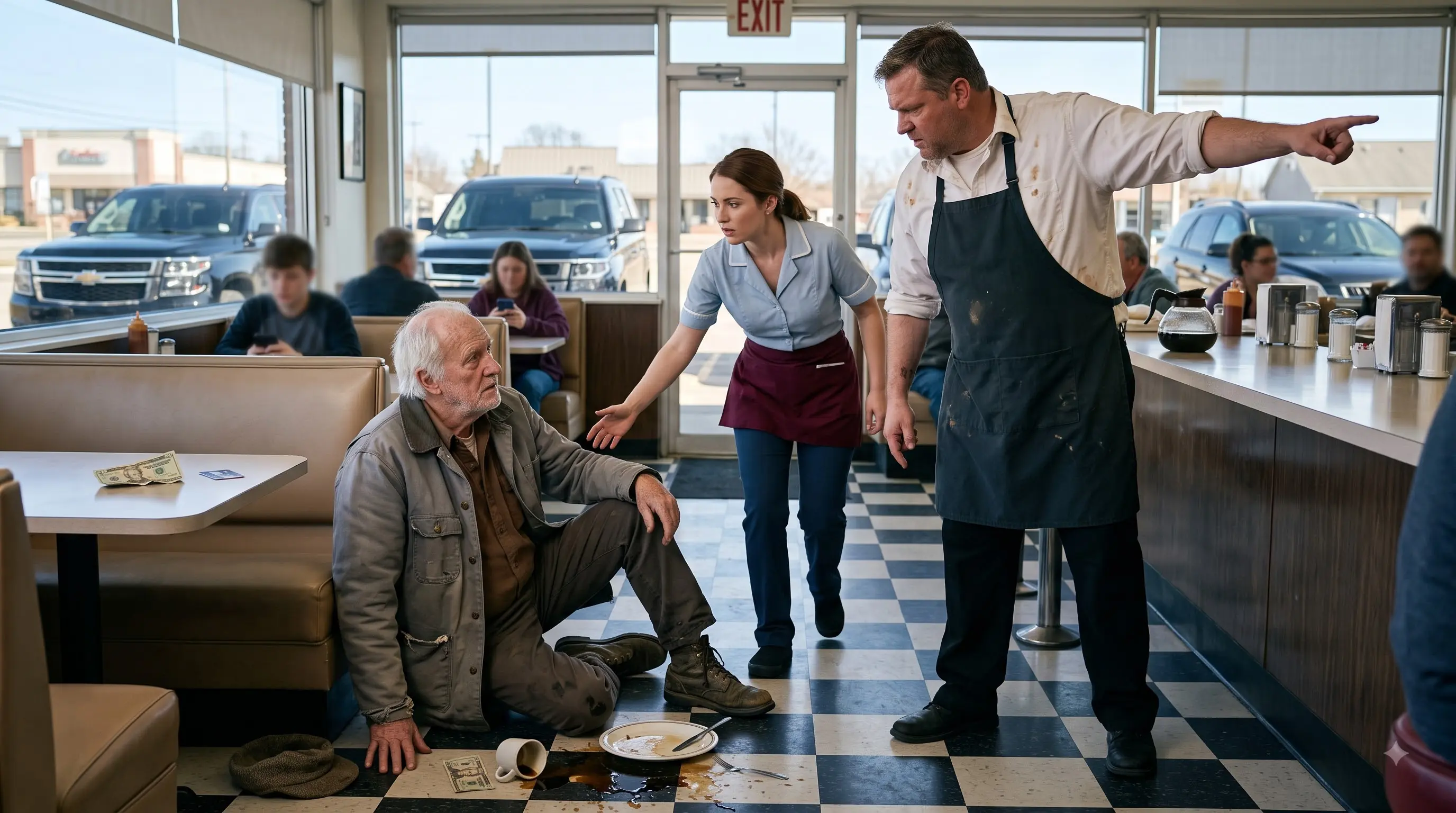
Phones came up.
A teenager laughed into his milkshake.
And in the corner booth, a young waitress named Grace Whitfield set down the coffee pot she had been holding for ten minutes, walked straight through the middle of that laughter, and knelt beside a stranger nobody else in the room would touch.
She had no idea that in exactly eleven minutes, three black SUVs would pull into that parking lot.
She had no idea the man on the floor owned the building she was standing in, the company that signed her paycheck, and forty-one restaurants across six states.
She only knew one thing.
Nobody deserved to be laughed at while they were down.
Not even a man in a twelve-dollar coat who could not seem to pay for his own cup of coffee.
Grace Whitfield was twenty-eight years old, and by every measure that mattered to the outside world, she had nothing to show for it.
She rented a one-bedroom apartment above a laundromat in a small town called Willow Creek, Ohio, where the winters lasted longer than they should, and the paychecks never quite caught up to the bills.
She had a six-year-old son named Caleb, a photograph of a husband who left before Caleb turned two, and a job waiting tables at Coleman’s Kitchen, a diner chain with a reputation for cheap coffee and honest food.
She worked doubles most weeks.
She came home smelling like bacon grease and dish soap, and some nights she cried quietly in the shower so Caleb would not hear her through the wall.
But if you asked anyone who knew her, they would tell you the same thing without hesitation.
Grace Whitfield was the kindest person they had ever met, and she did not do it for anyone to notice.
Grace had carried that sentence with her through every hard year since.
She let elderly customers take twenty extra minutes to count exact change without ever making them feel rushed. She slipped free pie to kids whose parents looked too tired to ask for dessert. She remembered names, remembered birthdays, remembered which regular liked his eggs a little wet, and which one could not stand ice in his tea.
None of it made her rich.
All of it made her someone people trusted the moment they sat down in her section, even if they could not explain exactly why.
That morning had started like every other one that month, gray and rushed and a little too cold for April.
Grace clocked in at 6:00, tied her apron, and started her section before the first regulars even walked through the door. She had no idea that the ordinary shift ahead of her was about to become the single most important morning of her life, or that a decision made in less than thirty seconds would determine the direction of everything that came after it.
She simply poured coffee, wiped down booths, and kept moving the way she always did because moving was easier than sitting still with how tired she actually was.
Walter Coleman was sixty-eight years old and worth just under 2.3 billion dollars, though almost nobody in that Ohio diner would have believed it if you told them.
He wore a gray canvas coat with a torn pocket seam, work boots that had seen thirty years of use, and a wool cap pulled low over hair that had gone completely white sometime in his fifties.
He had built Coleman’s Kitchen from a single sixteen-seat diner in Dayton back when he was twenty-three years old and washing dishes at another man’s restaurant to save enough money for a lease of his own.
Four decades later, his name sat on the door of forty-one locations across six states, and his signature sat on paychecks for over three thousand employees.
He had made a quiet, deliberate choice years earlier that almost none of those employees would ever recognize his face.
Once every few months, without warning anyone, Walter dressed in old clothes, drove himself in an unremarkable sedan, and sat down in one of his own restaurants as a stranger.
He did not do it to trap anyone or catch anyone in a lie.
He did it because he remembered exactly what it felt like to be poor and dismissed, and he never wanted his company to become a place where people forgot that feeling existed.
His late wife, Eleanor, used to tease him about it, calling him her undercover boss long before it was ever a phrase on television.
And after she passed three years earlier from a long illness, the visits had become something closer to a promise he was keeping to her memory than a business habit.
Before she passed, she had asked him for one thing.
Never let money make you forget who you used to be.
That morning, Walter had driven two hours from his home outside Columbus to check on a location flagged in his internal reports for a pattern of complaints. All of them had been filed anonymously. All of them described the same thing.
Staff members treating certain customers, usually older, usually poorer looking, with open disrespect.
He wanted to see it himself before he believed it.
He sat down in a corner booth, ordered black coffee and two eggs, and waited the same way he had waited in dozens of diners before.
Quiet.
Patient.
Completely unnoticed by everyone around him except one tired waitress named Grace, who brought his coffee with a genuine smile and asked if he wanted cream.
The way she asked every single customer.
Rich or poor.
Exactly the same.
The trouble started with a twenty-dollar bill that had gone soft and faded at the folds.
Walter reached into his coat pocket to pay for his coffee refill and a slice of pie, and the shift manager on duty that morning, a broad-shouldered man named Preston Doyle, snatched the bill from the counter, held it up to the light, and announced to half the dining room that it looked fake.
Walter calmly explained that it was simply old, that he had carried it folded in his wallet for longer than he probably should have, and offered to pay with a card instead.
Preston did not want to hear it.
He had already decided who Walter was the moment he walked through the door, and nothing Walter said was going to change his mind.
He told Walter that people like him were the reason the store lost money every month.
And he said it loud enough for three nearby booths to hear every word.
Grace watched the color rise in Walter’s face, not from anger, but from the particular kind of humiliation that comes from being spoken about instead of spoken to.
She had seen that look before on her own mother’s face years earlier in a grocery store, when a manager assumed her mother’s coupons meant her mother’s dishonesty.
She started to step forward, but Preston was already moving.
Already circling the booth.
Already telling Walter to gather his things and leave before he embarrassed himself any further.
A teenager two booths down lifted his phone and started recording, narrating quietly to whoever might be watching later that some old man was getting kicked out of Coleman’s for trying to scam the place.
The words landed on Walter like a slap, though his face never once lost its composure.
He simply folded his hands on the table and said very quietly that he understood.
What none of them understood was that Walter Coleman had been humiliated before.
Decades earlier.
Back when he really was poor.
Back when a different manager at a different diner had once refused to seat him and his young wife because his shoes were falling apart.
He remembered exactly how small that moment made him feel.
He had promised himself, standing outside that diner in the rain with Eleanor’s hand in his, that if he ever built something of his own, no one would ever feel that small inside it.
Watching Preston Doyle recreate that exact moment inside his own restaurant nearly forty years later was not just insulting.
It was proof that somewhere along the way, in some corner of his company, the promise he had made outside that diner had quietly failed.
Preston reached across the table and picked up Walter’s plate before he had finished eating, setting it down hard enough that the fork clattered onto the floor.
Walter reached down slowly to retrieve it.
That was the exact moment his knee gave out beneath him, sending him down onto the tile with a sound that made the entire dining room go quiet for half a second before the whispering started again.
Preston did not kneel down to check on him.
He stood over him instead, arms crossed, telling him to get up and get out before security got involved, as though an elderly man on the floor was an inconvenience rather than a person who might be hurt.
Coffee from the fallen mug spread slowly across the tile.
And for a moment, nobody in that diner moved to help him at all.
Grace set the coffee pot down on the nearest counter without thinking about it, walked past two co-workers who were pretending very hard to be busy with something else, and knelt down on the same dirty tile floor Preston refused to touch.
She asked Walter if he was hurt, kept her voice low and steady, and started gathering the scattered napkins and silverware around him without waiting to be asked.
Preston told her to get back to her section. He said this was not her table. He said she was going to get herself in trouble interfering with management decisions.
Grace looked up at him from the floor, still holding the old man’s trembling hand, and said the sentence that would later be repeated in nearly every account of that morning.
“Kindness doesn’t need a table assignment.”
She helped Walter to his feet slowly, letting him lean on her arm, and guided him back into the booth, ignoring the whispers that had started up again around them.
She poured him a fresh cup of coffee from her own section’s pot, refused to let Preston charge him for a replacement plate, and told him quietly enough that only he could hear it that whatever anyone else in that room thought of him, she believed he deserved to finish his breakfast in peace.
Walter looked at her for a long moment, studying her face the way a man studies something he is trying very hard not to forget.
He asked her name.
She told him.
He thanked her, and something in the way he said it, careful and deliberate, made her feel like the words carried more weight than the moment seemed to call for.
Preston was not finished.
Embarrassed in front of a room he had been performing for all morning, he doubled down instead of backing away, threatening to write Grace up for insubordination and telling Walter one final time that he needed to leave the property immediately or he would call the police and report a disturbance.
Grace stood between them without raising her voice.
She told Preston that calling the police on an elderly man who had done nothing but fall down was not the kind of decision either of them wanted following them around this town.
A few customers nearby had started filming again, but this time, the comments underneath were not laughing at Walter.
They were aimed squarely at Preston.
The room’s mood had begun to shift in a way Preston was too angry to notice.
What nobody in that dining room could have known was that thirty-one minutes earlier, a district compliance officer named Renata Alvarez, monitoring the location’s internal security feed as part of a routine review tied to those anonymous complaints, had watched the entire incident unfold in real time.
She recognized the man on the floor within seconds.
Not from his face, but from the small silver ring he always wore, the one Eleanor had given him the year they opened their first location.
Renata did not call security.
She called Walter’s assistant directly.
Within four minutes, a message had gone out to the small circle of people who knew exactly who was sitting in that corner booth.
The message was five words long.
He needs you there now.
The first sign that something unusual was happening came from the parking lot, where three black SUVs pulled in together and parked in a tight formation near the entrance, drawing the attention of nearly every customer near the windows.
Preston smiled to himself, assuming the police had finally arrived to remove the man he had spent the last twenty minutes trying to force out the door.
He straightened his collar and walked toward the entrance, ready to explain the situation to whoever walked in, already rehearsing the version of events that made him look responsible.
He could not have been more wrong about what was about to happen.
And the confidence on his face would not survive the next sixty seconds.
The doors opened.
Instead of police officers, a small group of people in business clothes walked in with the kind of urgency that made the entire dining room fall silent without anyone telling them to.
At the front of the group was a woman Grace did not recognize, moving quickly, scanning the room until her eyes landed on the corner booth.
Behind her walked two more people, one holding a tablet, one speaking quietly into a phone.
Every single one of them walked straight past the host stand, past the confused hostess, and past Preston Doyle without acknowledging him at all.
Preston opened his mouth to introduce himself as the shift manager on duty.
Nobody stopped to listen.
Renata reached the booth first, knelt beside Walter, and asked if he was all right, her voice cracking slightly in a way that told everyone nearby this was not a routine visit from corporate.
She helped him sit up straighter, checked his hands where he had braced his fall, and turned to Grace with an expression that mixed relief and something closer to disbelief.
She asked Grace’s name, wrote it down carefully, and told her in front of the entire room that she had just helped Walter Coleman, the founder and owner of every single Coleman’s Kitchen location in the country, including the one she was currently standing in.
The silence that followed lasted long enough for someone’s phone to buzz twice in the quiet.
Preston’s face drained of color as the words settled into the room.
He turned slowly toward the booth he had spent the last twenty minutes trying to empty, as if seeing it for the first time.
The teenager who had filmed the fall lowered his phone without a word.
Somewhere near the counter, a coffee cup was set down a little too hard, and the sound seemed to echo through a room that had gone almost completely still.
Walter, still seated, still calm, looked at Preston for a long moment before speaking.
When he finally did, his voice was quiet enough that people had to lean in to hear it.
He asked Preston a single question.
“How long have you worked at Coleman’s Kitchen?”
Preston, stammering, answered that it had been almost six years.
Walter nodded slowly, as though the number confirmed something he already suspected, and told him that six years should have been enough time to learn the one rule printed on the back of every employee handbook since the very first location opened in Dayton.
A rule Walter had written himself the year he hired his very first employee.
“Treat every person who walks through that door as though they might be the most important person you’ll ever serve, because you never actually know who they are until it’s too late to take back how you treated them.”
Preston tried to explain himself.
He insisted he was only following store policy on suspicious payment. He insisted he did not know, as though not knowing excused what the entire room had just witnessed.
Walter did not raise his voice.
He simply asked Preston whether he would have shouted at a man in a three-piece suit for a folded twenty-dollar bill.
Whether he would have knocked a plate onto the floor for a customer who looked like he could afford a lawyer.
Whether kindness in his restaurants only applied to people who looked wealthy enough to deserve it.
Preston had no answer because there was not one that did not confirm exactly what Walter already understood about him.
Within the hour, human resources had reviewed the security footage alongside three witness statements from customers who stayed behind specifically to give them, and Preston Doyle was formally terminated for gross misconduct.
It was a decision Walter insisted be handled by policy and documentation rather than emotion, because he wanted the outcome to hold up on its own, not simply as the reaction of an angry billionaire.
Two other employees who had laughed along or filmed without helping were given mandatory retraining rather than termination.
Walter made that decision deliberately because he believed people could still learn the lesson Preston had refused to learn if someone gave them the chance to.
Preston Doyle spent the following month struggling to find comparable work, his reputation trailing him through a small town where everyone had seen the videos that eventually surfaced online.
It would be dishonest to say his story ended in complete ruin, because six months later, while working at a warehouse two towns over, he told a coworker the story of the old man he had humiliated.
And for the first time, he said it as a warning instead of a joke.
He never fully rebuilt what he lost that morning.
But somewhere in the wreckage of his own mistake, he finally understood what Walter had been trying to tell him.
The story does not excuse what Preston did.
It simply leaves a small, honest door open for the kind of change that only comes after real consequence.
Walter did not leave the diner that morning without speaking to Grace one more time.
He asked her to sit down across from him, and when she hesitated, worried about leaving her section uncovered, he told her gently that her section could wait five minutes.
He asked her why she had helped him when nobody else in that room would even look at him.
Grace answered honestly.
She told him that she had grown up watching people dismiss her mother the exact same way, and she had promised herself a long time ago that she would never be the kind of person who stayed quiet when it mattered most.
Walter listened to every word without interrupting, the way a man listens when he is genuinely trying to understand someone rather than waiting for his turn to talk.
He did not offer her money that morning.
Later, when people asked why, he explained that he wanted to understand who she really was before deciding how to thank her for it. Money alone felt like the wrong first gesture for what she had actually done.
Instead, he asked about Caleb.
He asked about her mother.
He asked how long she had worked at Coleman’s Kitchen and whether she had ever wanted something different for herself.
Grace admitted, almost embarrassed to say it out loud, that she used to want to work in community outreach, helping families like her own get access to resources nobody ever told them existed.
Before life and bills and a six-year-old rearranged every plan she had ever made for herself.
Three weeks later, Grace received a phone call from Walter’s office asking her to come in for what they described only as an important conversation.
She sat across from Walter in a downtown Columbus office that smelled like fresh paint and old coffee, and he offered her a newly created position overseeing a community assistance program he was launching across all forty-one locations.
The program was designed to connect struggling families with food, utility, and child care resources through partnerships with local nonprofits.
It was, he told her plainly, the kind of work he wished someone had built years earlier.
He could not think of anyone more qualified to run it than the one employee in his entire company who had proven, without being asked, exactly what the job required.
Grace cried in that office.
Not from relief alone, but from something closer to being seen for the first time in years by someone whose opinion of her had nothing to do with pity.
She told Walter she had not helped him that morning because she wanted anything in return.
Walter told her he knew that better than anyone, which was exactly why he trusted her with something this important.
She accepted the position two days later.
She gave notice at the diner with tears in her eyes from co-workers who had watched her work double shifts for years.
Then she started the next chapter of her life with her son, Caleb, watching proudly from the front row of a small office celebration that felt bigger than anything either of them had ever experienced before.
Grace Whitfield never set out to be recognized.
She simply refused to look away when it would have been easier to.
Maybe that was the real lesson buried underneath all of it, the one Walter Coleman spent forty years trying to build into every restaurant he ever opened.
The people who change our lives rarely announce themselves.
Sometimes they are sitting quietly in a corner booth wearing a torn coat, waiting to see if anyone in the room still remembers how to be kind to a stranger who has nothing to offer them in return.