“We don’t run a charity here.”
Jake Morrison’s voice cut through Brighton Auto Repair like a blade.
The words echoed beneath the fluorescent lights, sharp enough to make two mechanics stop working and a young receptionist freeze with a stack of invoices in her hand. 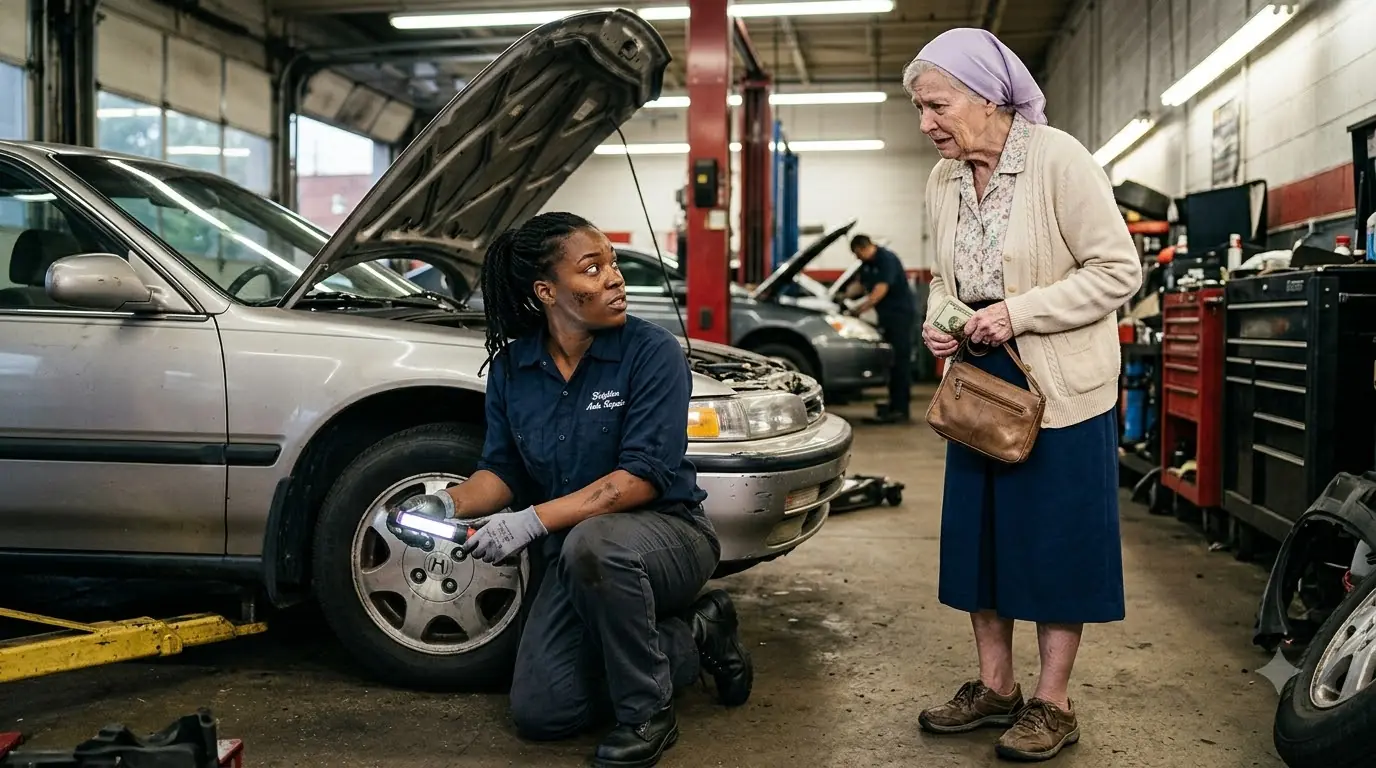
Outside, rain tapped lightly against the glass garage doors, blurring the street beyond into gray streaks and headlights.
Eleanor Hayes stood beside her aging silver Honda, clutching a worn brown purse against her chest.
Her hands trembled slightly, though not from age alone.
The Honda looked almost out of place in the service bay. The front bumper was scratched. The paint had faded unevenly under years of sun. One tire looked newer than the others, as if replaced only when necessity left no room for delay. The car was clean, but old, the kind of vehicle people drove when they counted maintenance costs carefully and prayed nothing major failed before the next check arrived.
Eleanor reached into her purse and touched the last twenty-dollar bill folded inside.
Then she pulled her hand back.
Twenty dollars was not enough.
She knew that.
Jake Morrison knew that too.
“Please,” Eleanor said softly. “My brakes are failing. I just need someone to look. I’m not asking for a full repair today. I just need to know if it’s safe to drive home.”
Jake barely looked at the car.
He was thirty-eight, broad-shouldered, clean-shaven, and dressed in a pressed Brighton Auto Repair shirt that looked newer than most of the uniforms worn by his employees. His hair was slicked back carefully. His shoes were spotless despite the oil-stained floor. A silver watch flashed at his wrist every time he moved his hand.
Jake liked the appearance of authority.
He liked being called boss.
Most of all, he liked deciding who mattered.
He gave Eleanor a quick glance, the kind that measured clothes, purse, shoes, age, race, and assumed money before a person had finished speaking.
“Lady,” he said, “take your junk car somewhere else.”
Eleanor’s face tightened.
The junior mechanic Miguel looked up from the sedan he was working on. Tony, the other mechanic in the second bay, paused with a wrench in his hand. Neither man spoke.
They had learned what happened when Jake felt challenged.
Eleanor swallowed.
“I can pay something today,” she said. “And if you can let me know the cost, I can come back with the rest. I just don’t want to hurt anyone if the brakes go out.”
Jake gave a short laugh.
“If you can’t afford to fix it, you can’t afford to drive it.”
The words landed heavily.
Eleanor lowered her eyes.
Not because she was ashamed.
Because she was deciding how long she would let him show himself.
Near the back of the shop, Kesha Williams stood beside a red pickup with its hood open. Her hands were covered in grease. Her dark hair was wrapped in a faded blue scarf, and her work shirt bore a small burn mark near one sleeve from a welding accident months earlier.
She should have kept her head down.
She knew that.
She had spent the entire morning repeating it to herself like a prayer.
Keep your head down.
Finish your shift.
Don’t give Jake a reason.
The eviction notice sitting in her locker had three days left on it. Her landlord had already given her two extensions. Her younger brother Marcus needed textbooks for his first semester at community college. Her gas tank was almost empty. Her refrigerator held eggs, hot sauce, and half a jar of peanut butter.
She could not afford to lose this job.
She could not afford pride.
She could not afford righteousness.
But Eleanor’s hands were shaking.
And the Honda had a brake problem.
Kesha could hear it in the way Eleanor described the pedal. Soft pressure. Pulling left. A faint grinding after stops. If that old woman got back on the road without at least an inspection, she could kill someone or be killed herself.
Jake turned away, dismissing Eleanor entirely.
That was when Kesha stepped forward.
“Ma’am,” she said, ignoring the sudden heat of Jake’s glare. “Pop your hood. I’ll take a look.”
The shop went silent.
Jake spun around.
“Kesha, what did I just say?”
His voice was low now, dangerous.
Kesha kept her eyes on Eleanor.
The old woman looked back at her with gratitude mixed with something else, something that almost looked like recognition.
“Thank you, child,” Eleanor whispered.
Kesha walked toward the Honda.
“Kesha,” Jake snapped. “Don’t touch that car.”
“She said the brakes are failing.”
“And I said she can take it somewhere else.”
“She might not make it somewhere else.”
Jake stormed toward them, his face reddening.
“You want to play hero on company time?”
Kesha opened the hood, then knelt near the front wheel and looked beneath the chassis.
“I want to make sure she doesn’t crash two blocks from here.”
Miguel’s eyes flicked toward Tony.
Tony stared at the floor.
They both admired Kesha.
Everyone in the shop did, even if they were too afraid to say it around Jake. She was the best diagnostic technician Brighton Auto had. She could identify engine trouble by sound before the scanner finished loading. Customers trusted her because she explained problems without making them feel stupid. She remembered whose child had asthma, who worked night shift, who needed the cheapest safe repair instead of the most expensive one.
Jake hated that.
He called it softness.
Kesha called it doing the job right.
Jake stepped closer until his shadow fell across her.
“You’re fired.”
Kesha stopped moving.
For one brief second, she did not breathe.
Eleanor’s lips parted.
“Sir, please. She was only trying to help me.”
Jake turned on her.
“And now she can help you both somewhere else. Get out. Both of you.”
Kesha slowly stood.
Her heart was pounding so hard she could feel it in her throat.
“Jake, don’t do this.”
“I already did. Clean out your locker.”
She looked around the shop.
Miguel looked devastated.
Tony’s jaw clenched.
The receptionist’s eyes shone with unshed tears.
But no one moved.
Kesha did not blame them.
Fear kept food on tables.
She knew that better than anyone.
Eleanor touched Kesha’s arm gently.
“I’m sorry,” the old woman said.
Kesha forced a small smile.
“Don’t be. Your car still needs to be checked.”
Jake barked a bitter laugh.
“You really don’t listen, do you?”
Kesha crouched again, pulled a flashlight from her pocket, and looked beneath the Honda.
“Kesha,” Jake warned.
She ignored him.
“Your front left brake line is leaking,” Kesha said to Eleanor. “You shouldn’t drive this.”
The old woman’s eyes narrowed slightly.
“Can it be patched?”
“Temporarily, maybe. Not permanently. You need a proper brake line replacement. But I can clamp the leak enough for you to get somewhere safe if you drive slow.”
Jake pointed toward the door.
“Out. Now.”
Kesha stood and wiped her hands on a rag.
“Fine.”
She turned to Eleanor.
“Call a tow if you can. If you can’t, wait until I’m outside. I’ll help you figure something out.”
Jake moved toward her locker first, as if afraid she might steal the dignity he had not managed to take.
Kesha followed in silence.
She had no idea that by choosing to help Eleanor Hayes, she had just changed everything.
She had no idea that the trembling old woman beside the aging Honda was not who she appeared to be.
And she had no idea that, by nightfall, someone very powerful would learn exactly what had happened inside Brighton Auto Repair.
The fluorescent light in Kesha’s studio apartment flickered like a dying heartbeat.
She stood in the doorway staring at the pink eviction notice taped there by her landlord’s office.
Seventy-two hours to vacate.
The paper had curled at the corners from humidity in the hallway. Someone had stepped on it before taping it to the door, leaving a dirty shoe print near the bottom.
Kesha peeled it off slowly, as if moving carefully might make the words less final.
Inside, the apartment was small enough that the bed, kitchenette, and living space all belonged to the same tired room. A box fan sat in the window. A pile of clean laundry rested on a chair because she had not had the energy to fold it. A stack of automotive manuals stood beside the bed, their pages bookmarked and worn.
Kesha dropped onto the mattress.
The ramen noodles in her lap went cold while she counted the crumpled bills from her wallet.
Forty-three dollars.
Not enough for rent.
Not enough for a security deposit somewhere else.
Barely enough for gas and food if she stretched both until they became miracles.
Her phone buzzed.
A text from her younger brother Marcus appeared on the screen.
Can you send money for textbooks? I’m sorry to ask.
Kesha stared at the message until the words blurred.
Marcus was nineteen, the first person in their family to attend college. Their mother had died when he was eleven and Kesha was twenty. Their father had disappeared long before that. Kesha had raised Marcus through the end of high school on waitressing money, night mechanic work, and stubbornness.
She had promised him he would not have to choose between school and survival the way she had.
She typed:
I got you. How much?
Then she deleted it.
She typed:
Give me a few days.
Deleted that too.
Finally, she turned the phone face down.
How could she explain that helping one frightened old woman had just cost her everything?
Across town, Eleanor Hayes sat in the living room of her modest ranch house, surrounded by photographs she had kept quietly displayed for years.
No gates protected her property.
No fountain sat in the yard.
No luxury car waited in the driveway.
Eleanor had chosen to remain in the same house she and her husband William bought in 1976, back when it seemed almost too large for two newlyweds and later somehow too small for three children, two dogs, and every cousin who needed a temporary bed.
The neighborhood had changed around her.
Some houses were renovated.
Some sold.
Some rented to young families who had no idea the elderly woman watering roses on Saturday mornings could move markets with one phone call.
Eleanor preferred it that way.
She sat in her favorite chair with a cup of tea growing cold on the side table.
In one frame, her late husband William Hayes stood smiling at the ribbon-cutting for their first auto shop in 1978. He wore coveralls, his hands still dirty because he had fixed a customer’s alternator twenty minutes before the photograph was taken. In another frame, their son Robert wore a graduation cap, his smile bright and hopeful.
A faded newspaper clipping sat beneath glass on the table.
Hayes Automotive Group Reaches 500 Locations.
That headline was old now.
There were 847 locations.
Eight hundred forty-seven shops carrying William’s name, his dream, his promise.
Or so Eleanor had thought.
She traced the edge of a frame holding Robert’s wedding photo. Her finger stopped on her son’s face.
When had his company become so cold?
When had profitable replaced principled?
When had a brake problem become less important than whether the customer looked wealthy enough?
Eleanor picked up her phone, then set it down.
For years, she had avoided interfering too much. Robert was the CEO now. He had expanded the company beyond anything William had imagined. He was smart, disciplined, respected, and under constant pressure from investors, franchise boards, legal teams, and industry analysts.
Eleanor had told herself he knew what he was doing.
But that afternoon at Brighton Auto Repair had shown her something she could no longer ignore.
It was one thing for a company to grow.
It was another for it to forget why it existed.
She picked up the phone again.
This call would change everything.
But Kesha Williams’s kindness demanded action.
Meanwhile, Jake Morrison slid into a leather booth at Murphy’s Bar, already three beers deep.
The bar smelled like fried onions, spilled whiskey, and old wood. It was where shop managers gathered after work when they wanted to complain about customers and congratulate themselves for surviving another day.
Tonight, Jake held court near the back.
Tommy from Eastside Auto sat across from him. Rick from West County Tire leaned in with a grin. Two other managers listened while Jake bragged, voice loud enough for the bartender to hear.
“Cleaned house today,” Jake said, foam clinging to his upper lip. “Got rid of dead weight.”
“Who?” Tommy asked.
“That bleeding-heart mechanic I told you about. Kesha Williams. Thought she could play Mother Teresa on company time.”
A few men laughed.
“She came by my shop once looking for extra hours,” Tommy said. “Good tech, from what I heard.”
“Good tech, bad attitude,” Jake replied. “Doesn’t understand business. Customers tell sad stories, and she melts like butter. You let one person get a free repair, next thing you know, every broke nobody in town shows up expecting charity.”
Rick raised his beer.
“You did the right thing. Margins don’t protect themselves.”
“Exactly.”
Jake clinked glasses with him.
“Word gets around fast. She’ll be flipping burgers by next week.”
The men laughed again, unaware that Eleanor’s phone call was already in motion.
She dialed a familiar number.
It rang once.
“Mom?” Robert answered. “It’s late. Is everything okay?”
His voice carried concern, love, and the weight of running an empire.
Eleanor closed her eyes.
She remembered the little boy who cried when his hamster died. The boy who gave his lunch money to a homeless man outside the grocery store. The boy who once asked his father why some people had to pay more to be poor.
“Robert,” she said, “I need you to listen carefully. Today I visited one of your shops.”
“Which one? I’ll have someone check.”
“Brighton Auto Repair on Morrison Street.”
There was a slight pause.
“All right. What happened?”
“A young woman named Kesha Williams was fired today for helping me.”
Silence stretched across the line.
Then Robert Hayes, CEO of a billion-dollar corporation, suddenly sounded like a ten-year-old boy.
“Mom? What exactly happened?”
Eleanor told him everything.
She described the Honda.
The brakes.
The twenty dollars.
Jake’s words.
Kesha stepping forward.
The way the shop went silent.
The moment Jake fired her.
She did not dramatize.
She did not need to.
The facts were damning enough.
By the time she finished, Robert’s breathing had changed.
It was the sound of shock becoming anger.
“Mom,” he said quietly, “are you safe?”
“Yes.”
“And the car?”
“Kesha made sure I did not drive it unsafely.”
“Of course she did.”
His voice hardened.
“I’ll handle this.”
“But are you sure you want to know what you might find?”
“Yes.”
Eleanor looked toward William’s photograph.
“There is something else you should know about what I saw today.”
“What?”
“That girl showed me more respect in five minutes than your manager showed in his entire life. If she is not the kind of person Hayes Automotive protects, then we have become something your father would not recognize.”
Robert said nothing.
That silence told Eleanor he understood.
As Eleanor explained, Kesha walked the dark streets past pawn shops and check-cashing stores toward the twenty-four-hour laundromat where she could sit without buying anything.
The city buses had stopped running.
She could not afford the gas to drive nowhere.
Her reflection in the shop windows looked ghostly, defeated.
Was this what doing the right thing got you?
A police cruiser slowed beside her.
The officer rolled down his window.
“You okay, miss? It’s pretty late to be walking alone.”
Kesha forced her voice steady.
“Yes, sir. Just heading home.”
The lie came easily.
Home.
What a joke.
The cruiser pulled away, and Kesha kept walking.
She did not see the black town car that drove past twice, its elderly passenger studying her face through tinted windows.
Eleanor ended the call with Robert after twenty minutes.
Her son’s shock had evolved into anger, then into the cold determination she recognized from his father.
Now Eleanor sat in her quiet house thinking about tomorrow.
About justice delayed but not denied.
About a young woman who chose kindness over self-preservation.
Outside, sprinklers whispered across perfect lawns in a neighborhood where no one suspected the woman who clipped coupons and drove a twelve-year-old Honda could change their world with one call.
She opened her laptop and searched for Kesha Williams and Brighton Auto.
The first result made her smile grimly.
Someone had posted a video of the confrontation to social media.
It began halfway through, just as Jake was pointing toward the door.
Kesha stood near Eleanor’s Honda, grease on her hands, face pale but steady.
Jake’s voice came clearly through the recording.
“You’re fired. Get out. Both of you.”
Hundreds of comments were already flooding in.
This is disgusting.
That mechanic deserves better.
Brighton Auto needs to answer for this.
I know Kesha. She helped my mom last year. Best mechanic in the city.
Eleanor sat back.
The revolution had begun before she even touched it.
She picked up her phone one more time.
She had other calls to make tonight.
The next morning hit Kesha like a sledgehammer.
Her landlord, Mr. Peterson, stood in the hallway with his arms crossed, watching as she stuffed her few belongings into garbage bags.
“I’m sorry, kid,” he said. “You seem like good people, but I got bills too.”
His voice carried genuine regret, but regret did not pay rent.
“You can store your stuff in the basement for a week, but after that…”
Kesha nodded, swallowing the lump in her throat.
“I understand.”
Three interviews yesterday.
Three rejections.
Word traveled fast in the automotive business. Jake Morrison had made sure of that.
“Mr. Peterson, if I can get the money by Friday…”
“Honey, you’d need eight hundred dollars plus late fees.” He shook his head. “I’ve given you every extension I can.”
As Peterson walked away, Kesha slid down the wall until she was sitting on the dirty carpet.
Her phone buzzed again.
Marcus.
Sis, you okay? Haven’t heard from you.
She typed and deleted a dozen responses before settling on one.
Everything’s fine. Focus on school.
The lie tasted bitter.
On the other side of town, Eleanor knelt beside William’s grave at Riverside Cemetery.
The morning dew soaked through her slacks, but she did not care. She needed to talk to the man who had started it all.
William’s headstone was simple.
William Arthur Hayes
Beloved Husband, Father, Builder, Servant
Below that was a line he had chosen himself years before death came for him.
Fix what you can. Help when you can. Leave people safer than you found them.
Eleanor touched those words with gloved fingers.
“You always said character shows when nobody’s watching,” she whispered. “Well, Will, I was watching yesterday. And what I saw would break your heart.”
The wind rustled through the oak trees William had planted there twenty years ago.
Eleanor remembered his words from their first shop.
“We’re not just fixing cars, El. We’re taking care of people when they’re vulnerable.”
Customers came to mechanics afraid.
Afraid of being stranded.
Afraid of being overcharged.
Afraid of not understanding enough to protect themselves.
William had built Hayes Automotive around that fear.
Not to exploit it.
To ease it.
“Our son built something big, Will,” Eleanor continued. “Eight hundred forty-seven locations now. But somewhere along the way, we lost what you started.”
Her voice cracked.
“That girl, Kesha. She reminded me of you. Same heart. Same willingness to do right even when it costs everything.”
A jogger passed by with earbuds in, oblivious to the woman making promises to the dead.
Eleanor stood and brushed damp grass from her knees.
She had work to do.
Back at Brighton Auto, Jake arrived whistling, coffee in hand, ready for another profitable day.
What he did not know was that corporate had already called an hour earlier.
What he did not know was that Robert Hayes had barely slept, spending the night reviewing personnel files, customer complaints, and legal notes that made his stomach turn.
“Morning, boss,” Miguel called cautiously. “It feels weird without Kesha here.”
Jake’s good mood soured.
“Don’t start.”
“She was the best diagnostic tech we had.”
“That bleeding heart?” Jake snorted. “You’re better off without her. Now we can focus on paying customers instead of charity cases.”
Miguel exchanged glances with Tony.
Both men had been on the receiving end of Jake’s jokes about their accents, their neighborhoods, their families, and whether customers like them belonged in “real business.”
Yesterday had felt different, though.
More vicious.
More personal.
“Boss,” Tony said carefully. “That lady Kesha helped. She seemed really scared. Maybe sometimes it’s worth…”
“Worth what?” Jake snapped. “Losing money?”
He slammed his coffee down on the counter.
“You two want to join her in the unemployment line? Because I can arrange that real quick.”
The men returned to work in uncomfortable silence.
Neither noticed the black sedan parked across the street, or the well-dressed investigator inside taking photographs of the shop.
Kesha spent the morning at the public library with a laptop open to job search sites.
Every automotive shop within thirty miles seemed to give the same response.
Position filled.
Not hiring.
Try again later.
She recognized the pattern.
In a small industry, one bad word from Jake Morrison traveled fast.
Her savings account read $23.47.
Her phone had seventeen missed calls from bill collectors.
The library’s free Wi-Fi was a lifeline she could not afford to lose.
“Excuse me,” the librarian, Mrs. Carter, said quietly as she approached. “I couldn’t help but notice. Are you okay, honey?”
Kesha forced a smile.
“Just job hunting. It’s tough out there.”
Mrs. Carter sat down and lowered her voice.
“My nephew owns a garage in the next county. It’s about an hour drive, but he pays fair wages and treats people right.”
Hope flickered in Kesha’s chest.
“That would be amazing. Could you…”
“Already called him,” Mrs. Carter said with a smile. “He wants to meet you tomorrow at two. Said anyone who helps strangers for free is exactly who he needs.”
Kesha looked down quickly, blinking hard.
“Thank you.”
As Kesha wrote down the address, she did not notice Eleanor Hayes entering the library.
She did not see the older woman pause at the sight of her, then quietly approach Mrs. Carter afterward.
“Excuse me,” Eleanor said softly. “That young woman who was just here. Does she come in often?”
Mrs. Carter studied Eleanor carefully. Something in the older woman’s eyes spoke of shared concern rather than idle curiosity.
“She’s going through a hard time,” Mrs. Carter said finally. “But she’s a good person. The kind who would give her last dollar to help someone else.”
Eleanor nodded, understanding more than Mrs. Carter realized.
“Yes,” she whispered. “I know exactly who she is.”
Hayes Automotive Group headquarters rose thirty floors above downtown, its glass facade reflecting the morning sun like a beacon of corporate power.
Eleanor’s modest Honda looked absurd in the visitor parking lot, dwarfed by BMWs, Mercedes, and executive SUVs that cost more than most people made in a year.
She took the executive elevator to the twenty-eighth floor, her key card still working after all these years.
The receptionist, Amanda, looked up with practiced politeness that melted into genuine warmth.
“Mrs. Hayes! What a lovely surprise. Mr. Hayes is in his office.”
“Thank you, dear. I’ll find my way.”
Eleanor walked through corridors lined with awards and photographs chronicling the company’s growth.
Employer of the Year.
Community Partner Excellence.
National Service Award.
The irony tasted bitter in her mouth.
Robert’s corner office overlooked the entire city. Floor-to-ceiling windows framed a view that cost eight million dollars and commanded respect from every visitor.
Behind the mahogany desk, her son looked every inch the CEO.
Tailored suit.
Confident posture.
A kind of authority that made people speak carefully around him.
But when he saw his mother, Robert Hayes became a worried son.
“Mom.”
He crossed the room in three strides and embraced her.
“I’ve been up all night thinking about your call. Tell me everything again.”
Eleanor settled into the leather chair across from his desk, the same chair where senators, governors, and billion-dollar partners had sat.
Today it held a seventy-two-year-old woman seeking justice for a stranger.
“Yesterday I decided to test something,” Eleanor began. “I dressed down and drove my old car to Brighton Auto Repair. I wanted to see how your people treat customers who can’t afford premium service.”
Robert’s face darkened.
“And now I know.”
“Mom, I had legal pull Morrison’s file this morning,” Robert said. “Three discrimination complaints in two years. All dismissed because victims couldn’t afford lawyers or because regional management said the claims were unsubstantiated.”
His jaw tightened.
“How did we let this happen?”
Eleanor stood and moved to the wall of family photographs.
There was William at the first shop opening, hands dirty from honest work. There was young Robert in coveralls, learning to change oil before he learned to read financial statements.
“Your father used to say, ‘We’re not in the car business, Robbie. We’re in the dignity business.’”
Eleanor touched the frame.
“When did we forget that?”
Robert joined her by the photos.
For a moment, both stared at the man who had started with one shop and a simple principle.
Treat every customer like family.
“What do you want me to do, Mom?”
Eleanor turned to face her son. In her eyes, he saw the same determination that had helped build the company from nothing.
“I want you to remember who you used to be. That little boy who cried when we had to repossess the Johnson family’s car, even though your father explained we had no choice. The boy who insisted we hire Maria at the front desk because he said she smiled like sunshine, even though her English was still rough.”
Her voice strengthened.
“I want Hayes Automotive Group to mean something again.”
“And Morrison?”
“Justice, Robert. Swift and public.”
Eleanor moved toward the door, then paused.
“Oh, and that young woman, Kesha Williams. I want you to meet her. Today, if possible.”
“Mom, we can’t just…”
Eleanor’s smile stopped him cold.
It was the same smile she wore when she convinced the bank to loan them money for their second shop. The same smile that preceded every major victory in the company’s history.
“Trust me, son. Some battles are worth fighting exactly the way they need to be fought.”
Robert Hayes did not waste time.
Within two hours of his mother’s visit, a team of corporate investigators arrived near Brighton Auto Repair in an unmarked van. They posed as customers, delivery workers, and prospective employees, hidden cameras recording every interaction, every dismissive glance, every moment that revealed Jake Morrison’s true character.
Meanwhile, Kesha drove her sputtering Toyota toward Carter’s Automotive in the next county, hope and desperation warring in her chest.
The gas gauge hovered near empty.
She was burning her last ten dollars on this interview.
If it did not work out, there was no plan left.
She forced the thought away.
It had to work out.
Robert watched the live feed from his office.
His investigators’ hidden cameras revealed a shop culture that made his stomach turn.
Jake berated Miguel for speaking Spanish to a customer who was more comfortable in Spanish. He dismissed an elderly man with a hearing aid, pretending not to understand him. He quoted inflated prices to a single mother whose minivan needed only a minor repair. He told a junior employee, “Poor customers take the most time and bring the least money.”
“Get me everything,” Robert told his head of security, Marcus Webb. “Personnel files. Customer complaints. Financial records. I want to know every corner Jake Morrison has cut, every person he has hurt.”
“Sir, with respect,” Marcus said carefully, “moving this fast without full legal review could expose the company to risk.”
Robert turned toward him.
“My mother tested our values yesterday, and we failed. How many other customers have we failed? How many employees like Kesha Williams have we destroyed for doing the right thing?”
Marcus nodded.
Some things mattered more than legal caution.
At Carter’s Automotive, Kesha met David Carter, Mrs. Carter’s nephew.
He was younger than she expected, maybe thirty-five, with calloused hands, oil under his fingernails, and the quiet confidence of a real mechanic who still worked on cars instead of only managing people who did.
“My aunt says you fixed someone’s brakes for free and got fired for it,” David said, wiping his hands on a shop rag. “Is that true?”
“Yes, sir. Probably not the smartest career move.”
David laughed.
“Depends how you define smart. Show me what you know.”
He led her to a 2015 Camry with a mysterious engine knock.
Kesha popped the hood, listened to the engine, and ran her hands along the components with the practiced touch of someone who spoke car fluently.
“Timing chain tensioner,” she said after three minutes. “Probably has around sixty thousand miles on it. Sound likely started subtle and got worse over the last month, especially on cold starts.”
David’s eyebrows rose.
“How did you know the mileage?”
“Wear pattern on the tensioner housing. Also, the owner keeps up with oil changes. I can tell from the condition of everything else. Someone who maintains their car wouldn’t ignore a major problem, so this just developed.”
David stared at her for a moment.
“You’re hired.”
The words hit Kesha like a physical blow.
“Sir?”
“Forty-five dollars an hour. Health benefits after ninety days. You can start Monday. My aunt was right. Anyone who gets fired for helping people is exactly who I want working here.”
Kesha felt tears threatening.
“Mr. Carter, I… thank you. You have no idea what this means.”
“Actually,” David said, his expression growing serious, “I do. I got blacklisted once too, for refusing to overcharge a single mother. Took me two years to find someone willing to give me a chance. Now I get to be that someone for you.”
As Kesha drove away, actually toward a future again, she did not notice the black sedan following at a discreet distance.
She did not see Eleanor Hayes in the passenger seat, making notes in a leather portfolio.
“She’s exactly what I hoped,” Eleanor told her driver, James, who had worked for the family for fifteen years. “Skilled, honest, resilient.”
“Ma’am,” James said, “if I may ask, why not just have Mr. Hayes offer her any position in the company right now?”
Eleanor smiled, watching Kesha’s battered Toyota navigate traffic with careful precision.
“Because charity creates dependence, James. Opportunity creates transformation. There’s a difference.”
Back at Hayes Automotive headquarters, Robert’s investigators delivered their preliminary findings.
The evidence against Jake Morrison filled three binders.
Discriminatory hiring practices.
Customer complaints buried by regional management.
Financial irregularities suggesting kickbacks from parts suppliers.
But it was the footage that sealed Jake’s fate.
Hidden cameras captured him using insulting labels for Miguel and Tony. They recorded him telling a customer, “We don’t do welfare work here,” when an elderly man asked about payment plans.
Most damaging of all, there was footage of Jake bragging to other shop managers about his “cleaning house” strategy, specifically targeting employees who showed too much sympathy for difficult customers.
“This is systematic,” Robert told his legal team. “It’s not just Brighton Auto. It’s spreading.”
His phone rang.
Eleanor’s name appeared.
“Mom?”
“How is your investigation proceeding?”
“Worse than we thought. Morrison has infected other managers with his approach. We’re looking at potential lawsuits from customers and former employees.”
“Good.”
Robert blinked.
“Good?”
“I mean it is terrible that it happened, but good that you are seeing the full scope. Robert, I need you to do something else for me.”
“Anything.”
“Tomorrow morning, visit Carter’s Automotive. No entourage. No corporate car. No suit if you can help it. Just you being human for an hour.”
Robert frowned.
“What aren’t you telling me?”
Eleanor’s laugh carried decades of love and wisdom.
“I’m telling you everything you need to know, when you need to know it, just like your father used to do.”
Monday morning at Carter’s Automotive felt like stepping into a different universe.
David greeted Kesha with fresh coffee and a genuine smile. Miguel, another mechanic who had recently left a Hayes location after being treated poorly, showed her the diagnostic equipment without condescension.
“This place runs differently,” Miguel said. “David actually listens when customers talk. Crazy concept, right?”
Kesha’s first customer was Maria Santos, whose minivan made grinding noises.
Instead of rushing to expensive assumptions, Kesha took time to listen.
Three kids.
A husband working two jobs.
A vehicle that needed to last two more years.
“Let me check the simple stuff first,” Kesha said gently.
Fifteen minutes later, she was tightening a loose heat shield vibrating against the exhaust pipe.
Total cost: zero dollars.
Maria’s relief filled the service bay like sunlight.
“Most places would have told me I needed a new exhaust system,” Maria said, tears in her eyes.
Kesha smiled.
“Most places should be ashamed of themselves.”
By lunch, word spread through social media.
Maria posted, Finally found a shop that treats working families with respect. Ask for Kesha. She saved me hundreds today.
Three shares became thirty.
Then three hundred.
By that afternoon, Carter’s Automotive had eight new appointments.
Eleanor Hayes sat in her kitchen reading the morning paper and monitoring Hayes Automotive Group reports on her laptop. The stock price was steady. Profitability looked strong. The company appeared respectable from the outside.
Her phone showed seventeen missed calls from Jake Morrison.
She deleted the voicemails without listening.
Robert Hayes spent his lunch break driving past Carter’s Automotive, following his mother’s instructions. The small shop looked honest. No flashy signage. No pressure tactics. Just open bays, steady work, and people speaking to one another like human beings.
Through the service bay doors, he saw Kesha explaining something to an elderly customer with patience and expertise. She held a brake pad in one hand, showing the worn edge clearly, not rushing, not selling fear.
Something about her careful attention reminded him of his father’s first employees, people who cared more about the work than the invoice.
He drove away without stopping.
But Eleanor’s plan was already working.
At Brighton Auto Repair, Jake Morrison felt the walls closing in.
Corporate had called twice asking about routine inspection schedules. His regional supervisor mentioned customer satisfaction audits that had never existed before. His phone kept buzzing with social media links to the video, but Jake told himself outrage always passed.
People forgot quickly.
Profit mattered longer.
Then came the call at 8:00 a.m. sharp.
Jake answered with the confidence of a man who believed his world was secure.
“Morrison, this is Regional Director Patterson. Congratulations. Corporate is promoting you to district manager. You’ll oversee fifteen shops across three counties.”
Jake’s grin could have powered the city.
“Thank you, sir. I won’t let you down.”
“Pack up today. You start at headquarters Monday. And Morrison, keep doing whatever you’ve been doing. Your profit margins are exactly what we want company-wide.”
As Jake hung up, he did not know Patterson had received his orders directly from Robert Hayes.
He did not know Eleanor had suggested placing him where his influence could be observed openly.
He did not know he had just been moved into the perfect position for a very public fall.
Two counties away, Kesha’s second week at Carter’s Automotive brought a steady stream of satisfied customers. Word of mouth traveled fast when competence met compassion. She was rebuilding her reputation one honest diagnosis at a time.
But Jake’s promotion meant his poisonous influence was about to spread.
By Wednesday, he was holding district manager meetings, teaching other shop managers his “efficiency methods.”
“Customer sympathy is a profit killer,” he told a room of twenty managers. “Sad stories don’t pay rent. You start making exceptions, word gets out that you’re a pushover.”
In the back row, Tom Bradley from Westside Auto shifted uncomfortably.
“What about community relations? Customer loyalty?”
Jake’s laugh was sharp as broken glass.
“Loyalty? These people drive ten-year-old cars and complain about fifty-dollar repairs. They’ll take their business wherever it’s cheapest. Might as well get full price while they’re here.”
The managers exchanged glances.
Some nodded.
Others looked sick.
“I cleaned house in Brighton last month,” Jake continued. “Fired a mechanic who thought she could play Mother Teresa with company resources. Now my team stays focused on paying customers.”
Eleanor Hayes watched this meeting through a hidden camera feed, her face stone cold with fury.
The investigators captured every word, every callous laugh, every moment of institutional cruelty dressed up as corporate policy.
She called Robert immediately.
“He’s teaching them,” she said. “Your new district manager is spreading his disease to fifteen shops. How many Kesha Williamses will suffer because we waited too long?”
Robert stared at the live feed on his computer screen. Jake Morrison stood before two dozen shop managers like a general addressing troops, weaponizing prejudice and calling it business strategy.
“Mom, I can stop this right now.”
“No,” Eleanor said sharply. “Let him dig deeper. Let him train more people in his methods. Let him feel safe enough to show his true face.”
“But the damage?”
“Will be evidence, Robert. When we are done, no one will ever doubt why Jake Morrison deserved what happened to him.”
Thursday brought Jake’s first surprise inspection to Carter’s Automotive.
He arrived in a Hayes Automotive Group sedan, clipboard in hand, looking for any excuse to destroy David Carter’s operation.
“You the owner?” Jake asked David, his tone suggesting ownership was somehow suspicious.
“Yes, sir. How can I help you?”
“District inspection. I’ll need to see your books, employee records, and customer satisfaction scores.”
David complied, but Jake had already decided his verdict.
Then he saw Kesha.
She was helping a young father understand why his check engine light was connected to an oxygen sensor, not a catastrophic engine failure.
Jake’s smile turned predatory.
“That mechanic,” he said. “She looks familiar.”
David looked toward Kesha.
“Kesha Williams. Best diagnostic tech I’ve ever seen.”
“Interesting.”
Jake made notes that would damn them all.
“Very interesting.”
After Jake left, Kesha felt the familiar chill of impending disaster.
She had seen that look before, the look of a man with power and a grudge.
“David, I need to tell you something.”
Her boss waved her off.
“Whatever it is, we’ll handle it.”
“You don’t understand. Jake doesn’t stop.”
David looked at her steadily.
“Kesha, you are family here now. If somebody comes after you, they come after us.”
Friday afternoon, the trap sprang shut.
David received an official notice. Carter’s Automotive was under investigation for irregular employment practices and potential safety violations. Effective immediately, all Hayes Automotive Group partnerships and referrals were suspended.
For a small shop, losing Hayes backing meant losing forty percent of business overnight.
“I’m sorry,” Kesha told David, guilt eating her alive. “This is because of me. Because I helped that woman, and Jake Morrison wants revenge.”
David studied the corporate letterhead.
Then he crumpled the letter in one hand.
“Kesha, let me tell you something about revenge. It only works when you care more about hurting others than helping yourself.”
He tossed the letter into the trash.
“Jake Morrison just picked a fight with the wrong family.”
That evening, Eleanor Hayes received her daily report from the investigators.
Jake Morrison’s first week as district manager included three shops adopting his discriminatory customer screening, two mechanics fired for “excessive empathy,” and one shop owner threatened for employing someone Jake personally disliked.
She called Robert one final time.
“Tomorrow,” she said simply. “It’s time.”
“Mom, are you sure? Once we do this…”
“Your father didn’t build this company so people like Jake Morrison could destroy lives for sport. Tomorrow, we remind everyone what Hayes Automotive Group actually stands for.”
Saturday evening, Eleanor Hayes drove her old Honda to Carter’s Automotive.
Through the service bay windows, she spotted Kesha under the hood of a customer’s truck, movements precise and confident.
When Kesha emerged, wiping her hands on a shop rag, Eleanor approached slowly.
“Excuse me, dear.”
Kesha turned, then stopped cold.
The elderly woman from Brighton Auto Repair stood before her, dressed simply but somehow different.
More purposeful.
“Ma’am,” Kesha said, “is everything okay with your car?”
Eleanor smiled.
“My car runs perfectly, thanks to you. I never got to properly thank you.”
“You don’t need to thank me. Anyone would have.”
“No,” Eleanor said gently. “Not anyone. Very few people would risk their job to help a stranger.”
At Murphy’s Diner across the street, Eleanor ordered apple pie while Kesha nursed coffee.
“Can I ask you something?” Eleanor said carefully. “That manager who fired you, has he caused trouble for other people?”
Kesha’s laugh was bitter.
“Jake Morrison? He’s got a whole system. Targets anyone who doesn’t fit his idea of profitable customers. Miguel told me Jake had mechanics fired from different shops for attitude problems.”
“What kind of attitude problems?”
“Helping people Jake thought were beneath notice. Spanish-speaking customers, elderly folks, single mothers counting pennies.”
Kesha’s anger built slowly.
“He calls it maintaining standards, but it’s just cruelty with a business plan.”
Eleanor listened, taking mental notes that would become evidence.
“Has anyone tried to complain?”
“To who? Jake’s got connections throughout the district. Corporate only cares about profit margins.”
Kesha stirred her coffee absently.
“People like us don’t have lawyers or influence.”
Eleanor repeated the words softly.
“People like us.”
Then she smiled faintly.
“Sometimes help comes from unexpected places.”
Meanwhile, at Hayes Automotive Group headquarters, Robert Hayes worked through the night with his investigative team. The evidence against Jake Morrison continued mounting.
Seventeen documented cases of discriminatory treatment.
Six wrongful termination complaints settled quietly.
Financial irregularities spanning three years.
Parts supplier kickbacks.
Regional management cover-ups.
The hidden camera footage from district meetings provided the smoking gun. Jake’s own words taught other managers to target vulnerable customers and employees.
“Sir,” Marcus Webb reported, “Morrison has supporters in regional management covering for him. Regional Director Patterson buried discrimination complaints. District Supervisor Collins took kickbacks from parts suppliers Morrison recommended.”
Robert studied the organizational chart, red lines connecting corruption throughout the system.
“How deep?”
“Systematic. This isn’t just one bad manager.”
At two in the morning, Robert called his mother.
She answered immediately.
“How did it go with Kesha?”
“She confirmed everything we suspected and worse,” Eleanor said. “Robert, this isn’t just about Jake Morrison. It’s about a culture that rewards cruelty and punishes compassion.”
“I know, Mom. We’ve got enough evidence to clean house completely.”
“Good. Tomorrow, we’re going to send a message to the entire industry.”
Her voice carried absolute determination.
“Is the boardroom ready?”
“Everything’s prepared. Full board attendance. Regional leadership. Media invited. Legal team standing by.”
“And Jake?”
“Believes he’s being honored for outstanding performance. He’ll arrive at ten expecting a promotion.”
Eleanor’s smile was sharp as winter moonlight.
“Perfect. Make sure Kesha Williams gets an invitation. Personal delivery tonight.”
“Mom, what are you planning?”
“Justice, dear. The kind your father would have demanded.”
An hour later, Marcus Webb arrived at Kesha’s temporary studio apartment with an official invitation.
“Hayes Automotive Group board meeting,” he said. “Your presence is requested. Ten o’clock Sunday morning.”
Kesha stared at the letterhead, confused.
“I don’t understand. Why would they want me there?”
“Ma’am, I’m just delivering the message, but I will say this. Tomorrow is going to be a day that changes everything.”
Sunday morning, 9:45 a.m.
Jake Morrison strutted through the marble lobby of Hayes Automotive Group headquarters like a man walking into his destiny.
His new suit cost more than most mechanics made in a month, and his confidence radiated from every step. He nodded at the receptionist, adjusted his cuffs in the elevator mirror, and rehearsed the humble smile he planned to wear when Robert Hayes praised him in front of the board.
The boardroom on the thirtieth floor buzzed with energy. Board members, regional managers, attorneys, and invited media filled the leather chairs around the massive conference table.
Jake spotted the cameras and grinned.
Corporate must want to document his promotion for the company newsletter.
He did not notice Kesha Williams sitting in the back corner, still confused about why she was there.
He did not see Miguel, Tony, David Carter, Maria Santos, or seventeen former employees and customers seated along the side wall.
And he did not recognize the thin elderly woman in a simple black dress positioned near the head of the table.
“Ladies and gentlemen,” Robert Hayes announced, stepping to the podium, “thank you for joining us this morning for what promises to be a historic announcement regarding the future direction of Hayes Automotive Group.”
Jake straightened his tie, ready for his moment of triumph.
“First, I’d like to introduce someone very special. Many of you know her as the widow of our founder, William Hayes. But today she speaks as a Hayes Automotive Group stakeholder with a sixty percent controlling interest.”
Eleanor Hayes rose slowly.
Her presence commanded the room without effort.
Several board members shifted uncomfortably. They had forgotten the quiet woman in the corner held the real power.
“My late husband founded this company on a simple principle,” Eleanor began. “Character is not tested in boardrooms. It is proven on garage floors.”
Jake’s smile faltered slightly.
Something felt wrong.
“Three weeks ago, I decided to test that principle. I dressed down, drove my oldest car to one of our Brighton locations, and presented myself as a customer in need.”
Eleanor’s eyes found Jake in the audience.
Recognition dawned on his face like sunrise over a cemetery.
“I was dismissed, ridiculed, and turned away because I did not appear profitable enough for our company’s attention.”
The room grew silent.
Media cameras swung toward Jake, whose face had gone pale.
“But one employee,” Eleanor continued, “stayed after hours to help a stranger for free. Kesha Williams risked her job to uphold the values this company was founded on.”
Kesha’s heart pounded as hundreds of eyes turned toward her.
Eleanor’s gentle nod gave her strength.
“For this act of kindness, our then-manager, Jake Morrison, fired Ms. Williams immediately.”
Murmurs rippled through the boardroom.
Jake started to stand, but Robert’s voice stopped him cold.
“Mr. Morrison, please remain seated. We have something to show you.”
The lights dimmed.
A massive screen descended from the ceiling.
Jake’s voice filled the room, recorded in high definition at the previous week’s district meeting.
“Customer sympathy is a profit killer. You start making exceptions for sob stories, word gets out that you’re a pushover.”
On screen, Jake’s recorded image gestured dismissively.
“I cleaned house in Brighton last month. Fired a mechanic who thought she could play Mother Teresa with company resources.”
The real Jake Morrison sank into his chair as his own words condemned him before the entire industry.
The video continued.
Jake teaching discrimination.
Jake mocking vulnerable customers.
Jake laughing about destroying careers.
Jake threatening David Carter’s shop.
Jake insulting Miguel and Tony.
Jake describing compassion as weakness.
When the screen went dark, the silence was deafening.
Eleanor stepped forward, her voice now carrying the authority of absolute judgment.
“Mr. Morrison, three weeks ago, you called helping people ‘playing Mother Teresa.’ Today, I want you to meet the woman whose kindness you punished.”
She gestured toward Kesha.
“Kesha Williams, would you please join me?”
Kesha stood on trembling legs and walked to the front.
Eleanor continued.
“This young woman embodies everything Hayes Automotive Group should represent. Skill. Integrity. Compassion. Courage.”
Eleanor paused.
“Mr. Morrison, I believe you two have met.”
Jake’s face crumbled as the full scope of his disaster became clear.
The old woman he dismissed.
The mechanic he fired.
The company he thought he controlled.
All connected in a web of consequences he never saw coming.
“Jake Morrison,” Robert announced formally, “you are terminated immediately. Legal proceedings for discrimination, fraud, and violation of company ethics will begin Monday. Regional Director Patterson and District Supervisor Collins have also been removed pending investigation.”
Security guards appeared at Jake’s shoulders.
As they escorted him out, Eleanor delivered the final blow.
“Mr. Morrison, the elderly customer you turned away three weeks ago, the one whose brake problem wasn’t profitable enough for your attention…”
Her smile was sharp as justice itself.
“That was me. The mother of the man who just ended your career.”
Jake’s legs weakened.
Security had to hold him upright as media cameras captured every moment of his humiliation.
Eleanor turned back to the assembled crowd, her voice warming as she addressed Kesha.
“Ms. Williams, on behalf of Hayes Automotive Group, I offer you the position of Regional Customer Relations Director. Your job will be ensuring that every customer, regardless of appearance, language, age, income, or apparent means, receives the dignity and respect my husband envisioned.”
Kesha could barely breathe.
“I don’t have a degree for that.”
“You have something more important,” Eleanor said. “You know what it feels like to be overlooked, and you chose not to overlook someone else.”
The room erupted in applause.
Kesha felt tears streaming down her face as Eleanor embraced her, smelling faintly of lavender and justice.
“But why?” Kesha whispered. “Why go through all this for someone like me?”
Eleanor pulled back, her eyes bright with unshed tears.
“Because, dear child, character isn’t about who you help when cameras are watching. It is about who you help when you think nobody is looking.”
She paused, her voice carrying across the silent room.
“But somebody is always looking. And sometimes that somebody has the power to make things right.”
Robert joined them at the podium.
“Ladies and gentlemen, effective immediately, Hayes Automotive Group is implementing the Williams Protocol, a company-wide mandate that every customer interaction be guided by compassion first and profit second. We will audit every location, reopen every dismissed complaint, compensate wrongfully terminated employees, and retrain leadership from the ground up.”
The media surged forward with questions.
Board members lined up to shake hands.
Regional managers who had enabled Jake Morrison quietly slipped toward the exits, knowing their own reckonings were approaching.
But in the center of the storm, two women stood together.
One had given everything to help a stranger.
One had everything to give back.
“Mrs. Hayes,” Kesha said softly, “I still don’t understand how you knew I was the right person for this job.”
Eleanor’s smile carried decades of hard-won wisdom.
“Child, I didn’t choose you for this job. You chose yourself the moment you stayed late to fix an old woman’s brakes.”
Outside, Jake Morrison sat in his car in the parking garage, staring at his phone as reporters’ calls flooded in.
His corporate credit cards had already been canceled.
His company car would be repossessed by evening.
His reputation in the automotive industry was destroyed.
He thought about the old woman whose brake problem had started the avalanche.
He wondered what his life would look like now if he had simply shown her basic human decency.
But some lessons came too late to matter.
Three months later, Brighton Auto Repair buzzed with transformed energy.
Miguel now managed the location, leading a team of five mechanics trained in the Williams Protocol: competence paired with compassion. The waiting area featured comfortable chairs, fresh coffee, a transparent price guide, and a children’s corner where families could relax while honest work happened.
Kesha walked through the shop on her monthly inspection, watching genuine care in action.
Tony explained brake options to an elderly gentleman with infinite patience. Sarah, the new hire, helped a young mother understand why her transmission problem was not as expensive as she feared. Miguel greeted every customer by name when possible, not because a script told him to, but because he finally worked in a place where kindness was not punished.
“How are we doing?” David Carter asked, joining Kesha near the service bay.
As regional training coordinator, he now helped ensure the culture change stuck across all Hayes locations.
“Better than anyone hoped,” Kesha said. “Customer satisfaction is up forty-seven percent. Employee retention is at an all-time high. Profits actually improved when we stopped chasing quick scores and started building relationships.”
Eleanor Hayes emerged from her Honda, the same car still running perfectly.
She had become a regular customer at every Hayes location, a living reminder of why kindness mattered.
“Mrs. Hayes,” Miguel called cheerfully. “Right on time for your oil change.”
“And I brought cookies,” Eleanor announced, producing a tin that made the entire crew gather around like grateful grandchildren.
As Eleanor settled into the waiting area, Kesha joined her with a cup of coffee.
“Any regrets?” Eleanor asked gently.
Kesha considered the question seriously.
Her new position came with challenges. Changing entrenched attitudes. Implementing training programs. Dealing with franchise owners who resisted cultural shifts. Some days, the work was exhausting.
But it mattered.
“Jake Morrison got eighteen months for fraud and discrimination-related charges,” Kesha said finally. “His enablers were fired. Seventeen wrongfully terminated employees have been compensated and offered positions.”
Eleanor nodded.
“That’s justice. But I asked about regrets.”
Kesha watched Tony teaching a new apprentice proper diagnostics. She saw Sarah helping a customer understand payment options. She observed Miguel treating every person with dignity, from luxury SUV owners to people driving cars that barely started.
“No regrets,” she said firmly. “This is exactly where I’m supposed to be.”
Eleanor’s smile carried deep satisfaction.
“Your brother called yesterday.”
Kesha blinked.
“Marcus?”
“Graduating with honors. Accepted to engineering school with a full scholarship.”
“Eleanor, you didn’t…”
“The Williams Family Foundation supports deserving students. Marcus earned every penny through merit.”
Eleanor’s eyes twinkled.
“Though having a sister who embodies integrity certainly didn’t hurt his application.”
Kesha looked away, overwhelmed.
As Eleanor’s Honda received the same careful attention given to luxury cars, Kesha realized this was what revolution looked like.
Not always marches.
Not always speeches.
Sometimes revolution looked like a brake inspection done for free.
A manager exposed.
A company reminded of its soul.
A customer treated like a human being.
A mechanic refusing to let fear make her cruel.
Outside, the Hayes Automotive Group sign gleamed in the afternoon sunlight.
But the real change lived inside the shop, in the hearts of people who remembered what service truly meant.
One year later, Kesha Williams stood before a packed auditorium at the National Automotive Service Excellence Conference, accepting the Community Impact Award on behalf of Hayes Automotive Group.
The stage lights were bright. The audience was full of executives, technicians, franchise owners, reporters, and industry leaders who had once treated customer dignity as a public relations phrase rather than a daily obligation.
Kesha stood at the microphone, steady and calm.
“This award doesn’t belong to me,” she said. “It belongs to everyone who believes kindness and competence are not opposites. They are partners.”
In the front row, Eleanor Hayes sat with a proud smile brighter than the stage lights. Beside her, Robert recorded every word for all eight hundred forty-seven Hayes locations.
“A year ago, I was fired for helping someone I thought was just another struggling customer,” Kesha continued. “Today, that customer is my mentor, and the woman who proved that sometimes angels drive old Hondas.”
The audience laughed.
Eleanor’s eyes glistened with tears.
“The Williams Protocol isn’t revolutionary because it is new,” Kesha said. “It is revolutionary because we forgot that treating people with dignity used to be normal.”
Applause thundered through the auditorium.
Eleanor stood slowly, joined by hundreds of automotive professionals who finally understood what William Hayes had known fifty years earlier.
Later, Kesha found Eleanor on the hotel balcony, looking out at the city lights.
“Still think about that day?” Eleanor asked softly.
“Every day,” Kesha admitted. “It changed everything.”
Eleanor took her hand, weathered fingers intertwining with calloused ones.
“No, dear. You changed everything. I just made sure the world noticed.”
Sometimes the smallest acts of kindness create the biggest changes.
Kesha had not helped Eleanor because she expected reward, promotion, rescue, or recognition. She had helped because an elderly woman was scared, because a car with failing brakes was dangerous, and because dignity should never depend on what someone can afford.
And because she chose compassion when it cost her everything, a company found its conscience again.
A cruel manager lost the power he had abused.
A forgotten legacy was restored.
A young mechanic became the voice of a new standard.
A brother got his chance at school.
A mother’s promise to her late husband was kept.
And somewhere in every Hayes Automotive shop, when a customer walked in worried, embarrassed, or counting the last dollars in their wallet, someone remembered Kesha Williams and asked the only question that mattered.
“How can we help?”