“We don’t run a charity here.”
Jake Morrison’s voice cut through Brighton Auto Repair like a blade.
Eleanor Hayes clutched her worn purse and watched her last twenty-dollar bill disappear back inside it. “Please. My brakes are failing. I just need someone to look at them.”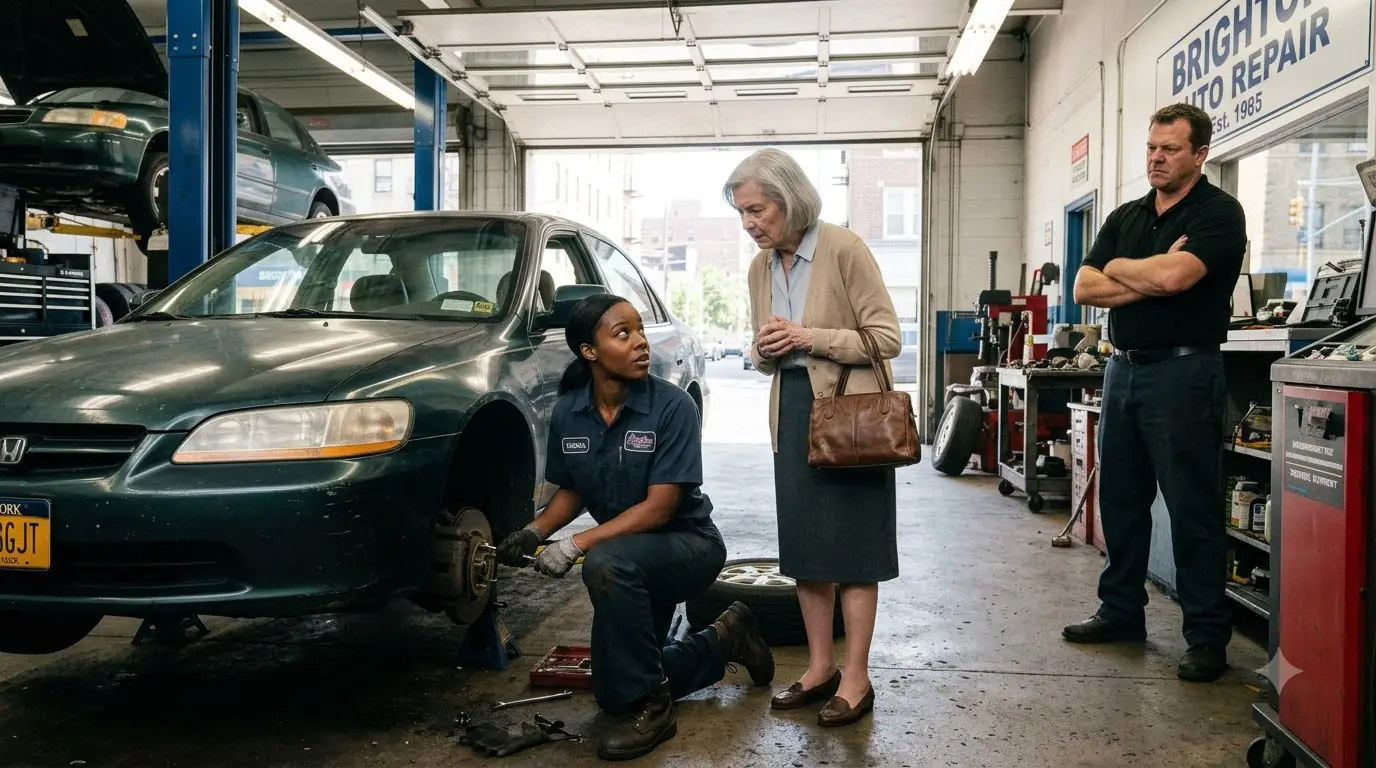
“Lady, take your junk car somewhere else.”
Jake turned away, dismissing the elderly woman as though she had stopped existing.
Keisha Williams should have walked away.
She should have kept her head down, finished her shift, and protected the paycheck she desperately needed. The eviction notice inside her locker said she could not afford to lose this job.
But Eleanor’s hands were trembling.
“Ma’am.”
Keisha stepped forward despite Jake’s glare.
“Pop the hood. I’ll take a look.”
Jake turned around.
“Keisha, what did I just say?”
Eleanor’s eyes met Keisha’s.
There was gratitude there.
But also something else.
Something that looked almost like recognition.
“Thank you, child,” Eleanor whispered.
Jake stormed toward them.
“You’re fired.”
Keisha stared at him.
“What?”
“You heard me. Get your things and get out.”
He pointed toward Eleanor.
“And take her with you.”
Keisha looked at the old Honda.
Then at Eleanor.
She had no idea that choosing kindness over self-preservation had just changed everything.
Because Eleanor Hayes was not who she appeared to be.
And before the night was over, someone very powerful would learn exactly what had happened inside Brighton Auto Repair.
The fluorescent light inside Keisha’s studio apartment flickered like a dying heartbeat.
She sat on the edge of her mattress staring at the pink eviction notice taped to the door.
SEVENTY-TWO HOURS TO VACATE.
A bowl of ramen noodles cooled in her lap while she counted the crumpled bills remaining in her wallet.
Forty-three dollars.
Not enough for another apartment.
Not enough for a deposit.
Barely enough to keep gas in her aging Toyota and food in the refrigerator.
Her phone buzzed.
A message from her younger brother, Marcus, who was attending community college.
Can you send anything for textbooks? Sorry to ask.
Keisha stared at the message.
Then deleted the draft response she had started.
How could she explain that helping one elderly woman had just cost her everything?
Across town, Eleanor Hayes sat inside a modest ranch house surrounded by photographs most people in Brighton had never seen.
One showed her late husband, William, at the ribbon-cutting for their first auto shop in 1978.
Another showed their son Robert wearing a graduation cap.
Beside it was a faded newspaper clipping.
HAYES AUTOMOTIVE GROUP REACHES 500 LOCATIONS.
Eleanor ran one finger along the edge of Robert’s wedding photograph.
Her hand stopped over her son’s face.
“When did your company become so cold?” she whispered.
When had profitable replaced principled?
When had efficiency become an excuse to stop seeing people?
Eleanor picked up her phone.
Set it down.
Picked it up again.
This call would change more than one person’s life.
But Keisha Williams had shown her something that demanded action.
Meanwhile, Jake Morrison slid into a leather booth at Murphy’s Bar already several beers into his evening.
A few other automotive managers leaned toward him while he bragged about what had happened.
“Cleaned house today,” Jake said, laughing. “Got rid of some dead weight.”
One of the men raised an eyebrow.
“What happened?”
“That bleeding-heart mechanic thought she could play Mother Teresa on company time.”
“The Black mechanic?” Tommy from Eastside Auto asked.
“Yeah. She came by earlier looking for another job, apparently.”
Jake grinned.
“I already told people she’s trouble.”
Another manager laughed.
“Word travels fast.”
“Exactly.”
Jake raised his beer.
“She’ll be flipping burgers by next week.”
The men clinked glasses.
None of them knew Eleanor Hayes had already made her first call.
The number rang once.
“Mom?”
Robert Hayes sounded concerned immediately.
“It’s late. Everything okay?”
Eleanor closed her eyes.
For just a moment, she remembered the boy Robert used to be.
The child who cried when his hamster died.
The little boy who once handed his lunch money to a homeless man without asking whether he would get it back.
“Robert, I need you to listen carefully.”
His tone changed.
“What happened?”
“Today I visited one of your shops.”
“Which one? I’ll have someone check it.”
“Brighton Auto Repair on Morrison Street.”
Eleanor’s voice hardened.
“A young woman named Keisha Williams was fired today for helping me.”
Silence stretched across the line.
Robert Hayes, chief executive of a company worth billions, suddenly sounded like the ten-year-old boy Eleanor remembered.
“Mom?”
His voice lowered.
“What exactly happened?”
As Eleanor began explaining, Keisha walked alone through the darker streets of Brighton.
She passed pawn shops, check-cashing stores, and convenience stores glowing beneath buzzing signs.
The city buses had stopped running.
Her Toyota barely had gas.
She was heading toward a twenty-four-hour laundromat because it was one of the few places where she could sit for a while without being expected to buy anything.
Her reflection moved across storefront windows.
Tired.
Defeated.
Almost transparent.
Is this what doing the right thing gets you?
A police cruiser slowed beside her.
The officer lowered his window.
“You okay, miss? Pretty late to be walking alone.”
“Yes, sir.”
Keisha forced a smile.
“Just heading home.”
The lie came easily.
Home.
What a joke.
The cruiser drove away.
Keisha kept walking.
She did not notice the black town car that passed twice.
Nor did she see the elderly passenger studying her carefully through the window.
Eleanor’s call with Robert lasted twenty minutes.
His shock turned into anger.
Then the anger became something colder.
Determination.
“I’ll handle this, Mom.”
Robert paused.
“Yes.”
Eleanor interrupted before he could finish.
“That girl showed me more respect in five minutes than your manager showed me during the entire visit.”
She inhaled slowly.
“And Robert, there’s something else you should know about what I saw.”
Now Eleanor sat alone in her living room thinking about tomorrow.
About justice delayed.
About a young woman who had chosen kindness even when kindness could cost her the little security she still had.
Outside, sprinklers moved quietly across lawns in the comfortable neighborhood where Eleanor had chosen to remain long after she could have bought any mansion she wanted.
Most of her neighbors thought she was simply a widow who clipped coupons and drove an old Honda.
None of them knew one phone call from Eleanor Hayes could change the direction of an entire corporation.
She opened her laptop.
Typed Keisha Williams Brighton Auto into the search bar.
The first result made Eleanor’s expression tighten.
Someone had recorded part of the confrontation at the repair shop.
The video was spreading online.
Hundreds of comments already filled the post.
People asked why a mechanic had been fired for helping an elderly customer.
Some recognized Jake.
Others began sharing their own experiences at Brighton Auto Repair.
Eleanor leaned back.
The truth had already begun moving.
She picked up the phone again.
There were more calls to make.
The next morning hit Keisha like a sledgehammer.
Her landlord, Mr. Peterson, stood in the hallway while she stuffed clothes and belongings into garbage bags.
“I’m sorry, kid.”
His arms were crossed, but his expression carried genuine regret.
“You seem like good people. But I’ve got bills too.”
Keisha nodded.
“I can store some of your stuff in the basement for a week.”
Mr. Peterson hesitated.
“After that, I can’t promise anything.”
Three interviews the previous day.
Three rejections.
In every case, the employer had seemed interested until someone called Brighton Auto Repair.
Jake Morrison had made sure his version of events traveled faster than hers.
“Mr. Peterson, if I can get the money by Friday—”
“Honey, you’d need eight hundred dollars plus the late fees.”
He shook his head.
“I’ve already given you every extension I can.”
After he walked away, Keisha slid slowly down the wall until she was sitting on the stained hallway carpet.
Her phone buzzed.
Marcus again.
Sis, you okay? Haven’t heard from you.
Keisha typed several responses.
Deleted each one.
Finally she wrote:
Everything’s fine. Focus on school.
The lie tasted bitter even through the screen.
On the other side of town, Eleanor Hayes knelt beside William’s grave at Riverside Cemetery.
Morning dew soaked through the knees of her trousers.
She did not care.
She needed to speak to the man who had started everything.
“You always said character shows when nobody is watching.”
Eleanor rested one hand against the granite.
“Well, Will, I was watching yesterday.”
The wind moved through the oak trees William had planted near the cemetery decades earlier.
“And what I saw would break your heart.”
Eleanor remembered their first repair shop.
Oil stains on the concrete.
Old tools.
Bills stacked beside the register.
William standing beneath a lifted car telling her what he believed.
“We’re not just fixing automobiles, El. We’re taking care of people when they’re vulnerable.”
Eleanor smiled sadly.
“Our son built something huge.”
She looked toward the headstone.
“Eight hundred forty-seven locations now.”
Her voice cracked.
“But somewhere along the way, we lost what you started.”
She wiped one cheek.
“That girl, Keisha…”
Eleanor swallowed.
“She reminded me of you.”
The same heart.
The same willingness to do what was right when doing right cost something.
A jogger passed nearby with earbuds in, unaware of the promise being made beside a grave.
Eleanor stood.
Brushed dirt from her knees.
She had work to do.
At Brighton Auto Repair, Jake Morrison arrived whistling with coffee in one hand.
He expected another profitable day.
What he did not know was that corporate headquarters had already called the regional office.
What he did not know was that Robert Hayes had spent most of the night reviewing personnel records, internal complaints, and customer reports.
“Morning, boss,” called Miguel, one of the junior mechanics.
Miguel hesitated.
“It feels weird without Keisha here. She was probably the best diagnostic tech we had.”
Jake’s good mood soured.
“That bleeding heart?”
He set down his coffee.
“You’re better off. Now we can focus on paying customers instead of charity cases.”
Miguel exchanged a look with Tony, another mechanic.
Both men had experienced Jake’s comments about their accents, neighborhoods, and families.
Yesterday had felt worse.
More personal.
More deliberate.
“Boss,” Tony said carefully, “that lady Keisha helped seemed really grateful. Maybe sometimes it’s worth—”
“Worth what?”
Jake slammed his coffee onto the counter.
“Losing money?”
Tony went quiet.
Jake pointed between them.
“You two want to join her in the unemployment line?”
Neither answered.
“Because I can arrange that real quick.”
Miguel and Tony returned to work.
Neither noticed the dark sedan parked across the street.
Nor the well-dressed man inside documenting the shop from a distance.
Keisha sat at a computer inside the public library with job-search pages open across the screen.
Every automotive shop within thirty miles seemed to offer the same answer.
Position filled.
Not hiring.
Try again later.
Keisha recognized the pattern.
The automotive community was smaller than people realized.
One damaging reference from Jake Morrison could follow her everywhere.
Her checking account showed twenty-three dollars and forty-seven cents.
Her phone displayed seventeen missed calls from bill collectors.
The library’s free internet connection was one of the few resources she still had.
“Excuse me.”
Keisha looked up.
Mrs. Carter, one of the librarians, stood beside her.
“I couldn’t help noticing.”
The older woman lowered her voice.
“Are you okay, honey?”
Keisha forced a smile.
“Just job hunting.”
She glanced at the screen.
“It’s rough out there.”
Mrs. Carter pulled over a chair.
“My nephew owns a garage in the next county.”
Keisha looked at her.
“It’s about an hour away, but he pays fair wages and treats people right.”
For the first time that morning, hope moved inside Keisha.
“Would you be able to—”
“Already called him.”
Mrs. Carter smiled.
“He wants to meet you tomorrow at two.”
Keisha stared.
“He said anyone who loses a job because she helped a stranger is exactly the sort of person he wants to meet.”
Keisha blinked rapidly.
“Thank you.”
Mrs. Carter squeezed her shoulder.
As Keisha wrote down the address, she did not notice Eleanor Hayes entering the library.
Eleanor stopped when she saw her.
She waited until Keisha had left.
Then quietly approached Mrs. Carter.
“Excuse me.”
“Yes?”
“That young woman who was sitting here.”
Eleanor nodded toward the computer.
“Does she come in often?”
Mrs. Carter studied her.
Something in Eleanor’s expression suggested concern rather than gossip.
“She’s going through a difficult time.”
Mrs. Carter folded her hands.
“But she’s good people.”
Eleanor waited.
“The kind who would give away their last dollar if someone else needed it more.”
Eleanor nodded.
“Yes.”
Her voice softened.
“I know exactly who she is.”
Hayes Automotive Group headquarters rose thirty floors above downtown.
Its glass exterior reflected the morning sky like a monument to corporate success.
Eleanor’s twelve-year-old Honda looked almost absurd in the visitor parking area beside imported luxury vehicles.
She walked through the lobby.
Then entered the executive elevator.
Her key card still worked.
On the twenty-eighth floor, the receptionist looked up.
Her professional smile transformed instantly into real affection.
“Mrs. Hayes!”
Amanda stood.
“What a wonderful surprise. Mr. Hayes is in his office.”
“Thank you, dear.”
Eleanor smiled.
“I’ll find my way.”
She walked through hallways lined with awards.
Employer of the Year.
Community Partner Excellence.
Service Leadership Award.
The words felt bitter now.
Robert’s corner office overlooked the city through floor-to-ceiling windows.
Behind a large mahogany desk, her son looked every inch the chief executive.
Tailored suit.
Controlled posture.
A presence designed to reassure investors.
But when he saw Eleanor, the executive disappeared.
“Mom.”
Robert crossed the room and embraced her.
“I’ve been up all night thinking about your call.”
He pulled out a chair.
“Tell me everything again.”
Eleanor sat in a leather chair where senators, governors, bankers, and executives had negotiated billion-dollar agreements.
Today it held a seventy-two-year-old woman seeking justice for a mechanic who had helped her for free.
“Yesterday I decided to test something.”
Robert listened.
“I dressed simply, drove my oldest car to Brighton Auto Repair, and presented myself as a customer who didn’t look capable of paying much.”
Robert’s expression darkened.
“And?”
“Your manager barely looked at the brakes.”
Eleanor’s fingers tightened.
“He told me to take my car somewhere else because I didn’t look profitable enough.”
Robert closed his eyes briefly.
“And Keisha?”
“She stayed.”
Eleanor’s voice softened.
“She offered to inspect the car after her shift. No payment. No audience. She simply saw someone who needed help.”
“And Morrison fired her?”
“Immediately.”
The city moved beyond the windows.
Robert looked toward his desk.
“Mom, I legally pulled Morrison’s personnel file this morning.”
He picked up several pages.
“Three formal discrimination complaints in two years.”
Eleanor stared at him.
“All dismissed?”
“Or settled quietly.”
Robert’s jaw tightened.
“Some complainants couldn’t afford to continue challenging the company.”
He exhaled.
“How did we let this happen?”
Eleanor stood and walked toward a wall filled with family photographs.
There was William at the opening of the first shop.
Hands dirty.
Shirt sleeves rolled.
There was young Robert in coveralls learning to change oil before he had ever read a financial statement.
“Your father used to tell you something.”
Robert joined her.
“I remember.”
Eleanor touched William’s photograph.
“We’re not in the car business, Robbie.”
Robert completed the sentence.
“We’re in the dignity business.”
Eleanor looked at him.
“When did we forget that?”
Robert stared at the photograph.
“What do you want me to do?”
Eleanor turned.
“I want you to remember the boy you used to be.”
Robert said nothing.
“The boy who cried when the Johnson family lost their farm.”
Her voice strengthened.
“The boy who insisted we hire Maria when other managers said her English wasn’t good enough.”
Eleanor looked around the office.
“I want Hayes Automotive Group to mean something again.”
Robert nodded slowly.
“And Morrison?”
“Accountability.”
Eleanor’s expression hardened.
“Swift, documented, and impossible to dismiss as a misunderstanding.”
She moved toward the door.
Then paused.
“And Keisha Williams?”
Robert waited.
“I want you to meet her.”
“Mom, we can’t simply offer a senior position because—”
Eleanor smiled.
Robert stopped speaking.
It was the same smile she had worn decades earlier when she convinced a reluctant bank manager to finance their second location.
The same expression William used to call Eleanor’s warning sign.
“Trust me, son.”
She opened the door.
“Some battles are worth fighting properly.”
As the elevator carried her downward, Eleanor thought about Keisha.
Probably still searching for work.
Probably still wondering whether helping a stranger had destroyed her future.
Not for long.
Robert Hayes moved quickly.
Within hours, a corporate review team began examining Brighton Auto Repair.
They documented customer interactions, reviewed complaints, checked employment files, and compared the location’s reported numbers against company standards.
Keisha knew none of this.
She was driving her sputtering Toyota toward Carter’s Automotive in the next county.
Hope and desperation fought inside her chest.
Her fuel gauge hovered near empty.
She had spent almost the last ten dollars she could spare getting there.
If the interview failed, she had no plan.
She forced the thought away.
It had to work.
At headquarters, Robert reviewed the first findings.
The shop culture made his stomach turn.
Jake berated Miguel for speaking Spanish with a customer.
He dismissed an elderly man who needed extra time understanding a repair estimate.
He routinely quoted higher work packages to customers he believed would not question him.
“Get me everything,” Robert told Marcus Webb, head of corporate security and compliance.
“Customer complaints. Personnel history. Financial reports. I want to know every pattern Morrison has created and every person affected.”
Marcus hesitated.
“Sir, we should coordinate carefully with legal before we move too fast.”
Robert looked at him.
“My mother walked into one of our shops yesterday and we failed the simplest test possible.”
Marcus remained silent.
“How many other customers have we failed?”
Robert continued.
“How many employees like Keisha Williams have been punished for doing what we claim our company stands for?”
Marcus nodded.
“I’ll work with legal and compliance.”
“Good.”
At Carter’s Automotive, Keisha met David Carter.
He was younger than she expected, around thirty-five, with calloused hands and oil beneath his fingernails.
A real mechanic.
Someone who had clearly spent years beneath hoods before owning the building around them.
“My aunt says you got fired because you helped an elderly customer without charging her.”
David wiped his hands on a rag.
“That true?”
“Yes, sir.”
Keisha gave a tired smile.
“Probably wasn’t the smartest career move.”
David laughed.
“Depends how you define smart.”
He pointed toward a Toyota Camry inside the service bay.
“Show me what you know.”
The vehicle had developed an engine noise several shops had failed to diagnose properly.
Keisha opened the hood.
Listened.
Asked several questions about maintenance history.
Then studied the engine.
After a few minutes, she looked at David.
“Timing-chain tensioner.”
His eyebrows rose.
“You sure?”
“I’d inspect it before replacing anything, but that’s where I’d start.”
David folded his arms.
“What makes you think that?”
“The sound pattern.”
Keisha pointed carefully.
“And everything else looks well maintained. The owner doesn’t ignore problems, so it probably started recently.”
David stared at her.
Then smiled.
“You’re hired.”
Keisha blinked.
“Sir?”
“Forty-five dollars an hour.”
He began counting on his fingers.
“Health benefits after ninety days. You can start Monday.”
Keisha’s eyes filled.
“Mr. Carter, I…”
She took a breath.
“Thank you.”
David’s expression became serious.
“You have no idea what this means.”
“Actually, I might.”
He leaned against the workbench.
“I got blacklisted once too.”
Keisha looked at him.
“For refusing to overcharge a single mother.”
David smiled without humor.
“Took me two years to find someone willing to give me another chance.”
He held out his hand.
“So now I get to be that person for you.”
Keisha shook it.
On the drive back, she finally allowed herself to cry.
Not from despair this time.
From relief.
For the first time in days, the road ahead contained something other than another rejection.
Elsewhere, Eleanor received an update about the interview.
She smiled.
“Exactly what I hoped.”
Her driver, James, glanced at her through the mirror.
“Skilled, honest, resilient.”
Eleanor nodded.
James had worked for the Hayes family for fifteen years.
“If I may ask, ma’am, why not simply have Mr. Hayes offer her a corporate job immediately?”
Eleanor looked out the window.
“Because charity creates dependence when it replaces opportunity.”
She smiled faintly.
“Opportunity lets someone prove what was already there.”
At Hayes Automotive headquarters, Robert’s review team delivered its preliminary report.
Three binders filled the conference table.
Discriminatory hiring practices.
Customer complaints ignored or buried by regional management.
Possible supplier kickbacks.
But Jake’s own conduct was most damaging.
Employees described him mocking customers who asked for payment options.
Former workers reported that he targeted anyone who showed too much sympathy toward customers he considered unprofitable.
Robert read in silence.
“This is systematic.”
His legal team agreed.
“It may extend beyond Brighton.”
Robert looked toward the organizational chart.
“How far?”
“We’re still determining that.”
His phone rang.
Mom.
Robert answered.
“How’s the investigation going?” Eleanor asked.
“Worse than we thought.”
He rubbed his forehead.
“Morrison has influenced other managers. We’re looking at potential claims from former employees and customers.”
“Good.”
Robert frowned.
“Good?”
“I mean it’s terrible that it happened.”
Eleanor corrected herself.
“But good that you’re finally seeing the full scope.”
She paused.
“I need you to do something else.”
“Anything.”
“Tomorrow, go to Carter’s Automotive.”
Robert leaned back.
“Why?”
“There’s someone there I want you to see.”
“Keisha?”
“Wear casual clothes.”
Eleanor ignored the question.
“No entourage. No corporate vehicle. Just spend an hour watching.”
Robert stared through the glass at the city.
“What aren’t you telling me?”
His mother laughed softly.
“I’m telling you exactly what you need to know, when you need to know it.”
“That sounds familiar.”
“Your father taught me.”
That evening, Keisha called her brother Marcus for the first time in several days.
“Sis, I was worried.”
“I got a job.”
There was silence.
“A good one.”
Marcus suddenly shouted loudly enough that Keisha pulled the phone away from her ear.
“That’s amazing!”
Keisha laughed for the first time in days.
“I knew something would work out.”
Marcus continued.
“You always land on your feet.”
Keisha did not tell him she had spent two nights sleeping in her Toyota after leaving the apartment.
She did not mention employers ending interviews the moment they contacted Jake.
Some victories felt too fragile to expose immediately.
“How are the textbooks?”
Marcus hesitated.
“Don’t worry about that right now.”
“I asked.”
“You just focus on the new job.”
But Keisha was already planning.
First paycheck for rent and food.
Second paycheck for overdue bills.
Third paycheck, maybe, could finally help Marcus without putting herself underwater again.
David Carter even helped her locate a temporary studio apartment close enough to the shop that she could manage the commute.
For the first time, Keisha slept somewhere she knew she would still be allowed to enter the next morning.
Monday at Carter’s Automotive felt like another universe.
David greeted her with fresh coffee.
The other mechanics showed her equipment without treating every question like proof she did not belong.
“This place runs differently,” one employee told her.
“David actually listens when customers talk.”
Keisha smiled.
“Crazy idea.”
Her first customer was Maria Santos.
A mother with three children whose minivan had begun making a grinding noise.
Maria explained that her husband was working two jobs and the vehicle needed to survive at least two more years.
Keisha listened.
She did not immediately jump toward the most expensive possibility.
“Let me check the simple things first.”
Fifteen minutes later, she discovered a loose heat shield vibrating against part of the exhaust system.
Nothing catastrophic.
Nothing requiring a new exhaust.
Keisha tightened it.
The noise disappeared.
“How much?” Maria asked nervously.
“For that?”
Keisha wiped her hands.
“Nothing.”
Maria stared.
“Most places would have told me I needed half the exhaust replaced.”
Keisha smiled.
“Not here.”
Maria’s relief filled the service bay.
That afternoon, she posted online.
Finally found a shop that treats working families like people.
A few shares became dozens.
Then hundreds.
Across town, Eleanor sat in her kitchen reading the morning paper and checking Hayes Automotive Group’s stock price.
Profitable.
Stable.
Respectable.
Everything looked normal from the outside.
Her phone contained several calls related to the Brighton investigation.
She ignored anything that could be handled by Robert.
Robert himself spent part of his lunch hour driving past Carter’s Automotive.
No executive car.
No assistant.
No announcement.
From the road, the shop looked almost ordinary.
No luxury waiting area.
No aggressive advertising.
Through the open service bay, Robert saw a young Black American mechanic speaking patiently with an older customer.
He knew immediately it was Keisha.
She did not know he was watching.
She was explaining something under the hood with the same calm seriousness Robert remembered from his father’s earliest employees.
People who cared about the work before they cared about the commission.
Robert drove away without introducing himself.
But his mother’s point had already landed.
At Brighton Auto Repair, Jake began noticing changes.
Corporate called more often.
Questions about customer-satisfaction procedures.
Regional leadership suddenly wanted documents nobody had asked for before.
He sensed something shifting.
Then he received what sounded like the best news of his career.
His regional director called early one morning.
“Morrison, congratulations.”
Jake straightened.
“What’s going on?”
“We’re giving you temporary district-management responsibility.”
Jake’s grin widened.
“You’ll oversee several locations while corporate reviews regional performance.”
“Thank you, sir.”
Jake could barely contain himself.
“I won’t let you down.”
“Keep doing what you’ve been doing.”
The regional director paused.
“We want to understand exactly how you’ve achieved those profit margins.”
Jake heard praise.
He did not hear the warning.
The temporary role placed Jake in a position where his management philosophy became visible.
Within days, he was conducting district meetings.
“Customer sympathy is a profit killer.”
Managers around the room looked at one another.
“Sad stories don’t pay overhead.”
Jake paced near the whiteboard.
“You start making exceptions, people talk. Suddenly every customer wants special treatment.”
Tom Bradley from Westside Auto raised his hand.
“What about customer loyalty? Community relationships?”
Jake laughed.
“Loyalty?”
He shook his head.
“People driving ten-year-old cars and complaining about fifty-dollar repairs will leave the second someone quotes them five dollars less.”
Several managers looked uncomfortable.
“Might as well make the sale while they’re standing in front of you.”
Jake continued.
“I cleaned house at Brighton.”
He smiled.
“Fired one mechanic who thought company resources existed for charity.”
Those words were documented in the internal investigation.
Eleanor later watched the meeting recording with an expression so cold Robert barely recognized her.
“He’s teaching it.”
She called her son.
“He’s not just behaving badly.”
Her voice tightened.
“He is turning cruelty into management policy.”
Robert stared at the same recording.
“Mom, I can stop this now.”
“Soon.”
“Why wait?”
“Because we need the full pattern.”
Eleanor’s voice remained controlled.
“If we act before we understand how far this reaches, everyone who enabled him will pretend Jake was one isolated problem.”
Robert looked at the organizational chart.
“And the employees being affected right now?”
“We protect them.”
Eleanor answered immediately.
“We do not let anyone else lose their livelihood while we finish this.”
That distinction mattered.
Robert ordered compliance staff to review every employment action taken under Jake’s temporary authority.
No additional termination could proceed without independent approval.
Jake never knew.
He believed he had been given real power.
That belief made him careless.
A few days later, Jake visited Carter’s Automotive.
He arrived in a company sedan carrying a clipboard.
David Carter met him near the office.
“You the owner?”
“Yes.”
David wiped his hands.
“How can I help you?”
“District review.”
Jake looked around.
“I’ll need access to the partnership paperwork, employee documentation, and customer-satisfaction records relevant to our referral agreement.”
David nodded slowly.
“All right.”
Then Jake saw Keisha.
Recognition changed his expression.
“That mechanic.”
He pointed.
“She looks familiar.”
“Keisha Williams.”
David smiled.
“Best diagnostic tech I’ve hired in years.”
Jake’s mouth tightened.
“Interesting.”
He made a note.
“Very interesting.”
After Jake left, Keisha approached David.
“I need to tell you something.”
David looked up.
“This is about Morrison?”
“Yes.”
Keisha’s voice lowered.
“He’s got a grudge.”
David waited.
“He can cause problems.”
David returned the clipboard to his desk.
“Whatever comes, we’ll handle it.”
Keisha frowned.
“You barely know me.”
David looked at her.
“I know enough.”
He pointed toward the service bay.
“You’re family here.”
Later that week, Carter’s Automotive received a notice stating that its referral partnership was under administrative review.
For a small independent garage, losing referrals from a company as large as Hayes Automotive could mean losing a significant portion of business.
Keisha stared at the letter.
“I’m sorry.”
David looked up.
“This is because of me.”
“Maybe.”
“Jake wants revenge.”
David studied the paper.
Then looked at her.
“Keisha, let me tell you something about revenge.”
He folded the notice.
“It only works when the person being targeted starts making decisions out of fear.”
He placed the paper on the counter.
“I’m not firing you.”
Keisha looked at him.
“And I’m not changing the way this shop treats people.”
He gave a small smile.
“If Morrison wants a fight, he picked the wrong garage.”
That evening, Eleanor reviewed another corporate report.
Under Jake’s brief district authority, several managers had already repeated parts of his customer-screening philosophy.
But Robert’s compliance controls had prevented anyone from being fired without review.
The evidence was enough.
Eleanor called her son.
“Tomorrow.”
Robert was silent for a moment.
“You’re sure?”
“Yes.”
“Once we do this, the whole company will know.”
“Good.”
Eleanor’s voice carried decades of accumulated steel.
“Your father did not build this company so men like Jake Morrison could use it to humiliate people.”
She paused.
“Tomorrow we remind everyone what Hayes Automotive Group actually stands for.”
Saturday evening, Eleanor drove her Honda to Carter’s Automotive.
Through the service-bay windows, she saw Keisha beneath the hood of a customer’s truck.
Her movements were precise.
Confident.
When Keisha emerged, wiping her hands on a shop towel, she saw Eleanor approaching.
She stopped.
“Ma’am.”
Eleanor smiled.
“Hello, dear.”
“Is everything okay with the car?”
“My car runs perfectly thanks to you.”
Eleanor looked at her.
“I never properly thanked you.”
“You don’t need to.”
Keisha shrugged.
“Anyone would have helped.”
“No.”
Eleanor interrupted gently.
“Not anyone.”
Keisha grew quiet.
“Very few people would risk the only paycheck they have to help a stranger.”
Later they sat across from one another at Murphy’s Diner.
Eleanor ordered pie.
Keisha drank coffee.
“Can I ask you something?”
“Sure.”
“That manager who fired you.”
Eleanor kept her voice neutral.
“Has he treated other people that way?”
Keisha gave a bitter laugh.
“Jake Morrison?”
She shook her head.
“He’s got a whole system.”
“What kind of system?”
“He decides who looks profitable.”
Keisha stirred her coffee.
“If he thinks you’re poor, elderly, struggling, or just unlikely to spend much, you become a problem instead of a customer.”
Eleanor listened.
“Miguel told me Jake had several mechanics pushed out over the years.”
“For what?”
“Attitude problems.”
Keisha made quotation marks with her fingers.
“What did that mean?”
“Helping people Jake thought were beneath notice.”
Her voice tightened.
“Spanish-speaking customers. Elderly people who needed extra explanations. Single mothers counting every dollar.”
Eleanor’s expression hardened.
“He calls it maintaining standards.”
Keisha looked toward the window.
“But it’s cruelty with a business plan.”
“Did anyone complain?”
“To who?”
Keisha smiled without humor.
“Jake has connections throughout the district.”
She looked at Eleanor.
“People like us don’t have lawyers or influence.”
Eleanor repeated the phrase.
“People like us.”
Keisha did not notice the meaning behind her expression.
“Sometimes help comes from unexpected places,” Eleanor said.
At headquarters, Robert Hayes worked late with his compliance and legal teams.
The scope had expanded.
Seventeen documented incidents involving discriminatory or abusive treatment.
Several wrongful-termination disputes settled quietly.
Supplier relationships showing signs of improper payments.
Marcus Webb placed another report on the table.
“This is bigger than Morrison.”
Robert looked up.
“Explain.”
“Regional Director Patterson buried complaints.”
Marcus pointed toward another name.
“Supervisor Collins appears tied to the supplier issue.”
Robert stared at the organizational chart.
Red lines connected multiple offices.
“How deep?”
“Systemic enough that one termination won’t fix it.”
At two in the morning, Robert called Eleanor.
She answered immediately.
“How did dinner with Keisha go?”
“She confirmed everything.”
Eleanor sat at her kitchen table.
“And she still believes corporate only cares about money.”
Robert looked around his office.
“She has reasons to believe that.”
“Then give her reasons to believe something else.”
“We have enough evidence to remove the people involved.”
“Good.”
Eleanor’s tone sharpened.
“Tomorrow we make sure everyone understands why.”
Robert glanced toward the boardroom.
“Everything is prepared.”
“Board attendance?”
“Yes.”
“Legal?”
“Yes.”
“Compliance?”
“Yes.”
“And Jake?”
Robert almost smiled.
“He believes he’s being invited to discuss a permanent district-management role.”
Eleanor leaned back.
“Perfect.”
“Mom.”
“Yes?”
“I’m also inviting Keisha.”
Eleanor smiled.
“Good.”
Robert continued.
“And David Carter.”
“Even better.”
Sunday morning arrived clear and cool.
At 9:45, Jake Morrison entered Hayes Automotive headquarters wearing a new suit.
It cost more than some junior mechanics earned in weeks.
He walked through the marble lobby like a man stepping into destiny.
The boardroom on the upper floor buzzed with unusual activity.
Board members.
Regional managers.
Compliance officials.
Company attorneys.
Representatives from several locations.
Jake noticed cameras documenting the corporate meeting and assumed the company wanted a record of his promotion.
He straightened his tie.
He did not notice Keisha sitting toward the back.
Nor did he initially pay attention to the elderly woman wearing a simple black dress near the head of the table.
Robert Hayes approached the podium.
“Ladies and gentlemen, thank you for joining us.”
The room quieted.
“Today’s meeting concerns the future direction of Hayes Automotive Group.”
Jake smiled.
Robert continued.
“Before we begin, I want to introduce someone whose role in this company has sometimes been forgotten by people who joined long after its founding.”
Eleanor rose.
Several executives immediately straightened.
“Many of you know Eleanor Hayes as the widow of our founder.”
Robert looked toward her.
“But she is also the largest individual shareholder in Hayes Automotive Group and retains controlling voting authority through the Hayes family trust.”
Jake’s smile weakened.
Eleanor walked toward the podium.
She did not need to raise her voice.
“My late husband founded this company on a simple principle.”
She looked across the room.
“Character is not tested in boardrooms.”
The room became still.
“It is proven on garage floors.”
Jake shifted.
“Several weeks ago, I decided to test that principle.”
Eleanor’s eyes moved toward him.
“I dressed simply, drove my oldest car to one of our Brighton locations, and presented myself as an elderly customer who appeared unable to afford major service.”
Recognition spread across Jake’s face.
Slowly.
Terribly.
“I was dismissed.”
Eleanor continued.
“I was spoken to as though my safety mattered less because my wallet looked thin.”
Jake went pale.
“My brake concerns were ignored.”
The room remained silent.
“But one employee stayed.”
Keisha’s heart began pounding.
“She did not know my name.”
Eleanor looked toward her.
“She did not know what I owned.”
“She did not know my son.”
“She did not know anyone was evaluating her.”
Eleanor smiled gently.
“She simply saw a person who needed help.”
Several people turned toward Keisha.
“Keisha Williams risked her job to uphold the values this company was supposedly built upon.”
Keisha stood slowly.
Eleanor continued.
“For doing that, she was terminated.”
Whispers moved across the table.
Jake pushed his chair back.
Robert spoke immediately.
“Mr. Morrison, remain seated.”
Jake froze.
Robert’s voice contained no anger.
That made it worse.
“We have more to review.”
The large screen at the end of the boardroom turned on.
Jake appeared in a recorded district meeting.
His own voice filled the room.
“Customer sympathy is a profit killer.”
The video continued.
Jake discussing vulnerable customers as bad business.
Jake celebrating the firing of employees who challenged him.
Jake describing his “clean house” strategy.
Jake encouraging other managers to prioritize immediate extraction of revenue over long-term trust.
The real Jake sat lower in his chair.
The recording ended.
The lights returned.
No one spoke.
Eleanor stepped forward.
“Mr. Morrison.”
Jake looked at her.
“Several weeks ago, you told me Hayes Automotive did not operate a charity.”
Her expression remained calm.
“You were correct.”
Jake swallowed.
“We are not a charity.”
She paused.
“We are a business.”
Then her voice hardened.
“But no honest business requires cruelty to become profitable.”
Robert approached the podium again.
“Jake Morrison, your employment with Hayes Automotive Group is terminated effective immediately.”
Jake’s mouth opened.
Robert continued.
“This decision follows documented violations of company policy, discriminatory conduct, retaliation against employees, improper customer treatment, and financial irregularities currently under review.”
Two members of security moved closer.
Jake stood.
“You can’t do this.”
Robert looked at him.
“We just did.”
Jake turned toward Eleanor.
“You set me up.”
“No.”
Eleanor answered quietly.
“You revealed yourself.”
Jake pointed toward Keisha.
“She broke company rules.”
Eleanor shook her head.
“She protected a customer.”
“She worked off the clock.”
“She made sure an elderly woman with failing brakes could drive safely.”
Jake’s face reddened.
“That’s not how profitable operations work.”
Eleanor took one step closer.
“My husband built the first Hayes shop by repairing cars for farmers who sometimes paid him two weeks late.”
She looked directly at Jake.
“We became profitable because people trusted us.”
The room was silent.
“You confused extraction with business.”
Jake said nothing.
“And you confused authority with permission.”
Security stepped beside him.
Before Jake was escorted from the room, Eleanor spoke one last time.
“There is something you should understand.”
Jake looked back.
“The elderly customer whose Honda was not profitable enough for your attention…”
Eleanor paused.
“That was me.”
Jake stared.
“The mother of the man who just ended your career.”
His expression collapsed.
For the first time, Jake understood the complete chain of consequences.
The old woman he dismissed.
The mechanic he fired.
The company he believed he controlled.
Everything had been connected.
Security escorted him from the room without incident.
Eleanor turned back toward the audience.
The anger in her expression softened when she looked at Keisha.
“Ms. Williams.”
Keisha stood.
“Would you please come forward?”
Her legs trembled as she walked toward the front of the room.
Eleanor took her hand.
“This young woman represents what Hayes Automotive Group should have protected.”
She looked toward the board.
“Skill.”
Then toward Robert.
“Integrity.”
Finally back to Keisha.
“And compassion.”
Keisha swallowed hard.
Eleanor continued.
“Robert and I would like to offer you a position in our new regional customer-relations and service-integrity program.”
Keisha stared at her.
“Me?”
Robert stepped closer.
“The role would begin with training and direct operational support.”
He smiled.
“You would not be expected to know corporate management overnight.”
Keisha exhaled.
“But you know something many managers forgot.”
“What?”
Robert answered.
“How it feels to be the person nobody powerful thinks is worth listening to.”
Eleanor squeezed Keisha’s hand.
“That perspective is valuable.”
Applause began around the room.
Keisha’s eyes filled.
“Why?”
Her voice was barely audible.
“Why go through all this for someone like me?”
Eleanor looked at her.
“Because character is not about who you help when cameras are watching.”
She paused.
“It is about who you help when you believe nobody important will ever know.”
Eleanor smiled.
“And you chose correctly.”
Robert returned to the podium.
“Effective immediately, Hayes Automotive Group will begin implementing a new company-wide customer dignity and service review standard.”
He looked toward Keisha.
“Internally, we’re calling it the Williams Protocol.”
Keisha’s mouth fell open.
Robert continued.
“Every customer interaction will be evaluated around transparent estimates, respectful treatment, appropriate accommodation, and accountability for discriminatory conduct.”
Several regional managers shifted uneasily.
Robert noticed.
“Managers who buried complaints should not assume today’s review ends with Mr. Morrison.”
The message landed clearly.
In the middle of everything, Eleanor and Keisha stood together.
One woman had risked everything to help a stranger.
The other had possessed enough power to return that kindness on a scale Keisha could never have imagined.
“Mrs. Hayes,” Keisha whispered, “how did you know I was the right person?”
Eleanor smiled.
“I didn’t choose you that day.”
She looked toward the room.
“You chose yourself.”
Keisha frowned slightly.
“You decided what kind of person you were the moment helping me became more dangerous than ignoring me.”
Outside headquarters, Jake Morrison sat in his car staring at his phone.
Calls were already arriving.
Regional managers.
Reporters.
Attorneys.
Former employees.
His company access had been revoked.
His corporate accounts were disabled.
His authority vanished faster than it had arrived.
For perhaps the first time, Jake thought about the old woman whose brake problem had started the collapse.
What would his life look like if he had simply treated her with basic human decency?
Some lessons arrive too late.
Inside the boardroom, Keisha signed preliminary employment documents that would change not only her life but potentially the experience of thousands of customers across Hayes Automotive locations.
She did not feel victorious.
She felt overwhelmed.
Eleanor remained beside her.
“Breathe, child.”
Keisha laughed through tears.
“I think I forgot how.”
Three months later, Brighton Auto Repair felt like a different place.
Miguel led a team of mechanics trained under the new standards.
The waiting room had been renovated.
Comfortable chairs.
Fresh coffee.
Clear pricing information.
A small area where children could sit while parents waited.
But the biggest change was not furniture.
It was the way people were treated.
Keisha walked through the shop during one of her monthly visits.
Tony patiently explained brake options to an elderly customer.
A new mechanic named Sarah reassured a young mother that the transmission noise she feared was not nearly as expensive as she imagined.
David Carter joined Keisha near the service bay.
After Hayes Automotive formally ended the retaliatory review of his shop, Robert invited David to help design the new training program.
“How are we doing?” David asked.
“Better than I expected.”
Keisha looked at the latest reports.
“Customer satisfaction is up forty-seven percent.”
David smiled.
“Employee retention?”
“Best in the district.”
“And profit?”
Keisha laughed.
“Also up.”
David nodded.
“Funny how that works.”
“We stopped chasing every quick dollar.”
Keisha watched a customer shake Tony’s hand.
“And people started coming back.”
A familiar old Honda pulled into the lot.
Eleanor Hayes climbed out.
“Mrs. Hayes!” Miguel called.
“You’re right on time.”
“For my oil change?”
Eleanor lifted a tin.
“And I brought cookies.”
Within seconds, several employees appeared.
Eleanor laughed.
“You people are easier to summon with sugar than memos.”
She settled into the waiting room.
Keisha brought her coffee.
“Any regrets?” Eleanor asked.
Keisha thought carefully.
Her new position was not easy.
Changing an entrenched corporate culture required constant work.
Some franchise operators resisted.
Some managers complained the new system was too soft.
Others treated it as public relations rather than actual policy.
Keisha spent long days traveling between locations, teaching supervisors how to listen before judging and employees how to report retaliation without risking their jobs.
“Jake’s case is moving through the system,” Keisha said.
Eleanor nodded.
“Several people who enabled him are gone.”
“Former employees are being reviewed for compensation and reinstatement.”
“That matters.”
“It does.”
Eleanor smiled.
“But I asked about regrets.”
Keisha looked around the shop.
Tony was teaching a new apprentice how to diagnose a problem before replacing parts.
Sarah was helping an older man understand financing options.
Miguel greeted every customer entering the door.
“No regrets.”
Keisha’s answer came firmly.
“This is exactly where I’m supposed to be.”
Eleanor’s smile deepened.
“Good.”
She lifted her coffee.
“Your brother called yesterday.”
Keisha’s eyes narrowed.
“Marcus?”
“He’s graduating near the top of his class.”
Eleanor smiled.
“And he’s been accepted into an engineering program with a full scholarship package.”
Keisha stared.
“Eleanor.”
“The Williams Family Foundation supports deserving students.”
“You didn’t.”
“Marcus earned his acceptance.”
Eleanor waved away the accusation.
“He earned every academic dollar.”
Her eyes twinkled.
“Though having a sister who understands integrity certainly made him memorable.”
Keisha laughed.
Then wiped her eyes.
As Eleanor’s old Honda received the same careful service given to expensive vehicles, Keisha understood what real change looked like.
Not one dramatic meeting.
Not one public termination.
Daily choices.
A manager who listened.
A mechanic who explained.
A company that stopped treating vulnerable people as opportunities.
The Hayes Automotive sign gleamed outside in the afternoon sun.
But the real transformation lived inside the people working beneath it.
Some victories could not be measured only in profit.
They were measured in dignity returned to people who had walked through the door expecting to be ignored.
One year later, Keisha Williams stood before a crowded auditorium at the National Automotive Service Excellence Conference.
Hayes Automotive Group had been selected for a Community Impact Award recognizing the reforms that began after the Brighton incident.
Keisha stood behind the microphone.
“This award does not belong to me.”
The room quieted.
“It belongs to everyone who believes kindness and competence are not opposites.”
She looked across the audience.
“They are partners.”
Eleanor sat in the front row.
Robert sat beside her.
Behind them were managers representing Hayes locations from across the country.
“A year ago, I was fired because I helped someone I believed was simply an elderly customer who needed her brakes checked.”
Several people smiled.
“Today, that woman is my mentor.”
Keisha glanced toward Eleanor.
“And she proved something I will never forget.”
Eleanor raised an eyebrow.
“Sometimes angels drive old Hondas.”
Laughter moved through the room.
Even Eleanor laughed.
“The Williams Protocol is not revolutionary because treating people with dignity is a new idea.”
Keisha’s voice strengthened.
“It matters because somewhere along the way, too many businesses convinced themselves that respect was optional when money was tight.”
She shook her head.
“It never was.”
The applause began before she finished.
Later that evening, Keisha found Eleanor standing on a hotel balcony overlooking the city lights.
“Still think about that day?” Eleanor asked.
“Every day.”
Keisha leaned against the railing.
“It changed everything.”
Eleanor reached for her hand.
“No, dear.”
Keisha looked at her.
“You changed everything.”
Eleanor’s weathered fingers closed around Keisha’s calloused ones.
“I only made sure the right people finally noticed.”
Keisha looked across the city.
A year earlier, she had possessed forty-three dollars, an eviction notice, and no idea where she would sleep.
Now she helped shape policies affecting hundreds of locations.
But the part she valued most was not the title.
Not the salary.
Not the awards.
It was walking into a service bay and seeing a mechanic sit beside an elderly customer instead of talking down to him.
It was seeing a single mother leave with an honest repair instead of an inflated bill.
It was watching employees understand that compassion did not weaken a business.
It built trust.
Eleanor looked toward her.
“You know what William would have said?”
Keisha smiled.
“What?”
Eleanor’s eyes softened.
“He would have asked why it took us so long to remember something so simple.”
Keisha laughed quietly.
Then the two women stood together beneath the city lights.
One had once needed help.
The other had once needed someone to remind her family what their company was supposed to be.
Neither had understood what their first meeting would become.
It began with an elderly woman carrying twenty dollars into an auto shop.
A manager looked at her and decided she was not worth his time.
A mechanic looked at the same woman and saw someone whose brakes were failing.
That difference changed everything.
Because Keisha Williams did not know Eleanor Hayes had influence.
She did not know Robert Hayes would hear about her.
She did not know cameras would eventually document the culture Jake Morrison had built.
She did not know her name would become attached to a company-wide standard.
She knew only one thing.
Someone needed help.
And she was capable of helping.
For Eleanor, that was the entire point.
Character had never been about what people did when reward was guaranteed.
It was what they did when kindness appeared to cost more than it returned.
And on one ordinary afternoon inside Brighton Auto Repair, Keisha Williams had paid that price without hesitation.
Everything that followed was simply the world finally paying attention.