There is a kind of strength that does not announce itself.
It does not ride into town with a brass buckle shining at its waist.
It does not lean back in a saloon chair and wait for weaker men to notice.
It does not speak louder than necessary.
It shows up before sunrise.
It sweeps a yard no one will compliment.
It plants a garden no one will praise.
It patches a roof with borrowed nails, sets fence posts with bleeding hands, mends a harness by lamplight, and holds a piece of land together with nothing but the refusal to quit.
That kind of strength is easily overlooked because it does not ask to be admired.
It simply keeps going.
Reeve Callaway had built an empire on that same principle.
Three hundred thousand acres across Cimarron County.
Twelve thousand head of cattle.
Four line camps.
Sixteen working wells.
A name that moved judges, bankers, freight agents, cattle buyers, surveyors, and railroad men without him ever needing to raise his voice.
Men in Kansas, Colorado, and New Mexico knew the Callaway brand.
They knew the weight of it.
A C inside a broken circle burned into the hide of a steer meant something. It meant the animal came from range that was watched, water that was guarded, riders who were paid on time, and an owner who did not forget a debt or a favor.
Reeve Callaway was not the loudest cattleman in the territory.
He was not the most charming.
He did not waste words in saloons or buy admiration with reckless generosity.
He had the kind of authority that made men straighten before they remembered deciding to.
At forty-three years old, he had the weathered face of a man built by sun, distance, and decisions that had cost him. His hair had gone dark silver at the temples. His hands were scarred across the knuckles. He wore good boots, but not fancy ones, and his hat had been reshaped by years of weather instead of vanity.
He had seen nearly everything the frontier produced.
Drought.
Flood.
Stampede.
Blizzard.
Fever.
Rustlers.
Bankers.
Young fools with guns.
Old fools with contracts.
He had watched good men die for lack of water and bad men prosper because they understood paperwork better than prayer.
He had seen ranches rise out of nothing and disappear in a single dry season.
He had seen widows cheated, homesteaders broken, gamblers shot, children buried, and grasslands carved into claims by men who had never slept under a sky without a roof.
He had seen everything.
Or so he thought.
He had never seen anything like what he found that October morning.
He rode the long trail back from Cedar Falls alone, the way he always rode when inspecting water.
Cattle he trusted to his foreman.
Water he checked himself.
In that country, water was not merely a resource.
It was law.
It was blood.
It was the difference between an empire and a graveyard.
A man could survive a poor market, a bad winter, even a sick herd if he had enough water and enough time.
But lose water, and the land itself turned against him.
Reeve had not built what he built by delegating what mattered most.
So that October morning, under a low gray sky with his stallion moving steady beneath him, he rode the ridge line above East Creek and counted what the year had taken.
The country had gone hard and pale.
Cottonwoods stood bare along the creekbed, black against the sky. Grass lay thin and brittle over the low ground. The soil at the trail edge had cracked where summer heat had stayed too long.
His horse, a bay stallion named Atlas, picked his way carefully down a stony slope.
Reeve leaned slightly in the saddle, eyes tracing the line of water below.
East Creek still ran.
Not strong, not generous, but alive.
That mattered.
He had been considering the winter movement of three hundred head from the north pasture toward better shelter, but the main crossing had taken damage from the late September storm. If the banks were too soft, cattle would break them down by December. If he moved too late, ice would make the crossing dangerous.
He was thinking through numbers when he almost missed the ranch entirely.
It sat below the trail line, tucked behind a stand of dead cottonwoods and a low rise of yellowed grass.
The house was bleached pale as old bone.
The south fence was gone.
The porch rail had caved at one end.
Boards were missing from the barn wall.
One side of the smokehouse leaned as if it had grown tired of standing.
At first glance, it looked abandoned.
Then Reeve saw the yard.
It was swept clean.
Not casually.
Not the half-hearted clearing people do when expecting company.
It was morning clean.
Fresh clean.
A thin line of dust still hung in the still air, proof of someone who had risen before the cold and done the work anyway.
Reeve stopped his horse.
Atlas blew softly through his nose.
Then Reeve saw the garden.
Along the eastern wall of the house, where a little windbreak held off the worst of the weather, someone had worked a strip of hard October ground into neat rows.
Not much.
A poor garden by the standards of any prosperous place.
But the rows were straight.
The soil had been turned carefully.
Small stakes marked where something had been planted for spring.
Garlic, maybe.
Winter onions.
A person did not plant hard ground in October unless they intended to still be there when it softened.
Reeve sat motionless in the saddle, looking down at that stubborn strip of earth.
He had seen wealth announced in many ways.
Painted signs.
Good barns.
Fine horses.
Glass windows.
New wire.
Imported seed.
But this was a different declaration.
A swept yard and a winter garden beside a failing house.
A woman or man telling the world, without audience, I am not gone yet.
He dismounted and told himself it was to check the well boundary.
He knew that was a lie before he finished thinking it.
The front door stood open.
That, more than the falling fence or the missing barn boards, troubled him.
In country like this, open doors meant one of three things: careless habit, trouble, or death.
The yard told him the first was unlikely.
He tied Atlas to a cottonwood, loosened the tie on his coat, and walked toward the porch.
His boots sounded loud on the packed dirt.
No dog barked.
No chickens scattered.
No voice called out.
The porch sagged under his weight but held.
He stopped at the doorway and looked in.
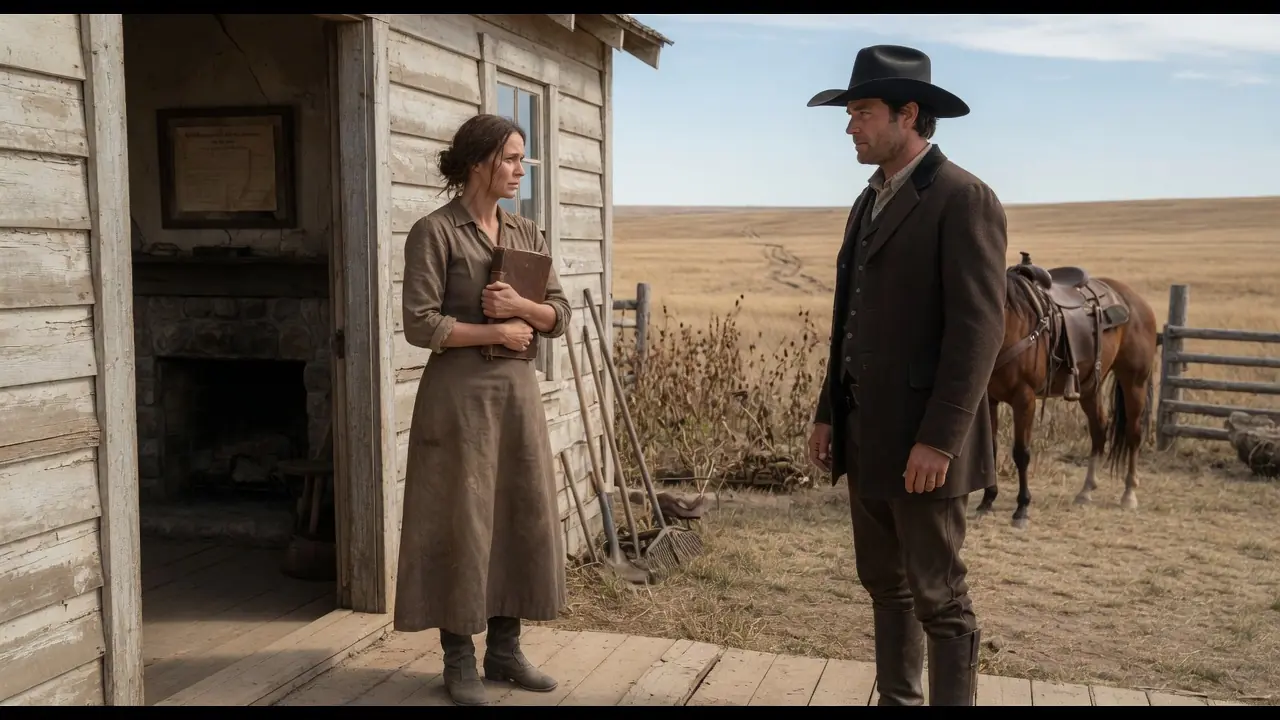
Inside, a woman lay asleep in a chair beside a cold hearth.
Boots on.
Sleeves rolled.
A worn ledger book open across her knee, as if she had paused mid-accounting and her body had made a different decision without her permission.
She had one hand still resting on the page.
A pencil had slipped from her fingers and fallen to the floor.
There was no fire in the hearth, only gray ash. A tin cup sat on the table. A skillet hung from a nail. Dishes were washed and stacked. The room was poor but not dirty. Sparse but not careless.
Reeve stood at the threshold and did not move.
He looked at the swept yard behind him, the stubborn garden, the open door, the sleeping woman, and something in him went very quiet.
Her name was on the deed framed above the cold fireplace.
Vance Homestead.
Registered 1869.
Cimarron County, Kansas Territory.
The paper was faded, trapped behind cracked glass in a plain wooden frame.
It was not decoration.
It was proof.
The kind of proof people put where they can see it every day because the world has spent too long trying to make them forget what is theirs.
Reeve stepped one inch closer to read the smaller line.
Filed under the Homestead Act claim of Thomas Vance.
Transferred to Elias Vance.
Then, in a later hand, Nora Vance.
Widow.
He was still reading when she woke.
No gasp.
No scramble.
Her eyes opened and found him with the flat precision of someone who had trained part of herself to stay awake even in sleep.
Her hand moved first, not toward her throat or mouth, but toward the side of the chair where a rifle should have been.
It was not there.
Reeve stayed in the doorway.
“You’re on private property,” she said.
Not afraid.
Not angry.
Stating a fact.
“I am,” Reeve said. “Door was open.”
“No.”
Her eyes narrowed slightly, taking his measure.
She closed the ledger in one motion and stood.
She was perhaps thirty-five, though hardship had written older shadows into the angles of her face.
Her hair was brown, pinned back carelessly because work had more claim on her than vanity. A few strands had come loose near her temples. Her eyes were hazel, pale enough to catch light, hard enough not to waste it.
She wore a faded calico dress under a man’s old work coat. Her boots were cracked at the sides. Her hands, visible when she set the ledger on the table, were raw across the knuckles.
She had the posture of someone who had spent years compensating for weight missing from the other side of things.
Not broken by it.
Just permanently recalibrated.
“Nora Vance,” she said.
Names were fair exchange.
“Reeve Callaway.”
If the name struck her, she did not show it much.
Only the slightest stillness.
“Running cattle?” he asked.
“Sold the herd to keep the land. Last two seasons were dry.”
No apology in it.
No invitation for sympathy.
Just the arithmetic of survival stated plainly.
He understood.
The drought years of the mid-1870s had forced small ranchers across southern Kansas into an impossible calculation.
Sell the livestock to hold the deed.
Or hold the animals and lose the land entirely.
The Homestead Act of 1862 had promised free land to anyone willing to work five years.
It had not promised rain.
“How long alone?” he asked.
“Maintaining it,” she said.
Correcting the assumption before he finished the question.
Running required resources.
Maintaining required will.
He looked at the ledger, the cold hearth, the swept yard beyond the open door.
“South fence is down.”
“I know.”
“I’m going to look at it.”
“I didn’t ask you to.”
“No.”
He went anyway.
She did not stop him.
Outside, the cold air felt sharper after the stillness of the house.
Reeve walked the south line, reading the land the way other men read letters.
Three sections gone.
Two more failing.
Posts pulled loose where runoff had chewed the ground. Wire rusted where it had lain in wet soil. One corner brace cracked. A gate hanging crooked enough that a determined calf could have worked through it in minutes.
The original work had been solid.
Good post depth.
Correct wire gauge.
Straight line.
Someone had known what he was doing.
Time had done what neglect finishes.
Before 1874, a broken fence was inconvenience.
Then Joseph Glidden patented barbed wire, and the open range began its slow death. Fencing became survival. A gap in your line was not merely a gap. It was an invitation.
Drifting herds.
Boundary disputes.
Neighbors who arrived with surveyors.
Lawyers who called theft clarification.
Nora Vance’s fence was not a small problem.
When Reeve returned, she was hoeing between garden rows with the focused economy of someone rationing energy across a long day.
She had not waited to see whether he came back.
That told him something.
Her hands were raw at the knuckles, the kind of rawness that builds over weeks, not days.
“Three sections gone,” he said. “Two more failing. Any stock you bring in this spring drifts onto Cooper’s pasture inside a week.”
She already knew.
She kept hoeing.
“What would it take to fix it?”
Pricing a problem.
Not asking for rescue.
“Six days. Two men. Forty dollars in materials if you salvage what can be salvaged.”
She did not answer.
Forty dollars was not a number she had.
He could tell by the way her hands kept moving.
“I’m not offering to pay for it,” he said.
She looked up.
“I’m offering to send the crew.”
Her face closed.
“In exchange for something.”
“Hear me out first. Then decide.”
She studied him, trying to find the hidden hook.
Reeve did not blame her.
Men with resources rarely arrived without hooks.
“Porch,” she said.
They sat outside because she did not invite him into the house again.
That, too, he respected.
The porch boards creaked under his weight. The cold had teeth in it. Atlas shifted near the cottonwood. Somewhere down by the creek, a crow gave a single rude call and fell silent.
Reeve took off his hat and rested it against his knee.
“East Creek runs through your north boundary,” he said.
“Yes.”
“I need winter movement along the lower crossing. Eight weeks each season, three years. Not permanent water ownership. Movement and watering rights for a specific head count, specific window.”
“How many cattle?”
“Three hundred first year. Possibly four hundred second and third, depending on water table.”
She did not react to the numbers.
“What damage allowance?”
“Fair market rate for crossing use plus repair of the south fence, barn roof before freeze, and creek bank protections if traffic degrades the approach.”
“Fair market rate according to whom?”
He almost smiled.
“Good question.”
She did not smile back.
“According to the county recorder’s last three comparable leases. I have the figures in my saddlebag.”
“You came prepared.”
“I came to inspect water. I am always prepared where water is concerned.”
She looked toward the creek.
“Why not just buy the parcel? That’s what men with your name do.”
“Because it’s not for sale.”
“How do you know I don’t want to sell?”
He looked through the open doorway at the deed above the fireplace.
“Because you hung the title where you could see it every morning.”
Something shifted in her expression.
Not warmth.
Not trust.
Recognition.
The look of someone accurately read who is deciding whether that is comfort or danger.
Her fingers tightened once around the handle of the hoe.
“Men have made offers.”
“I imagine.”
“Some polite.”
“Some not.”
“Yes.”
“I am not making one.”
“No,” she said. “You’re making a lease sound like a favor.”
“It is not a favor.”
“Good.”
“It is a business arrangement.”
“Better.”
“I need controlled access to water. You need fence and roof repairs before winter. Both can be true without either party owing gratitude.”
She looked at him then with more interest than before.
“Put it in writing.”
“I planned to.”
“With a termination clause if your cattle damage the creek bank.”
He pulled a notebook from his coat and wrote the clause on his knee, right there on the porch.
Her eyes followed every word.
No cattle movement shall continue across East Creek if bank degradation exceeds agreed threshold without corrective work funded by leaseholder.
He tore the page out and handed it to her.
She read it twice.
Then a third time.
“You write plain.”
“Plain contracts last longer.”
“Plain men are rarer.”
“That has been my experience.”
She looked at him, deciding whether he had meant to amuse her.
Perhaps he had.
Only a little.
At last, she nodded.
“Bring the full contract.”
“I’ll have it drawn in Cedar Falls and notarized.”
“Bring two copies.”
“Of course.”
“I keep one.”
“Of course.”
“Don’t say of course as though most men would agree.”
“They would not.”
Her mouth moved faintly.
Not quite a smile.
But enough that he noticed.
The fence crew arrived at first light two days later.
Four men, loaded wagon, a full week of materials.
Not two men, as Reeve had estimated.
Four.
Nora stood in the yard when they came, hair pinned, work coat buttoned, hands wrapped in cloth at the knuckles.
The foreman, Aldous Briggs, climbed down from the wagon and looked at the south fence.
He was a thick-shouldered man with a beard going gray and the steady manner of someone who had built more fences than he had ever discussed.
“You Miss Vance?”
“Yes.”
“Callaway said you know the line.”
“I do.”
“Then show us.”
No condescension.
No hesitation.
Nora looked at him once, then took the post hole digger from the wagon bed and carried it toward the south line.
Aldous watched her go.
Then he looked at the youngest hand, who had opened his mouth.
“Don’t,” Aldous said.
The boy closed it.
Nora worked the line with them all morning.
She did not try to outwork the men.
That would have been foolish.
But she worked steadily.
She carried tools.
Cleared old wire.
Marked post positions.
Held the line tight when Aldous set the corner.
By midday, her shoulders ached in a way that reached bone, but she reset her grip and kept moving.
A section she had calculated for six posts needed seven. The ground had shifted more than she measured.
She pulled the extra post herself and did not mention the error.
Aldous did not mention it either.
Working people know when silence is respect.
At noon, she fed them beans, cornbread, and coffee because men working a line need food even if she had little to spare.
The youngest hand, Caleb, looked at the cracked bowl in front of him and said, “Much obliged, ma’am.”
Nora nodded.
Aldous ate quietly, then walked to the pump and fixed the loose handle without asking.
Nora saw him do it.
She said nothing until he finished.
Then, “That handle’s been bad since May.”
“Figured.”
“Thank you.”
“Part of the work.”
“No,” she said. “It wasn’t.”
Aldous looked at her.
Then nodded once.
Reeve arrived the second afternoon with the signed lease, notarized, two copies.
He found Nora at the south line with one boot propped on a newly set post, reading measurements from a scrap of paper while Aldous marked the next stretch.
She looked up when Reeve approached.
He handed her the contract.
She wiped her hands before taking it.
That small care impressed him.
Not because the paper mattered more than work, but because she understood both did.
She read it standing in the field.
All of it.
Slowly.
No embarrassment over taking time.
No pretense.
“You added a drainage clause,” she said.
“I did.”
“I didn’t ask for that.”
“Cattle traffic on a creek crossing without drainage management degrades the bank inside two seasons. You asked for termination if damage occurred. Better to prevent damage.”
“It protects you too.”
“Yes.”
“But more me.”
“Yes.”
She looked up.
“Why?”
“Because the creek is yours.”
“And you need it.”
“That does not make it mine.”
The wind moved across the dry field.
She looked at the contract again.
“You always do business this clean?”
“When I intend to sleep.”
“Must be useful, sleeping.”
He heard the edge beneath the words.
The dry humor.
The exhaustion.
The question she had not asked: What does rest feel like when you can afford it?
“Sometimes,” he said.
She read the lease again.
Then she signed.
Nora Vance.
Firm hand.
No flourish.
The fence crew finished in five days instead of six because Aldous ran men well and Nora knew the ground.
They repaired the south line, braced the corners, reinforced the gate, and replaced the worst of the wire. They salvaged what could be salvaged and burned what could not.
Then they moved to the barn.
The roof repair took another three days.
Reeve had included enough lumber to patch the missing wall boards too.
Nora objected.
“That wasn’t in the agreement.”
Aldous shrugged.
“Materials were sent.”
“By Callaway.”
“Likely.”
“I didn’t agree to charity.”
Aldous rubbed his beard.
“Miss Vance, there’s a difference between charity and a man not wanting his leased winter crossing equipment stored in a barn that can’t keep weather out.”
“I have no equipment of his.”
“Not yet.”
She looked at him.
Aldous kept his face bland.
Nora knew nonsense when she heard it.
She also knew good wall boards when she saw them.
“Fine,” she said. “But I’m keeping record.”
“Figured you would.”
That evening, Aldous told her what Callaway had said before the crew left his ranch.
“She’ll know more about what that place needs than you do. Listen when she speaks.”
Nora stood in the repaired barn with a lantern in her hand.
Fresh pine and old hay.
Warm light on new walls.
She absorbed the words quietly, turning them over the way she turned everything.
Reeve had not sent a crew to work on her ranch.
He had sent them to work with her.
That mattered more than she wanted it to.
Three months ago, her only promise to herself had been simple.
Survive the winter.
Keep the deed.
Face spring with her name still on the land.
Now the fence stood straight.
The barn roof was tight.
The creek lease money would cover seed, flour, lamp oil, and perhaps one pair of boots if she stretched carefully.
She walked the barn slowly, checking every rafter and joint because trust was good but inspection was better.
Then she blew out the lantern and crossed the yard under the cold rising moon.
Inside the house, the deed still hung above the fireplace.
She looked at it for a long moment.
Then she loaded her father’s Colt Navy revolver and set it on the ledger where she could reach it.
Some promises required more than will to keep.
November arrived hard.
The first freeze locked the ground overnight.
Nora was banking the garlic rows in straw when she heard a horse in the yard.
Not one of Reeve’s.
Not one of Aldous’s.
A showy roan with silver-trimmed tack that had no business in working country.
The man dismounted without being invited.
He was dressed too well for mud and too carefully for honest travel. His coat was dark wool, his gloves clean, his boots polished under dust that had been acquired recently enough to look intentional. He had a narrow face, a neat mustache, and eyes that seemed to move over property before people.
“Miss Vance,” he said with a smile that had been practiced before mirrors.
Nora held the straw fork upright.
“Do I know you?”
“Gerald Pell. Land acquisition, Wichita. I’ve been authorized to make you a serious offer.”
“I’ve heard of Pell.”
“Good news travels.”
“The news I heard wasn’t good.”
The smile did not disappear.
It adjusted.
Pell worked the space just inside the law.
Not a forger.
Not violent on the surface.
But precise about finding ranchers at their lowest and presenting terms that looked fair until the details consumed them.
He had acquired eleven parcels in Cimarron County in two years.
Most from widows, drought-broke homesteaders, or men too sick to read the second page.
As railroad lines pushed west through Kansas, speculators moved ahead of the tracks like coyotes ahead of a storm, buying distressed land cheap and reselling it at multiples that would have seemed criminal five years earlier.
“Twelve hundred dollars,” Pell said. “Clean sale. Quick close.”
Nora did not move.
Twelve hundred dollars was a large number.
Large enough to buy comfort somewhere else.
Large enough to settle accounts, purchase passage east, rent rooms in town, maybe even start a small business if no one cheated her too badly.
Large enough to make a tired woman imagine sleeping without listening for weather.
But it was not enough to buy what hung above her fireplace.
“No.”
Pell blinked once.
He had expected hesitation.
He had not expected the answer to arrive without ceremony.
“You may wish to consider.”
“I considered before you finished speaking.”
His gaze moved toward the repaired fence.
“Repairs cost money.”
“Yes.”
“And winter will cost more.”
“Yes.”
“Land like this is difficult for a woman alone.”
“Most things are difficult for someone alone.”
Pell’s smile sharpened.
“Sentiment does not hold title.”
“No. Filing does.”
“The property is vulnerable.”
“The property is under lease. Water rights and pasture access signed and notarized through 1880. Leaseholder is Reeve Callaway.”
There.
The name entered the yard like another rider.
The broad smile did not disappear.
It recalibrated.
Slower.
Colder.
Becoming something else entirely.
“Leases are paper, Miss Vance.”
He let the silence work.
“Paper is fragile in a dry winter. This county is a long ride from the nearest law office.”
Nora’s hands tightened around the straw fork.
Pell tucked his document away with the unhurried confidence of a man who had done this before.
“I’ll be back Friday. I’d suggest having a different answer ready.”
He mounted.
The roan turned cleanly.
Then he rode out.
Nora watched until he disappeared over the trail line.
Only then did she realize how cold her fingers had become.
She went inside and wrote in her ledger:
Pell. November 4th. Threat made explicit. Friday.
Then she sent a rider to Callaway that same hour.
Reeve arrived Thursday evening with three men, quietly, without announcement, the way serious people handle serious situations before they escalate.
He found Nora at the kitchen table checking the Colt.
The weapon lay open in front of her.
The ledger sat beside it.
A lamp burned low.
He stepped inside only after she said, “Come in.”
He sat across from her without removing his coat and looked at the revolver, then at her.
“You know how to use it,” he said.
Not a question.
“My husband taught me before he died.”
She cleaned the cylinder with a cloth.
“Elias?”
“Yes.”
“Good man?”
“Yes.”
No more.
Reeve accepted that.
She set the Colt on the table between them.
“I’m not hiding in the house while Pell burns my fence.”
Reeve looked at her for a long moment.
“Nobody’s asking you to.”
That answer did something to the room.
Nora had been ready for instruction.
For command.
For protection that sounded too much like confinement.
She had been ready to fight Reeve as well as Pell if necessary.
Instead, he had met her where she stood.
“What are you asking?” she said.
“That you don’t stand alone.”
“I sent for help, not guardianship.”
“I know.”
“Do you?”
“Yes.”
He removed his hat and set it on the table.
“Aldous and two hands will be at the south line at dawn. I’ll be there. If Pell comes, he finds witnesses, leaseholder interest, armed presence, and a woman who has already recorded his threat in a ledger that can be carried to the county seat.”
Her eyes flicked to the ledger.
“You read upside down?”
“I read evidence.”
She almost smiled.
Almost.
“He said leases are fragile.”
“Men like Pell say that to people they think are more afraid of courts than they are of being cheated.”
“He’s not wrong. Courts cost money.”
“Witnesses cost less.”
“And if he brings hired men?”
“Then they see mine.”
Nora looked toward the window, where darkness pressed against the glass.
“I will stand outside.”
“Yes.”
“I will speak for my land.”
“Yes.”
“And if he ignores me?”
Reeve’s face hardened slightly.
“Then he answers to more than you.”
She studied him.
“Do you enjoy this?”
“No.”
“You’re good at it.”
“That is not the same thing.”
For the first time, she wondered what his empire had cost him.
Not in money.
In whatever part of a person hardens when too many men try to take what is his.
Friday came cold and clear.
The sky was bright as a blade.
Frost silvered the grass.
Nora dressed before dawn, braided her hair tightly, ate half a biscuit standing at the table, and strapped on the Colt.
It felt heavy on her hip.
Not unfamiliar.
Just honest.
She walked the south fence line as the sun came up.
The repaired posts stood dark against the pale field.
Aldous was already there, along with two Callaway hands. They had built a small fire in a shallow hollow, more for the horses than themselves.
Reeve arrived shortly after.
He wore no expression Nora could read.
He looked at the fence.
Then the creek.
Then her.
“Morning.”
“Morning.”
No questions.
No speeches.
That helped.
Pell arrived mid-morning with two riders whose coats were clean and whose eyes were not.
Hired men.
The kind found at the edges of cattle towns where questions about the last job were not asked.
They stopped a short distance from the fence line.
Pell took in the scene without expression.
Reeve standing beside the boundary marker.
Aldous and the two hands behind him.
Nora six feet to Reeve’s left, not behind him, the Colt on her hip and her eyes level.
Pell looked at Reeve.
“Callaway. Didn’t expect you personally.”
“I inspect my water rights personally.”
“This is a land matter.”
“This creek runs through a property under my lease. That makes what happens here my business.”
Pell glanced at Nora.
Then at the revolver.
“Miss Vance has until Sunday,” Pell said. “The offer stands.”
“The offer is declined,” Nora said.
Her voice carried across the cold field without effort.
“It was declined Monday. It was declined when you threatened me. It is declined now. This land is not for sale, and the next time you ride onto it, I will have the county sheriff here to meet you.”
A long silence.
One of Pell’s riders shifted in his saddle.
The other stared at a fixed point somewhere past the fence line.
Pell’s face remained smooth, but something sour moved beneath it.
“You are making a mistake.”
“I’ve made some,” Nora said. “This is not one.”
His eyes narrowed.
“You think Callaway will stand here every time someone offers you money?”
Reeve answered before Nora could.
“No.”
Pell’s mouth curved faintly.
Then Reeve continued.
“He won’t need to. The lease is filed. The threat is recorded. My men witnessed this conversation. And if any fence burns between now and spring, every cattleman in this county will know who benefits.”
Pell’s expression cooled.
“You overstate your influence.”
“No,” Aldous said quietly behind him. “He doesn’t.”
Pell looked at Aldous.
That was when he understood the problem.
Reeve’s strength was not merely money.
It was the number of men who would say plainly what they had seen because his word had made their own lives steadier.
Pell looked once more at Nora, measuring, calculating, and found nothing to work with.
He touched the brim of his hat, turned his horse, and rode out.
His men followed.
No one spoke until the sound of hooves faded.
Then Aldous said quietly, “That’s the first time I’ve seen Pell leave without paperwork.”
Nora was already walking back toward the house.
Not because she was untouched by fear.
Because she refused to let anyone see how deeply it had entered her.
Inside, she closed the door, removed the Colt, and set both hands flat on the table.
Only then did they shake.
She hated that.
She hated that after all the steadiness, the trembling still came.
A knock sounded.
“Miss Vance?”
Reeve.
She took one breath.
Then another.
“Come in.”
He entered and saw her hands.
He looked away.
That small mercy nearly undid her.
“Pell won’t stop forever,” he said.
“No.”
“But he’ll move to easier ground first.”
“That was the aim.”
“Yes.”
She flexed her fingers until they obeyed.
“I was afraid.”
“I know.”
Her eyes lifted sharply.
He met them.
“Standing anyway is not the absence of fear.”
“I don’t need a sermon.”
“I don’t give them.”
“No. You give clauses.”
His mouth moved.
A nearly invisible smile.
She sat down because her knees had begun making decisions without her permission.
Reeve sat across from her.
For a while, neither spoke.
Then Nora said, “Elias would have liked you.”
Reeve stilled.
“Your husband?”
“He respected men who kept their word and didn’t waste breath proving it.”
“That is a generous comparison.”
“He also would have been jealous.”
Reeve looked up.
This time Nora’s faint smile appeared and stayed for half a second.
“He was a good man, not a saint.”
Reeve looked down at his hat.
“Few are.”
Word traveled fast in that county.
By the following week, three ranchers had ridden to the Vance place specifically to ask what had happened at the south fence line.
A land broker turning away from a signed confrontation was not common, and people who lived close to the ground noticed uncommon occurrences.
Nora told each of them the same thing.
“Pell made an offer. I declined it. He left.”
No embroidery.
No drama.
That frustrated them.
People prefer stories with more decoration.
The real story was simpler and more dangerous.
A woman had said no.
A powerful man had backed her.
And the paperwork had held.
Two weeks later, Samuel Darrington, the county land recorder in Cedar Falls, stopped Reeve outside his office.
“Heard Pell left the Vance property empty-handed.”
“He did.”
Samuel was a narrow man with spectacles that always slid down his nose and an expression of permanent legal disappointment. He had recorded deeds in Cimarron County for thirty years and trusted ink more than personality.
“You know what you did,” Samuel said.
“I know what I intended.”
“Leasing from a broke widow with a failing fence.”
Reeve’s eyes cooled.
Samuel raised a hand.
“I am stating the way speculators will read it, not the way I do.”
“Then continue carefully.”
Samuel did.
“Every speculator in the territory is going to think twice before approaching a property with your name in the paperwork. Not because you own it, but because you recognized her right not to sell it.”
“That was the intention.”
Samuel shook his head slowly.
“Most men in your position would have just bought the parcel.”
“Most men would have.”
“She didn’t want to sell?”
“No.”
Samuel looked at him over his spectacles.
“In thirty years of recording deeds in this county, I don’t think I’ve seen that once.”
“What?”
“A rich man who takes no for an answer from a woman with nothing.”
He said it plainly, without ceremony, but it landed the way plain things do when they are true.
Reeve said nothing.
Samuel looked back down at his ledger.
“I filed the lease under priority notation. If Pell contests, he’ll have to do it in open court.”
“Thank you.”
“I didn’t do it for you.”
“I know.”
Samuel dipped his pen.
“I did it because the paper was clean.”
Reeve rode back to the Vance ranch that afternoon and told Nora what Samuel had said.
She listened with the ledger open in her lap, pencil between her fingers.
“He’s right,” she said. “That is unbelievable.”
She said it without irony.
With the same directness she applied to everything.
“Thank you, Reeve.”
It was the first time she had used his given name.
He did not make anything of it.
But he noticed.
December settled in hard.
The creek froze edge inward, slow gray plates building toward the dark center current.
Reeve’s cattle crossed twice a week.
Nora monitored the crossings as the lease required.
Water level.
Ice conditions.
Bank compression.
Hoof damage.
Time of crossing.
Number of head.
Temperature if relevant.
She sent weekly reports to Cedar Falls through riders or with Aldous when he passed through.
Reeve replied with brief, precise notes that added context to what she tracked.
Bank at north bend holds under 210 head. Avoid crossing after thaw if wind shifts west.
Watch ice shelf below cottonwood root. Breaks unevenly.
Your estimate on mud depth was correct. Moving fewer per push.
It was a correspondence of facts that was, without either of them naming it, something else entirely.
Nora began to expect his notes.
Not eagerly.
She would not have used that word.
But she noticed when a rider came late.
She noticed his handwriting.
Strong and spare.
No wasted loops.
No unnecessary explanation.
She kept the notes folded in the back of the ledger because they were part of the ranch record.
That was the reason.
At least, that was the reason she gave herself.
Reeve arrived in person the third Thursday of December, ostensibly to check the crossing before the heaviest cattle movement of the season.
He found her crouching at the bank, examining a section of compressed soil.
Her coat was patched at the elbow. Her braid had come loose at the nape of her neck. Mud marked the hem of her skirt. She looked cold, focused, and entirely unwilling to surrender the day to weather.
“Needs a branch and rock deflector here,” she said without looking up, “and three yards upstream. Slows the approach, distributes weight.”
Reeve dismounted and came down the bank.
He crouched beside her.
She was right.
The technique was used by experienced ranchers across the territory to protect high-traffic stream crossings, practical knowledge that lived in people rather than books.
“Who taught you that?”
“My father. Then Elias. Then watching water argue with dirt.”
“Water usually wins.”
“Only if dirt stands alone.”
He looked at her.
She seemed unaware she had said anything larger than creek management.
They stood.
Neither moved away with the hurry of someone who found proximity uncomfortable.
“These reports,” he said, “in ten years, whoever works this land will know exactly how this crossing behaves. That knowledge usually dies with the person who holds it. You’re making it survive.”
She looked at him.
“You’ve been thinking about who works this land in ten years.”
“I have.”
The wind moved through the cottonwood stands.
The cold was deep and honest, the kind that clarifies rather than confuses.
Nora looked across the creek.
“My father thought this land would make us respectable.”
“Did it?”
“No. It made us tired.”
Reeve smiled faintly.
“Land often does.”
“He loved it anyway. Elias too.”
“And you?”
She did not answer quickly.
“I hated it the first year after Elias died,” she said. “Hated every acre. Every broken hinge. Every animal that needed feed. Every drought line. Every man who rode in assuming grief had made me stupid.”
“And now?”
“Now I know it better than I know anything. I don’t know if that’s love. It might be another form of stubbornness.”
“Sometimes they share a fence.”
She glanced at him.
“That sounded almost poetic.”
“I apologize.”
“You should.”
They stood in the cold, looking at the creek that had brought them into business and then into something more difficult to name.
That evening, Nora invited him inside for coffee.
It was the first time she had done so without necessity.
Reeve accepted as though it were not a turning point.
The house was warmer now than it had been in October. The repaired barn had reduced the need to store tools inside. The chimney had been cleaned. A small fire burned low in the hearth. The deed still hung above it.
Reeve sat at the table while Nora poured coffee.
No sugar.
No cream.
He drank it black and strong.
“You drink like a man who expects punishment,” she said.
“I’ve had worse.”
“So have I. That doesn’t make it good.”
He looked at the cup.
“Fair.”
She set a small plate of biscuits between them.
“They’re hard.”
“How hard?”
“Not bulletproof. Maybe knife-resistant.”
He took one.
It was indeed hard.
He ate it anyway.
Nora watched him.
“You don’t have to be polite.”
“I’m hungry.”
“That’s worse.”
He almost laughed.
The sound surprised them both.
Nora looked away first, but not quickly.
The silence that followed was not empty.
It was simply new.
January brought snow.
Not deep, but persistent enough to soften the hard outlines of the ranch.
The repaired fence collected white along the wire. The barn roof held. Smoke rose from Nora’s chimney each morning. Reeve’s cattle moved through in controlled pushes, their bodies dark against the pale ground.
Pell did not return.
But other pressure did.
A letter came from the county tax office.
Back amount due.
Penalty assessed.
Nora sat at the kitchen table and read it three times.
Then she folded it carefully and placed it beside the ledger.
She could manage it if the lease payment came early.
She would not ask.
She would rather sell the stove.
That afternoon, Reeve arrived with a crate of supplies and a receipt.
“Advance on second crossing payment,” he said.
Nora stood in the yard, arms crossed.
“I did not request advance.”
“No.”
“Then why is it here?”
“Because I prefer paying before the county adds another penalty to land I need under a clean lease.”
“Convenient.”
“Yes.”
She looked at the receipt.
The amount matched exactly what the county demanded, plus a little over.
“You spoke to Samuel.”
“I asked about filing dates.”
“You asked about my taxes.”
“I asked about threats to the lease.”
She stared at him.
“That is thin.”
“Yes.”
“Do not make a habit of rescuing me and naming it business.”
Reeve stepped closer, not enough to crowd her.
“I am not interested in making you smaller.”
“Then don’t.”
“I won’t.”
“I pay it back through the lease balance.”
“Already recorded.”
He handed her the paper.
She read it.
Advance deducted from second payment. No interest.
Her jaw tightened.
“You are difficult.”
“So I’ve been told.”
“You’re also careful.”
“More useful.”
Nora looked at the crate.
Flour.
Coffee.
Lamp oil.
Nails.
Two pairs of work gloves.
“Those are not tax payments.”
“No. Those are supplies for creek monitoring.”
She lifted the gloves.
“For creek monitoring.”
“Yes.”
“My knuckles are not the creek.”
“They affect the quality of the reports.”
She stared at him.
Then, against her will, she laughed.
It was small.
Rusty.
Almost startled.
But it was a laugh.
Reeve stood very still, as if sudden movement might scare it away.
Nora realized what she had done and turned toward the house.
“I’ll record it.”
“Of course.”
“And the gloves are deducted from the lease.”
“No.”
She turned back.
“Reeve.”
“Those are not business.”
The directness of it stopped her.
He held her gaze.
“They are gloves.”
The cold air moved between them.
Nora looked down at the work gloves in her hand.
Then she nodded once.
Not surrender.
Acceptance.
A much harder thing.
By late winter, the Vance place no longer looked abandoned from the ridge.
It still looked poor.
But alive.
Smoke from the chimney.
Fence straight.
Barn patched.
Garden banked under straw.
Tracks in the yard.
A new gate latch.
Order did not mean wealth.
But it meant intention.
Reeve found himself riding that way more often than necessary.
At first, he justified it by the lease.
Then by Pell.
Then by creek conditions.
Then, finally, he stopped making excuses to himself.
He wanted to see her.
That fact settled inside him with the weight of a decision already made.
Reeve had been married once.
Long ago, before the empire had become an empire.
Her name had been Margaret.
She had loved music, hated dust, and tried for three years to make peace with a ranch that kept taking him away from the house before dawn and returning him after dark. She died of fever at twenty-nine, leaving no children, only a piano that went out of tune and a room Reeve kept closed for two years.
After Margaret, Reeve married work.
Work did not ask where he had been.
Work did not die in a bed while he stood useless beside it.
Work rewarded attention and punished carelessness in ways he understood.
He built and built and built until loneliness looked like discipline and people admired him for it.
Nora complicated that.
Not because she needed him.
Because she did not perform need.
Her need was real, but she refused to make a trade of helplessness.
She met him as a party to a contract.
A person with land, memory, rights, skill, and conditions.
He respected her before he understood he cared for her.
That, perhaps, was why the caring took root so deeply.
On the last day of February, a blizzard came down harder than predicted.
Reeve was at the north line of her property with two hands, moving the last cattle push across before the weather closed in.
The wind shifted suddenly.
Snow came sideways.
Visibility dropped.
A young heifer broke from the line and slid down near the creek bend, where ice had formed under loose snow.
One of the hands started after it.
Nora, who had been watching from the bank, shouted, “Not there!”
The hand froze.
The ice shelf cracked under the heifer.
Reeve swung down from his horse.
Nora was already moving.
She grabbed a rope from the fence post and slid down the bank on her hip, boots cutting into mud and ice.
Reeve cursed and followed.
The heifer thrashed, half in freezing water, half on broken shelf.
Nora looped the rope with hands made clumsy by cold, but she got it around the animal’s neck and shoulder.
Reeve caught the line, braced, and called to Aldous.
Together they pulled.
The heifer came free in a burst of water, mud, and panic.
Nora tried to move back, but her foot slipped.
For one terrible second, she went down toward the creek.
Reeve caught her by the arm so hard she gasped.
He hauled her upright and half carried, half dragged her up the bank.
At the top, she jerked free.
“I had it.”
“You nearly went under.”
“I knew where the shelf was.”
“It broke.”
“And you think I didn’t notice?”
Snow whipped between them.
Reeve’s face was pale under the weathering.
His anger came from fear, which made it worse because Nora understood it.
“You don’t get to be careless with yourself,” he said.
Her eyes flashed.
“You don’t get to tell me what I get to be.”
Aldous, wisely, moved the men and cattle farther off.
Reeve took one breath.
Then another.
“You’re right.”
Nora blinked.
The fight had expected resistance.
It found none.
Reeve looked down at the creek, then back at her.
“I saw you slip.”
“I did slip.”
“I thought…”
He stopped.
The wind filled the gap.
Nora’s anger shifted.
Not gone.
Changed.
“You thought what?”
Reeve looked at her.
“That I was about to lose something I had no right yet to name.”
The words hung between them, raw as weather.
Nora’s face went still.
Snow caught in her hair, along her lashes, on the shoulders of her coat.
For once, she had no ready answer.
Reeve seemed to realize what he had said only after saying it.
He looked away first.
Not from shame.
From restraint.
“We need to get inside,” he said.
“You’re soaked.”
“So are you.”
They rode to the house in silence.
Inside, Nora built the fire high while Reeve removed his wet coat and hung it near the hearth. Her hands shook from cold, not fear this time.
He noticed.
He said nothing.
She appreciated it.
After the fire caught, she placed two cups of coffee on the table.
They sat across from each other in the storm-dim room.
The wind pressed snow against the windows.
The house creaked.
The deed above the hearth seemed to watch them both.
Nora wrapped both hands around her cup.
“You were married,” she said.
“Yes.”
“What was her name?”
“Margaret.”
Nora nodded.
“Did you love her?”
“Yes.”
“Do you still?”
Reeve looked at the fire.
“Not the way the living require. But yes.”
Nora absorbed that.
“Elias died thinking I would sell.”
“Did he tell you to?”
“No. He told me I should if keeping it ruined me.”
“Has it?”
She looked around the poor room.
Then at her raw hands.
Then toward the repaired barn outside, invisible in the snow.
“Not yet.”
A faint smile touched his mouth.
“No.”
She looked at him directly.
“What are we doing, Reeve?”
He did not answer quickly.
That was one of the things she trusted.
“We began with a lease.”
“Yes.”
“Then a fence.”
“Yes.”
“Then a fight at the south line.”
“That was not a fight. That was a refusal.”
“Then reports. Creek crossings. Coffee. Gloves.”
“The gloves were suspicious.”
“They were gloves.”
“They were not.”
He conceded with a slight tilt of his head.
The fire cracked.
Reeve said, “I am not asking you for anything tonight.”
“Because of the storm?”
“Because if I ask, it will not be in a moment when fear has made both of us less careful.”
Nora looked down at her coffee.
“You are very careful.”
“I have lost enough through haste.”
“So have I.”
Their eyes met again.
Nothing was settled that night.
But something was acknowledged.
That was often the beginning of settlement.
Spring came the way it always had, slowly, testing what winter had left standing.
The garlic pushed through the straw first.
Small green points breaking dark soil.
The fence line held true.
The barn roof shed snowmelt without a gap.
The creek bank showed none of the degradation that had threatened it in November.
Reeve’s cattle moved back north without incident.
The lease had done what it was meant to do.
More than that, it had created a pattern.
Nora and Reeve now had reasons to meet that were no longer strictly necessary but still useful.
Aldous began pretending not to notice when Reeve took the Vance trail.
Nora began pretending not to notice that she swept the porch before he came.
In April, Reeve invited Nora to the Callaway ranch.
“For what purpose?” she asked.
“To see the east range records.”
“Why?”
“Because I want your opinion.”
She looked suspicious.
“On three hundred thousand acres?”
“On the east range records.”
“That is still a very large opinion.”
“Yes.”
She rode there two days later.
The Callaway main ranch was everything hers was not.
Large barns.
Multiple corrals.
A blacksmith shed.
Bunkhouse.
Cookhouse.
Well houses.
Riders coming and going.
Cattle beyond the far fence like a moving dark sea.
Men nodded to Reeve as he passed but did not swarm him.
That told Nora something about his leadership.
He did not need to remind them he was owner.
They already knew.
He took her to the records office, a separate room off the main house with ledgers stacked by year and range.
Nora stood in the doorway, looking at shelves of organized paper.
“Good Lord.”
“Too much?”
“No. I’m deciding whether to admire you or call you deranged.”
“Both may be accurate.”
She spent three hours reviewing the east range books.
Reeve left her alone after showing her the system.
That impressed her more than hovering would have.
When he returned, she had notes.
Many.
“You track cattle by head and loss, but not water stress by week.”
“We track by month.”
“Too wide. A bad week can disappear inside a tolerable month.”
He leaned over the ledger.
She pointed.
“This dry spell last August. Loss increased in September, but the stress began here. If you had weekly water pressure notes, you might have moved earlier.”
Reeve looked.
She was right.
“Anything else?”
“Yes.”
She turned the page.
“You are overusing the south well because it is reliable and underusing two smaller sources because they are annoying to access.”
“Annoying?”
“Your riders are human. They choose easier paths unless ledgers shame them.”
He gave her a long look.
“Ledgers shame them?”
“A good ledger shames everyone eventually.”
Reeve laughed.
Several men outside the office turned at the sound.
Aldous, passing by the door, stopped mid-step, stared, then wisely kept walking.
By June, Nora had redesigned the east range water tracking.
By July, losses dropped enough that Reeve’s accountant asked who had changed the forms.
When Reeve said “Nora Vance,” the accountant frowned and said, “The widow with the creek lease?”
Reeve looked at him until the man corrected himself.
“Miss Vance.”
“Better.”
The partnership people whispered about became harder to categorize.
Some said Reeve meant to absorb her land eventually.
Some said Nora had trapped him.
Some said no woman belonged in range records.
Some said a woman who could find a water loss pattern faster than a hired accountant could sit wherever she pleased.
Nora ignored all of it.
Mostly.
One afternoon in Cedar Falls, she overheard two men outside the recorder’s office.
“Callaway’s gone soft over that Vance woman.”
“Soft? He got weekly water reports now. Lost fewer cattle this spring than anyone in the county.”
“Still. A man like him letting a woman set terms.”
Nora stepped around the corner.
Both men stopped.
She looked at them.
“If either of you would like to compare terms, records, or survival rates, I’ll be inside filing bank copies for the next twenty minutes.”
Neither answered.
She went inside.
Samuel Darrington smiled into his ledger.
“You are becoming bad for idle conversation, Miss Vance.”
“Good.”
In August, Reeve rode to her ranch at sunset.
Nora was in the garden, tying bean vines to poles.
The air smelled of dust, green leaves, and coming rain.
The repaired fence ran strong along the south line. The barn stood square. The house remained plain but no longer looked beaten.
He stopped at the garden edge.
“Beans did well.”
“Better than expected.”
“Squash?”
“Too eager. It’s trying to take the yard.”
“Ambitious squash.”
“I don’t trust it.”
He smiled.
She looked up, and for a moment the year between them seemed to gather in the warm air.
October.
The open door.
The cold hearth.
The first contract.
Pell.
Snow.
The creek.
Ledgers.
Gloves.
Coffee.
Reeve removed his hat.
“Nora.”
She stilled.
Not because he used her name. He had done that before.
Because of the way he said it.
“I’d like to discuss whether the arrangement between us might take a different form. Something permanent.”
She placed the twine on the ground.
“You’re talking about more than the lease.”
“I am.”
Her heart beat once, hard.
She did not answer immediately.
She had never answered anything that deserved consideration with less than consideration.
“What form?”
“Marriage.”
The word came plainly.
No poetry.
No ornament.
The way he stated serious things because he trusted them to hold without decoration.
Nora looked toward the house.
The deed hung inside.
The land spread around them.
Her father’s labor.
Elias’s grave on the low rise.
Her own years of refusing to leave.
“What would happen to the Vance deed?”
“It stays registered separately unless you decide otherwise.”
“My name?”
“Your name.”
“My title?”
“Yours.”
“The three hundred twenty acres do not disappear into Callaway holdings.”
“No.”
“If I marry you, I don’t become a story men tell about how you acquired East Creek.”
His expression hardened.
“No.”
“I manage my land.”
“Yes.”
“I keep the ledger system.”
“I’d be disappointed if you didn’t.”
“And I don’t become an ornament at your table.”
Reeve’s eyes held hers.
“I told my fence crew you would know more about this ranch than they did. I have known what I was looking at since October.”
The silence between them held more than words could carry.
Nora looked down at her hands.
They were still rough.
Still marked.
But no longer bleeding.
“I have conditions,” she said.
Something moved through his expression.
Quiet.
Warm.
“I expected nothing less.”
“I will write them.”
“I’ll read them.”
“You may object.”
“I may.”
“I may refuse your objection.”
“I expect you will.”
This time she smiled fully.
It changed her face so completely that Reeve felt the force of it like weather.
“Then come back Tuesday,” she said. “Frost or no frost, I’ll have terms.”
He placed his hat back on his head.
“I’ll come.”
He turned to leave.
“Reeve.”
He looked back.
“Yes?”
“If your terms are sound, I am not opposed.”
For a moment, the powerful Reeve Callaway, owner of three hundred thousand acres, master of twelve thousand cattle, man whose name moved banks and judges, looked like he had been given something he did not know how to hold.
Then he nodded.
“Good.”
Nora shook her head.
“Least poetic man in Kansas.”
“I apologize.”
“No, you don’t.”
“No.”
Tuesday morning came with frost on the grass and a white rim along the water trough.
Nora rode to the Callaway ranch instead of waiting for him.
She tied her horse at the gate and walked to where he was working on the north pasture water tank with Aldous and two hands.
Aldous saw her first and hid a smile in his beard.
Reeve turned.
She held a folded paper.
“I have conditions.”
He wiped his hands and came down from the tank.
“Let’s hear them.”
“The Vance deed stays registered separately. The three hundred twenty acres remain mine. My name, my title.”
“Agreed.”
“I manage the east range records.”
“Agreed.”
“The ledger system stays intact across both properties.”
“I’d expect nothing less.”
“I retain authority over planting decisions on Vance land.”
“Yes.”
“I will not host dinners for men who call me fortunate to have been saved by you.”
Reeve’s mouth twitched.
“Agreed.”
“If Gerald Pell ever sits at your table, I reserve the right to leave the room or overturn it.”
Aldous coughed behind them.
Reeve ignored him.
“Agreed.”
“And I don’t become an ornament. If I’m part of this operation, I’m part of it.”
He looked at her steadily.
“Yes.”
She unfolded another page.
“Your conditions?”
“I have fewer.”
“Convenient for you.”
“Perhaps.”
“Say them.”
“You stop assuming every offer is a trap.”
She looked at him.
“I will consider that.”
“You let repairs be made before something collapses.”
“If the ledger supports it.”
“It will.”
“Fine.”
“You sleep when sick.”
“No.”
“Nora.”
“That is not a condition. That is tyranny.”
Aldous turned away completely now, shoulders shaking.
Reeve’s eyes warmed.
“I’ll amend it. You tell me when you are sick so I can begin the argument earlier.”
She considered.
“Agreed.”
“And if fear comes, mine or yours, we speak before it becomes command.”
That one entered quietly.
She looked down at the paper.
Then back at him.
“Agreed.”
He extended his hand.
She shook it, firm and clean, the same as the first time.
Not relief.
Not rescue.
The steady confidence of someone who had read every clause and found the terms sound.
They married in October, one year after Reeve found her asleep beside the cold hearth.
Not in a large church.
Not with every cattleman in the territory watching.
They married at the Vance place, under the cottonwoods near the creek, because Nora said if she was going to make a permanent agreement, the land might as well witness it.
The preacher rode from Cedar Falls.
Aldous stood with Reeve.
Samuel Darrington came with the paperwork in a leather case and a look of legal satisfaction.
A few Callaway hands attended.
So did three neighboring ranchers who had asked politely, perhaps out of respect, perhaps curiosity.
The day was cold and clear.
Nora wore a dark blue dress that had belonged to her mother, altered at the waist and mended at one sleeve. Reeve wore a black coat and a clean shirt. His hat remained in his hand throughout the ceremony.
Elias Vance’s grave was visible on the low rise.
Nora had placed fresh cedar there that morning.
Reeve had gone with her but said nothing.
At the vows, Nora’s voice was steady.
So was Reeve’s.
When the preacher pronounced them husband and wife, no great cheer rose.
Only a quietness.
Deep.
Complete.
As if everyone present understood they had witnessed not a rescue, not a conquest, but a treaty between two people who knew the cost of land, loneliness, and pride.
Afterward, Samuel filed the marriage record and the land agreement together.
“Unusual,” he said.
Nora looked at him.
“Legal?”
“Yes.”
“Then unusual will do.”
The first page of the new spring ledger, written months later in Nora’s hand, read:
Callaway Vance Ranch.
Cimarron County.
Spring 1879.
The name took time for people to learn.
Some called it Callaway Ranch still.
Some called it the Vance place.
Aldous corrected both when he felt like it.
“Callaway Vance,” he would say.
“Which part?”
“All of it.”
The Vance deed stayed separate.
The Callaway holdings remained vast.
But the east range began running through Nora’s records, and no one with sense argued the results.
Water loss decreased.
Crossing damage reduced.
Winter feed was planned earlier.
Repairs happened before collapse rather than after.
Nora’s garden expanded along the eastern wall.
Beans.
Squash.
Garlic.
Onions.
Medicinal herbs she traded with women in Cedar Falls.
The swept yard remained swept.
Not because anyone would compliment it.
Because that was how Nora recognized herself.
Reeve did not move her into the Callaway main house immediately.
People found that strange.
Nora did not.
They spent part of the week at the Vance place and part at Callaway, depending on work, weather, and records. Over time, the arrangement became less odd because it worked, and on the frontier, what worked eventually became respectable if it lasted long enough.
One evening in their second year, Reeve found Nora standing in front of the deed above the fireplace.
The original Vance Homestead paper still hung there.
Beside it now, in a second frame, was the Callaway Vance agreement.
Not larger.
Not above.
Beside.
He stood behind her.
“You ever regret not selling?”
She did not look away from the paper.
“No.”
“Twelve hundred dollars was a serious offer.”
“It was.”
“You could have had comfort.”
She turned then.
“I have comfort.”
Reeve glanced around the plain room.
The same worn table.
The mended chairs.
The patched quilt.
The repaired walls.
Nora smiled faintly.
“You’re looking in the wrong place.”
He looked back at her.
She touched the ledger on the table.
“The fence holds. The roof keeps rain out. The garden feeds us. The creek bank is sound. The taxes are paid. I sleep without listening for riders.”
Her voice softened.
“And when I speak, someone listens.”
Reeve stepped closer.
“That is comfort?”
“That is wealth.”
He took her hand.
Her knuckles were still rough.
He loved them more than any polished thing he owned.
Years passed, and the story changed in the telling, as stories always do.
Some said Reeve Callaway saved Nora Vance from losing her ranch.
Some said Nora Vance saved Reeve Callaway from becoming nothing but land and cattle.
Both versions were too simple.
The truth was better.
He saw a swept yard and understood it as evidence.
She saw a powerful man take no for an answer and understood it as character.
He sent a crew, but told them to listen.
She accepted help, but wrote every term.
He stood beside her when Pell came.
She stood for herself.
He brought drainage clauses.
She brought water knowledge.
He had acres.
She had attention.
Together, they built something neither would have built alone.
There is a kind of wealth that does not announce itself with silver-trimmed tack or Wichita ledgers.
It announces itself in a swept yard at first light.
In a fence line that holds through the first cattle push of spring.
In a ledger written clearly enough that knowledge survives the person who learned it.
In a contract where both names matter.
In a man who has power and does not use it to take.
In a woman who has almost nothing and still refuses to sell the one thing that tells her who she is.
Callaway Vance Ranch, three hundred twenty acres registered separately, east range records maintained jointly, water rights protected, permanent.
That deed was not hung above the fireplace.
It did not need to be.
Both of them knew exactly where it was.
And every morning, when the yard was swept and the garden rows held straight against the wind, the land itself seemed to know too.