The little convenience store outside Meridian, Mississippi, looked almost painfully bright against the empty highway.
Fluorescent tubes burned behind wide glass windows.
An old white ice freezer hummed near the entrance.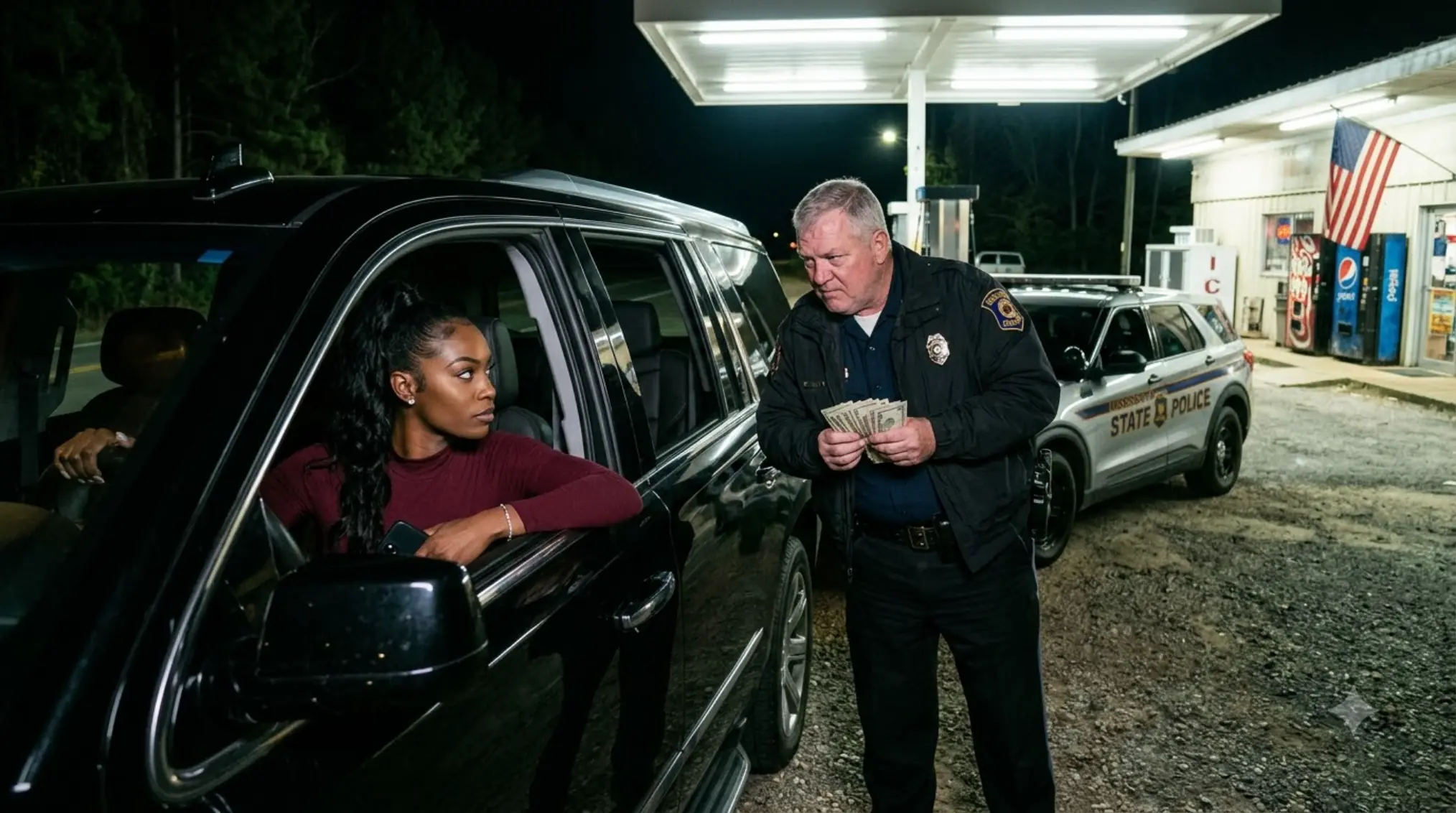
Two faded vending machines stood against the brick wall beneath an American flag that moved slightly whenever wind crossed the parking lot.
Beyond the edge of the asphalt, darkness swallowed everything.
No houses.
No restaurants.
No crowds.
Just pine trees, utility poles, and a two-lane road disappearing in both directions.
At 12:17 a.m., Simone Carter sat behind the wheel of a black SUV and watched a Mississippi state trooper count thirteen hundred dollars beside her open window.
She kept her face tense.
That part was not difficult.
Her heart was hammering hard enough that she wondered whether the trooper could see the pulse moving beneath the skin at her throat.
He counted the bills slowly.
One hundred.
Two.
Three.
Then folded them into a thick bundle.
Simone watched without speaking.
The trooper was Richard Harlan, fifty-eight years old, twenty-seven years in highway enforcement, broad through the chest and waist, short gray hair, deeply lined pale skin, and the weary expression of a man who had spent decades believing motorists should answer before asking questions.
He wore a dark patrol jacket over a navy uniform shirt.
Badge.
Duty belt.
Radio.
Black trousers.
Polished boots.
Behind him, his marked cruiser waited beneath the parking-lot lights.
Its emergency lights were no longer flashing.
That had been his decision.
Simone had noticed immediately.
Harlan looked toward the highway.
Empty.
Then toward the convenience store.
The clerk inside was busy near the register and too far away to hear anything through the glass.
Perfect.
Harlan folded the money once more.
“Keep quiet and keep driving.”
Simone did not move.
He expected her to.
That much was obvious.
He expected trembling hands reaching for the gear selector.
A quick nod.
Maybe tears.
Instead, Simone looked directly into his face.
“What if I call your supervisor?”
For the first time since he discovered the money, Harlan really looked at her.
His eyes narrowed.
“What?”
“My money.”
She kept her voice controlled.
“What happens if I call your supervisor and tell him you took it?”
A normal officer had several possible answers.
The cash might have been evidence.
Subject to a seizure receipt.
Related to an investigation.
Maybe Harlan could have shown paperwork.
Maybe he could have explained probable cause.
Maybe he could have returned it.
He did none of those things.
Instead, Harlan pushed the folded bills into the inside pocket of his patrol jacket.
Then leaned closer to the window.
“Then you’ll have a bigger problem.”
The sentence passed between them quietly.
Simone looked down.
Harlan mistook that for surrender.
Exactly as she needed him to.
He straightened.
“Understand?”
Simone nodded once.
Harlan stepped away.
One step.
Two.
Then three.
He turned toward his cruiser.
Simone waited.
She had spent six weeks preparing for the next ten seconds.
Five steps.
Six.
Seven.
Harlan crossed beyond the edge of her side mirror.
Simone’s frightened expression disappeared.
She reached beneath the center console.
Her fingers found the phone concealed inside a narrow black compartment.
The line had been connected for twenty-three minutes.
She lifted it.
“Did you hear the threat?”
A man’s voice answered immediately.
“Clear.”
Simone looked through the mirror.
Harlan was nearly at his cruiser.
She inhaled once.
Then said the phrase everyone had agreed upon.
“Take him.”
She lowered the phone.
And waited.
The parking lot remained still for perhaps two seconds.
Then headlights appeared.
One vehicle entered from the east.
Another from the west.
A dark pickup rolled out from behind an abandoned service building beyond the gas pumps.
Harlan stopped walking.
He looked toward the first vehicle.
Then the second.
Simone watched his shoulders stiffen.
Doors opened.
Not aggressively.
Deliberately.
Men and women stepped out wearing plain clothes beneath marked investigative vests.
One of them called:
“Sergeant Harlan, keep your hands where we can see them.”
Harlan turned slowly.
His face changed.
Confusion.
Then recognition.
Then disbelief.
“What the hell is this?”
The lead investigator walked toward him.
“Internal investigations. Do not reach inside your jacket.”
Harlan immediately looked toward Simone’s SUV.
That one movement confirmed everything.
He understood.
Simone opened her door.
The lead investigator raised one hand toward her.
“Stay there, Simone.”
She remained seated.
Harlan pointed toward her.
“She set me up.”
Nobody answered.
Two investigators approached him.
“Hands away from your belt.”
Harlan’s voice grew louder.
“You people don’t know what happened.”
The lead investigator said:
“We heard what happened.”
Silence.
Harlan looked toward the convenience store.
The clerk had finally noticed the vehicles and now stood frozen behind the glass.
The investigator continued.
“We heard the entire contact.”
Harlan’s eyes went toward Simone again.
The hidden phone rested in her hand.
For the first time that night, she let him see it.
His mouth opened.
Nothing came out.
“Sergeant,” the investigator said, “place your hands on the hood of the cruiser.”
Harlan did not move immediately.
Then he looked around.
Five investigators.
Two vehicles blocking exits.
His own radio traffic already being preserved.
No easy way to turn the moment into something else.
He obeyed.
An investigator reached into Harlan’s jacket pocket.
The folded cash came out.
Thirteen one-hundred-dollar bills.
Each bill had been photographed and recorded earlier that evening.
Serial numbers logged.
The investigator held the bundle up.
“Recovered.”
Simone closed her eyes.
Six weeks.
Thirty-four prior complaints.
Nine questionable roadside cash seizures.
Four motorists who later changed their stories.
Two who refused to cooperate.
One body-camera pattern nobody could explain.
And now thirteen marked bills sat inside an evidence bag.
The parking lot that Harlan believed would hide what he did had become the most documented traffic stop of his career.
Six weeks earlier, Simone Carter had never heard the name Richard Harlan.
She was twenty-nine years old and worked as a financial-compliance analyst for a regional insurance company in Jackson.
Numbers were easier than people.
That was one reason she liked the job.
Transactions either matched or they did not.
Accounts reconciled or they did not.
Patterns existed whether anyone wanted them to exist.
Simone’s older brother Marcus Carter worked as an investigator with the Mississippi Department of Public Integrity, a small state unit that assisted agencies with corruption complaints involving public employees.
He rarely discussed cases.
Then one Sunday afternoon, he asked Simone an unusual question.
“How much cash do you carry?”
They were sitting on their mother’s back porch.
Simone laughed.
“Why?”
“Just answer.”
“Maybe forty dollars.”
“Would you ever travel with more?”
“Depends.”
“How much?”
She thought.
“If I was buying something from somebody. Maybe a thousand.”
Marcus nodded.
Simone stared.
“What are you working on?”
“Can’t say.”
“Then why ask?”
Marcus looked toward the yard.
“Because somebody keeps reporting roadside seizures that don’t exist afterward.”
Simone stopped smiling.
“What does that mean?”
Marcus immediately regretted speaking.
“Forget I said anything.”
“No.”
“Simone.”
“You already said it.”
He sighed.
The investigation had begun with a complaint from a twenty-three-year-old construction worker named Javier Soto.
Javier said a state trooper stopped him on Highway 45 late at night.
The trooper searched his vehicle after claiming he smelled marijuana.
No drugs were found.
But the officer discovered nine hundred dollars in an envelope beneath the passenger seat.
Javier said the trooper accused him of carrying suspicious cash and took it.
No receipt.
No citation.
No seizure paperwork.
Nothing.
Javier reported it three days later.
The trooper denied taking cash.
Body-camera footage showed the beginning of the stop.
Then a thirty-seven-minute gap.
Technical failure, according to the initial review.
The trooper’s name:
Richard Harlan.
A second complaint surfaced when investigators searched older records.
A traveling mechanic from Alabama said four hundred fifty dollars disappeared during another Harlan stop.
Complaint dismissed.
No evidence.
Third complaint.
A woman named Teresa Winn claimed Harlan told her she could “lose the cash or lose the car” after finding seven hundred dollars in her glove compartment.
She refused to provide a formal statement later.
Marcus’s unit became interested.
They pulled three years of traffic records.
Harlan stopped more motorists than average during late-night shifts.