The neon sign outside Rusty’s Bar flickered red and blue at nine o’clock on a Thursday night in Milbrook, a quiet Missouri town with one grocery store, three churches, two traffic lights, and three thousand two hundred people who believed they knew one another.
That was what people said about Milbrook.
Everybody knew everybody.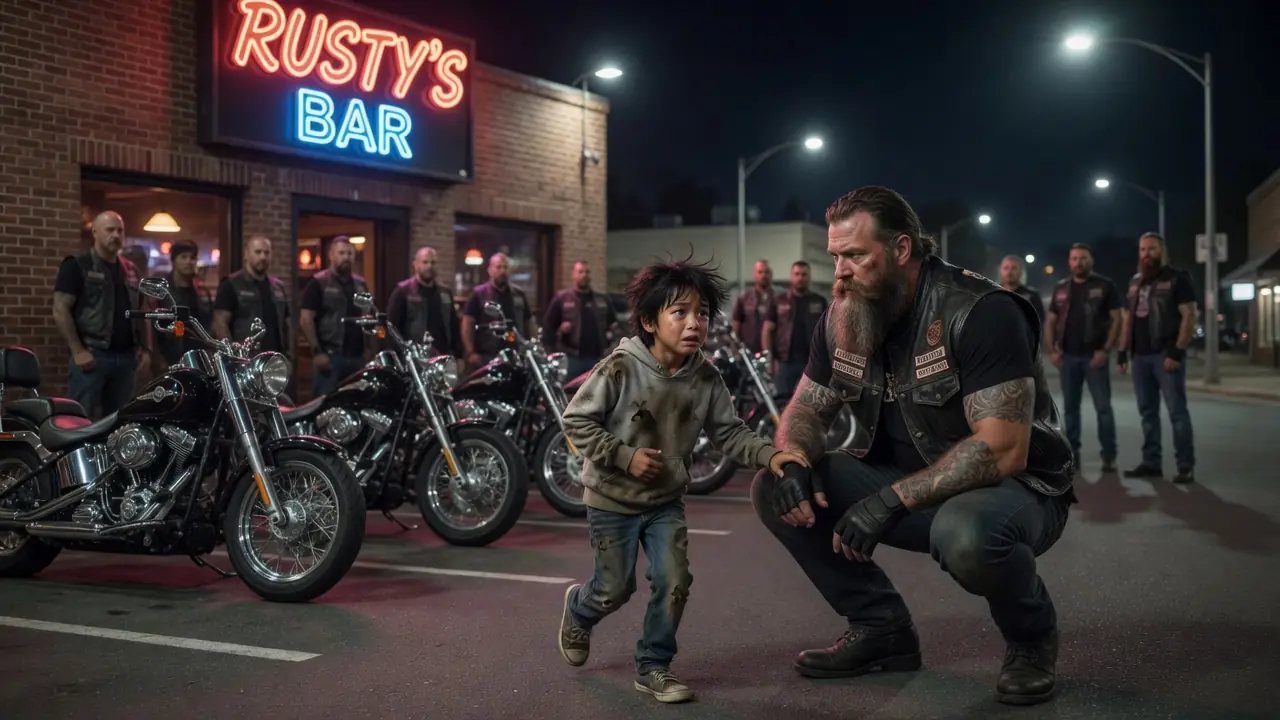
Everybody knew who cut their lawn too early on Saturdays. Everybody knew whose teenage son drove too fast near the elementary school. Everybody knew who brought the best peach cobbler to the church picnic and who never paid back borrowed tools.
But Milbrook also had another talent.
It knew how not to see.
It knew how to look away from the wrong kind of trouble when the person causing it wore a clean shirt, sat in the right pew on Sundays, donated to the little league team, and shook hands with the mayor during the Fourth of July parade.
Across from Rusty’s Bar, the streetlights buzzed over a cracked parking lot where two dozen Harley-Davidsons sat in perfect rows. Chrome caught the neon glow. Leather jackets hung over seats. Helmets rested on handlebars like dark, silent witnesses.
Inside the bar, laughter rolled low and rough through the walls, but outside, leaning against a black Harley Road King, Sunny “Cavira” Barger smoked alone beneath the flickering sign.
Sunny was forty-five years old, six-foot-four, and built like a wall that had decided to grow a beard. He weighed close to two hundred sixty pounds, with arms covered in old tattoos, a long dark beard streaked with gray, and eyes that made most men lower their voices before they realized they were doing it.
His vest carried the patch that made strangers cross streets.
Hell’s Angels MC.
Some people in Milbrook called them criminals. Some called them trouble. Some crossed themselves when the bikes rolled through downtown, even though the club had raised more money for burned-out families and sick children than most of the town’s formal committees combined.
Sunny knew what people said.
He had stopped caring years ago.
He took one last pull from the cigarette, then looked toward the road when he heard running footsteps.
Fast.
Uneven.
Desperate.
Not adult footsteps.
A child’s.
He straightened before he saw the boy.
Down the sidewalk, under the broken strip of light from the pharmacy sign, a child sprinted toward the bar as if the dark itself had teeth. He was small, maybe nine, maybe ten, thin enough that his torn shirt hung loose from his shoulders. One pant leg was ripped at the knee. One shoe was untied. He limped every few steps but kept running anyway.
Sunny dropped the cigarette and crushed it under his boot.
The boy stumbled near the edge of the parking lot.
For one long second, he stopped.
He looked at the motorcycles. Then at the bar. Then at Sunny.
Fear flashed across his face.
Not fear of the man chasing him.
Fear that he had reached the wrong place.
That he had run from one danger into another.
Sunny did not move toward him. He had learned a long time ago that scared children were like wounded animals. If you rushed them, even to help, they might bolt back toward the very thing that hurt them.
The boy stared at the patch on Sunny’s vest.
Then he made a decision.
He ran straight to him.
“Please,” the boy gasped, grabbing Sunny’s jeans with both hands. “Please protect me. My dad’s going to kill me. Please don’t send me back.”
Sunny froze.
The boy’s fingers were locked around the denim near his knee. His face tilted upward under the neon light, and Sunny saw the injuries clearly.
One eye swollen almost shut.
Lip split.
Cheek bruised.
Finger-shaped marks along the side of his neck.
A purple line across one arm.
Sunny felt something old and ugly open inside his chest.
Not memory exactly.
Memory had edges.
This was deeper than that.
This was the voice of his own childhood climbing out of a locked room after thirty-six years.
He crouched slowly until he was eye level with the boy.
“Hey,” Sunny said, keeping his voice low. “Easy. You’re safe right now. What’s your name?”
The boy’s breath came in broken little pulls.
“Lucas. Lucas Chen. I’m nine.”
“Okay, Lucas. My name’s Sunny.”
The boy looked at him like he was trying to decide whether a man called Sunny could really be that frightening.
Sunny gave him a small nod.
“Who hurt you?”
“My dad. Robert Chen. He runs the hardware store on Maple Street. He was drunk. He’s always drunk now, but tonight was worse. He kept hitting me and saying I killed Mom. He said he should have buried me with her.”
Sunny’s jaw tightened so hard the muscles in his face moved.
Behind him, the door to Rusty’s opened.
Tank stepped out first, wide as a refrigerator, bald head gleaming under the neon. He stopped when he saw the child.
“What the hell?”
Sunny did not turn around.
“Get Reaper,” he said. “And Doc. Now.”
Tank vanished back inside.
Sunny looked at Lucas again.
“Where’s your mom?”
“Dead. Cancer. Two years ago. It’s just me and Dad now.”
“Does he know where you ran?”
Lucas shook his head quickly, then winced.
“I don’t think so. I ran when he fell against the coffee table. I thought he passed out. I just ran. I didn’t know where else to go.”
His voice cracked.
“Everybody says you guys are dangerous. But I thought maybe dangerous people could stop him.”
Sunny closed his eyes for half a second.
When he opened them, his voice was rougher.
“Can you walk?”
“I think so. My ribs hurt.”
“Okay. We’re going inside. There are going to be a lot of big men in there. Some of them look mean. Some of them are mean when they need to be. But nobody in that room is going to hurt you. Understand?”
Lucas nodded.
Sunny stood, then offered a hand instead of grabbing him.
Lucas hesitated, then took it.
His hand was ice-cold.
Inside Rusty’s, the room went silent.
One moment, twenty Hell’s Angels had been talking over beer, burgers, and a baseball game playing with no sound on the television. The next, every conversation died.
Reaper stood from the center table.
He was in his early fifties, iron-gray hair pulled back, face lined by miles, leadership, and too many funerals. He did not look like a man who wasted words.
His eyes moved from Sunny to Lucas.
Then to Lucas’s face.
The whole room saw the same thing.
The bruises looked worse under the bar lights.
The split lip had dried at one corner.
The swelling around his eye had turned deep purple.
Doc, a former army medic with a limp and calm hands, moved before anyone told him to.
He lowered himself slowly in front of Lucas.
“Hey, buddy. I’m Doc. I’m going to look at you, but only if that’s okay. I won’t touch without asking.”
Lucas glanced at Sunny.
Sunny nodded.
“It’s okay.”
Doc examined the injuries gently. He asked before moving Lucas’s sleeve. Asked before checking his ribs. Asked before shining a small light toward his swollen eye.
The longer he looked, the colder the room became.
Finally, Doc stood and pulled Reaper aside.
His voice stayed low, but Sunny heard every word.
“Bruised ribs, possibly fractured. Defensive marks on the arms. Finger marks on the throat. Old bruising under new bruising. This isn’t one bad night. This is a pattern.”
Reaper’s face hardened.
He walked back to Lucas and knelt.
“Lucas, I’m Reaper. I need to ask you one question right now. Are you telling us the truth?”
Lucas’s eyes filled immediately.
“Yes, sir.”
Reaper nodded once.
Not because he was testing the boy.
Because he wanted Lucas to hear the next part clearly.
“Then we believe you.”
Lucas stared at him.
“You do?”
“Yeah,” Reaper said. “We do.”
Something in the boy’s face collapsed.
Not with relief exactly.
Relief takes trust.
This was what came before trust. The first crack in a wall a child had built because nobody had ever opened the door.
Sunny guided Lucas to the back office, away from the bar, away from twenty angry men trying very hard not to look angry around him.
The office held an old couch, a desk covered in paperwork, a mini-fridge, and a small television that only worked if someone hit the top. Sunny placed a blanket over the couch and helped Lucas sit.
“I’ll get food,” Sunny said.
“I’m not hungry.”
His stomach made a sound loud enough to betray him.
Sunny almost smiled.
“Your stomach disagrees.”
He returned with a cheeseburger, fries, water, and a carton of chocolate milk left over from a toy drive lunch earlier that week. Lucas looked at the plate like someone might snatch it away.
“Go on,” Sunny said. “It’s yours.”
Lucas ate fast at first, then slowed as if remembering he should be polite.
Sunny sat on the chair across from him, not too close.
“How long has your dad been hurting you?”
Lucas stared at the fries.
“Since Mom died. At first, he just yelled. Then he pushed me. Then he started hitting. He says I took her away because she got sick after I was born. But that’s not true, right?”
The question was so small that it nearly broke Sunny.
“No,” he said. “That is not true. Your mom getting sick was not your fault. Your dad drinking is not your fault. Him hitting you is not your fault. Not one part of this belongs to you.”
Lucas chewed his lip, then flinched because it hurt.
“He says nobody will believe me. He says he’s respected. He says everyone knows I’m difficult.”
Sunny leaned forward.
“Are you difficult?”
Lucas looked ashamed.
“Sometimes I get in trouble at school. I don’t always do homework. Sometimes I fall asleep in class. Sometimes I get mad.”
“You ever wonder why?”
Lucas shrugged.
Sunny’s voice softened.
“Kids who are scared all night have a hard time staying awake in class. Kids who are hurt at home have a hard time acting calm at school. That doesn’t make you bad. It means you’ve been carrying too much.”
Lucas looked at him carefully.
“Did someone hurt you too?”
Sunny was quiet.
Outside the office door, the bar murmured low with planning. Reaper’s voice. Tank’s. Axel’s younger voice saying he could call his sister Maria, the county social worker.
Sunny looked down at his hands.
“When I was your age, my old man used to hurt me too. He drank. He blamed me for everything. Broke my arm once and told the school I fell from a tree. I learned early that people believe the adult with clean clothes before they believe the kid with bruises.”
“What happened?”
“I ran away at fourteen. Made bad choices for a while. Found the club later. They gave me a family when I didn’t have one.”
Lucas watched him with his one good eye.
“Are you still scared of him?”
Sunny took a long breath.
“No. But sometimes the old fear still knows where I live.”
Lucas nodded like he understood completely.
That was another thing that broke Sunny.
Children should not understand sentences like that.
“You’re not going back tonight,” Sunny said. “Or tomorrow. Not if we have anything to say about it.”
Lucas whispered, “Promise?”
Sunny looked him straight in the eye.
“I promise.”
Lucas fell asleep twenty minutes later with the blanket pulled up to his chin and the half-finished chocolate milk still on the desk.
Sunny stayed in the chair all night.
He did not smoke.
He did not drink.
He listened to Lucas breathe.
In the main room, Reaper held court at the center table.
“This is not a street problem,” he said. “This is a child protection problem. We handle it smart. No one touches Robert Chen unless he forces our hand. We document. We call the right people. We build proof.”
Tank scowled.
“The right people already missed it.”
“Then we make them see it.”
Axel, the youngest patched member in the room, had his phone in hand.
“My sister Maria works county child services. She’s off duty, but she’ll answer.”
“Call her,” Reaper said.
Axel stepped outside and returned ten minutes later.
“She’s coming at seven. Told me to take pictures now. Every bruise. Every mark. With timestamp. She said don’t clean anything until she sees him unless it’s medically necessary.”
Doc nodded.
“I already documented what I could.”
Reaper looked around the room.
“Robert Chen is not some nobody. Hardware store. Church deacon. Little league. Parade committee. City council donors. The second this breaks, half the town will defend him because it’s easier than admitting they missed a child getting hurt.”
“Or ignored it,” Tank muttered.
“Exactly,” Reaper said. “So we stay cleaner than clean. Cameras on. Phones charged. No threats. No speeches. No giving his lawyer ammunition.”
Sunny stepped into the room.
The conversation stopped.
“He’s asleep,” Sunny said. “He ate. He’s exhausted.”
Reaper nodded.
“You good?”
Sunny’s face was unreadable.
“No.”
Reaper understood.
“Stay with him.”
“I plan to.”
Morning came pale and cold through the bar windows.
Lucas woke confused, sat up too fast, and clutched his ribs.
Sunny appeared with a tray of eggs, toast, bacon, and orange juice.
“Easy. You’re still at Rusty’s.”
Lucas blinked, then remembered.
“Did my dad come?”
“Not yet.”
Lucas looked frightened.
“He will.”
“I know.”
Sunny placed the tray across his lap.
“When he does, he doesn’t get past us.”
Maria Santos arrived at 7:18 a.m.
She was twenty-nine, practical, and warm in a way that did not feel fake. She wore a navy coat, carried a thick case file bag, and looked briefly at the motorcycles before stepping inside like she had decided fear was not useful today.
Axel met her at the door.
“Thanks for coming.”
“Don’t thank me yet,” she said. “Tell me where he is.”
Maria sat with Lucas in the back office for almost two hours. Sunny stayed only because Lucas asked him to. Maria did not rush. She asked open questions. She let silence sit. She wrote down the words exactly as Lucas said them.
When he described the belt, her jaw tightened.
When he described his father choking him, she put the pen down for a moment and breathed through her nose.
When he said Robert told him he should have died instead of his mother, Maria’s eyes filled, but her voice stayed steady.
At the end, she said, “Lucas, I believe you.”
Lucas stared at her.
“Adults keep saying things like that, but then they send me back.”
“I know,” she said. “So I’m going to tell you the truth. This will be hard. Your father is respected. People will struggle to believe something terrible about someone they’ve decided is good. That is unfair, but it is real.”
Lucas looked down.
“But we are going to document everything,” Maria continued. “Photos. Medical exam. Statements. School records. Neighbor reports. Police calls. Anything that shows the pattern. We are going to make the truth too heavy to ignore.”
“Where do I go?”
Maria hesitated.
That hesitation frightened him more than shouting.
Reaper spoke from the doorway.
“He stays here until there’s a safe placement.”
Maria turned.
“I cannot officially place a child with a motorcycle club.”
“No one asked you to call it that. Call it temporary protective supervision while paperwork moves.”
“That is not how regulations work.”
“Regulations didn’t keep him from getting choked.”
The room went quiet.
Maria looked at Lucas.
“Do you feel safe here?”
Lucas nodded quickly.
“With Sunny.”
Sunny did not move, but something shifted in his face.
Maria closed her folder.
“I’m filing emergency paperwork. I’m also requesting a medical exam today. Until the court responds, I will note that Lucas is in a safe disclosed location under adult supervision and that removing him prematurely may create immediate harm.”
Reaper nodded.
“Good enough.”
Maria pointed at him.
“No hero moves. No intimidation. No retaliation.”
Reaper almost smiled.
“Ma’am, we’re a motorcycle club, not idiots.”
By noon, Robert Chen knew.
He called the bar first.
Tank answered, listened for three seconds, then held the phone out like it smelled bad.
“Reaper.”
Reaper took it.
“This is Reaper.”
“You have my son.”
Robert Chen’s voice was cold and precise. Not drunk now. Controlled. Public voice. The voice he used at Rotary breakfasts and church fundraisers.
“Your son ran to us injured and terrified.”
“Lucas is troubled. He lies. He hurts himself for attention.”
Reaper looked through the glass toward the office where Lucas was sitting with Sunny, drawing shaky lines on a napkin because Maria had told him grounding exercises could help panic.
“Children don’t put finger marks around their own throats.”
A pause.
“You don’t know who you’re talking to,” Robert said.
“I know exactly who I’m talking to.”
“I’m calling the police.”
“Do that.”
“I know the police chief.”
“Then he knows where to find us.”
Robert’s voice dropped.
“You’re a biker gang. I’m a respected business owner. Who do you think they’ll believe?”
Reaper answered calmly.
“The evidence.”
Robert hung up.
By three that afternoon, Milbrook had divided itself into two towns.
In one town, Robert Chen was a grieving widower who had lost his wife to cancer and done his best with a troubled boy.
In the other, people whispered about things they had seen and ignored.
Lucas wearing long sleeves in May.
Lucas flinching when someone raised a hand too quickly.
Lucas falling asleep over his reading worksheet.
Lucas once hiding in the school bathroom for forty minutes after Robert came early to pick him up.
At four, Police Chief Tom Bradley arrived.
He was a broad man in his late fifties with thinning hair and a face that looked permanently tired. He had known Robert Chen for twenty years. Bought paint from his store. Coached against him in little league. Sat two pews behind him in church.
He did not look happy to be standing inside Rusty’s Bar.
“Reaper,” he said.
“Chief.”
“I need to see the boy.”
“Maria Santos is present. Sunny stays if Lucas asks.”
Bradley hesitated.
Then nodded.
The interview lasted thirty-five minutes.
Lucas answered quietly. He showed the bruises. He described the night. He described previous nights. He named dates when he could remember them by school events.
Afterward, Bradley stepped outside the office and stood near the pool table, rubbing his forehead.
“He sounds credible,” Maria said.
“He’s a child,” Bradley replied. “Children can be influenced.”
Sunny stood so fast that Tank put one hand on his shoulder.
Reaper spoke first.
“Careful, Chief.”
Bradley looked at Sunny, then back at Maria.
“I’m not dismissing him. I’m saying this will be ugly. Robert has standing in this town. His lawyer will use your club against this child.”
“He already did,” Reaper said. “He counted on everyone seeing us before they saw Lucas.”
Bradley had no answer.
That night, Robert Chen came to the bar.
He did not come alone.
Mayor Richard Walsh stood beside him in a wool overcoat. Councilman David Kim stood slightly behind them. Pastor James Morrison, who had baptized Lucas as a baby and conducted Linda Chen’s funeral, held a Bible in one hand like it might protect him from the leather standing across the parking lot.
Robert looked perfect.
Clean shirt.
Dark jacket.
Hair combed.
Eyes red enough to suggest grief but not loss of control.
A performance built for witnesses.
Reaper stepped onto the porch.
“What can I do for you gentlemen?”
“I want my son,” Robert said.
“Your son does not want to go with you.”
Mayor Walsh cleared his throat.
“Reaper, I understand emotions are high, but you cannot interfere with parental custody. Robert is Lucas’s legal father.”
“Legal father doesn’t mean safe father.”
Pastor Morrison frowned.
“That is a serious accusation.”
“Yes,” Reaper said. “It is.”
Robert spread his hands.
“My boy is sick with grief. He has been since Linda died. He says things. He makes up stories. I have tried everything. Counseling. Discipline. Love.”
Sunny stood in the doorway behind Reaper.
His voice was low.
“You call belt marks love?”
The pastor’s face changed.
Robert looked at him sharply.
“You don’t know my family.”
“No,” Sunny said. “But I know your son’s bruises.”
Reaper opened the door wider.
“You want to see him? You’ll see him with Maria Santos present, the police notified, and cameras recording. You take one step toward him without permission, this conversation ends.”
Robert’s jaw tightened.
Inside, Lucas heard his father’s voice and began to shake.
Sunny knelt in front of him.
“You don’t have to see him.”
“He’ll say I’m lying.”
“You know you’re not.”
“What if they believe him?”
Sunny held his gaze.
“Then we keep fighting.”
Lucas nodded, though tears were already falling.
When Robert entered the office and saw Lucas, his expression softened instantly. Anyone watching from far away would have seen a heartbroken father.
“Buddy,” Robert said gently. “Come on. Let’s go home.”
Lucas pressed himself into the couch.
“No.”
Robert’s face twitched.
Only Sunny saw it.
“Lucas,” Pastor Morrison said softly. “Your father says this is a misunderstanding.”
Lucas looked at the pastor, and pain entered his face in a way that accusation never could.
“You told me God sees everything,” Lucas said. “Didn’t He see my dad hitting me?”
The pastor went pale.
No one spoke.
Lucas pulled up his sleeve. His small arm was covered with bruises at different stages of healing.
“He did this.”
Robert inhaled sharply.
“Lucas, stop this.”
Lucas flinched at the tone.
The mayor saw it.
So did Councilman Kim.
So did Pastor Morrison.
For the first time, Robert realized his audience was not responding the way they always had.
Doc stepped forward.
“I examined him. Bruised ribs. Marks consistent with strangulation. Defensive wounds. Older bruising under new injuries. This is repeated abuse.”
Robert’s mask cracked.
“You people think you can lecture me? You? A bar full of criminals? You have no idea what it’s like raising an ungrateful child alone.”
Pastor Morrison whispered, “Robert.”
Robert turned on him.
“What? You think I’m a monster now? After everything I’ve done for this town?”
Lucas began to sob silently.
Sunny moved in front of him.
“Conversation’s over,” Sunny said.
Robert pointed at Lucas.
“You are coming home.”
Reaper stepped between them.
“No. He isn’t.”
Robert looked at each man in the room, then at the camera in the corner.
He noticed it too late.
The mask returned, but it did not fit as cleanly.
“This isn’t over,” he said.
“No,” Reaper replied. “It isn’t.”
The hearing was set for Tuesday.
Robert hired Benjamin Drake, one of the most expensive family law attorneys in the state. Drake filed a counter-petition claiming Lucas had been manipulated by a criminal motorcycle organization, that the child had emotional disturbances after his mother’s death, and that Robert Chen was the true victim of community harassment.
By Monday night, the bar had gathered twelve witnesses.
Mrs. Henderson, Lucas’s third-grade teacher, admitted she had seen bruises and written them off as playground accidents.
Pastor Morrison admitted Lucas had once asked during Sunday school whether God forgave fathers who hurt their sons, and he had treated it as a grief question instead of a cry for help.
A neighbor named Diane Wells reported hearing yelling through the walls for two years.
A former little league assistant coach admitted Robert had once grabbed Lucas so hard by the back of the neck that the boy cried out.
Each one had seen something.
Each one had explained it away.
Now they were ready to say that out loud.
The courthouse was packed Tuesday morning.
Robert sat at one table in a dark suit, looking tired, noble, wounded. Drake stood beside him, polished and confident.
Across the aisle sat Maria Santos, Lucas, Sunny, Reaper, Doc, and enough Hell’s Angels to fill two rows.
Judge Margaret Harrison entered at nine sharp.
She had a reputation for being strict, unsentimental, and difficult to impress.
Drake spoke first.
He was good.
Everyone knew it within thirty seconds.
He painted Robert as a grieving widower trying to save a troubled son. He spoke about the difficulty of single parenthood, childhood grief, behavioral challenges, and the danger of allowing “men with violent reputations” to replace lawful authority.
Then he called Robert.
Robert cried at the right moments.
He described Linda’s cancer. He described Lucas’s “outbursts.” He claimed the bruises came from fights at school, falls from a bike, and rough play.
“I love my son,” Robert said, voice breaking. “I just want him home.”
Some people in the gallery wiped their eyes.
Then Maria called Doc.
Doc testified clinically.
No drama.
No rage.
He described the injuries and why they did not match Robert’s explanations.
Then Mrs. Henderson testified.
Her voice shook.
“I saw bruises. More than once. I asked Lucas, and he said he fell. I accepted that because accepting it was easier than asking the harder question.”
Pastor Morrison testified next.
“I believed Robert because he looked like the kind of man I wanted to believe. I did not believe Lucas because I did not want to admit a child was being hurt in my own congregation. That is my failure.”
The courtroom went very quiet.
Then Maria called Lucas.
He walked to the witness stand with Sunny beside him until the bailiff gently stopped Sunny at the rail. Lucas looked back once.
Sunny tapped two fingers to his chest.
I’m here.
Lucas sat.
His feet did not touch the floor.
Maria approached slowly.
“Lucas, do you know why we’re here today?”
“Yes. To decide if I have to go back.”
“What do you want the judge to know?”
Lucas looked at Judge Harrison.
“My dad is nice outside. He smiles at people. He helps at church. But at home, when he drinks, he hurts me. I tried to be better. I tried to be quiet. I tried to make him not mad. It didn’t work.”
Drake cross-examined gently at first.
Then carefully.
Then sharply.
He suggested Lucas was confused. Angry. Grieving. Influenced by bikers who wanted attention.
Lucas gripped the edge of the chair.
“I know what happened to me.”
“Do you also know these men have criminal records?” Drake asked.
“Objection,” Maria said.
“Sustained,” Judge Harrison snapped.
Drake rephrased.
“Lucas, isn’t it true that you wanted to stay with them because they gave you food and attention?”
Lucas looked at Sunny.
Then at the judge.
“I wanted to stay because when I said my dad hurt me, they believed me.”
The courtroom fell silent.
Drake had no more questions.
Judge Harrison recessed for one hour.
Lucas sat in the hallway between Sunny and Reaper, shaking so hard the bench trembled.
“What if she sends me back?” he whispered.
Sunny’s answer came immediately.
“Then we appeal.”
“What if that fails?”
“Then we keep going.”
“For how long?”
Sunny looked at him.
“As long as you need.”
When court resumed, Judge Harrison read her decision slowly.
“Robert Chen has standing in this community. That is not evidence of safety. Lucas Chen has injuries. That is evidence. Lucas Chen has fear. That is evidence. Multiple adults saw signs and failed to act. That is evidence too.”
Robert’s face hardened.
Judge Harrison continued.
“Lucas Chen will remain in state custody. Robert Chen’s visitation is suspended pending full investigation. A restraining order is granted. A full psychological evaluation is ordered. This court will not return a terrified child to the home he fled simply because the adult in that home has a good reputation.”
Robert stood.
“You can’t do this. He’s my son.”
Judge Harrison looked at him over her glasses.
“One more word, Mr. Chen, and you will be held in contempt.”
Robert sat.
But his eyes found Lucas.
And Lucas understood something.
His father had lost control in public.
That meant he would do something dangerous in private.
Three nights later, he did.
At 2:13 a.m., the alarm at Rusty’s screamed.
Sunny was asleep in a chair beside the office couch. He woke before the second beep.
On the security monitor, Robert Chen crossed the parking lot carrying a red gas can.
Sunny moved fast.
“Lucas,” he said. “Storage room. Now.”
Lucas woke instantly, terror trained into him.
Reaper and Tank were already moving through the bar. Doc grabbed the emergency phone. Axel hit record on the security backup.
Outside, Robert poured gasoline along the side wall beneath the office window.
He was drunk.
His hair was wild.
His perfect public face was gone.
“You took him,” he muttered. “You took my boy. You ruined me.”
Tank stepped out slowly, hands visible.
“Robert. Put the can down.”
Robert spun, holding a lighter.
“Stay back.”
“You light that, your son burns with the building.”
Robert laughed once.
It was a terrible sound.
“If I can’t have him, nobody does.”
The words carried clearly into the cameras.
Police sirens rose in the distance.
Robert panicked.
He flicked the lighter.
Tank moved.
He hit Robert low and hard, driving him sideways before the flame could touch the gasoline. The lighter flew into the gravel. Reaper kicked it away. Sunny came out the side door just as police cruisers turned into the lot.
Chief Bradley stepped out with his weapon drawn.
“Hands where I can see them!”
Reaper backed away.
“Camera caught all of it.”
Robert screamed as officers handcuffed him.
“He’s mine! He’s my son!”
Lucas appeared in the doorway behind Sunny, wrapped in a blanket.
He watched his father being pushed into the cruiser.
He did not cry.
Sunny put one hand on his shoulder.
“It’s over.”
Lucas asked, “For real?”
Sunny looked at the gas on the wall, the police lights, the camera, and Robert Chen’s face pressed against the cruiser window.
“For real.”
Robert Chen pleaded guilty after the video became public.
Attempted arson.
Violation of a protective order.
Child abuse.
Endangerment.
His parental rights were terminated.
He received twelve years in prison.
Milbrook changed slowly after that.
Not all at once.
Towns do not confess easily.
But people began saying things they should have said sooner.
Teachers received new training on injury patterns and child disclosures. The church created a child safety reporting team that did not answer to one person. The police department changed its welfare check policy so no report involving a child could be dismissed without a documented in-person follow-up.
The new community center was named after Linda Chen, Lucas’s mother.
At the dedication ceremony six months later, Lucas stood at the podium wearing a clean blue shirt and the small leather vest Sunny had given him.
On the back, stitched carefully in white, it read:
Little Brother Lucas.
The crowd stretched across the lawn.
Teachers.
Neighbors.
Church members.
Police officers.
Foster families.
And behind Lucas, in full colors, stood the Hell’s Angels.
Sunny stood closest.
Lucas took a breath.
“My mom used to say family is the people who show up,” he began. “For a long time, I thought nobody was coming. I thought everyone believed my dad because he smiled at them. Then I ran to the scariest men in town, and they weren’t scary to me. They were safe.”
He looked at Sunny.
“They believed me before I had perfect words. They protected me before everyone else understood. They taught me that being brave doesn’t mean you’re not scared. It means you ask for help even when you think nobody will listen.”
The applause started softly.
Then grew.
Sunny did not clap.
He could not.
His hands were shaking, and he did not want anyone to see.
Lucas stepped down and walked straight to him.
“Thank you,” Lucas said.
“You already said that,” Sunny replied.
“I’m going to keep saying it.”
Sunny crouched in front of him, just like he had that first night under the neon sign.
“Then I’m going to keep telling you the same thing. Live a good life. Be happy. That’s the thank-you.”
Lucas nodded.
“I can do that.”
“I know.”
Lucas hugged him.
Sunny closed his eyes and held the boy carefully, as if holding something rescued from fire.
Across the street, Rusty’s neon sign flickered red and blue in the afternoon light, barely visible now, but still glowing.
The town had once feared the men who parked motorcycles beneath that sign.
Maybe some fear would remain.
Sunny did not need everyone to understand them.
He only needed one thing to be remembered.
On the night a nine-year-old boy ran through Milbrook with a swollen face and nowhere left to go, the most feared man in town did not send him away.
He knelt.
He listened.
He believed him.
And because of that, the whole town finally had to see what it had been hiding.