Rain pounded against nurse Diane Foster’s windshield as she drove home after a 14-hour shift.
The road was dark, cold, and she just wanted to sleep.
But suddenly, she saw an old man standing frozen by the roadside, soaked to the skin, with lost, unfocused eyes.
She stopped the car immediately, ran to him, brought him home, helped him shower, fed him, and warmed him up.
But then she accidentally discovered a crumpled piece of paper he always carried.
And when she opened it, the name of a son made her stop in her tracks.
The rain hammered down on Diane Foster’s windshield like a thousand angry fists.
She could barely see the road ahead.
Her wipers worked overtime, squeaking back and forth in a rhythm that matched her exhaustion.
Fourteen hours.
That was how long she had been on her feet at Riverside General Hospital.
Her lower back ached.
Her feet throbbed inside her worn sneakers.
The smell of antiseptic still clung to her scrubs, no matter how many times she washed them.
Diane was 32 years old, but tonight she felt 60.
Being a nurse did that to you.
It aged you from the inside out.
She turned onto Riverside Avenue, taking the quiet route home like she always did.
The street was empty.
Most people had the sense to stay inside on a night like this.
The rain had been falling for hours, flooding the gutters and turning the streets into rivers.
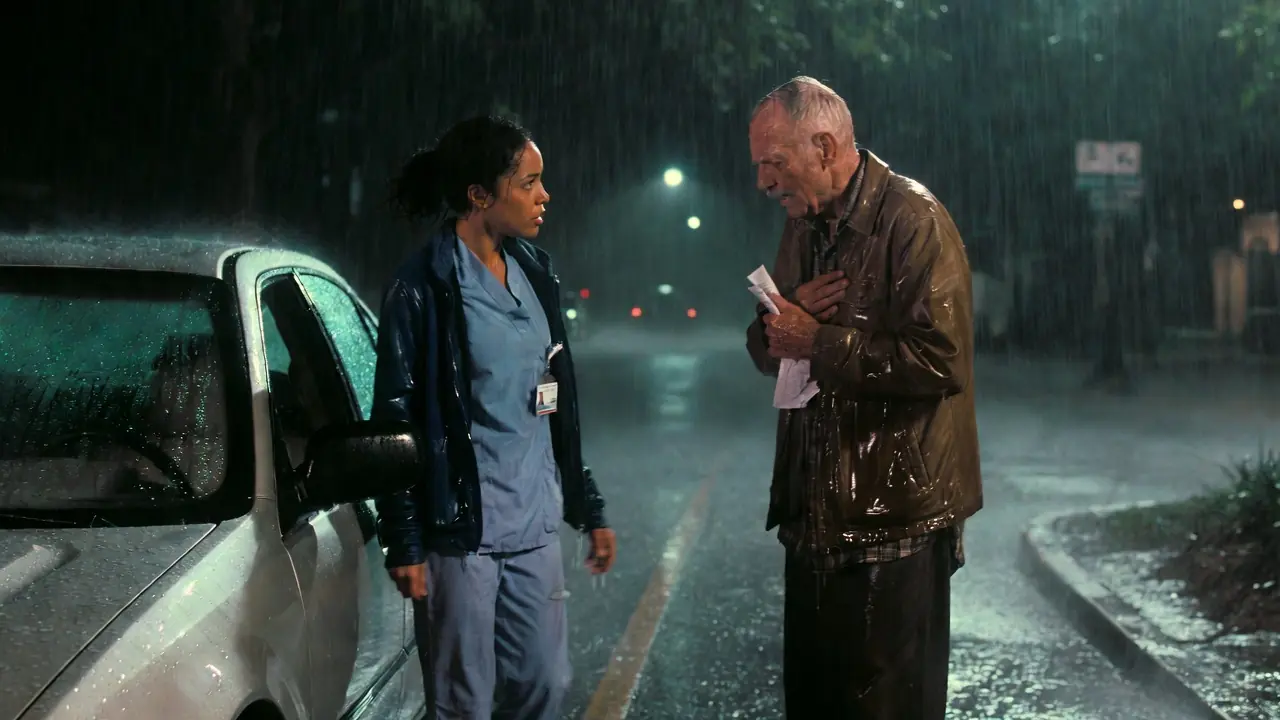
That was when she saw him.
An old man standing on the sidewalk, completely soaked.
He was not moving.
He was just standing there in the downpour like he was waiting for something.
His thin jacket clung to his frame.
His white hair was plastered to his head.
He looked lost, confused.
Diane’s first instinct was to keep driving.
She was tired.
She just wanted to get home, take a hot shower, and collapse into bed.
But something stopped her.
Maybe it was the way he stood there so still, so vulnerable.
Maybe it was the fact that he reminded her of her own father before he passed.
She could not just drive by.
Diane pulled over sharply, tires splashing through a deep puddle.
She threw the car into park and jumped out into the rain.
The cold hit her immediately, soaking through her scrubs in seconds.
“Sir,” she called out, jogging toward him. “Sir, are you okay?”
The old man turned slowly.
His eyes were cloudy, unfocused.
He looked at her like he was trying to remember who she was, even though they had never met.
His lips moved, but at first, no sound came out.
Diane stopped a few feet away, not wanting to startle him.
“My name is Diane. I’m a nurse. Are you hurt? Do you need help?”
The man blinked several times.
Rain dripped down his face.
When he finally spoke, his voice was thin and trembling.
“I have to find my son.”
“Your son?” Diane stepped closer. “Where is he?”
“At the hospital.”
The old man’s hand shook as he reached into his jacket pocket.
He pulled out a crumpled piece of paper so wet it was falling apart.
“Thomas. My boy. He needs me.”
Diane took the paper carefully.
She could barely make out the words.
Riverside General.
Floor 4.
ICU.
The ink was smudged, faded like it had been written years ago and handled a thousand times since.
“You’re looking for someone at Riverside General?” she asked gently.
“Thomas,” he repeated, more urgently now, his eyes filled with tears that mixed with the rain. “He was in an accident. I have to see him. I have to. I have to.”
His voice trailed off.
He swayed slightly, and Diane reached out to steady him.
“Okay, okay,” she said softly. “Let’s get you out of this rain first. My car is right here.”
She led him slowly to her old Honda, opened the passenger door, and helped him inside.
He moved stiffly, like his joints hurt.
Once he was seated, she hurried around to the driver’s side and climbed in, both of them dripping water all over the seats.
Diane cranked the heat up as high as it would go.
The old man sat there shivering, still clutching that piece of paper like it was the most important thing in the world.
She studied him more closely now.
He was probably in his mid-70s.
His clothes were old, but clean.
There were no visible injuries, but there was something off about the way he looked at things, the way his eyes did not quite focus.
She had seen it before in patients with dementia.
“What’s your name, sir?” she asked gently.
He stared at the dashboard for a long moment before answering.
“Walter. Walter Hayes.”
“Mr. Hayes, do you know where you live? Do you have family I can call?”
He did not answer.
He just kept looking at that paper.
“Thomas needs me. He’s waiting for me.”
Diane felt her heart squeeze.
This poor man.
He was clearly confused, possibly suffering from Alzheimer’s or some other form of dementia.
The question was what she should do.
Take him to the police?
Try to find his family?
It was almost midnight.
He was soaking wet and shivering.
She made a decision.
“Mr. Hayes, I’m going to take you to my place for tonight. It’s warm and dry. I’ll get you some food and clean clothes. Then tomorrow morning, we’ll figure everything out. We’ll find your son. Does that sound okay?”
Walter looked at her with those cloudy eyes.
For a moment, she saw clarity there.
Recognition of kindness.
“Thank you,” he whispered. “Thank you, child.”
Something about the way he said it made Diane’s throat tighten.
He reminded her so much of her father.
Her dad had died from Alzheimer’s three years ago.
By the end, he had not recognized her either.
The disease had stolen him piece by piece until there was nothing left but a shell.
She had promised herself back then that if she ever saw someone in need, someone lost and confused like her father had been, she would not look away.
“You’re welcome, Mr. Hayes,” she said quietly. “Let’s get you home.”
As she pulled back onto the road, Walter leaned his head against the window and closed his eyes.
His lips moved silently, and Diane could just barely hear what he was saying.
“Hold on, Thomas. Daddy’s coming. Hold on.”
Diane’s apartment was small but tidy.
One bedroom on the third floor of an old building in a modest neighborhood.
She led Walter inside, leaving wet footprints on the carpet.
“Okay, Mr. Hayes,” she said, guiding him to sit on the couch. “First things first. You need to get out of those wet clothes.”
She went to her closet and pulled out an old tracksuit that had belonged to her father.
She had kept it all this time, unable to let it go.
Now she was glad she had.
“Here,” she said, handing it to Walter. “The bathroom is right through that door. Take a warm shower if you want. Take your time.”
Walter took the clothes slowly, his hands still shaking.
“You’re very kind,” he said again. “Very kind.”
While he was in the bathroom, Diane changed into dry clothes and started making soup.
Nothing fancy, just chicken broth with vegetables and rice.
Comfort food.
The kind of thing her mother used to make when she was sick as a child.
She heard the shower running and breathed a small sigh of relief.
At least he was warming up.
Fifteen minutes later, Walter emerged.
The tracksuit hung loose on his thin frame, but he looked better.
His hair was still damp, but clean.
His face had more color.
“Come sit at the table,” Diane said, ladling soup into a bowl. “You must be hungry.”
Walter shuffled over and sat down.
Diane placed the bowl in front of him, along with a spoon and some crackers.
He stared at it for a moment, then picked up the spoon and took a tentative sip.
“Good,” he murmured. “This is good.”
“My mama’s recipe,” Diane said with a small smile.
She sat down across from him with her own bowl, though she was not really hungry.
She just wanted him to feel less alone.
They ate in silence for a few minutes.
The only sound was the rain still pattering against the windows and the quiet clink of spoons against bowls.
When Walter had finished half the bowl, Diane spoke gently.
“Mr. Hayes, can I look in your wallet? Maybe there’s some information that can help us find your family.”
Walter reached into the pocket of his wet jacket, which Diane had draped over a chair to dry.
He pulled out an old leather wallet, worn smooth with age, and handed it to her.
Diane opened it carefully.
Inside was a driver’s license that had expired two years ago.
Walter Hayes, 76 years old.
There were a few dollars in cash, a faded photo, and tucked into one of the slots, that same crumpled piece of paper about the hospital.
She pulled out the photo.
It showed a younger Walter standing next to a man in his 40s.
The younger man had his arm around Walter’s shoulders.
On the back, written in faded ink, were the words:
Thomas and Dad. Summer 2019.
“Is this your son?” Diane asked, showing him the photo.
Walter’s face lit up.
“Thomas. That’s my boy. He’s a good boy. Smart. So smart.”
“He looks like a good man,” Diane said softly. “Tell me about him.”
Walter’s eyes went distant, like he was looking at something far away.
“He was a teacher. High school history. The kids loved him. He always... he always...”
His voice trailed off.
He looked confused again, like he had lost the thread of what he was saying.
Diane reached across the table and gently touched his hand.
“It’s okay. You don’t have to remember everything right now.”
But Walter’s face crumpled.
Tears started rolling down his cheeks.
“He was in an accident. A car accident. Three years ago. I have to see him. I have to go to the hospital, but I keep forgetting where it is. I keep...”
He put his face in his hands and sobbed.
Not loud, dramatic sobs, but quiet ones that somehow hurt worse to hear.
Diane felt her own eyes burning.
She got up and moved to his side, putting her arm around his thin shoulders.
“It’s okay, Mr. Hayes. It’s okay.”
“I can’t remember things anymore,” he whispered through his tears. “Everything gets mixed up, but I know Thomas needs me. I know he’s waiting for me at the hospital.”
Diane held him while he cried, her own heart breaking.
She understood now.
Walter’s mind was trapped in some loop, some memory from three years ago that he could not escape.
Every day, he woke up thinking his son was in the hospital, that he needed to go see him.
But where was Thomas now?
Was he still alive?
Did Walter have other family?
After Walter had calmed down, Diane helped him to her bedroom.
She gave him the bed, insisting she would take the couch.
He was too tired to argue.
Within minutes of lying down, he was asleep.
Diane sat on her couch with her laptop, searching for information.
She typed in Thomas Hayes teacher car accident, but got nothing useful.
Too common of a name.
Too long ago.
She looked at Walter’s driver’s license again.
There was an address listed.
Tomorrow.
She decided tomorrow she would take him to Riverside General like he wanted.
Someone there might have information, and if not, she would try to find his family.
She pulled a blanket over herself and lay down on the couch.
But sleep did not come easy.
She kept thinking about her own father, about those last years when he had gotten confused, when he would wander off if you did not watch him constantly.
About how hard it had been to watch him disappear piece by piece.
No one should have to go through that alone.
In the bedroom, Walter’s voice drifted out, mumbling in his sleep.
“Thomas, Daddy’s here. Don’t be scared.”
Diane closed her eyes and tried not to cry.
Morning came gray and drizzly.
The rain had stopped, but the sky looked like it might start again any minute.
Diane woke up stiff from the couch and made breakfast.
Scrambled eggs, toast, and coffee.
Walter emerged from the bedroom looking better rested, but still confused.
He looked around the apartment like he did not remember how he had gotten there.
“Good morning, Mr. Hayes,” Diane said gently. “Did you sleep okay?”
“Where am I?” he asked, not unkindly, just confused.
“You’re at my apartment. I’m Diane. I found you last night in the rain. Remember? You were looking for your son, Thomas.”
Recognition flickered across his face.
“Thomas? Yes, I need to see him.”
“I know. And we’re going to go to the hospital this morning. But first, let’s eat something.”
“Okay.”
They sat at the small table and ate.
Walter was quiet, lost in his own thoughts.
Diane watched him carefully.
He seemed calmer today, less agitated.
Maybe a good night’s sleep had helped.
After breakfast, Diane helped Walter into his now dry clothes.
They were wrinkled but clean.
She grabbed her purse and keys.
“Ready to go?” she asked.
Walter nodded, gripping that paper again.
He must have taken it out of his wallet during the night.
“I’m ready.”
The drive to Riverside General took 20 minutes.
Walter sat in the passenger seat, staring out the window.
Occasionally, he would mutter something to himself, too quiet for Diane to hear.
As they pulled into the hospital parking lot, Walter suddenly sat up straighter.
“I know this place. I’ve been here before.”
“I’m sure you have,” Diane said gently. “This is where you said Thomas is, right?”
“Yes. Floor four. ICU.”
Diane felt a knot form in her stomach.
The ICU on floor four.
That was the cardiac intensive care unit.
She worked on floor two, but she knew the ICU well.
It was where the most critical patients went.
They walked through the front entrance together.
The lobby was busy with early morning visitors and staff starting their shifts.
Diane led Walter to the main reception desk, where a middle-aged woman with glasses sat typing on a computer.
“Excuse me,” Diane said politely. “I need some help. This is Mr. Walter Hayes. He’s looking for his son, Thomas Hayes. He believes Thomas is a patient here.”
The receptionist looked up, her expression neutral and professional.
“Do you have the patient’s date of birth or medical record number?”
“No, I’m sorry. We don’t have that information.”
The receptionist typed something into her computer, then frowned.
“I’m not showing any current patient by that name.”
“Thomas Hayes,” Diane said.
“Yes.”
Walter spoke up, his voice getting agitated.
“Thomas Hayes. He was in a car accident. He’s on floor four, the ICU.”
The receptionist’s expression did not change.
“Sir, I’m showing no current patient by that name in our system.”
“But he’s there,” Walter said, his voice rising. “I have to see him. He needs me.”
Diane put a calming hand on his arm.
“It’s okay, Mr. Hayes.”
She turned back to the receptionist.
“Is it possible there’s an old record from three years ago?”
“Maybe,” the receptionist sighed, clearly losing patience. “Ma’am, I can’t give out information on patients without proper authorization. Hospital policy.”
“I understand, but this man is clearly confused. He needs help finding his family. Surely there’s some way.”
“Hospital policy,” the receptionist repeated, her voice harder now. “If you’d like to file a formal request with patient services, they’re open from nine to five.”
Diane felt frustration rising in her chest.
“Look, I’m a nurse here. I work on floor two. This is a special circumstance.”
“Then you should know the privacy policies, ma’am. If you’re not currently on duty, you’re considered a visitor. I can’t help you without proper documentation.”
“This is ridiculous,” Diane muttered.
She looked at Walter, who was starting to breathe faster, his eyes darting around the lobby.
He was getting overwhelmed.
“Let’s sit down for a minute,” she said, guiding him to some chairs in the waiting area.
They sat, and Walter leaned forward, his head in his hands.
“Why won’t anyone help me?” he whispered. “Why can’t I find my son?”
Diane rubbed his back gently.
“We’ll figure this out. I promise.”
But she was running out of ideas.
She could not just wander around the hospital with Walter, searching randomly.
She needed help.
She needed someone with access to old patient records.
She pulled out her phone and scrolled through her contacts.
Maybe someone from patient services could help.
Or maybe she should try calling the social work department.
Before she could decide, a security guard approached them.
He was a heavyset man in his 50s with a thick mustache.
“Ma’am, is there a problem?” he asked, his tone polite but firm.
“No problem,” Diane said quickly. “We’re just trying to find information about a former patient.”
“I need you to come with me, please.”
Diane’s stomach dropped.
“Why? We haven’t done anything wrong.”
“You’re causing a disturbance. The receptionist called it in. I need to ask you some questions.”
“A disturbance?” Diane’s voice rose. “We’re sitting here quietly.”
“Ma’am, please don’t make this difficult.”
Walter suddenly stood up, his face red.
“I just want to see my son. Why is that so hard? Why won’t anyone help me?”
“Sir, I need you to calm down.”
“He’s confused,” Diane said, standing between them. “He has dementia. He doesn’t understand.”
“Then you need to take him somewhere appropriate. This is a hospital, not a place for confused elderly people to wander around.”
Diane stared at the guard in disbelief.
“Are you serious right now? He’s not wandering. He’s looking for his son, and I’m trying to help him.”
“I’m going to have to ask you both to leave.”
“No.”
Diane crossed her arms.
“Not until someone helps us.”
The guard reached for his radio.
“I’m calling backup.”
“Fine. Call whoever you want. We’re not leaving.”
But even as she said it, Diane felt eyes on her.
She turned and saw other people in the lobby watching.
Staff members.
Visitors.
All of them looking at her with expressions ranging from curiosity to disapproval.
She was a woman raising her voice with an elderly white man who was clearly distressed.
She could already imagine what they were thinking.
Troublemaker.
Causing a scene.
Who does she think she is?
The familiar weight settled on her chest.
The weight of being watched, judged, suspected.
Even though she was a nurse at this hospital.
Even though she had worked here for five years.
Even though all she was trying to do was help someone.
None of that mattered when people looked at her and saw what they wanted to see.
“Come on, Mr. Hayes,” she said quietly, taking his arm. “Let’s go.”
“But Thomas...”
“We’ll find another way. I promise.”
She led him toward the exit, feeling the guard’s eyes on her back the whole way.
When they stepped outside into the damp morning air, Walter looked at her with such confusion and sadness that it nearly broke her heart.
“I don’t understand,” he said. “Why won’t they let me see my son?”
Diane took a deep breath, trying to keep her voice steady.
“The system doesn’t always work the way it should, Mr. Hayes. But we’re not giving up, okay? We’re going to find answers. Just not here. Not like this.”
She helped him into the car, her mind already racing.
There had to be another way.
Someone who could help.
Someone who would actually listen.
As she started the engine, she glanced back at the hospital.
Somewhere in there was the truth about Thomas Hayes.
About what happened three years ago.
About why Walter was so desperate to find him.
And Diane was going to find out what it was, even if she had to break every rule to do it.
They drove in silence for a few minutes.
Walter stared out the window with that lost look on his face again.
Diane’s hands gripped the steering wheel tight enough to make her knuckles ache.
She could not just take him back to her apartment and give up.
But going back to the hospital lobby was not going to work either.
Not with that receptionist and that guard ready to call the cops on them.
She needed to think.
She needed to come up with a plan.
“Mr. Hayes,” she said carefully. “Do you remember where you live or any family besides Thomas? A wife? Other children?”
Walter frowned, his forehead creasing with concentration.
“Grace,” he said slowly. “I have a daughter, Grace.”
Diane’s heart leapt.
“That’s great. Do you know how to reach her? A phone number? An address?”
But Walter’s face fell.
“I can’t remember. I can’t. Everything’s foggy.”
“That’s okay. We’ll figure it out.”
Diane pulled into a gas station parking lot and took out her phone.
She typed Grace Hayes and Walter Hayes into Google, hoping for something.
Anything.
Several results came up, but nothing jumped out as obviously correct.
Then she tried adding Riverside to the search, and there it was.
Dr. Grace Hayes, cardiac surgeon, Riverside General Hospital.
Diane read the words three times to make sure she was not seeing things.
“Mr. Hayes,” Diane said slowly. “Your daughter Grace. Is she a doctor?”
Walter’s eyes lit up with recognition.
“Yes. Yes, Grace is a doctor. A heart doctor. She’s very smart. So smart.”
Diane felt a mix of emotions crash over her.
Relief that she had found the family.
But also confusion.
Anger.
If Grace Hayes worked at Riverside General, why was her father wandering the streets in the rain?
Confused and lost.
Why was she not taking care of him?
She pulled up the hospital staff directory and found Dr. Grace Hayes’s photo.
A professional headshot of a striking woman in her late 40s wearing scrubs and a white coat.
She looked confident, successful.
The bio underneath listed an impressive array of credentials and achievements.
“Is this her?” Diane showed Walter the phone.
He squinted at the screen, then nodded.
“That’s my Grace.”
“Okay,” Diane said more to herself than to him. “Okay, I’m going to call her.”
She found the number for the cardiac surgery department and dialed.
A secretary answered.
“Hi, I need to speak with Dr. Grace Hayes, please. It’s urgent.”
“Dr. Hayes is in surgery right now. Can I take a message?”
“When will she be out?”
“Not for several hours. May I ask what this is regarding?”
Diane hesitated.
“It’s about her father, Walter Hayes. I have him with me, and he needs her.”
There was a pause.
“I’ll make a note for her to call you back. What’s your number?”
Diane gave her cell phone number and hung up, frustrated.
Several hours.
Walter could not wait several hours.
He was already getting agitated again, fidgeting with that crumpled paper.
She made a decision.
“Mr. Hayes, we’re going to go somewhere. You’ll be comfortable for a while. Then we’re going to wait for Grace to call. Okay?”
“I want to see Thomas.”
“I know you do, and we’re going to figure that out. I promise.”
She drove to a small diner not far from the hospital.
Inside, it was warm and smelled like coffee and bacon.
They slid into a booth, and Diane ordered them both breakfast even though they had already eaten.
Coffee.
Pancakes.
Eggs.
Comfort food.
While they waited, Diane pulled up more information about Grace Hayes on her phone.
Article after article about her work.
Awards she had won.
Speeches she had given.
She was clearly at the top of her field, but not one single mention of family.
Not one photo that included Walter.
“How long has it been since you’ve seen Grace?” Diane asked gently.
Walter stared at his coffee cup.
“I don’t know. Time gets mixed up.”
“Do you live with her?”
He shook his head.
“I live in a nice place. Clean. They take care of me, but I don’t like it there. I want to go home. I want to see Thomas.”
A care facility.
Diane realized he was in a nursing home or assisted living.
That explained why he had been wandering.
He must have slipped away somehow.
The food arrived, and Walter ate mechanically without much interest.
Diane’s own breakfast sat untouched.
She could not stop thinking about Grace Hayes, a successful doctor who had put her father in a home and apparently rarely visited.
It made Diane’s blood boil.
Her phone rang, making her jump.
Unknown number.
“Hello?”
“This is Dr. Grace Hayes. You called about my father.”
The voice was cool, professional, with an edge of impatience.
“Yes,” Diane said, her own voice sharper than she intended. “I found him last night wandering in the rain. He was looking for his son, Thomas. Looking for you. I have him with me now.”
There was a long silence.
“Where is he?” Grace asked finally.
“At a diner near Riverside General. He’s safe, but he’s confused and upset.”
“I’ll send someone from Sunnyvale Care Home to pick him up. That’s where he lives. He must have wandered off again.”
“Again?” Diane repeated. “This happens often?”
“Occasionally. We have security measures, but my father is resourceful when he wants to be.”
“He was trying to get to the hospital, to floor four. He thinks his son is there.”
Another long pause.
When Grace spoke again, her voice was tighter, more controlled.
“My brother Thomas died three years ago. My father has Alzheimer’s. He doesn’t remember. Or when he does remember, he forgets again an hour later. It’s a cycle. We’ve tried everything.”
Diane felt the anger drain out of her, replaced by something else.
Something sadder.
“I’m sorry. I didn’t know.”
“Why would you? You’re not family.”
The coldness in Grace’s voice stung.
“Maybe not,” Diane said. “But I cared enough to stop in the rain, to take him home and feed him and keep him safe, to try to help him.”
“I didn’t ask for your help,” Grace said sharply. “And I don’t need your judgment. You don’t know anything about my situation.”
“Then tell me.”
“I don’t owe you an explanation. Just tell me where you are, and I’ll have someone pick him up.”
Diane gave her the address of the diner.
Her jaw clenched so tight it ached.
“He’ll be here.”
Grace hung up without saying goodbye.
Diane set the phone down and looked at Walter.
He was pushing his eggs around on his plate, humming softly to himself, completely unaware of the conversation that had just happened.
“Your daughter is sending someone to take you home,” Diane said gently.
Walter looked up, confused.
“Grace is coming?”
“No. Someone from where you live.”
His face fell.
“But I want to see Thomas.”
“I know.”
Diane reached across the table and took his hand.
“I know you do.”
They sat there in the warm diner, holding hands across the table.
Two people who had been strangers yesterday, but were now bound together by circumstance and compassion.
Twenty minutes later, a van pulled up outside.
Two attendants came in, a man and a woman in matching polo shirts with Sunnyvale Care Home embroidered on them.
They were kind but efficient, greeting Walter by name, speaking to him in those overly cheerful tones people used with the elderly.
“Ready to go home, Walter? Everyone’s been worried about you.”
Walter looked at Diane with such sadness that it broke her heart all over again.
“Will you come visit me?”
“Of course I will,” she said, squeezing his hand.
But even as she said it, she wondered if she would be allowed.
If Grace Hayes would put her on some kind of list for interfering.
They helped Walter out to the van.
He moved slowly, reluctantly.
At the door, he turned back.
“Thank you,” he said clearly, more lucid than he had been all morning. “You’re a good person. The world needs more people like you.”
Then they loaded him into the van and drove away.
Diane stood in the parking lot and watched until they were gone.
She should let it go.
She should go home, shower, sleep.
She had done her good deed.
Walter was back where he belonged, safe and cared for.
But something would not let her drop it.
Maybe it was the way Grace had spoken to her on the phone.
That cold, dismissive tone, like Diane was a nuisance instead of someone who had helped.
Maybe it was thinking about her own father and how she would have given anything to have more time with him before Alzheimer’s took him completely.
Or maybe it was just that she could not stand the thought of Walter waking up tomorrow, forgetting everything again, trying to get back to that hospital to see a son who was already gone.
Diane got in her car and drove home, but she was not done with this.
Not by a long shot.
That night, Diane could not sleep.
She lay in bed staring at the ceiling, her mind spinning.
Finally, at two in the morning, she gave up and got her laptop.
She started searching.
Really searching.
First, she found the obituary for Thomas Hayes.
It confirmed what Grace had said.
Three years ago.
Car accident.
Survived by his father, Walter, and sister, Grace.
The funeral had been held at a church in downtown Riverside.
Then she looked up Sunnyvale Care Home.
Reviews were mixed.
Some families loved it, said their relatives were well cared for.
Others complained about staff shortages, about residents being overmedicated to keep them docile.
She found Dr. Grace Hayes’s personal social media.
It was all professional photos of her at conferences, accepting awards with colleagues, articles she had published.
Not a single personal photo.
Not one mention of her father or her deceased brother.
It was like that part of her life did not exist.
Diane chewed her thumbnail, thinking.
What she really wanted was to talk to Grace face to face.
To understand why she had put her father in a home and seemingly washed her hands of him.
To make her see that Walter needed more than just a clean room and three meals a day.
He needed family, connection, love.
But Grace had made it clear she did not want Diane’s involvement.
Too bad Diane was not very good at staying out of things when she thought something was wrong.
The next day was her day off.
She slept late, then got dressed and drove to Riverside General.
She did not have a plan exactly.
She just knew she needed to do something.
She parked in the staff lot and used her badge to enter through the side entrance.
She knew the hospital’s schedule well enough.
Grace Hayes would likely be making rounds in the cardiac surgery unit around this time.
Diane took the elevator to floor six and walked down the familiar hallway.
She spotted Grace almost immediately, standing at the nurse’s station with a chart, discussing something with a resident.
Up close, Grace was even more striking than her photo suggested.
Tall, with perfect posture, her hair pulled back in a neat bun.
She radiated competence and authority.
Diane hesitated, suddenly unsure.
What was she going to say?
How did you confront someone about their family issues when you barely knew them?
But then she thought of Walter’s face when he had said goodbye.
That sadness.
That confusion.
She walked up to the nurse’s station.
“Dr. Hayes.”
Grace looked up, her eyes narrowing slightly when she recognized Diane.
“Yes?”
“I’m Diane Foster. We spoke on the phone yesterday about your father.”
Grace’s expression hardened.
“I’m working. This isn’t the time or place.”
“I just need five minutes.”
“I don’t have five minutes.”
Grace turned back to the resident, dismissing her.
But Diane did not leave.
“Your father thinks his son is still alive. He thinks Thomas is still in the ICU on floor four, waiting for him. Every day, he wakes up and thinks he has to get to the hospital. Can you imagine what that’s like?”
Grace’s jaw tightened.
She handed the chart to the resident.
“Go check on the patient in 612. I’ll meet you there in a minute.”
The resident scurried off.
Grace turned to face Diane fully, her eyes cold.
“You want to talk? Fine, let’s talk. But not here.”
She walked briskly down the hallway toward an empty conference room.
Diane followed, her heart pounding.
Once inside, Grace closed the door and crossed her arms.
“You have exactly three minutes. Say what you came to say.”
Diane took a breath.
“Why did you put him in that home?”
“Because he needs 24-hour care that I can’t provide while working 60-hour weeks as a cardiac surgeon. Anything else?”
“Do you visit him?”
“When I can.”
“Which is how often?”
Grace’s eyes flashed.
“That’s none of your business.”
“You’re right. It’s not. But I made it my business when I found him soaking wet and confused in the middle of the night. When I took him home and fed him and tried to help him find what he was looking for.”
“And what exactly was he looking for?” Grace’s voice rose. “His dead son. His life before Alzheimer’s destroyed his brain. There’s nothing I can give him. Don’t you understand that? Nothing.”
“He wants you.”
“He doesn’t even know who I am half the time.”
Grace’s composure cracked just for a moment.
“Do you know what it’s like to visit your father and have him look at you like you’re a stranger? To have him call you by your dead brother’s name? To spend an hour trying to connect with him, only to have him forget you were there five minutes after you leave?”
Diane saw the pain flash across Grace’s face before she could hide it.
“I can imagine,” she said more softly. “My father had Alzheimer’s, too. I know how hard it is.”
“Then you should understand why I can’t. Why I don’t.”
Grace’s voice broke.
She turned away, facing the window.
“Every time I see him, it’s like losing my brother all over again. Dad doesn’t ask for me. He asks for Thomas over and over. Thomas. Thomas. Thomas. Like I don’t exist. Like I never existed.”
Silence filled the room.
Diane felt her anger draining away, replaced by sympathy.
“I’m sorry. I didn’t know.”
“Of course you didn’t know,” Grace said, her voice thick with unshed tears. “You don’t know anything about me, about what I’ve been through. You just assumed I was some cold, uncaring daughter who dumped her father in a home and forgot about him.”
“I shouldn’t have judged,” Diane admitted. “You’re right. I don’t know your situation.”
Grace turned back around, her eyes red but dry.
“My brother was my best friend. When he died, it destroyed my father. The grief triggered the Alzheimer’s, or maybe made it worse. I don’t know. But instead of grieving together, I had to watch my father forget Thomas died again and again. Every morning, it’s like he finds out for the first time. The shock, the pain, and then by afternoon, he’s forgotten again, and he’s trying to get to the hospital because surely Thomas is just there waiting.”
She wiped her eyes roughly.
“I tried. I really did. I tried to take care of him myself, but I couldn’t watch it anymore. I couldn’t keep breaking my own heart every single day. So, yes, I put him in Sunnyvale. And yes, I don’t visit as often as I should because I’m a coward who can’t face her own father.”
The words hung in the air between them.
“You’re not a coward,” Diane said quietly. “You’re human, and you’re hurting.”
Grace laughed bitterly.
“Is that supposed to make me feel better?”
“No, but maybe understanding why it’s so hard can help us figure out a solution.”
“There is no solution. My father has Alzheimer’s. It’s only going to get worse.”
“Maybe,” Diane said. “But that doesn’t mean we can’t make the time he has left better, easier, more peaceful.”
Grace stared at her for a long moment.
“Why do you care so much? You don’t even know us.”
Diane thought about her own father.
About the guilt she still carried.
The feeling that she had not done enough, had not been there enough at the end.
“Because someone should,” she said simply. “And because I think your father deserves to be at peace. Even if his mind is broken, his heart isn’t. He’s still in there, still feeling things. And right now, he’s trapped in this loop of trying to find his son. Maybe, just maybe, we can help him find a different kind of peace.”
“How?” Grace asked.
But there was something in her voice now.
Not hope exactly, but maybe curiosity.
Diane took a breath.
She had been thinking about this all night.
An idea had been forming, crazy as it was.
“What if we brought him here to the hospital? Let him see floor four. Let him see the ICU. Maybe if we show him that Thomas isn’t there, if we let him look for himself, he’ll finally be able to accept it. To move on.”
Grace shook her head immediately.
“That’s not how Alzheimer’s works. He’ll just forget again.”
“Maybe. Or maybe if we do it right, if we create a kind of, I don’t know, a ritual or something that gives him closure, it might stick. At least emotionally, if not mentally.”
“That’s a long shot.”
“You have a better idea?”
Grace was quiet for a long time.
Then she sighed, a sound so tired and defeated it made Diane’s heart ache.
“No,” Grace said. “I don’t.”
They agreed to try it.
Not right away.
Grace said she needed time to arrange things, to talk to the staff at Sunnyvale, to make sure her schedule was clear, and most importantly, to prepare herself emotionally for what might happen.
Diane gave her time, but she also gave her something else.
Her phone number.
“Call me,” Diane said. “Anytime, even just to talk. You don’t have to go through this alone.”
Grace looked at her strangely, like she could not quite figure out why this stranger cared so much.
But she took the number.
A week passed.
Then another.
Diane went back to work, doing her regular shifts on floor two.
But she could not stop thinking about Walter.
About whether this crazy plan would work.
About whether Grace would even follow through.
She was halfway through a double shift on a Thursday when her phone buzzed.
Unknown number.
She stepped into the break room to answer.
“Hello?”
“It’s Grace.”
A pause.
“I’ve been thinking about what you said about bringing my father to the hospital.”
Diane’s heart jumped.
“And?”
“I want to try it, but I need help. I can’t do this alone.”
“You won’t be alone. I’ll be there.”
Another pause.
“Why are you doing this? Really?”
Diane leaned against the wall, suddenly exhausted.
“Because when my father was dying, I felt so helpless. I couldn’t stop the disease. I couldn’t bring him back. All I could do was sit there and watch him disappear. And I swore to myself that if I ever had a chance to help someone else in that situation, I would, no matter what.”
She heard Grace’s breath catch.
“Your father, did he have Alzheimer’s, too?”
“Yes. He died three years ago, about six months after your brother.”
“I’m sorry.”
“So am I.”
They were quiet for a moment.
Two women connected by grief and loss and the impossible task of loving someone whose mind was slipping away.
“This Saturday,” Grace said finally. “Can you meet me at Sunnyvale at nine in the morning?”
“I’ll be there.”
“And Diane, thank you for not giving up on him, on us.”
“That’s what family does,” Diane said softly. “They don’t give up.”
The days until Saturday crawled by.
Diane found herself anxious, second-guessing the plan.
What if it made things worse?
What if seeing the empty ICU room broke Walter all over again?
What if Grace could not handle it?
But she had committed, and she was not going to back out now.
Saturday morning arrived cold and clear.
Diane dressed carefully, professionally.
She wanted to look like someone who belonged, someone the staff would trust.
She drove to Sunnyvale Care Home, a sprawling single-story building in a quiet neighborhood.
Grace was already there, standing in the parking lot next to her expensive car.
She looked different out of her scrubs and white coat.
More vulnerable somehow in jeans and a sweater.
Her hair was down, falling past her shoulders.
She looked younger, more like someone’s daughter than a renowned surgeon.
“Ready?” Diane asked as she approached.
Grace let out a shaky breath.
“No, but let’s do it anyway.”
They walked in together.
The lobby smelled like disinfectant and cafeteria food, that distinctive nursing home smell Diane knew too well.
An older woman sat at the front desk, greeting them with a practiced smile.
“Dr. Hayes, good to see you. Here to visit your father?”
“Yes, Carol. Is he in his room?”
“I believe so. He had a rough night last night.”
Carol lowered her voice conspiratorially.
“Tried to leave again around two in the morning. We found him in the parking lot in his pajamas. We had to give him something to help him settle down.”
Grace’s jaw tightened visibly.
Diane could see her fighting to keep her composure.
“What did you give him?”
“Just the standard sedative Dr. Morrison prescribed. Ten milligrams of Zolpidem. He calmed right down after that.”
“He was in the parking lot?” Grace’s voice was carefully controlled, but Diane heard the anger underneath. “In the middle of the night? In his pajamas?”
“We found him within minutes,” Carol said quickly. “He was perfectly safe.”
“Minutes,” Grace repeated, like the word tasted bitter. “My father was wandering outside in the cold for minutes before anyone noticed he was gone.”
Carol’s smile faltered.
“Dr. Hayes, I assure you, we have excellent security protocols.”
“We’ll discuss this later.”
Grace turned and walked toward the hallway.
Diane followed, throwing an apologetic look at Carol.
They walked in silence past rooms where other residents sat watching TV or staring at nothing.
Some called out greetings.
Others did not seem to notice them pass.
The walls were painted a cheerful yellow, with generic landscape paintings hung at intervals.
Everything was clean and bright and utterly depressing.
“This is supposed to be one of the best facilities in the area,” Grace said quietly, more to herself than to Diane. “Top ratings, excellent care. But they let my father wander into a parking lot in his pajamas at two in the morning.”
“They found him,” Diane offered gently.
“They shouldn’t have lost him in the first place.”
Grace stopped at a door at the end of the hall.
Room 127.
She took a deep breath.
“He might not recognize me. Sometimes he doesn’t.”
“That’s okay. We’ll work with wherever he is today.”
Grace nodded and knocked softly before opening the door.
Walter was sitting in a chair by the window, looking out at a small garden.
The morning sun cast long shadows across his face.
He turned when they entered, his eyes cloudy and distant.
“Dad,” Grace said softly, her voice catching slightly. “It’s Grace, your daughter.”
Walter looked at her blankly for a long moment.
Diane watched Grace’s face, saw the hope there, followed by the familiar flicker of pain when her father did not immediately recognize her.
Then something changed in Walter’s expression.
His eyes focused slightly.
“Grace. Little Grace.”
Grace’s whole body seemed to sag with relief.
“Not so little anymore, Dad.”
“When did you get so grown up?” Walter’s voice was confused but warm. “Last time I saw you, you were just a girl.”
“Time passes fast.”
Grace moved closer and knelt beside his chair, taking his hand.
“How are you feeling today?”
“Tired. They give me pills. So many pills.”
His gaze shifted to Diane.
And suddenly, his face lit up with recognition.
“You. I know you. You helped me find my way.”
Diane felt her throat tighten.
“That’s right, Mr. Hayes. I’m Diane. We met in the rain. Do you remember?”
Walter’s brow furrowed with concentration.
“The rain? Yes. You were kind. You gave me soup.”
“I did.”
Diane smiled, surprised and touched that he remembered even that much.
“That was a few weeks ago.”
“Was it?” Walter looked confused again. “Time is funny now. Everything runs together.”
Grace squeezed his hand gently.
“Dad, we want to take you somewhere today. Diane and I. Would that be okay?”
Walter’s eyes sharpened with sudden intensity.
“To the hospital? To see Thomas?”
Grace’s hand tightened on her father’s, her knuckles going white.
Diane could see her struggling.
Could see the words catching in her throat.
“Yes,” Grace finally managed. “We’re going to the hospital. To Riverside General, where I work.”
“Thomas is there,” Walter said with absolute certainty. “He’s waiting for me. I need to see him, Grace. I need to tell him.”
His voice trailed off, but his eyes were wet with unshed tears.
“I know, Dad. We’re going to go see him, but first, let’s get you dressed, okay? We want you to look nice.”
Between the two of them, they helped Walter change out of his elastic-waist pants and oversized cardigan.
Grace had brought clothes from home.
Real clothes.
Slacks and a button-down shirt that had been Walter’s favorites.
As they dressed him, Diane noticed how thin he had become, how his skin seemed paper-thin over his bones.
“You look very handsome, Dad,” Grace said when they were finished. Her voice wavered slightly. “Just like I remember.”
Walter looked down at himself, running his hands over the shirt.
“This is my good shirt, the blue one. My wife bought this for me. Where is she? Is she at the hospital, too?”
Grace’s face crumpled for just a moment before she caught herself.
“Mom passed away, Dad. Five years ago, remember?”
But Walter had already moved on, his attention shifting like water flowing around an obstacle.
“We should go. Thomas is waiting. He doesn’t like to wait.”
“Then let’s not keep him waiting,” Diane said gently.
They walked back through the hallway together, Walter between them.
Carol looked up from the desk as they approached.
“Signing him out for a visit, Dr. Hayes?”
“Yes. We’ll have him back this afternoon.”
“Will you need his medication? He’s due for his noon dose.”
“We’ll be fine,” Grace said curtly. “I’m a doctor. I know his medications.”
They helped Walter into Grace’s car, settling him in the back seat with Diane beside him.
Grace slid into the driver’s seat and sat there for a moment, her hands on the wheel, not moving.
“You okay?” Diane asked quietly.
“No.”
Grace started the engine.
“But let’s do this anyway.”
The drive to the hospital took 25 minutes.
Walter sat quietly, occasionally muttering to himself.
Once, he reached over and took Diane’s hand, squeezing it gently.
“You’re a good person,” he said clearly. “Thomas would like you.”
Diane felt tears sting her eyes.
“Thank you, Mr. Hayes.”
As they pulled into the hospital parking lot, Walter suddenly became more animated.
He pressed his face to the window like a child.
“I know this place. This is where Thomas is.”
“That’s right,” Grace said, her voice tight. “This is Riverside General.”
They parked and helped Walter out of the car.
He moved slowly but with purpose, his eyes fixed on the hospital entrance.
Grace led them through the main doors into the lobby.
It was busy, as hospital lobbies always were on weekend mornings.
Visitors signing in.
Staff moving purposefully.
The constant hum of activity.
But Grace had arranged everything.
She had called ahead, explained the situation to the charge nurse on floor four, gotten special permission.
No one stopped them as they walked to the elevators.
Grace’s ID badge and white coat were armor against questions.
They rode up to floor four in silence.
Walter stood between them, clutching that crumpled piece of paper he always carried.
When the elevator doors opened, Walter stepped out first.
He looked around, his expression intense with concentration.
“I’ve been here before,” he said. “Yes, this is the right place.”
Grace led them down the hallway toward the ICU.
A nurse Diane did not recognize was at the station.
Grace spoke to her briefly, showing her ID.
“Dr. Hayes, yes, we got your call. Room 412 is empty right now, just like you requested. Take all the time you need.”
“Thank you.”
They walked slowly down the ICU hallway.
Walter’s steps were hesitant now, his earlier confidence fading.
When they reached room 412, he stopped, staring at the closed door.
“Is he in there?” Walter whispered. “Is Thomas in there?”
Grace opened the door without answering.
Inside was a typical ICU room.
Monitors.
Equipment.
A bed with crisp white sheets.
Empty.
Waiting.
The machines were silent, no patient requiring their constant vigilance.
Walter walked in slowly, like he was entering sacred space.
He moved to the bedside and put his hand on the rail, his fingers tracing the cold metal.
“Thomas.”
His voice was barely audible.
“Thomas, are you here?”
Diane stood in the doorway, watching, her heart breaking.
Grace stood beside her, tears streaming silently down her face.
“Thomas, it’s Dad,” Walter continued. “I came as soon as I could. I’m sorry it took me so long. I kept getting lost, but I’m here now. I’m here.”
He stood there waiting.
Waiting for an answer that would never come.
For a son who had been gone for three years.
For a past that could not be changed.
The silence stretched out, broken only by the distant sound of monitors in other rooms, the hushed voices of medical staff, the endless rhythm of hospital life.
Finally, Grace walked over to her father.
She put her arm around his shoulders, her touch gentle.
“Dad,” she said softly. “Thomas isn’t here.”
Walter turned to look at her, confusion clouding his features.
“But this is his room. This is where he was. I remember. He was right here.”
“He was,” Grace agreed, her voice breaking. “Three years ago, he was here after the accident. You came every single day, Dad. You sat right in that chair.”
She pointed to the visitor’s chair in the corner.
“You held his hand. You talked to him. You were the best father anyone could ask for.”
“Three years ago?”
Walter’s face twisted with the effort of trying to understand.
“Yes. Thomas was in an accident. He was here for two weeks. You never left his side. And when he... when he died, you were there. You were holding his hand. You told him you loved him.”
“He died.”
The words came out small, childlike, full of a grief so fresh it might have happened yesterday.
“Yes, Dad. Thomas died three years ago.”
Walter’s legs seemed to give out.
Grace caught him, helping him to the chair.
He sat down heavily, his whole body shaking.
“But I saw him,” Walter said, tears streaming down his face. “I was just talking to him, wasn’t I? Or was that... I can’t remember. I can’t remember anything anymore.”
Grace knelt in front of him, taking both his hands in hers.
“I know you can’t, Dad, and that’s okay. The disease in your brain, it mixes things up. It makes you forget. But Thomas isn’t suffering. He’s at peace now.”
“And where am I?”
Walter looked around the empty room like he did not recognize it.
Like he did not recognize anything.
“You’re here with me,” Grace said, crying openly. “Now, with your daughter. I’m right here, Dad. I’m right here with you.”
For a long moment, Walter just looked at her.
Really looked at her.
Like he was seeing her for the first time or maybe remembering her for the last time.
His hand came up slowly to touch her face, his fingers trembling.
“My little girl,” he whispered. “Grace, my sweet Grace, when did you get so old?”
Grace let out a sound that was half laugh, half sob.
“Time passed, Dad. A lot of time.”
“I forget things now.”
“I know.”
“But I remember you were always so smart, so strong. Stronger than me.”
“You’re strong, too, Dad.”
Walter shook his head.
“I couldn’t save him. I couldn’t save Thomas.”
“Nobody could, Dad. It wasn’t your fault.”
“But I’m his father. I should have protected him.”
Grace pressed her forehead against their clasped hands, her shoulders shaking with sobs.
“You did protect him. You loved him. You were there when he needed you. That’s all any of us can do.”
Diane backed away quietly, giving them this moment.
She stepped out into the hallway, wiping her own tears.
A nurse passed by, gave her a sympathetic look, but did not stop.
Inside the room, she could hear Grace’s voice, soft and broken, talking to her father.
Telling him about Thomas.
About the funeral.
About the years that had passed.
Whether Walter would remember any of it tomorrow did not matter.
Right now, in this moment, he was hearing it.
He was there.
After what felt like an eternity, but was probably only fifteen minutes, Grace emerged.
Her eyes were red and swollen, her face blotchy from crying.
But there was something different in her expression.
Something lighter.
“He’s resting,” she said quietly. “Just sitting in the chair, looking out the window. I think... I think he’s more peaceful now.”
“How are you?” Diane asked.
Grace wiped her eyes.
“I don’t know. Exhausted. Sad. But also... I actually talked to him. Really talked to him about Thomas, about what happened. I haven’t been able to do that in years.”
“That’s good.”
“Is it?”
Grace looked at her.
“He’ll forget it all by tomorrow. We’ll be right back where we started.”
“Maybe, but you won’t forget. And sometimes that’s what matters.”
They stood there in the hallway for a moment, not speaking.
“What happens now?” Diane asked finally.
Grace took a deep breath.
“Now we take him home, back to Sunnyvale, and I... I need to make some decisions about his care.”
“What kind of decisions?”
“Whether to keep him there. Whether to bring him home with me. Whether there’s any point to any of it.”
Grace’s voice cracked again.
“How do you care for someone who doesn’t remember you from one day to the next?”
“The same way you care for anyone,” Diane said gently. “One day at a time. One moment at a time.”
Grace nodded, but did not look convinced.
“I need to sit with him a little longer. Is that okay?”
“Take all the time you need.”
Grace went back into the room.
Through the open door, Diane watched her pull the visitor’s chair close to her father and sit down.
She took his hand again, and they sat there together.
Father and daughter.
In the empty room where Thomas Hayes had died three years ago.
And maybe, just maybe, they were both finding a way to say goodbye.
An hour later, they left the hospital.
Walter was quiet, subdued.
The emotional weight of the morning had exhausted him.
They settled him back in Grace’s car, and he fell asleep almost immediately on the drive back to Sunnyvale.
But Grace did not drive to Sunnyvale.
Instead, she pulled into a coffee shop parking lot halfway there and put the car in park.
She sat there, hands on the wheel, staring straight ahead.
“Grace?” Diane asked from the back seat. “What’s wrong?”
“I can’t take him back there,” Grace said.
Her voice was flat, emotionless.
“I can’t take him back to that place where they let him wander into parking lots at night, where they drug him to keep him compliant, where he wakes up every morning alone and confused, trying to find his way back to a son who’s been dead for three years.”
“What’s the alternative?”
Grace turned in her seat to face Diane.
“He comes home with me. His real home. The house where he raised me and Thomas. I move back in. I take care of him.”
“Grace, you work 60-hour weeks.”
“Then I’ll work less. Forty hours, thirty, however much I need to. I’ll hire help for when I’m at the hospital. But I can’t... I can’t leave him there anymore.”
Tears started flowing again.
“Did you see his face in that room when he was looking for Thomas? He was so lost, Diane. So utterly lost. And I did that. I put him in that facility and walked away because I couldn’t deal with my own pain.”
“You were doing your best.”
“My best wasn’t good enough.”
Grace’s voice rose, then dropped again.
“I’m a doctor. I save lives every day. I perform miracles in the operating room, but I couldn’t even be bothered to visit my own father more than once a month. What kind of person does that make me?”
Diane reached forward and put a hand on Grace’s shoulder.
“It makes you human. It makes you someone who was hurting and didn’t know how to cope. But you’re here now. You showed up today. You held his hand. You told him the truth, even though it broke your heart. That counts for something.”
Grace wiped her eyes roughly.
“Does it? Or am I just trying to ease my own guilt?”
“Maybe both. And that’s okay.”
They sat in silence for a moment.
Walter snored softly in the back seat, oblivious to the conversation happening around him.
“If you take him home,” Diane said carefully, “it’s going to be hard. Really hard. Alzheimer’s doesn’t get better. It only gets worse. I know there will be nights when he doesn’t sleep, days when he doesn’t recognize you, times when he gets angry or combative or tries to run away. You’ll need help. A lot of help.”
“I know,” Grace repeated. “But he’s my father. He took care of me my whole life. The least I can do is be there for him at the end.”
Diane nodded slowly.
“Then I’ll help you however I can.”
Grace turned to look at her, surprise evident on her face.
“Why would you do that? You barely know us.”
“Because that’s what people do,” Diane said simply. “They help each other, especially when things are hard.”
Grace stared at her for a long moment, then nodded.
“Okay, then. Let’s do this.”
She started the car and drove not to Sunnyvale, but to the house where Walter had lived for 40 years.
The house where Grace and Thomas had grown up, where memories lived in every room, waiting to be rediscovered.
It was a modest two-story house in an older neighborhood with a front porch and a small yard.
Grace parked in the driveway and sat there for a moment, looking at the house.
“I haven’t lived here in fifteen years,” she said quietly. “After Mom died, Dad stayed on by himself for a while. Then, when the Alzheimer’s got worse, I moved him to Sunnyvale and kept the house maintained. I couldn’t bring myself to sell it.”
“It looks like it’s been well cared for.”
“I have a service come every month. Clean, do the yard work, make sure everything’s in order.”
Grace got out of the car.
“I just couldn’t let it go.”
They woke Walter gently and helped him out.
He looked around at the house, and something flickered in his eyes.
“I know this place,” he said slowly. “This is... this is my house.”
“That’s right, Dad.”
Grace unlocked the front door.
“This is home. Your home. Our home.”
They stepped inside.
The house smelled slightly musty from being closed up, but it was clean.
Furniture sat exactly where it had always been, covered with sheets.
Photos lined the walls.
Frozen moments of a family’s life together.
Walter walked through the living room slowly, touching things.
The back of the couch.
The mantle over the fireplace.
He stopped at a photo of Thomas, young and smiling in his high school graduation gown.
“That’s my boy,” Walter said softly. “That’s Thomas.”
Grace stood beside him.
“Yes, that’s Thomas.”
“He’s gone now, isn’t he?”
The clarity in his voice surprised them both.
Grace’s breath caught.
“Yes, Dad. He’s gone.”
Walter nodded slowly.
“I remember now. Not always, but right now I remember. The accident, the hospital, sitting by his bed, watching him.”
His voice broke.
“I couldn’t save him.”
Grace put her arms around her father, and they stood there in front of Thomas’s photo, grieving together for the first time in three years.
Diane busied herself in the kitchen, giving them privacy.
She found the light switches, opened some windows to let in fresh air.
The kitchen was dated but functional.
She found tea in the cupboard and put the kettle on.
When Grace and Walter came into the kitchen a few minutes later, both their faces were wet but calmer.
“I made tea,” Diane said. “I hope that’s okay.”
“That’s perfect.”
Grace helped her father sit at the kitchen table.
“Thank you.”
They sat there drinking tea in the quiet house, afternoon sunlight streaming through the windows.
Walter looked tired but peaceful.
More peaceful than Diane had seen him since that first night in the rain.
“I like it here,” he said. “I feel... I feel like myself here.”
“Then this is where you’ll stay,” Grace said firmly. “This is where you belong.”
Over the next few hours, they made plans.
Grace called Sunnyvale and officially checked Walter out, arranging for his belongings to be delivered.
She contacted a home health agency about getting a part-time caregiver.
She called her hospital and requested a reduced schedule, effective immediately.
Diane stayed, helping to uncover furniture, make up Walter’s old bed, and stock the kitchen with groceries from a nearby store.
It felt good to be useful.
To be doing something concrete.
By evening, the house felt lived in again.
They ordered pizza and ate together at the kitchen table.
Walter in his old spot.
Grace across from him.
Diane at the end.
“This feels right,” Walter said, looking around. “Having people here. Having family.”
“It does,” Grace agreed.
She looked at Diane.
“You’ll come back, won’t you? To visit?”
“Of course. Whenever you need me.”
“I need to figure out a schedule. I can work three days a week at the hospital, maybe four if I cut my hours, but I’ll need help the other days.”
“I can help,” Diane offered. “My schedule is flexible. I can come by on your work days, spend time with your dad, make sure he’s okay.”
“I can’t ask you to do that.”
“You’re not asking. I’m offering.”
Grace’s eyes filled with tears again.
“Why are you being so kind to us?”
Diane thought about her own father, about the loneliness of those final months, watching him slip away.
About wishing someone, anyone, had offered to help shoulder the burden.
“Because I wish someone had done this for me,” she said simply. “When I was caring for my father, I was all alone trying to work full-time and be there for him. It nearly broke me. Nobody should have to do it alone.”
Grace reached across the table and took Diane’s hand.
“You’re a gift. You know that?”
“I’m just a person who stopped in the rain.”
“No, you’re more than that. You’re...”
Grace struggled to find the words.
“You’re family now. If you want to be.”
Diane felt warmth bloom in her chest.
“I’d like that.”
They finished dinner and cleaned up together.
By the time everything was put away, Walter was dozing in his chair in the living room, exhausted from the emotional day.
“I should go,” Diane said quietly. “Let you both rest.”
“Will you come back tomorrow?” Grace asked. “I want to start getting a routine established, and I could use the support.”
“I’ll be here at nine.”
“Thank you, Diane. For everything.”
Diane drove home through the darkening streets, her mind full of the day’s events.
The pain in Grace’s face when Walter did not recognize her.
The moment of clarity when he remembered Thomas was gone.
The quiet peace of sitting together in that house, eating pizza like a family.
She had done the right thing.
She knew it in her bones.
But she also knew this was just the beginning.
The real work, the daily grind of caring for someone with Alzheimer’s, was yet to come.
Still, they would not face it alone.
Not anymore.
That night, Diane slept better than she had in weeks.
The next few weeks fell into a rhythm.
Grace worked at the hospital three days a week.
On those days, Diane came to the house and stayed with Walter.
They would have breakfast together, then spend the day doing simple activities.
Walking in the garden.
Looking at old photo albums.
Sometimes just sitting quietly, keeping each other company.
Walter had good days and bad days.
Sometimes he knew exactly where he was and who Diane was.
Other times, he thought she was his wife or a nurse or someone he used to know but could not quite place.
Diane learned to roll with it, to meet him wherever his mind happened to be on any given day.
Grace hired a nighttime caregiver, a kind woman named Maria who had worked in elder care for 20 years.
Between the three of them, they managed.
It was not perfect, but it was working.
Until the call came.
Diane was at the house with Walter on a Tuesday afternoon when her phone rang.
Grace’s name flashed on the screen.
“Hey,” Diane answered. “Everything okay?”
“No.”
Grace’s voice was tight with barely controlled anger.
“I need you to come to the hospital right now. Can Maria come early?”
“What’s wrong?”
“Martha Collins happened. My supervisor. She’s demanding a meeting about my reduced hours. She says I’m violating my contract and putting patient care at risk.”
Diane’s stomach dropped.
“Can she do that?”
“I don’t know, but she’s trying. Can you come?”
“I’ll be there in thirty minutes.”
Diane called Maria, who agreed to come early.
Then she drove to Riverside General, her mind racing.
Grace had been at the hospital for five years, building her reputation as one of the best cardiac surgeons in the region.
Could they really fire her for taking care of her father?
She found Grace in an empty conference room on the administrative floor, pacing like a caged animal.
“What happened?” Diane asked.
“Martha called me into her office this morning. Said she’s been concerned about my recent performance, that my reduced hours are impacting the department, that other surgeons have complained about having to cover my cases.”
“Have they?”
“No.”
Grace’s voice rose.
“I’ve been meticulous about my schedule. I’ve made sure every patient is covered. I haven’t missed a single emergency. But Martha doesn’t care about facts. She cares about optics.”
“Maybe she’s just...”
“She told me I need to go back to full-time or resign.”
Grace’s voice broke.
“Those were my options. Full-time or leave.”
Diane felt anger surge through her.
“She can’t do that.”
“She can if she frames it as a patient care issue. If she can document that my reduced availability is harming patients, she can force me out.”
“But you said you haven’t missed anything.”
“I haven’t. But she’s already building a case, talking to other doctors, twisting conversations, making it sound like I’m abandoning my responsibilities.”
Grace sank into a chair.
“I can’t go back to full-time, Diane. I can’t leave my father alone that much. But if I quit, I lose my income, my health insurance, everything. I’ll have no way to pay for his care.”
Diane sat beside her, her mind working.
“There has to be another way.”
“If there is, I don’t see it.”
A knock on the door interrupted them.
A woman in a business suit poked her head in.
“Dr. Hayes, Ms. Collins is ready for you in the conference room.”
Grace stood, straightening her white coat.
“This is it.”
“I’m coming with you,” Diane said.
“You don’t have to.”
“Yes, I do.”
They walked down the hall together to a larger conference room.
Inside, Martha Collins sat at the head of the table, flanked by two other administrators Diane did not recognize.
Martha was in her mid-50s, with steel-gray hair pulled back in a severe bun and a face that looked like it rarely smiled.
“Dr. Hayes,” Martha said coolly. “I wasn’t aware you’d be bringing company.”
“Diane Foster is a colleague and friend. She’s welcome to stay.”
Martha’s eyes narrowed as she looked at Diane.
“I remember you. You’re the nurse who caused a disturbance in the lobby a few weeks ago with an elderly man.”
“That elderly man is Dr. Hayes’s father,” Diane said evenly. “And I wasn’t causing a disturbance. I was trying to help him.”
“By breaking hospital protocols and entering restricted areas?”
“By doing what any decent human being would do.”
The tension in the room ratcheted up several notches.
Martha’s expression hardened.
“Miss Foster, this meeting is about Dr. Hayes’s employment status. It doesn’t concern you.”
“Actually, it does,” Diane said, surprising herself with her own boldness. “Because Mr. Hayes’s situation is a direct result of systemic failures in this hospital. Failures that I witnessed firsthand.”
“I don’t know what you’re talking about.”
“When I brought Mr. Hayes here looking for help, your staff turned us away. Your receptionist cited protocol. Your security guard threatened to have us arrested. Not one person in this entire hospital offered any assistance or compassion to a confused, frightened elderly man. That’s the system you’re so concerned about protecting.”
Martha’s face flushed.
“Hospital policies exist for a reason.”
“Policies that prioritize paperwork over people aren’t worth protecting,” Diane shot back. “And now you’re punishing Dr. Hayes for trying to take care of her father. The same father your hospital failed.”
“That’s enough,” Martha said sharply. “Dr. Hayes, are you going to control your friend, or do I need to call security?”
“Leave her alone,” Grace said quietly. “She has every right to be here.”
Martha took a deep breath, visibly trying to control her temper.
“Fine. Then let’s get to the point. Dr. Hayes, your reduced hours are becoming a problem. We’ve received complaints.”
“From whom?” Grace interrupted.
“That’s confidential.”
“Then how can I address concerns if I don’t know what they are?”
“The specifics don’t matter. What matters is that your current arrangement isn’t working. You’re a full-time cardiac surgeon. That’s what you were hired for. That’s what the department needs.”
“And what about what my father needs?” Grace’s voice was sharp. “Or does that not matter?”
“Of course it matters, but personal issues can’t interfere with professional obligations.”
“Personal issues?”
Grace stood up, her hands flat on the table.
“My father has Alzheimer’s. He’s dying, Martha. Slowly, cruelly, piece by piece. And I’m trying to make sure he doesn’t spend his final months alone and confused in some facility where he’s just another problem to be managed.”
“I sympathize.”
“Do you? Because it doesn’t sound like it. It sounds like you care more about departmental metrics than about the fact that I’m trying to care for my dying father.”
Martha’s expression did not change.
“Your personal situation is unfortunate, but it doesn’t change the fact that this hospital has needs. Patients have needs. You have a responsibility.”
“I have a responsibility to my father, too.”
Grace was crying now, angry tears streaming down her face.
“When did we become the kind of doctors who put paperwork ahead of people? When did we forget that our patients are people with families who love them?”
“This isn’t about putting paperwork ahead...”
“Yes, it is.”
Grace’s voice echoed through the room.
“That’s exactly what this is about. You want me to abandon my father so I can keep performing surgeries. You want me to prioritize this hospital’s bottom line over my own family. And if I don’t, you’ll fire me.”
“Nobody said anything about firing you,” Martha said, but her tone suggested otherwise.
“You didn’t have to. The message is clear. Full-time or leave. Those are my options.”
Diane stood up beside Grace.
“What if there’s a third option?”
Martha looked at her with barely concealed irritation.
“Such as?”
“Part-time status, officially. Dr. Hayes continues working three days a week, but the position is restructured to accommodate that schedule. Hire another surgeon to cover the other days. Make it work.”
“That would require significant administrative restructuring.”
“So restructure,” Diane said. “Or is the real issue here that you don’t want to bother?”
Martha’s eyes flashed with anger.
“Miss Foster, I don’t appreciate your tone.”
“And I don’t appreciate watching good people being punished for trying to do the right thing.”
Diane leaned forward.
“Dr. Hayes is one of the best surgeons in this hospital. Everyone knows it. Patients request her specifically. She saves lives, but she’s also a daughter trying to care for her dying father. Why can’t she be both?”
“Because medicine demands...”
“Medicine demands doctors who remember their humanity,” Diane interrupted. “Doctors who understand that the people we care for have families who love them. Doctors who can balance professional excellence with personal compassion. Dr. Hayes is showing you what that looks like, and you’re punishing her for it.”
The room fell silent.
Martha stared at Diane with an expression that suggested she would like nothing more than to have her thrown out.
But before she could respond, one of the other administrators, a younger man who had been silent until now, spoke up.
“She has a point, Martha.”
Martha turned to him, surprised.
“Excuse me?”
“Miss Foster has a point. Dr. Hayes’s situation highlights a gap in our policies. We have no formal accommodation for employees dealing with family health crises. We should.”
“That’s not what this meeting is about.”
“Maybe it should be.”
The man continued.
“We can’t be the only hospital facing this issue. As our staff ages, as their parents age, we’re going to see more situations like this. Maybe instead of forcing Dr. Hayes out, we should be figuring out how to support her and others like her.”
Martha looked like she had been blindsided.
“Alan, this isn’t the time.”
“When is the time?” he asked. “After we’ve lost one of our best surgeons? After we’ve created a reputation as a hospital that doesn’t support its staff?”
“We support our staff.”
“Do we?”
Alan looked at Grace.
“Dr. Hayes, if we created a formal part-time position for you, would that work? Three days a week with adjusted responsibilities and compensation?”
Grace looked stunned.
“Yes. That would be... yes.”
“Then let’s explore that option before we make any rash decisions about termination.”
Martha’s face was red now.
“This is highly irregular.”
“So is forcing out a valuable surgeon because she’s caring for her dying father,” Alan said. “Let’s table this discussion and reconvene in a week. Give us time to look at the options.”
He stood up, clearly ending the meeting.
The other administrator followed suit.
Martha had no choice but to agree, though her expression made it clear she was not happy about it.
As everyone filed out, Alan stopped beside Diane and Grace.
“Dr. Hayes, I’m sorry you’re going through this. My mother had Alzheimer’s. I know how hard it is.”
“Thank you,” Grace said, her voice thick with emotion.
“And Miss Foster.”
Alan extended his hand.
“Thank you for speaking up. Sometimes we need outside voices to remind us what’s important.”
After he left, Grace and Diane stood in the empty conference room, both of them slightly stunned by what had just happened.
“Did we just win?” Grace asked.
“Maybe,” Diane said. “Or maybe we just bought some time.”
Grace sat down heavily.
“I can’t believe you did that. Stood up to Martha like that.”
“Someone had to.”
“You could get in trouble. She’s vindictive.”
Diane shrugged.
“Then she’s vindictive. I’m not going to stand by and watch good people get punished for doing the right thing.”
Grace looked at her with something like awe.
“You’re fearless.”
“No, I’m not. I’m scared all the time. But I’m also tired of being scared. Tired of seeing people get pushed around by systems that don’t care about them.”
Diane sat down beside Grace.
“We have to fight back, or nothing ever changes.”
“I don’t know how to thank you.”
“You don’t have to thank me. Just take care of your dad. That’s thanks enough.”
They sat there for a moment.
Two women who had been strangers a month ago, but were now bound together by something deeper than friendship.
Shared battles.
Shared values.
Shared understanding of what it meant to care for someone when the world seemed determined to make it as hard as possible.
“What happens now?” Grace asked.
“Now we wait and hope that Alan follows through.”
“And if he doesn’t?”
Diane met her eyes.
“Then we figure out the next step together.”
The week that followed was tense.
Grace continued working her reduced schedule, waiting to hear if the hospital would approve the part-time arrangement.
Every day, she expected to be called back to Martha’s office and told her services were no longer needed.
But the call did not come.
Instead, a week later, she received an email from Alan requesting a follow-up meeting.
This time, Martha was not there.
Just Alan and another administrator from HR.
“Dr. Hayes,” Alan began. “We’ve reviewed your situation, and we’d like to propose a solution.”
Grace held her breath.
“We’re creating a new category of employment. Family medical leave, part-time status. It allows employees facing significant family health crises to reduce their hours temporarily while maintaining their position and benefits. You’ll be the first person approved for this status.”
Grace felt tears spring to her eyes.
“Are you serious?”
“Completely. You’ll work three days a week, maintain your benefits, and your position will be protected. We’re hiring another cardiac surgeon to cover the other days. When your father’s condition... when you’re ready to return to full-time, the option will be there.”
“I don’t know what to say.”
“Say yes.”
“Yes. God, yes. Thank you.”
Alan smiled.
“Thank your friend. Miss Foster’s speech in that conference room made some of us realize we needed to do better. She was right. We can’t claim to care for people while ignoring the caregivers in our own midst.”
After the meeting, Grace immediately called Diane.
“They approved it,” she said, her voice shaking with relief. “Part-time status with full benefits. You did it, Diane. You actually did it.”
“We did it,” Diane corrected. “Together.”
“I have to go tell my dad. He’ll be... well, he might not understand, but I have to tell him anyway.”
That evening, Grace sat with Walter in the living room of the house where she had grown up.
He was having a good day, relatively clear and present.
“Dad,” she said, “I have some good news. I’m going to be able to work less at the hospital, which means more time here with you.”
Walter looked at her, his eyes focusing with effort.
“You work too much, just like Thomas used to. Always working.”
“I know, but I’m going to do better. I promise.”
“You’re a good daughter, Grace.”
Walter’s hand found hers.
“I forget things, but I know that. You’re a good daughter.”
Grace squeezed his hand, tears streaming down her face.
“I love you, Dad.”
“I love you, too, sweetheart.”
It was the clearest, most present he had been in months.
And Grace knew enough about Alzheimer’s to understand these moments were precious and fleeting.
Tomorrow, he might not remember this conversation.
Tomorrow, he might not remember her.
But today, right now, her father knew her, loved her, and she was there.
That was enough.
Over the next few months, word spread about the new family medical leave part-time status.
Other employees started applying for it.
The hospital refined the policy, created guidelines, developed support systems.
What had started as one doctor’s desperate attempt to care for her father became a movement.
A recognition that health care workers were human too, with families and crises of their own.
Diane continued visiting Walter several times a week.
She and Grace had become true friends, bonded by those early weeks of struggle and uncertainty.
Maria, the nighttime caregiver, became part of their little family, too.
Together, they created a network of care around Walter.
He continued to decline, as Alzheimer’s patients always do.
Some days were better than others.
But he was home.
He was loved.
He was not alone.
Six months after that first meeting in Martha’s office, another meeting took place.
This time, in the hospital auditorium, with the entire staff invited.
The hospital director stood at the podium.
“Today, we’re announcing the establishment of the Walter Hayes Family Support Initiative. This program will provide resources, counseling, and flexible scheduling options for any hospital employee dealing with family health crises.”
Diane sat in the audience next to Grace, listening as the director outlined the new program.
Support groups for caregivers.
Counseling services.
A dedicated staff member to help employees navigate family medical issues.
“This initiative was inspired by Dr. Grace Hayes and her father, Walter,” the director continued. “Their story reminded us that our mission to care for people extends to our own staff. We hope this program will help other families the way we should have helped the Hayes family from the beginning.”
After the announcement, people came up to Grace, thanking her, sharing their own stories.
An ICU nurse whose mother had dementia.
A lab tech whose husband had ALS.
A resident whose child had special needs.
Every one of them had struggled in silence, afraid to ask for help, afraid to show weakness in a profession that demanded strength.
“You gave us permission,” the ICU nurse said to Grace, tears in her eyes. “Permission to be human. To need help. Thank you.”
Diane stood back, watching.
She thought about that night in the rain when she had seen an old man standing on a street corner.
How easy it would have been to drive past.
How her life might have continued on its familiar path if she had.
But she had stopped, and everything had changed.
“Quite something, isn’t it?” a voice beside her said.
She turned to find Alan, the administrator who had supported Grace in that first meeting.
“It is,” Diane agreed.
“The director wants to offer you a position,” Alan said. “Program coordinator for the Walter Hayes Initiative. It would mean leaving bedside nursing, but you’d be helping families on a much larger scale.”
Diane’s breath caught.
“Me?”
“You started this in a way. Or at least you helped push it along. We need someone who understands both the medical side and the family side. Someone who isn’t afraid to fight for what’s right.”
“I need to think about it.”
“Take your time. The offer stands.”
That evening, Diane went to the Hayes house for dinner.
It had become a weekly tradition.
Grace cooked.
Diane brought dessert.
Maria joined them when she could.
And Walter sat at the head of the table, sometimes participating in the conversation, sometimes not.
Tonight was a quiet night.
Walter was tired, only picking at his food, but he was peaceful, content to be surrounded by people who loved him.
After dinner, Grace and Diane sat on the back porch while Maria helped Walter get ready for bed.
“The hospital offered me a job,” Diane said. “Coordinating the new family support program.”
“Are you going to take it?”
“I don’t know. It feels like a big change.”
Grace was quiet for a moment.
“Can I tell you something? When I first met you, when you came barging into my life with my father, I thought you were the most annoying person I’d ever encountered.”
Diane laughed.
“Thanks.”
“But you were also the bravest. You saw something wrong, and you didn’t look away. You didn’t make excuses or pass the responsibility to someone else. You just acted, and you kept acting even when it was hard, even when people told you to stop.”
“I just did what anyone would.”
“No,” Grace interrupted. “That’s where you’re wrong. Most people wouldn’t. Most people would have driven past my father that night. And even if they had stopped, they would have handed him over to the authorities and walked away. You didn’t. You stayed. You fought. You cared.”
She turned to look at Diane.
“That’s a gift. And the hospital needs people like you. People who remember why we do this work in the first place.”
Diane felt tears sting her eyes.
“Your father is dying, Grace. No matter what I did, I can’t stop that.”
“No, but you gave him something precious in his final months. You gave him dignity. You gave him family. You gave me the courage to be the daughter he needed.”
Grace’s voice broke.
“That matters, Diane. More than you know.”
Inside the house, they could hear Walter’s voice, querulous and confused.
Maria’s patient response.
The nightly routine of helping someone whose mind was slipping further away every day.
“It’s going to get harder,” Diane said. “You know that, right?”
“I know.”
“There will come a time when he doesn’t recognize you at all. When he can’t speak or walk or feed himself. When every day is a struggle.”
“I know,” Grace repeated. “But I’ll be there. We’ll be there. That’s what matters.”
Diane nodded.
“Then I’ll take the job. Because someone needs to make sure other families have the support you do, so no one has to face this alone.”
Grace reached over and took her hand.
“Thank you for everything.”
“Thank you for letting me in.”
They sat there on the porch as the sun set.
Two women who had found each other in the most unlikely circumstances.
Who had fought together, grieved together, and built something meaningful out of pain and loss.
Inside, Walter called out,
“Grace? Where’s Grace?”
“I’m here, Dad,” Grace called back. “I’m right here.”
And she was.
Finally, after years of running, of hiding from her own pain, she was there.
Present.
Caring.
Loving.
It would not last forever.
Alzheimer’s had its own timeline, cruel and inevitable.
But for now, in this moment, Grace was with her father.
Diane was there to support them both.
And a hospital full of people had learned that it was okay to be human.
To need help.
To put family first.
One year later, Walter Hayes died on a quiet Tuesday morning in spring.
Grace was with him, holding his hand as she had promised.
Diane was there, too, having rushed over when Grace called to say the end was near.
He went peacefully, which was all anyone could ask for.
No pain.
No fear.
Just a gradual slipping away, like falling asleep after a very long day.
The funeral was small but well attended.
Hospital staff came to pay their respects.
Nurses who had heard his story.
Doctors who had been inspired by Grace’s fight.
Families who had been helped by the program that bore his name.
Diane stood beside Grace at the graveside service, their arms linked together.
As the pastor spoke, Diane thought about that rainy night a year ago.
About a confused old man looking for his son.
About stopping when she could have kept driving.
“In caring for Walter, Grace found her way back to her father,” the pastor said. “And in helping Walter, Diane reminded us all of our shared humanity. Their story is one of love, sacrifice, and the courage to do what’s right, even when it’s hard.”
After the service, people came up to share memories.
Maria cried and said Walter had taught her patience.
Alan said Walter’s story had changed the hospital for the better.
Even Martha Collins appeared, stiff and formal, but present, offering a brief condolence.
When everyone had left, Grace and Diane stood alone at the grave.
Thomas’s headstone was right next to Walter’s.
Father and son finally reunited.
“I miss him already,” Grace said quietly. “Is that strange? I knew this was coming. I was prepared. But I still miss him.”
“It’s not strange. It’s love.”
“I couldn’t have done this without you. You know that, right? If you hadn’t stopped that night, if you hadn’t kept pushing, I might never have found my way back to him.”
Diane shook her head.
“You would have found your way eventually. I just helped you get there a little sooner.”
“Maybe. Or maybe that’s what angels do. They show up when we need them most, disguised as regular people.”
“I’m not an angel, Grace. I’m just someone who believes people should help each other.”
“Well, you helped me more than you’ll ever know.”
They stood there for a few more minutes, then walked back to the car together.
Diane drove Grace home, staying until Maria arrived to keep her company through the evening.
As she drove home that night, Diane thought about the past year.
About everything that had changed because of one decision to stop in the rain.
The Walter Hayes Family Support Initiative was thriving, helping dozens of families navigate the difficult waters of caring for sick loved ones.
Grace was still working part-time, though now she was also leading training sessions for other doctors on work-life balance and family care.
And Diane had found her calling.
Every day, she met with families facing impossible situations.
Every day, she helped them find resources, navigate systems, advocate for themselves.
Every day, she remembered why she had become a nurse in the first place.
Not just to treat disease, but to care for people.
To see them.
To help them.
To remind them they were not alone.
Her phone buzzed with a text from Grace.
Thank you for today, for everything. Love you, friend.
Diane smiled and texted back.
Love you, too. Always here.
Because that was the thing about kindness, about stopping when you could keep driving.
It did not just change one life.
It rippled outward, touching everyone it encountered, creating waves that lasted long after that first act.
Walter Hayes had been lost in the rain, looking for a son who was already gone.
But in searching for the past, he had helped create a better future.
His story had opened doors, changed policies, and reminded people what really mattered.
And Diane, who had stopped to help a stranger on a rainy night, had found her purpose.
She pulled into her apartment parking lot and sat there for a moment, looking up at the cloudy sky.
It looked like rain again.
Good, she thought.
Maybe someone else out there needed help tonight.
Maybe someone else was lost and confused and scared.
And maybe, just maybe, someone would stop.
Someone would ask if they needed help.
Someone would care, because that was what people did.
Or at least, that was what they should do.
One person at a time.
One act of kindness at a time.
One rainy night at a time.
That was how the world changed.
That was how love spread.
That was how lost people found their way home.
Diane got out of her car and walked toward her apartment, ready for whatever tomorrow would bring.
Ready to stop.
Ready to help.
Ready to care.
Always ready.
Because kindness was not just an act.
It was a promise.
And it was one she intended to keep.
For Walter.
For Grace.
For every confused, scared person who needed someone to see them.
To really see them.
To stop in the rain and ask,
“Do you need help?”
Because everyone, at some point, needed someone to stop.
Everyone needed someone to care.
And sometimes, if you were lucky, that one small act of kindness could change everything.