The call button sounded above seat 2A, and every nearby conversation stopped. Malcolm Grant remained in the aisle with one hand resting on the blue leather headrest while Catherine Whitmore leaned back as though the aircraft had been built around her comfort. His burnt-orange suit stood out against the muted navy cabin, but there was nothing playful in his expression. For several seconds, the only sound inside first class was the ventilation system pushing cool air through the overhead panels.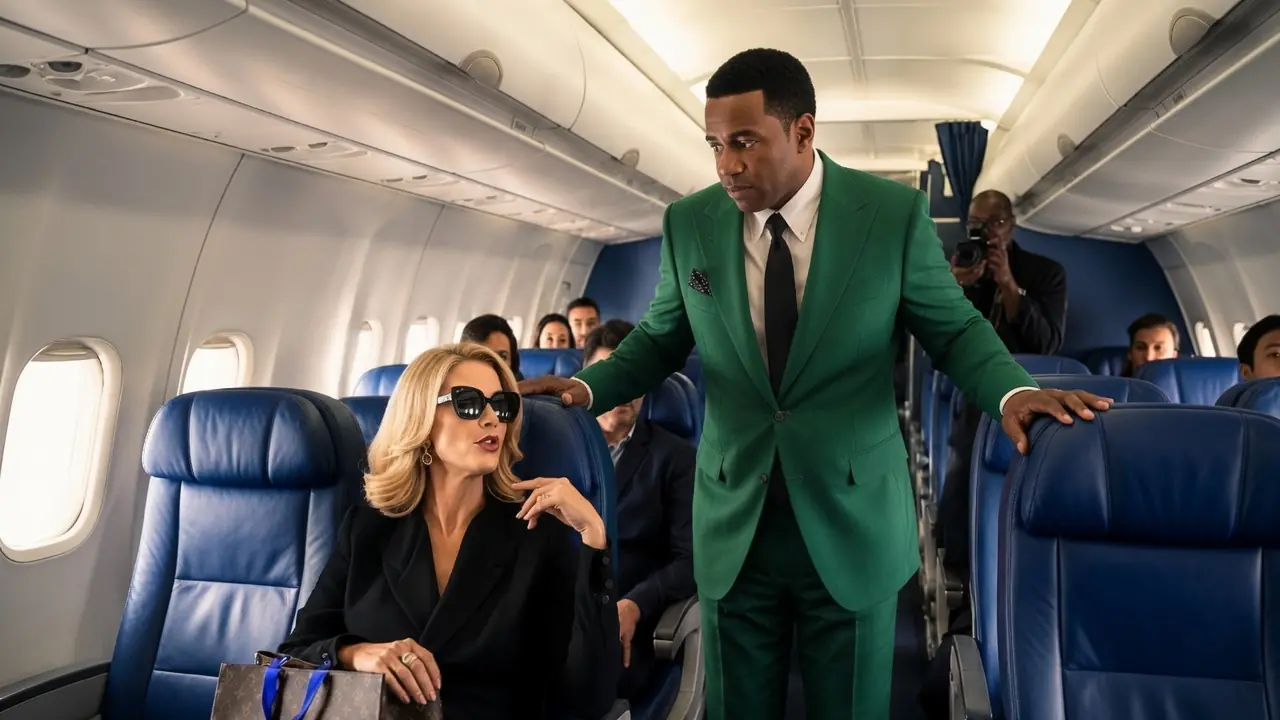
A flight attendant named Olivia Chen hurried forward from the galley. She was thirty-one, composed under pressure, and already carrying the exhaustion of a fully booked transcontinental departure. Catherine pointed at Malcolm before Olivia could greet either passenger. “Remove him,” she demanded. “He is harassing me over a seat that belongs to a Diamond Elite member.”
Malcolm handed Olivia his boarding pass without argument. It showed his name, the flight number, and the assignment 2A in clear black letters. Olivia scanned it with the handheld reader, and a green confirmation appeared immediately. She then asked Catherine for her boarding pass, but Catherine waved one manicured hand as if documentation were beneath her.
“I have flown this route every month for twelve years,” Catherine said. “Your station manager knows exactly who I am.”
“Your boarding pass, please,” Olivia repeated.
Catherine finally removed a folded document from her monogrammed handbag. The printed assignment said 4C, a first-class aisle seat two rows behind Malcolm’s position. Someone had crossed out the number in blue ink and written 2A beside it. At the bottom appeared a handwritten notation: EXECUTIVE COURTESY OVERRIDE—R. COLE.
Olivia studied the note. “Ma’am, handwritten seat changes are not valid after boarding begins.”
“Richard Cole approved it personally.”
Malcolm’s eyes sharpened at the name. Richard Cole was American Royal Airlines’ senior station director at JFK, responsible for gate operations, passenger upgrades, and ground-security coordination. He was also one of three executives Malcolm had placed under quiet review after auditors discovered unexplained first-class seat overrides. Catherine had just connected herself to the investigation without realizing it.
Olivia requested assistance from the purser, a veteran cabin manager named Teresa Morgan. Teresa arrived, examined both boarding passes, and asked Catherine to move to 4C. Catherine refused again, declaring that her loyalty status entitled her to any available seat within the cabin. When Teresa explained that 2A was not available, Catherine looked Malcolm up and down and laughed.
“You expect me to believe someone dressed like that purchased the most protected seat in the cabin?” she said. “He probably found that pass in the lounge.”
Several passengers raised their phones. Malcolm noticed a photographer standing near the rear curtain, but the man was not a tourist. He was part of the independent compliance team Malcolm had placed on the flight to document how employees handled elite-passenger pressure. Malcolm had boarded without an entourage because he wanted to observe the airline as an ordinary customer would experience it.
He had not expected the audit to begin with his own seat.
Malcolm Grant had spent thirty-two years in commercial aviation. He began as a baggage handler at Newark, completed night classes in operations management, and eventually became a regional logistics director known for repairing failing routes. Twenty years later, he led an investor group that rescued American Royal Airlines from bankruptcy. He now served as chairman, chief controlling shareholder, and the final authority over every executive whose decisions shaped the company.
He rarely announced that authority while traveling. Malcolm believed an airline revealed its character when employees thought no powerful person was watching. He sat in economy on short routes, stood in ordinary security lines, and visited maintenance facilities without advance notice. The burnt-orange suit was not a costume; it was simply what he had worn after attending an aviation-investment conference that morning.
Catherine interpreted visibility as vulnerability.
“Security is waiting at the jet bridge,” she told Olivia. “Call them before this man becomes violent.”
Malcolm had not raised his voice or touched her. He stood with both hands visible and left enough room for passengers to pass behind him. The accusation was deliberate, designed to transform his refusal to surrender the seat into a threat requiring force. Olivia recognized the tactic and did not repeat Catherine’s language over the radio.
Instead, she contacted the gate and requested a boarding-record verification.
The answer arrived thirty seconds later. Richard Cole himself spoke through her earpiece, instructing the crew to “honor the executive courtesy upgrade” and relocate Malcolm to any remaining business-class seat. He never asked whose name appeared on the valid boarding pass. He did not know Malcolm was standing in the aisle listening.
“Put him on speaker,” Malcolm said.
Olivia hesitated, but Teresa nodded.
Richard’s irritated voice filled the first-class cabin. “Move the displaced passenger now. Mrs. Whitmore’s relationship with this airline is worth more than one seat complaint.”
Malcolm looked directly at Catherine. Her confident smile returned.
“Richard,” Malcolm said, “identify the executive who authorized you to override a confirmed first-class assignment.”
Silence answered.
Richard knew the voice.
“Mr. Grant?”
Catherine’s smile disappeared.
Malcolm stepped closer to Olivia’s handset. “Answer the question.”
Richard began speaking rapidly. He claimed Catherine had suffered repeated service failures and deserved special accommodation. He said the system had temporarily shown 2A as unoccupied, though the gate record already proved Malcolm’s boarding pass had been issued three weeks earlier. When Malcolm asked who entered the handwritten override, Richard stopped answering.
“Hold the aircraft at the gate,” Malcolm said. “Freeze every seat-change log connected to your credentials, and remain in your office until compliance arrives.”
Catherine removed her sunglasses. “Who exactly do you think you are?”
Malcolm turned toward her. “The person whose signature appointed Richard Cole.”
A quiet murmur moved through the cabin.
Teresa recognized Malcolm fully now. She straightened, not from fear but from the realization that the confrontation had become an executive investigation. Olivia’s handheld scanner displayed the private service code attached to Malcolm’s reservation. It identified him as BOARD CHAIRMAN—NO SPECIAL HANDLING UNLESS REQUESTED.
Catherine looked from the screen to Malcolm’s face. “You own American Royal?”
“I own enough of it to decide who represents it.”
Her posture changed, but not into apology. She immediately blamed Richard, saying he had pressured her to accept the seat and assured her the original passenger would be moved. Malcolm reminded her that she had insulted him before any employee spoke. She replied that the situation had been confusing and that her comments were being intentionally misinterpreted.
The compliance photographer lowered his camera and introduced himself as Aaron Bell, an outside aviation auditor. He had recorded the entire exchange from the moment Malcolm entered the cabin. Two passengers offered their own videos, including one that captured Catherine saying, “People like me get what we want.”
Catherine reached for her handbag. “I’m leaving this aircraft.”
Teresa stepped into the aisle. “You may leave, but your bag must remain until ground security confirms it contains no airline property.”
“That is absurd.”
Malcolm looked at the handwritten override. “Not when the passenger carrying it may be connected to unauthorized access to our reservation system.”
The aircraft door reopened. Three members of American Royal’s corporate compliance division boarded with airport security and the company’s general counsel, Nina Patel. Richard Cole arrived behind them, his face pale and his tie loosened. He tried to speak privately with Malcolm, but Malcolm refused to move the conversation away from the witnesses Richard had been willing to inconvenience.
Nina requested Catherine’s phone and boarding documents under the airline’s fraud-review terms. Catherine refused to surrender the phone, but she agreed to display her communication with Richard after airport security explained that the aircraft would not depart while the dispute remained unresolved. The messages showed far more than a favor involving one seat.
For eighteen months, Richard had been selling unapproved upgrades to wealthy passengers.
He used a restricted executive code designed for medical emergencies, security relocations, and board travel. Passengers paid him through consulting invoices, luxury gifts, event tickets, and transfers to a company owned by his brother. In exchange, Richard moved confirmed customers out of premium seats, removed legitimate passengers from oversold flights, and restored expired elite benefits.
Catherine was one of his largest clients.
Her messages showed that she had paid more than seventy thousand dollars to Richard’s brother’s company. She had received twelve unauthorized upgrades, waived change fees, lounge access for unregistered guests, and the restoration of Diamond Elite status after failing to meet the required travel threshold. On three occasions, families traveling for medical treatment had lost premium seats so Catherine and her companions could sit together.
The note beside Malcolm’s flight was especially direct.
Put me in 2A. If the original passenger complains, send him backward.
Catherine claimed she meant business class rather than economy. No one asked Malcolm where he should be moved before she insulted him, but the intention was clear. Richard had already changed the cabin map, and only Malcolm’s protected board-level reservation prevented the electronic transfer from completing.
Unable to alter the system, Richard wrote the false override by hand.
Nina ordered the aircraft’s passenger manifest preserved and requested a list of every reservation Richard had modified. Malcolm then addressed the first-class cabin. He apologized for the delay and told passengers they could disembark without penalty if they preferred another flight. No one left.
Catherine stood from 2A at last.
She tried to take her handbag, but security asked her to open it first. Inside were three unused lounge-access cards, a stack of handwritten upgrade certificates, and an American Royal employee tablet marked as missing from Richard’s office six months earlier. Catherine said Richard had loaned it to her so she could “manage travel more efficiently.”
The tablet still carried administrative access to passenger profiles.
Investigators later discovered that Catherine had searched the travel history of business rivals, tenants involved in lawsuits against her, and several public officials. She used private flight information to schedule surprise meetings, monitor negotiations, and determine when properties would be unattended. Richard had given her access because she promised to introduce him to investors who could fund a private aviation company.
The confrontation in seat 2A had exposed an internal data breach.
Richard was removed from the gate area and suspended immediately. Catherine was escorted off the aircraft while passengers watched in silence. As she reached the door, she turned toward Malcolm and accused him of humiliating her publicly over “a misunderstanding involving one chair.”
Malcolm answered without leaving the aisle.
“You were willing to humiliate a stranger for that same chair.”
The flight departed ninety minutes late. Malcolm finally sat in 2A, but he did not relax. He spent most of the journey reviewing the preliminary reservation logs with Nina through a secure tablet. Every search uncovered another passenger whose travel had been disrupted by Richard’s paid-access network.
One was an eighty-two-year-old woman moved away from her caregiver after Catherine demanded adjacent seats.
Another was a Black technology founder removed from first class after Richard claimed his payment failed, though the transaction had cleared weeks earlier. Catherine later posted a photograph from his seat and described the cabin as “properly arranged.” The passenger had filed a complaint, but Richard closed it himself.
A family traveling with a sick child had been separated because Catherine wanted an empty seat beside her handbag.
Malcolm’s anger deepened with every record. The problem was not that one arrogant passenger had mistaken him for someone powerless. The problem was that employees had built a system in which wealthy customers could purchase the power to treat ordinary travelers as obstacles.
Before landing in Los Angeles, Malcolm drafted the first emergency reforms.
No station manager could override a confirmed premium assignment alone. All executive courtesy changes required two independent approvals and an automatic notification to the displaced passenger. Handwritten overrides became invalid unless linked to a documented safety emergency.
Loyalty status changes would be reviewed externally.
Employees could no longer close complaints involving their own actions. Passenger-data searches would generate alerts, and private profiles could not be accessed without a recorded operational purpose. Anyone displaced because of Richard’s scheme would receive refunds, compensation, and restored travel benefits.
Malcolm also created a protected reporting channel for gate agents and flight attendants.
Olivia later admitted that several employees suspected Richard was abusing his authority. They remained silent because he controlled schedules, promotions, and international assignments. One agent who questioned Catherine’s upgrades had been transferred to baggage claims and denied overtime.
Malcolm reinstated the employee and placed her under whistleblower protection.
The investigation expanded across four airports. Richard had trained two other managers to use the override code and received a percentage of their payments. More than three hundred reservations had been altered without legitimate cause. Auditors traced nearly nine hundred thousand dollars in gifts, consulting fees, and hidden transfers.
Several passengers had been selected for displacement based on assumptions about who would complain effectively.
Richard’s private spreadsheet ranked travelers by “resistance risk.” Corporate executives, attorneys, politicians, and celebrities were considered dangerous to move. Elderly passengers, immigrants, young travelers, people using discount fares, and passengers with unfamiliar names were considered low risk.
Malcolm’s reservation had been marked incorrectly because he booked through his personal account rather than the board office.
Beside his name, Richard had written:
Unrecognized. Loud clothing. Likely upgraded through points. Move if needed.
The description became a central piece of evidence.
Richard had not merely failed to identify Malcolm. He had developed a system for deciding whose dignity carried the lowest cost. Catherine benefited because she understood exactly how that system worked and encouraged him to target passengers she believed would remain quiet.
Federal transportation investigators became involved after the stolen tablet revealed unauthorized access to protected passenger data. Richard and two managers faced charges related to fraud, bribery, identity misuse, and unlawful computer access. Catherine faced charges connected to the stolen device, illicit payments, and the use of private travel data for commercial advantage.
Her attorneys attempted to separate her insults from the larger crime.
They argued that rude behavior was not illegal and that she relied on Richard’s assurances. Prosecutors agreed that arrogance alone was not the offense. The payments, messages, private searches, and stolen employee tablet were.
At trial, the cabin recording played before the jury.
“Move along—first class isn’t for men who look like a circus act.”
Then came Richard’s message:
Mrs. Whitmore’s relationship with this airline is worth more than one seat complaint.
The prosecutor displayed the payment ledger beside passenger records showing who had been displaced for her comfort. Catherine’s status had not reflected loyalty to the airline. It reflected the amount she was willing to pay one corrupt executive.
Richard pleaded guilty and cooperated with investigators. He lost his aviation credentials and received a custodial sentence along with a restitution order. Catherine was convicted on several counts and permanently banned from American Royal Airlines after the criminal case concluded.
Her Diamond Elite account was erased before Flight 777 reached Los Angeles.
Malcolm refused suggestions that the airline advertise the incident as a heroic owner defending his seat. He rejected a marketing campaign built around the viral videos and instructed communications staff to focus on the passengers harmed by the scheme. He believed turning the confrontation into entertainment would reduce a systemic failure to one satisfying reversal.
American Royal published the audit.
The company admitted that senior employees had manipulated assignments, sold access, and ignored complaints. It contacted every affected passenger directly and did not require confidentiality in exchange for compensation. The transparency caused several difficult weeks of negative coverage, but bookings recovered after independent reviewers confirmed that the airline had implemented the promised controls.
Olivia Chen became part of a new cabin-integrity council.
Teresa Morgan helped rewrite conflict procedures so employees could verify documents without allowing status or intimidation to control the decision. Aaron Bell’s outside compliance firm conducted unannounced audits across the network.
A year later, Malcolm boarded Flight 777 again.
He wore a dark blue suit this time and carried the same leather portfolio he had brought on the previous trip. His seat was 2A. Olivia was working the cabin and greeted him exactly as she greeted every other passenger.
Before departure, a nervous young man approached and said his boarding pass also displayed 2A.
Olivia checked both records calmly.
The young man’s ticket was correct. Malcolm’s seat had been changed during an aircraft substitution, and the updated assignment was 3D. Malcolm thanked her, moved without complaint, and placed his bag beneath the new seat.
Several passengers recognized him and watched for a reaction.
There was none.
Owning the airline did not make every seat his.
The rules mattered most when they required something from the powerful.
After takeoff, Olivia brought Malcolm a folder containing the final restitution report. Every passenger identified in Richard’s network had been contacted. Most accepted compensation, while several chose to pursue separate legal claims.
On the final page was a photograph of the family with the sick child who had once been separated for Catherine’s empty seat. American Royal had flown them together for a follow-up medical appointment, this time without publicity.
Malcolm closed the folder.
The confrontation in 2A had gone viral because viewers enjoyed watching an arrogant passenger discover she had insulted the owner. Yet Malcolm remembered something different: the silence before anyone knew his name.
Catherine believed he did not belong because of the way he looked, while Richard believed his complaint would be inexpensive to ignore. Their mistake was not simply failing to recognize the man who controlled the airline.
Their mistake was believing respect should depend on recognition at all.