The white Gulfstream waited beneath the bright Virginia sky like something carved from light. Its polished fuselage reflected the private terminal, the concrete runway, and the neat row of black SUVs parked near the Sterling Aviation hangar. Ground crew moved around it with practiced efficiency, checking luggage doors, tire pressure, fuel numbers, and final departure paperwork while the aircraft stairs remained open beneath the forward cabin door. Everything was ready for the company’s new chief executive except for one fact almost nobody on the tarmac knew: she had already arrived.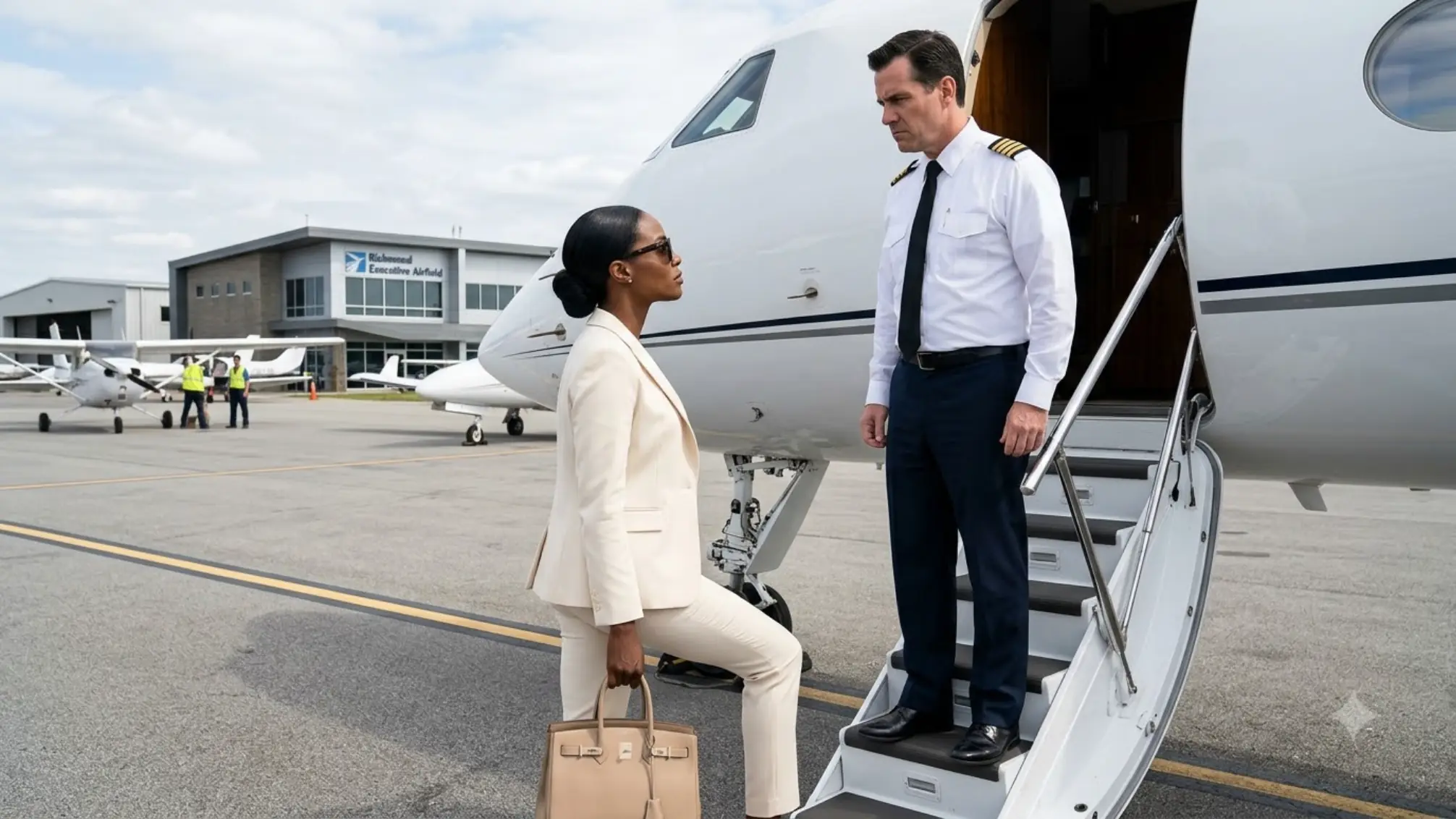
Sophia Sterling crossed the pavement without an entourage. At thirty-eight, she was an extraordinarily beautiful Black American woman with deep-brown skin, elegant high cheekbones, sharp intelligent eyes hidden behind dark designer sunglasses, and black hair arranged into a sleek low bun. Her cream tailored suit fit perfectly, her gold earrings were understated, and the beige handbag in her left hand looked expensive without demanding attention. She walked toward the jet as though she had done it a thousand times because, in one form or another, she had.
At the top of the stairs stood Captain Mark Dawson. Forty-seven years old, experienced, polished, and proud of both facts, Mark had built his professional identity around command. His white shirt was immaculate, his black epaulets displayed four gold stripes, and his shoes carried a shine more suited to an executive lobby than an airport apron. When he noticed Sophia approaching, his expression shifted almost immediately from professional neutrality to suspicion.
Flight attendant Ava Brooks noticed the change. She stood just inside the doorway wearing a fitted black uniform, her hands clasped neatly in front of her. Ava had been working for Sterling Aviation for six years, long enough to recognize the exact look on Mark’s face before he spoke. She also knew enough about Sophia Sterling to understand that the next sixty seconds could become very expensive for someone.
Mark descended one stair.
“Ma’am, this flight is private.”
Sophia stopped at the bottom.
“I know.”
Mark looked her over once, slowly enough that the judgment was impossible to miss but subtle enough that he could later call it a security assessment. He did not recognize her face. He did not see an executive badge. He saw an elegant Black woman arriving alone and decided that recognition mattered more than confirmation.
“Then you’re at the wrong aircraft.”
Sophia lowered her sunglasses just enough to look directly at him.
“I’m not.”
Ava’s shoulders tightened.
Mark smiled faintly. “Sterling Aviation executive flights are controlled access. If you’re here delivering documents or meeting someone, ground staff can help you.”
Sophia remained still.
“Delivering documents?”
Mark’s smile sharpened.
“Or whatever your employer sent you here for.”
Sophia stared at him for a long second.
“My employer.”
He mistook her calmness for embarrassment.
“I don’t have time for confusion, ma’am.”
Sophia looked past him toward the cabin.
“Neither do I.”
Mark stepped lower and blocked the stairs completely.
“Then step away from the aircraft.”
The ground technician standing near the nose looked up.
A luggage handler slowed.
Ava shifted one foot forward but stopped herself.
Sophia raised her chin.
“Are you refusing to let me board?”
“I’m protecting an aircraft that doesn’t belong to you.”
There it was.
Not a verification request.
Not a manifest check.
A conclusion.
Sophia reached into her handbag and removed her phone.
Mark’s expression hardened.
“Who are you calling?”
She unlocked the screen.
“What’s your full name?”
Mark hesitated.
Something in the question disturbed him for the first time.
“Captain Mark Dawson.”
Sophia selected one contact.
The call connected almost immediately.
“This is Sophia. Terminate Captain Mark Dawson’s flight assignment and suspend his Sterling credentials effective now.”
Mark blinked.
Ava closed her eyes for half a second.
Sophia listened.
“Yes. Right now.”
She ended the call.
Mark laughed once, but there was no confidence behind it.
“Excuse me?”
Sophia stepped toward the stairs.
He remained in place.
She looked at him.
“Move.”
Mark’s phone began vibrating inside his pocket.
Once.
Then again.
He pulled it out.
The screen showed three missed calls from Flight Operations.
His face changed.
Sophia walked past him.
Ava stepped aside immediately.
“Good morning, Ms. Sterling.”
Mark froze.
The name reached him before the meaning fully did.
Sterling.
Sophia Sterling.
Majority owner of Sterling Aviation.
Chairwoman of the board.
The woman who had spent the previous two years restructuring the company after her father’s death.
The executive whose photograph appeared in annual reports Mark rarely bothered reading because he cared more about flight operations than corporate leadership.
And the woman whose aircraft he had just told her did not belong to her.
“Ms. Sterling.”
Sophia turned.
Mark stood two steps below.
“I didn’t know.”
She removed her sunglasses completely.
“That’s exactly the problem.”
“I thought—”
“Yes.”
Her expression remained cold.
“You did.”
The jet door closed behind her.
Mark remained on the stairs holding his phone as another message appeared.
FLIGHT STATUS: REMOVED.
Then another.
REPORT TO OPERATIONS IMMEDIATELY.
Inside the cabin, Sophia placed her handbag on a cream leather seat and stared briefly through the window at the pilot outside. She had expected some version of this. She had not expected it to happen so quickly.
That was why she had arrived alone.
For eight months, complaints had been reaching her private corporate office. Some were anonymous. Others came through employees who had bypassed Human Resources because they believed normal channels were protecting senior staff instead of investigating them.
Different stories contained the same patterns.
Female executives questioned until male assistants confirmed their identity.
Passengers with accents asked for additional identification beyond company requirements.
Junior maintenance staff ridiculed for slowing flights with technical concerns.
Flight attendants punished through scheduling after reporting pilots.
One name appeared repeatedly.
Mark Dawson.
Ava remained near the galley.
Sophia turned toward her.
“How long?”
Ava swallowed.
“With Mark?”
“With all of it.”
The younger woman glanced toward the closed door.
“Years.”
Sophia’s jaw tightened.
Ava continued carefully.
“People complained. They just stopped believing anything would happen.”
“Why?”
“Because every complaint ended with someone saying Captain Dawson had excellent client reviews.”
Sophia leaned one hand against the seat.
“And you?”
Ava hesitated.
Sophia immediately understood.
“You filed one.”
Ava nodded.
“Last year.”
“What happened?”
“My international routes disappeared.”
Sophia looked at her sharply.
“They said scheduling needs changed. Then Mark told two other crew members I wasn’t suited for high-value clients because I was ‘too sensitive.’”
“Who signed the schedule?”
Ava looked toward the cockpit.
“Gordon Vale.”
Sophia knew the name well.
Vice President of Flight Operations.
Twenty-one years with the company.
Trusted by Sophia’s late father.
Protected by directors who described him as “old-school but effective.”
Sophia opened her handbag and removed a thin folder.
Ava’s eyes dropped to it.
“You already knew?”
“I knew enough to come.”
Sophia sat.
“I didn’t know enough to act.”
Ava looked toward the windows.
“And now?”
Sophia opened the folder.
“Now I know Mark behaves exactly the way the complaints described when he thinks the person in front of him has no power.”
Ten minutes later, the aircraft stairs reopened.
Sophia walked down first.
Ava followed.
Mark was standing beside two security employees near the bottom. His captain’s hat had disappeared, and the authority in his posture had gone with it.
Across the tarmac, Gordon Vale hurried from the terminal.
He was fifty-eight, silver-haired, neatly dressed in a navy business suit and red tie. His expression wore the carefully controlled urgency of a senior executive arriving to contain something before it became public.
“Sophia.”
She stopped.
“Chairwoman Sterling.”
Gordon’s step faltered.
Then his smile returned.
“Of course. Chairwoman Sterling.”
Mark turned toward him with visible relief.
“Gordon, I didn’t know it was her.”
Sophia looked at Mark.
“You keep saying that like it makes the situation better.”
His mouth closed.
Gordon raised one hand.
“This appears to be an unfortunate misunderstanding.”
“No.”
Sophia’s answer came immediately.
“He understood perfectly. He decided I did not belong.”
Gordon lowered his voice.
“Mark made a security judgment.”
“Without checking the manifest.”
Gordon glanced toward the jet.
Sophia continued.
“Without calling dispatch.”
Silence.
“Without asking ground operations.”
Mark looked down.
Sophia stepped closer.
“He looked at me and decided.”
Gordon sighed.
“Then we correct the protocol.”
Sophia almost smiled.
“Did Ava Brooks file a complaint about Captain Dawson?”
The question struck harder than Gordon expected.
His eyes flicked toward Ava.
“All concerns are processed through—”
“That wasn’t my question.”
He paused.
“Yes.”
“And afterward, did her international schedule disappear?”
“Crew allocation changes constantly.”
“So yes.”
“I didn’t say that.”
“You didn’t have to.”
Gordon’s expression hardened.
“This is an operational issue, Sophia.”
“Chairwoman Sterling.”
His nostrils flared.
“Chairwoman Sterling, terminating a captain on the tarmac over one misunderstanding is emotional management.”
Ava went still.
Mark looked toward Gordon.
Sophia stared at him.
“Emotional.”
Gordon realized the word had landed badly.
“That’s not what I meant.”
“It’s exactly what you meant.”
She opened the folder.
“But Mark Dawson isn’t why I came.”
For the first time, Gordon looked genuinely worried.
Sophia removed a maintenance report.
“Tail number N804SX.”
Mark’s head turned.
Gordon did not move.
“Last month, junior mechanic Luis Ortega reported irregular fuel-pressure readings during a ground test.”
Gordon’s voice dropped.
“That matter was resolved.”
Sophia held his gaze.
“No. It was reclassified.”
The nearest mechanics stopped working.
Ava’s face changed.
She had been aboard N804SX two weeks earlier.
Sophia continued.
“Luis escalated twice.”
Nobody spoke.
“A maintenance supervisor agreed the aircraft needed an extended inspection.”
She turned a page.
“Operations overruled the delay.”
Gordon shook his head.
“The aircraft passed minimum release requirements.”
“After the original warning was downgraded from maintenance discrepancy to monitoring note.”
Mark spoke for the first time.
“Gordon told us engineering cleared it.”
Gordon turned sharply.
“Mark.”
Sophia looked between them.
“There it is.”
Mark swallowed.
Sophia handed Ava the first page.
“Two weeks later, the same aircraft experienced another pressure fluctuation en route to Denver.”
Ava stared at the report.
Her face drained.
“That was our flight.”
“Yes.”
“We were told it was turbulence.”
Sophia nodded.
“The cabin was told that.”
Ava looked at Mark.
Mark stared at Gordon.
The entire power structure on the tarmac shifted without anybody moving physically.
Gordon adjusted his jacket.
“You’re drawing conclusions from partial information.”
Sophia removed another document.
“Here’s the full information.”
Gordon did not take it.
Sophia read.
“Internal Operations message: ‘Avoid grounding N804SX during the executive travel period unless pressure variation exceeds mandatory limit.’”
Mark’s mouth opened.
Gordon’s face hardened.
Sophia continued.
“Another message: ‘Junior mechanic appears inexperienced and overly cautious.’”
A mechanic near the hangar whispered something under his breath.
Sophia looked toward Gordon.
“Luis Ortega had identified the issue correctly.”
Gordon said nothing.
“And somebody decided protecting the schedule mattered more than listening to him.”
“It was never unsafe.”
Sophia’s voice sharpened.
“You don’t get to redefine safety after ignoring the person who warned you.”
Two black SUVs entered the tarmac.
The sight of them silenced even the ground crew.
They stopped beside the hangar.
Three people stepped out.
Sterling Aviation general counsel Rebecca Vaughn.
Independent aviation investigator Thomas Reed.
And an FAA safety liaison who had been quietly briefed by Sophia’s office the previous week.
Gordon took one step backward.
“You involved the FAA?”
Sophia looked toward him.
“I involved people whose job does not depend on keeping you comfortable.”
Rebecca approached carrying a document case.
“Chairwoman.”
Sophia nodded.
“Begin credential collection.”
Mark looked up.
“What?”
Sophia turned toward security.
“Captain Dawson’s company flight credentials.”
Mark’s face reddened.
“And Mr. Vale’s facility access pending investigation.”
Gordon’s voice became sharp.
“You cannot suspend me based on an allegation.”
Sophia opened the folder again.
“I’m suspending you based on documented retaliation complaints, altered maintenance classifications, witness statements, internal communications, and an active independent safety review.”
Gordon looked around.
The ground crew was watching.
So were mechanics.
A dispatcher stood frozen beside a cart.
“This is not the place.”
Sophia’s expression became almost calm.
“This is exactly the place.”
She pointed toward the jet.
“Beside the aircraft.”
Then toward the employees.
“In front of the people your department taught to believe that challenging senior authority could cost them their careers.”
Gordon’s jaw tightened.
Sophia continued.
“My father had a rule.”
Everyone listened.
“He said aviation works only when the lowest-ranking person in the room can stop the highest-ranking person from making a fatal mistake.”
A mechanic lowered his head.
Sophia looked at Gordon.
“You built a department where raising a concern became a career risk.”
“That is an exaggeration.”
Ava stepped forward.
“No.”
Every head turned.
Her voice trembled, but she continued.
“I reported Captain Dawson.”
Gordon looked toward her.
“Your scheduling decision was unrelated.”
“You told me privately that executive crews needed people who could ‘handle personalities.’”
Silence.
Ava continued.
“You removed me from three international routes within the same month.”
Gordon glanced toward Rebecca.
The general counsel was writing.
Mark looked increasingly sick.
Sophia turned toward him.
“You signed N804SX’s readiness statement.”
He swallowed.
“Operations told me maintenance had cleared it.”
“Did Luis warn you directly?”
Mark looked down.
Sophia waited.
“Yes.”
“What did he say?”
“That he wasn’t comfortable with the pressure behavior.”
“And what did you tell him?”
Mark remained silent.
A mechanic near the hangar looked toward him.
Sophia’s eyes narrowed.
“What did you tell him?”
Mark finally answered.
“I said he needed to stop trying to impress people by finding problems.”
Ava closed her eyes.
Sophia stared at him.
“And you still think the problem today was that you didn’t recognize me.”
Mark’s face broke.
“Ms. Sterling, I’m a good pilot.”
Sophia nodded once.
“Maybe.”
Hope returned to his eyes for half a second.
Then she finished.
“But you were a bad captain.”
That hurt him more than being fired.
His entire identity depended on the difference.
A pilot could manipulate controls.
A captain carried responsibility for every person aboard and every warning beneath him.
Mark had understood authority.
He had not understood stewardship.
The FAA liaison approached Gordon.
“Mr. Vale, we need your cooperation with document preservation.”
Gordon stared at Sophia.
“You’re going to damage this company publicly.”
Sophia answered without hesitation.
“No.”
She looked toward the jet.
“I’m going to find out how badly you already damaged it privately.”
The investigation expanded within forty-eight hours.
Sophia ordered independent preservation of maintenance records, crew scheduling changes, safety reports, internal complaints, text messages, and operations directives going back three years. She removed herself from direct decisions involving individual disciplinary findings so investigators could not later claim the process existed only to justify what happened on the tarmac.
The findings were worse than she expected.
Mark Dawson had accumulated eleven complaints.
Six involved behavior toward crew.
Three involved passengers.
Two involved maintenance staff.
None had produced significant discipline.
In one incident, Mark questioned a female corporate attorney boarding with an executive group until another male passenger vouched for her. Human Resources classified the matter as a “communication issue.”
Another complaint came from an Indian-American technology founder whose assistant had been welcomed aboard before Mark questioned whether the founder himself belonged on the manifest.
Again, no discipline.
The most important cases involved maintenance.
Luis Ortega had not been the only junior employee whose warnings disappeared.
Three separate mechanics described pressure to avoid delays during high-profile client periods.
One wrote in an internal message:
Sometimes it feels like the aircraft has to prove something is broken before Operations believes us.
Sophia read that line three times.
Aircraft did not get second chances because executives preferred schedules.
She ordered all questionable tail numbers reviewed immediately.
Two jets were voluntarily grounded for extended inspection.
The cost was enormous.
Sophia approved it without negotiation.
Some board members resisted.
During an emergency meeting, director Charles Whitmore leaned toward the conference table.
“We are burning millions because of reputational panic.”
Sophia looked at him.
“No.”
She pushed the independent report across the table.
“We are spending millions because people responsible for aviation safety confused inconvenience with loss.”
Charles frowned.
“Our clients expect reliability.”
“Reliability without safety is theater.”
Another director spoke.
“We need to control the narrative.”
Sophia shook her head.
“That phrase is how we got here.”
“What do you propose?”
“The truth.”
The room became uncomfortable.
Sophia continued.
“We tell clients what happened.”
Several directors objected immediately.
She waited.
Then said, “If we believe transparency destroys Sterling Aviation, then Sterling Aviation deserves to be destroyed.”
Nobody responded.
The public announcement came one week later.
Sophia stood inside the private terminal where Gordon had once planned to greet her after departure.
No sunglasses.
No carefully manufactured corporate slogan behind her.
Just the Sterling Aviation logo.
Reporters filled the room.
Sophia explained that an internal investigation had uncovered failures involving employee retaliation, maintenance escalation, passenger treatment, and management oversight.
A reporter shouted, “Were passengers placed in danger?”
The communications director standing beside the stage visibly tensed.
Sophia answered.
“Yes.”
Pens stopped.
Cameras moved.
Another reporter called, “How serious?”
“We are still determining that.”
“Did Sterling Aviation knowingly fly unsafe aircraft?”
Sophia paused.
“We found instances in which valid maintenance concerns were minimized or reclassified in ways that should not have occurred.”
“Was anybody injured?”
“No.”
“Then why call passengers endangered?”
Sophia looked directly toward the reporter.
“Because safety is not measured by whether the worst outcome happened.”
That quote traveled nationally.
The board hated it for three days.
Then something unexpected happened.
Clients began calling.
Not to cancel.
To ask what Sterling Aviation was changing.
Corporate safety departments requested briefings.
Insurance partners demanded documentation but praised the independent review.
Employees submitted additional testimony.
The company’s short-term image took damage.
Its long-term credibility began recovering.
Gordon Vale resigned before termination proceedings concluded.
He denied intentionally endangering anyone but admitted that operational pressure had influenced how certain concerns were handled.
Three managers were removed.
Two supervisors received formal discipline.
Human Resources leadership was restructured after investigators discovered that repeated complaints involving high-performing employees had been downgraded because managers feared losing experienced personnel.
Mark Dawson appealed his termination.
Sophia did not interfere.
An independent committee reviewed his case.
The termination stood.
His technical flying record had been strong.
His command record had not.
Ava Brooks received an unexpected phone call two months later.
Sophia asked her to come upstairs.
Ava entered the executive office looking nervous.
Sophia handed her a folder.
“What’s this?”
“Director of Cabin Safety and Crew Advocacy.”
Ava stared.
“You’re promoting me?”
“I’m asking if you want the job.”
“I’m a flight attendant.”
“You’re an experienced crew member who understands exactly where our reporting culture failed.”
Ava remained stunned.
Sophia continued.
“You would not report through Flight Operations.”
“To whom?”
“Independent Safety.”
Ava looked down at the offer again.
“You trust me with that?”
Sophia smiled faintly.
“You tried telling us the truth when it cost you something.”
Ava’s eyes filled slightly.
“That’s the qualification I care about.”
Luis Ortega received a different promotion.
Not management.
He did not want it.
Instead, Sophia helped create an independent technical escalation desk and asked Luis to become one of its first lead inspectors. Any licensed mechanic could now request a secondary safety review without approval from flight operations.
No pilot could cancel it.
No scheduling manager could quietly downgrade it.
A delayed flight became an inconvenience.
A buried warning became misconduct.
Sophia introduced another change after thinking repeatedly about her own confrontation.
Manifest verification became standardized.
No employee could reject or delay a passenger based simply on recognition.
No assumptions about clothing.
No assumptions about race.
No assumptions about gender.
No assumptions about who looked wealthy enough.
Check the manifest.
Verify identity.
Treat everyone professionally.
Sophia explained the change during pilot training.
A senior captain raised his hand.
“Doesn’t this remove command discretion?”
“No.”
“Then where is the line?”
Sophia walked toward him.
“Discretion begins after facts.”
The captain listened.
“It does not replace facts.”
A year passed.
Sterling Aviation did not collapse.
It became smaller for several months because Sophia intentionally reduced flight volume while maintenance systems were rebuilt.
Then business returned.
Aviation publications that originally criticized the scandal later covered the reforms.
Sophia avoided portraying herself as the hero.
She disliked that version of the story.
When interviewers asked about the famous moment on the stairs, they usually focused on Mark discovering she owned the company.
Sophia redirected them.
“My ownership was never the important part.”
One journalist frowned.
“But that’s why he lost his job.”
“No.”
Sophia shook her head.
“He lost his job because of how he behaved when he believed I had no power.”
That became the real lesson.
One year after the confrontation, Sophia returned to Richmond Executive Airfield on another bright afternoon.
The same white jet waited near the terminal.
The stairs were open.
Ava, now wearing the badge of Director of Cabin Safety, stood beside Sophia near the hangar.
A young woman approached the aircraft.
Nineteen years old.
Jeans.
College sweatshirt.
Worn backpack.
She looked nothing like Sterling Aviation’s typical billionaire clientele.
At the bottom of the stairs stood a new captain.
He smiled professionally.
“Good afternoon. Name, please?”
“Isabella Ortega.”
The pilot checked his tablet.
His expression brightened.
“Welcome aboard, Ms. Ortega.”
He stepped aside.
No hesitation.
No judgment.
No question about who she worked for.
Isabella was Luis Ortega’s daughter.
She was flying to Washington as the first recipient of the Nathaniel Sterling Aviation Safety Scholarship, created for children of maintenance, ground, and cabin employees pursuing aviation careers.
Isabella turned before boarding.
Luis stood near the hangar.
He was trying very hard not to cry.
She ran back and hugged him.
Sophia smiled.
Ava looked toward her.
“You planned this flight yourself, didn’t you?”
“Maybe.”
“You’re sentimental.”
“Don’t spread that around.”
Isabella climbed the stairs.
The door closed.
The aircraft prepared to taxi.
Ava watched it.
“Do you ever think about Mark?”
Sophia remained quiet for a moment.
“Yes.”
“Do you regret firing him on the tarmac?”
Sophia considered the question carefully.
“No.”
Then she added, “I regret that our company allowed him to become convinced that behavior was normal.”
Ava nodded.
“That’s worse.”
“It is.”
The engines increased power.
Sophia looked toward the moving jet.
Her father, Nathaniel Sterling, had started the company with one leased aircraft after leaving public aviation service decades earlier. He had believed private aviation should be safer precisely because clients expected more, not because wealthy people deserved better treatment than everyone else.
Somewhere along the way, luxury had distorted that idea.
Employees began confusing expensive customers with superior human beings.
Pilots became celebrities inside small corporate worlds.
Executives protected high performers.
Staff learned which complaints were worth the career risk.
Sophia had inherited an airline company worth billions.
The harder inheritance had been the culture hidden inside it.
She watched Isabella’s jet taxi toward the runway.
A year earlier, Sophia herself had approached those stairs and heard:
This aircraft is private.
The pilot believed those words gave him authority.
The mistake was not that he failed to recognize her.
It was that he believed recognition should determine respect.
Sophia had spent the following year trying to remove that idea from Sterling Aviation.
Not completely.
Cultures never changed completely in twelve months.
There were still complaints.
Still mistakes.
Still managers who needed correction.
But employees now saw complaints investigated.
Mechanics saw aircraft grounded when evidence supported them.
Flight attendants knew retaliation could end a supervisor’s career instead of their own.
And passengers were verified by information rather than appearance.
The Gulfstream accelerated down the runway.
Sophia watched until the wheels lifted.
Ava smiled.
“Nathaniel would have liked that.”
Sophia looked toward her.
“The scholarship?”
“No.”
Ava nodded toward the departing aircraft.
“Luis Ortega’s daughter walking onto a Sterling jet while everyone treated her like she belonged there.”
Sophia’s eyes softened.
“Yes.”
She looked back toward the sky.
“He would.”
They stood silently for another moment.
Then Sophia’s phone vibrated.
A board meeting reminder.
She sighed.
Ava laughed.
“Back to owning the sky?”
Sophia picked up her handbag.
“No.”
She began walking toward the terminal.
“That was Mark’s mistake.”
Ava followed.
“He thought somebody had to own the sky.”
Sophia looked once more toward the aircraft disappearing into the distance.
“People only get trusted to move through it safely.”
And somewhere inside that simple distinction was everything Sterling Aviation had nearly forgotten.
Authority was not ownership.
Command was not superiority.
Respect was not a reward reserved for people with recognizable faces, expensive titles, or powerful names.
Sophia Sterling had already owned the jet when Mark Dawson blocked her from boarding.
She already controlled his contract.
She already chaired the company.
None of those things created her right to be treated with dignity.
They only exposed how quickly his behavior changed once he realized she could punish him.
That was why Sophia never framed the incident as revenge.
Mark had not been fired because he insulted the wrong woman.
He had been fired because the company finally discovered what happened when he believed he was insulting someone who could not fight back.
And that difference changed Sterling Aviation long after the private jet disappeared beyond the Virginia horizon.