Lieutenant Warren Mercer noticed the medals before he noticed the woman wearing them.
Three small decorations hung against the left side of Maya Williams’s dark formal jacket, each suspended from a narrow ribbon and aligned with the almost irritating precision of someone who believed details mattered.
Mercer stared at them as she entered his office.
Then he looked at her face.
Maya was fifty-eight years old, Black American, slim, composed, and unusually difficult to read. Her deep-brown skin showed fine lines at the corners of intelligent dark eyes, and her black hair was pulled neatly away from her face into a low knot.
She carried no handbag.
No stack of legal papers.
No attorney.
Only a dark folder tucked beneath one arm.
Mercer leaned back in his chair.
“You lost?”
Maya looked at the gold nameplate on his desk.
LT. WARREN MERCER
Then she looked back at him.
“I was told Lieutenant Mercer handles vehicle seizures.”
“That depends who’s asking.”
“Maya Williams.”
Mercer waited.
Maya waited too.
The silence irritated him.
“Am I supposed to know that name?”
“No.”
That answer irritated him more.
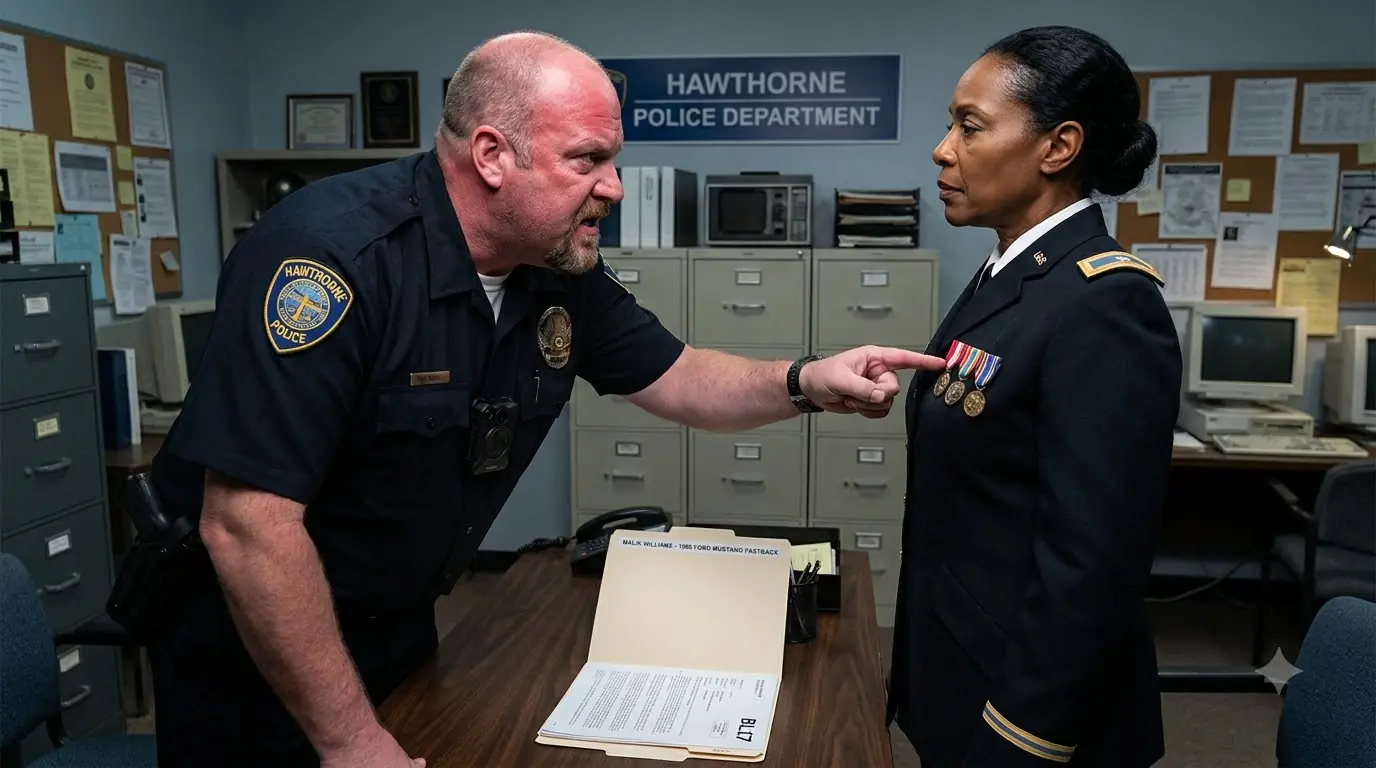
Mercer was fifty-five, white American, bald except for a thin shadow around the sides of his head, with a thick dark goatee beginning to gray beneath his lower lip. Years of lifting weights had left his arms enormous beneath the short sleeves of his dark navy command uniform.
He had spent twenty-seven years in Hawthorne Police Department.
Thirteen as lieutenant.
He ran property enforcement, evidence intake, traffic interdiction, and what the department called the Special Vehicle Compliance Unit.
In practical terms, very little involving a seized vehicle entered Hawthorne’s fenced impound lot without eventually passing through Warren Mercer’s hands.
That morning Maya had come because one of those vehicles belonged to her family.
A 1968 Ford Mustang Fastback.
Dark Highland green.
Black interior.
Four-speed transmission.
Original steering wheel.
Recently rebuilt engine.
The car had belonged to Maya’s late husband, Henry.
After Henry died, ownership transferred into a family trust.
Her daughter drove it for years.
Then the car passed to Maya’s grandson, Malik Williams, when he turned twenty.
Malik had spent almost every Saturday of his teenage years working on the Mustang.
He knew every sound it made.
Every vibration.
Every place the old weather stripping leaked when it rained.
Three days earlier, Officer Caleb Norton had stopped him on Briar County Road for what the citation described as an “obscured rear registration.”
The plate was visible.
Malik had photographed it fifteen minutes before leaving home because he had washed the car.
That was not what concerned Maya most.
The stop had changed.
The officer asked where Malik bought the Mustang.
Malik explained it belonged to a family trust.
The officer asked whether he had proof.
Malik showed digital insurance.
Registration.
A photograph of the title packet.
The officer then claimed one dashboard VIN character appeared inconsistent with state records.
A second unit arrived.
Then a third.
Forty-nine minutes later, Malik stood on roadside watching a private tow truck carry away the car his grandfather had spent eleven years restoring.
No arrest.
No accusation of theft.
No criminal charge.
Just a property hold pending verification.
Malik called Maya.
He was angry.
Not frightened.
That mattered to her.
Fear could make people exaggerate.
Anger could too.
So Maya did what she always did.
She asked questions.
“What exactly did the officer say?”
“He said the VIN looked wrong.”
“What looked wrong?”
“He wouldn’t tell me.”
“Did you consent to search?”
“No.”
“Did they search?”
“They looked through the windows and opened the hood after the tow driver came.”
“Who opened it?”
“I don’t know.”
“Was your phone recording?”
“Some of it.”
“Save the original.”
“I already did.”
“Do not edit it.”
“I know.”
“Upload a copy somewhere else.”
“Grandma.”
“Do it.”
He sighed.
“Yes, ma’am.”
Maya called the state motor vehicle office next.
The Mustang’s VIN matched.
No stolen record.
No title alert.
No lien.
No ownership discrepancy.
She called Hawthorne Police Department.
The desk clerk said the vehicle remained on investigative hold.
Reason?
“Documentation review.”
By whom?
“Special Vehicle Compliance.”
When would review end?
“No projected release.”
Who authorized hold?
“Lieutenant Mercer.”
That brought Maya to the station.
Mercer glanced again at her medals.
“What agency are you pretending to be with?”
Maya’s face did not change.
“I didn’t say I was with an agency.”
“You walked into my building dressed like that.”
“Like what?”
He pointed toward her chest.
“That.”
Maya looked down briefly.
Her jacket was part of a formal state public-service uniform used during ceremonies and official recognition events. She had come directly from a governor’s civic-integrity luncheon where she had spoken about public procurement oversight.
The three medals were legitimate public-service decorations.
One for government fraud prevention.
One for public records reform.
One for twenty-five years of distinguished civil service.
They carried no arrest authority.
Maya had never claimed otherwise.
She looked back at Mercer.
“You’re concerned about my clothing?”
“I’m concerned about people using costumes to create authority they don’t have.”
Maya’s eyebrows lifted slightly.
“Do you believe I’ve claimed police authority?”
“No.”
“Then what authority am I pretending to have?”
Mercer leaned forward.
“You tell me.”
“I came to ask about a car.”
“That jacket says otherwise.”
Maya glanced at the closed office door.
Then the desk.
Then his body camera.
Not active.
There was no requirement for it to be active during routine administrative conversation inside his office.
Still, she noticed.
She noticed everything.
“I’m here about a 1968 Mustang seized Saturday from Malik Williams.”
Mercer’s expression changed a fraction.
Recognition.
Then disappeared.
“Vehicle’s under review.”
“For what?”
“VIN irregularity.”
“What irregularity?”
“Active matter.”
“State database shows no irregularity.”
“Then state database doesn’t show everything.”
Maya placed her folder on desk.
“May I see the seizure authorization?”
“No.”
“Property receipt?”
“Your grandson has one.”
“He has a tow inventory slip.”
“That’s receipt.”
“No.”
Mercer’s eyes narrowed.
Maya continued.
“The slip has no allegation number, no evidence seal, no inventory certification, and no statutory basis for continued hold.”
“You a lawyer?”
“No.”
“Then don’t practice law in my office.”
Maya almost smiled.
“I’m not.”
“What are you?”
“Someone asking why your department is holding property that the state says is clean.”
Mercer leaned back.
“Here’s how this works.”
Maya waited.
“We investigate first.”
“You wait.”
“When we finish, somebody contacts owner.”
“How long?”
“As long as needed.”
“Under what authority?”
Mercer exhaled loudly.
“There it is.”
“What?”
“You people always come in here thinking if you use the word authority enough times, somebody gets nervous.”
Maya became very still.
“You people?”
Mercer recognized the phrase had landed.
He waved a hand dismissively.
“People who think paperwork runs police work.”
Maya looked at him for several seconds.
“Paperwork is police work when you seize property.”
Mercer pushed his chair back.
“You came in looking for argument.”
“No.”
“Sure sounds like it.”
“I asked for the legal basis of a seizure.”
“And I told you it’s under investigation.”
“That describes status.”
“It doesn’t identify basis.”
Mercer stood.
He was much larger than Maya.
Perhaps he expected that to matter.
It did not.
He stepped around the desk.
His finger moved toward the three medals.
“What are those, anyway?”
“Public-service awards.”
“For what?”
“Work.”
“What kind of work?”
“Government accountability.”
Mercer laughed.
That laugh told her more than the words.
“Of course.”
Maya tilted her head.
“What does that mean?”
“Means you people who sit behind desks always think you know how actual enforcement works.”
Again.
You people.
This time he did not correct himself.
Maya said:
“I’ve spent more than thirty years reviewing government systems.”
“That supposed to impress me?”
“No.”
“Then why wear medals in here?”