“Kneel down, old man—this is what happens when you challenge my badge.”
Officer Grant Keller squeezed the metal nozzle with both hands, sending another violent stream of water into Thomas Hale’s chest. The pressure drove the fifty-eight-year-old homeowner backward across his carefully trimmed lawn, but Thomas refused to fall. His pale-blue polo clung to his body, his beige trousers were soaked to the knees, and water ran from his short gray hair into eyes that remained fixed on the officer.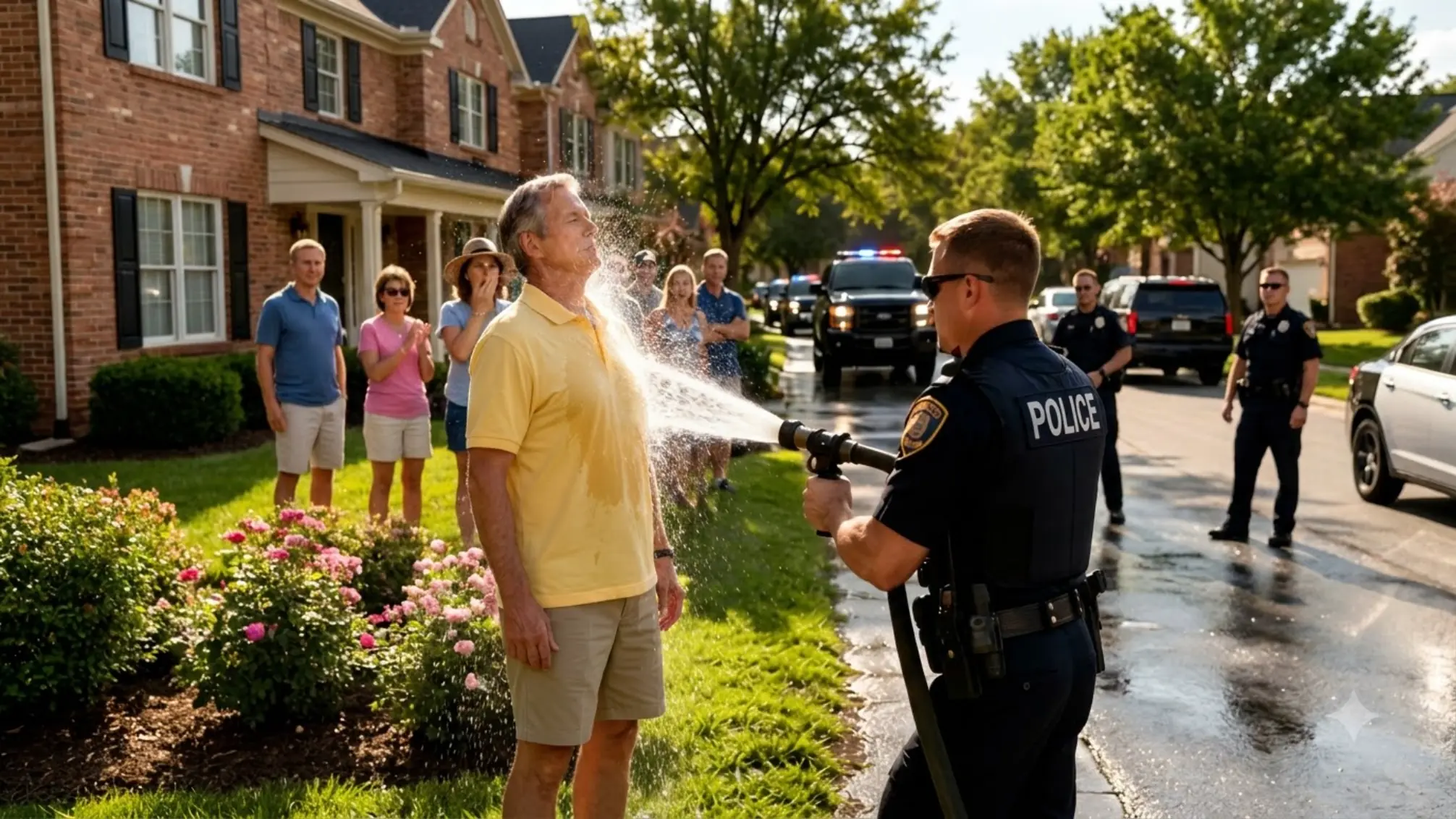
“You entered my property without a warrant and assaulted me in front of witnesses,” Thomas said.
Grant moved closer, his black patrol boots sinking into the wet grass. Behind his sunglasses, the forty-one-year-old officer wore the confident smile of a man who believed the uniform would become the only version of events anyone trusted. “I’ll write the report,” he said. “And everyone here will believe me.”
Thomas wiped water from his face and looked toward the end of the street.
Four black SUVs had turned into Hawthorne Ridge.
“Then make it convincing,” he said. “The state investigators recording you just reached the corner.”
Grant’s smile disappeared.
The SUVs moved slowly between the large brick houses, their dark windows reflecting the afternoon sun. Red-and-blue lights flashed behind their grilles, but no sirens announced their arrival. Neighbors who had gathered along the sidewalk stepped away from the street as the vehicles approached Thomas’s driveway.
Grant released the nozzle.
The stream died against the grass.
“What investigators?” he demanded.
Thomas did not answer immediately. He looked down at the small black phone lying beneath the covered porch chair, positioned where Grant had not noticed it. The call timer remained active. A tiny microphone icon showed that every threat had been transmitted live.
Grant followed his gaze.
He dropped the hose.
Thomas Hale had lived in Hawthorne Ridge outside Richmond, Virginia, for twelve years. He was not wealthy enough to impress the neighborhood’s loudest residents, but he had purchased his home through thirty years of disciplined work as a municipal construction inspector. He knew permits, property boundaries, inspection procedures, and the precise difference between an official order and a threat wearing official clothing.
That knowledge had made Officer Grant Keller hate him.
The trouble began seven months earlier when Grant’s brother-in-law, Mason Keller, purchased a vacant parcel behind Hawthorne Ridge. Mason intended to build a private storage facility with nearly two hundred units, twenty-four-hour vehicle access, and a service road connecting to the state highway.
The proposed road required cutting through a narrow strip of land owned by Thomas.
Mason offered him thirty thousand dollars for a permanent easement.
Thomas refused.
The strip included mature trees, a drainage channel, and the only barrier separating his backyard from the proposed commercial traffic. Losing it would place headlights, delivery trucks, and security lights less than forty feet from his bedroom.
Mason returned with a second offer.
Thomas refused again.
Two weeks later, Hawthorne Ridge’s homeowners association received an anonymous complaint claiming Thomas had built an illegal drainage system. A county inspector visited and found nothing wrong. The shallow channel behind the house had existed since the subdivision was developed.
Then another complaint arrived.
This one accused Thomas of storing hazardous construction materials in his garage. A police officer arrived with a city code employee and demanded entry.
The officer was Grant Keller.
Thomas stood inside the open garage while Grant examined shelves holding ordinary tools, paint cans, gardening supplies, and boxes of family records.
“Where are the chemicals?” Grant asked.
“There are no chemicals.”
“We received credible information.”
“From whom?”
“That is confidential.”
Thomas pointed toward the driveway camera.
“Then the inspection is being recorded.”
Grant looked up at the lens.
His expression hardened.
They found nothing.
Before leaving, Grant stepped close enough that only Thomas could hear him.
“You could make all this stop by signing the easement.”
Thomas stared at him.
“Your brother-in-law sent you?”
Grant smiled.
“I didn’t mention anyone.”
Thomas preserved the video.
Over the next several months, Grant appeared at the property five more times. He responded to complaints about noise when Thomas was not home, claimed a visitor’s vehicle obstructed the street, and accused Thomas of threatening a survey crew that crossed the rear boundary without permission.
Each report ended the same way.
No citation survived review.
No evidence supported the allegation.
But the pressure kept increasing.
Thomas began documenting everything. He saved doorbell recordings, patrol-car numbers, officer names, emails, property maps, and copies of every dismissed complaint. He submitted a formal misconduct report to the police department’s internal-affairs unit.
The department closed it after eight days.
The letter said Grant’s contacts with Thomas were connected to legitimate calls for service. It also stated that no evidence proved a personal relationship between Grant and the proposed development.
Thomas sent them the marriage announcement linking Grant to Mason’s sister.
Internal affairs did not reopen the complaint.
That was when Thomas contacted the State Public Corruption Bureau.
Investigator Renee Walker answered his call.
Renee was a forty-six-year-old Black American woman who had spent more than fifteen years investigating public officials accused of using government authority for private gain. She did not promise that Grant would be arrested. She asked Thomas to send every document in chronological order.
Three days later, she called again.
“The pattern matters,” she said.
Thomas sat at his kitchen table with the property map open before him.
“Internal affairs said each visit had a separate complaint.”
“That is how patterns hide. Each event looks small when viewed alone.”
“Can you prove Mason is involved?”
“Not yet.”
“What should I do?”
“Do not provoke anyone. Do not consent to searches without proper authority. Record only where the law allows you to record. And contact me immediately if Keller returns.”
Renee began reviewing land records, calls for service, and communications connected to the storage project. She discovered that Grant had searched Thomas’s name and address through restricted police databases eleven times.
There was no legitimate case requiring those searches.
She also found that anonymous complaints about Thomas were submitted from internet addresses connected to Mason’s development office. That evidence was suspicious, but Renee wanted proof connecting Grant’s police actions directly to the land dispute.
Thomas agreed to cooperate.
The opportunity arrived on a Saturday afternoon.
Thomas was repairing a loose sprinkler head near the driveway when a marked police SUV stopped in front of his house. Grant stepped out alone.
No dispatcher had called Thomas.
No neighbor had reported an emergency.
Grant approached the lawn without greeting him.
“We received information that you are tampering with the municipal water supply.”
Thomas looked at the sprinkler head in his hand.
“This is my irrigation line.”
“You’ve been diverting public water.”
“Do you have a warrant?”
“I don’t need one to investigate an active theft.”
“Then show me the complaint.”
Grant moved toward the side gate.
Thomas stepped into his path.
“You do not have permission to enter the backyard.”
Grant placed one hand on his utility belt.
“Move.”
“Not without a warrant.”
“You’re obstructing an investigation.”
“There is no investigation. You are here about the easement.”
Grant’s face changed.
Thomas had already called Renee.
His phone rested beneath the porch chair, transmitting the conversation to investigators waiting several blocks away. Renee had instructed him to remain calm and never physically block the officer.
Thomas stepped aside from the walkway but kept the locked gate closed.
Grant approached it and pulled the handle.
“Open this.”
“No.”
“That is a direct order.”
“Under what authority?”
Grant turned toward him.
“You really believe that paperwork protects you?”
“I believe your badge does not give Mason Keller my property.”
Grant moved so quickly that Thomas barely saw his hand reach for the garden hose lying beside the flower bed.
The hose had been connected to a high-pressure cleaning nozzle because Thomas had washed the front steps that morning. Grant seized it, opened the valve fully, and aimed it at Thomas’s chest.
The first blast struck hard enough to knock the air from his lungs.
Neighbors came outside.
A woman across the street shouted for Grant to stop.
He continued.
Thomas kept his hands visible.
That decision became important later.
Grant would claim Thomas had reached for him. Every witness and every recording showed otherwise. Thomas stood in his own yard, arms lowered, while the officer used the pressurized hose to punish him for refusing access.
“Kneel down,” Grant ordered.
Thomas remained upright.
“You have no reason to arrest me.”
“I don’t need to arrest you to teach you respect.”
That sentence traveled directly to Renee’s team.
The SUVs had already started moving.
Now they stopped across Thomas’s driveway.
The first door opened before the vehicles had fully settled. Renee Walker stepped out wearing a dark charcoal suit beneath a protective vest marked STATE INVESTIGATOR. Five investigators and two state police officers exited behind her.
Grant stared at them.
Then he looked toward his patrol vehicle as though calculating whether he could leave.
Renee walked onto the lawn.
“Officer Keller, step away from Mr. Hale.”
Grant recovered part of his confidence.
“This man resisted a lawful property investigation.”
Renee looked at Thomas’s soaked clothes, then at the hose on the grass.
“What crime were you investigating?”
“Utility theft.”
“Dispatch has no such call.”
“It came directly to me.”
“From whom?”
“Confidential informant.”
Renee held out her hand.
“Give me your body-camera unit.”
Grant’s hand moved protectively toward his chest.
“My body camera malfunctioned.”
Renee looked at the small dark device clipped to his vest.
“The indicator shows it is powered.”
“It stopped recording.”
“When?”
“Before I arrived.”
One of the state officers examined the device without removing it.
“The camera is in standby mode.”
Grant’s jaw tightened.
Renee’s voice remained calm.
“Activate it now.”
“This is my department’s equipment.”
“And you are standing inside an active state corruption investigation.”
Neighbors began recording openly from the sidewalk.
Grant lowered his voice.
“You have no authority to interfere with a municipal police officer.”
Renee displayed her credential.
“I have authority to investigate criminal misuse of public office. I also heard you threaten this homeowner live.”
Grant looked toward Thomas.
“You set me up.”
Thomas’s voice remained steady.
“You came to my house.”
“You refused a lawful order.”
“You demanded access without a warrant.”
Grant pointed toward the backyard.
“He has altered public drainage.”
Renee opened a folder carried by another investigator.
“The county closed that complaint five months ago. Your own department received the finding.”
Grant said nothing.
Renee continued.
“You searched Mr. Hale’s restricted personal records eleven times. You contacted him repeatedly after he rejected a land easement requested by your brother-in-law. Today you arrived without a dispatched call and attempted to enter his property.”
“This is a family neighborhood. I’m allowed to respond to concerns.”
“Then why did Mason Keller text you this morning?”
Grant’s face went still.
Renee read from a printed page.
Get Hale outside. Pressure him before Monday. Financing dies if we don’t have the road.
Another message followed.
Grant’s response:
I’ll make him choose between the strip and a criminal problem.
The watching neighbors fell silent.
Thomas looked at Grant.
For months, the officer had hidden behind vague reports and anonymous complaints. Now his own words stood in the afternoon air.
Grant shook his head.
“Those messages are incomplete.”
“Then provide the complete phone.”
“I need an attorney.”
“You may contact one.”
Renee turned toward the state officers.
“Secure his duty weapon and phone.”
Grant stepped backward.
“Do not touch me.”
The officers did not rush him. One spoke clearly.
“Keep your hands visible.”
Grant looked toward his patrol SUV again.
The driver’s door stood open.
Thomas saw the thought enter his face before he moved.
Grant turned and ran.
He crossed the wet grass, slipped near the curb, regained his balance, and reached the police vehicle. A state officer caught the rear of his vest before he could climb inside.
Grant swung one arm backward.
The officer blocked it.
Two investigators helped force him against the side of the SUV. His sunglasses fell onto the street as they secured his wrists.
“You’re making a mistake!” he shouted.
Renee stood several feet away.
“No. We spent seven months checking before acting.”
Grant continued struggling until the handcuffs locked.
Thomas watched without satisfaction.
The officer had humiliated him in front of the neighborhood, threatened his home, and used public authority to pressure him into surrendering private land. But seeing Grant restrained did not erase the months of uncertainty or the fear that every passing patrol car might bring another fabricated accusation.
Renee approached Thomas.
“Are you injured?”
“My chest hurts.”
An ambulance was called.
Medical workers documented bruising where the water pressure struck him. The physical injury was not severe, but the recording captured the deliberate nature of the assault.
State investigators searched Grant’s patrol vehicle under a warrant obtained that evening.
Inside the center console, they found prewritten citations accusing Thomas of obstruction, utility theft, threatening an officer, and unlawful modification of public infrastructure. Several sections were completed before Grant arrived at the property.
One report stated Thomas had become physically aggressive.
The live recording proved that had never happened.
Another document offered a resolution: charges could be reconsidered if Thomas signed a “community access agreement” allowing the service road through the rear property.
The paper was not a police form.
It had been prepared by Mason’s development attorney.
Investigators searched Mason’s office the following morning.
They found property maps, financing deadlines, correspondence with private lenders, and a folder labeled HALE PRESSURE OPTIONS. It contained copies of every complaint filed against Thomas, summaries of police visits, and estimates of how criminal charges might affect his employment and ability to defend the property.
Mason had treated Grant’s badge as a business tool.
The storage project depended on securing the easement before Monday. Without it, the lender would withdraw because the proposed road failed emergency-access standards.
Mason’s messages showed increasing desperation.
He instructed Grant to create a documented confrontation that could be used to portray Thomas as unstable. If Thomas were arrested, Mason planned to contact him through an attorney and offer help in exchange for the land.
The hose attack was not planned in detail.
The intimidation was.
Grant’s loss of control merely made the hidden purpose impossible to deny.
The investigation expanded into the police department.
Internal-affairs supervisors had received Thomas’s evidence months earlier. One investigator recognized Grant’s connection to Mason but removed the marriage announcement from the final review file.
Emails showed why.
The department’s deputy chief owned a small investment interest in the storage project through a private partnership. He asked internal affairs to handle Thomas’s complaint “quietly” and avoid creating delays for “a valuable commercial development.”
Calls for service had been manipulated.
Complaints submitted through Mason’s office were entered as independent neighborhood reports. Grant then volunteered to respond, creating the appearance that he had been assigned randomly.
Several officers knew he was using police visits to pressure Thomas.
None reported it.
One later told investigators that Grant joked about making Thomas “beg for the easy deal.”
Renee’s team arrested Mason three days after Grant.
The deputy chief was suspended and later charged with obstruction and failure to disclose a financial conflict. The internal-affairs investigator who altered the file accepted a cooperation agreement.
Grant faced charges involving official misconduct, assault, attempted extortion, falsifying reports, unlawful database access, and conspiracy.
Mason faced attempted property fraud, conspiracy, and related financial offenses.
The proposed storage facility collapsed.
The lender withdrew immediately after learning that the required easement had been pursued through police pressure.
At the first court hearing, Grant wore a dark suit instead of his uniform. His attorney argued that the confrontation resulted from Thomas’s refusal to cooperate with a legitimate water investigation.
The prosecutor played the live recording.
Grant’s voice filled the courtroom:
I don’t need to arrest you to teach you respect.
Then the prewritten report appeared on a screen. It claimed Thomas had charged at the officer before the hose was used.
The video showed Thomas standing still with his hands down.
Grant’s attorney changed direction and argued that the water caused no meaningful injury. The prosecutor answered that the charge concerned the officer’s use of authority, not merely the amount of bruising.
“He did not need to break the homeowner’s bones,” she said. “He needed to make him afraid of what the badge could do next.”
Thomas testified.
He described the first easement offer, the repeated complaints, the unauthorized searches, and the moment Grant mentioned signing the land away. The defense attorney asked why he had secretly involved state investigators rather than continuing through police channels.
“I tried police channels,” Thomas said.
“And you were dissatisfied with the result?”
“The officer I complained about kept arriving at my house.”
“You wanted Officer Keller punished.”
“I wanted him stopped.”
The attorney showed photographs of Thomas standing wet in the yard.
“You remained calm because you knew investigators were coming, correct?”
“I remained calm because an armed officer wanted an excuse to say I attacked him.”
The courtroom became quiet.
Grant looked down.
The case did not reach a full trial. Faced with messages, recorded threats, false reports, and testimony from department employees, Grant accepted a plea agreement. Mason entered a separate agreement after his attorney learned the deputy chief had agreed to testify.
Grant permanently lost his badge and received a sentence reflecting the assault, extortion attempt, and misuse of official systems.
Mason surrendered his interest in the disputed project and paid restitution.
The deputy chief resigned before pleading guilty to obstruction-related charges. The police department reopened more than twenty complaints involving officers who had personal or financial connections to enforcement actions.
Hawthorne Ridge changed too.
For years, neighbors had watched Grant arrive at Thomas’s house and assumed that repeated police attention meant Thomas must have done something wrong. After the investigation, several apologized.
The woman across the street visited first.
“I saw him spray you,” she said. “But before that day, I thought maybe there was something you weren’t telling us.”
Thomas nodded.
“That’s why he kept coming in uniform.”
She looked ashamed.
“He wanted us to believe the visits.”
“Yes.”
“What can I do?”
“Next time authority keeps targeting one person, ask what the evidence actually says.”
Thomas kept his property.
The trees behind his home remained standing, and the drainage channel continued carrying stormwater exactly as it had for years. No commercial road cut through the backyard.
He replaced the damaged hose nozzle but did not remove the porch camera.
One year later, Renee visited Hawthorne Ridge after the final court order was entered. Thomas met her in the driveway wearing another pale-blue polo, though this one remained dry.
“You could finally sell that strip for twice the old offer,” she said.
“I know.”
“Will you?”
“No.”
Renee smiled.
“I expected that.”
They walked toward the backyard.
The trees blocked most of the view of the abandoned development parcel. Birds moved through the branches, and water flowed quietly along the narrow channel after a morning storm.
Thomas looked toward the street where the black SUVs had once appeared.
“People still talk about that day like the vehicles saved me.”
“They helped.”
“The recording saved me.”
Renee considered that.
“The recording proved what happened.”
“What saved me?”
“You kept records before anyone important believed you.”
Thomas nodded.
Grant had expected to control the story because he wore the badge, held the hose, and planned to write the report. He believed the wet homeowner would look powerless while the uniformed officer looked official.
The black SUVs changed the scene.
The evidence changed the outcome.
Long before either arrived, Thomas had already made the decision that mattered most: he would not surrender his property merely because a man with authority promised to make resistance painful.
Grant tried to wash away that resistance in front of the entire neighborhood.
Instead, the water exposed exactly how far he was willing to go.