Nia Brooks arrived at Harbor City International Airport with fifty-three minutes left before boarding. At twenty-nine, she had learned to prepare for delays, double-check every document, and leave nothing to chance when traveling for work. Her long black hair fell neatly over the shoulders of a fitted black business dress, its small keyhole neckline fastened beneath a silver floral brooch. Black pointed heels clicked across the terminal floor as she pulled a compact suitcase behind her and carried a structured leather handbag containing her passport, conference notes, and first-class ticket.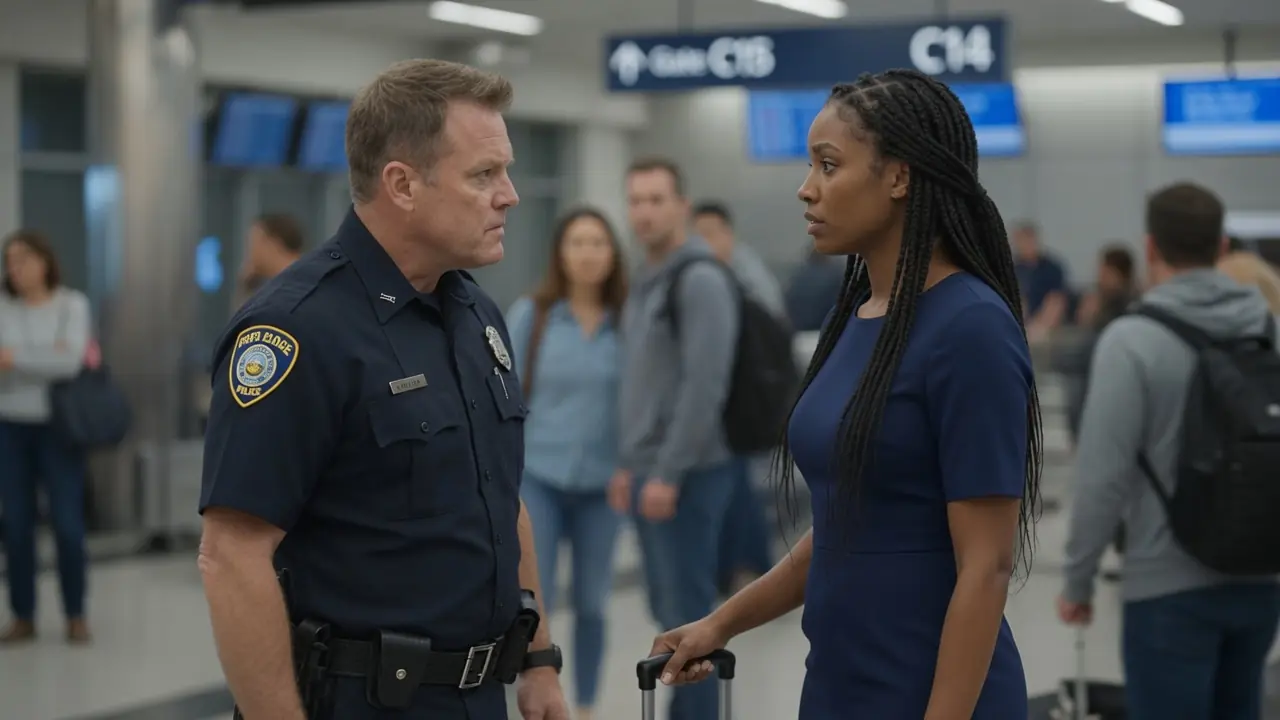
Gate C15 was already crowded when Nia reached the priority boarding lane. Families clustered around charging stations, business travelers stared at their phones, and two overhead screens displayed a fifteen-minute delay. Nia joined the line behind an elderly couple and opened the airline app to confirm her seat, 2A. She was traveling to Denver to lead a federal workshop on defensive restraint, de-escalation, and lawful physical intervention for airport security agencies.
The assignment carried a bitter irony. Nia had spent eight years teaching officers how to control dangerous situations without allowing fear, pride, or prejudice to dictate their actions. She had also practiced taekwondo since childhood, earning a fourth-degree black belt and competing nationally before a knee injury ended her tournament career. Her training had taught her that the most important skill was not striking. It was knowing when restraint protected more people than force.
The priority line moved forward until a broad man in a navy airport-police uniform stepped across the entrance. Officer Daniel Rourke was forty-six, square-faced, short-haired, and visibly irritated before he even looked at Nia. He had been summoned after a gate employee reported a passenger dispute near the economy queue, but instead of asking what had happened, he began scanning the travelers as though searching for someone who looked suspicious. His gaze stopped on Nia.
“Step out of the line,” he said.
Nia glanced behind her, assuming he meant someone else. “Are you speaking to me?”
“You’re blocking priority boarding,” Rourke replied. “Move to the regular line and have your ticket checked.”
“My ticket has already been checked,” Nia said, raising her phone. “I’m seated in 2A.”
Rourke did not examine the boarding pass. His eyes moved from her dress to her handbag, then to her face with an expression that was less confusion than disbelief. “That ticket might not belong to you.”
Several passengers turned toward them. Nia felt the familiar tightening in her chest, the instant understanding that the conversation was no longer about a boarding pass. She kept her voice measured because she knew how quickly a calm Black woman could be described as hostile once someone in authority decided she did not belong. “My name is displayed on the ticket and matches my identification.”
“Then you won’t mind stepping aside,” Rourke said.
“I do mind being removed from a line without cause.”
The elderly man in front of her looked over his shoulder. “Officer, she’s been standing behind us quietly for ten minutes.”
Rourke raised one hand toward him. “Sir, stay out of police business.”
Nia lowered her phone but did not move. “What exact rule have I violated?”
Rourke’s jaw tightened. “You people always think asking questions makes you smarter than everyone else.”
The words silenced the passengers nearest the gate. A woman holding a coffee cup slowly lifted her phone and began recording. Nia saw the screen reflected in a nearby window, but Rourke did not appear to notice. He was watching Nia with the rigid concentration of a man who had decided that obedience mattered more than truth.
“You should choose your next words carefully,” Nia said.
Rourke stepped closer. “You’re leaving this line because someone dressed like you did not buy a first-class ticket.”
Nia looked down at her tailored black dress, polished shoes, and conference bag. The insult was absurd, but she understood that clothing had never truly been the issue. He had already decided what kind of woman she was, and every fact that contradicted him only made him angrier. “Take your hand off your belt and check the ticket.”
“Don’t give me orders.”
“Then perform your duty.”
Rourke reached for her arm.
Nia shifted half a step backward, denying him the grip without making contact. Her suitcase remained upright between them, and the movement was so controlled that most observers barely noticed it. Rourke interpreted the retreat as resistance rather than caution. He seized her left wrist with one hand and tried to pull her out of the lane.
“Release me,” Nia said.
“You’re being removed from the terminal.”
“For what offense?”
“Interfering with an investigation.”
“There is no investigation.”
Rourke twisted her wrist harder. Pain traveled up Nia’s forearm, but her expression remained steady. She had taught this exact scenario in classrooms: an authority figure manufactures resistance after initiating unnecessary force, then cites the reaction as justification for escalation. She could feel his weight shifting forward and saw his free hand moving toward her shoulder. Behind him, a luggage cart stood empty near a support column.
“Let go before you injure yourself,” she warned.
Rourke laughed sharply. “You think you can threaten a police officer?”
“I am explaining the consequence of grabbing a trained person incorrectly.”
His grip tightened. “Touch me again, and I’ll drag you out of this airport in cuffs.”
Then he lunged.
Nia moved before fear could interrupt technique. She rotated her trapped wrist toward the weak point between his thumb and fingers, stepped outside his stance, and delivered one precise side kick against his reaching forearm—not his head, chest, or knee. The controlled impact broke his grasp and redirected his momentum. Rourke stumbled backward into the empty luggage cart, which rolled several feet before striking the column with a metallic crash.
Gasps spread through the gate area. Nia immediately lowered her leg and placed both hands where they could be seen. Her suitcase remained beside her, and she made no attempt to advance. The entire exchange had lasted less than two seconds.
Rourke stared at her in disbelief. His pride registered the embarrassment before his body registered that he was not seriously hurt. He grabbed his radio and shouted, “Officer assaulted at Gate C15! Suspect is combative!”
“I used the minimum force required to stop an unlawful grab,” Nia said clearly, knowing the recordings would capture every word. “I am standing still and presenting no threat.”
Rourke drew his Taser.
Passengers began backing away. The woman recording shouted, “She didn’t attack him! He grabbed her first!”
“Put the phone down!” Rourke barked.
“No,” the woman replied. “I recorded the whole thing.”
Three uniformed airport officers appeared near the gate entrance. Rourke pointed toward Nia before they could assess the scene. “Take her down.”
Nia recognized the danger immediately. Once multiple officers responded to a distorted emergency call, each new arrival could interpret the posture of the others as proof that a threat existed. She kept her hands raised and spoke directly to the nearest officer, a young woman named Patel. “Your colleague initiated physical contact after refusing to verify my ticket. There are multiple witnesses and video recordings.”
Rourke shouted over her. “She kicked me!”
“She struck your arm after you twisted hers,” the elderly passenger said. “I saw it.”
Officer Patel looked from Rourke’s Taser to Nia’s raised hands. “Everyone stay where you are.”
“You heard my order,” Rourke snapped. “Cuff her.”
Patel hesitated. That pause saved the situation from becoming worse. She noticed that Nia was not advancing, shouting, or reaching for anything. She also saw the red marks forming around Nia’s wrist.
Before Patel could respond, four people in dark business suits emerged from the concourse. Two wore federal credentials on their jackets, while another carried a hard equipment case marked with the seal of the Transportation Security Training Division. At the front was Deputy Director Marcus Grant, a former federal marshal who had worked with Nia for three years. His expression changed the moment he saw Rourke aiming a Taser at her.
“Lower the weapon,” Marcus ordered.
Rourke turned. “Federal personnel need to stay back. This woman assaulted an officer.”
Marcus stopped several feet away. “That woman is Dr. Nia Brooks, the lead instructor your department requested for tomorrow’s federal de-escalation workshop.”
Rourke blinked. “She’s what?”
Nia’s voice remained level. “My position does not determine whether I deserve lawful treatment.”
Marcus nodded once. “Correct. Her title is irrelevant to the legality of what you did.”
Rourke’s face reddened. “You didn’t see her kick me.”
“No,” Marcus said. “But at least six cameras did.”
The airport’s security supervisor arrived seconds later and ordered Rourke to holster his Taser. He resisted until Patel quietly repeated the command, reminding him that the terminal cameras had unobstructed views of the priority lane. Rourke finally lowered the weapon, though he continued insisting that Nia had behaved aggressively. He claimed she had presented a fraudulent ticket, refused screening, and struck him without warning.
The gate agent stepped forward. Her name tag read Melissa. “Her ticket is valid,” she said. “I scanned it before Officer Rourke arrived.”
Rourke turned on her. “Then why was I called?”
“You weren’t called about her,” Melissa replied. “The complaint was about two passengers arguing near the economy line.”
Silence followed.
Rourke looked toward the economy queue, where two men stood separated by another employee. In his rush to assert control, he had not even identified the people involved in the original report. He had chosen Nia because she caught his attention and then built an accusation around that choice. The error was no longer an unfortunate misunderstanding. It was a sequence of deliberate decisions.
The airport supervisor requested Rourke’s body-camera footage. Rourke touched the device on his chest and claimed it had malfunctioned. Patel checked the status light and found the camera had been manually deactivated nine minutes earlier. That meant it had been turned off before he approached Nia.
Marcus’s expression hardened. “Secure the device.”
Rourke stepped back. “You don’t have authority to seize my equipment.”
“The airport does,” the supervisor said. “And you are relieved of duty pending investigation.”
Rourke stared around the gate as though expecting someone to defend him. Instead, he found passengers holding phones, officers avoiding his gaze, and Nia standing with one bruised wrist but complete control of herself. The authority he had treated as unquestionable was now being examined by the very people he expected to silence.
Nia was escorted to a private airport office, where a medic examined her wrist. The injury was a moderate sprain, painful but not fractured. She declined transportation to the hospital after receiving a support brace, though Marcus urged her to reconsider. Her flight had been delayed again, but she no longer intended to board it without giving a formal statement.
The woman who had recorded the confrontation introduced herself as Laura Jenkins, a high-school principal traveling to a conference. She handed investigators the original unedited video and refused to leave until they confirmed it had been preserved. The elderly couple also provided statements, as did three airline employees and Officer Patel. Their accounts matched in nearly every important detail.
Rourke’s report did not.
He wrote that Nia had entered the priority lane without authorization, ignored repeated commands, threatened him, and launched a kick while he attempted a lawful detention. He did not mention checking her identification because he had never checked it. He also omitted the remarks about people like her and the assertion that her ticket could not belong to her. Within an hour, Laura’s video contradicted every significant claim.
The investigation widened the following morning. Internal-affairs officers reviewed archived complaints involving Rourke and found nine previous allegations over four years. Six came from Black or Latino travelers who had been questioned while carrying business-class tickets, entering private lounges, or retrieving expensive luggage. Three complainants specifically reported that Rourke had accused them of using stolen tickets or credit cards without evidence.
Most of the complaints had been closed after brief reviews. Supervisors had accepted Rourke’s reports, even when airport footage was missing or body cameras had been switched off. One former supervisor had repeatedly described the incidents as communication failures. Another recommended customer-service training but imposed no discipline.
Nia learned of the pattern while sitting in a conference room with Marcus and an independent investigator. The information angered her more than the pain in her wrist. Her encounter had attracted attention because witnesses had recorded it and federal officials happened to be nearby. The earlier travelers had faced the same conduct without a convoy arriving to validate their accounts.
“I don’t want this reduced to what he did to an important person,” Nia said. “He was wrong before anyone knew my job.”
The investigator agreed. “The prior cases will be reopened.”
“Not merely reviewed,” Nia replied. “The people who filed those complaints deserve direct contact, access to their records, and an explanation of why the process failed them.”
Marcus glanced at her brace. “You’re still planning to teach tomorrow?”
“Yes.”
“You were assaulted by an officer from the department attending your course.”
“Which means the course is more necessary than it was yesterday.”
News of the confrontation spread after Laura’s video appeared online. The footage showed Rourke dismissing the boarding pass, grabbing Nia, twisting her wrist, and lunging after she escaped his hold. It also showed the controlled kick landing only on his forearm and Nia immediately returning to a nonthreatening posture. Viewers slowed the clip frame by frame, noting how easily she could have struck a vulnerable target but deliberately chose not to.
Some headlines described her as a taekwondo champion who defeated an airport officer. Nia disliked that framing. It transformed a frightening abuse of authority into entertainment and suggested that survival depended on extraordinary skill. Most people grabbed in an airport line would not know how to escape safely, and they should not need martial-arts training to protect their rights.
At the workshop the next morning, sixty-two security officers sat in a hotel ballroom expecting the program to be canceled. Nia entered wearing the same black dress, though her injured wrist was supported by a brace. Conversations stopped as she walked to the front. Officer Patel was seated in the second row.
Nia placed her notes on the podium. “Yesterday, one officer treated my questions as defiance, my presence as suspicion, and my self-protection as assault,” she began. “Today, we are not going to discuss whether I kicked correctly. We are going to discuss why he believed he had the right to grab me at all.”
No one moved.
She displayed a timeline of the encounter without naming Rourke. The first failure was not the physical contact. It was the unsupported assumption that a Black woman in a priority line was using someone else’s ticket. The second was his refusal to verify information that would have resolved the issue immediately. The third was interpreting calm disagreement as aggression.
“The moment an officer decides a person is guilty before collecting facts, every later observation becomes distorted,” Nia explained. “A question sounds like resistance. Fear looks like deception. Self-defense becomes an attack. Then the report is written backward to justify the first assumption.”
Patel raised her hand. “What should the responding officers have done differently?”
“Stopped and assessed instead of inheriting his panic,” Nia said. “You did that.”
Patel looked uncomfortable. “I still hesitated too long.”
“You hesitated before obeying a dangerous order. That pause prevented escalation. The goal now is to turn ethical hesitation into confident intervention.”
The department adopted the training material as part of a mandatory certification program. More importantly, the airport authority announced structural changes rather than presenting one class as a complete solution. Body cameras could no longer be disabled without generating an automatic alert to a supervisor. Passenger-removal incidents required documented justification and immediate preservation of nearby camera footage.
An independent civilian office was established to review complaints involving discriminatory treatment. Complainants would receive case updates, access to findings, and the name of the supervisor responsible for each decision. Officers with repeated similar allegations could no longer remain on passenger-facing duty while cases were evaluated. The airport also created a policy requiring officers to verify travel documents before making accusations about fraudulent access.
Rourke was charged with official misconduct, unlawful detention, falsifying a police report, and misdemeanor assault. His attorney argued that the kick proved Nia was dangerous, but three independent use-of-force experts disagreed. They concluded that her response was proportionate, targeted, and ended the moment the unlawful contact stopped. Airport video also showed that Rourke had enough time to disengage before lunging at her again.
During the disciplinary hearing, Rourke insisted he had made a reasonable mistake. Nia listened from the witness table as he described the confrontation without once acknowledging the words he had used or the assumptions he had made. He apologized only for how the event appeared, not for the harm he caused. That distinction mattered.
When Nia was invited to speak, she did not mention her degrees, federal contracts, or competition medals. “You did not need to know my occupation to check my ticket,” she told him. “You did not need to respect my clothing, my education, or my status to keep your hands off me. The law was supposed to protect the traveler standing alone just as fully as it protects the person surrounded by officials.”
Rourke looked away.
His employment was terminated after the hearing. Two supervisors who had dismissed earlier complaints were removed from command positions, and one faced a separate investigation for altering review notes. The reopened cases resulted in formal apologies, financial settlements, and corrected records for travelers who had been falsely described as disruptive. For several of them, the acknowledgment arrived years later, but it still mattered.
Nia returned to Harbor City Airport six months after the incident. She had been invited to review the new complaint system and observe scenario-based training at Gate C15. The terminal looked unchanged: rolling suitcases, glowing flight boards, families searching for outlets, and travelers hurrying beneath signs they barely read. Yet the officers working the concourse now carried cameras linked to automatic monitoring software.
Patel met her near the priority line. She had recently been promoted to training sergeant and now taught intervention protocols for officers responding to a colleague’s questionable command. “I think about that day every time someone tells me to act before I understand what happened,” she said.
Nia smiled. “That is not weakness. It is responsibility.”
Before leaving, Nia stood for a moment near the support column where the luggage cart had crashed. A small scratch remained near the base, almost invisible unless someone knew where to look. She remembered the grip on her wrist, the drawn Taser, and the terrible possibility that a single uncontrolled movement could have changed the outcome.
Laura, the woman who recorded the encounter, had later told Nia that she almost lowered her phone when Rourke ordered her to stop. Fear had nearly silenced her. The elderly couple had admitted the same thing about speaking up. Courage, Nia realized, was rarely the absence of fear; it was the decision that someone else’s safety mattered more than remaining comfortable.
Her flight announcement sounded overhead.
Nia joined the priority line, presented her ticket, and waited as the gate employee scanned it. No one questioned whether it belonged to her. No officer stepped between her and the aircraft.
As she walked down the boarding bridge, she thought about the kick that had made the video famous. People remembered the speed, the balance, and the officer stumbling into the cart. But the real victory had not come from the movement of her leg.
It came from the witnesses who refused to look away, the officer who paused before following a wrongful order, and the investigators who finally examined the pattern hidden beneath one man’s reports. It came from changing a system that had required extraordinary proof before ordinary people were believed. And it came from insisting that dignity belonged not only to a federal instructor with a black belt, but to every traveler who entered that airport line alone.