The green garden hose continued spraying across the sidewalk as Officer Grant Keller advanced toward Cedric Boon. Red and blue lights from the police SUV flashed across the wet driveway, the brick house, and the neighbors gathering behind raised phones. Cedric stood barefoot inside his own routine, dressed in a soaked black T-shirt, gray sweatpants, and white sneakers, yet Keller stared at him as though he had discovered a dangerous intruder. When Cedric asked what law he had broken, Keller responded by ordering him to turn around.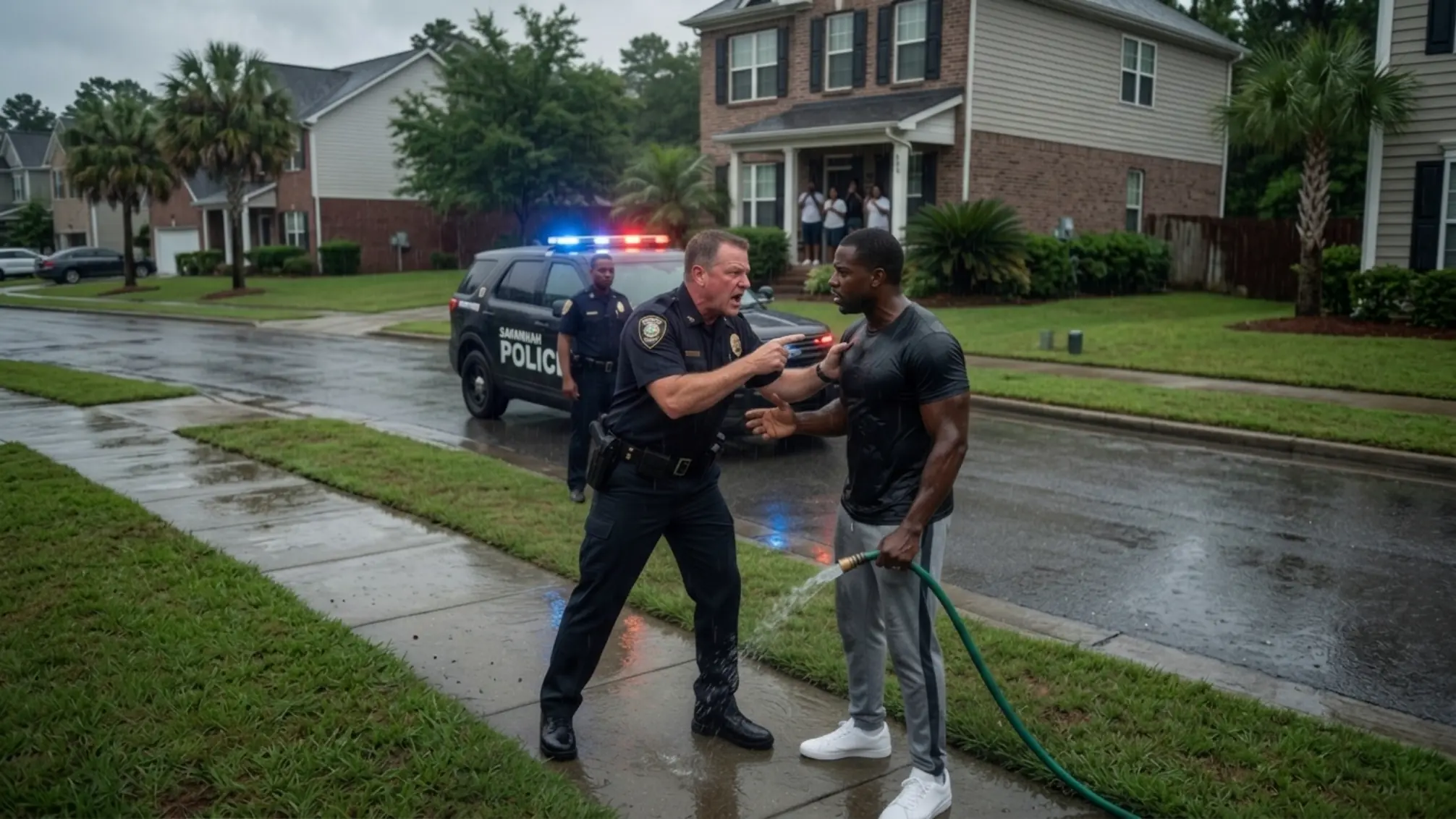
Cedric had spent fourteen years serving in the United States Army. He completed two overseas deployments, led frightened young soldiers through dangerous situations, and learned to remain composed when every instinct told him to react. At forty-two, he finally owned the quiet two-story home outside Savannah that he had dreamed about during nights spent sleeping inside temporary military quarters. He never imagined that watering the lawn outside that home would end with a police officer twisting his arms behind his back.
Keller seized Cedric’s wrist before verifying his name, address, or identification. The metal handcuffs closed so tightly that Cedric immediately felt pressure around the bones of both wrists. Officer Nolan Briggs stood several feet away, watching with uncertainty while keeping one hand near his duty belt. A third officer remained beside the black SUV as though Cedric might suddenly transform a garden hose into a threat.
“Too tight,” Cedric said.
“Good,” Keller answered.
That single word told Cedric the encounter was no longer an ordinary investigation. Keller was not restraining him because procedure required caution; he was enjoying the humiliation. Cedric stared toward the open front door of his house, where family photographs, military awards, tax records, and years of mail could have proved his identity within seconds. Keller had chosen the cuffs first because the truth was less important than the authority he wanted the entire street to witness.
Three houses away, Elaine Porter stood beside her mailbox wearing gardening gloves and oversized sunglasses. She was a fifty-eight-year-old white American woman who had watched Cedric through closed blinds for six years without ever learning more than his name. She saw him leave for the base before sunrise, return in uniform, carry groceries inside, and spend weekends with his twelve-year-old son. Yet that afternoon, she called police and described him as a suspicious Black man casing homes.
The dispatch description contained almost nothing beyond race, build, and clothing. Black male, tall, muscular, wearing a dark shirt. Keller saw Cedric beside the hose and decided the description fit before asking whether the address belonged to him. He never spoke with Elaine first, checked property records, or asked dispatch whether anyone had reported an actual crime. The suspicion existed because Cedric stood outside a valuable house in a neighborhood where some residents still considered him temporary.
“Your identification is inside?” Briggs asked.
“On the kitchen counter,” Cedric replied. “My military ID is beside my wallet.”
Keller leaned close behind him. “And you expect us to enter a house where you admitted there are weapons?”
“I said there are legally registered firearms locked inside a safe.”
“There we go,” Briggs muttered, though his voice lacked confidence.
Cedric slowly turned his head. “You asked whether I owned weapons. I answered honestly because I’m active duty and trained to follow the law.”
Keller shoved him toward the police SUV. “Walk.”
Neighbors stepped farther onto their lawns as Cedric stumbled across the wet sidewalk. A teenage boy began recording from beside a mailbox, while a man holding a small dog called out that the neighborhood tip line had finally worked. Someone near the brick house whispered that Cedric had always seemed suspicious despite never speaking to him. The humiliation burned more deeply than the handcuffs because these were people Cedric had protected during storms, power outages, and emergencies without asking whether they considered him one of them.
Briggs entered the house without a warrant or Cedric’s permission. His body camera later showed him walking through the living room, scanning framed photographs and opening doors while Keller kept Cedric beside the SUV. On one wall hung photographs of Cedric in uniform beside soldiers from both deployments. Another frame contained an award recognizing his leadership after he carried an injured service member to safety during an attack.
The kitchen counter held everything Keller claimed did not exist. Cedric’s driver’s license displayed the exact address. His military identification remained inside the wallet beside mortgage statements, utility bills, and a letter from his son’s school. Briggs lifted the documents one by one, his expression becoming more uncomfortable each time the evidence contradicted Keller’s assumptions.
Outside, Elaine approached the sidewalk.
Keller saw her and asked whether she had made the call.
“Yes,” she said. “I saw that man walking around this property for almost an hour.”
Cedric turned toward her. “That man? You know my name.”
Elaine crossed her arms. “I know someone lives there.”
“You’ve watched me mow this lawn for six years.”
“You looked different today.”
Cedric stared at his soaked shirt and the hose lying across the grass. “Different how?”
“You were pacing and looking toward the street.”
“I was watering flowers.”
Elaine lowered her voice. “You people always become aggressive when someone asks a simple question.”
The nearby conversations stopped.
Cedric’s jaw tightened. “What does ‘you people’ mean?”
“That isn’t what I meant.”
“It is exactly what you meant.”
Keller stepped between them and ordered Cedric to calm down. He told Elaine that residents had the right to report anyone who made them uncomfortable. When Cedric asked whether being Black outside his own house qualified as suspicious behavior, Keller warned him to watch his tone. The officer’s response confirmed that Elaine’s fear mattered more than Cedric’s ownership, service, or dignity.
Briggs returned carrying the wallet and framed military photograph. He handed Keller the identification and quietly said that everything checked out. The house belonged to Cedric, the military card was valid, and the documents showed he had lived there for six years. Any reasonable officer would have removed the cuffs and apologized.
Keller studied the card without unlocking Cedric.
“Active duty doesn’t mean you’re innocent,” he said.
“Innocent of what?”
“We’re still investigating.”
“What crime?”
“You were reported as suspicious.”
“That is not a crime.”
Keller’s face reddened. “You don’t explain the law to me.”
Cedric looked at Briggs. “Your partner verified my address. Why am I still handcuffed?”
Briggs hesitated. “Grant, we should probably release him.”
Keller ignored him and asked Cedric whether he had gang connections from his time overseas. Even Briggs looked shocked. Cedric went completely still, realizing Keller was searching desperately for a reason to justify what the neighborhood had already seen. The officer had begun with trespassing, shifted toward burglary, moved to weapons, and now wanted military service itself to sound criminal.
“You’re trying to turn my life into evidence,” Cedric said.
“I’m asking questions.”
“No. You’re protecting your pride.”
Keller stepped closer. “You want another charge?”
“For answering you?”
“For becoming hostile.”
Cedric gave a bitter laugh. “You tightened cuffs around a homeowner watering his lawn and called the pain good. Hostility entered this driveway with your SUV.”
The teenage boy recording from the sidewalk lowered his phone slightly, stunned by the exchange. Other neighbors began moving closer as Keller’s voice rose. The officer believed the uniform guaranteed that his version would become official, while everyone else’s memory would become confusion. He did not know that Cedric’s doorbell camera, garage camera, and lawn-security system had captured the confrontation from three separate angles.
Cedric had installed the cameras after packages disappeared from neighboring porches. They recorded continuously and stored footage remotely through a military-grade security service. Keller could seize phones, order neighbors away, or claim his body camera malfunctioned, but he could not reach the encrypted backup. Every command, accusation, and threat had already been preserved.
A bicycle appeared at the end of the street.
Twelve-year-old Isaiah Boon pedaled toward the house, saw the police vehicles, and dropped the bike into the grass. His face changed when he recognized his father standing in handcuffs beside the SUV. He ran toward the driveway before Cedric shouted for him to stop. Keller stepped into the boy’s path and raised one hand.
“Back up.”
“What are you doing to my dad?” Isaiah demanded.
“We’re investigating.”
“That’s his house!”
“We know.”
“Then why is he handcuffed?”
No officer answered.
Isaiah looked toward Elaine. “Did you call them?”
She shifted uncomfortably. “I thought someone suspicious was outside.”
“You see my dad every weekend.”
“I couldn’t be certain.”
“You lied.”
Keller grabbed Cedric’s arm and ordered him to control his son. The sudden movement made Isaiah flinch, and Cedric’s controlled expression finally cracked. He warned Keller not to touch him that way or speak aggressively to the boy. Keller smiled as though he had been waiting for anger to justify everything that came before it.
“Oh, now you want to act tough?”
“I want you to stop frightening my child.”
“You people always claim we’re escalating.”
Cedric’s voice dropped. “Say that again.”
Keller realized what had escaped but refused to retreat. “I said people in your situation.”
“No, you didn’t.”
Briggs stepped between them. “Grant, enough. We verified his identity.”
Keller pointed toward Isaiah. “The kid is interfering.”
“He’s watching police handcuff his father outside his own home,” Briggs replied. “What reaction did you expect?”
A retired firefighter named Leonard Pike crossed the street from the house next door. Leonard was a sixty-four-year-old white American man who had known Cedric since the day the moving truck arrived. Cedric repaired his generator during a hurricane and helped carry Leonard’s wife to an ambulance after she collapsed. Leonard positioned himself several feet away and told Keller that Cedric was a homeowner, serviceman, and trusted neighbor.
Keller ordered him to return home.
“No,” Leonard said. “I watched you cuff an innocent man before asking his name.”
“You’re interfering with police business.”
“I’m witnessing it.”
“You want to join him?”
More phones rose immediately.
Briggs grabbed Keller’s arm. “Do not threaten another resident.”
Keller pulled away, furious that his partner had challenged him publicly. Before he could respond, dispatch crackled through the radio attached to his shoulder. The caller had contacted them again and clarified that the possible weapon in the suspect’s hand might have been gardening equipment.
Everyone looked toward the green hose.
Isaiah stared at the officer. “You thought water was a weapon?”
Elaine attempted to explain that the view from her window was unclear. Cedric looked directly at her and said she had seen exactly what she wanted to see. The sentence struck the street harder than any shout because every neighbor understood the meaning.
Keller finally reached for the cuff key.
As he unlocked Cedric’s wrists, he leaned close and whispered that Cedric should be more careful in the neighborhood. Cedric asked what activity required caution. Keller’s answer was barely audible, but the microphone on the lawn camera captured it clearly.
“Existing.”
The cuffs opened, leaving deep red marks around Cedric’s wrists. Isaiah ran to him and immediately touched the injuries with trembling fingers. Keller pointed at Cedric’s chest and said he had been lucky. He warned that the encounter could have ended differently if Cedric had made one sudden movement.
Cedric stepped forward.
Briggs moved between them, expecting a fight.
Instead, Cedric raised his swollen wrists where the neighbors could see them. “You entered my house, searched my property, handcuffed me, threatened my son, and called me lucky after proving I committed no crime.”
Keller’s confidence returned slightly. “We responded to a report.”
“You created the rest.”
“We followed procedure.”
“The cameras will decide that.”
Keller looked toward the doorbell.
For the first time, fear crossed his face.
He ordered Briggs to collect the recordings as evidence, but Cedric refused consent. Keller said he would obtain a warrant. Cedric told him to explain to a judge what crime justified searching a homeowner’s security system after the officers had already verified his identity. Briggs quietly warned Keller that attempting to seize footage could look like evidence tampering.
The officers returned to their vehicles beneath the gaze of the neighborhood. Isaiah asked the question no adult had been brave enough to say aloud.
“If my dad wasn’t military, would you have treated him worse?”
Keller looked away.
The SUVs left without answering.
Cedric stood in the wet driveway after everyone else began returning home. His hands shook now that discipline no longer had to hold his body together. Isaiah wrapped both arms around him, and Cedric placed one injured hand across the boy’s back. He wanted to promise that nothing like this would happen again, but honesty would not allow it.
That evening, Leonard helped download copies of the recordings while Cedric contacted his commanding officer. Colonel Rebecca Shaw arrived at the house wearing civilian clothes, listened to the account, and examined the red marks around Cedric’s wrists. She had commanded soldiers for twenty-three years and rarely displayed anger openly. By the end of the footage, her hands were clenched tightly.
“You identified yourself?”
“Repeatedly.”
“They verified your military card?”
“Yes.”
“And kept you restrained?”
“Until dispatch admitted the weapon was a hose.”
Colonel Shaw asked Cedric what he wanted.
He answered without hesitation. “A real investigation. Not an apology written by the same department.”
The next morning, she contacted the county sheriff, the base legal office, and a civil-rights attorney familiar with military personnel mistreated by local authorities. Cedric submitted formal complaints supported by the doorbell recordings, the neighbor’s phone videos, the dispatch call, and photographs of his injuries. Because Keller had entered the house and continued the detention after identification, the case quickly moved beyond an unfortunate misunderstanding.
The police department initially released a statement claiming officers responded to a report of suspicious activity and briefly detained an uncooperative individual. Cedric read it twice before sending the complete footage to his attorney. The recording showed him complying, holding one hand in the air, and calmly asking what crime had occurred. It also captured Keller saying that men like him did not belong in the neighborhood.
The attorney released a carefully edited section containing the undisputed timeline. Within hours, local news stations requested the full video. The image of Cedric holding a garden hose while an officer ordered him to the ground spread across the country. Keller’s statement that the cuffs being too tight was “good” became the line no department spokesperson could explain.
Other residents came forward.
A Black delivery driver said Keller detained him outside another subdivision after refusing to believe he worked for a catering company. A college professor reported being questioned while entering her sister’s home. A young father described Keller searching his car because the officer claimed the expensive vehicle did not appear to belong to him.
Each complaint had previously been closed as unsubstantiated.
Body-camera records revealed repeated gaps during Keller’s most controversial stops. His camera often activated only after citizens were already restrained. Supervisors accepted his explanation that equipment shifted during physical movement, even when the same failure occurred nine times in two years. Briggs admitted during an independent interview that officers were pressured not to challenge Keller because he had connections within the department.
The investigation also examined Elaine’s call. Dispatch audio showed that she never reported seeing a weapon clearly, a burglary attempt, or anyone entering a property. She described a Black man walking outside a nice home and insisted that he could not belong there. When the dispatcher asked whether he was committing a crime, Elaine answered that she simply knew something was wrong.
Keller converted prejudice into probable cause.
The outside investigators concluded that Cedric’s detention became unlawful once officers verified his residence and identity. Entering the home without consent created another serious violation. Keller’s refusal to release Cedric, racist language, threat toward Isaiah, and whispered warning after removing the cuffs demonstrated that the officer’s conduct was not a reasonable mistake made under pressure.
Keller was suspended without pay.
Briggs received discipline for entering the house and failing to intervene sooner, but his cooperation prevented termination. During his hearing, he admitted that recognizing misconduct while remaining silent still made him part of it. He later testified against Keller and the supervisors who repeatedly protected him.
Elaine attempted to apologize through a handwritten letter.
Cedric returned it unopened.
Several weeks later, she approached him while he repaired the mailbox. She said she had been frightened and insisted she was not racist. Cedric looked toward the upstairs window where her blinds remained partly closed.
“You watched me for six years,” he said. “You learned enough to fear me but never enough to know me.”
“I made a mistake.”
“You made a choice.”
“I didn’t know the officer would treat you that way.”
“You gave him the story he wanted.”
Elaine began crying, but Cedric did not comfort her. Accountability did not require cruelty, yet it also did not require him to relieve the guilt of the person whose call placed his life at risk. He told her the most meaningful apology would be telling investigators the complete truth without protecting herself.
She eventually did.
Keller faced charges for unlawful detention, falsifying the official report, civil-rights violations, and evidence-related misconduct. The department’s original report claimed Cedric resisted and behaved aggressively. Video showed the opposite. The false statements transformed a disciplinary case into a criminal one.
At trial, Keller’s attorney argued that the officer responded to a rapidly developing situation. Prosecutors played the footage from beginning to end. The jury watched Cedric raise his hands, offer identification, identify the house, warn that the cuffs were too tight, and request that officers stop frightening his son.
Then they heard Keller answer, “Good.”
The jury convicted him.
Cedric spoke at sentencing with Isaiah sitting in the front row. He did not describe himself as a decorated serviceman until the final paragraph. He emphasized that military status should never have been required to receive lawful treatment.
“My uniform should not make my rights more valuable than anyone else’s,” he said. “The question my son asked remains unanswered. What would have happened if I had no military card, no cameras, and no neighbor willing to record?”
The judge looked toward Keller.
No answer came.
The department entered an independent reform agreement. Officers could no longer detain someone based only on vague reports that a person appeared out of place. Home entries required documented legal justification, and every complaint involving missing body-camera footage received outside review.
A duty-to-intervene rule required officers to stop unlawful conduct by colleagues rather than silently watching. Dispatchers received training to challenge callers who described race without identifying criminal behavior. Supervisors who dismissed Cedric’s earlier complainants were removed from oversight positions.
Months later, Cedric stood outside the brick house holding the repaired garden hose. Isaiah helped adjust the sprinkler while children rode bicycles past the driveway. A patrol car slowed near the curb, and for a moment, Cedric’s body tightened automatically.
The officer lowered the window.
“Afternoon, Sergeant Boon.”
Cedric recognized Briggs behind the wheel.
“Officer.”
Briggs looked toward the lawn. “Everything all right?”
“It is.”
The officer nodded and continued down the street without questioning whether Cedric belonged there.
Isaiah watched the patrol car disappear. “Do you trust him now?”
Cedric considered the question.
“Trust is built slowly.”
“Like the lawn?”
Cedric smiled for the first time that afternoon. “Slower.”
The deep marks around his wrists eventually faded, but the lesson remained. Cedric had spent his adult life serving rules designed to protect people, yet Keller used those rules as camouflage for assumptions he had never questioned.
The officer believed the flashing lights, uniform, and handcuffs would make his version stronger than the truth.
He never expected the truth to be recording from the front door, garage, sidewalk, phones, body cameras, and the frightened eyes of a twelve-year-old boy.
Cedric was not lucky that afternoon.
He was prepared.
And when the evidence finally reached people willing to see it, the man Keller tried to humiliate outside his own home became the witness who exposed every lie behind the badge.