For several seconds, the Police Officer continued gripping the German Shepherd’s leather leash. His confident sneer disappeared, but his thick fingers remained locked around the strap as though releasing it would confirm he had lost control. Behind the front desk, another officer stopped typing, while two civilians seated near the wall looked up from their paperwork. The polished lobby of the city police department suddenly felt smaller than it had moments earlier.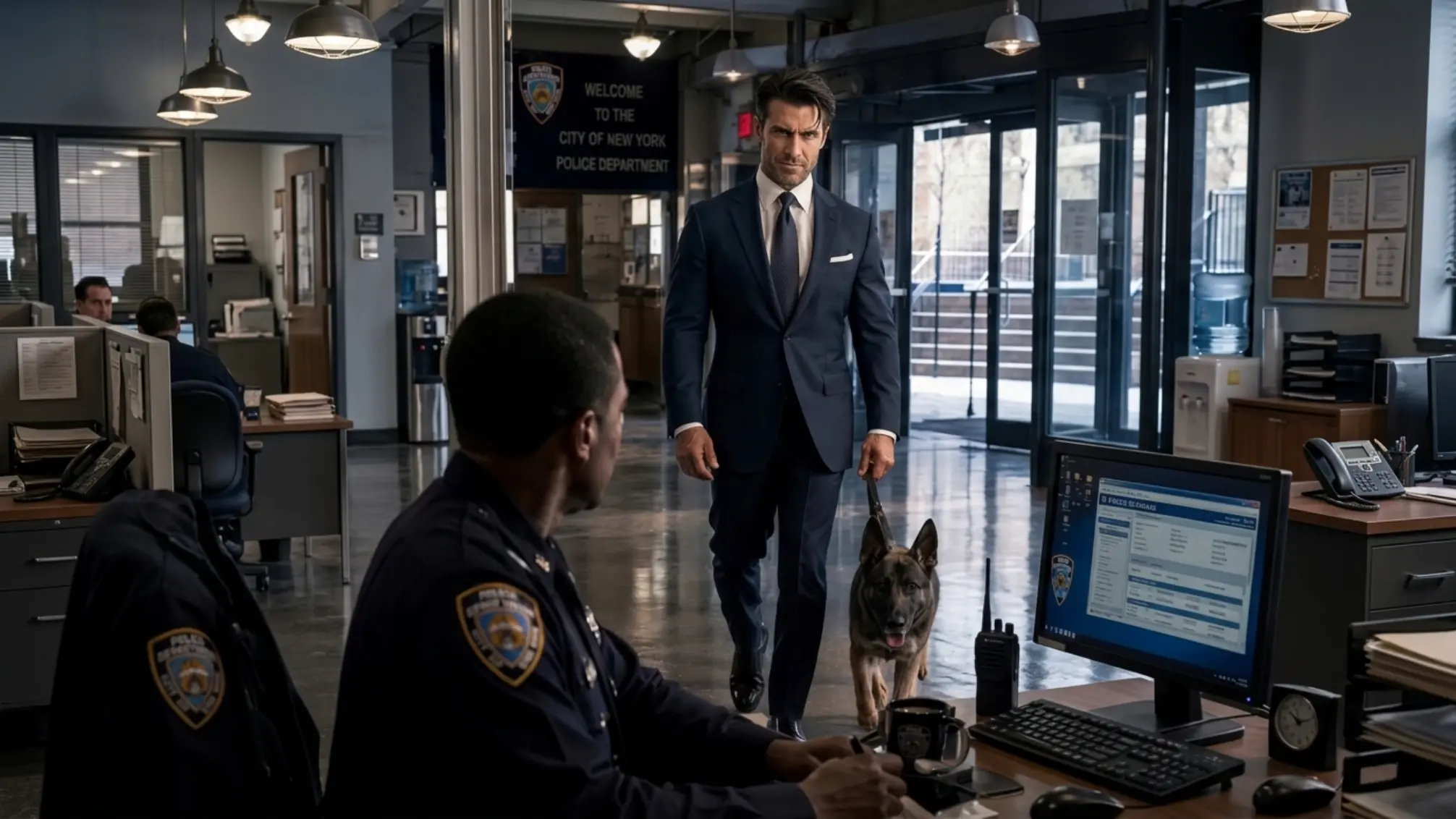
The Mayor stood directly in front of him without raising his voice. At fifty-eight, he had lightly tanned skin, sharp gray eyes, dark hair streaked with silver, and the broad athletic build of a man who still trained before sunrise. His tailored navy suit, white shirt, dark tie, and polished shoes made him appear wealthy, but nothing on his clothing identified him as the city’s highest elected official. In one hand, he held the remaining length of the leash attached to a calm German Shepherd sitting beside his leg.
The dog did not bark or pull. It watched the Police Officer with focused brown eyes, its body still but alert. The animal had once served inside the department’s K9 unit before an injury ended its active career. The Mayor had adopted it months earlier after visiting the city shelter and learning that retired service animals sometimes waited far longer than people expected for permanent homes.
He had not brought the German Shepherd to create a scene. He had arrived for an unannounced inspection after receiving dozens of complaints about how civilians were treated inside the headquarters lobby. Residents claimed officers ignored reports, mocked victims, demanded unnecessary identification, and threatened people who asked to speak with supervisors. Several complainants specifically described a muscular front-desk officer who acted as if the building belonged to him.
The Mayor wanted to see the truth without cameras, escorts, or advance warning. Whenever he entered a public building with security staff and aides, everyone became polite before he reached the door. Floors were cleaned, supervisors appeared, and employees suddenly remembered procedures they had ignored for months. An official inspection showed him how people behaved around power, not how they treated citizens who appeared to have none.
That morning, he left City Hall through a private exit and dismissed his driver several blocks away. He wore an ordinary business suit, carried no visible city identification, and walked the German Shepherd toward police headquarters. His security team remained nearby but out of sight under strict instructions not to intervene unless someone faced immediate danger. The Mayor wanted to enter the building as any resident might.
The first warning appeared before he reached the desk. An elderly woman stood near the lobby entrance holding a plastic folder and asking where she could report repeated threats from a neighbor. The Police Officer barely looked at her before saying the department did not handle “personal arguments.” When she explained that the neighbor had broken her window and left written threats, he told her to return with better proof.
A young delivery worker approached next. His bicycle had been stolen outside a restaurant, and his phone contained a clear photograph of the thief. The Police Officer told him the property was not valuable enough to justify a report and suggested working additional hours to purchase another bicycle. The young man left with his shoulders lowered, too embarrassed to continue arguing.
The Mayor watched both interactions from near the entrance. He wrote the time inside a small notebook and then approached the desk with the German Shepherd beside him. He politely asked for the officer supervising civilian complaints. The Police Officer looked at the dog, then at the Mayor’s suit, and responded as though he had been insulted.
“No animals.”
“This is a retired police K9.”
“I don’t care what story you made up. Take it outside.”
The Mayor pointed toward the department identification tag attached to the dog’s collar. It included the animal’s former unit number, medical status, and official retirement registration. The Police Officer never examined it. Instead, he stood, walked around the desk, and grabbed the leash without asking permission.
The Mayor’s expression changed immediately.
“Release it.”
The officer pulled the strap toward the door. “Take that dog and get out of this police department—NOW!”
The words carried across the lobby. The German Shepherd rose but remained close to the Mayor, trained not to resist unless commanded. The officer interpreted the animal’s discipline as fear and pulled harder. The Mayor stepped between them, preventing the leash from tightening around the dog’s neck.
That was when the confrontation became personal.
The Mayor asked why the officer threatened civilians instead of helping them. The officer answered that he controlled the lobby and could remove anyone he considered disruptive. When the Mayor requested his name and badge number, the officer covered the badge with one hand and ordered him to stop asking questions.
The officer believed he was facing an arrogant businessman who expected special treatment. He mocked the Mayor’s suit, called the German Shepherd a dangerous pet, and warned that both could be detained for interfering with police operations. Two officers behind the desk heard the threats but remained silent.
The Mayor looked toward them. “Are either of you going to correct him?”
Neither answered.
The muscular Police Officer stepped close enough for their shoulders to touch. He said the Mayor had ten seconds to leave before being placed in handcuffs. His hand moved toward the restraints on his belt, and the civilians seated along the wall shifted nervously. They had entered the building seeking protection, yet now they were watching an officer manufacture an arrest because someone questioned him.
The Mayor remained still.
“Call your captain.”
“I don’t take orders from civilians.”
“You’re about to.”
The officer laughed and reached for the Mayor’s wrist. Before he could secure it, a calm female voice came from the hallway behind the desk.
“What is happening here?”
The Police Captain entered the lobby carrying a folder from the morning briefing. She was a composed forty-six-year-old Black American woman with dark brown skin, intelligent eyes, and neatly tied hair beneath her uniform cap. Her expression hardened when she saw the officer gripping the Mayor’s wrist and holding the retired K9’s leash.
The front-desk officer immediately changed his tone. He claimed the visitor had brought an uncontrolled animal into the building, refused lawful commands, and threatened officers. He said he was preparing to arrest the man for obstruction. The Captain looked at the German Shepherd sitting calmly beside the Mayor and then examined the department tag hanging from its collar.
“This dog served in our K9 unit,” she said.
The officer released the leash.
The Captain turned toward the Mayor. Recognition reached her face slowly, followed by visible alarm. She straightened and addressed him by his official title. Every officer in the lobby immediately stood.
The civilians looked from the Captain to the man in the navy suit.
The Police Officer’s face lost its color.
The Mayor retrieved a slim wallet from inside his jacket and opened it. The city identification card carried his photograph, title, and security classification. He did not hold it toward the frightened officer for long because the revelation itself was not the purpose of the visit.
“Return to your position,” the Captain ordered.
The officer tried to speak.
“Now.”
He moved behind the desk while the Mayor knelt to examine the German Shepherd’s collar. A red mark had formed where the officer pulled the leash too tightly. The dog remained composed, but the Mayor’s jaw tightened as he touched the irritated skin.
The Captain apologized and promised immediate disciplinary action. The Mayor stood and looked toward the elderly woman and delivery worker, who had not yet left the building. He asked both to return to the desk.
“Before we discuss what happened to me,” he said, “they will receive the service they came here for.”
The Captain personally took the elderly woman’s folder and assigned an officer to document the threats and property damage. Another officer reviewed the delivery worker’s photograph and began a theft report. Tasks dismissed as unimportant minutes earlier were suddenly treated as legitimate police work.
The Mayor watched carefully. The speed of the change disturbed him more than the original insults. It proved the department possessed the ability to serve these residents but had chosen not to until someone powerful was watching.
He asked the Police Captain how many civilian complaints had been filed against the front-desk officer. She hesitated before answering. The Mayor repeated the question.
“Seven formal complaints during the past two years,” she admitted.
“How many resulted in discipline?”
“None.”
“Why?”
“Three lacked supporting video. Two witnesses withdrew cooperation. The others were classified as communication disputes.”
The front-desk officer regained enough confidence to interrupt. He said difficult civilians frequently exaggerated after being denied special treatment. He claimed the Mayor had seen only a few minutes of stressful work and could not understand the abuse officers received from the public.
The Mayor turned toward him.
“I saw an elderly woman report a broken window and written threats.”
“She had no immediate emergency.”
“You refused to create a report.”
“We prioritize serious crimes.”
“You also dismissed the theft of a worker’s only transportation.”
“It was a bicycle.”
“It was how he earned his living.”
The officer opened his mouth, then stopped.
The Mayor asked whether lobby cameras had recorded the confrontation. The Captain confirmed that several cameras covered the entrance and front desk. She ordered the footage preserved immediately. The officer looked toward one camera mounted above the information board.
His reaction was small but noticeable.
The Mayor noticed.
He requested the previous ninety days of lobby recordings, visitor logs, complaint records, and rejected incident reports. The Captain explained that storage limitations might prevent recovery of all footage. The front-desk officer added that cameras frequently malfunctioned because the system was old.
A technician arrived twenty minutes later and discovered something more troubling. The cameras were functioning, but several recordings had been manually flagged for early deletion using a supervisor-level password. Nearly every deleted period matched dates when citizens filed complaints about the front desk.
The password belonged to the Police Officer’s immediate supervisor, a Desk Sergeant scheduled to arrive that afternoon.
The Mayor’s surprise inspection became a formal integrity investigation before lunch. Internal Affairs was notified, along with the city inspector general and an independent civilian oversight attorney. The front-desk officer was removed from public duty and ordered to surrender his access credentials while investigators reviewed the recordings that remained.
He protested loudly.
“You’re suspending me over one argument with a politician?”
The Mayor stepped toward the desk.
“No. I’m suspending you because you abused civilians when you believed no one important was watching.”
The officer’s expression became bitter. “So if you weren’t the Mayor, none of this would matter?”
The question was intended as an accusation, but it struck the center of the problem.
The Mayor answered honestly.
“It should have mattered before I walked through the door.”
Investigators began interviewing employees separately. The officer who had remained seated during the confrontation admitted that front-desk staff regularly discouraged reports to keep crime statistics low. Every official report increased recorded incidents within the district, and commanders received pressure to demonstrate declining numbers. Officers were told to describe complaints as civil disagreements, insufficient evidence, or non-police matters whenever possible.
The second officer revealed something worse. Residents who insisted on filing reports were sometimes directed toward a private “document assistance service” operating across the street. The business charged between fifty and three hundred dollars to prepare statements that police should have accepted for free.
The service belonged to the Desk Sergeant’s sister.
Financial records showed that the front-desk officer received monthly payments from the company. His role was to reject confused or vulnerable civilians and then suggest they needed professionally prepared documents before returning. The elderly, immigrants, and people unfamiliar with police procedures became the easiest targets.
The Mayor remembered the elderly woman’s plastic folder. She had already brought photographs, written threats, repair estimates, and a witness statement. The officer rejected the report not because evidence was missing but because accepting it would eliminate an opportunity for the private company to collect money.
Investigators crossed the street with a warrant. Inside the document service, they found hundreds of copied identification cards, police complaints, medical records, and photographs of damaged property. Many files contained private information that should never have left official channels.
A locked cabinet held envelopes labeled with officer badge numbers.
The front-desk officer’s number appeared repeatedly.
The internal inquiry expanded through the building. Several supervisors had questioned the referral pattern but accepted the Desk Sergeant’s explanation that the private company helped residents organize complicated cases. Others suspected misconduct but remained silent because the Sergeant controlled schedules, overtime assignments, and performance evaluations.
One young officer described being transferred to overnight property duty after helping a homeless veteran file an assault report without charging him for outside assistance. The Sergeant accused her of wasting department resources. She kept emails documenting the retaliation.
The Mayor read them in the Captain’s office.
“What did you do when she reported this?” he asked.
The Captain’s face tightened. She admitted forwarding the complaint to a deputy commander who closed it without interviewing anyone. The Captain had accepted the decision because challenging senior leadership might have damaged her promotion prospects.
The Mayor appreciated the honesty but did not excuse the failure.
“Leadership is not proven when rules are easy to enforce,” he said. “It is proven when enforcing them costs you something.”
The Captain nodded.
Internal Affairs found forty-one civilian complaints linked to the front-desk officer and Sergeant, far more than the seven previously acknowledged. Many had been entered under incorrect categories, separated into unrelated databases, or marked resolved after a single unanswered phone call. Some residents were never contacted.
The delivery worker’s stolen bicycle became another example. He had visited the same headquarters six months earlier after his previous bicycle disappeared. The same officer refused that report, and the worker lost a restaurant job because he could no longer complete deliveries.
The Mayor asked what a replacement bicycle cost.
The worker named an amount small compared with city budgets but impossible on his current income. A local business association later replaced the bicycle, but the Mayor insisted the department still investigate both thefts. Charity could repair a personal loss; it could not replace law enforcement’s duty.
The elderly woman’s case produced an arrest within forty-eight hours. Officers discovered that her neighbor had threatened three other residents and violated an existing protective order. Had the front desk accepted earlier complaints, the escalation might have been stopped months before her window was broken.
The Mayor visited her home after the arrest. She offered coffee and apologized for causing political trouble. He told her she had caused nothing.
“The trouble was already there,” he said. “You simply kept asking someone to see it.”
The front-desk officer and Desk Sergeant were placed on administrative suspension. Their union representative argued that the Mayor’s presence had influenced the investigation and demanded an outside review. The Mayor agreed immediately because he wanted evidence, not political revenge.
The state attorney general assigned independent investigators. They confirmed the referral payments, deleted footage, falsified complaint classifications, and retaliation against officers. The front-desk officer had also threatened several citizens with arrest after they refused to visit the private service.
One recording recovered from a backup server showed him grabbing a grieving father who demanded a report about his missing teenage daughter. The officer told the man to stop wasting police time because the girl had probably run away. She was found injured two days later in another district.
That footage ended any remaining support inside the department.
The officer claimed he had followed common practice. Investigators responded that common misconduct remained misconduct. The Desk Sergeant attempted to blame his sister, but bank records showed he received part of the company’s profits and used his department credentials to access case information.
Both men were charged with corruption, unlawful access to personal data, evidence destruction, fraud, obstruction, and conspiracy. The front-desk officer also faced assault charges related to several civilians, including the Mayor. The Mayor declined special treatment and provided his statement like every other witness.
The German Shepherd’s veterinary report documented the collar injury. Prosecutors included it as supporting evidence but focused primarily on the pattern of human abuse. The Mayor agreed because the dog had recovered quickly, while some residents had carried the consequences for years.
The Police Captain kept her position during the investigation but received formal discipline for failing to challenge the closed complaint. She accepted responsibility publicly and requested that her promotion consideration be suspended for one year. Some city officials considered the decision unnecessarily damaging to a respected commander.
The Mayor supported it.
Accountability could not apply only to people already disliked. The Captain had not joined the corruption scheme, but her silence allowed warnings to disappear. She later became one of the strongest advocates for rebuilding the complaint system.
The department created an independent civilian intake office inside the lobby. Residents could file reports through trained specialists who did not answer to local crime-statistics supervisors. Every rejected report required a written legal reason and automatic review.
Lobby recordings were stored on secure external servers that local supervisors could not delete. Officers were prohibited from referring residents to private businesses, and any outside service relationship required public disclosure. Retaliation complaints went directly to an independent inspector.
The city also changed how success was measured. Precincts would no longer be rewarded simply because reported crime decreased. Audits examined whether officers accepted valid complaints, contacted victims, preserved evidence, and resolved cases fairly.
The elderly woman and delivery worker were invited to the first public oversight meeting. Neither wanted attention, but both spoke because they understood how easily an ordinary resident could disappear inside a dishonest system. Their testimony mattered more than the Mayor’s confrontation.
Months later, the front-desk officer entered a guilty plea after several former colleagues agreed to testify. The Desk Sergeant went to trial and was convicted. Money recovered from their accounts funded restitution for citizens charged by the document company.
The officer continued insisting that the Mayor had destroyed his career over a dog.
At sentencing, the judge corrected him.
“Your career ended because you repeatedly used public authority to intimidate people who needed help. The dog merely entered the building beside someone you could not frighten.”
The Mayor attended but made no statement requesting a harsher sentence. He sat beside residents whose complaints had been ignored and listened while they described lost jobs, delayed investigations, fear, and humiliation. The officer had treated each story as too small to matter.
Together, they showed the full damage.
One year after the unannounced visit, the Mayor returned to police headquarters wearing another ordinary suit. This time, no one had been warned. The German Shepherd walked beside him, older but healthy, wearing a comfortable harness instead of the collar injured during the confrontation.
The lobby looked different. An officer helped a young mother complete a report while a civilian intake specialist spoke patiently with a man who struggled to explain a theft. The Police Captain watched from a distance but did not interfere merely because the Mayor had entered.
A newly assigned officer greeted him.
“Good morning, sir. How can we help you?”
The Mayor pointed toward the dog’s service-retirement tag. “I’m here to ask about the department’s retired K9 support program.”
The officer examined the tag carefully and directed him toward the correct office. He did not recognize the Mayor until another employee addressed him by title.
His face changed.
The Mayor smiled slightly. “You were doing fine before you knew.”
That was the test.
Public service did not begin when someone important revealed a badge, title, or political office. It began when an elderly woman carried a folder through the door, when a delivery worker reported a bicycle, or when an unfamiliar man entered with a retired police dog.
The corrupt officer believed the lobby belonged to him because he controlled who received help and who left afraid. He saw the tailored suit, dismissed the quiet visitor, and grabbed the German Shepherd’s leash to demonstrate power.
He ordered the man to take the dog and get out of the police department.
Then the Police Captain entered, recognized the visitor, and revealed that the civilian he intended to handcuff was the Mayor responsible for the entire city.
Yet the Mayor’s identity was never the most important discovery that morning.
The real discovery was how the department treated people who were not mayors—and how many officers had watched it happen without saying a word.