“Women like you deliver packages here. You don’t own houses like this.”
Officer Grant Holloway planted one polished tactical boot in the center of the driveway, blocking Dr. Simone Carter from reaching her own front door. His navy patrol uniform stretched across a heavily muscular frame, and his raised palm hovered inches from her face as though he were controlling traffic instead of confronting a homeowner. Behind him, a marked police cruiser sat beneath the bright Virginia sun, its emergency lights flashing against the windows of Simone’s two-story brick house.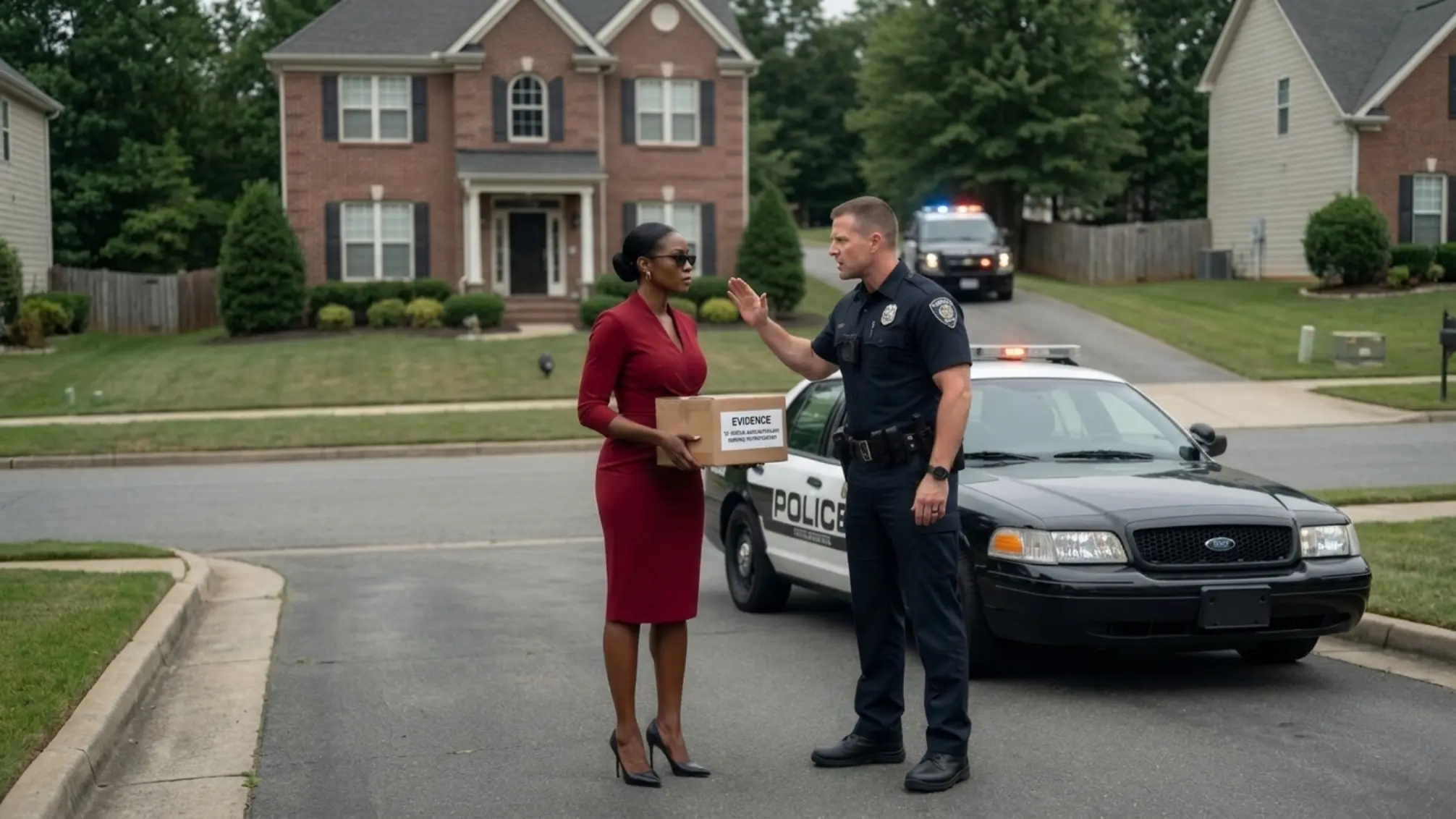
Simone did not retreat.
At thirty-nine, she had spent fifteen years prosecuting men who believed volume could replace evidence. Her fitted deep-red dress, black heels, and narrow sunglasses had apparently convinced Holloway she was wealthy enough to rob the neighborhood but not respectable enough to live there. She held a sealed cardboard evidence box against one hip while her other hand remained visible beside the leather folder containing her deed and identification.
“I told you this is my house,” Simone said.
“And I told you to put the package down.”
“It is addressed to me.”
“That is what porch thieves say.”
Simone glanced toward the patrol cruiser. Holloway’s body camera displayed a green operating light, though she noticed a strip of black tape partly covering the lens. The alteration was subtle enough that most people would miss it, but Simone had reviewed hundreds of hours of police footage and knew exactly what an unobstructed camera looked like.
“Remove the tape from your body camera,” she said.
Holloway’s expression tightened. “You don’t give me instructions.”
“No. Department policy does.”
He stepped closer. “You think wearing an expensive dress makes you smarter than the police?”
“I think owning this house makes me legally entitled to carry my own property through the driveway.”
A curtain moved inside the house across the street. Someone was watching, but nobody had come outside. Simone understood the calculation because she had seen it repeatedly in communities where officers like Holloway operated. Neighbors might later claim they had been uncomfortable, yet discomfort rarely became intervention while the person holding authority still appeared capable of retaliation.
Holloway pointed toward the box.
“Set it down.”
“No.”
“That was a lawful order.”
“Identify the law requiring a homeowner to surrender a sealed package on her own property.”
His jaw moved.
He had expected panic, not questions.
The call that brought him to Magnolia Court had supposedly come from a resident reporting a suspicious woman removing a package from a porch. Holloway arrived within three minutes and found Simone walking from the delivery truck toward her front door. She had signed for the package, thanked the driver, and turned toward the house when the cruiser blocked her driveway.
The delivery driver was already gone.
Holloway did not ask her name before accusing her.
He demanded identification, ignored the address printed on her license, and said anyone could possess stolen documents. When Simone offered to unlock the front door remotely through her phone, he claimed sophisticated thieves often studied homeowners before committing burglaries.
Every answer she provided became another reason to distrust her.
That pattern interested Simone professionally.
It frightened her personally.
“Place the box on the ground,” Holloway repeated. “Last warning.”
Simone’s grip tightened around the cardboard.
The package had arrived from the state’s digital evidence laboratory under restricted chain-of-custody procedures. It contained certified copies of body-camera recordings, arrest reports, dispatch logs, and financial records linked to an eighteen-month public-corruption investigation. Simone was the special prosecutor appointed to determine whether officers within Holloway’s department had planted narcotics, stolen cash, and falsified probable-cause statements during traffic stops.
Holloway did not know she led the investigation.
He also did not know his badge number appeared throughout the evidence inside the box.
“Call your supervisor,” Simone said.
“I am the senior officer on scene.”
“Then call someone with better judgment.”
His face reddened.
Across the street, a man lifted a phone above his garden fence and began recording. Holloway noticed, turned slightly, and changed his tone without changing his intent.
“Ma’am, I’m trying to resolve this peacefully.”
“You began by telling me Black women do not own houses here.”
“I never mentioned race.”
“You said ‘women like you.’”
“You’re twisting my words.”
“Your body camera recorded them.”
His eyes flicked toward the taped lens.
That movement confirmed the obstruction was intentional.
Holloway reached for the box.
Simone pivoted, keeping it beyond his hand.
“Do not touch evidence under seal.”
He froze.
“Evidence?”
“That is what I said.”
“What kind of evidence?”
“The kind you have no authority to open.”
Holloway’s suspicion became something sharper. He looked at the state laboratory label, the tamper-evident seal, and the initials printed beside the tracking number. Simone watched recognition form slowly behind his cold blue eyes.
He had seen similar labels before.
Possibly when investigators collected material from his department.
“You stole that from a government facility,” he said.
Simone almost laughed. “The delivery label contains my name and address.”
“I don’t care what the label says.”
“You should. Reading could have prevented this entire encounter.”
Holloway grabbed the box with both hands.
Simone released it rather than risk damaging the seal. He stepped backward triumphantly, holding the package as though the transfer proved his authority. The neighbor’s phone remained raised, and a second person had begun recording from a parked vehicle near the corner.
“Officer Holloway,” Simone said clearly, “you are now interfering with evidence connected to an active state investigation.”
“You’re under arrest for theft and obstruction.”
“On what probable cause?”
“You were seen taking a suspicious package.”
“From my porch.”
“We have not established that this is your residence.”
Simone opened the leather folder and held up the recorded deed.
“My name is printed at the top.”
“A document can be forged.”
She displayed her driver’s license.
“Same name. Same address.”
“Also potentially fraudulent.”
She unlocked her phone and activated the smart lock. The front door clicked open behind them.
Holloway glanced toward it.
“That proves you obtained access.”
Simone lowered the folder. “There is no fact you will accept because you did not stop me to investigate a burglary. You stopped me to prove your first assumption correct.”
“That accusation is going into my report.”
“Write carefully. Someone else will be reading it.”
Holloway placed the box on the hood of his cruiser.
The evidence seal remained intact.
For the moment.
He pulled a folding knife from his duty belt and extended the blade.
Simone stepped forward. “Do not open that.”
He smiled. “I’ll decide what is stolen and who leaves this street in handcuffs.”
“You were warned.”
He sliced through the evidence tape.
The sound was quiet.
Yet to Simone it carried the weight of a door closing permanently behind him.
Holloway opened the first flap and removed a black evidence binder marked with the state seal. A yellow cover sheet warned that unauthorized review could constitute obstruction, evidence tampering, or violation of a sealed judicial order.
He ignored it.
The first page contained an investigative summary.
His eyes moved across the heading.
COMMONWEALTH OF VIRGINIA
SPECIAL PUBLIC INTEGRITY INQUIRY
SUBJECT: OFFICER GRANT HOLLOWAY — BADGE 4172
Holloway stopped breathing.
Simone removed her sunglasses.
“Keep reading,” she said. “The officers behind you brought the warrant with your name on it.”
Three dark internal-affairs vehicles turned onto Magnolia Court.
They moved without sirens, followed by a state police sedan and an evidence-recovery van. Holloway looked over his shoulder, then back at the binder. His face lost color so quickly that the neighbor recording across the street lowered his phone in disbelief.
The lead vehicle stopped behind the cruiser.
Special Agent Lena Brooks stepped out wearing a charcoal suit beneath a tactical vest. Two state investigators followed her, while uniformed troopers positioned themselves near the street exits. None appeared surprised to find Simone there.
Brooks looked at the opened box.
Then at Holloway.
“Step away from the evidence.”
He closed the binder quickly. “This woman stole state property.”
Brooks approached. “That woman is Special Prosecutor Simone Carter.”
Holloway stared at Simone.
“No.”
Simone’s expression did not change.
Brooks continued. “She was appointed by the attorney general and the chief judge of the circuit court. The package was delivered to her residence under documented chain of custody.”
Holloway’s fingers tightened around the binder.
“She refused to identify herself.”
“I gave you my name, license, deed, and the opportunity to call a supervisor,” Simone said. “You rejected all of them.”
“You never said you were a prosecutor.”
“My profession was irrelevant to whether I owned this home.”
He looked toward the cameras surrounding them.
The arrogance that had filled his posture began to collapse.
Brooks removed a folded warrant from her vest.
“Grant Holloway, you are under arrest for conspiracy, evidence tampering, deprivation of civil rights under color of law, filing false reports, theft, obstruction of justice, and multiple counts related to the planting of controlled substances.”
Holloway backed toward the cruiser.
“This is retaliation.”
“The warrant was signed at seven this morning,” Brooks replied. “Hours before you arrived here.”
“She provoked me into opening that box.”
Simone looked at the sliced seal.
“I told you not to touch it four times.”
“You made me believe it was stolen.”
“You decided that before I spoke.”
Holloway reached toward his radio.
A trooper caught his wrist.
“Hands behind your back.”
“This is my scene.”
“Not anymore.”
The metal handcuffs closed around Holloway’s wrists while the people of Magnolia Court watched from porches, windows, and sidewalks. The officer who had threatened to arrest Simone was placed against his own cruiser and searched beneath the flashing lights he activated to intimidate her.
Investigators removed his service weapon, phone, body camera, and wallet.
Brooks held up the camera.
“Why is there tape over the lens?”
Holloway did not answer.
The silence strengthened another part of the case.
Eighteen months earlier, twenty-two-year-old Malik Harris had been driving home from his evening shift when Holloway stopped him for allegedly failing to signal. The patrol report claimed Malik appeared nervous, refused commands, and consented to a vehicle search.
The body-camera footage began after Holloway opened the driver’s door.
Malik’s attorney requested the missing minutes, but the department said the recording system suffered a technical failure. Officers later reported finding forty grams of methamphetamine beneath the passenger seat.
Malik had no criminal history.
He insisted the drugs were not his.
The prosecutor offered a plea agreement carrying eighteen months instead of a possible ten-year sentence. Frightened that a jury would trust two uniformed officers over him, Malik accepted.
His mother never believed the evidence.
She filed complaints, contacted journalists, and sent letters to state officials. Every response praised the department’s professionalism and referred her back to the same internal-affairs unit that had already cleared Holloway.
Then another driver reported a nearly identical stop.
A young nurse named Vanessa Lee was pulled over for a broken taillight. Holloway claimed to find narcotics in her glove compartment after ordering her to stand behind his cruiser. Her body-camera footage also began late.
Vanessa refused a plea bargain.
Her private attorney obtained surveillance video from a convenience store beside the traffic stop. The recording showed Holloway standing near the open passenger door with one hand inside his pocket moments before entering the vehicle.
The footage did not clearly show him planting drugs.
But it raised enough concern for the attorney general to appoint an outside prosecutor.
Simone accepted the case.
At first, the records suggested procedural misconduct rather than an organized scheme. Holloway’s camera repeatedly malfunctioned during searches, yet worked perfectly during ordinary patrol calls. His reports relied on identical language describing drivers as nervous, evasive, and physically tense.
Those phrases created probable cause.
They also appeared copied.
Simone’s team reviewed four years of stops.
Thirty-one cases involved drugs discovered after unexplained camera gaps. Twenty-six drivers were Black or Latino. Seventeen accepted guilty pleas because public defenders warned them that challenging a police officer without video could end badly.
The search expanded to evidence storage.
Packages seized during unrelated investigations were lighter when they reached the laboratory than when officers first weighed them. Some narcotics appeared in multiple cases under different evidence numbers.
Someone was removing drugs from the evidence room and planting them during stops.
Holloway’s access card opened the storage area late at night on eleven occasions. Each visit occurred days before a questionable arrest.
His partner, Officer Neal Denton, signed several logs.
A supervising lieutenant approved the reports without meaningful review.
The corruption had become routine because everyone involved believed the defendants lacked enough money or credibility to challenge it.
Simone reconstructed the operation carefully.
Holloway selected motorists driving older vehicles through affluent neighborhoods. He claimed minor traffic violations, ordered them from their cars, and created camera gaps by covering the lens or activating recording late. After planting narcotics, he seized any cash found during the search and underreported the amount.
A portion entered the evidence system.
The remainder funded private purchases through a landscaping company owned by his brother.
Holloway’s bank records showed payments on a boat, home renovations, vacations, and a rental property far beyond his salary. He claimed family gifts, but his relatives denied providing the money.
The strongest evidence came from Denton.
He contacted Simone secretly after learning investigators had requested access logs. Denton admitted writing false reports and standing lookout while Holloway planted drugs. He also revealed that Holloway kept copies of altered footage on a private drive because he enjoyed reviewing what he called “clean stops.”
Simone found the phrase chilling.
Nothing about the stops was clean.
The encrypted drive recovered from Holloway’s storage unit contained more than video. It held lists of motorists, photographs of seized cash, and messages discussing which neighborhoods offered the safest locations for searches without witnesses.
One message from Holloway read:
Rich street, poor driver. Nobody believes he belongs there.
When Simone read it, the words remained with her.
That morning outside her home, Holloway had repeated the same logic without knowing he had chosen the prosecutor leading his investigation.
Rich street.
Black woman.
Therefore, she could not belong.
His prejudice was not separate from his crimes.
It was the tool that made them possible.
After Holloway’s arrest, investigators searched his cruiser. Beneath the spare-tire compartment, they found two unlogged packets of methamphetamine, empty evidence bags, and a roll of black tape matching the strip over his body camera.
His phone contained messages warning Denton that the state was “getting close.”
Another message instructed him to delete traffic-stop backups and claim a software upgrade destroyed the files.
Holloway’s confrontation with Simone added new charges, but the investigation had already secured enough evidence to prosecute him.
Denton entered a cooperation agreement.
The supervising lieutenant resigned before being indicted, but resignation did not prevent arrest. Three evidence technicians were questioned, and one admitted ignoring irregularities because Holloway threatened her job.
The department’s leadership insisted the wrongdoing involved only a few officers.
Simone refused that explanation.
A system that dismissed thirty-one defendants, ignored repeated camera failures, and rejected every complaint was not innocent merely because only a few people planted the drugs. Many people had chosen comfort, loyalty, or institutional reputation over truth.
The false convictions began returning to court.
Malik Harris appeared first.
He stood beside Simone while the state moved to vacate his conviction. The judge reviewed the recovered video showing Holloway removing a packet from his uniform pocket before approaching Malik’s passenger door.
The conviction was dismissed.
Malik did not celebrate.
Outside the courthouse, reporters asked whether he felt vindicated.
“I told the truth before anybody believed me,” he said. “The system catching up does not make me more innocent today than I was then.”
His mother stood beside him crying.
Vanessa Lee’s charges were dismissed the following week. Her nursing license, suspended after the arrest, was restored, though she had already lost two years of income and professional standing.
Other defendants received hearings, compensation, and formal apologies.
None received their stolen time back.
Holloway’s trial began thirteen months later.
He entered the courtroom wearing a charcoal suit rather than a uniform. His attorneys argued that Denton was the true criminal and framed Holloway to secure leniency. They described the money in his accounts as family assistance and claimed the drugs inside his cruiser were emergency training samples.
The prosecution introduced inventory records proving no training samples had been assigned to him.
Then they played the private videos.
The jury watched Holloway cover his body camera, reach into his pocket, and place narcotics beneath a seat. They heard him laugh afterward while telling Denton that the driver would “take eighteen months before gambling on ten years.”
Several jurors looked away.
Simone testified about the investigation, the chain of custody, and the box delivered to her home. Holloway’s attorney tried to portray the driveway confrontation as proof that she held a personal grudge.
“You were offended by Officer Holloway’s assumptions,” he said.
“Yes.”
“You became angry.”
“Yes.”
“You wanted him punished.”
“I wanted the law applied to conduct already documented before he came to my house.”
“He called your ownership into question.”
“He ignored evidence of ownership.”
“You did not immediately reveal that you were a special prosecutor.”
Simone looked directly at the jury.
“Because a citizen should not need a powerful title to be believed when her license, deed, address, key, and open front door all confirm the truth.”
The attorney paused.
Simone continued before he could interrupt.
“If I had been a teacher, nurse, cashier, or unemployed woman carrying groceries, his conduct would still have been wrong. My office did not create my rights.”
The courtroom remained silent.
The defense played the neighbor’s complete recording of the driveway encounter, apparently hoping Simone’s calm resistance would appear confrontational. Instead, the jury heard Holloway dismiss every piece of verification and announce that women like her did not own houses in that neighborhood.
They watched him cut open the sealed box after repeated warnings.
They saw his expression when he discovered his own badge number.
The recording ended as internal-affairs vehicles entered the street.
The jury deliberated for seven hours.
Holloway was convicted of conspiracy, evidence tampering, civil-rights violations, theft, obstruction, false imprisonment, and filing fraudulent reports. The judge sentenced him to thirty-four years in federal prison.
During sentencing, Holloway offered a brief apology to the department and his family.
He did not apologize to the people he falsely imprisoned.
The judge noticed.
“You remain concerned with the consequences to your identity,” she told him, “while showing little understanding of the identities you deliberately erased beneath the word ‘suspect.’”
Denton received six years after cooperation.
The supervising lieutenant received twelve.
The department entered a federal consent agreement requiring independent review of body cameras, evidence storage, traffic searches, and civilian complaints. Officers could no longer deactivate or obstruct cameras without immediate written justification.
Simone returned to Magnolia Court after the final hearing.
The sliced evidence box remained inside her office as a trial exhibit, but the state returned the black binder once proceedings ended. She placed it on a shelf rather than hide it.
Not as a trophy.
As a warning.
Weeks later, Malik visited her home with his mother. They stood in the same driveway where Holloway attempted to arrest Simone, though no flashing lights disturbed the afternoon.
“You could have told him who you were sooner,” Malik said.
“I could have.”
“Why didn’t you?”
“Because you told him who you were during your stop.”
He understood immediately.
Malik had provided a license, employment badge, insurance card, and registration. Holloway disregarded all of them because his first assumption mattered more than the facts.
Simone continued. “I wanted to see whether evidence could change his mind when he thought I had no power over him.”
“It couldn’t.”
“No.”
Malik looked toward the porch. “Then what changed it?”
“Consequences.”
One year after Holloway’s conviction, the state established a legal fund for victims challenging suspicious traffic searches. Vanessa Lee became a member of its advisory board, while Malik began studying criminal justice at a local university.
Simone remained a prosecutor.
She did not become less cautious or less angry. She simply learned to use both emotions without allowing them to choose facts for her.
The neighbor who recorded the confrontation eventually apologized for not intervening.
“I thought filming was helping,” he said.
“It did preserve evidence.”
“But I could have said something.”
“Yes.”
The answer made him uncomfortable, but Simone had stopped protecting people from the discomfort required for growth.
On the anniversary of Holloway’s arrest, another package arrived.
The delivery driver placed it on the porch, captured a photograph, and left. Simone stepped outside wearing ordinary clothes and carried it inside without incident.
The box contained framed copies of the vacated judgments from every false case connected to Holloway.
Thirty-one names.
Thirty-one lives the officer had reduced to numbers because he believed nobody important would examine them closely.
Simone hung the frame inside the public-integrity office.
Beneath it, she placed a simple inscription:
Evidence does not become true when power accepts it. It was true before power arrived.
Grant Holloway stopped Simone outside her own home because he believed her red dress, skin, and expensive neighborhood formed a contradiction he was authorized to solve. He rejected her license, deed, keys, address, and open door because accepting any of them would require admitting his assumption was wrong.
Then he opened the box.
His badge number appeared on the first page.
His crimes filled the pages behind it.
And the woman he intended to place in handcuffs watched as officers arrived with the warrant that finally placed them on him.