The Police Sergeant’s hand remained twisted inside the Taxi Driver’s faded checkered collar as the woman in the red dress opened a small black leather wallet. Afternoon traffic moved past the yellow taxi, but the roadside itself became unnaturally quiet. Three uniformed officers stood several feet away, each of them aware that the Sergeant had demanded money without writing a citation. None had expected the ordinary passenger to hold a gold captain’s shield.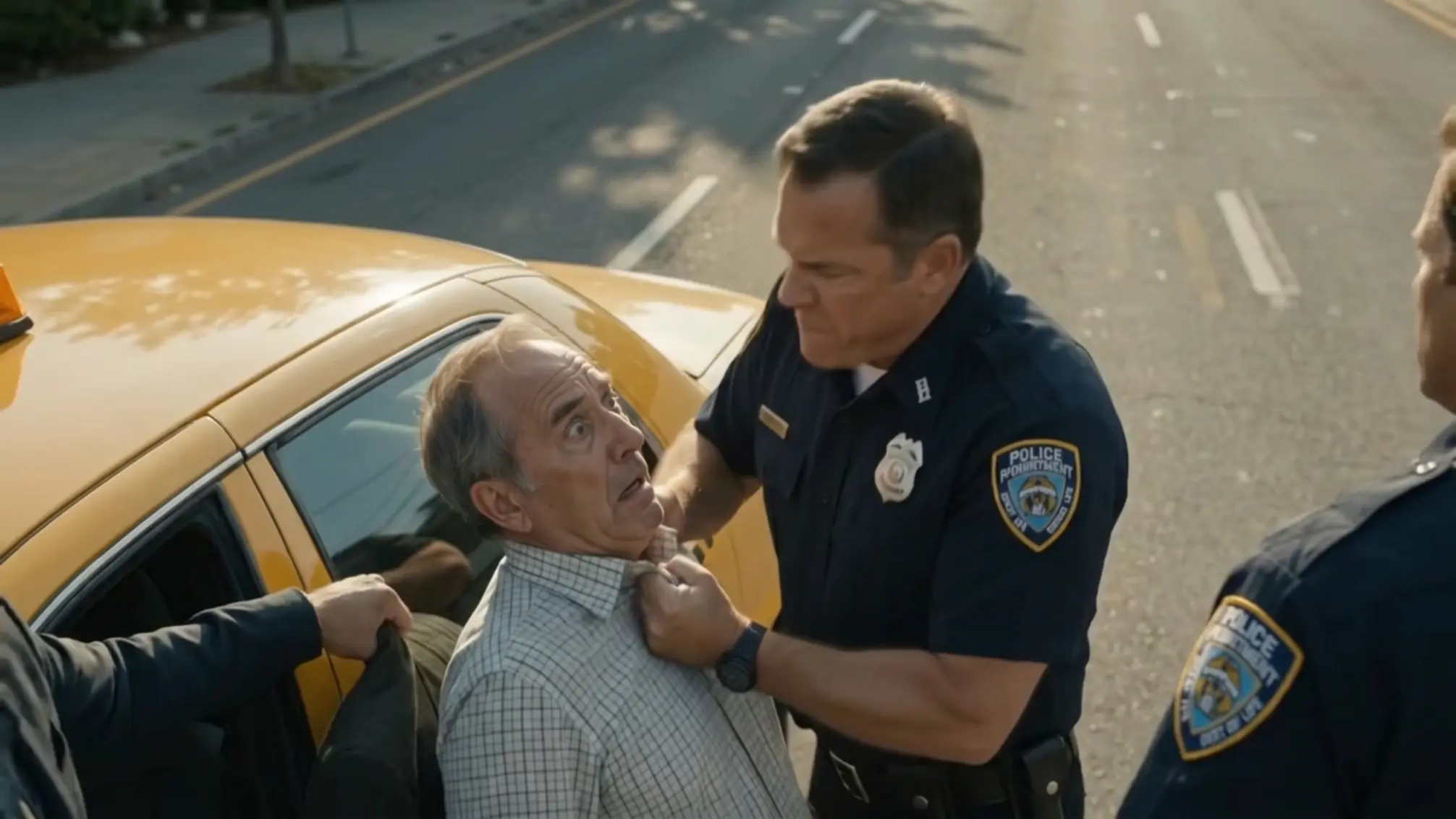
The Police Captain raised the badge until it caught the sunlight. She was thirty-nine, composed and attractive, with clear brown eyes, shoulder-length dark hair, and the steady posture of someone accustomed to command. Her fitted red dress and black heels had hidden her rank from everyone on the road. Beneath her calm expression, however, anger had been building from the moment the Sergeant first slapped the taxi roof.
“Captain, City Police Command,” she said.
The Sergeant released the Taxi Driver so quickly that the older man nearly fell against the open door. His aggressive expression disappeared, replaced by disbelief as he looked from the badge to the woman’s face. Behind him, the three officers snapped upright, but their sudden discipline came too late. They had already watched their supervisor threaten a frightened civilian and had chosen silence.
The Captain held her phone at chest height. A call had been active for almost seven minutes, connected directly to an investigator inside the Internal Affairs Division. Every demand, threat, insult, and confession had been recorded. The Sergeant had even stated that his decision was the only one that mattered on that road.
A voice came through the speaker.
“Captain, we have the full recording. Our units are approaching now.”
Two unmarked vehicles turned into the street.
The Sergeant stared at them, then looked toward his own officers as though expecting loyalty to protect him. One officer lowered his eyes. Another took two steps backward. The youngest of the three appeared pale, realizing the confrontation was no longer about a supposed traffic offense.
“This is a misunderstanding,” the Sergeant said.
The Captain moved between him and the Taxi Driver. “You demanded €500 without issuing a lawful citation.”
“He was speeding.”
“You inspected his documents and found no violation.”
“I observed dangerous driving.”
“You never checked the speed device in your patrol vehicle.”
The Sergeant’s jaw tightened. “Captain, you weren’t watching the road.”
“I was sitting directly behind him.”
The Taxi Driver leaned against the taxi, rubbing the red marks on his neck. He was sixty-two, with silver hair, tired blue eyes, and a lean body shaped by long hours behind the wheel. His shirt was clean but worn, and his open wallet still revealed only a few small notes beside a photograph of two children. Minutes earlier, the Sergeant had seen that photograph and reduced his demand from €500 to €300, not out of mercy, but because he believed he could take everything the man had.
The Internal Affairs vehicles stopped beside the patrol cars. Four investigators stepped out, led by a composed woman in a dark suit carrying an evidence folder. She approached the Captain first, confirmed that the live recording had been preserved, and then instructed the officers to separate.
The Sergeant refused.
“You cannot treat me like a suspect because of one heated conversation.”
The Internal Affairs Investigator glanced toward the Taxi Driver’s torn collar. “We are treating you like a suspect because your own words describe extortion, unlawful seizure, intimidation, and assault.”
“I was enforcing traffic regulations.”
“Then produce the citation.”
The Sergeant reached toward the ticket book clipped to his belt. Several pages inside had already been signed at the bottom but contained no driver names, vehicle details, speeds, or locations. The investigator photographed them before placing the book into an evidence bag.
The Captain asked the Taxi Driver whether he needed medical attention. He shook his head, although his hands were still trembling. His greatest fear was not the pain in his neck. It was that the Sergeant would find a way to take his taxi after the investigators left.
“This car is all I have,” he said quietly. “If I lose it, my children don’t eat.”
The Captain looked directly at him. “No one is taking your car.”
The Sergeant laughed once, but the sound lacked confidence. “You’re promising him too much. The vehicle may still be impounded.”
“On what legal grounds?”
“He was obstructing traffic.”
The Captain pointed toward the curb. “His taxi was fully stopped inside a marked passenger area when your officers surrounded it.”
The youngest officer finally spoke.
“That’s true.”
Everyone turned toward him.
The Sergeant’s expression hardened. “Be careful.”
The young officer swallowed but continued. He admitted the Taxi Driver had not been speeding. Their patrol unit had followed the taxi for less than a minute before the Sergeant ordered it stopped. No speed reading had been taken, and the driver had not crossed a lane marker.
The Sergeant stepped toward him.
The Internal Affairs Investigator blocked the path. “You will not approach or threaten a witness.”
“He is my subordinate.”
“Not during this investigation.”
The Captain had not entered the taxi that morning expecting to conduct an operation. She had left her uniform at home because her younger brother was getting married, and for one day she wanted to arrive as his sister rather than the senior officer whose presence changed every room. Her red dress had been chosen by the bride, and the overnight bag contained nothing more official than a makeup case, a folded jacket, and the badge she carried because department policy required identification during emergencies.
The Taxi Driver had unknowingly changed the day when he confessed that he usually avoided the district. He described officers who stopped drivers without evidence, demanded cash, and threatened to confiscate vehicles. The Sergeant’s name appeared repeatedly in his account, along with the same roadside location and the same €500 demand.
The Captain could have identified herself immediately and ordered a formal review. Instead, she contacted Internal Affairs quietly from the back seat and asked them to record the journey. She needed to know whether the Taxi Driver’s fear came from rumors or direct abuse.
The Sergeant provided the answer himself.
He had waved the taxi down without activating emergency lights, slapped the roof with his ticket book, and demanded payment before requesting identification. When the documents proved valid, he invented a second accusation and lowered the amount as though negotiating the price of stolen goods.
The investigators escorted him toward an unmarked vehicle.
“Am I under arrest?” he demanded.
“You are being detained while we preserve evidence.”
“I know people inside the ministry.”
The Internal Affairs Investigator opened the rear door. “You should save that sentence for your attorney.”
Before entering, the Sergeant looked back at the three officers.
“Say nothing.”
The young officer raised his head. “You told us that every time.”
The statement changed the investigation.
Internal Affairs separated all three officers and obtained individual accounts. The youngest admitted that roadside extortion had been happening for at least two years. The Sergeant chose taxi drivers, delivery workers, and tourists because they carried cash and feared losing their vehicles.
The routine was simple. A driver was accused of speeding, illegal parking, faulty documents, or dangerous behavior. The Sergeant demanded an immediate cash payment described as an unofficial reduced fine. If the driver refused, officers threatened arrest or called a towing company controlled by the Sergeant’s cousin.
The vehicle then accumulated storage fees until the owner paid.
The other two officers initially claimed they had never seen money exchanged. Investigators confronted them with the roadside recording and the Taxi Driver’s wallet. Both had been standing close enough to hear the Sergeant reduce the demand from €500 to €300 after seeing the driver carried only €50.
One eventually admitted receiving small payments for remaining silent.
The second requested an attorney.
Internal Affairs obtained emergency warrants for the Sergeant’s patrol locker, home, office, and personal accounts. Inside his locker, investigators found envelopes labeled with dates and street names. Several contained cash in amounts matching complaints filed by local taxi drivers.
They also found copied vehicle keys, unsigned seizure forms, and a notebook containing license numbers beside handwritten amounts.
The Taxi Driver’s registration appeared on the final page.
Beside it, the Sergeant had written: Yellow taxi—older driver—easy pressure.
He had noticed the vehicle days earlier and planned the stop.
The discovery proved that the confrontation was not an impulsive abuse of authority. The Sergeant had been tracking vulnerable drivers and deciding in advance how much money he could extract from them. The €500 demand had been calculated before the taxi entered the district.
Records from the towing company expanded the case. Forty-three vehicles had been removed from the area during the previous eighteen months, yet only twelve official towing requests appeared in police systems. The other vehicles were transferred through handwritten authorizations carrying the Sergeant’s signature.
Many belonged to taxi drivers.
One man paid €2,400 to recover a car taken after he refused a €500 roadside payment. Another lost his vehicle permanently because storage fees exceeded its value. The towing company later sold it to a used-car dealership connected to the Sergeant’s brother.
Complaints existed, but they had been closed without investigation.
Several were marked unsubstantiated by a precinct commander who had never interviewed the drivers. Internal Affairs discovered monthly transfers from the towing company to a consulting account controlled by the commander’s wife.
The scheme reached beyond one Sergeant.
By evening, the precinct commander and towing-company owner were also being questioned. Investigators seized financial records, phones, body-camera files, and dispatch logs before anyone could delete them.
The Captain remained on the roadside longer than she intended. Her brother’s wedding ceremony was approaching, and her phone displayed several missed calls from family members wondering why she had not arrived. Still, she refused to leave until the Taxi Driver’s statement had been recorded and his vehicle formally protected from seizure.
He looked at her red dress and finally understood where she had been going.
“You’re missing something important,” he said.
“So were you.”
“My problem can wait.”
“No. That is how men like him stay powerful. Everyone believes their own mistreatment should wait.”
The Taxi Driver lowered his eyes. “Your brother will be angry.”
“He knows what my job requires.”
The Captain called him.
Her younger brother answered before the first ring finished. She explained that she was safe, but an urgent police matter had delayed her. He listened, then asked one question.
“Did someone need you?”
“Yes.”
“Then come when you’re done.”
The ceremony was delayed by twenty minutes.
The Taxi Driver insisted on taking her to the wedding himself after investigators released the taxi. She initially refused because his hands still shook, but he said driving her safely would help him feel that the Sergeant had not stolen the entire day.
The Captain sat in the back seat once more.
This time, no one stopped them.
When they arrived at the wedding venue, the family waited near the entrance. Her younger brother walked down the steps in his suit and saw the tear in the Taxi Driver’s collar before noticing the police vehicles trailing behind them.
The Captain apologized for being late.
Her brother embraced her.
“You arrived,” he said. “That’s what matters.”
The Taxi Driver tried to leave quietly, but the bride saw him standing beside the taxi and invited him inside. He protested that he was not dressed for a wedding and did not belong among the guests.
The Captain looked at him. “You heard what happens when someone says another person doesn’t belong.”
He stayed through dinner.
For the first time in years, he ate without checking the taxi through a window every few minutes.
The criminal investigation continued for months. Internal Affairs reviewed every stop, fine, towing order, and property seizure connected to the Sergeant and his unit. More than seventy drivers came forward after news of his detention became public.
Their accounts shared the same language.
“Pay now.”
“Be grateful I lowered it.”
“Refuse, and I’ll take your car.”
Most victims had believed they were alone. When their stories were compared, the scale of the operation became undeniable. The Sergeant had treated the district like private territory and his uniform like permission to collect money from anyone too frightened to resist.
The three officers who witnessed the roadside assault faced different consequences. The youngest received protection after cooperating fully and revealing earlier incidents. He admitted that fear had kept him silent, but the Captain made clear that fear did not erase responsibility.
“You took an oath before he became your supervisor,” she told him.
He accepted disciplinary action and later testified against the Sergeant.
The officer who received payments was charged as part of the conspiracy. The third officer lost his position after evidence showed he had falsified reports and warned the Sergeant whenever complaints were filed.
The precinct commander was arrested for obstruction, financial fraud, and conspiracy. Banking records showed that he received a percentage from every unlawfully seized vehicle. In return, he closed complaints and reassigned officers who questioned the system.
One honest patrolwoman had been transferred to night desk duty after asking why cash fines were not appearing in official records. Her personnel file contained a false report accusing her of insubordination.
The Captain ordered the report removed.
The patrolwoman returned to active duty and later joined the department’s new anti-corruption unit.
The Sergeant denied everything through the early court hearings. His attorney argued that cash payments were voluntary settlements and that officers sometimes used discretion to resolve minor violations quickly.
Prosecutors played the recording.
“Because I said so.”
“My decision is the only one that matters here.”
The statements destroyed the idea that the payments were lawful or voluntary. The jury also saw photographs of the Sergeant gripping the Taxi Driver’s collar and heard three officers confirm that no speeding violation had occurred.
The notebook was even more damaging. Each driver had been categorized by age, occupation, vehicle value, and expected ability to resist. Older drivers and immigrants were marked as easy. Tourists received higher demands because the Sergeant believed they would pay rather than return for court.
The Taxi Driver testified near the end of the trial.
He wore a new checkered shirt purchased by his children, but carried the same wallet. When the prosecutor asked why he had not reported earlier incidents, he looked toward the jury.
“I drive to feed my family,” he said. “He wore the uniform I was supposed to trust. I thought reporting him would only tell him where to find me.”
The courtroom became silent.
The Sergeant was convicted of extortion, assault, conspiracy, unlawful seizure, falsifying records, and abuse of public authority. The commander and towing-company owner were also convicted. Funds recovered from their accounts and property were placed into a restitution program for affected drivers.
Several confiscated taxis were returned.
Others had already been sold or damaged beyond recovery, so victims received compensation based on verified value and lost income. False citations were removed, towing debts canceled, and criminal records created from retaliatory arrests were reviewed.
The department prohibited roadside cash payments entirely. Every fine now required a digital citation visible immediately in a central system. Vehicle seizures needed approval from an independent duty supervisor, and towing assignments rotated automatically among licensed companies.
Body-camera activation became mandatory before officers approached stopped vehicles. Failure to record required immediate review by a separate unit rather than the officer’s own commander.
More importantly, complaints from taxi drivers could no longer return directly to the precinct being accused. They were routed to an external civilian and Internal Affairs panel.
The reforms did not erase every injury.
Some drivers had lost years of savings. Others had abandoned the profession because the roadside no longer felt safe. One victim recovered his taxi but not the business contracts lost while it sat inside the corrupt towing yard.
The Captain refused to call the case a complete victory.
Justice was not complete simply because the Sergeant went to prison. It required rebuilding the trust his uniform had damaged.
She began meeting monthly with drivers’ associations, delivery workers, and transportation groups. Officers attended without weapons displayed and listened while civilians described what traffic stops felt like from inside the vehicle.
The Taxi Driver spoke during the first meeting.
He did not shout or demand revenge. He placed the photograph of his children on the table and explained that every euro taken from a working driver represented food, rent, medicine, or school expenses.
“When he looked into my wallet,” he said, “he did not see a father. He saw how little resistance I could afford.”
The young officer who had testified listened from the back of the room.
Afterward, he apologized.
The Taxi Driver did not forgive him immediately.
“You watched,” he said.
“I know.”
“You could have stopped him.”
“I know.”
“Then spend the rest of your career stopping the next one.”
The officer promised he would.
A year after the confrontation, the Captain entered another taxi outside police headquarters. She wore her full uniform this time, but the driver recognized her before turning around.
It was the same Taxi Driver.
His collar was clean and unbroken. A new digital permit rested beside the steering wheel, and a small framed photograph of his children had been attached to the dashboard.
The Captain asked how business was going.
“Better,” he said. “Not easy. Better.”
He had used his restitution payment to repair the taxi and clear several debts. His oldest child had started university, while the youngest was training as a mechanic.
The Captain smiled. “Where to?”
“My choice today.”
He drove toward the same district where the Sergeant once stopped him. The street appeared ordinary, filled with buses, taxis, pedestrians, and officers directing traffic. No one watching would have known that a corruption network had operated there.
At the roadside stood the young officer who had testified. He was helping an elderly driver replace a damaged tire. His body camera faced forward, and he spoke calmly while traffic passed.
The Taxi Driver slowed.
For several seconds, neither man spoke.
Then the driver continued.
The story later spread through the city as the day a corrupt Sergeant demanded €500 from the wrong passenger. People focused on the red dress, the gold shield, and the unmarked Internal Affairs vehicles turning onto the road.
The Captain remembered something different.
She remembered the almost-empty wallet.
She remembered the photograph of two children.
She remembered three officers watching in silence while a frightened man was slammed against the taxi that kept his family alive.
The badge inside her bag ended the roadside confrontation, but it was the Taxi Driver’s testimony that exposed the truth behind it. His courage brought dozens of other victims forward and forced the department to confront the system that had protected the Sergeant.
The corrupt officer believed power meant deciding who paid, who drove away, and who spent the night inside a cell.
He learned too late that real authority did not come from shouting the loudest or making frightened people obey.
It came with accountability.
And when the woman in the red dress opened her bag, she did not merely reveal the badge that ended his career.
She revealed every silent witness, every stolen payment, and every terrified driver he had believed would never be brave enough to speak.