The rain had not let up since sunrise.
It was not the kind of soft drizzle that made people feel poetic.
It was the sharp, bone-soaking kind that cut through layers of wool and cotton and patience.
The train station, tucked between two crumbling brick buildings on the edge of downtown, echoed with the distant clatter of heels on wet tile and the occasional announcement over the speakers that no one really listened to.
There were puddles in every dip of the concrete floor, and the gray morning light filtering through the high windows made everything look colder than it already felt.
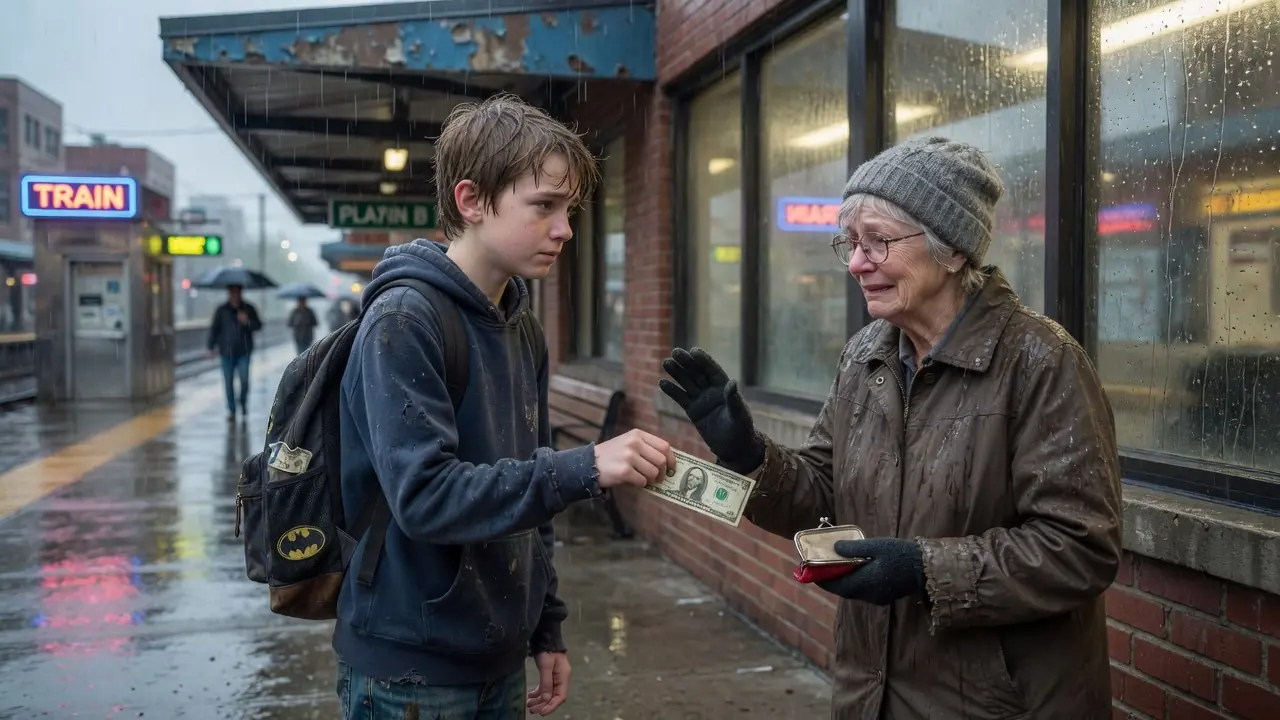
Caleb Brooks stood just under the narrow awning outside the platform entrance, trying to warm his fingers inside the sleeves of his old hoodie.
His jacket was too thin for weather like this.
It was not made for rain, wind, or the kind of cold that seemed to crawl into a person’s bones and stay there.
He was seventeen years old, but that morning, with his shoulders hunched and his backpack sagging against one side, he looked younger.
His hands curled tighter around the crumpled paper ticket in his right pocket and the single $10 bill in his left.
He had counted that bill five times already, like it might magically become more.
It had not.
That $10 was supposed to be his meal after the scholarship interview.
One small meal.
Not even something nice, just something hot enough to make his stomach stop twisting while he rode the train home.
But now, with the train due in less than ten minutes, he could already feel his stomach tightening with more than hunger.
His eyes flicked up to the arrival board and then back down again.
Still on time.
He shifted from one worn sneaker to the other, trying to keep moving, trying to keep the blood flowing.
The interview was across the city, and if he missed this train, he did not have the fare or the strength to try again tomorrow.
That scholarship was the last thread he had.
Everything else had already started to come apart.
His mother’s hospital bills.
The overdue rent.
The electricity warning notice taped to their apartment door.
His school counselor’s voice telling him that this interview could change his life if he simply showed up prepared.
Prepared.
Caleb almost laughed at that.
He had prepared as much as a boy could prepare while sharing a bedroom with his little brother, eating toast for dinner, and working nights washing dishes behind a diner.
Now it was just him, a damp hoodie, two printed recommendation letters in a plastic folder, and the $10 bill he was trying not to spend too soon.
A voice interrupted his thoughts.
Soft.
Hesitant.
“Excuse me.”
Caleb turned too fast, like someone used to being startled.
The old woman standing a few feet away looked worse than he did, which was saying something.
Rain had soaked through her pale gray coat, darkening the wool until it clung heavily to her narrow shoulders.
Her silver hair had slipped loose from its pins, and strands of it stuck to her cheeks.
One of her gloves was missing.
In her trembling hand, she clutched a small leather purse and a folded train schedule that had almost dissolved in the rain.
But it was her eyes that held Caleb’s attention.
Blue.
Tired.
Not wild or demanding.
Just scared.
Ashamed, maybe.
Or carrying the kind of sadness that made a person stop expecting help.
“I’m sorry,” she said again, almost whispering. “Someone took my wallet. I just need $10 to get home. I swear I will pay you back.”
Caleb blinked.
The moment felt too ordinary for how much it cost.
No drama.
No shouting.
No trick he could clearly see.
Just an old woman standing there, shivering in the rain, asking for the exact amount he barely had.
$10.
His last money.
The gap between him and not eating all day.
Between him and getting through the interview without feeling faint.
His first instinct was to step away.
People lied all the time.
He knew that.
He had seen men outside convenience stores make the same promise.
He had seen adults act helpless when they wanted something.
He had also seen people truly desperate enough to ask strangers for help because no one else would answer.
So he did not walk away.
Instead, he looked at her harder.
He noticed the way her lips trembled.
The way her fingers pressed against the wet leather purse like she was trying not to fall apart.
The way she kept glancing toward the ticket machines, then back to the tracks, as though the whole station had become a maze she no longer understood.
“Do you have a phone?” Caleb asked carefully.
The old woman shook her head.
“It is dead. I tried to call someone earlier, but I could not remember the number. Then the screen went black.”
Caleb swallowed.
“How do I know you’re not lying?”
“You don’t,” she admitted.
Her voice cracked on the last word.
“But I would not ask if I had another way.”
The honesty in that answer hurt more than a better excuse would have.
Caleb’s fingers tightened around the $10 bill in his pocket.
He thought about his mother.
He thought about her coming home after double shifts at the nursing home, feet swollen, eyes tired, still dividing food on plates so his little brother got the biggest portion.
He thought about what she always said when Caleb complained that kindness did not pay bills.
“No, baby. But cruelty charges interest.”
He closed his eyes for half a second.
Then he pulled out the bill.
“This is crazy,” he muttered, more to himself than to her.
The old woman watched his hand like it might disappear.
Her eyes widened as he held it out.
“I don’t know why I’m doing this,” Caleb said, his voice rough. “But I believe you.”
She took it carefully, as if it were made of glass.
For a moment, she did not speak.
Then her shoulders shook once.
“Thank you,” she whispered. “I promise I’ll pay you back.”
Caleb gave her a small, tired smile.
“Just get home safe.”
The train hissed into the station behind them.
The old woman clutched the bill and turned toward the ticket machine, moving slowly but with purpose.
Caleb watched until the crowd swallowed her.
Then she was gone.
His stomach growled almost immediately, as if angry at his decision.
He checked his ticket again.
His train was next.
He stepped onto the platform, shoes squeaking against wet concrete, and found a seat near the window.
As the train pulled away, the platform fading behind streaks of rain on the glass, Caleb let himself breathe.
He did not know if he had done the right thing.
He only knew he had not been able to look away.
Something in him still believed kindness was not wasted, even when it felt like it.
And somewhere deep down, beneath hunger and fear and exhaustion, something small stirred.
Not hope exactly.
Maybe just the place where hope could grow if the world gave it one inch of room.
The train ride did not warm him.
If anything, it made the emptiness in his stomach louder.
Caleb sat by the window with his backpack on his lap and his sleeves pulled over his hands.
His recommendation letters were still dry inside the plastic folder.
That felt like a victory.
Outside, the city blurred past in streaks of gray, brown, and silver.
With every stop, the memory of the $10 bill tugged at him.
Not with regret.
It was quieter than that.
A question.
A small voice asking whether one kind act mattered when everything else still seemed impossible.
The speaker crackled overhead, reminding passengers to check for personal belongings.
Caleb clutched his backpack tighter.
It held two letters, a notebook full of scholarship essays, a half-broken phone charger, and a granola bar wrapper he kept forgetting to throw away.
Not much.
But it was his.
He arrived at the office building twenty minutes late.
The lobby was bright and clean, full of people who smelled like coffee, perfume, and dry wool.
Caleb knew immediately that he looked wrong.
His hoodie was damp.
His hair was flattened by the rain.
His sneakers left faint wet marks on the polished floor.
The receptionist’s smile tightened the moment he approached.
“I’m here for the scholarship interview,” he said, trying to sound older than seventeen. “Caleb Brooks.”
She looked at her screen.
Then at him.
Then back at her screen.
“I’m sorry,” she said. “The interview panel has moved on to the next applicant. You were scheduled for 10:00.”
“I know. My train was delayed, and then I had to walk from the station because I did not have bus money. Please, I can wait. I just need five minutes.”
Her expression did not change.
“The panel has a full schedule.”
“I understand, but this scholarship is really important.”
“I’m sure it is.”
The words were polite, but empty.
Caleb stood there a moment longer, rain dripping from the ends of his sleeves.
A boy in a pressed shirt and clean shoes walked past him, carrying a leather folder.
The receptionist smiled warmly at that boy and said, “They’re ready for you.”
Caleb stepped back.
He understood.
Not completely, maybe.
But enough.
“We’ll call you if there is another opening,” the receptionist said.
They would not.
People always said that when they wanted you to leave quietly.
Caleb nodded once and walked back outside.
The rain had softened to a drizzle, but the wind was sharper now.
It cut through his damp hoodie and made his shoulders ache.
He did not have money for food.
He did not have good news for his mother.
He did not even have a working phone to pretend he was busy while he figured out what to do next.
The walk home took forty minutes.
His apartment building looked the same as always, tired brick, cracked steps, a front door that never latched properly.
But there was a yellow envelope taped to the door of their unit.
Caleb’s stomach dropped before he even touched it.
Final Notice.
Rent unpaid.
Three days to pay.
His mother was asleep when he entered, still wearing her work pants, curled on the couch with one arm over her eyes.
His little brother, Mason, sat at the kitchen table doing math homework with a pencil sharpened down to almost nothing.
“Did you get it?” Mason whispered.
Caleb looked at him.
The hope in his little brother’s face was too much.
“I don’t know yet,” Caleb said.
It was not quite a lie.
Not quite the truth either.
Mason nodded like he believed him.
Caleb went to the bathroom, closed the door, and sat on the edge of the tub.
He pressed both hands over his face.
For the first time all day, he let himself feel the full weight of what had happened.
The hunger.
The missed interview.
The $10 gone.
The rent notice.
The helplessness of being seventeen and already feeling like he was standing between his family and disaster with nothing but wet shoes and good intentions.
He did not cry.
Not then.
He just breathed until the tightness in his chest eased enough for him to stand.
That night, after his mother woke and saw the notice, she said nothing for a long time.
Then she put one hand on Caleb’s shoulder.
“We’ll figure it out.”
He hated those words.
Not because she meant them lightly.
Because she meant them with all her heart, and he knew she was running out of ways to make them true.
The next morning, Caleb woke before dawn.
He took an extra dishwashing shift at the diner before school.
By the time he reached class, his hands smelled like soap and grease no matter how hard he scrubbed them.
He tried to focus on history.
Tried to take notes.
Tried not to think about the scholarship panel moving on without him.
At lunch, he gave half his sandwich to Mason’s friend Eli, who had forgotten his lunch again.
“You need to eat too,” Eli said.
Caleb shrugged.
“I ate earlier.”
He had not.
But lying about hunger had become almost automatic.
After school, he went to the library.
It was warm, and warmth was free as long as you looked like you were studying.
He found a corner table and opened his notebook.
Instead of homework, he began writing a list.
Rent.
Electric.
Mother’s medicine.
Mason’s field trip.
Food.
The numbers did not add up.
They never did.
He leaned back and stared at the ceiling.
He wondered where the old woman was.
He wondered if she had made it home.
He wondered if she remembered him at all.
Then he felt ashamed for wondering.
Kindness was not supposed to come with a receipt.
Still, the thought remained.
Days passed.
The rent deadline came closer.
Caleb took extra shifts, skipped meals, and sold his old video game console for far less than it was worth.
It still was not enough.
On Thursday evening, he came home to find his mother sitting at the kitchen table with her head bowed over her hands.
The landlord had given them one more week.
One week.
That was mercy, maybe.
Or just delayed cruelty.
Caleb went to bed that night on the floor beside Mason’s mattress and stared at the cracked ceiling.
He thought about the old woman again.
Not with anger.
Not really.
Just with a strange ache.
He had given away the only money he had because someone needed help.
And now he needed help.
The world, however, did not seem to be looking in his direction.
The next morning was cold and gray.
Caleb stopped at Highland Park on his way to school because he needed five minutes alone before pretending to be okay.
He sat on a damp wooden bench near the north end of the park, hugging his backpack to his chest.
His socks were wet again.
His stomach was empty again.
The city moved around him like a machine that did not care whether he was inside it or crushed beneath it.
Joggers passed.
A woman pushed a stroller.
A man in a business coat stepped around a puddle and glanced at Caleb without really seeing him.
Caleb gave a dry little laugh.
“If I ever write a memoir,” he muttered, “I’m calling it How to Starve Politely While Maintaining Eye Contact.”
The sound of his own voice startled him.
He had not spoken out loud in hours.
That was when he noticed her.
An old woman walked slowly along the path.
She wore a deep green wool coat, a cream scarf, and sensible shoes.
Her silver hair was neatly pinned now.
Her posture was straighter than it had been at the station.
In one hand, she carried a small brown paper bag.
Caleb stared.
It took him a moment to recognize her without rain running down her face.
But the eyes were the same.
Blue.
Clearer now.
Still carrying sadness, but no longer lost inside it.
She stopped a few feet from the bench.
“Caleb Brooks,” she said softly.
His heart lurched.
“You remember my name?”
“I asked someone after I found my way home.”
Caleb slowly stood.
“You said you’d pay me back.”
“I did.”
She held up the paper bag.
“I also brought interest.”
Despite himself, Caleb blinked.
Inside the bag was a thick sandwich wrapped in wax paper, an apple, and a small carton of milk.
The smell of fresh bread nearly broke him.
“I can’t take that,” he said automatically.
“Why not?”
His pride rose fast and useless.
“Because I didn’t give you the money for food back.”
“I know,” she said. “That is why I came.”
Caleb looked at her.
Really looked.
The coat.
The polished shoes.
The quiet authority in her face.
“You’re not just some old lady who lost her wallet, are you?”
A small smile touched her mouth.
“I am certainly old. And I did lose my wallet. But no, I am not only that.”
She extended her hand.
“My name is Eleanor Dawson.”
Caleb knew that name.
It took a second, but then the memory clicked.
Dawson Foundation.
Dawson Center.
Dawson Housing Initiative.
His school had posters about one of her programs.
His mother had once applied for utility assistance through a Dawson community grant but had been waitlisted.
“You’re Eleanor Dawson?” he asked.
She nodded.
“I founded Dawson Community Trust twenty-five years ago. I have more money than I can spend, more buildings than I need, and still, on that morning, I found myself standing in the rain with no wallet, no phone, and no memory of the number I needed to call.”
Caleb did not know what to say.
Eleanor stepped closer and placed the bag gently on the bench.
“You gave me your last $10.”
He looked away.
“How do you know it was my last?”
“Because I have been poor before,” she said. “And because no one holds $10 that tightly unless it is standing between them and something important.”
Caleb swallowed.
“It was just money.”
“No,” Eleanor said. “It was trust. And trust is far rarer.”
He sat back down slowly.
She sat beside him, leaving enough space that he did not feel trapped.
For a moment, neither spoke.
The wind moved through the bare trees.
Finally, Eleanor said, “I went back to the station after my assistant found me. Security showed me the footage. I saw you miss your own train window. I saw you stand there, hungry and wet, and still give without making me beg.”
Caleb stared at the ground.
“I missed my interview.”
“I know.”
His head snapped up.
“How?”
“I called the scholarship office.”
His face flushed.
“You did what?”
“I asked why a boy named Caleb Brooks had not been seen.”
“They told you?”
“They told me enough. Then I asked more questions.”
“That’s embarrassing.”
“No,” Eleanor said firmly. “What is embarrassing is a system where a seventeen-year-old boy can lose his chance at a scholarship because he stopped to help an old woman who should have had a dozen people protecting her.”
Caleb’s throat tightened.
“I don’t need pity.”
“I did not bring pity.”
She reached into her coat pocket and removed a small envelope.
“I brought an invitation.”
He did not take it immediately.
“What kind of invitation?”
“To meet my board. To tell them what happened. To tell them what our programs miss when they measure need but fail to recognize character.”
Caleb gave a humorless laugh.
“I’m not boardroom material.”
“Neither was I at your age.”
He looked at her.
“You were poor?”
“Very.”
Eleanor folded her gloved hands in her lap.
“I grew up in a mining town in Pennsylvania. My mother cleaned houses. My father drank away whatever money came in. I left home at sixteen with fourteen dollars and a coat too thin for winter.”
Caleb was silent.
“I know what hunger does,” she continued. “I know what pride does. I know what it means to be seen only when someone wants to judge you.”
Her voice softened.
“That morning at the station, you saw me before you knew who I was. I would like to return the honor.”
Caleb stared at the envelope.
“What exactly are you offering?”
“A second interview with the scholarship committee. This afternoon, if you will accept. I have already spoken with them.”
His breath caught.
“And if they say no?”
“They will not.”
“That sounds like you’re buying it.”
“No,” Eleanor said. “I am reopening a door that should never have closed. What you do in the room will be yours.”
Caleb’s hands trembled slightly.
He tried to hide it.
Eleanor pretended not to notice.
“Eat first,” she said, nudging the paper bag toward him. “No one should defend his future on an empty stomach.”
He unwrapped the sandwich.
Turkey, cheese, mustard, lettuce.
Simple.
Fresh.
Real.
The first bite hurt, the way food sometimes did when hunger had gone on too long.
He blinked hard and chewed slowly.
Eleanor looked away to give him dignity.
That made him almost cry.
“Why are you doing all this?” he asked after a few bites.
“Because you reminded me of something I had forgotten.”
“What?”
“That good people still exist when no one is watching.”
The second interview happened in a glass-walled conference room downtown.
Caleb wore the cleanest shirt he owned.
Eleanor’s assistant had arranged for a car, but Caleb insisted on taking the train.
He said he needed to prove he could arrive on his own.
Eleanor did not argue.
She simply met him in the lobby.
This time, when the receptionist saw Caleb’s name, she stood.
“Mr. Brooks, they’re expecting you.”
Mr. Brooks.
He almost looked behind him.
The committee had three people.
A dean.
A program director.
A donor representative with silver glasses and a careful smile.
Eleanor sat at the end of the room, not speaking, only watching.
Caleb answered every question honestly.
He told them about his mother’s work.
His brother’s homework.
His dishwashing shifts.
His interest in urban planning and community design.
He told them he wanted to study how cities failed poor families and how they could be rebuilt to serve them better.
When the donor representative asked why he had missed the original interview, Caleb hesitated.
Then he told the truth.
“I stopped to help someone who needed help.”
The room went quiet.
The dean asked, “And knowing what it cost you, would you make the same choice again?”
Caleb looked at Eleanor.
Then he looked back at the committee.
“Yes,” he said. “Because if success means walking past people who are scared and alone, then I don’t want that kind of success.”
Eleanor’s eyes shone.
The scholarship was awarded that afternoon.
Full tuition.
Books.
Transit support.
A monthly living stipend.
Caleb did not speak when they told him.
He just sat there, hands flat on the table, as if any sudden movement might make the moment disappear.
Eleanor walked him outside afterward.
Rain had started again.
Soft this time.
Almost gentle.
“You earned it,” she said before he could protest.
“I only gave you $10.”
“No,” she said. “You showed me the kind of man you are becoming. That is worth far more.”
The scholarship changed things, but not everything at once.
Poverty did not vanish politely because a door opened.
The rent still had to be paid.
The lights still threatened to go off.
His mother still worked too many hours.
Mason still needed shoes.
But Eleanor Dawson was not the kind of woman who opened one door and called it mercy.
She visited their apartment the following week.
Not with cameras.
Not with reporters.
Just herself, her assistant, and two bags of groceries.
Caleb’s mother, Denise Brooks, stood in the doorway, proud and suspicious.
“We don’t take charity,” Denise said.
Eleanor nodded as though she respected that answer.
“Good. Then take partnership.”
Denise narrowed her eyes.
“What does that mean?”
“It means your son has been selected for a Dawson Community Trust scholarship. It also means our family stabilization program can help with rent arrears, utility debt, and job training support if you choose to apply.”
“We applied before. We were waitlisted.”
“I know,” Eleanor said. “That waitlist is one reason I am here.”
Denise looked at Caleb.
Caleb looked at the floor.
His mother exhaled slowly.
Then she stepped aside.
“Come in.”
That was how Eleanor Dawson became part of the Brooks family’s life.
Not all at once.
Not dramatically.
But steadily.
She helped Denise get connected to a better-paying position at a rehabilitation center.
She helped Mason enroll in an after-school program.
She made sure Caleb had a laptop, a train pass, and a winter coat that did not soak through in the rain.
Every time Caleb tried to say it was too much, Eleanor told him the same thing.
“Help is not humiliation. It is how communities survive.”
Caleb started college that fall.
He was not the loudest student in the room.
He was not the most polished.
But he listened deeply.
He noticed things others missed.
He noticed which bus shelters had broken lights.
Which neighborhoods had no grocery stores within walking distance.
Which public housing units had ramps too steep for wheelchairs.
Which families chose between heating bills and internet access their children needed for homework.
He began writing papers that professors kept after class to discuss.
By nineteen, he was working part-time with Eleanor’s foundation.
By twenty-one, he had helped design a pilot program called Safe Routes Home, mapping transit gaps for low-income students and elderly residents.
Eleanor watched him grow with quiet pride.
She never called him her project.
She never made him feel like a debt being repaid.
She called him her reminder.
“You remind me why I started,” she told him once.
Caleb smiled.
“You remind me not to quit.”
Years passed.
Caleb became known for speaking plainly in rooms full of people who preferred polished language.
At twenty-eight, he was hired as director of community design at Dawson Community Trust.
He redesigned programs from the inside out.
No more applications that required internet access from families who could not afford internet.
No more meetings held downtown during working hours when the people most affected were on shift.
No more “outreach” that looked like charity from above.
He built listening circles.
Mobile support vans.
Emergency transit cards.
Scholarships that included food, housing, and mental health care.
Eleanor was older now.
Her steps were slower.
Her memory sometimes slipped in small ways, though she remained sharp when it mattered.
One rainy afternoon, Caleb found her sitting alone in the foundation courtyard, staring at a folded train schedule in her lap.
For a second, he saw her as she had been that first morning.
Cold.
Lost.
Proud.
Afraid.
He sat beside her.
“You okay?”
She looked at him and smiled faintly.
“Did I ever pay you back?”
Caleb laughed softly.
“Many times.”
“No,” she said, touching the schedule. “The $10.”
He reached into his wallet and pulled out a laminated bill.
The same $10.
Eleanor had returned it to him years earlier, preserved between plastic, with a note that said:
For the boy who gave before he knew the ending.
Caleb had carried it ever since.
He placed it in her hand.
“You paid it back by making sure I had a future.”
Eleanor’s fingers closed around the bill.
“Good,” she whispered. “I would hate to still owe interest.”
He smiled, but his throat ached.
The next year, Eleanor passed away peacefully at the age of eighty-four.
Her funeral filled an entire church.
Business leaders came.
Politicians came.
Families came.
Former scholarship students came with children of their own.
Denise Brooks sat in the front row beside Caleb and Mason.
When Caleb stood to speak, he held the laminated $10 bill in his hand.
“My story with Eleanor Dawson began at a train station,” he said. “She was cold, lost, and frightened. I was poor, hungry, and late for an interview that I thought would decide my future.”
He paused.
“I gave her my last $10. At the time, I thought I was giving away the only thing I had. But Eleanor taught me that kindness does not subtract from a life. It multiplies.”
The church was silent.
“She could have repaid me with money and ended the story there. Instead, she repaid me with belief. She saw me. She saw my family. Then she challenged me to spend my life seeing others.”
Caleb looked at the crowd.
“Eleanor Dawson was wealthy, yes. But her greatest gift was not money. It was attention. She noticed who was being ignored. She listened to people others dismissed. She understood that a person does not need to be perfect to deserve help. They only need to be human.”
His voice thickened.
“She once told me that help is not humiliation. It is how communities survive. I have carried those words into every room, every program, every decision. And I will carry them for the rest of my life.”
Years later, Dawson Community Trust opened a new center beside the same train station where Caleb and Eleanor first met.
It was called The Open Platform.
Inside were food services, emergency travel funds, scholarship counseling, family support offices, and a warm waiting room open to anyone who needed shelter from the rain.
Near the entrance, behind glass, hung the laminated $10 bill.
Under it was a small plaque.
One act of kindness can become a doorway.
Caleb stood in front of that display on opening day, now a grown man with silver beginning at his temples.
His mother stood beside him, older but healthier.
Mason stood nearby with his own children.
A reporter asked Caleb if he considered himself proof that charity worked.
Caleb shook his head.
“No,” he said. “I’m proof that dignity works. Charity gives from a distance. Dignity sits beside you in the rain.”
That evening, after the ceremony ended, rain began falling again.
Caleb stayed behind to lock up.
As he stepped outside, he noticed an old man standing near the ticket machines, patting his coat pockets with rising panic.
People walked around him.
Busy.
Distracted.
Unseeing.
Caleb stopped.
He smiled softly.
Then he walked over.
“Sir,” he said gently. “Are you all right?”
The old man looked at him, embarrassed and afraid.
“I think I lost my wallet.”
Caleb reached into his pocket.
He did not have the original $10 anymore.
That one belonged behind glass now.
But he had another bill.
Another small beginning.
He held it out.
“Here,” Caleb said. “Get home safe.”
The old man stared at him.
“I’ll pay you back.”
Caleb smiled.
“Maybe you will. Maybe you’ll pay it forward.”
The rain fell softly around them.
The station lights glowed against the wet concrete.
And somewhere in the echo of trains, announcements, footsteps, and remembered kindness, Eleanor Dawson’s legacy lived on.
Not in money.
Not in buildings.
Not even in the name carved above the door.
But in the simple courage of one person choosing not to walk away.
Because sometimes a boy gives his last $10 to a lost old woman.
Sometimes that old woman comes back and opens a future.
And sometimes the smallest kindness becomes the first brick in a life no one saw coming.