The evening air was crisp in the west side of Cincinnati, carrying the faint scent of grilled onions, fresh bread, and rain-soaked pavement from the narrow row of restaurants along Harper Street.
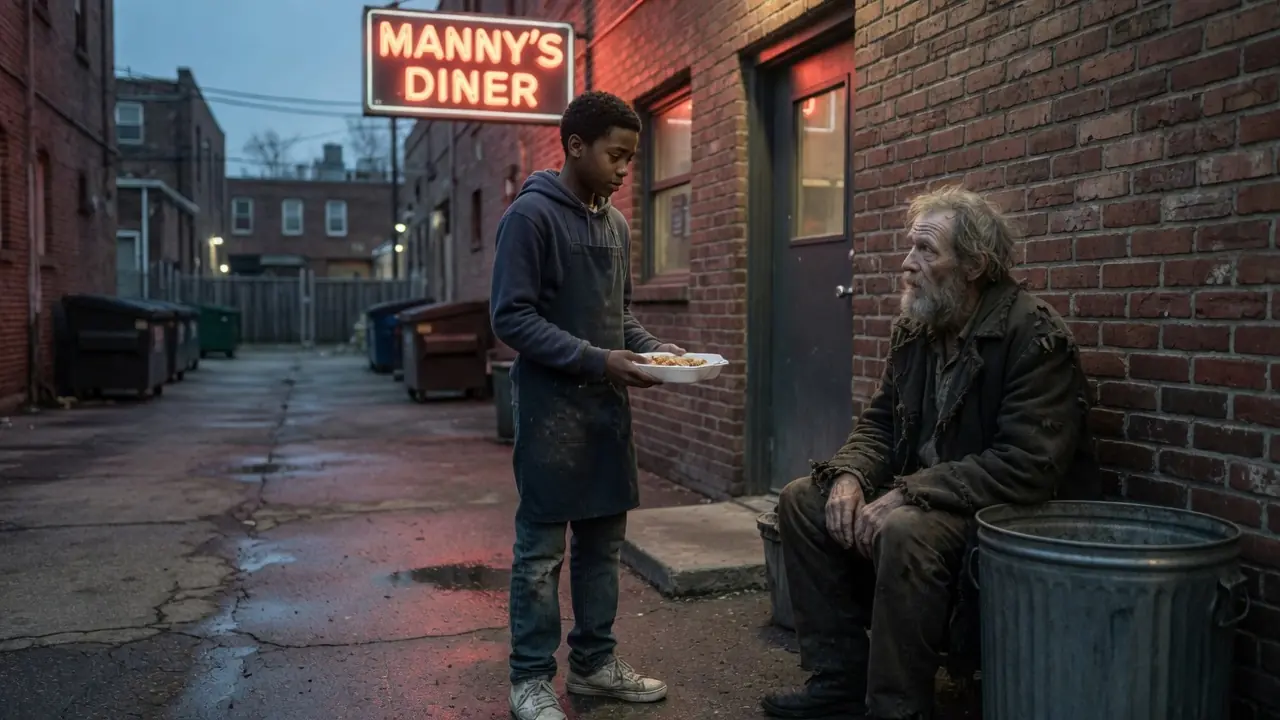
The neon sign above Manny’s Diner buzzed softly in the growing dark, its red letters flickering every few seconds like a tired heartbeat that refused to stop.
Inside, the last customers had already left, the booths were wiped clean, the coffee pots were cooling, and the old jukebox in the corner had finally gone silent after playing the same three songs all afternoon.
Behind the diner, in the dim alley where the brick walls held the day’s dampness long after sunset, thirteen-year-old Ethan Parker pushed open the back door with his shoulder and stepped outside carrying a garbage bag nearly half his size.
His arms ached.
His feet hurt.
His stomach was empty enough to make him feel lightheaded.
But he did not complain.
Ethan was used to being tired.
He had been working after school at Manny’s Diner for nearly six months now. Not officially, not on paper, because he was still too young for most of the work Manny let him do, but everyone in the neighborhood understood how things really were. Manny paid him a little cash at the end of each week to sweep floors, wipe tables, refill napkin holders, carry dishes, take trash out, and do whatever else needed doing when the diner got busy.
It was not much money.
But it helped.
And in Ethan’s house, help mattered.
He lived with his mother, Sarah Parker, and his younger sister, Naomi, in a small apartment above a closed laundromat three blocks away. Their building had old pipes, thin walls, and windows that rattled whenever a truck passed too close to the curb. In the winter, the heat worked only when it felt like it. In the summer, the rooms trapped the air until it felt thick enough to chew.
But it was home.
Sarah worked as a cleaner at an office building downtown during the day and sometimes took extra evening shifts at a hotel when the rent was due. Naomi was eight years old and bright in the way some children are bright even when life keeps trying to dim them. She drew flowers on the backs of old receipts, sang while washing dishes, and still believed her brother could fix almost anything.
Ethan tried hard to be worthy of that belief.
He was a poor boy in a city that had taught him early how invisible some people could become. He knew what it felt like to walk into a store and be watched too closely. He knew what it felt like when grown men spoke to his mother like she was less than them because her uniform smelled faintly of cleaning chemicals. He knew what it meant to count coins before buying milk, to stretch cereal with extra water, to pretend he was not hungry so Naomi would eat the last piece of toast.
At thirteen, Ethan had already learned many things children should not have to learn.
But he had also learned one thing from his mother that he carried like a rule carved into his bones.
“Hard times don’t give you permission to have a hard heart,” Sarah always said.
Ethan had heard those words so many times he could almost say them in her voice.
That evening, as he dragged the garbage bag toward the dumpster, he was thinking about the math homework waiting in his backpack and the cold walk home. He had a dollar and twenty-three cents in his pocket, half a leftover biscuit wrapped in a napkin, and an ache in his shoulders that made him feel older than thirteen.
He lifted the lid of the dumpster and was about to throw the bag inside when something moved near the alley entrance.
Ethan froze.
At first, he thought it was just a pile of discarded blankets beside the brick wall. People sometimes left things there: broken umbrellas, torn coats, plastic bags filled with empty cans. But then the shape shifted, and a thin hand reached into a small trash can near the diner’s back steps.
The hand trembled badly.
Ethan lowered the garbage bag.
A man was crouched beside the trash can.
An old man.
He was hunched over as if his body had folded in on itself from cold and exhaustion. His coat was torn at the sleeve, the fabric dark with stains and weather. His gray beard was tangled, his hair uneven, and his shoes looked too large for his feet. One shoe had a split near the toe, revealing a sock so worn it had almost become thread.
The old man pulled something from the trash.
A piece of bread.
He looked at it with a strange, distant concentration, as if he could not quite decide whether it was food or memory.
Ethan stood still, gripping the garbage bag tighter.
He had seen homeless people before. Everyone in the neighborhood had. Some slept under the bridge near the bus depot. Some stood outside stores with cardboard signs. Some drifted through alleys after closing time, hoping restaurants had left something edible behind.
Most people looked away.
Not always because they were cruel.
Sometimes because looking too closely made them feel responsible.
Ethan knew that feeling. He felt it now.
He should have thrown the trash away and gone back inside. Manny had warned him more than once not to get involved with strangers in the alley. His mother had warned him too, not because she lacked compassion, but because she had learned that poor people had to be careful with every risk they took.
Still, something about this old man made Ethan pause.
Maybe it was the way he held the bread without eating it.
Maybe it was the confusion in his face.
Maybe it was the way his eyes moved over the alley as if he had woken up in a world he no longer recognized.
Ethan swallowed.
“Sir?”
The old man did not respond.
Ethan took one cautious step closer.
“Hey, sir. Are you okay?”
This time, the man looked up.
His eyes were pale blue and cloudy, but not empty. They were lost, yes, but searching. Searching for a place, a name, a reason. His mouth opened slightly, then closed.
For several seconds, neither of them spoke.
Then the man nodded once.
It was not convincing.
Ethan looked at the bread in his hand.
“You hungry?”
The old man’s gaze dropped to the bread, then back to Ethan.
He seemed embarrassed.
That embarrassed look did something to Ethan.
He knew hunger. He knew what it felt like to pretend you were fine when your stomach was turning itself inside out. He knew the shame of needing something and not wanting anyone to see.
“Wait here,” Ethan said.
The old man blinked.
Ethan set the garbage bag down beside the dumpster and hurried back inside the diner.
Manny was in the kitchen, counting the register money while the cook, Luis, scraped the grill.
“You forget something?” Manny asked without looking up.
Ethan opened the refrigerator and found the tray of food that would be tossed out at closing. Two leftover burgers, some fries, a container of soup, and half a piece of pie from the display case.
“Manny,” Ethan said carefully, “can I take some of the leftovers?”
Manny looked up over his glasses.
“For your family?”
Ethan hesitated.
Manny’s eyes narrowed, but not with anger. Manny had owned the diner for twenty-two years and had seen every kind of need walk through his doors. He could tell when a boy was about to lie, and he could tell when a boy was trying not to.
“There somebody outside?”
Ethan looked down.
“An old man. He was looking in the trash.”
Luis stopped scraping the grill.
Manny sighed heavily and rubbed his forehead.
“Ethan.”
“I know,” Ethan said quickly. “I know I’m not supposed to, but he’s really old. He looks sick. And confused.”
Manny stared at him for a long moment.
Then he waved one hand.
“Take the burger and soup. Not the pie.”
Ethan looked up.
Manny grunted.
“Fine. Take the pie too. But don’t make a habit of feeding the whole city out my kitchen.”
“Thanks, Manny.”
“And don’t bring him inside,” Manny called after him. “I don’t need problems tonight.”
Ethan grabbed the food, found a plastic spoon, and hurried back into the alley.
The old man had not moved. He still crouched near the trash can, bread in hand, his shoulders shaking slightly from the cold.
Ethan crouched a few feet away and held out the styrofoam container.
“Here,” he said. “This is better.”
The old man stared at the food.
His eyes moved from the container to Ethan’s face, then back again, as if trying to understand why a stranger would give him something warm.
Slowly, he reached out.
His fingers brushed Ethan’s.
They were icy.
“Thank you,” the man whispered.
His voice was hoarse, barely more than air.
Ethan sat on an overturned crate while the man ate. He did not eat quickly. He took small careful bites, as if his body had forgotten how to accept food without fear. Every now and then, he paused and closed his eyes.
The soup seemed to steady him.
After a few minutes, Ethan asked, “What’s your name?”
The man froze.
The spoon remained halfway to his mouth.
His brow furrowed.
“I...” He looked down at the soup. “I know it.”
Ethan waited.
The man closed his eyes tightly.
“I know it,” he repeated, but this time his voice trembled.
“It’s okay,” Ethan said. “You don’t have to—”
“Henry,” the man said suddenly.
His eyes opened.
“I think... Henry.”
“You think?”
The old man’s face filled with shame.
“It comes and goes,” he said. “Some mornings I know things. Some mornings everything is fog. I remember pieces. A house. A piano. Someone calling my name. Then it slips away.”
He lifted one hand to his temple. Ethan noticed a faint scar near his hairline.
“What happened?” Ethan asked.
Henry’s fingers trembled against the scar.
“I fell. Maybe. Or someone found me after I fell. I woke up somewhere cold. People asked questions. I couldn’t answer. Then I started walking.”
“How long ago?”
Henry shook his head.
“I don’t know.”
The alley suddenly felt colder.
Ethan looked toward the street, then back at Henry.
“You don’t have family?”
“I...” Henry stared at the brick wall across from him. “I feel like I do. But I can’t see their faces.”
The words landed hard.
Ethan imagined forgetting his mother’s face. Naomi’s laugh. The apartment window. Manny’s diner. His own name.
It scared him more than he expected.
“You can’t stay out here,” Ethan said.
Henry looked up.
Ethan heard his mother’s voice in his head.
Hard times don’t give you permission to have a hard heart.
He also heard her other voice, the tired practical one that counted rent money and worried about electricity.
They could barely feed themselves.
They had one couch, one small table, and no space for an old man whose past had disappeared.
But Henry was shivering.
And the night was getting colder.
Ethan stood.
“Come with me.”
Henry stared at him.
“What?”
“My mom might get mad,” Ethan admitted. “But she won’t let you sleep outside.”
Henry’s lips parted, but no words came.
Ethan picked up his backpack, grabbed the garbage bag, and tossed it quickly into the dumpster.
“Come on,” he said. “Before I change my mind.”
Henry struggled to stand. Ethan reached out instinctively, then stopped, unsure whether the old man would want help.
Henry accepted it.
His hand felt light and fragile in Ethan’s grip.
They walked through the alley and out onto Harper Street. The diner sign buzzed behind them. Storefronts were closing one by one, metal gates sliding down, lights switching off. Ethan kept glancing back to make sure Henry was still with him.
The old man walked slowly, but he kept going.
They passed a bakery, a corner store, and the bus stop where Ethan sometimes waited when rain was too heavy for walking. A group of teenagers laughed outside a convenience store. One of them glanced at Henry and made a face.
Ethan stepped slightly closer to the old man.
Not enough to be obvious.
Enough to say he was not alone.
By the time they reached the apartment building, Sarah Parker was already home.
The light in their kitchen window glowed pale yellow through thin curtains.
Ethan stopped at the bottom of the stairs.
His stomach tightened.
Henry looked at him.
“You don’t have to,” the old man said quietly.
Ethan looked up at the window.
“My mom says if you start doing the right thing, you better not quit halfway.”
Henry’s eyes softened.
Ethan climbed the stairs and opened the apartment door.
Warmth, thin but real, met them. The smell of canned soup and onions filled the room. Naomi sat at the table coloring on the back of an envelope. Sarah stood near the stove in her work uniform, her hair wrapped in a scarf, her feet still in slip-resistant shoes.
She turned when the door opened.
“Ethan, you’re late.”
Then she saw Henry.
Her expression changed immediately.
Not fear.
Not exactly.
But alertness.
The kind mothers carried when danger might be near their children.
“Ethan,” she said slowly. “Who is this?”
Naomi looked up.
Ethan swallowed.
“This is Henry. I found him behind Manny’s. He was hungry. He doesn’t remember where he lives.”
Sarah looked from Ethan to Henry.
Henry stood just inside the door, shoulders hunched, eyes lowered, holding the empty food container like proof he had already taken too much.
“I’m sorry,” he said. “I shouldn’t have come.”
Sarah’s face tightened.
For one second, Ethan thought she would tell him to leave.
Instead, she stepped aside.
“Close the door,” she said. “You’re letting the heat out.”
Ethan obeyed quickly.
Sarah took another bowl from the cabinet.
“We don’t have much,” she said, ladling soup. “But what we have, we can share.”
Henry stared at her.
Naomi whispered, “Mama, is he staying?”
“Tonight,” Sarah said.
Then she looked at Henry.
“If that’s all right with you.”
Henry’s eyes filled so suddenly Ethan looked away.
“Yes, ma’am,” he whispered.
Sarah set the bowl on the table.
“Sit down, Mr. Henry.”
It had been a long time since anyone had called him Mister.
Ethan saw the old man’s face shift at the sound, as if the word itself had touched some buried part of him.
He sat.
Naomi slid her drawing to the side and watched him with open curiosity.
“Do you like soup?” she asked.
Henry looked at the bowl.
“I think I do.”
Naomi frowned.
“You think?”
“Naomi,” Sarah warned softly.
But Henry gave a faint smile.
“It’s all right. Sometimes I forget things.”
Naomi considered that.
“I forget spelling words.”
Henry nodded gravely.
“That sounds serious.”
“It is,” Naomi said. “Especially Wednesday words.”
For the first time, Henry laughed.
It was a small laugh, rusty and surprised, but it filled the room like a candle being lit.
Sarah turned back to the stove, and Ethan saw her wipe quickly at one eye with the back of her wrist.
That night, Henry slept on the couch beneath an old quilt Sarah had patched three times. Ethan slept on a mat on the floor beside Naomi’s bed because the apartment had no other space. He stared at the ceiling for a long time, listening to the quiet sounds of the household: his mother washing the last dishes, Naomi breathing softly, Henry shifting on the couch.
He wondered who Henry had been.
He wondered if anyone was looking for him.
He wondered if he had just made their already difficult life harder.
But when he closed his eyes, all he could see was Henry in the alley, holding that stale piece of bread as if he did not know whether he deserved to eat it.
Ethan did not regret bringing him home.
Not yet.
The next morning, Ethan woke to the smell of coffee.
For one confused second, he thought his mother had made some, which would have been unusual because coffee was expensive and Sarah saved it for days when she needed to stay awake through a double shift.
Then he heard a soft clatter from the kitchen.
He rose quietly and walked out.
Henry stood by the stove.
He wore the same worn clothes from the night before, but Sarah had given him one of Ethan’s old hoodies to wear beneath his coat. It was too small in the shoulders, but warmer than what he had.
On the counter sat three pieces of toast, lightly browned, and a small pot of oatmeal.
Henry turned, startled.
“I didn’t mean to wake you.”
Ethan blinked.
“You cooked?”
Henry looked down at the toast as if surprised by it himself.
“I suppose I did.”
“You remembered how?”
Henry was quiet.
“My hands did.”
Sarah appeared in the doorway behind Ethan, already dressed for work.
She looked at the food on the counter.
Then at Henry.
“You didn’t have to do that.”
Henry folded his hands in front of him.
“I wanted to help.”
Sarah studied him carefully.
Then nodded.
“All right. Thank you.”
That became the beginning of Henry staying.
Not officially.
No one said it that way.
But one night became two. Two became a week. A week became something that looked almost like routine.
Henry slept on the couch. Sarah brought home a secondhand sweater from the donation box at the office building. Naomi drew him pictures and taped them to the wall above the couch. Ethan walked with him to Manny’s Diner in the mornings because Henry had asked if he could come.
Manny was not pleased.
At first.
“You brought him back?” Manny asked, wiping his hands on a towel as Ethan and Henry stood near the diner entrance.
“He wants to help,” Ethan said.
Manny looked Henry up and down.
“With what? Falling over?”
Henry straightened as much as he could.
“I can wipe tables. Sweep. Wash dishes slowly, perhaps.”
“Perhaps,” Manny repeated.
Ethan looked at him pleadingly.
Manny grumbled under his breath.
“You’re not on payroll,” he told Henry. “I can give you meals and coffee. That’s it.”
Henry nodded.
“That’s more than fair.”
“And if you break dishes, Parker pays for them.”
“Hey,” Ethan protested.
Manny pointed at him.
“You brought him.”
But Henry did not break dishes.
He worked slowly, but carefully. He wiped tables with a focus that made each surface shine. He folded napkins evenly. He lined salt and pepper shakers in perfect pairs. When customers left, he gathered plates without rushing, moving as though the small dignity of work mattered.
At first, customers stared.
Some looked away.
Some whispered.
A few complained.
One woman asked Manny if he had “started hiring street people now.”
Manny looked at her over the register.
“You want coffee or commentary?”
She did not complain again.
Henry never reacted to the whispers. Or if he did, he kept it hidden.
But Ethan noticed something.
When Henry worked, he seemed less lost.
His eyes focused. His back straightened. He moved with purpose, as if the routine gave his mind a path to follow.
And sometimes, memory flickered.
One afternoon, as Ethan struggled with his math homework during a quiet hour at the diner, Henry passed behind him and stopped.
“That answer is wrong,” Henry said.
Ethan looked up.
“What?”
Henry pointed at the notebook.
“You carried the two incorrectly. Try again from here.”
Ethan stared.
“You know algebra?”
Henry looked surprised.
“I... apparently.”
Manny, who was pouring coffee nearby, snorted.
“Well, look at that. Old man’s got school left in him.”
Henry sat beside Ethan and helped him through the problem. His explanations were patient and clear. He did not make Ethan feel foolish. He asked questions that guided him to the answer instead of simply giving it away.
By the end of the week, Ethan was bringing homework to Henry every afternoon.
Naomi followed soon after.
“Mr. Henry,” she asked one evening at home, holding up a spelling worksheet. “What does necessary mean?”
Henry paused.
“Necessary means something you need. Something important enough that life becomes harder without it.”
Naomi thought about that.
“Like dinner?”
“Yes.”
“Like Mama?”
Henry smiled.
“Especially like Mama.”
Sarah, standing at the sink, turned away quickly.
The apartment changed in ways no one expected.
Henry fixed the loose leg on the kitchen table using an old screw and a butter knife. He repaired Naomi’s broken drawer. He organized the bills by due date because, he said, “Panic becomes smaller when it has categories.” He showed Ethan how to stretch soup without making it taste watered down. He taught Naomi a song he said he remembered from somewhere, though he could not remember who had sung it to him.
For the first time in a long while, their apartment felt less like a place where people were barely surviving and more like a place where people were living.
But Henry’s memory remained uncertain.
Some days, he knew his name clearly.
Other days, he woke frightened and did not know where he was.
On those mornings, Sarah would sit across from him at the table and speak gently.
“You’re in our apartment, Henry. You’re safe. Ethan brought you here. I’m Sarah. That’s Naomi.”
Henry would grip the edge of the table until his breathing slowed.
Then shame would settle over him.
“I’m sorry,” he would whisper.
Sarah always answered the same way.
“You don’t apologize for being lost.”
Ethan heard it every time.
And every time, he loved his mother a little more.
One Thursday afternoon, nearly three weeks after Henry first appeared in the alley, Ethan took the trash out behind Manny’s Diner and saw a piece of paper stuck to the wet pavement near the dumpster.
He almost ignored it.
Then he noticed the face.
He bent down and picked it up.
It was a missing person flyer.
The edges were torn. The ink had faded slightly from rain, but the photo was clear enough.
An older man.
Neatly dressed.
Clean-shaven except for a trimmed gray beard.
Standing beside a garden fence, smiling gently at the camera.
Ethan’s breath stopped.
It was Henry.
The name beneath the photograph read:
MISSING: HENRY THOMPSON
Last seen three months ago near Westbrook Avenue.
Memory impairment possible.
Family desperately searching.
Reward offered for information.
Please contact William Thompson.
There was a phone number and an address printed at the bottom.
Ethan stood in the alley with his heart pounding.
Henry had a family.
Not just maybe.
Not just somewhere in the fog of his mind.
A real family.
A real home.
People searching for him.
Ethan ran back inside so quickly the door slammed against the wall.
Manny looked up.
“What now?”
Ethan ignored him and crossed the diner toward Henry, who was wiping down booth four.
“Henry,” Ethan said, breathless.
The old man looked up.
Ethan held out the flyer.
“I found this.”
Henry took the paper slowly.
At first, his face showed only confusion.
Then his eyes sharpened.
His mouth opened.
The rag slipped from his hand and fell to the floor.
“I know this,” he whispered.
Ethan stepped closer.
Henry touched the photograph with one trembling finger.
“That’s me.”
“Yes,” Ethan said softly.
Henry’s breathing changed. Quick. Uneven.
His hand moved to the address.
“I know this street.”
“You do?”
Henry looked up.
For the first time since Ethan had met him, the old man’s eyes were not cloudy.
They were afraid.
Hopeful.
Awake.
“This is my home,” Henry said.
The diner seemed to go quiet around them.
Manny came from behind the counter, wiping his hands on his apron.
“Well,” he said gruffly, though his voice was softer than usual. “What are you waiting for?”
Ethan looked at him.
“I’m still on shift.”
Manny rolled his eyes.
“Go, Parker.”
“But—”
“Don’t make me say something nice. Take him home.”
Ethan grabbed his jacket.
Henry was already moving toward the door, clutching the flyer like it was the only thing keeping him attached to the world.
The address was too far to walk, so Ethan used nearly all the money in his pocket for bus fare. Henry sat beside him near the back of the bus, both hands folded tightly over the flyer. He stared out the window, eyes moving over each passing street with growing urgency.
“Do you remember anything?” Ethan asked quietly.
Henry did not answer at first.
Then he said, “A porch. White railing. A woman laughing in the kitchen.”
“Your wife?”
Henry shut his eyes.
“Maybe.”
The bus carried them across town, away from the worn streets Ethan knew and into neighborhoods with larger houses, clean sidewalks, and lawns that looked carefully kept even in the cold.
Ethan felt suddenly aware of his faded hoodie, his scuffed sneakers, the smallness of his own world.
Henry leaned forward when the bus turned onto Westbrook Avenue.
His breathing hitched.
“That’s it,” he whispered.
Ethan looked.
At the end of the block stood a large white two-story house with dark shutters, a wide porch, and warm light glowing through the front windows.
Henry stood before the bus fully stopped.
Ethan followed him off.
They walked toward the house slowly at first, then faster. Henry’s steps were uneven, but he moved with a purpose Ethan had never seen in him before.
At the porch, Henry stopped.
His hand hovered over the doorbell.
“What if...” His voice broke.
Ethan stood beside him.
“What if what?”
Henry looked at him, terrified.
“What if they stopped looking?”
Ethan thought of the flyer.
The word desperately.
The phone number.
The reward.
“They didn’t,” he said.
Henry pressed the doorbell.
For a few seconds, nothing happened.
Then footsteps sounded inside.
The door opened.
A man in his early thirties stood there wearing a wrinkled dress shirt, sleeves rolled to his elbows. His face looked tired in a way Ethan recognized from his mother’s face after hard days. But when he saw Henry, every part of him changed.
His eyes widened.
The color drained from his face.
“Dad?”
Henry made a sound Ethan would never forget.
Half sob.
Half breath.
Half memory returning from a place too far away.
“William,” Henry whispered.
The younger man stepped forward.
Henry’s knees nearly gave out.
William caught him before he fell.
For one second, they stood frozen like that.
Then William wrapped both arms around his father and held on with a desperation that made Ethan’s throat ache.
“Dad,” William choked. “Dad, where were you? We looked everywhere. We never stopped looking.”
Henry clung to him.
“I got lost,” he whispered. “I’m sorry. I got lost.”
William shook his head fiercely.
“No. No, don’t apologize. You’re home. That’s all that matters.”
Ethan stepped back.
This moment did not belong to him.
He turned to leave quietly, but William noticed.
“Wait,” he called.
Ethan froze.
William looked at him over Henry’s shoulder.
“You brought him here?”
Ethan nodded awkwardly.
“I found the flyer.”
William’s eyes filled.
“What’s your name?”
“Ethan.”
Henry turned, still holding his son’s arm.
“He fed me,” Henry said. “He and his mother gave me a place to sleep. He brought me back.”
William stared at Ethan as if he did not know how to measure what he owed.
“Come inside,” he said.
Ethan shook his head quickly.
“I should go. My mom’s waiting.”
“At least let me drive you.”
“It’s okay.”
But Henry reached out and took Ethan’s hand.
“Please,” he said.
Ethan looked at the old man.
Then nodded.
Inside the house, everything felt like another world. Hardwood floors. Framed photographs. A piano near the window. A staircase with polished railings. On a table near the door were stacks of missing flyers, the same ones Ethan had found, printed in bundles.
A woman came running from another room.
She was older than William, maybe his aunt or Henry’s sister, and when she saw Henry, she covered her mouth and began to cry.
More voices followed.
More footsteps.
Within minutes, the house filled with emotion so strong Ethan felt overwhelmed by it.
People hugged Henry.
People cried.
People called others.
Someone said, “He’s alive.”
Someone else kept repeating, “Thank God.”
Ethan stood near the wall, unsure what to do with his hands.
William returned to him after making a phone call.
“I’m taking my father to be checked by a doctor tonight,” he said. “But first, I need your address.”
Ethan stiffened.
“Why?”
“Because I need to thank your mother.”
“You don’t have to.”
William’s face softened.
“I do.”
Henry sat in an armchair wrapped in a blanket, his eyes tired but clearer. He looked at Ethan.
“Let him,” he said.
Ethan gave the address.
William insisted on driving him home.
The ride back was quiet. Ethan sat in the passenger seat of a car nicer than any car he had ever been inside. He kept his hands folded in his lap, afraid to touch anything.
William glanced at him.
“How old are you?”
“Thirteen.”
“And you work at the diner?”
“Yes, sir.”
“You found my father behind that diner?”
Ethan nodded.
“He was hungry.”
William’s jaw tightened.
“We searched shelters. Hospitals. Bus stations. We put up flyers. Hired people. Called every place we could think of.” His voice roughened. “I kept thinking maybe he was gone.”
Ethan looked down.
“He helped us too,” he said.
William looked at him.
“At the diner. At home. He fixed things. Helped me with homework. Helped my sister with spelling.”
A small smile crossed William’s face through his grief.
“That sounds like him.”
“What did he do before?” Ethan asked.
William’s hands tightened slightly on the wheel.
“My father built Thompson Community Foods. It started as one grocery store. Then two. Then a chain of neighborhood markets and diners. He believed food businesses should serve people who actually lived nearby, not just customers with money.” William paused. “He stepped back from the company a few years ago after his memory began getting worse. Then one afternoon he walked out during a confused spell and disappeared.”
Ethan stared at him.
Henry had not just been someone’s father.
He had been someone important.
But Ethan thought of him wiping tables at Manny’s, sleeping beneath their patched quilt, patiently explaining algebra.
Important suddenly seemed like the wrong word.
Henry had already been important before Ethan knew any of that.
William pulled up outside Ethan’s apartment building.
Sarah was waiting near the window. She came downstairs the moment Ethan stepped from the car, worry written across her face.
“Ethan Parker, where have you been?”
Then she saw William.
Ethan explained quickly.
Sarah’s expression changed from worry to shock to quiet relief.
“He found his family?” she whispered.
“Yes, ma’am,” William said. “Because of your son. And because of you.”
Sarah looked uncomfortable with the praise.
“We just gave him soup and a couch.”
William’s eyes glistened.
“You gave him dignity when he had nothing else.”
Sarah was silent.
William reached into his coat and pulled out a business card.
“I know this is sudden,” he said, “and I don’t want to overwhelm you. My father needs care tonight, and there will be doctors and family and a lot to sort through. But I would like to come back tomorrow. If you’ll allow it.”
Sarah looked at the card.
Then at Ethan.
Then back at William.
“All right,” she said carefully.
The next day, William returned.
Not alone.
Henry came with him, looking tired but clean, wearing a navy sweater and a wool coat. He moved slowly, but when Naomi opened the door and shouted, “Mr. Henry!” his face broke into the warmest smile Ethan had ever seen.
Naomi threw her arms around him.
Henry bent carefully and hugged her back.
“I remembered your spelling words,” he said.
Naomi gasped.
“Even Wednesday words?”
“Especially Wednesday words.”
Sarah laughed softly.
William stood in the doorway holding a folder.
They sat at the kitchen table, the same wobbly table Henry had repaired.
William looked around the small apartment, not with judgment, but attention. He saw the bills stacked near Sarah’s elbow. The flickering kitchen light. The blankets folded neatly despite wear. The careful dignity of a family doing its best with too little.
“My father told me what you did,” William said. “All of it.”
Sarah shook her head.
“We did what anyone should do.”
“But not everyone does,” Henry said quietly.
The room went still.
Henry looked at Ethan.
“You saw me when most people would have looked away.”
Ethan shrugged, embarrassed.
“You were hungry.”
“Yes,” Henry said. “And you fed me.”
He looked at Sarah.
“You gave me a place to sleep.”
Then Naomi.
“And you gave me spelling words.”
Naomi nodded solemnly.
“That was important.”
Henry smiled.
William opened the folder.
“I’m not here to embarrass you or make you feel like this is charity,” he said. “My father was very clear about that. He wants to help in a way that honors what you gave him.”
Sarah’s shoulders stiffened.
“We don’t take handouts.”
“I understand,” William said. “That’s why this is not a handout.”
He placed one paper on the table.
“Thompson Community Foods owns several diners and grocery markets across the state. We’re opening a small community market and café in this neighborhood next year. We need a local operations coordinator. Stable salary. Benefits. Training included. Mrs. Parker, my father thinks you would be perfect for it.”
Sarah stared at him.
“I clean offices,” she said.
“You manage a household, work long hours, stretch limited resources, and raised a son who brought a stranger home instead of walking away,” Henry said. “That is management.”
Sarah’s eyes filled.
William placed another paper down.
“And Ethan,” he said, turning to him, “my father would like to fund your education through a scholarship trust. School supplies, tutoring, college if you choose it. No pressure. No conditions beyond staying in school and becoming whatever kind of man you decide to become.”
Ethan could not speak.
Naomi looked between everyone.
“Does that mean Ethan can stop working so much?”
Silence fell.
Sarah covered her mouth.
Ethan looked down quickly, but not before Henry saw the tears in his eyes.
“I like working,” Ethan muttered.
Henry leaned forward.
“Work is honorable,” he said gently. “But a child should not have to carry a family on his back.”
Ethan’s face crumpled.
He hated that Henry understood.
Sarah reached for her son and pulled him close.
For a long moment, no one spoke.
The flickering kitchen light hummed above them.
Then Henry said softly, “You helped me find my way home. Let me help you find yours.”
That was how everything began to change.
Not all at once.
Life rarely changes cleanly.
Sarah took the job after three days of prayer, hesitation, and long conversations with Ethan. At first, she felt out of place in the training office, sitting beside people with college degrees and polished shoes. But she learned quickly. She understood people. She understood neighborhoods. She understood hunger and pride and the difference between help that humiliates and help that restores dignity.
Henry insisted those were the exact skills the company needed.
Ethan kept working at Manny’s only on Saturdays, and Manny pretended not to miss him during weekday afternoons.
“You got school,” Manny said gruffly. “Don’t waste it.”
But when Ethan came in on weekends, Manny always had a plate waiting.
Naomi got new shoes before winter. Not expensive ones, but new. Shoes that did not pinch her toes. She wore them around the apartment for two days because she liked the sound they made against the floor.
Their kitchen light was fixed.
The overdue bills stopped piling up.
Sarah slept better.
Ethan did too.
Henry visited often.
Sometimes with William. Sometimes alone with a driver and strict instructions from his doctor not to wander anywhere without telling someone.
He still had memory trouble. Some days were clear. Some days were cloudy. But he remembered Ethan. He remembered Sarah. He remembered Naomi’s spelling words.
And every time he came to Manny’s Diner, he insisted on wiping at least one table.
Manny would grumble, “You own half the grocery stores in the state and you’re still trying to steal my job?”
Henry would answer, “I was good at this one.”
One spring afternoon, Thompson Community Foods announced the new neighborhood market and café would be named Parker’s Table.
Sarah protested immediately.
“No,” she said. “Absolutely not.”
Henry smiled.
“It was already decided.”
“By who?”
“Me.”
“You don’t get to name a whole business after us.”
“I believe I do,” Henry said. “I own the building.”
Ethan laughed so hard Sarah had to glare at him.
But the name stayed.
Parker’s Table opened on a bright Saturday morning in June. The storefront was clean and welcoming, with wide windows, affordable groceries, a small café counter, and a community board filled with job postings, tutoring flyers, and neighborhood announcements.
Sarah stood near the entrance in a blue blouse, nervous and proud.
Ethan wore a button-down shirt Naomi had helped pick. Naomi carried a small bouquet of flowers and kept telling everyone she was “basically management.”
Henry arrived with William just before the ribbon cutting.
He looked older than he had months earlier, but stronger too. His cane tapped gently against the sidewalk as he approached Ethan.
“You ready?” he asked.
“For what?”
Henry looked at the crowd gathering outside: neighbors, customers, reporters, Manny, Luis, Mrs. Alvarez from upstairs, and half the regulars from the diner.
“For what comes after kindness,” Henry said.
Ethan thought about the alley.
The trash can.
The piece of stale bread.
The old man who had looked forgotten by the world.
Then he looked at his mother standing in front of a business she helped run, at Naomi smiling with new shoes and bright eyes, at William watching his father with gratitude, at Manny pretending he had dust in his eyes.
“I think so,” Ethan said.
Henry put a hand on his shoulder.
“You did not save me because I was important,” he said. “You saved me because I was hungry.”
Ethan looked up at him.
“That matters more,” Henry continued. “Remember that. The world will always tell you some people are worth more than others. Don’t believe it.”
Ethan nodded.
Sarah called him over for the ribbon cutting.
Henry stepped back and let the Parker family stand in front.
Sarah held the scissors, but her hands trembled.
Ethan placed his hand over hers.
Naomi placed her hand over Ethan’s.
Together, they cut the ribbon.
The crowd clapped.
Parker’s Table opened its doors.
Years later, people in the neighborhood would tell the story many different ways.
Some would say a poor boy found a rich man in disguise.
Some would say fate brought Henry Thompson to that alley.
Some would say Ethan Parker was lucky.
But Ethan never liked those versions.
Because they missed the point.
Henry had not looked rich in that alley.
He had not looked powerful.
He had not looked like someone who could change anyone’s life.
He had looked cold.
Hungry.
Lost.
And Ethan had helped him anyway.
That was the real story.
Not that kindness had been rewarded with money.
Not that the old man turned out to be important.
The real story was that he had always been important, even when no one knew his name.
He was important when his hands shook around a styrofoam container.
He was important when he slept under a patched quilt.
He was important when he wiped tables for no pay because he needed to feel useful.
He was important before the suit, before the house, before the company, before anyone recognized him.
Ethan understood that now.
So did Sarah.
So did Naomi.
And Henry, on his clearest days, would sit at the corner table of Parker’s Table, sipping coffee and watching the neighborhood move around him with quiet satisfaction.
Sometimes a hungry person came in unable to pay.
Sarah always fed them.
Sometimes a tired mother needed a job.
Sarah always listened.
Sometimes a child came after school because home was too quiet or too hard or too far away.
Naomi, now older, always found them a snack.
And Ethan, who grew taller and stronger and eventually earned a scholarship no one in his family had ever dreamed possible, never forgot the alley behind Manny’s Diner.
He never forgot the lesson that had changed his life.
A person does not need to know someone’s full story to offer kindness.
A person does not need to have much to give something.
And sometimes, when you help someone find their way home, you discover that home was never just a place.
It was the people who refused to leave you lost.
For Henry, that had been Ethan.
For Ethan, it had become Henry.
And for an entire neighborhood, it became Parker’s Table, a warm place on Harper Street where the coffee was always fresh, the lights always stayed on, and no one was ever treated like trash simply because life had left them searching through it.
The world had looked at Henry Thompson and seen a helpless old man.
Ethan Parker had looked at him and seen a human being.
That made all the difference.
And because of that one choice, one poor boy, one lost old man, and one struggling family changed each other’s lives forever.