The storm came down on Pine Hollow, Kentucky, like the sky had finally given up holding itself together.
Rain hammered the rooftops, rushed along the gutters, and turned the narrow dirt roads into brown rivers. The wind screamed through the trees behind the trailer park, bending the old pines until their branches scraped against windows like tired fingers begging to be let inside.
Twelve-year-old Caleb Turner sat at the kitchen table of trailer number seventeen, doing his math homework by the weak yellow light above the stove.
The power had already flickered three times.
 His mother, Rachel Turner, stood near the sink, wrapping a towel around a leak in the window frame. She was still wearing her blue housekeeping uniform from the motel, her hair damp from the walk home, her face pale with exhaustion.
“Mom,” Caleb said quietly, “you should sit down.”
Rachel forced a smile. “I will, baby. Just need to stop this water first.”
Caleb looked around their small home. The couch had a blanket over one torn arm. The heater rattled when it worked, and tonight it barely did. A pot sat under a drip in the hallway. The refrigerator was almost empty except for eggs, half a loaf of bread, and a small container of soup Rachel had made the night before.
Still, to Caleb, this place was home.
It was the place where his mother kissed his forehead every morning before work. It was the place where she taught him never to look down on anyone, because poverty could touch a person’s wallet without touching their soul.
Outside, thunder cracked so loudly the floor trembled.
Caleb jumped.
Rachel turned from the window. “It’s okay. Just thunder.”
Then they heard it.
A faint knock.
Not on the front door.
On the side wall.
Caleb froze. “Did you hear that?”
Rachel listened.
For a moment, there was only rain.
Then came another sound.
A weak voice outside.
“Help... please...”
Rachel’s eyes widened.
Caleb pushed back his chair. “Someone’s out there.”
“Caleb, wait.”
But he was already grabbing his old raincoat from the hook.
Rachel hurried after him as he opened the door. Wind rushed in, cold and sharp. Rain sprayed across the floor. Caleb squinted into the storm.
At first, he saw nothing.
Then lightning flashed.
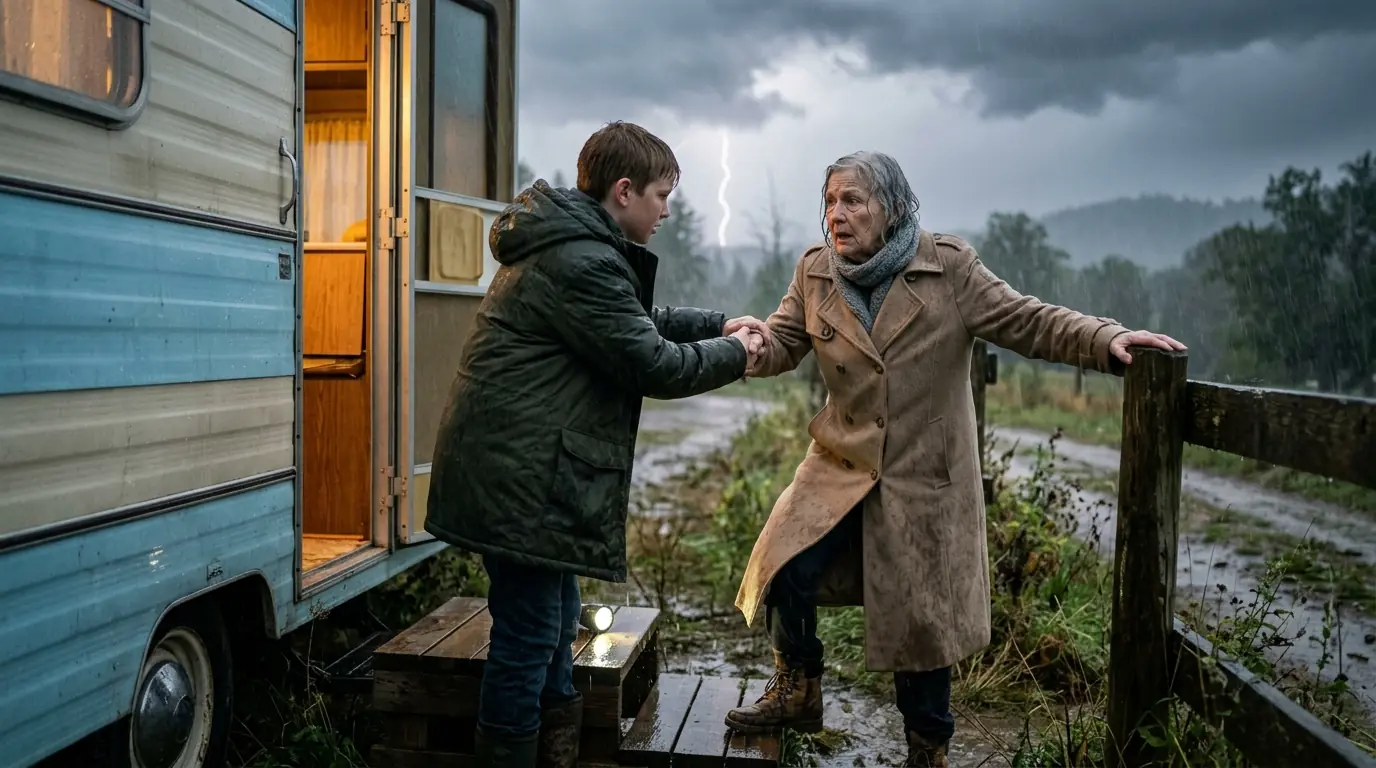
Near the broken fence, beside the muddy road, stood an elderly woman in a soaked beige coat. Her gray hair clung to her face. One hand held a small purse against her chest. The other pressed against the fence as if it was the only thing keeping her upright.
She looked lost.
Terrified.
Caleb ran into the rain.
“Ma’am!” he shouted. “Are you okay?”
The old woman turned toward his voice. Her eyes were confused, glassy, and frightened.
“I don’t know where I am,” she whispered. “I was trying to find the road. I think... I think I got turned around.”
Rachel reached them moments later, pulling her own coat around the woman’s shoulders.
“Come inside,” Rachel said. “You’re freezing.”
The old woman hesitated. “I don’t want to trouble anyone.”
Caleb looked at her trembling hands.
“You’re not trouble,” he said. “Please come in.”
Together, they guided her through the mud and into the trailer.
Rachel shut the door against the storm. Caleb quickly grabbed the cleanest blanket from the couch and wrapped it around the woman’s shoulders.
The old woman lowered herself into a chair at the kitchen table. She was shivering so badly her teeth clicked.
Rachel knelt in front of her. “What’s your name?”
The woman blinked. “Eleanor. Eleanor Whitmore.”
Caleb placed a cup of warm water in front of her. “I’m Caleb. That’s my mom.”
Eleanor stared at him for a long moment, as though trying to remember something important.
“You’re a kind boy,” she said softly.
Caleb felt his cheeks warm. “My mom says kindness doesn’t cost anything.”
Rachel smiled faintly, but Caleb saw the worry in her face.
Their phone service was weak in the storm. Rachel tried calling the sheriff’s office, but the call dropped twice. She tried again and finally got through long enough to report that they had found an elderly woman wandering in the storm.
The dispatcher promised help when the roads cleared enough.
That could be hours.
Maybe longer.
Rachel looked at Eleanor. “Do you remember where you live?”
Eleanor looked down at her purse. “I live... somewhere with white columns. There’s a garden. My son said not to go out alone.”
Her voice broke.
“I only wanted to find my cat.”
Caleb’s heart tightened.
Rachel’s expression softened. “It’s okay. You’re safe here tonight.”
Eleanor looked around the trailer. Her eyes moved over the cracked linoleum, the old stove, the patched curtains, the dripping hallway ceiling.
Caleb suddenly felt embarrassed.
He wished their house looked nicer. Warmer. Safer.
But Eleanor only smiled.
“This reminds me of my first home,” she whispered. “After my husband and I got married, we lived in a little place smaller than this. We didn’t have much, but we had peace.”
Rachel poured the last of the soup into a small bowl and placed it in front of Eleanor.
Caleb noticed.
“That was your dinner,” he whispered to his mother.
Rachel shook her head gently. “She needs it more.”
Eleanor heard him.
Her eyes filled with tears.
“No,” she said. “I can’t take your food.”
Caleb pushed the bowl closer. “Please. We already ate.”
It was not true.
But Eleanor was too cold and weak to argue.
She lifted the spoon with shaking fingers.
The three of them sat around the little table while the storm beat against the walls.
For the first time that night, Eleanor seemed to breathe easier.
Caleb asked gentle questions, hoping to help her remember. She remembered music. She remembered a son named Daniel. She remembered roses. She remembered a large house on a hill. But then her thoughts would drift, and fear would return to her face.
“My son will be angry,” she murmured. “He worries too much.”
Rachel reached across the table. “He’ll just be grateful you’re safe.”
Eleanor looked at Caleb.
“You remind me of him when he was small,” she said. “He used to give away his lunch at school. Came home hungry and pretended he wasn’t.”
Caleb smiled. “Sounds like a good kid.”
“He was,” Eleanor said. “Then life made him busy.”
A silence settled.
Not an empty silence.
A sad one.
Later, Rachel gave Eleanor her own dry sweater and helped her change in the bathroom. Caleb laid blankets on the couch. He wanted Eleanor to take his bed, but she refused.
“I’ve already taken too much,” she said.
“You haven’t,” Caleb replied.
When the power finally went out, the trailer fell into darkness.
Rachel lit two candles. Their small flames shook in the draft.
Caleb sat on the floor near the couch, just in case Eleanor needed anything. His mother tried to stay awake in the chair, but exhaustion finally pulled her eyes closed.
Eleanor looked down at Caleb.
“Why aren’t you sleeping, child?”
“Just making sure you’re okay.”
“You should rest.”
“I’m fine.”
She studied him for a long time.
“Are you always this brave?”
Caleb looked toward his sleeping mother.
“I’m not brave,” he said. “I just don’t want my mom to worry more than she already does.”
Eleanor’s face changed.
“What does she worry about?”
Caleb shrugged. “Money. Rent. The landlord. My school shoes. The heater. Everything.”
He regretted saying it immediately.
But Eleanor did not look away.
“Poverty makes children grow up too soon,” she whispered.
Caleb swallowed.
“I don’t mind being poor. I just hate seeing her tired.”
Eleanor reached out and touched his shoulder with a fragile hand.
“That is love,” she said. “And love is worth more than every mansion in the world.”
By morning, the worst of the storm had passed.
Gray light seeped through the curtains. Rain still fell, but softer now.
Rachel woke with a stiff neck. Caleb had fallen asleep on the floor, wrapped in an old quilt.
Eleanor sat quietly on the couch, staring at the front window.
“I remember,” she whispered suddenly.
Rachel looked up. “What?”
“My son. Daniel. Daniel Whitmore.”
Rachel froze.
The name sounded familiar.
Everyone in Pine Hollow knew Whitmore Industries. The company owned warehouses, farms, trucking routes, and half the commercial buildings downtown. Daniel Whitmore was one of the richest men in the county.
Rachel looked at Eleanor again.
No.
It couldn’t be.
Before she could speak, the sound of engines rolled into the trailer park.
Not one.
Several.
Caleb woke and sat up.
Outside, black SUVs pulled slowly through the muddy road. Behind them came a sheriff’s cruiser and an ambulance.
Neighbors stepped onto their porches, staring.
The vehicles stopped in front of trailer number seventeen.
A tall man in a dark coat stepped out of the first SUV before anyone could open an umbrella for him. His hair was streaked with gray. His face looked like he had not slept all night.
He ran to the door and knocked hard.
Rachel opened it.
The man looked past her.
“Mom?”
Eleanor stood.
The man’s face broke.
“Mom.”
He rushed inside and wrapped his arms around her like a little boy who had finally found his way home.
Eleanor closed her eyes. “Daniel.”
He held her carefully, trembling with relief.
“We searched everywhere,” he said. “The police, the staff, everyone. I thought...” His voice failed. “I thought I lost you.”
Eleanor touched his cheek. “This boy found me.”
Daniel turned.
His eyes landed on Caleb, who stood barefoot near the kitchen table, nervous and unsure.
For a moment, Daniel said nothing.
Then he walked over and knelt in front of him.
“You saved my mother’s life.”
Caleb shook his head quickly. “No, sir. We just brought her inside.”
“You brought her inside during a storm when most people would have shut their curtains.”
Rachel stepped forward. “Anyone would have helped.”
Daniel looked around the trailer.
His gaze moved over the leaking ceiling, the cold stove, the thin blankets, the empty soup container.
Then he looked back at Rachel.
“No,” he said quietly. “Not everyone.”
The paramedics checked Eleanor while the sheriff took a report. Daniel stayed beside his mother, never letting go of her hand.
Before Eleanor was helped toward the ambulance, she turned to Caleb.
“Come here, sweet boy.”
Caleb walked to her.
She took his hands.
“Never let this world make you ashamed of having a good heart.”
Caleb nodded, embarrassed by the tears in his eyes.
Daniel watched silently.
Then Eleanor and the paramedics left.
The SUVs remained.
Daniel stood in the doorway, rain dripping from the edge of the roof behind him.
“Mrs. Turner,” he said, “may I speak with you and your son?”
Rachel stiffened. “Of course.”
Daniel stepped back inside.
He looked uncomfortable now, not powerful. Not like a rich man used to giving orders. More like a son who had been humbled by fear.
“My mother has early dementia,” he said. “Some days are clear. Some are not. Last night, she slipped away from the house while the staff was distracted during the storm. We believe she walked nearly two miles.”
Rachel covered her mouth. “Oh my God.”
“If your son had not gone outside, she might not have survived the night.”
Caleb looked down. “I just heard her.”
Daniel’s voice softened. “And you listened.”
He reached into his coat and took out a card.
Rachel’s eyes narrowed. “Mr. Whitmore, we don’t need a reward.”
“I understand,” Daniel said. “But I need you to understand something too. Gratitude is not charity.”
Rachel said nothing.
Daniel looked at Caleb.
“What do you want to be when you grow up?”
Caleb blinked. “I don’t know. Maybe a doctor. Or maybe a teacher. Something useful.”
Daniel smiled faintly. “Useful is a good goal.”
Then his face grew serious.
“I own the old Miller house on Chestnut Road. It’s been empty for a year. It needs people in it. Good people.”
Rachel stepped back. “Sir, we can’t afford anything like that.”
“I’m not asking you to buy it.”
Rachel’s face hardened. “Then I can’t accept it.”
Daniel nodded as if he expected that.
“My mother told me something once,” he said. “When I was young, our family lost everything for a while. A neighbor gave us a place to stay. My mother tried to refuse. The neighbor said, ‘Don’t insult kindness by calling it pity.’”
Rachel looked at Eleanor’s empty blanket on the couch.
Daniel continued, “I’m not offering because you’re poor. I’m offering because last night, when my mother was helpless, your family treated her like she mattered.”
Caleb looked at his mother.
Rachel’s eyes were wet.
Daniel placed the card on the table.
“There will be a lease. One dollar a month, if that makes it easier to accept. Repairs covered. Heat works. Safe neighborhood. Close to Caleb’s school.”
Rachel whispered, “Why would you do this?”
Daniel looked toward the road where the ambulance had disappeared.
“Because my mother spent her life telling me to notice people before it was too late. And somewhere along the way, I stopped noticing.”
The room fell silent.
Outside, neighbors still watched from porches.
Caleb could hear water dripping into the hallway pot.
Rachel wiped her face.
“I don’t know what to say.”
Daniel stood.
“Say you’ll think about it.”
Rachel nodded slowly. “We’ll think about it.”
But Daniel was not finished.
He turned to Caleb.
“And for you, young man, I’d like to set up an education fund. Not because you asked. Because the world needs more boys who run into storms for strangers.”
Caleb’s mouth opened, but no words came.
Rachel began to cry.
Not loudly.
Just quietly, like someone who had been strong for so long that hope felt almost painful.
Two weeks later, the Turners moved into the Miller house.
It was not a mansion, but to Caleb it felt like one.
There were three bedrooms, a real kitchen, strong windows, and a porch where rain sounded gentle instead of frightening. The first night, Rachel stood in the hallway and cried because every room was warm.
Caleb got new shoes.
Rachel got a job managing housekeeping at one of Daniel’s hotels, with better pay and normal hours.
And Eleanor Whitmore visited every Sunday afternoon.
Some days, she remembered everything.
Some days, she forgot Caleb’s name.
But she always remembered his kindness.
She would sit on the porch beside him, holding a cup of tea, and say, “You were the boy in the storm.”
And Caleb would smile.
“Yes, ma’am.”
Years later, when Caleb Turner graduated from medical school, Daniel Whitmore sat in the front row beside Rachel and Eleanor.
Eleanor was much older then, thinner and quieter, but when Caleb crossed the stage, she lifted her trembling hands and clapped.
After the ceremony, Caleb walked straight to her.
She looked up at him, confused for a moment.
Then her eyes cleared.
“My storm boy,” she whispered.
Caleb knelt beside her wheelchair and took her hands.
“You saved me too,” he said.
Eleanor shook her head.
“No, child. You already had everything inside you. We only helped the world see it.”
Caleb looked at his mother, then at Daniel, then at the woman who had wandered into their lives on the worst night of a storm and somehow brought the sunrise with her.
He understood then that kindness does not always arrive as a miracle.
Sometimes it looks like a poor boy opening a door.
Sometimes it looks like an old woman who needs shelter.
And sometimes, years later, it returns with engines in the driveway, tears in a rich man’s eyes, and a promise that one good heart will never be forgotten.