Montana, 1882.
“Go! Go! Faster!”
Caleb Morrison had faced a lot of things in his 22 years.
He had faced a horse that threw him three times before he finally stayed on.
He had faced a Montana winter alone in a line shack with nothing but dried beans and stubbornness.
He had faced a cattle stampede at 16 that had left him with a scar on his left forearm and a story he still told badly.
None of it had prepared him for the front porch of the Reed ranch.
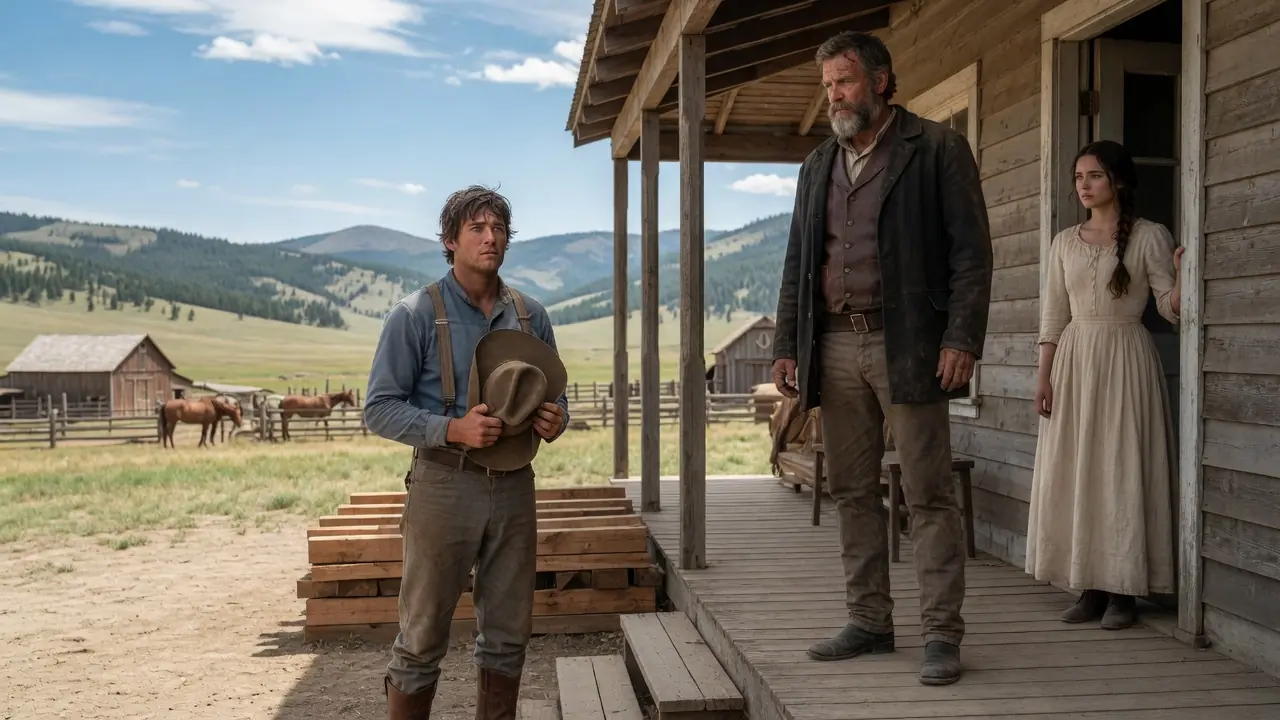
He stood at the gate on a Thursday morning in October with his hat in his hands and his heart doing something unreasonable in his chest. He looked at the house where Frank Reed was almost certainly inside and thought about turning around. He had thought about turning around every day for three months.
Frank Reed was 55 years old, six feet and two inches of Montana rancher, with a beard gone gray before its time and eyes that had the quality of a man who had seen enough to know exactly what he was looking at. He was the kind of man other men described as fair. What they meant was that he was fair the way weather is fair, consistently, without sentiment, and entirely without interest in what you thought about it.
Caleb was 22 years old. He owned a horse, a saddle, a good knife, and approximately 14 dollars. He worked for wages on the Henderson operation six miles east, which paid decently for seasonal work and not at all in winter.
He was, by any reasonable measurement, too poor for Frank Reed’s daughter.
He knew this. He had known it for the entire three months he had been trying not to fall in love with Annie Reed, which had been approximately as successful as trying not to notice the sunrise.
He opened the gate. He walked to the porch. He knocked, and when Frank Reed opened the door and looked at him with those eyes, Caleb Morrison said the truest and most terrifying thing he had ever said to another human being.
“Mr. Reed, I’d like to speak with you about Annie.”
It had started as most things in Caleb’s life started, with a fence.
Specifically, it had started with the fence line between the Henderson property and the Reed property, which had a section that came down every spring when the creek flooded. In the spring of 1882, it had come down on the Henderson side, which technically made it Henderson’s problem. That meant Caleb was the one fixing it.
He had been out there for two hours on a May morning, driving posts into ground that was still soft from the melt, when he heard someone on the other side of the fence line. He looked up.
Annie Reed was 19 years old, with dark, wavy hair that she kept in a loose braid and the specific directness of a person who had grown up knowing exactly where things were and how they worked. She was checking the Reed fence line, the section on her side, which was also down. That meant she was doing her father’s fence work on a Saturday morning without being asked, which Caleb noted.
“Henderson side?” she said by way of greeting.
“Yes,” he said. “We’re down on our side, too.”
She looked at the damage with the assessing eye of someone who had repaired fences before. “That post has been soft since last fall. Papa kept saying he’d get to it.”
“I can do your side, too,” Caleb said. “While I’m here.”
She looked at him with an expression he couldn’t quite read. “You don’t have to.”
“I know,” he said.
When he rode home that evening, he was already in trouble, and he knew it.
He saw her four more times before June, always at some distance, always briefly. Each time he rode away feeling like a man who had been standing too close to a fire and had not moved away when he should have.
By July, he had stopped pretending this was going to resolve itself without his involvement.
Ruth Reed had been married to Frank for 28 years and had developed in that time the specific skill of seeing things her husband was going to need three weeks to arrive at on his own.
She saw Caleb Morrison the first time he came to the Reed property, not to speak to Frank, not yet. He was just passing through on an errand for Henderson that happened to bring him within conversation distance of the front porch, where Annie was shelling peas.
Ruth watched from the kitchen window. She watched him take his hat off when he spoke to Annie. She watched him listen when Annie spoke, actually listen, not wait. She watched him laugh at something Annie said with the genuine laugh of a person who had been surprised into it. She watched Annie watch him ride away.
That evening at supper, Ruth said nothing about it.
Frank was talking about the north pasture and the price of beef in Billings. Ruth listened and said the appropriate things, and she thought about a young man who took his hat off and listened.
“Annie was talking to the Henderson hand today,” Frank said eventually.
“Mhm,” Ruth said.
“Young fellow. Morrison, I think.”
“Mhm,” Ruth said.
Frank looked at her. In 28 years, he had learned that Ruth’s “mhm” had approximately 14 different meanings, and this particular one meant she knew something he didn’t.
“What?” he said.
“Nothing,” she said. “Pass the bread.”
Frank passed the bread with the expression of a man who knew he was behind on information and was not sure how to catch up.
Ruth buttered her bread with the serenity of a woman who had already decided how the story ended and was simply waiting for everyone else to get there.
October arrived, and Caleb ran out of reasons to wait. He had spent the summer finding legitimate reasons to be near the Reed property. Fence repairs. Cattle questions. Returning a tool Henderson had borrowed from Frank years ago, even though Henderson had no memory of borrowing it.
Each time he saw Annie. Each time the conversation was good. Each time he rode away more certain and more afraid.
In September, Annie had looked at him across the Reed kitchen table after Ruth invited him for coffee. He had helped bring in a section of fence that had come down in a storm, which Ruth had engineered with the precision of a woman who knew exactly what she was doing.
“You always find a reason to come by,” Annie said simply.
“The fences,” he said.
“The fences are fine, Caleb.”
He looked at his coffee. “Yes,” he said. “I always find a reason.”
She smiled at him with an expression that was not a question.
So he came in October, hat in hands, 14 dollars, and the particular terror of a young man who had decided to do the honest thing regardless of how it landed.
Frank answered the door, looked at him, and said nothing.
“Mr. Reed,” Caleb said. “I’d like to speak with you about Annie.”
Frank looked at him for a long moment. Then he stepped aside.
“Come in,” he said.
They sat at the kitchen table. Ruth appeared with coffee that she had clearly already had ready, which meant she had been expecting this. Caleb found that simultaneously comforting and alarming.
He said it plainly because he did not know how to say things any other way.
“I care about Annie. I’d like to court her properly, with your permission.”
He looked at the table.
“I know I’m too poor for your daughter, Mr. Reed. I don’t have land or savings or anything much to offer, except that I work hard and I mean what I say, and I would…”
He stopped. Then he started again.
“I would spend my life making sure she never regretted it.”
The kitchen was very quiet.
Frank Reed looked at this young man, the worn shirt, the hat, the hands, and the 14 dollars visible in the complete absence of anything else. He said nothing for long enough that Caleb’s heart had time to do several unreasonable things.
Then Frank said, “She needs a good man, not a rich one.”
He paused.
“But I’m not giving you my answer today.”
He looked at Caleb with those fair-weather eyes.
“I’m going to give you something first, and we’ll see what you do with it.”
The something Frank gave him was the Harlan property, eight miles north. It was the hardest piece of ranching land in the county. Old Jim Harlan had died in August, leaving the operation to his son, who was 19, had no experience, and was going to lose the entire winter’s cattle if he didn’t have help. Frank had agreed to send a hand.
“You’ll spend the winter there,” Frank said. “No wages. The boy can’t pay. You’ll work from October through March and come back in the spring.”
Caleb looked at him. “And if I do?”
“Then we’ll talk,” Frank said.
It was not a yes. It was not a promise. Caleb understood that was entirely the point.
He said yes before Frank had finished the sentence.
Frank noted this without showing that he noted it. Ruth, who was refilling coffee that didn’t need refilling, noted it, too, and was considerably less subtle about her expression. Frank chose not to look at her.
Annie heard the entire conversation from the hallway. She had not been invited to participate and had participated anyway, silently, from six feet away.
When Caleb came out, she was standing by the door with an expression that was equal parts worried and proud.
“The Harlan place,” she said quietly.
“Yes,” he said.
“It’s hard land.”
“I know.”
“Jim Harlan broke two hands and a foreman in 10 years.”
“I know that, too.”
She looked at him for a moment. Then she said in a voice low enough that Frank couldn’t hear from the kitchen, “Come back in the spring.”
It was not a declaration. It was not a promise. It was simply a direction, delivered with the confidence of someone who had already decided how things were going to go and was informing the relevant parties.
Caleb put his hat on, walked to his horse, and rode north.
Ruth Reed watched him go from the kitchen window and said to no one in particular, “He said yes before Frank finished the sentence.”
Frank stood behind her and said nothing.
But he was watching, too.
The Harlan property was, as advertised, hard. The land was rocky and exposed, catching every wind that came down from the Canadian border with nothing to slow it. The barn needed work. The cattle were poorly managed. Old Jim had done his best in his last years, but his best had been declining.
Young Thomas Harlan, 19, earnest, and completely overwhelmed, greeted Caleb on the first day with the expression of a drowning man seeing a rope.
“I don’t know what I’m doing,” Thomas said by way of introduction.
“That’s all right,” Caleb said. “I do.”
What Caleb had not expected was how much Thomas reminded him of himself at 19. Not in circumstance, but in quality. The same willingness to admit what he didn’t know. The same determination to learn it. The same understanding that the land did not care about your feelings, and the only response to that was to pay attention and keep working.
He found himself teaching with a patience he did not know he had. Not because it was required of him, but because Thomas deserved it. Thomas deserved someone who showed up and stayed and didn’t make him feel stupid for not knowing things he had never been taught.
By November, Thomas could read weather well enough to move cattle before a storm. By December, he understood the feeding rotation. By January, he was doing half the work without being directed.
Caleb wrote to Annie twice, short letters, practical letters. She wrote back longer ones, describing the Reed ranch in winter, the snow coming down the mountain, and something her mother had said that had made them both laugh. She was choosing every word. He could tell. She wrote the way someone writes when she wants a person to feel the thing she is describing, not just read it.
He read her letters four times each.
He did not tell her that.
In February, the worst storm of the winter came down from Canada. Caleb spent 36 hours straight moving cattle, fixing collapsed fence in temperatures that turned breath to ice, and keeping Thomas from three decisions that would have cost them the herd.
When it was over, he sat in the Harlan kitchen drinking the worst coffee he had ever tasted and thought, “This boy is going to be all right.”
Then he thought, “I want a son like this someday.”
Then he stopped thinking and went to sleep.
Frank Reed did not sit idle that winter. He asked questions. Not obviously. Frank Reed did not do anything obviously. He asked with the deliberate patience of a man conducting an investigation he had not announced.
He asked Henderson about Caleb. Henderson said Caleb was the best hand he had hired in five years, and the only one who fixed things without being asked twice. Frank noted this.
He asked Jim Harlan’s neighbor, Pete Connell, how the Morrison boy was managing up north. Pete said he had ridden past the Harlan place in December, and the cattle looked better than they had in three years. He said the Harlan boy had been out working the fence line in weather that would keep most men inside.
Frank noted this, too.
He said nothing to Ruth about any of it.
Ruth, who had her own sources, already knew what he had found out and several things he hadn’t. She said nothing either, because 28 years of marriage had taught her when to speak and when to let a man arrive somewhere on his own.
What Frank was doing, though he would not have described it this way, was building a case, not against Caleb, but for him. He was assembling the evidence the way he assembled everything, carefully, without rushing, making sure the structure would hold.
Frank Reed understood something Caleb did not yet know. The test was never really about the Harlan property. The test was about what a man does when there is no guarantee, when the answer might be no, when the work is hard and the winter is long, and nobody owes him anything.
The test was about what he was made of.
Frank, who prided himself on reading men accurately, thought he already knew. But he was going to wait for spring anyway, because some things need to be completed before they can be confirmed.
Also, Ruth had told him three times already that he was being stubborn, and he had told her three times that he was being thorough. Neither of them was entirely wrong.
Caleb rode back to the Reed ranch on the 15th of March. Snow was still on the high peaks, but the valley was showing the first green of spring. The creek between the Henderson and Reed properties was running full and clear, the way it had run the morning he fixed the fence and met Annie for the first time.
He had 14 dollars when he left in October. He had 14 dollars when he came back because the Harlan work had paid nothing, which was the arrangement, and because he had spent the winter keeping himself and Thomas and 60 head of cattle alive rather than accumulating wealth.
He was aware of the 14 dollars.
He rode to the Reed ranch anyway.
Frank was on the porch. It was as if he had not moved since October, except that he was wearing a lighter jacket and the mountains behind him were different colors.
Caleb tied his horse at the gate, walked to the porch, and stood where he had stood in October.
“Mr. Reed?” he said.
Frank looked at him for a long moment.
“Pete Connell tells me the Harlan cattle came through the winter in better shape than they’ve been in years,” Frank said.
“Thomas worked hard,” Caleb said. “He learned fast.”
“Pete also says you fixed the north fence in the February storm. Thirty-six hours.”
“It needed fixing.”
Frank was quiet for a moment.
“You still have nothing,” he said.
“Yes, sir,” Caleb said. “I still have nothing.”
“And you’re still here.”
“Yes, sir.”
Frank Reed looked at this young man, 22 years old, worn from a hard winter, standing on his porch in March with 14 dollars and a horse. Caleb had done what was asked and was not pretending it had been easy. He was not asking for credit, either.
Frank felt something shift in his chest, something he would have described, if pressed, as satisfaction.
“Come inside,” he said. “Ruth has coffee.”
It was not a yes, but it was the closest Frank Reed came to one before he was ready.
The coffee was good. Ruth’s coffee was always good, which Caleb had noticed in October and noticed again now. He said so, which made Ruth look at him with the expression she had been wearing since the fence conversation in May. It was the expression of a woman whose conclusions had been confirmed repeatedly and who was no longer surprised by any of it.
They sat at the kitchen table, Frank, Ruth, and Caleb. There was a moment of silence that had several things in it.
Then Ruth said, “Annie has been corresponding with you?”
“Yes, ma’am,” Caleb said. “She wrote six letters. I wrote four back.”
He hesitated.
“I didn’t know how many was appropriate.”
Ruth looked at Frank.
Frank looked at his coffee.
“It was appropriate,” Ruth said.
Another silence settled.
“The Harlan boy,” Frank said. “Thomas. How is he set for next winter?”
“He’ll manage,” Caleb said. “He knows what he’s doing now. He might need help with the north fence before October. That section is going to come down again. But the cattle management he has.”
Frank nodded slowly.
“You taught him.”
“He learned fast,” Caleb said again.
“You keep saying that,” Frank said. “That he learned fast. That the cattle came through because Thomas worked hard.”
He looked at Caleb directly.
“You don’t take credit for things.”
Caleb looked at the table. “It doesn’t seem right to.”
Frank was quiet for a long time. Long enough that Ruth refilled everyone’s coffee with the serenity of a woman who knew exactly how this ended and was simply waiting for the last page to turn.
Then Frank said, “I built this ranch from nothing. Twenty-eight years ago, I had a horse and a saddle and Ruth, and about as much money as you have right now.”
Caleb looked up.
“Ruth’s father thought I was too poor for her,” Frank said. “He was right, technically. I was.”
He looked at his coffee.
“He gave me a year to prove otherwise. I spent that year working his land for nothing.”
He paused.
“I thought you should know that.”
The kitchen was very quiet. Ruth was looking at the window with the expression of a woman who had been waiting 28 years for her husband to tell that story to the right person.
Caleb Morrison sat at the kitchen table and understood, with the specific clarity of a young man receiving information that rearranged everything. The test had never been Frank’s idea at all. It had been the only thing Frank knew how to give.
Frank gave his answer that afternoon. Not formally. Frank Reed did not do things formally. He gave it the way he gave everything, plainly, without decoration, while doing something else.
They were on the porch after lunch, looking at the valley, when Frank said, “You’ll need to find work for the summer. Henderson will take you back. By fall, you’ll have enough saved for a start.”
Caleb looked at him.
“The south pasture on this property hasn’t been properly grazed in two years,” Frank continued. “A man who knew what he was doing could run 20 head there this season without crowding the main herd.”
He paused.
“That man would need to negotiate terms with me.”
“What kind of terms?” Caleb asked carefully.
“Fair ones,” Frank said.
Caleb understood.
He was being given a start. Not given, offered. On terms. Which was the right way, and he knew it.
“Yes, sir,” he said. “I’d like that.”
Frank nodded once. Then he went inside.
Annie appeared from around the side of the house approximately 40 seconds later, which meant she had been listening from the corner. Caleb had suspected as much, and it made him smile in a way he could not entirely control.
“The south pasture,” she said.
“Twenty head,” he said.
She looked at him with the expression she had worn at the fence line in May.
“He told you about his father-in-law,” she said.
“Yes.”
“Mama said he’d tell you when he was ready.”
She paused.
“She’s been waiting eight months.”
He laughed. She laughed. The Montana spring held them both, the mountains, the new grass, and the creek running clear between the properties.
“He wrote you six letters that winter,” she would tell him years later.
She had written six. She had counted.
He took her hand for the first time standing in the Reed yard in the March sun, and she held it with the complete naturalness of something that had found its place.
“I still have 14 dollars,” he said.
“I know,” she said. “You’ll have more by September.”
“Is that enough time?” he asked.
She looked at him with Annie Reed’s eyes, direct and unafraid and entirely certain.
“It’s exactly enough time,” she said.
They were married in September of 1882 on a Saturday in the Millbrook church. Ruth Reed cried from the front pew with the unashamed satisfaction of a woman whose conclusions had been correct for 18 months.
Frank Reed stood beside her with the expression of a man who was moved and would prefer not to show it. Everyone could see through it immediately, and Frank was aware of that and had decided to endure it with dignity.
Caleb wore his good shirt and stood at the altar watching Annie walk toward him. He thought about a fence in May, a porch in October, and a Montana winter that had felt, at times, very long. He understood that every day of it had been entirely worth it.
Annie wore a cream dress her mother had made, with her dark hair properly arranged. She walked with the certainty of a woman who had known where she was going for quite some time.
They settled on the Reed property that first year, working under the south pasture arrangement with Frank. That arrangement expanded in the spring to include a partnership that neither of them formally proposed but both understood was coming.
Caleb was the kind of man who fixed things without being asked twice. The Reed operation was considerably better managed by the following spring. Frank noticed, said nothing directly, but began consulting Caleb on decisions in a way that was not quite asking for advice, but was not quite not asking either.
Ruth noticed this and said nothing, which took considerable discipline.
Their son arrived in June of 1883. They named him Thomas.
Ruth looked at Caleb when she heard the name and said nothing, but her expression said everything.
Frank said, “Thomas. After the Harlan boy.”
Caleb said simply, “He deserved something.”
Frank was quiet for a moment. Then he said, “Good name.”
Thomas came into the world with his father’s dark curly hair and his mother’s direct gaze. From the first moment Frank Reed held him, standing in the bedroom doorway with the baby in his arms, something happened to Frank Reed’s face that Ruth had seen only a few times in 28 years.
He went soft.
Not visibly. Not dramatically. But Ruth saw it.
It was the specific softening of a man who had been strong for a very long time and had found, in the weight of a child in his arms, something that did not require strength.
He held Thomas for a long time without speaking. Then he looked at Caleb, who was standing near the window watching him, and said, “Good boy.”
Caleb understood he was not talking about Thomas.
On a Sunday afternoon that summer, the Reed property was full in the way it had not been full since Annie was small. Frank sat on the porch with Thomas on his knee, talking to the baby with the seriousness of a man who had decided this person deserved real conversation. Ruth stood in the doorway watching with the expression she had worn since May of the previous year. Caleb and Annie stood in the yard together.
The Montana mountains were doing what they always did. The creek was running clear between the properties, and Frank Reed, who had tested a young man with a hard winter, 14 dollars, and no promises, sat on his porch with his grandson and was, by every measure he knew how to apply, entirely satisfied with how things had turned out.
Frank Reed gave Caleb Morrison the hardest winter of his life. No wages, no guarantee, no promise that yes was waiting at the end. Just work. Just the test. Just the question of what a man does when nobody owes him anything.
Caleb, 22 years old, with 14 dollars and a worn shirt, said yes before Frank finished the sentence.
That was the moment that mattered.
Not the wedding. Not the south pasture deal. Not even the spring when Frank told him about Ruth’s father. The moment that mattered was the fraction of a second between the end of Frank’s offer and the beginning of Caleb’s answer, when a young man with nothing looked at a hard winter with no guarantee and said yes anyway.
Because that is what character looks like before it has anything to prove itself with.
Frank Reed knew this. He had lived it himself 28 years earlier on a different piece of land, with a different father-in-law who had given him the same gift. Not the easy yes, but the chance to show what he was made of.
The richest thing Caleb Morrison brought to the Reed family was not what he built in the summer of 1882. It was what he did in the winter, when it was cold and hard and nobody was watching, and there was no reward but the work itself.
Ruth had known from May. Frank had known from the moment Caleb said yes before the sentence was finished. Annie had known from the fence line in spring.
Some people, when they show up, show up completely from the very beginning.
And the ones who love them, or are paying attention, see it immediately.
The rest is just time.