The alarm on David Calloway’s phone had been set to 5:47 a.m. for three years running.
Not because he had any particular affection for that number, but because Lily needed her medication at 6:00, and he needed exactly 13 minutes to warm the kitchen, heat the milk, and have her pills sitting beside the cup before she padded in from her bedroom in her duck-print socks.
Thirteen minutes was the margin.
There was no room in their life for anything larger.
He lay still for a moment after the alarm buzzed, listening to the apartment settle around him.
The radiator knocked twice, then went quiet.
Somewhere above him, Mrs. Pierce’s terrier crossed the living room floor.
Click, click, click.
Then silence.
Outside the single window above the kitchen sink, the sky was still the dark blue of early winter, the color of bruised water.
Snow had fallen overnight.
He could hear its particular silence pressing against the glass.
David was 38 years old and felt closer to 50.
Not in a bitter way.
He had stopped being bitter about that somewhere around Lily’s third birthday, when he had realized that carrying resentment was the same as carrying an extra 20 pounds up a flight of stairs.
Pointless.
Exhausting.
He had set it down and walked on lighter.
But the years had written themselves onto him anyway.
The calluses on his palms from three years on construction crews.
The slight hesitation in his right knee from a fall off a scaffold the previous spring.
The way he had begun to squint at printed text even though the optometrist told him his vision was fine.
Some things do not need a reason to wear you down.
They just do.
He rose, pulled on thermal underlayers, and the good flannel shirt he kept folded on the chair beside his bed, the one with no fraying at the collar.
Today mattered.
He needed to look like a man who had things under control.
The job interview was at 10:00 a.m. at Meridian Logistics, a midsize freight coordination firm that had posted a warehouse operations supervisor position at $46,000 a year.
Forty-six thousand was a number David had written on a notepad in the kitchen and circled three times.
It was the number that meant Lily’s pulmonologist visits without choosing between them and groceries.
It was the number that meant a second bedroom in a year, maybe two.
It was the number that meant he could stop doing the math every single morning.
He had spent two evenings preparing.
Not nervous preparing.
Methodical preparing.
He had looked up Meridian’s recent contracts, their operating radius, their turnover history.
He had ironed his only dress pants until the crease held like a blade.
He had printed his resume on the good paper at the library, and the woman at the reference desk had told him it looked professional.
He had said thank you in a voice that tried not to sound relieved.
Lily emerged at 6:02, her hair a magnificent catastrophe, one sock on and one off.
She was six years old and small for it.
The doctors used words like constitutionally slight, which David understood to mean she would always be the smallest in the class, though she had never been the quietest.
She had her mother’s eyes, wide and very dark, and his jaw, stubborn and forward.
The combination made her look, at rest, like a child who had already thought of seven counterarguments to whatever you were about to say.
“It snowed,” she announced, climbing onto her stool at the kitchen counter.
“It did.”
“A lot.”
“Enough.”
She considered this.
“Will the buses run?”
“Yes. Buses always run.”
“Mrs. Garrett’s car didn’t run last Tuesday when it snowed.”
“Mrs. Garrett drives a 2003 Civic. Buses are different.”
Lily accepted this with the equanimity she reserved for structural facts.
She took her pill with the warm milk and ate six spoonfuls of oatmeal before announcing that she was full.
David ate the rest of it standing at the counter, looking out the window at the street below.
The snow had accumulated overnight, four inches, maybe five.
The plows had not been through yet.
He adjusted his mental departure time by 15 minutes.
The bus would run, but it would run slow.
He kissed the top of her head when Mrs. Garrett knocked at 7:15 to take her to school.
Lily had her backpack, her hat, her gloves, and the small purple thermos of hot chocolate he had made with the last of the cocoa powder.
She paused at the door and looked at him with her serious, forward chin.
“Good luck, Daddy.”
“Don’t need it,” he said. “But thank you.”
After they left, the apartment was very quiet.
He stood in it for a moment, in his good flannel shirt and his ironed pants, with the interview folder tucked under his arm, and felt the full specific weight of a life balanced on a single morning.
He breathed out once, slow and deliberate.
Then he locked the door behind him and walked down into the snow.
The bus was late, as expected.
A woman in a nurse’s coat under an inadequate jacket.
A teenager with earbuds in.
An older man who kept checking a paper schedule as though the numbers on it might change.
The snow was still coming down, smaller flakes now, the kind that accumulated without spectacle.
The cold was real and serious.
David’s breath came out in hard clouds.
He had left himself a margin of 40 minutes.
The bus ran every 12 minutes on a normal morning.
Factoring in the snow, he had estimated 20.
That left him 20 minutes at the other end, enough to walk three blocks to the Meridian building, enough to arrive looking composed rather than rushed.
He had thought this through.
He was good at thinking things through.
The bus arrived 17 minutes late.
He recalculated as he boarded.
He still had time.
Not comfortable time.
Not the kind that let you stand outside and breathe before you went in.
But enough.
He stood in the aisle because the seats were taken, holding the overhead rail, watching the city move past the fogged windows.
The Meridian building was on Greystone Avenue, eleven stops up.
He counted them silently.
At the seventh stop, the bus stopped and did not move.
He craned his neck.
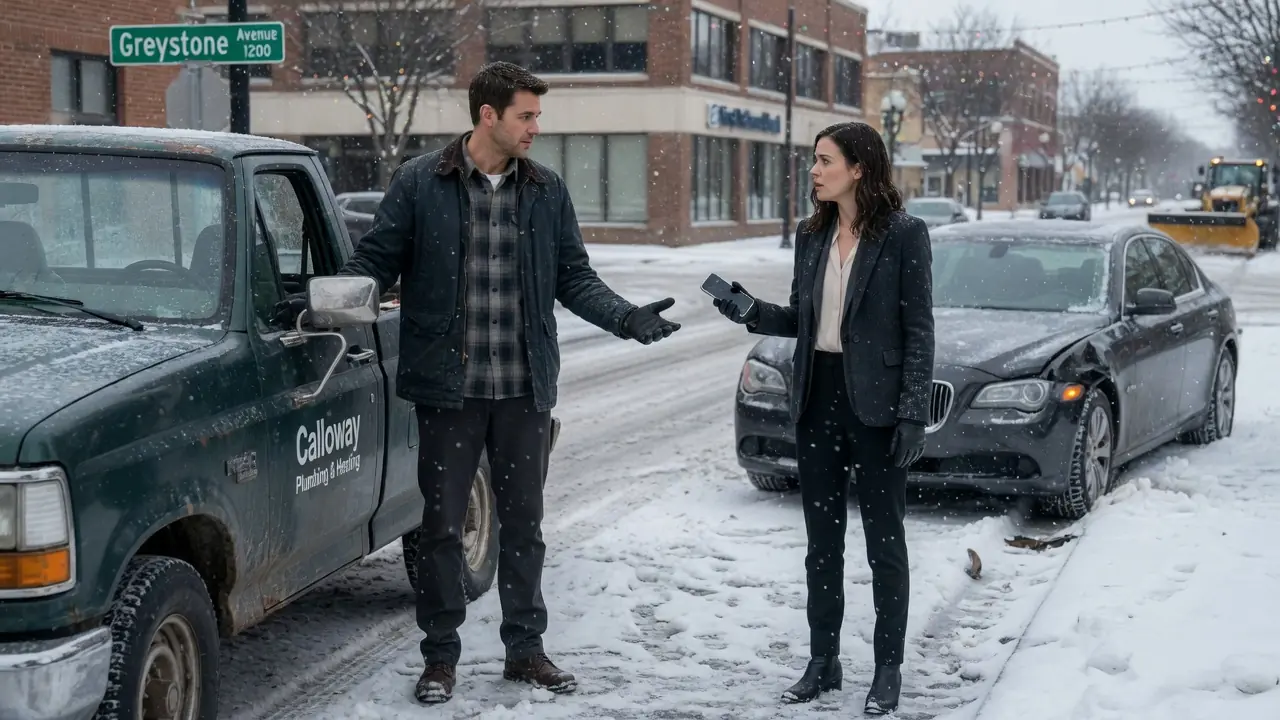
Through the front windshield, he could see, 100 yards up the road, the angular geometry of something gone wrong.
A vehicle sitting at an angle across the intersection.
Around it, the beginning of a backup that would not clear quickly.
The driver spoke into his radio in a flat, patient voice.
The nurse in the seat ahead of him exhaled loudly through her nose.
David looked at his phone.
9:31 a.m.
He had 29 minutes, and the bus was not moving, and the Meridian building was four blocks away through open snow.
He got off at the next stop and walked.
He walked fast, not quite running, because he was not a man who ran through snow in dress shoes without good reason.
But fast enough that his breath came in urgent pulls, and the snow muffled the sound of everything except his own movement.
The cold hit harder when you were moving through it.
His face tightened.
His fingers, in thin dress gloves, began to lose their dexterity.
He was on Aldermore Street, parallel to Greystone, when he heard the impact.
It was not loud.
The snow softened everything.
It was more of a dense thud, followed by the brittle sound of a side mirror or signal light bouncing off the pavement.
Then silence.
He stopped.
To his left, through the gap between two buildings, he could see Greystone Avenue.
He could see, on the far side of the intersection, a dark sedan that had slid into the concrete barrier at the edge of the road.
The front quarter panel was accordioned against the barrier.
The engine was still running.
He could see the exhaust cloud rising white and steady into the cold air.
No one was moving inside.
He stood still for exactly three seconds.
He knew exactly what he was standing at the edge of.
He knew what the choice was before he had finished making it.
Which is the only way the real choices ever present themselves.
Not as deliberation, but as recognition.
He turned left and ran.
The sedan had slid on black ice at the intersection and hit the barrier at maybe 30 mph.
Not catastrophic speed, but enough.
The driver’s side was away from the barrier.
The passenger side, where the impact had come, was crumpled inward.
David got there in 40 seconds, out of breath, snow filling his collar.
The woman inside was conscious.
That was the first thing.
She was sitting at an angle, the seat belt tight across her chest, her head against the deployed side airbag.
There was blood at her hairline, not much, but bright.
Her window had shattered on impact, and the cold was already pouring in.
She was shaking, though whether from cold or shock or both, he could not tell.
“Hey.”
He put his hands on the door frame.
“I’m here. Can you hear me?”
She turned her head toward him slowly.
Her eyes were dark and very sharp, even now.
She looked at him the way a person looks when they are trying to remember where they are.
“Yes,” she said.
Her voice was steady.
That was something.
“Can you move your arms? Your legs?”
She tested them carefully.
“Yes. I think.”
She stopped, winced.
“My shoulder.”
“Don’t push it. Just stay still.”
He pulled out his phone and called 911.
While it rang, he assessed.
The door on her side was jammed, the frame buckled.
He went around to the driver’s side.
That door opened.
He leaned across, released her seat belt with care, one hand braced against her shoulder to prevent her from pitching forward.
“I’m David,” he said, because it felt important to have a name in a situation like this. “What’s your name?”
“Emma,” she said.
“Okay, Emma. There’s an ambulance coming. We’re going to stay right here until it arrives.”
He looked around.
The street was not empty.
Two cars had slowed at the intersection and stopped, their drivers watching from inside the warmth of their vehicles.
None of them had gotten out.
He felt something move through him that was not quite anger.
Just a clear, flat recognition of the way things were.
He took off his coat.
It was the right thing to do, and he did it without ceremony, without hesitation, folding it and laying it across her like a blanket, tucking it around her shoulders because she was shaking more now.
The cold hit him immediately, specific and thorough, working through his flannel shirt in less than a minute.
He crouched beside the open driver’s door, keeping her in sight, keeping her talking.
“The ambulance is five minutes out,” he told her. “Talk to me. Where were you headed this morning?”
She blinked.
“A meeting. Board meeting at 9:30.”
A pause.
“I’m going to be very late.”
“Boards are patient,” he said. “Or they should be.”
The corner of her mouth moved.
Not quite a smile, but the beginning of one, which was what he had been going for.
He watched her color and kept her talking about things that did not matter.
The weather.
The neighborhood.
Whether she preferred the city plowed or whether the plows made everything worse.
She answered in complete sentences.
Her eyes stayed focused.
These were good signs.
He was very cold.
He did not register it as suffering exactly, more as information.
His hands, which had been starting to warm from the walking, went cold again quickly, then numb, then past numb into that particular cotton-wrapped insensibility that preceded real trouble.
He tucked them under his arms when he was not using them.
He kept his voice even.
The ambulance arrived in six minutes.
Two paramedics moved efficiently into the scene, professional and kind.
The larger of the two glanced at David shivering, shirtless under a thin flannel, crouched in the snow, with an expression that was equal parts concern and acknowledgement.
“Good work,” the man said.
Just that.
David nodded.
He picked up his coat from the ambulance door where it had been set aside and shrugged it back on.
Emma was being assessed with calm efficiency.
She turned her head once and looked at him over the paramedic’s shoulder.
He raised one hand in a gesture that meant, “You’re fine. I’m going.”
Then he walked away before anyone could ask him questions he did not have time to answer.
He looked at his phone.
10:09 a.m.
He kept walking anyway.
The Meridian Logistics building was a glass and steel box on Greystone Avenue, with a lobby that was warm and clean and utterly indifferent to him.
The woman at the reception desk looked up with the professionally neutral expression of someone who manages arrivals for a living.
“David Calloway,” he said. “I had a 10:00 interview for the Operations Supervisor position with Mr. Holt.”
She looked at her screen.
A beat.
“That interview was at 10:00 a.m., Mr. Calloway. It’s now 10:17.”
“I know. There was an accident on Greystone. A vehicle went into the barrier at the Aldermore intersection. I stopped to assist the driver until the ambulance arrived.”
She looked at him for a moment.
Genuinely, he thought.
Not unkindly.
Then she picked up her phone and said something quietly into it.
A pause.
She set the phone down.
“Mr. Holt says he won’t be able to reschedule.”
He absorbed this without expression.
“Would it be possible for me to speak with him for two minutes? Just to...”
“I’m sorry, Mr. Calloway.”
He stood there for one more moment, looking at nothing in particular.
The lobby was warm.
Behind him, through the glass doors, the snow was still falling.
“Thank you,” he said.
Then he turned around and walked back out into the cold.
He did not call anyone.
There was no one to call.
He walked to the bus stop and stood in the snow and waited.
The bus came eventually, and he rode it home.
The ride took 40 minutes because of the backup at the Aldermore intersection, which had not yet been fully cleared.
He watched it pass out the window.
The concrete barrier.
The dark stain of leaked fluid on the snow.
The amber and white tape of an emergency scene being wound down.
He looked at it until it passed from view, then he looked at his own hands in his lap, still wearing the dress gloves that had done nothing against the cold.
The knuckle on his right index finger had a shallow abrasion from the car door frame.
He had not noticed it happening.
He thought about what the paramedic had said.
Good work.
He turned it over in his mind.
Not for comfort.
He was not looking for comfort.
But because it had been said plainly by someone who knew what they were looking at.
And that meant something.
He did not know quite what, but it meant something.
It was the kind of thing that did not need to be explained or justified or weighed against what had been lost.
It simply was.
A man who knew about cold and injury and the particular stillness of someone in shock had looked at the situation and named it accurately.
That had its own worth.
The harder thing, the thing he sat with on the long bus ride home, was not regret.
Regret would have required him to believe he had made the wrong choice, and he did not believe that.
He had seen the situation and responded to it, and he would respond to it the same way again, in the same cold, in the same snow, on the same morning.
That was not virtue, or not only virtue.
It was just the way he was built.
Some things you know about yourself with the same certainty you know your own height.
This was one of his.
What he sat with was something quieter and harder to name.
The sheer exhaustion of being a person who kept doing the right thing in a world that did not always arrange itself to reward that.
Not never.
He was not cynical about it.
But not always.
Not reliably.
Not on any particular Tuesday.
When he got home, the apartment was empty and clean and quiet.
He made coffee and sat at the kitchen table and looked at the notepad where he had written $46,000 and circled it three times.
The number looked exactly as it had that morning.
It had not changed.
The world had continued to turn, and the number remained what it was.
A destination he had not reached today.
He thought about Lily.
He thought about Dr. Ashworth’s face at the last appointment, the careful way she had said, “We need to watch the coming months.”
Not alarming, but not reassuring either.
He thought about the specific amount in his account and how many weeks it represented before it was gone.
He picked up the pen.
He did not cross out the circled number.
He wrote below it, in the same deliberate hand, “Tomorrow. Try again.”
Then he put the pen down, finished his coffee, and went to be there when Mrs. Garrett brought Lily home.
Emma Carter was 34 years old and the Chief Executive Officer of Northgate Capital Group, which managed a portfolio of mid-market acquisitions and turnaround operations across seven states.
She had held the position for three years, inheriting it from a board that had been skeptical and finding, over 36 months of 12-hour days and very precise decision-making, that their skepticism had been the thing that was wrong.
She was not widely famous in the way that certain CEOs became famous.
But she was known in the financial press, in the specific geography of the city’s business community, as someone whose judgment was unusually reliable and whose attention to detail was, depending on whom you asked, either admirable or exhausting.
She woke in the hospital at 1:00 p.m. with a separated shoulder, four stitches at her hairline, and a mild concussion that the attending physician described as unremarkable in a tone that managed to convey both medical accuracy and faint condescension.
Her assistant, a young man named Patrick, was already in the room with her laptop and a revised agenda for the board meeting, which had been postponed to Friday.
“The police report is filed,” Patrick told her. “Your car is totaled. The insurance company has been notified.”
“Who called 911?”
Patrick looked at his tablet.
“The responding paramedics noted that the call came from a bystander who provided assistance at the scene. No name recorded.”
Emma had a memory of the man, fragmented by shock and cold, but persistent.
The way he had said her name back to her.
The coat he had put over her.
The fact that he had crouched in the snow in nothing but a flannel shirt for six minutes and kept his voice completely steady the entire time, as though the cold was a detail rather than a condition.
“Find him,” she said.
Patrick blinked.
“I’m sorry?”
“The man who called it in and stayed with me. Find him.”
The search took four days and produced a significant amount of noise.
Patrick retained a private investigator named Hollis, who was efficient and methodical.
There was no usable camera footage from the intersection.
The city’s traffic camera had been obscured by ice accumulation on the lens, a maintenance failure that the city’s infrastructure department would later answer for.
The two motorists who had stopped and watched from their vehicles had not exited their cars and could not provide useful identification.
Hollis worked from the paramedics’ notes and the 911 call transcript, which gave him very little.
A male voice, steady, no distinguishing accent, had called from a cell phone registered to a David Calloway at an address on Farnsworth Avenue.
Emma read the report on a Thursday morning, sitting in her office on the 22nd floor of the Northgate building, with her arm in a sling and the city wide and flat below her.
She looked at the name for a long time.
She asked Patrick to find out what he could.
What he found was this.
David Calloway, 38.
Single father.
Daughter named Lily, six, with a documented respiratory condition.
Current employment, intermittent construction labor, paid under a general contractor’s umbrella.
Previous employment, factory floor supervisor, plant closed three years ago.
He had applied for 11 jobs in the past four months.
He had an interview at Meridian Logistics on the morning of the accident.
He had arrived 17 minutes late and been turned away.
Emma read this twice.
She thought about the coat.
She thought about six minutes in the snow.
She thought about the man at the door of her car who had said, “I’m David,” because he understood that names mattered in a crisis, and had kept her talking about plows and weather as though the most natural thing in the world was to crouch in the snow in shirt sleeves and keep a stranger calm until help arrived.
She picked up her phone and called the director of operations for Northgate’s facilities division.
“Rebecca,” she said. “I need to know what positions we currently have open in building operations and facilities management.”
David heard about it from a flyer, not from the news, not from the investigation.
He did not know about the investigation.
The days after the accident had the ordinary texture of his ordinary life.
The construction site on Bellwood Road where he was doing interior demolition for a residential conversion.
The crew foreman named Mitchell who communicated exclusively through volume and sarcasm.
The particular fatigue of work that used the body without engaging the mind.
He worked, and he went home, and he helped Lily with her reading, and he cooked whatever was practical, and he went to sleep and started again.
He had no way of knowing, standing on the bus in his work gear with dried plaster dust on his jacket, that four blocks away on the 22nd floor of a stone and steel building, someone was systematically reconstructing the morning of the accident from camera reports and 911 transcripts and paramedic notes, looking for him.
He applied for two more jobs that week.
One was a warehouse role with a packing company on the East Side.
They sent an automated rejection within 48 hours, which he had come to understand was actually kinder than silence because at least it closed the loop.
The other was a maintenance coordinator role with a property management company downtown.
That one went quiet, which he also understood meant no.
Lily had a checkup with Dr. Ashworth on the Wednesday after the accident.
He took the morning off from the site, which cost him the hours but could not be avoided.
Dr. Ashworth was a careful woman in her mid-50s, with reading glasses she wore on a chain around her neck and a manner that was precise rather than warm, which David had come to trust more than warmth would have suggested.
She listened to Lily’s lungs, reviewed the latest round of monitoring data, and told him in her measured way that the current trajectory was concerning without being critical.
She wanted to try an adjusted protocol.
It would require a four-week evaluation period.
She handed him the script.
He looked at the price on the pharmacy’s website that evening after Lily was in bed.
It was not impossible.
It was close to impossible.
He moved some numbers around on the notepad and arrived at an arrangement that would work if nothing else went wrong for the next six weeks.
He underlined the number and went to bed.
Nothing spectacular happened in the week after that.
The demolition job ended.
There was a two-day gap before the next one started.
He used the two days to do the things that piled up during working weeks.
The laundry.
The shelf in the bathroom that needed a new bracket.
The phone call to the building management about the window seal that let cold air in above the sink.
The building manager said someone would come look at it.
David noted this without particular expectation.
He did not know that a private investigator named Hollis was making calls.
He did not know that his name had been attached to a 911 call.
He did not know that Emma Carter had read a summary document about his daughter’s medical history and sat with it quietly in an office 22 floors above the city, holding a coffee that had gone cold.
He was at the community job center on Harwick Street on a Tuesday morning, the one with the plastic chairs and the single working printer, when he saw the flyer.
Northgate Capital Group.
Facilities Operations Coordinator, Building Services Division.
He stared at it for longer than was strictly necessary.
The pay range was listed as $42,000 to $48,000 annually, dependent on experience.
It was within $3,000 of the number on his notepad, the one he had circled three times.
He had no reason to connect it to anything.
He did not know who Emma Carter was.
He did not know that the listing had gone up that week specifically.
He copied down the application address and walked the three blocks to the library and sent his resume from the public terminal, the same one he had used for the Meridian application.
The woman at the reference desk did not recognize him this time.
That was fine.
He printed his resume on the good paper and put it in the folder and went back to the construction site.
The call came six days later.
The woman on the phone said her name was Rebecca Strand, director of operations.
She had a brisk, organized voice.
She scheduled him for Tuesday at 2:00 p.m., Northgate Capital Group, 22nd floor, ask for Patrick at reception.
He ironed the flannel shirt again.
He went through the same preparation.
Research.
Resume.
The mental rehearsal of likely questions.
He told Lily Tuesday morning that he had another interview.
She looked at him with her serious dark eyes and said, “This one will work, Daddy. I can tell.”
“How can you tell?”
She considered.
“Because you have your good socks on.”
He looked down.
He did, in fact, have on his good socks.
He had not been aware of putting them on.
He told her she had good instincts and kissed the top of her head and went out into the cold.
The Northgate building lobby was different from Meridian’s.
Less glass, more stone.
The kind of lobby that had been designed to convey permanence rather than transparency.
The man at reception, Patrick, was younger than David had expected, with a quick, efficient manner that masked what David sensed was considerable anxiety.
He offered coffee.
David declined.
He was shown to a conference room with a window that looked out over the white city, and he sat down and waited.
The door opened, and Rebecca Strand came in, followed by a woman in a charcoal blazer whose left arm was in a sling.
David looked at her.
She looked at him.
The world went very quiet for a moment.
He placed her face in the same instant, he thought, that she placed his.
The accident.
The cold.
The coat folded over her shoulders.
He saw it cross her expression not as recognition, but as something more complex.
A recalibration.
A rapid reassembly of a story she had been telling herself in incomplete form.
He said nothing.
He was not certain what was appropriate to say.
She sat down across from him with the careful movement of someone managing a shoulder injury, set her folder on the table, and looked at him for a moment with those sharp, steady eyes.
Then she said, “You didn’t mention it in your cover letter.”
“No,” he said.
“Why not?”
He considered the question seriously because it deserved that.
“Because I didn’t want the job because of it. I want the job because of what I can do.”
Rebecca Strand, beside her, was looking between them with the expression of someone who had entered a conversation well after it started.
Emma Carter nodded slowly.
“Tell me,” she said, “about what you can do.”
The interview ran 40 minutes, which was 20 longer than scheduled.
David talked about the factory floor.
Twelve years there, the last four as floor supervisor, overseeing a team of 23, managing supply chain coordination and shift scheduling, and the specific problem-solving that came with aging equipment in a building that had been designed for a different era of manufacturing.
He talked about the construction work, which he framed honestly not as a step down because it was not, but as the kind of work that showed you how buildings actually operated from the inside.
Emma Carter asked questions that were precise and not easy.
She asked how he had handled a conflict between two senior staff members.
She asked what he would do if a facilities contractor gave him a false progress report.
She asked, near the end, almost casually, how he managed the demands of the job alongside single parenthood.
Not as an intrusive question, he could tell, but as a practical one, the kind an employer asked when they were thinking about reliability rather than character.
He answered honestly, carefully, with systems.
With the understanding that being a parent and being a professional were not competing conditions, but parallel disciplines that both required you to show up even when you did not feel like it.
She nodded again.
She made a note.
When it was over, Rebecca Strand showed him to the elevator.
In the hallway, waiting for it, she said quietly, “She’s not sentimental, you know. She wouldn’t offer you something because of what happened. That’s not how she operates.”
“I know,” David said.
“You seem very certain of that.”
“She asked hard questions,” he said. “Sentimental people ask soft ones.”
Rebecca looked at him for a moment with something that might have been amusement.
The elevator arrived.
Emma Carter sat in the conference room for a few minutes after he left, looking at the city through the window.
Her shoulder ached.
The stitches at her hairline had come out the previous Friday and left a thin seam she could feel with her fingertip but not see without the mirror at a specific angle.
She thought about the morning of the accident.
The car going sideways on the ice.
The barrier coming up fast.
The impact that had knocked the world sideways and left her hanging in her seat belt, cold pouring in through the broken window.
And then him.
His face in the doorframe.
I’m David.
The coat.
Six minutes of his steady, unhurried voice keeping her from the edge of panic she could feel waiting just below the surface.
She had never been, in her professional life, someone who made decisions on sentiment.
She had made decisions on data and on instinct that had been sharpened over years until it was reliable.
The two things were not the same as sentiment.
Sentiment asked, “Did this feel meaningful?”
Data and instinct asked, “Is this the right call?”
She pulled his resume toward her and read it again.
It was the right call.
She picked up her phone and called Rebecca.
“Make him an offer,” she said. “$47,500. Full benefits, standard trial period.”
The call came the following Thursday at 7:00 p.m. while David was helping Lily with a worksheet about weather patterns.
He answered it at the kitchen table with Lily watching him from across the pile of crayons and paper.
Rebecca Strand said the words cleanly and completely.
David wrote the number down on the notepad in the kitchen.
It was slightly more than the number he had circled before, and he sat looking at it for a moment before he said, “I accept. Thank you.”
When he hung up, Lily was still watching him.
“Well?” she said.
“I got it,” he said.
She thought about this with the gravity she brought to important information.
Then she picked up a red crayon, drew a star on the corner of her weather worksheet, and pushed it across the table to him.
“There,” she said. “For the good socks.”
He laughed.
It came out of him unexpectedly, real and full.
Lily looked pleased with herself in the way she only did when she had achieved something she had been working toward, which, he thought, was probably exactly what had happened.
He put the star on the refrigerator with a magnet shaped like the letter L.
There were things the offer did not immediately fix because no single salary ever fixes everything at once.
The medical bills were structured on a payment plan that would take 18 months to clear.
The apartment on Farnsworth Avenue still had the unreliable radiator and the window above the sink that let in cold at the frame.
Lily’s pulmonologist, Dr. Ashworth, had her on a new protocol that needed four weeks of close monitoring before they could know if it was working.
But the weight of the impossible math, the morning calculation, the checking and rechecking of numbers that never quite added up, that specific pressure began, slowly, to ease.
Not all at once.
These things do not ease all at once.
They ease the way winter does, by degrees, almost imperceptibly, until one day you notice the light has changed.
David started at Northgate on a Monday in February in an office on the fourth floor with a window that looked at the parking structure, which was fine.
He liked work that had physical consequence.
Systems that either worked or did not.
Problems that had solutions once you understood their nature.
The facilities division was under-organized, as he had sensed from the interview.
The previous coordinator had relied on a combination of good luck and strong vendor relationships, neither of which constituted a management system.
He began building one, methodically, without announcing it.
Rebecca Strand stopped by his office at the end of the second week.
“I’m getting good reports,” she said.
“It’s only been two weeks.”
“From the contractors,” she said. “They say you actually read the specs before you sign off. Apparently, that’s unusual.”
He looked up at her.
“It shouldn’t be.”
“No,” she agreed. “It shouldn’t be.”
He did not speak to Emma Carter again for three weeks.
He saw her in the lobby twice.
She moved through the building with the focused efficiency of someone running a constant internal calculation.
And once in the elevator, where they shared 40 floors of silence that was not uncomfortable.
Just occupied.
She had removed the sling.
She was carrying a portfolio under her arm.
She looked at the floor indicator the whole time, and so did he.
When she stepped off at 22, she turned once and looked at him with an expression he did not try to interpret.
Then the doors closed.
He thought, at intervals, about what she had been like in the car.
Not the shock of it.
Not the blood at her hairline.
Those were details, surfaces.
What he thought about was the way she had tested her limbs before he had asked her to, quietly and methodically, taking inventory of herself.
The way she had said, “I’m going to be very late,” about the board meeting.
Even with an airbag against her face, not in panic, but in the tone of someone whose first instinct in any situation was to identify the practical problem and name it.
He had found that oddly steadying at the time.
It had told him something about her that had made her easier to help.
He was aware, in the careful way that he was aware of most things, that proximity to someone who had once needed your help created its own particular geometry.
He was not romantic about it.
He was practical.
He was a man who had been, for three years, entirely focused on the work of keeping two lives running, and he had neither the time nor the appetite for anything that would complicate that.
But he was also honest with himself, and honesty required acknowledging that the woman on the 22nd floor occupied a specific space in his thinking that had nothing to do with the accident and everything to do with who she had been after it.
The conversation that changed things happened on a Thursday in late February at 7:15 in the morning, in the small kitchen on the fourth floor that served the operations staff.
He was making coffee.
She appeared in the doorway with a travel mug and the expression of someone who had been awake since 5:00.
“You’re here early,” she said.
“Water main inspection at 8:00. The contractor likes a briefing first.”
She came in and refilled her mug from the pot he had made.
He moved to give her space at the counter, and she stood at the other end.
They were both quiet for a moment with their coffee, in the way that people are quiet when the silence is comfortable rather than avoidant.
“How is your daughter?” she said.
He looked at her.
“You know about Lily?”
“Patrick’s thorough.”
She said it simply, without apology.
“She’s better,” he said. “The new protocol is working. Dr. Ashworth says she may be able to reduce the frequency of visits by spring.”
Emma Carter nodded, looking at her coffee.
“Good,” she said.
Just the one word.
But the weight of it was not simple.
He heard something in it that he recognized.
The specific relief of someone for whom medical news about a child is not abstract.
“You have a nephew,” he said.
It was not a question.
He had done his own reading.
Cautiously and without particular agenda.
She looked up.
The expression on her face was briefly unguarded.
“Yes. Theo. He had a rough few years.”
A pause.
“He’s 17 now. He runs track.”
“Good,” David said, in the same tone she had used.
She looked at him for a moment with something that was almost amusement and entirely without pretense.
They went back to their coffee.
“I want you to know,” she said after a moment, “that the interview was real. The questions were real.”
“I know.”
“I’m saying it because I imagine it might have felt complicated.”
“Most things feel complicated,” he said. “That doesn’t mean they aren’t also straightforward.”
She considered this.
Then she nodded once with the definite quality of someone closing one file and opening another.
“I have a board presentation at 9:00. You have a water main.”
“I do.”
She picked up her travel mug and turned to go.
At the door, she paused.
“Thank you,” she said. “For the coat.”
He looked at her across the small kitchen, with the early morning light coming in gray and clean through the high window.
“You were cold,” he said.
She nodded once, and then she was gone.
The kitchen was quiet.
He drank his coffee standing at the counter and looked out at the parking structure.
Quietly and without drama, he felt that things were beginning.
Not ending.
Not resolving.
But beginning in the way things begin when the cold finally starts to break.
March came slowly, the way it always does in the north.
Not a sudden thaw, but a gradual relenting.
The snow pulling back from the south-facing walls first, then the edges of the parking lots, then the wide-open spaces where it had been deepest.
The light changed before the temperature did.
David noticed it on a Tuesday morning.
The quality of the light coming through the window above the kitchen sink was different.
Not warm yet, but directional.
It had an angle to it.
Lily noticed it too, in the way children notice weather as a direct personal message from the world.
“Spring’s coming,” she told him at breakfast.
“Starting to.”
“Will I be able to walk to school without the big coat?”
“In a few weeks. Maybe.”
She ate her oatmeal with the purposeful efficiency she brought to things that needed to be finished so she could get to more important things.
She was doing better.
Genuinely, measurably better.
The new protocol had reduced her nighttime symptoms by nearly half.
Dr. Ashworth had used the word encouraging three times in the last appointment, which was two more times than she had used it before, and David had been counting.
At the office, things had the feeling of systems finding their groove.
The facilities division ran more cleanly than it had.
The contractors were reliable because the specs were clear.
And the specs were clear because someone was reading them.
Small improvements, unmistakable in aggregate.
Rebecca Strand had said in the third week that the vendors were using the word professional in their feedback forms, which she said was not as common as it should be.
He had thanked her and meant it, then gone back to the spec he had been reading.
The fourth-floor operations team was four people.
A mechanical engineer named Grant, who was meticulous but slow.
A scheduling coordinator named Darlene, who was fast and occasionally imprecise.
And a building systems technician named Jerome, who had been at Northgate for 11 years and knew everything about the building that was not in any document, which was the most valuable knowledge of all.
David spent his first two weeks mostly listening.
To the building.
To the vendors.
To the team.
By the third week, he had a clear picture of what was working and what was being held together with the institutional equivalent of tape and goodwill.
He built a system.
He built it the way he built most things.
Quietly.
Incrementally.
Without announcing each step.
A shared maintenance log that everyone could update.
A vendor response time protocol.
A monthly walk-through schedule that rotated who attended so that institutional knowledge did not stay siloed in Jerome’s head, where it would leave with him when he eventually retired.
Grant thought the log was redundant.
David asked him to try it for 30 days before deciding.
Thirty days later, Grant admitted it had saved him two hours the previous week.
Darlene adapted to it immediately.
Fast and slightly imprecise people often adapt to structures that protect them from their own speed.
By April, the division was running in a way that had a name.
David and Emma Carter had developed a working acquaintance that was, by the standards of their respective positions, unusually direct.
She came to him with facilities questions that she could have routed through Rebecca.
He brought her operational proposals without the excessive cushioning that subordinates often apply to uncomfortable recommendations.
They had coffee twice more in the fourth-floor kitchen.
Once, she stopped at his office door to show him a structural report about the parking garage that had alarmed her.
He walked through it with her and showed her which numbers mattered and which did not.
She listened without interrupting.
At the end, she said, “Thank you,” with the clean, unadorned quality of someone who actually meant it.
He was careful.
He was always careful.
But he was also honest with himself.
And honesty required acknowledging that careful and closed were not the same thing.
On the last day of March, the city got one more snow.
A late, soft, apologetic snow that fell for three hours in the late afternoon and covered everything white, then stopped.
By evening, the sky had cleared and the snow lay clean and untouched under the first real cold stars of the year.
David picked up Lily from Mrs. Garrett’s at 6:00.
She was carrying a drawing she had made at school, a house with a yellow door and two figures standing in front of it under a large sun with spiky rays.
“Who’s that?” he asked, pointing.
“That’s us,” she said.
“And the yellow door?”
“Our new house.”
She said it the way she said most things, as established fact.
“We don’t have a yellow door.”
“Not yet.”
He took her hand and they walked home through the new snow, their footprints the only ones on the sidewalk.
The evening air was cold but lighter than it had been.
The specific lightness of late-season cold, the kind that carries in it the memory of warmth and the promise of it returning.
The city was quiet in the particular way it goes quiet after unexpected snow.
Muffled.
Attentive.
Briefly suspended.
He thought about Emma Carter.
He thought about Lily’s drawing.
He thought about the distance between where he was standing and where he wanted to be.
For the first time in a long time, the distance did not feel insurmountable.
It felt like a number you could work with, like a problem with a solution once you understood its nature.
He was not, by temperament, a person who leaned into uncertainty.
He was a person who mapped it, who found the edges of a thing and charted what could be controlled and accepted what could not.
Three years of single parenthood on insufficient income had made him very good at knowing the difference between those two categories.
Some things you could work on.
Some things you had to carry.
What he felt now, walking through the late March snow with Lily’s hand in his, was something that did not fit neatly into either category.
It was something more like the feeling of a system beginning to stabilize the moment after you had corrected the inputs.
When you did not know yet exactly what the output would be, but you could tell from the way the numbers were moving that it was going in the right direction.
That small, quiet signal that says, “This is working.”
Not resolved.
Not finished.
But working.
The yellow-door house in Lily’s drawing had a garden.
He had not asked her about the garden because he was afraid it would lead to a conversation about whether they could get a dog, and he was not ready to have that conversation.
But he had noticed it.
A small rectangle of color, green and unspecified, below the windows.
A thing she had thought to include.
Not soon.
Not simply.
But possible.
And possible was everything.
Possible was the whole country of things that could happen if you kept showing up.
They walked home through the snow, the two of them, their breath rising white in the cold air.
The city glittered under the stars like something that had been cleaned and set out new, waiting for whatever came next.
Lily swung their joined hands once, twice, as she always did when she was happy without a specific reason for it.
He let her.
The night was cold and clear and full of the particular stillness that follows unexpected snow.
And for this one moment between the last of winter and whatever spring would bring, it was enough to be exactly where he was.