A poor single father was leading his young son home after an exhausting day of work, their stomachs aching with hunger, when they saw an elderly woman lying unconscious on the steps of a closed shop.
Her lips were turning purple.
Her body trembled beneath the falling snow.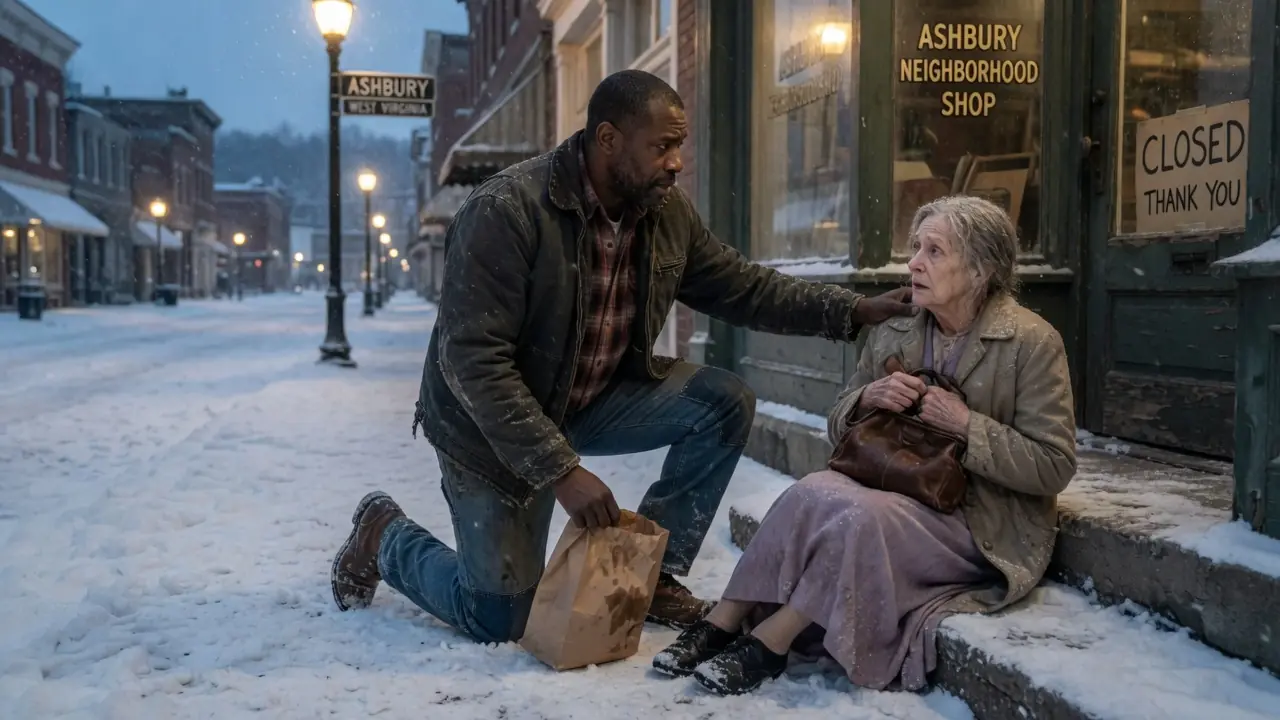
Her hands were bare, stiff, and pale against the concrete.
Without a moment’s hesitation, the man rushed to her side, pulled off his only coat, and wrapped it around her thin shoulders. His son knelt beside him in the snow, frightened but brave, blocking the wind with his small body while his father checked for a pulse.
That single act of mercy cost them almost everything they had left.
The man spent his last money getting her out of the storm. The boy gave her his most precious blanket. They fed her with food they could not spare, warmed her in a house that barely had heat, and cared for her through the night as if she were family.
But when the woman’s wealthy son finally arrived, he did not fall to his knees in gratitude.
He pulled out his wallet.
He looked around their crumbling home with contempt.
Then he said, “How much do I owe you?”
And in that moment, he shattered something far greater than pride.
He turned kindness into an invoice.
What happened next would change all of their lives in ways none of them could have imagined.
The bus rattled along Interstate 89, its headlights cutting through the thickening snow.
Evelyn Harper sat in the fourth row from the back, her hands folded over a worn leather purse in her lap. She was seventy-eight years old, and this was the longest trip she had taken alone in over a decade.
Through the frost-edged window, she watched the landscape blur into white. New Hampshire had disappeared hours ago. The dark line of trees beyond the highway looked like smudges of charcoal beneath the storm clouds. Every few minutes, the bus rocked hard in the wind, and passengers lifted their heads from phones and books to glance nervously toward the driver.
Evelyn did not complain.
She had been raised not to.
She simply tightened both hands around her purse and pressed her forehead lightly against the cold glass, breathing slowly until the flutter in her chest calmed.
She thought about the house she had left behind in Concord.
The little wooden house with the sagging porch where she had lived for forty-two years. The house where her husband George had planted lilacs along the fence because he said a woman should smell spring before she saw it. The house where their son Brandon had taken his first steps across a faded braided rug while Evelyn clapped and George pretended not to cry.
George’s rocking chair was still in the living room, positioned just where he had left it before the heart attack took him.
The mailbox in the hallway still held postcards he had sent her from business trips long ago, their edges yellowed, but his words still clear.
On the kitchen wall, beneath layers of ordinary years, there were pencil marks tracking Brandon’s height year by year until he had grown too tall to measure and too busy to visit.
Evelyn had not told Brandon she was coming.
That was the foolish part.
She knew it was foolish, but loneliness has a way of making foolish plans sound brave.
She had tried calling three times over the past month. Each conversation had been the same.
“Mom, I’m in a meeting.”
“Mom, can I call you back?”
“Mom, let me get through this quarter and we’ll figure something out.”
She did not blame him.
That was the habit of mothers.
Explaining the absence of children until it hurt less.
Brandon had worked hard to build his career. He was a senior manager now, something important in logistics. She did not fully understand what he did, but she knew it mattered. People relied on him. Companies paid him well. His name appeared on conference badges and business emails. He had become successful in the way parents say they want their children to become successful before they realize success can also become a wall.
He had a wife named Sarah.
Two children, Olivia and Ben.
A house with a two-car garage.
A lawn service.
A refrigerator that made ice through the door.
He had made it.
Evelyn was proud of him.
But pride did not warm an empty kitchen.
Pride did not answer the phone on a Tuesday afternoon when the house had been quiet since breakfast.
Pride did not sit across from her at dinner or ask whether her knees still hurt in the rain.
She missed him.
She missed him the way you miss sunlight after too many gray days.
So she had packed her old suitcase, withdrawn two hundred dollars from the bank, and bought a bus ticket toward St. Paul, Minnesota. She would surprise him. She would see her grandchildren. She would sit at his kitchen table and feel, just for a moment, like she still belonged to someone.
The bus lurched suddenly.
A woman near the front gasped.
The driver’s voice crackled over the intercom.
“Folks, we’ve got a situation. Highways closed ahead due to the storm. We’re going to have to reroute.”
Murmurs rippled through the passengers.
A young man in a hoodie cursed under his breath.
A mother tried to calm a baby.
An older gentleman across the aisle muttered that the company never should have sent them out in this weather.
Evelyn clutched her purse tighter.
The bus turned off the interstate onto smaller roads. The snow came down in thick, slanting sheets now, and the wipers struggled to keep up. The world outside became nothing but white gusts, dark trees, and occasional flashes of roadside signs swallowed almost immediately by the storm.
Evelyn’s chest tightened again.
She reached into her coat pocket for her phone.
The battery icon showed eight percent.
She should have charged it at the last stop. She had meant to. But the outlet near her seat had not worked, and she had not wanted to bother anyone by asking to switch seats.
She put the phone back in her pocket and closed her eyes.
George would have scolded her gently.
“Evie, you cannot cross three states on eight percent and faith.”
She almost smiled.
Then the bus swayed hard again, and the smile faded.
An hour later, the bus pulled into a small town and stopped abruptly near a dark row of storefronts. The brakes hissed. The engine groaned. Snow battered the windshield so fiercely that the headlights seemed to illuminate only a wall of white.
The driver stood and turned to face them, his face grim.
“All right, everybody off. Town’s called Ashbury. Storm’s too bad to keep going tonight. You’ll need to find somewhere to stay.”
“What about our tickets?” someone called.
“Company will sort it out. Right now, I need everyone off the bus. We can’t keep idling here.”
“What are we supposed to do?” another passenger demanded.
The driver rubbed his face.
“Find the motel. Call family. Shelter at the diner if it’s open. I’m sorry, folks. I don’t make the roads.”
Evelyn gathered her things slowly.
Her fingers felt stiff and clumsy. Her legs ached from sitting too long. She waited as younger passengers pushed down the aisle with bags and complaints, then followed them into the freezing night.
The cold hit her like a slap.
She gasped, and the air burned her throat.
Snow stung her face and clung to her thin coat. The wind found the gap between her scarf and collar immediately, sliding icy fingers against her skin.
Around her, people hurried toward the few lit buildings on the main street, their figures disappearing into the white haze. Evelyn stood on the sidewalk, suitcase in hand, and looked around.
Ashbury was barely a town.
Just a strip of old storefronts, most of them dark. A hardware shop. A closed bakery. A gas station with one flickering pump light. A small diner whose sign blinked weakly through the storm. Farther down, a motel sign buzzed red against the snow.
Evelyn started walking toward it.
Her feet slipped on the ice, and she had to stop every few steps to catch her breath. The suitcase wheels clogged with snow, forcing her to drag it by the handle. By the time she reached the motel, her chest was heaving and her face was numb.
The sign on the door said:
NO VACANCY.
She stood there for a moment, staring at the words.
Then she knocked anyway.
A man behind the desk looked up, saw her through the glass, and shook his head before she could even speak.
She tried another place two blocks down. Closed.
The diner was packed with stranded passengers, and a handwritten note on the door said, NO MORE SEATING. PLEASE TRY CHURCH SHELTER ON 3RD.
Evelyn did not know where Third Street was.
Her phone showed five percent battery.
She tried calling Brandon.
The call would not go through.
She tried again.
No signal.
Her vision swam.
The cold was no longer just outside her body. It had entered her bones. Her hands felt far away. Her legs trembled under her. She looked around for somewhere to sit, somewhere out of the wind, and saw a closed storefront with a small concrete step beneath a torn green awning.
She made her way over and sank down onto it.
The cold from the concrete seeped through her clothes immediately.
She coughed.
The cough turned into a harsh rattling sound that scared her.
She tried to stand.
Her legs would not obey.
Her head felt light, disconnected. The neon sign in the distance smeared into red and white streaks. Snow gathered on the shoulders of her coat.
She thought about Brandon.
She thought about the house in Concord.
She thought about the pencil marks on the kitchen wall.
“If I fall here,” she whispered to no one, “will he even know?”
She tried to stand again.
The world tilted.
Her vision went dark at the edges.
Then entirely.
She collapsed into the snow.
The street was empty.
The wind howled.
Snow accumulated on her still form, covering her coat, her hair, her face. The neon sign in the distance continued to flicker, indifferent.
Minutes passed.
The temperature dropped further.
Evelyn’s breathing grew shallow, barely visible in the freezing air.
And then, through the curtain of falling snow, two figures appeared at the far end of the street.
A man and a boy walking home.
The man carried a paper bag from the hardware store. The boy stayed close to his father’s side, head down against the wind, one gloved hand gripping the hem of the man’s jacket.
They were just passing by.
Just trying to get home before the storm got worse.
Just two hungry people with no room in their lives for another emergency.
But the man’s eyes caught something.
A dark shape where there should not have been one.
He slowed his steps.
“Stay close,” he told his son.
Then he moved toward what he had seen.
Malik Johnson dropped to his knees beside the woman lying in the snow.
His heart hammered in his chest as he brushed snow from her face and pressed two fingers to her neck, searching for a pulse.
There it was.
Faint.
Unsteady.
But there.
She was alive.
Barely.
“Dad,” his son whispered.
Eli was beside him, ten years old and shivering despite his winter coat. His eyes were huge in his thin face.
“Is she…”
“She’s alive.”
Malik pulled off his own coat and draped it over her.
The wind punched through his sweater immediately, stealing warmth from his back and shoulders, but he ignored it.
“Eli, come here. Stand close to block the wind.”
Eli obeyed without question.
The boy was used to his father’s quick decisions, the way Malik moved through emergencies with calm efficiency because panic wasted time and time was usually the one thing they did not have.
Malik looked around.
The street was empty.
No cars passing.
No people close enough to call.
The hospital was fifteen miles away, and in this storm, it might as well have been on the moon.
He reached into his pocket and pulled out his wallet.
Three twenties and a ten.
That was it.
That was all the money he had until next week when, if he was lucky, the foreman would call him back for another day of work.
Seventy dollars.
Food money.
Bus money.
Electric bill money.
Not enough for everything, but enough to keep them breathing a few more days.
He looked at the woman again.
Her lips were blue now.
Her breathing was so shallow he could barely see her chest rise and fall.
If he left her here to find help, she would be dead before he returned.
He made the decision.
“Eli, help me get her up.”
Together, they lifted the woman to her feet. She was light, frighteningly so. Malik half-carried, half-dragged her along the sidewalk toward the corner where a taxi was idling outside the gas station.
He knocked on the window.
The driver rolled it down an inch.
“Yeah?”
“I need to get her somewhere warm. Fast.”
The driver looked at the woman.
Then at Malik.
His eyes held the calculation Malik had seen a thousand times before. The weighing. The judgment. The decision about whether to help or drive away.
“That’s going to be twenty bucks cash.”
Malik handed him a twenty without hesitation.
“Take us to Maple Street. The rentals near Hancock.”
The driver hesitated, then nodded.
“Get in.”
They bundled the woman into the back seat. Eli climbed in after her, and Malik followed, holding her upright so her head would not knock against the window as the taxi jerked forward into the storm.
Her skin was so cold it barely felt human.
Malik rubbed her hands, trying to bring warmth back into them.
“Is she going to be okay?” Eli asked quietly.
“She will be,” Malik said.
He was not sure if he believed it.
But he needed his son to.
The taxi pulled up to the row of rental houses ten minutes later. Malik handed the driver the rest of his money, thirty dollars more, because the man had driven through streets most drivers would have refused.
His last fifty dollars gone.
Just like that.
The money he had been saving for groceries.
For the bus fare to the next town where there might be work.
For the electric bill already stamped in red.
But he had made his choice, and he did not regret it.
Not then.
His house was the third from the end.
The porch light was out. The door stuck in its frame from the cold. Malik shouldered it open and carried the woman inside.
The house was barely warmer than the street.
The heater was broken again, and the small space heater in the living room could only do so much. Plastic sheeting covered one window. A towel had been stuffed under the door to stop the draft. The walls held the kind of cold that came from years of neglect.
Malik laid the woman on the couch and started pulling blankets from the bedroom.
“Eli, get some water heating on the stove.”
“Okay.”
Malik wrapped the woman in every blanket they had. Her skin was still ice cold. He rubbed her hands, her arms, trying to bring warmth back into them without hurting her fragile skin.
After a few minutes, she stirred.
Her eyelids fluttered.
“It’s okay,” Malik said gently. “You’re safe. You’re inside.”
The woman’s eyes opened.
They were gray, clouded with confusion. She looked around the dim room, at Malik, at Eli standing in the kitchen doorway with a pot in his hands.
“Where?” Her voice was barely a whisper.
“You’re in Ashbury. You collapsed in the snow. I brought you here.”
She tried to sit up, but Malik put a careful hand near her shoulder, not pressing hard.
“Don’t. You need to rest.”
“I…” She coughed, a harsh sound that shook her whole body. “I’m sorry. I don’t… I don’t want to be a burden.”
“You’re not,” Malik said. “Just breathe. We’ll figure it out.”
Eli brought over a mug of hot water. Malik helped the woman sit up enough to take small sips. Color was slowly returning to her face, though her hands still trembled around the mug.
“What’s your name?” Malik asked.
“Evelyn,” she said. “Evelyn Harper.”
“I’m Malik. This is my son, Eli.”
Evelyn looked at Eli, and something in her expression softened.
The boy’s eyes were wide with concern, his thin face serious beyond his years.
“You’re very brave,” she told him.
Eli ducked his head, shy.
Malik stood and went to the kitchen.
He opened the cupboard and stared at what was left.
Half a loaf of bread.
A can of soup.
Some pasta.
A jar of sauce that was almost empty.
A small bag of oats.
He had been planning to make it stretch until Friday.
Now there were three of them.
He made the soup.
He toasted the bread.
He divided it carefully, giving Evelyn the largest portion and Eli the second largest. For himself, he took barely enough to call it a meal.
When he brought the bowl to Evelyn, she looked at the soup, then at him, her eyes filling with tears.
“You don’t have to…”
“Eat,” Malik said simply.
They ate in silence.
Evelyn noticed everything.
The way Malik watched Eli, making sure his son ate slowly, making sure there was enough. The threadbare couch beneath her. The crack in the window patched with tape. The way the single space heater sputtered and hummed, struggling against the cold that seeped through every gap in the walls.
The bills stacked on the small table.
Their envelopes already opened.
Their contents clearly bad news.
She realized with a sinking feeling that she had stumbled into a home already stretched too thin. A home barely holding together. A home where her need had just taken food, warmth, and money from people who had almost none of any of it.
When they finished, Eli stood and disappeared into his room.
He returned a moment later with a blanket folded in his arms.
It was thin, printed with faded stars and moons, worn soft from years of use. Evelyn could see places where it had been carefully mended, the stitches small and precise.
This was not just a blanket.
This was something cherished.
He brought it to Evelyn without a word.
“This is yours,” Evelyn protested, her voice cracking. “I can’t take this.”
“You need it more,” Eli said quietly.
His voice was matter-of-fact, without any sense of martyrdom or self-pity. He simply saw a need and filled it the way his father had taught him.
Malik did not stop him.
He just nodded at his son.
And Evelyn saw in that single gesture a world of love, pride, worry, and sadness all mixed together.
Evelyn pulled the blanket around herself and felt something break inside her chest.
Not pain.
Something worse.
Gratitude mixed with shame.
Here was a child who had almost nothing, giving away one of the few things that brought him comfort. Here was a man who had spent his last dollar, his last food, his last resources on a stranger he might never see again.
These people had nothing.
And they had given her everything.
The house settled into an uneasy quiet.
Outside, the wind howled and threw snow against the windows with increasing violence. Inside, the space heater clicked and hummed, fighting a losing battle against the cold creeping through every crack.
Evelyn lay on the couch, wrapped in Eli’s star blanket and three others Malik had piled over her. Warmth returned to her body slowly, like water seeping into dry ground.
Malik sat in a wooden chair across from her, his hands clasped between his knees. He had said little since dinner, his face thoughtful but closed off, the expression of someone used to keeping his struggles private.
Eli had gone to his room to do homework, but Evelyn could hear him coughing softly through the thin walls. It was a wet, persistent cough that made her chest tighten with worry.
“Your son,” Evelyn said, her voice still hoarse from the cold. “He’s sick.”
“It’s just a cold,” Malik said.
But there was a tightness in his voice.
“He gets them every winter. Doctor said it’s nothing serious.”
Evelyn heard the way he said doctor like it was a luxury he had barely afforded.
She looked around the room again.
Really looked.
The wallpaper was peeling in the corners, revealing water-stained drywall beneath. The floorboards were warped near the door where rain or snow had leaked in repeatedly. There was a patch of cardboard taped over a hole in the wall, painted over in an attempt to match the faded beige but not quite succeeding.
On the small table by the window sat a stack of bills, their corners curling, some stamped in red letters.
PAST DUE.
FINAL NOTICE.
DISCONNECT WARNING.
The house was not just poor.
It was on the edge of collapse, both structurally and financially.
“How long have you lived here?” she asked.
“Two years. It’s cheap. Landlord doesn’t fix much, but he doesn’t ask questions either.”
Malik’s voice was neutral.
Accepting this as simply the reality of his life.
Evelyn nodded slowly.
She understood this was the kind of place people came to when they had no other options. When every door had closed, and this was the only one left standing, even if it hung crooked on its hinges.
“I’m sorry,” she said suddenly, the words bursting out. “I’m so sorry for the trouble.”
Malik looked at her, his dark eyes steady and impossibly kind.
“You didn’t cause trouble. You needed help.”
“But the money, the taxi, the food. You spent everything you had.”
“It’s done,” Malik said. “Don’t worry about it.”
“How can I not worry? You and Eli will go hungry because of me.”
“We’ve gone hungry before.”
He said it simply.
Without drama.
Without self-pity.
“We’ll figure it out. We always do.”
Evelyn felt tears prick her eyes. She blinked them away, but they came anyway, hot and shameful.
“Can I ask you something?”
“Sure.”
“Why did you help me? You don’t know me. You clearly have your own struggles. Most people would have walked past.”
Malik was quiet for a long moment.
He looked at his hands, then at the doorway where Eli’s room was, then back at Evelyn.
“My wife died six years ago,” he said finally.
His voice was steady, but Evelyn could hear the old grief underneath, worn smooth but still sharp.
“Complications during childbirth. Our second child didn’t make it either. A little girl. We’d already picked out her name.”
Evelyn’s breath caught.
“Her name was Naomi,” Malik said quietly. “Eli was four then. He didn’t understand why his mama wasn’t coming home. Kept asking if the hospital was far away.”
“I’m so sorry,” Evelyn whispered.
“After that, it was just me and him. I had to work, but I couldn’t afford childcare. Lost my steady job because I kept missing shifts to take care of him when he was sick. Couldn’t find another one that was flexible. One thing led to another, and we ended up here.”
He looked around the room, not with embarrassment, but with the tired acceptance of a man who had already had shame burned out of him by necessity.
“I’ve been on the other side of it, you know. Needing help and not getting it. Asking for work and getting doors slammed in my face. Standing in line at the food bank and seeing people look at me like I was less than human because I needed help feeding my son.”
He paused.
When he spoke again, his voice was quiet but intense.
“So when I see someone who needs help, I don’t think about it too much. I don’t calculate whether I can afford it. I just do what I can because I know what it’s like to be invisible. To need someone to see you and have everyone look away instead.”
“Even when you can’t afford to?”
Malik shrugged.
“Especially then. That’s when it matters most.”
They sat in silence for a moment, the weight of his words settling between them.
Outside, the wind rattled the windows.
The space heater sputtered, went quiet for a heart-stopping moment, then clicked back on.
“Tell me about your son,” Evelyn said.
Malik’s face softened immediately.
“Eli is a good kid. Better than I deserve. Smart as anything. He’s in fifth grade. Gets straight A’s even though we move around a lot, and he’s changed schools three times. Loves reading, especially science books. Checks them out from the library and reads them cover to cover, then goes back for more.”
He smiled just a little.
“Wants to be an engineer when he grows up. Keeps drawing these elaborate designs for bridges and buildings. Uses whatever paper he can find. Homework assignments, backs of junk mail, napkins from fast-food places.”
“He sounds wonderful,” Evelyn said.
“He is. He’s patient when I can’t buy him the things other kids have. He never complains when dinner is just beans and rice for the third night in a row. He helps out without being asked. And he still believes…”
Malik’s voice caught.
“He still believes things will get better. That one day, we’ll have a real home with heat that works and walls that don’t leak. He draws pictures of it sometimes. A little house with a yard, a tree we could put a swing in, a room that’s really his with bookshelves for all the books he wants to read.”
Evelyn felt her heart breaking.
“He’s lucky to have you.”
“I hope so. I’m doing my best. But…”
Malik rubbed his face, and Evelyn saw how tired he was, the kind of tired that goes bone-deep and never really leaves.
“Some days I don’t know if my best is enough. Some days I look at him and think about all the things I can’t give him, and I wonder if he’d be better off with someone else. Someone who could provide for him properly.”
“Don’t say that,” Evelyn said sharply. “Don’t ever say that. That boy does not need another father. He needs you. He needs to know he is loved, and he does. I can see it in the way he looks at you. That child knows he is loved.”
Malik nodded slowly, accepting the words like something he needed to hear but had never allowed himself to believe.
Eli appeared in the doorway then, wearing oversized pajamas patched at the knees and elbows.
“Dad, I finished my homework.”
“Good. Come here a second.”
Eli padded over in worn socks, and Malik pulled him into a gentle hug. The boy leaned into his father, and Evelyn saw the absolute trust in that gesture. The complete security of a child who knew he was safe, even in an unsafe world.
“You should get to bed,” Malik said. “School tomorrow.”
“Even with the snow?”
“Even with the snow. They don’t close schools around here unless the power goes out.”
Eli looked at Evelyn.
His eyes were serious, too old for his face.
“Are you feeling better?”
“Much better,” she said. “Thank you for the blanket.”
“You can keep it as long as you need.”
Then, hesitantly, he asked, “Where were you going before you got stuck here?”
“I was going to see my son,” Evelyn said. “He lives in Minnesota.”
“Does he know you’re coming?”
“No. I wanted to surprise him.”
Eli nodded, processing this with the gravity of a much older person.
“I bet he’ll be really happy to see you. I would be if my mom could come back. I mean, I’d want to see her all the time.”
The simple honesty of it hit Evelyn like a physical blow.
She managed to smile.
“I hope so, sweetheart.”
Malik sent Eli to bed, and the boy went without protest, though Evelyn could hear him coughing again once his door closed.
Each cough made Malik’s shoulders tense.
Made his hands curl into fists.
He noticed her watching.
“He’ll be fine,” he said.
But there was a tightness in his voice that suggested he was not entirely sure.
“The doctor gave him medicine last time. It just takes a while.”
“When was the last time he saw a doctor?”
“Last month. I took a day’s pay I couldn’t afford to lose, and we went to the clinic.”
Malik stood and went to the kitchen, busying himself washing the dishes in the small rust-stained sink.
“They said it was bronchitis. Gave him an inhaler and antibiotics. Said to bring him back if it got worse.”
“And has it?”
Malik’s hands stilled in the soapy water.
“Maybe. I don’t know. I keep telling myself it’s just the cold weather, that it’ll get better when spring comes.”
But spring was months away.
They both knew it.
Evelyn watched him. This man who carried so much weight on his shoulders, who kept moving forward even when the path ahead was impossibly dark.
She thought about Brandon.
About the distance between them that had grown so gradually she had not noticed until it was a canyon.
She thought about phone calls that never lasted more than five minutes. Promises to visit that never became visits. The way she had started to feel like an obligation rather than a mother.
“My son is very busy,” she said.
Malik did not turn around, but she knew he was listening.
“He has an important job, a family of his own, a big house, and a good neighborhood. He has worked very hard for everything he has. Made something of himself. I’m proud of him.”
Malik dried his hands on a threadbare towel.
“After my husband George died, Brandon started calling more,” Evelyn continued. “Just to check in, he said. Just to make sure I was okay. For a while, those calls were the best part of my week. We would talk for an hour. Sometimes he’d tell me about his work, his kids, what they were learning in school. I’d tell him about the garden, the neighbors, what was on TV.”
She paused, remembering.
“But gradually, the calls got shorter. He’d say, ‘Mom, I’ll come visit soon.’ But soon never came. Then it was, ‘Let me get through this work thing first.’ Then it was, ‘Maybe next quarter.’ Then it was just, ‘We’ll see.’”
Malik returned to the chair.
“I stopped asking,” Evelyn said. “I didn’t want to be a burden. I didn’t want to be the nagging mother who could not understand that her son had his own life. So I just waited. I waited for him to call. Waited for him to remember. Waited for the day when he would have time for me again.”
“You’re not a burden for wanting to see your son,” Malik said.
“But I feel like one.”
The tears came then.
Hot and shameful.
“Every time I call, I can hear it in his voice. He’s busy. He’s stressed. He has meetings, deadlines, things that actually matter. And here is his old mother calling to chat about nothing important, taking up time he doesn’t have.”
She wiped her eyes with shaking hands.
“So I stopped calling as much. I stopped asking when he’d visit. I stopped mentioning how quiet the house gets, how long the days are. I just waited. But the waiting became so lonely, so unbearably lonely.”
“Is that why you got on the bus?”
“Yes.”
The word came out as barely more than a whisper.
“I thought if I showed up, if he could see me standing there in front of him, maybe it would be different. Maybe we could sit together just for a little while, and I could remember what it felt like to matter to someone.”
Malik leaned forward, elbows on his knees.
“My boy needs me,” he said quietly. “Every single day, he needs me. Some days, that’s the only thing that keeps me going. When work dries up and the landlord’s banging on the door and the cupboards are empty and I don’t know how we’re going to make it through another week, I look at Eli and think, I have to figure this out. He’s counting on me. I’m all he has.”
“You are a good father,” Evelyn said.
“I’m a tired father,” Malik said with a small, sad smile. “A father making it up as he goes and hoping I don’t mess him up too badly. But I love him. God, I love that boy more than I’ve ever loved anything.”
“That counts for everything,” Evelyn said.
They fell silent again.
The space heater sputtered.
The wind pressed against the windows.
Evelyn pulled the star blanket tighter around herself, feeling the places where Eli’s small hands had carefully mended the tears.
“Can I tell you something?” she asked.
“Of course.”
“I used to think that if I was patient enough, if I waited long enough and didn’t complain or make demands, things would go back to how they were. When Brandon was little, we were so close. He’d come home from school and tell me everything. Who he played with at recess, what the teacher said, what he learned that day.”
She smiled at the memory even as fresh tears fell.
“We’d bake cookies together on Sunday afternoons. He’d fall asleep on the couch with his head on my shoulder, and I’d sit there not moving because I didn’t want that moment to end. I thought when he had kids of his own, he’d understand. He’d remember what it was like to be a child who needed his mother. And he’d bring his children to visit, and we’d be a family again.”
Her smile faded.
“But he didn’t. He got busier. The distance got bigger. The visits got shorter, then stopped. And I realized I was the only one still waiting for something that was not coming.”
“That’s hard,” Malik said.
The simple acknowledgement, without false comfort, meant more than elaborate sympathy could have.
“The hardest part,” Evelyn said, “is that I don’t think he is trying to hurt me. I don’t think he wakes up and decides to ignore his mother. I think he simply forgot. Forgot that I’m still here. Forgot that time doesn’t stop for me the way it seems to for him. Forgot that every day that passes is a day I’m getting older, closer to the end, and he is missing it.”
She looked at Malik, her eyes red and desperate.
“Do you ever worry that Eli will forget you? That one day he’ll grow up and move away and you’ll just be a voice on the phone he doesn’t have time for?”
“Every single day,” Malik admitted.
The confession seemed to cost him something.
“I worry that one day he’ll grow up and remember only what we didn’t have. The cold house. Empty cupboards. Moving schools. Skipping meals. I worry he’ll remember being poor more than being loved.”
“He won’t,” Evelyn said with fierce certainty. “Because you are here. You are present every single day. You are giving him something more valuable than anything money can buy.”
“What’s that?”
“Your time. Your attention. Your complete, undivided love.”
She paused.
“My son sends me money for my birthday. He sends gift cards at Christmas. But what I want is a phone call that lasts longer than five minutes. I want him to ask how I am doing and actually wait for the answer instead of half-listening while he checks his email. I want him to remember that I am still his mother, not a task he needs to complete.”
Malik nodded slowly.
“I hope he realizes what he has before it’s too late.”
“So do I,” Evelyn whispered. “God, so do I.”
As she drifted toward sleep, she heard Malik moving quietly around the room, checking the door, turning off the one lamp that worked, adding another thin blanket over her despite the fact that he had none left for himself.
He paused beside the couch.
“Rest well, Mrs. Harper,” he said softly.
And for the first time in months, maybe years, surrounded by strangers in a falling-down house in a town whose name she had never heard before that day, Evelyn felt something she had not felt in a long time.
She felt seen.
She felt valued.
She felt like she mattered.
Not because of who she had been.
Not because of what she could provide.
Simply because she was a human being who needed help, and someone had cared enough to give it.
Morning came gray and cold, the kind of morning that never fully becomes light.
Evelyn woke to the sound of movement in the kitchen and the smell of oatmeal. She sat up slowly, her body stiff and aching in ways that had nothing to do with age and everything to do with exposure and exhaustion.
Malik stood at the stove, stirring a battered pot.
Eli sat at the small table, writing carefully in a notebook, his tongue caught between his teeth in concentration.
He was doing homework in the dim morning light because they could not afford to waste electricity keeping the lamp on all day.
“Good morning,” Malik said when he noticed her. “How are you feeling?”
“Better,” Evelyn said.
It was mostly true.
Her chest still ached with every breath, and her throat felt raw, but the bone-deep cold that had nearly killed her was gone.
“I made oatmeal. It’s not much, but it’s warm.”
They ate together, the three of them crowded around the small table that wobbled unless you wedged a folded napkin under one leg.
Evelyn noticed Malik gave her and Eli most of the food, taking only a small portion for himself.
When she tried to give some back, he shook his head.
“I already ate.”
He lied.
They both knew it.
But what could she say?
“I need to call my son,” Evelyn said after breakfast. “Let him know where I am.”
“Phone’s in the living room. Help yourself.”
Evelyn’s hands shook as she dialed Brandon’s number.
It rang four times, then went to voicemail.
The sound of his voice, “You’ve reached Brandon Harper. Leave a message,” made her chest tighten.
“Brandon, it’s Mom. I… there was a storm. The bus got rerouted to a town called Ashbury. I’m okay, but I’m stuck here. I need you to call me back, please, as soon as you can.”
She left Malik’s address, stumbling over the street name, and hung up.
She tried twice more throughout the morning.
No answer.
By afternoon, she was checking the phone every few minutes, willing it to ring. By evening, when Brandon still had not called back, she felt something worse than anxiety.
That old familiar invisibility settling over her like a shroud.
The next morning brought bitter cold and no word from Brandon. Malik went out early looking for work, leaving Eli to get ready for school.
Evelyn helped the boy make a sandwich for lunch from the last of the bread and a thin scraping of peanut butter.
“Is your dad going to be okay?” she asked.
Eli shrugged with the practiced nonchalance of a child who had learned not to worry out loud about things he could not control.
“He always figures something out. That’s what he says.”
But his eyes were worried.
Malik came back at noon, his face tight.
“Nothing today. Maybe tomorrow.”
That night, Evelyn gave them the forty-seven dollars she had left.
“Please take it for food.”
“No, ma’am,” Malik said firmly. “You need that to get home.”
“I need you and Eli to eat.”
“We’ll manage.”
They went to bed hungry.
The knock came at dawn the next morning.
Not a polite knock.
A pounding that rattled the door in its frame and echoed through the small house like a threat.
Malik was in the kitchen, standing by the stove where the pot from the night before still sat unwashed because there had been nothing to wash out of it. Eli was in his room getting dressed in clothes washed so many times they were more holes than fabric.
Evelyn was on the couch, her phone fully charged now, but still silent.
Malik opened the door.
The landlord stood there.
Carl Ducker was a thick man in a heavy coat, his face weathered and hard, his eyes the kind of cold that had nothing to do with temperature.
He looked at Malik the way you would look at something stuck to your shoe.
“Johnson.”
“Mr. Ducker.”
“You know why I’m here.”
“I know. I’m working on it.”
“Working on it.” Ducker’s lip curled. “You’ve been working on it for three weeks. That’s nine hundred dollars you owe me, Johnson. Nine hundred dollars I don’t have because you can’t pay your bills.”
Malik’s jaw tightened, but his voice stayed level.
“I said I’m working on it. The foreman told me he’d have work next week.”
“Next week doesn’t pay this week’s rent. Next week doesn’t pay last week’s rent or the week before that.”
Ducker leaned against the door frame, his bulk blocking most of the weak morning light. His eyes scanned the dim interior of the house, taking inventory like a vulture.
They landed on Evelyn.
His expression darkened.
“Who the hell is that?”
“A guest.”
“A guest.” Ducker laughed without humor. “You’re three weeks behind on rent and taking in guests. What is this, a bed and breakfast?”
“She needed help.”
“I need help. I need nine hundred dollars that I’m owed. You think I’m running a charity?”
He jabbed a thick finger toward Evelyn.
“She paying rent? She’s not staying here. If she’s staying here, she owes me money too. This is my property, Johnson. Mine, not yours.”
Malik’s hands curled into fists at his sides.
“She’s leaving soon. She just needed a place to stay while—”
“I don’t care.”
Ducker straightened.
“You’ve got three days. Three days to get me every cent you owe. Not four days. Not a week. Not when the foreman calls. Three days. You understand me?”
“Yes.”
“Because on day four, I’m coming back with a locksmith. I’m changing every lock on this dump, and I’m putting every piece of trash you own on the curb. Your clothes, your furniture, that kid’s toys, all of it.”
He leaned closer, his breath visible in the cold air.
“And if you’re still inside when I get here, I’m calling the cops and having you removed for trespassing. That clear enough for you?”
“Yes.”
“Three days, Johnson. Think about where your boy’s going to sleep when you’re out on the street in the middle of winter.”
He turned to go, then looked back once more.
“And get that guest out of here before I decide she owes me back rent too.”
He walked away, his boots leaving deep prints in the snow.
Malik stood there with his hand on the door for a long moment before slowly pushing it closed.
His hand was trembling.
His breathing was carefully controlled, like he was fighting to keep something down.
Rage.
Despair.
Or both.
“Dad.”
Eli stood in the hallway.
His eyes were enormous in his thin face.
He had heard everything.
“It’s okay, buddy.” Malik’s voice was steady, but Evelyn could hear the effort it took. “Go finish getting ready for school.”
“But he said…”
“I know what he said. Go on now.”
“We’re going to lose the house.” Eli’s voice cracked. “We don’t have the money. We’re going to be on the street again.”
“We’re not going to be on the street.”
“How? How are we not going to be on the street? You don’t have any money. You spent it all.”
He stopped.
His eyes cut to Evelyn.
She saw the moment he connected the dots.
The money his father had spent on the taxi.
On getting her warm.
On feeding her.
Money they did not have.
Money they needed.
Money that might have helped them survive a little longer.
“Eli,” Malik said gently, “this isn’t her fault.”
“I didn’t say it was.”
But his eyes were wet, and his voice was small and broken.
“I just don’t want to go back to the shelter, Dad. I don’t want to sleep on those cots where people cough all night. I don’t want to move schools again. I finally have friends here. I finally…”
He could not finish.
He just stood there, ten years old and trying not to cry.
Malik crossed the room and pulled his son into a fierce hug.
“We’ll figure it out. I promise. Have I ever let you down?”
“No.”
“Then trust me now. Go to school. Let me handle this.”
Eli nodded against his father’s chest, then pulled away and went to get his backpack. He did not look at Evelyn as he left, but she felt the weight of his disappointment like a physical thing.
When the door closed behind him, Malik stood with his back to Evelyn, his shoulders rigid.
“I’m so sorry,” Evelyn whispered.
The words felt pathetically inadequate.
“It’s not your fault,” Malik said to the door.
“It is. The money you spent on me, if you had that money right now…”
“Would have been gone anyway.”
He finally turned, and his face was calm, but his eyes were exhausted.
“That money was all I had left. I was going to use it to buy food for the week and take the bus to the next town to look for work. But even if I’d done that, it wouldn’t have been enough for rent. I’d still be short. I’d still be here having the same conversation.”
“But now you have nothing.”
“I’ll figure it out.”
He said it like a prayer.
Like something he had repeated so many times it had become automatic.
“I always do.”
Evelyn reached for her purse with shaking hands, pulled out her wallet, and counted the bills.
Forty-seven dollars.
That was all she had left until she could get to a bank.
She held it out to Malik with both hands.
“Take this, please. It’s not enough, but it’s something.”
“No.” His voice was firm.
“Malik, please.”
“I said no.”
He did not raise his voice, but there was steel underneath.
“You need that money to get home, Mrs. Harper.”
“I need to help you. You saved my life. You and Eli gave me everything when you had nothing. Now you’re going to lose your home because of me, and I can’t bear it. Please let me help.”
“What happens to you if you give me that money?” Malik’s voice was gentle but unyielding. “You’re stuck here with no way to get home, no way to buy food, no way to get a bus ticket.”
“I’ll manage. I’ll figure something out. Just like you always do.”
“No.”
He gently pushed her hands back toward her chest.
“Keep your money. I mean it. You’re going to need it.”
Evelyn wanted to argue.
Wanted to force the money into his hands.
Wanted to do something, anything, to fix what her presence had broken.
But she could see in his face that arguing would be useless.
His pride would not allow it.
His dignity, the last thing he had left, would not let him take money from an old woman who had almost nothing herself.
She put the money back in her wallet, feeling helpless and ashamed and angry at her own uselessness.
She tried calling Brandon again.
Six times throughout the day.
His voicemail box was full.
That night, she barely slept.
She kept thinking about Eli’s face.
About the three days counting down.
About winter cold and the shelter where a ten-year-old boy did not want to go back.
She kept thinking about Malik lying awake in his room, trying to figure out how to perform a miracle with empty hands.
The next day, Brandon finally called back.
Brandon Harper had been in back-to-back meetings for three days straight.
A distribution crisis in the Midwest.
A supplier going bankrupt in Texas.
A hundred small fires that needed putting out.
Each one urgent.
Each one critical.
He had barely slept. He had eaten lunch at his desk for five days running. His wife was annoyed. His children barely saw him.
When his assistant knocked on the conference room door, looking worried, he had been in the middle of a presentation about optimizing warehouse logistics.
He held up one finger.
Wait.
Then he continued talking about efficiency metrics and cost reduction.
It was not until the meeting ended two hours later that he finally listened to his voicemails.
Seven missed calls from an unknown number.
Three voicemails from his mother, each one more strained than the last.
“Brandon, it’s Mom. I… there was a storm. The bus got rerouted…”
He stopped walking in the middle of the hallway. Other employees had to step around him, throwing him curious glances.
By the time he finished listening to all three messages, his face was white.
His mother stuck in some town he had never heard of.
Staying with strangers.
She could have died.
She could have frozen to death.
And he had been too busy to notice she was traveling, too busy to wonder why she had not called in over a week.
He called the number back immediately.
A man answered, his voice wary.
“This is Brandon Harper. My mother, Evelyn Harper. Is she there?”
“Yes. She’s safe. She’s okay.”
“What happened?”
The man said his name was Malik.
He explained briefly.
The storm.
The bus stop.
His mother collapsing in the snow.
Bringing her home.
Brandon’s mind raced with questions, with concerns, with a growing horror at how close he had come to losing her.
But what came out of his mouth was, “I’ll be there in six hours. Tell her I’m coming.”
He did not wait for a response.
He hung up, grabbed his coat, and was in his car within ten minutes.
Six hours of driving through snow, slush, and his own mounting dread.
Six hours to think about the fact that his mother had taken a bus alone to see him because he had been too busy to visit her.
Six hours to imagine her lying in the snow, dying, calling his name.
By the time he reached Ashbury, his hands were white-knuckled on the steering wheel and his jaw ached from clenching.
Brandon’s car, a new Lexus SUV with heated seats and a premium sound system, pulled onto Maple Street just after six in the evening.
The contrast between his vehicle and the neighborhood was jarring.
Everything here looked held together with duct tape and desperation.
The houses were crumbling. Half looked abandoned. Broken-down cars sat in driveways, some stripped for parts. Trash bins overflowed. Windows were boarded up or covered with plastic sheeting.
A dog barked frantically from behind a chain-link fence.
This was not poverty the way Brandon imagined poverty in reports and statistics.
This was destitution with doors and windows.
He found the address and parked, locking his car twice, then checking the doors again. He got out, expensive shoes crunching in the snow, wool coat insulated against the cold.
The house looked like it might collapse in a strong wind.
The porch sagged. Paint hung from the walls in long strips. One window was cracked and taped over with plastic. The door hung slightly crooked in its frame.
He knocked.
A man opened the door.
Mid-forties.
Flannel shirt washed so many times the pattern had faded to almost nothing. Jeans with patches on the knees. Work boots that had seen better years.
His hands were calloused.
His eyes tired.
His face weathered beyond his years.
Brandon looked at him and his first instinct was not gratitude.
It was wariness.
Suspicion.
The automatic calculation he would have sworn he did not make.
Poor neighborhood.
Unknown man.
His mother staying here.
The prejudices he would have denied having rose up like bile.
“I’m Brandon Harper,” he said, his voice clipped and professional. “Where’s my mother?”
“Inside. She’s okay.”
Brandon did not wait for an invitation.
He pushed past Malik into the dim interior of the house, his eyes scanning for threats, signs of deception, anything that would confirm his worst suspicions.
He saw Evelyn on the couch, wrapped in blankets that had clearly seen better decades, looking small and fragile in a way that made his heart clench.
“Mom!”
He crossed the room in three long strides and dropped to his knees beside her.
“Are you okay? Are you hurt? Did anyone hurt you?”
“No. No, I’m fine.” Evelyn’s voice was weak but steady. Her eyes were red like she had been crying. “Brandon, this man helped me. He saved my life. He and his son.”
Brandon looked back at Malik, who stood by the door with Eli beside him.
The boy was thin, wearing clothes that did not fit right, staring at Brandon with wide, weary eyes.
Something in Brandon’s expression shifted.
Not to gratitude.
To something harder.
Calculation.
“Right,” he said, standing.
He pulled out his wallet, the leather worn soft from years of use, from being full of credit cards and cash, from carrying the weight of success.
“Okay, let’s settle up. How much?”
Malik blinked.
“Excuse me?”
“How much do I owe you?” Brandon’s voice was brisk, businesslike. The tone of someone negotiating a transaction. “For taking care of my mother. Taxi, food, lodging, whatever else. What’s the total? Let’s handle this now and be done with it.”
The air in the room changed.
Went cold in a way that had nothing to do with the broken heater.
“I don’t want your money,” Malik said quietly.
His voice was controlled, but there was something underneath it.
Something hurt.
Insulted.
Angry.
Brandon let out a short laugh.
It was dismissive.
Condescending.
“Come on, don’t be like that. Everyone wants something, right? You brought her here. You fed her. You gave her a place to stay. That’s worth something. That’s a service. So let’s be adults about this and name your price.”
“Brandon,” Evelyn said, her voice sharp with warning.
“Stop it, Mom. I’m handling this.”
He did not even look at her. His eyes were fixed on Malik, and his expression was the one he wore in negotiations. Patient, slightly amused, certain he had all the power.
“Look, I get it. You did a good thing. You helped someone who needed help. That’s great. But let’s be realistic here. You clearly need the money.”
His eyes swept the room.
The peeling wallpaper.
The patched walls.
The ancient furniture.
“So let’s make this easy for everyone. Five hundred, one thousand. I can write you a check right now. Tell me what it costs and we’re done.”
Eli took a step closer to his father, pressing against his side.
Malik put a hand on his shoulder, and Brandon saw the gesture, protective and defensive, but read it as challenge.
“I didn’t help your mother for money,” Malik said.
His voice was still quiet, but there was steel underneath now.
“I helped her because she needed help. Because she was dying in the snow, and I couldn’t walk past that.”
“Sure, sure. I get that.” Brandon’s tone was patronizing now, the voice of an adult explaining simple concepts to a child. “You’re a good Samaritan. Very noble. But let’s not pretend here. You must want something. Nobody does this kind of thing for free. Especially not…”
He stopped himself.
Too late.
The implication hung in the air like smoke.
Especially not people like you.
Especially not poor people.
Especially not men in falling-down houses and bad neighborhoods.
The words he had not said echoed louder than if he had shouted them.
Malik’s jaw tightened.
His hand on Eli’s shoulder tightened.
“You need to leave.”
“Not without my mother.”
“Then take her. But you need to leave.”
Brandon stepped closer, using his height, his expensive clothes, his entire bearing as a weapon.
“Do you have any idea who I am? What I do? I manage distribution for one of the largest logistics companies in the Midwest. I have connections, resources. I could help you out. I could make your life easier. I could…”
He gestured around the room with barely concealed disgust.
“Get you out of this place. But you need to be reasonable.”
“Reasonable.” Malik’s voice was flat. “You think I’m being unreasonable because I won’t let you pay me off like some kind of stray dog you fed once.”
“I’m offering you money. Real money. Enough to fix this dump you’re living in.”
“I said get out.”
Brandon stepped back, startled.
Not by the volume.
Malik had not shouted.
But by the fury underneath it, the barely contained rage of a man whose dignity had been trampled in his own home.
“Dad helped her because she would have died.”
Eli’s voice cracked on the word.
Tears streamed down his thin face.
“He used his last money. All of it. We don’t have food now. We don’t have rent. We’re going to lose our house. And he still helped her because that’s what you’re supposed to do when someone needs help.”
“Eli,” Malik said gently.
But the boy could not stop.
“You don’t get to come in here and act like we’re bad people because we’re poor. You don’t get to treat my dad like he’s… like he’s something dirty.”
“Eli.”
This time Malik’s voice was firmer.
He pulled his son against his side, and the boy buried his face in his father’s shirt.
“That’s enough.”
But Eli had said what needed saying.
The truth hung in the air between them, ugly and undeniable.
Malik looked at Brandon, and there was something in his eyes that made Brandon take another step back.
Not fear.
Not anger.
Something worse.
Disgust.
Profound, bone-deep disgust.
“Take your mother,” Malik said quietly. “And get out of my house.”
Brandon opened his mouth to argue, to explain, to make Malik understand he was trying to help, that he was being generous, that this man was being irrational and ungrateful.
Then he looked at his mother.
Evelyn was staring at him with an expression he had never seen before.
Her face was white.
Her eyes were red.
In them was something that made his words die in his throat.
Disappointment.
Deep, profound, soul-crushing disappointment.
“Brandon,” she whispered, and her voice was broken. “What have you become?”
The question hit him like a physical blow.
“Mom, let’s just go. We’ll talk in the car.”
He helped her to her feet, wrapped her coat around her shoulders with hands that were not quite steady.
Evelyn looked at Malik, at Eli still crying against his father’s side, and her face crumpled.
“I’m so sorry,” she said. “I’m so, so sorry for all of it. For being here, for costing you everything, for what he…”
She could not finish.
She just stood there crying.
This old woman who had almost died and who had been saved by people who had nothing, only to have her son treat them like servants to be paid off and dismissed.
“It’s not your fault,” Malik said.
He would not look at Brandon.
Could not.
“You didn’t do anything wrong.”
Brandon guided his mother to the door.
As they reached the threshold, he turned back one more time.
Unable to leave it like that.
Unable to accept that he was the villain here.
“Look, if you change your mind about the money…”
Malik closed the door in his face.
The sound of it, solid and final, echoed in the cold evening air.
Brandon stood there for a moment, staring at the closed door, feeling something he had not felt in years.
Shame.
The car ride was silent for twenty minutes.
Brandon drove with his hands tight on the steering wheel, his mind racing. He kept replaying the scene. The way Malik had looked at him. The way Eli had cried. The way his own mother had stared at him like he was a stranger.
He had been trying to help.
He had been trying to make things right.
He had offered money, real money, that could have solved their problems, and they had thrown it back in his face like it was an insult.
“That was ridiculous,” he finally said.
His voice was defensive.
Self-justifying.
“Who turns down help like that? I was trying to do the right thing.”
“Help?” Evelyn’s voice was small but sharp. “Is that what you think you were offering?”
“Yes. I was trying to compensate him for what he did. That’s how the world works, Mom. People provide services. Other people pay for those services.”
“You were trying to buy your way out of feeling anything.”
Evelyn turned to look at him.
Her eyes were still red, but now they were blazing too.
Angry in a way he had never seen before.
“You didn’t see him, Brandon. You didn’t see them. You didn’t see the man who carried me through a blizzard when he had every reason to walk past. You didn’t see the little boy who gave me his most precious possession because I was cold. You just saw poor people who must want money. That is all you saw.”
“That’s not—”
“That’s not fair, is it?” Her voice rose. “Did you even look at them? Really look? Did you see the way that little boy looked at his father? Did you see the dignity in that man’s face when you kept pushing money at him? Did you see anything except your own discomfort?”
Brandon’s face flushed hot.
“I was trying to help.”
“No. You were trying to make it clean. Easy. Simple. Write a check. Solve the problem. Walk away without having to actually feel gratitude or respect.”
She was breathing hard now, her chest heaving.
“That man gave me his coat when he was freezing. He spent his last dollar, Brandon. His last dollar. The money he needed to feed his son. His child went without so I could eat. They shared everything they had when they had nothing. And you reduced all of that kindness and sacrifice and basic human decency to a transaction.”
“You’re being dramatic.”
“Am I?” Her voice cracked. “Did you see his son crying? That little boy is about to lose his home partly because his father helped me, and you couldn’t even give them the respect of acknowledging that without trying to pay it off.”
“I was trying—”
“They did not want your money, Brandon.”
She was shouting now, this woman who rarely raised her voice.
“They wanted your respect. They wanted to be seen as human beings who did something good. You stood in their home, where they welcomed a stranger and saved her life, and you treated them like they were beneath you.”
“That’s not what I—”
“That is exactly what you did.”
She turned away, staring out the window, thin shoulders shaking.
Brandon drove in silence.
His hands trembled on the steering wheel.
His face burned.
Somewhere deep in his chest, in a place he did not want to acknowledge, he knew she was right.
But admitting that meant admitting something worse about himself.
So he drove faster, as if speed could carry him away from the truth.
They drove in silence the rest of the way to St. Paul.
Four hours of highway, snow, and the weight of things unsaid pressing down until Brandon could barely breathe.
When they finally pulled into his driveway, Sarah came rushing out.
“Thank God you’re okay.”
She pulled Evelyn into a hug, and Evelyn clung to her daughter-in-law like a lifeline.
“We were so worried. What happened?”
“I’ll tell you later,” Brandon said curtly.
His voice was tight, controlled.
“Let’s just get Mom inside.”
That night, lying in the guest bed in Brandon’s house, the guest room with the comfortable mattress and thick comforter and heat that actually worked, Evelyn could not sleep.
She kept thinking about Malik’s face when Brandon tried to give him money.
The quiet dignity that refused to be bought.
The hurt underneath that dignity.
The wound of being reduced to a price tag.
She kept thinking about Eli’s tears.
The star blanket.
The way Malik had stood between his son and the world, protecting him even from kindness that felt like insult.
She thought about her own son and how somewhere along the way, in all his success, climbing, achieving, and accumulating, he had forgotten the things that actually mattered.
She had raised him better than this.
She had taught him compassion.
Taught him to hold doors.
Taught him to say thank you.
Taught him that people were never less valuable because they had less money.
And she wondered, lying there in the dark, if there was any way to make him remember before it was too late.
Two days after they returned to St. Paul, Evelyn collapsed in the bathroom.
Sarah found her unconscious on the tile floor, her skin gray, her breathing shallow and ragged.
The ambulance came within minutes, but it felt like hours.
At the hospital, Brandon paced the waiting room like a caged animal. Back and forth, back and forth, his expensive shoes squeaking on the linoleum.
Sarah sat with her hands folded, praying silently.
The minutes stretched into hours.
When the doctor finally came out, his face told Brandon everything before he spoke.
“Mr. Harper, your mother has severe congestive heart failure. It appears to have been progressing for some time. The exposure she experienced during the storm, the stress, the cold, all of it likely accelerated the deterioration.”
Brandon felt the floor tilt.
“What does that mean? You can fix it, right? Surgery? Medication?”
“I’m afraid her heart is too weak for surgery. We can manage symptoms and keep her comfortable, but…”
The doctor paused, his eyes kind but unflinching.
“I would estimate six months. Possibly less.”
The words did not make sense.
They were in English, but Brandon could not process them.
“Six months? That can’t… She’s not that sick. She’s just tired.”
“I’m very sorry. We’ll do everything we can to make sure her remaining time is as comfortable as possible.”
Remaining time.
The phrase echoed in Brandon’s head like a death knell.
He sat down hard in a plastic chair.
Sarah sat beside him and took his hand, but he barely felt it.
Six months.
His mother had six months left.
Six months before she was gone forever.
Six months before he could never call her again, never visit her again, never have the chance to be the son he should have been.
Six months was not enough.
A lifetime would not be enough.
That evening, he sat by his mother’s hospital bed. She was awake but tired. An oxygen tube rested beneath her nose, monitors beeping softly around her, painting lines of her failing heart on screens he could not bear to watch.
“Hey, Mom.”
“Hi, sweetheart.” Her voice was weak but warm.
Even now, even after everything, she was glad to see him.
“The doctor talked to me.”
He did not know how to say it.
How to speak the words that would make it real.
“He said…”
“I know what he said,” Evelyn said calmly. “I’ve known something was wrong for a while. The shortness of breath. The fatigue. The way my heart races when I climb stairs. I just didn’t want to make a fuss.”
“You should have told me.”
His voice broke on the last word.
“Would you have listened?”
The question was gentle.
That made it worse.
Brandon opened his mouth to say yes.
Of course he would have listened.
He would have dropped everything.
But they both knew that was not true.
He would have told her to see her doctor. He would have said he would call back to discuss it. He would have meant to follow up, then gotten busy, then forgotten until weeks later when guilt flashed through him and faded into the demands of another workday.
He would not have listened.
Not really.
Not in the way that mattered.
“I’m sorry,” he whispered. “God, Mom, I’m so sorry.”
Evelyn reached for his hand.
Her grip was weak, her fingers cold and thin.
“Brandon, I need you to do something for me.”
“Anything. Whatever you need. Do you want another doctor, a specialist? I can find the best.”
“I need you to go back to Ashbury.”
His breath caught.
“I need you to find Malik and Eli.”
“Mom, please.”
She squeezed his hand with what little strength she had.
“I need to see them again. I need to apologize. Really apologize. Not just for what you did, though that needs apologizing for, but for what I cost them. For being there at all. For using up resources when they had nothing.”
“You didn’t do anything wrong.”
“I brought trouble into their lives. My presence cost them money they could not afford. Then you made it worse by treating them like they were…”
She stopped, gathering strength.
“They deserved better from us. They deserve better still. And I need to make it right before I…”
She did not finish.
She did not have to.
Brandon wanted to argue.
To say she should focus on getting better.
To say those people did not matter as much as her health.
But he looked at his mother’s face and saw something he recognized but had not seen in years.
Determination.
Purpose.
The fierce resolve of someone who knew time was limited and refused to waste what was left on anything that did not matter.
“Okay,” he said quietly. “When you’re strong enough, we’ll go.”
“Promise me.”
“I promise, Mom. I’ll take you back. We’ll find them.”
She smiled, a small, sad smile that broke his heart.
“Thank you.”
She closed her eyes, exhausted from even that brief conversation.
Brandon sat there holding her hand, watching her breathe, counting each breath like a precious coin he might lose if he looked away.
Three weeks later, when Evelyn was stable enough to travel, Brandon drove her back to Ashbury.
Sarah wanted to come. She offered to sit with her mother-in-law, help with medication, smooth over what Brandon had broken.
But Evelyn was firm.
“This is between us and them,” she said. “We are the ones who need to make it right.”
The drive was long and uncomfortable.
Brandon’s mind kept wandering back to that day. The way Malik looked at him. The way Eli cried. The way he had stood there with his wallet out and his assumptions naked on his face.
He tried to tell himself he had been trying to help.
But his mother’s words kept echoing.
You treated them like they were beneath you.
When they pulled onto Maple Street, Brandon’s stomach twisted into knots.
The neighborhood looked even worse in the harsh light of a winter afternoon. Every flaw was visible. Every sign of poverty and neglect on display.
But this time, instead of superiority or wariness, he felt shame.
These were people’s homes.
People lived here, raised families here, did their best with what they had, and he had looked at all of it with contempt.
They found the house.
Brandon’s heart sank.
It was empty.
Not just empty.
Abandoned.
The windows were dark. The door hung open, showing a bare interior. Trash sat on the porch, discarded mail, a broken lamp, things left behind or thrown out.
“No,” Evelyn whispered. “No, no, no.”
Brandon parked and got out, then helped his mother from the car.
An older woman came out of the house next door, wearing a purple house dress, her gray hair wrapped in a scarf. She looked at them with suspicious eyes.
“You looking for the Johnsons?” she called.
“Yes,” Brandon said, his throat tight. “Do you know where they went?”
“Landlord kicked them out last week. Said they couldn’t pay rent. Put all their stuff on the curb.”
She shook her head, her expression sad and angry.
“That boy cried the whole time they were packing. Shameful. Just shameful.”
“Where did they go?” Evelyn asked, her voice desperate.
The woman’s expression softened when she looked at Evelyn.
“They’re at the shelter on Hancock Street. That’s where most folks end up when Ducker kicks them out. Been happening a lot lately. He’s trying to sell the properties, so he’s clearing people out left and right.”
“Thank you,” Brandon managed.
His voice sounded hollow.
They got back in the car.
Evelyn was silent, staring straight ahead. Tears slid down her cheeks, but she made no sound.
They drove to the shelter.
It was a converted church, the kind of building that had probably been beautiful once but now looked tired and worn. Peeling white paint. Bars on the windows. A sign out front that said:
HANCOCK STREET EMERGENCY SHELTER
ALL ARE WELCOME
Inside, the smell hit them first.
Unwashed bodies, industrial cleaner, old coats, damp shoes, and the particular smell of desperation that clings to places where people go when they have nowhere else.
The main room was full.
Families sitting at folding tables.
Children doing homework on the floor.
Old men slumped in plastic chairs, staring at nothing.
Babies crying.
People coughing.
Feet shuffling on linoleum.
They found Malik and Eli in the common area, sitting at a corner table away from the main crowd. Malik was helping Eli with homework, bent over a math worksheet, his voice patient as he explained something.
Eli’s face was serious, concentrating, but he looked thinner.
His clothes were the same ones he had worn before, still too big, still held together with patches.
When Malik saw them approaching, his entire body went rigid. He put a protective hand on Eli’s shoulder, his expression closing off like a door slamming shut.
“We don’t want any trouble,” he said.
His voice was flat.
Warning.
“We’re not here to cause trouble,” Evelyn said, stepping forward.
Her voice shook, but she kept going.
“Please, can we talk for a few minutes?”
Malik looked at her for a long moment, then at Brandon, then back at her. Something in his face softened.
Not much.
But enough.
“Five minutes.”
They sat down at the table.
Eli watched them warily, his body pressed close to his father’s side.
“I came to apologize,” Evelyn said.
Her voice was thin but clear. Every word was an effort.
“Not just for what happened when my son came to get me. For all of it. For being there at all. For costing you money you could not afford to lose. For bringing this…”
She gestured around at the shelter, tears streaming down her face now.
“For bringing this into your lives.”
“You didn’t do anything wrong,” Malik said.
His voice was gentle, but his eyes were tired.
So tired.
“But I did. I let my son treat you like you were less than human. I should have stopped him sooner. I should have made him see.”
Her voice broke completely.
“You saved my life. You and Eli gave me everything when you had nothing. And because of that, because of me, you lost your home. You are here in this place. And I…”
She could not finish.
She just sat there crying.
“Mrs. Harper.” Malik’s voice was firm now, cutting through her tears. “I don’t blame you. I made the choice to help you. I made the choice to spend that money. I knew what it could cost, and I did it anyway. That’s not on you.”
“But if I hadn’t been there—”
“Maybe we’d have lost the house a month later,” Malik said. “We were barely hanging on before you showed up. The money I spent was the final straw, not the whole load.”
He paused.
“And I do not regret it. Even now, sitting here, I do not regret helping you.”
“How can you say that?” Brandon asked.
His voice cracked.
“You lost everything. You’re in a shelter. Your son is…”
He looked at Eli.
The boy’s hollow cheeks.
His thin arms.
His tired eyes.
“How can you not regret it?”
Malik turned to look at Brandon fully for the first time. His eyes were steady and unflinching.
“Because some things matter more than keeping a roof over your head. Your mother was dying in the snow. If I had walked past because my problems were bigger than her life, I might have kept that house. But I would have lost something more important.”
He touched Eli’s shoulder.
“I would have taught my son that you only help people when it is convenient. That you only show kindness when you can afford it. That some lives matter less because saving them costs too much.”
“But you’re suffering because of it,” Brandon said. “You’re here because you helped her.”
“I’m here because rent is too high, wages are too low, and one unexpected expense can destroy you. I’m here because my landlord values profit more than people. I’m here because a lot of folks are one bad week away from losing everything.”
He leaned forward.
“But I’m not here because I helped your mother. I’m here because helping your mother revealed how close to the edge we already were.”
Brandon felt the words like a slap.
He wanted to defend himself.
To explain that he had worked hard for what he had, that he had earned it, that it was not his fault.
But the excuses died in his throat.
“I was wrong,” he said finally.
The words came out hoarse.
“What I did, how I acted, it was wrong. I treated you like you were something to manage. A problem to solve with money. I tried to reduce what you did to a transaction because that was easier than actually feeling grateful. Easier than admitting you were a better man in that moment than I was.”
Malik did not respond.
Brandon looked around the shelter again.
At the cots visible through a doorway.
At the worn floor.
At Eli’s backpack propped against the table leg, held together with duct tape.
“Let me help you,” he said.
His voice was raw.
“Really help you. Not because I owe you, though I do. Not to make myself feel better, though maybe it will. But because you deserve better than this. Because what you and Eli did deserves to be honored, not punished.”
“I’m not a charity case,” Malik said sharply.
“I know.”
“Do you?”
Brandon swallowed.
“I’m trying to.”
Malik’s eyes narrowed.
“Why now?”
The question cut through everything.
“Three weeks ago, you couldn’t leave fast enough. You couldn’t wait to write me a check and forget we existed. So why now?”
Brandon opened his mouth.
Then closed it.
The truth was ugly and uncomfortable.
“Because my mother is dying,” he said finally.
The words broke something open inside him.
“The doctors say she has six months, maybe less, and she’s going to die knowing the last thing I did for her was insult the people who saved her life. She’s going to die disappointed in me, ashamed of me, and I can’t…”
His voice broke completely.
He put his head in his hands, shoulders shaking.
“I can’t live with that,” he whispered. “I can’t let that be her last memory of me. I can’t let her die knowing I’m the kind of person who looks at someone like you and sees a price tag instead of a human being.”
The silence stretched out.
Then Eli spoke, his small voice cutting through the quiet.
“Mrs. Harper is dying because of the snow?”
Evelyn shook her head gently.
“Partly the snow made things worse, sweetheart. But mostly I’m old and my heart is worn out. Sometimes things wear out, and there’s no fixing them.”
Tears filled Eli’s eyes.
“That’s not fair. You were just trying to see your son.”
“Life isn’t always fair,” Evelyn said gently. “But I got to know you and your father. I got to see real kindness. So even though I am sick, I am grateful for that.”
Malik’s jaw worked.
His eyes were wet now too, though he was fighting it.
He looked at Brandon.
Then at Evelyn.
Then at his son, who was trying so hard not to cry.
“What kind of help are you offering?” he asked finally.
His voice was cautious.
But underneath it was something carefully guarded.
Hope.
Brandon laid it out slowly.
Not cash pushed into a hand.
Not a check tossed across a table.
A clean apartment.
A doctor for Eli.
A connection to a construction company that needed reliable workers and paid steady wages with benefits.
School supplies.
Winter clothes.
A path toward stability.
“If you don’t want it from me directly, I’ll work through the shelter director,” Brandon said. “You can meet every employer yourself. You can review every lease yourself. You can say no to anything. I’m not asking you to be grateful. I’m asking you to let me repair what I can.”
“I can’t accept charity,” Malik said again.
“Then don’t call it charity,” Evelyn said, her voice gaining strength. “Call it a bridge. And when you are stable, when you have something to give, help someone else cross.”
Malik looked at her for a long time.
“That’s really all you want?”
“That’s all,” Evelyn said. “I want to know something good came from all of this. That you and Eli are okay. That my son learned something. That the kindness you showed me did not cost you everything with nothing left behind.”
Malik wiped his face with one hand.
Then he nodded once.
Sharp.
Quick.
Unable to speak.
“Okay,” he finally managed. “Okay.”
Brandon felt something break open in his chest.
Relief.
Grief.
Gratitude.
All of it together.
“I’ll start today,” he said.
It took three months to get everything in place.
Brandon used every connection he had, called in favors he had once saved for business, and pushed harder than he had ever pushed for anything that did not benefit his company.
He found Malik a job with a construction firm that needed dependable workers. Steady hours. Benefits. A foreman who cared more about effort than polish.
He helped secure a small two-bedroom apartment in a safer neighborhood. Not fancy, but clean and warm, with windows that sealed and a heater that worked.
He made sure Eli saw a real doctor and got the medication he needed for his bronchitis.
He bought winter clothes, but he did it carefully, through the shelter’s family support program so Malik did not have to stand in a store feeling indebted. He donated books to Eli’s school library, then quietly made sure Eli had a shelf of his own.
Malik accepted slowly.
Wariness first.
Then practicality.
Then something that almost resembled trust.
He worked hard at the construction job. Harder than anyone expected. Within six weeks, the foreman told Brandon, “That man is worth three people who talk twice as much.”
Eli’s cough improved.
He gained weight.
He started drawing houses again.
But this time, the house in his drawings had a real address.
And a bookshelf.
And a tree.
Evelyn watched from Brandon’s house in St. Paul, growing weaker by the week, but smiling more than she had in years. She saw her son becoming someone she recognized. Someone she had taught. Someone she thought she had lost beneath ambition and efficiency.
Brandon changed too.
Not all at once.
People do not become better in a single apology.
He started by putting his phone down during dinner.
Then he called his children from work just to ask about their day and actually listened to the answer.
He stopped telling his mother, “I’ll call you back,” unless he meant it.
He sat beside her in the afternoon and let her tell the same stories twice because he finally understood that repetition was sometimes memory asking to be held.
He drove her past the lake because she wanted to see open water one more time.
He made her tea the way George used to, too weak and too sweet, and she drank it with a smile.
Six months after the diagnosis, Evelyn slipped away in her sleep.
Brandon was there holding her hand.
Sarah was beside him.
Olivia and Ben had been called from school because Grandma was having a bad day and might not have many more.
Evelyn went peacefully.
Surrounded by family.
In a warm house.
With people who loved her finally present enough to know the exact shape of what they were losing.
It was as good as death could be.
At the funeral, Brandon stood at the podium and looked out at the gathered crowd. Family, friends, neighbors, coworkers, and in the third row, Malik and Eli, both wearing dark suits Brandon had quietly helped them acquire through a community donation program.
Eli had the star blanket with him, folded carefully on his lap.
“My mother taught me something important at the end of her life,” Brandon said.
His voice was steady, though his hands shook where they gripped the podium.
“She taught me that love is not about grand gestures or money or success. It is not about what you can buy or what you can achieve. It is about being present. It is about seeing people, really seeing them, and honoring their dignity even when it costs you something.”
He had to stop.
Had to breathe.
“I spent years being too busy for my mother. Too busy working, building a career, creating a life that looked successful from the outside. And all that time, the woman who had raised me, loved me unconditionally, and would have dropped everything if I needed her was slowly disappearing while I looked the other way.”
His voice cracked.
“She is gone now. I cannot get that time back. I cannot undo the phone calls I cut short, the visits I postponed, or the moments I missed because I was too focused on things that did not matter as much as I thought they did.”
He looked directly at Malik, who sat very still, his arm around his son.
“But she gave me a gift at the end. She introduced me to people who showed me what I had forgotten. People who showed me kindness is not transactional, dignity cannot be bought, and sometimes the poorest people have the richest hearts while the most successful people are the most bankrupt.”
He wiped his eyes.
“My mother is gone, but I can honor her by living differently. By being present instead of merely productive. By seeing people instead of managing them. By showing up when needed, not only when convenient.”
After the service, people came up to offer condolences, share memories, and hug him and Sarah and the children.
Eventually, the crowd thinned.
Malik approached slowly, Eli beside him. They stood in the cold sunshine, snow crunching under their feet, breath visible in the frozen air.
“She was a good woman,” Malik said simply.
“She was,” Brandon agreed.
His throat tightened.
“You made her last months better,” Brandon said. “You gave her something to hold on to. Something good to remember. Thank you. For all of it.”
“You don’t have to thank me.”
“I know,” Brandon said. “But I’m going to anyway.”
He looked at Eli, who was holding the star blanket against his chest.
“You taking good care of that?”
“Yeah,” Eli said. “It’s important.”
“It is,” Brandon agreed. “It reminds us what matters.”
They stood there for a moment, three people connected by circumstances none of them could have predicted.
Then Brandon pulled Malik into a brief, fierce hug.
“You changed my life,” Brandon said quietly. “You and Eli. You showed me what I had become, and I’m not going to forget that.”
Malik patted his back once.
“Take care of your family. That’s what she’d want.”
“I will.”
A year later, Brandon stood in a small office downtown.
The sign on the door read:
EVELYN’S LIGHT FOUNDATION
The foundation helped elderly people who were isolated, forgotten, and slipping through cracks in a society that valued productivity over presence. It connected them with transportation, check-in volunteers, meal deliveries, community visits, emergency lodging, and people who remembered that everyone deserved to be seen.
It also helped single parents barely holding on, families one emergency away from disaster, people who needed a bridge before they fell all the way down.
Malik worked there part-time, coordinating outreach programs. He kept his construction job because the benefits were too good to give up and the steady income meant stability for Eli. But he volunteered every week, helping others navigate systems that had once defeated him.
Eli, now eleven and healthier than he had been in years, helped after school. He organized donated books, carried bags, sat with elderly visitors, and listened to their stories with the seriousness of someone who understood what loneliness could do.
On the wall of the main office hung a photograph of Evelyn, taken years before when she still smiled easily.
Next to it, in a simple frame, was Eli’s star blanket.
Brandon touched it sometimes when he was alone in the office late at night, working on grant applications or planning new programs. The fabric was still thin, patched in places, worn soft from years of use.
But it had saved a life once.
Now it reminded him every day what actually mattered.
Not the size of your house.
Not the balance in your account.
Not your title, your achievements, or the things you could afford to buy.
But the moments you chose to show up.
The times you saw someone and decided they mattered.
The love you gave before time ran out.
One evening, Brandon picked up his phone and called his daughter.
“Hey, Liv. I know you’ve got homework tonight, but I was wondering if you wanted to have dinner together. Just us. No phones, no TV, no distractions. Just time.”
There was a pause on the other end.
“Really, Dad? You’re not too busy?”
Brandon closed his eyes.
The question hurt.
But it also reminded him.
“I’m never too busy for you,” he said. “I learned that lesson too late with Grandma. I’m not making that mistake again.”
“I’d love that, Dad.”
“Good. I’ll pick you up at six.”
He hung up and looked at the star blanket again, running his fingers over the careful stitches where a ten-year-old boy had mended tears with small, patient hands.
“I’m trying, Mom,” he whispered to the empty office, to the photograph on the wall, to the memory of a woman who had died teaching him how to live. “I’m really trying.”
Outside, snow began falling softly over the city.
Somewhere across town, Malik was helping a family move into emergency housing.
Eli was finishing homework at a kitchen table in an apartment with working heat.
Sarah was setting dinner plates out for the children.
And Brandon Harper, who had once tried to pay kindness off with a check, finally understood what his mother had wanted all along.
Not money.
Not gifts.
Not success polished enough to impress strangers.
She had wanted time.
Presence.
Respect.
A son who saw her before it was almost too late.
Kindness was not an invoice to be paid.
Love did not wait for convenient timing.
People mattered more than productivity.
And being present, truly present, was worth more than being impressive.
Evelyn Harper’s journey had begun because she wanted to feel remembered by her son.
It ended with her son remembering everyone else.
And in a small office downtown, beneath a framed photograph and a faded star blanket, her light kept moving from hand to hand, from life to life, proving that one act of kindness in a snowstorm could become a shelter large enough for strangers who had not yet found their way home.