She said no to $2,000.
Two thousand dollars she desperately needed.
Two thousand dollars that could have saved her from eviction, kept her lights on, and fed her daughter for months.
The stranger begged.
His hands shook as he counted out the bills.
"Please take it. You worked 4 hours in the dark for me."
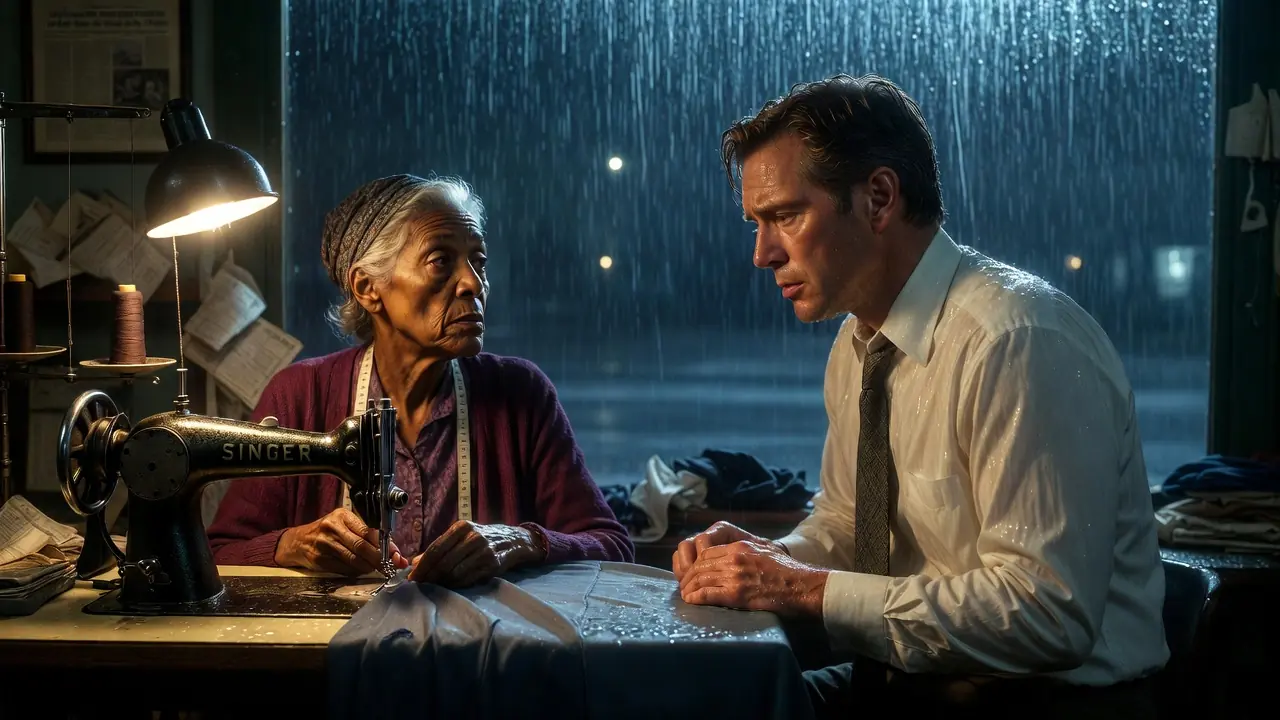
Beatrice Anderson, an elderly seamstress with silver-gray curls, deep brown skin, tired eyes, and hands shaped by a lifetime of sewing, pushed the money back across her sewing table.
"I don't take money from desperate people."
He stared at her like she was insane.
Maybe she was.
Her bank account had $283.47.
Her electricity was getting shut off Friday.
Her daughter needed new shoes.
But something in his terrified eyes reminded her that kindness was not kindness if you charged for it.
He left at 2:00 a.m.
She went to bed believing she had done the right thing.
The next morning, eight lawyers in suits surrounded her shop, and nothing, absolutely nothing, would ever be the same again.
But let us go back to that morning before the lawyers, before everything exploded.
Before Beatrice Anderson learned that sometimes doing the right thing does not just feel good.
It changes your entire life.
The alarm screamed at 5:30 a.m.
Beatrice slapped it silent and stared at the ceiling of her tiny bedroom above the shop.
Another day.
Another fight to survive.
She reached for her phone and opened her banking app.
The number had not magically changed overnight.
$283.47.
Her stomach twisted.
Rent was due in 4 days.
$950.
The electricity company had sent their final notice.
$215 by Friday, or they would cut the power.
She did the math in her head for the hundredth time.
She was $881 short.
Four days to find it.
Beatrice dragged herself out of bed.
The apartment was cold.
She kept the heat off to save money and wore a sweater indoors instead.
In the kitchen, she opened the refrigerator.
Three eggs left.
The heels of a bread loaf.
Some butter.
Her daughter, Nia, was already awake, hunched over homework at the small table.
"Morning, baby."
Nia looked up.
Fourteen years old, beautiful, brilliant, wearing a sweater too.
She never complained about the cold.
"Morning, Mom."
Beatrice made scrambled eggs and split them onto two plates.
She gave Nia the bigger portion.
Always.
Nia glanced at her mother's plate.
"Mom, you didn't eat much."
"I'm not that hungry. Big breakfast yesterday."
A lie.
She had eaten crackers for dinner.
On the counter sat a permission slip.
Science camp.
$350.
Nia had not mentioned it.
She knew money was tight.
Next to the slip were Nia's worn sneakers.
The toes were pushing through.
Beatrice had noticed last week.
New shoes cost at least $65.
Money she did not have.
She forced brightness into her voice.
"How's school?"
"Good. We're doing a robotics unit in engineering class."
"That's wonderful, baby."
Beatrice's heart ached.
Nia wanted to be an engineer.
Needed to go to college.
The college fund jar sat on the shelf.
$1,100 saved over 3 years.
At this rate, it would take 20 more years to afford even one semester.
Nia left for school.
Beatrice cleaned up, changed into work clothes, and went downstairs.
Anderson Alterations looked exactly like it had for 40 years.
The same brick walls her mother had painted.
The same wooden floors that creaked in the same spots.
The same Singer sewing machine from 1964, older than Beatrice had been when she first learned to sew.
She ran her hand over the machine.
Temperamental but loyal.
Just like her.
On the wall hung a framed newspaper clipping, yellowed with age.
The headline read, "Local Seamstress Saves Wedding Day."
The photo showed her mother, needle in hand, smiling.
The article told the story.
A bride's dress had torn 2 hours before the ceremony.
Beatrice's mother had fixed it, refused payment, and said, "You need a miracle today, not a bill."
Beatrice touched the frame.
"I'm trying, Mama. I'm trying to be like you."
But her mother had never mentioned how hard it was.
How you could have character and still wonder how to pay rent.
She unlocked the front door, flipped the sign to Open, and sat at her machine.
The shop phone rang.
Beatrice's chest tightened.
She knew that number.
"Anderson Alterations."
"Ms. Anderson, this is Houston Electric. Your account is past due."
"I know. I'll have the payment Friday. I promise."
The woman on the other end sighed.
"Ma'am, you've requested two extensions already. Friday is final. If we don't receive payment, service will be disconnected Saturday morning."
"I understand. Friday. I'll have it."
Another promise she did not know how to keep.
She hung up and opened the cash register.
$47 in bills.
Her revenue from yesterday.
At this rate, she would need a miracle.
The morning brought her usual customers.
Mrs. Lopez needed a dress hemmed.
Normally $15, but Mrs. Lopez cleaned houses for a living and paid in cash she could barely spare.
"That'll be $10, Mrs. Lopez."
"You're too kind, mija."
"You've been loyal for years. It's the least I can do."
Mrs. Lopez tried to add a $5 tip.
Beatrice gently pushed it back.
"Keep it. Buy yourself something nice."
After Mrs. Lopez left, Mr. Samuel came in.
He was 82 years old, walked with a cane, and lived on Social Security.
He needed a button replaced on his only dress shirt.
"That'll be..."
Beatrice caught herself and looked at his kind, weathered face.
"No charge today, Mr. Samuel."
"Beatrice, you can't keep doing this."
"Doing what?"
"Giving everything away. You got bills, child."
She managed to smile.
"I'll be fine. Coffee?"
She poured him a cup from her personal pot.
They could not afford much, but they could afford to be decent.
Mr. Samuel studied her face.
"Your mama would be proud of you."
"My mama knew something I'm still learning."
"What's that?"
Beatrice threaded a needle, her hands moving with practiced grace.
Nearly a lifetime of this, since she was seven, learning at her mother's knee.
She knew that if you could see your repair work, you had not done your job right.
And if someone could see your struggle, you had not carried it with enough dignity.
Mr. Samuel shook his head.
"That's a heavy load, baby girl."
"It's the only load I know how to carry."
By 8:00 p.m., Beatrice had made $130.
She deposited it mentally into the impossible math.
Still $751 short.
She had one job left.
Mrs. Carter's dress alteration.
$25 already paid.
Already spent on last week's groceries.
She would finish it tonight, go to bed, wake up tomorrow, and figure something out.
That was the plan until 8:58 p.m.
Until everything changed.
The knock came at 8:58 p.m.
Not a normal customer knock.
Urgent, almost desperate, the kind of sound that makes your heart jump.
Beatrice looked up from Mrs. Carter's dress.
Through the window, she could see rain starting to fall.
The weather alert on her phone had warned about storms tonight.
The knocking came again, harder.
She hesitated.
An elderly woman alone late at night.
A bad neighborhood.
Every instinct said, lock the door and ignore it.
But then she saw his face through the glass.
A man, maybe early 50s, soaked through.
No umbrella.
And the look on his face was not angry, not entitled.
Terrified.
She walked to the door and cracked it open with the chain still on.
"Please," his voice broke. "I know it's late. I'm so sorry, but I saw your light still on, and every tailor in the city is closed. I'm desperate."
Beatrice studied him.
Expensive suit, but the shoulder seam was completely torn.
The lining hung out like a wound.
His hands were shaking.
"What happened?"
"I flew in for a meeting tomorrow, 8:00 a.m., the most important meeting of my life. My luggage got lost at the airport. I bought this suit emergency, and I caught it on a car door."
He stopped, trying to steady his breathing.
"If I don't look professional tomorrow, 300 people will lose their jobs."
Something in the way he said it stopped her.
He was not exaggerating.
Not performing.
Just stating a fact that was crushing him.
Beatrice looked past him.
A town car sat at the curb, engine running.
A driver waited inside.
She unhooked the chain and opened the door.
"Come in."
He practically stumbled inside, dripping rain onto her floor.
"Thank you. God, thank you."
She took the jacket from him and laid it under her work lamp.
The damage was extensive.
The entire shoulder seam had ripped, taking part of the lining with it.
This was not a quick fix.
This was 4 hours of careful reconstruction.
"This is serious work," she said quietly. "Full seam reconstruction, lining repair, pressing. I'd normally charge $200, but at this hour..."
"I'll pay anything."
He pulled out his wallet, fat with cash.
"Five hundred. A thousand. I have $2,000 right here in cash. It's yours. All of it. Please."
Beatrice stared at the bills in his hand.
$2,000.
Her mind went into overdrive.
The math she had been doing all day suddenly solved itself.
Electricity, $215.
Rent, $950.
Groceries, $400.
Nia's shoes, $65.
Science camp, $350.
Still a little left over.
Her hand started to reach for the money, then stopped.
She looked at his face.
Really looked.
His eyes were red.
From rain, or had he been crying?
A photo had fallen from his wallet when he pulled out the cash.
A teenage girl in a white coat.
Medical scrubs, maybe.
He scrambled to pick it up, protective.
"My daughter, Caroline. She's in medical school."
Beatrice thought of Nia upstairs, asleep, dreaming of college she could not afford.
She thought of her mother's newspaper clipping on the wall.
You need a miracle today, not a bill.
She pushed his hand back, the hand holding $2,000.
"No."
He blinked.
"What?"
"I can't take your money."
"But you need to be paid. This is 4 hours of work."
"You said you're desperate," Beatrice said softly. "You're scared. Your daughter's future might depend on tomorrow."
She gestured to the shutoff notice on her desk.
He could see it.
She did not hide it.
"I need money desperately, but not like this."
"I don't understand."
Beatrice sat down at her machine and started threading a needle.
Her hands knew the motion so well she did not need to look.
"My mama taught me something. She said, when someone's drowning, you don't charge them for the rope. You throw it free."
Gregory's eyes filled with tears.
"Why? You don't even know me."
"I know you're a father trying to save people's jobs. I know you showed me your daughter's picture like she's your whole world. I know you're standing in my shop at 9:00 p.m. in the rain because you're out of options."
She looked up at him.
"That's enough."
"But the bill on your desk..."
"I'll figure it out. I always do."
She managed a tired smile.
"Now take off that jacket. We're burning 4 hours of night."
He sat down hard in the chair across from her and put his face in his hands.
His shoulders shook.
"Thank you," he whispered. "I don't deserve this."
"Kindness isn't about deserving, Mr. Gregory."
"Just Gregory."
"Okay, Gregory. Now tell me about this meeting while I work."
Outside, the storm intensified.
Thunder rolled.
The lights flickered once.
Beatrice lit two candles just in case.
She had done this before.
Hurricanes, outs, late nights when the power company shut her off.
She could work in the dark if she had to.
For the next 4 hours, neither of them knew that this moment, this choice, would change everything.
But it would.
The needle moved through fabric like a promise being kept.
Beatrice's hands worked with the kind of precision that comes from a lifetime of practice.
Remove the damaged stitching carefully, one thread at a time.
Do not rush.
Rushing ruins everything.
Gregory watched from his chair, mesmerized.
"You make it look like surgery."
"It is surgery," Beatrice said without looking up. "Just on fabric instead of people."
She examined the lining.
Cheap thread on expensive fabric.
That was why it had failed.
Someone had cut corners on a $1,000 suit.
"Whoever made this used the wrong thread. That's why it ripped so easily."
Gregory leaned forward.
"Can you fix it?"
"I can fix anything. The question is whether it'll hold."
She selected a spool from her collection.
Heavy-duty polyester.
The good stuff.
"But with the right materials, it'll be stronger than new."
9:47 p.m.
Three hours and 13 minutes until she had to be done.
Outside, the rain became a downpour.
Thunder cracked loud enough to rattle the windows.
Gregory flinched.
"This storm..."
"It'll pass. They always do."
Beatrice's needle never stopped moving.
"Now tell me about this meeting. What's so important?"
He was quiet for a moment.
Then he said, "It's a merger. My company with another. $800 million."
Beatrice's hands paused for just a second.
Eight hundred million dollars.
She could not even imagine that much money.
"If it goes through, three factories stay open. Three hundred people keep their jobs, keep their insurance, keep their homes."
"And if it doesn't?"
"They close. Everyone gets laid off right before the holidays."
Beatrice resumed stitching.
"So tomorrow isn't about you. It's about them."
"Yes," his voice cracked. "But if I walk in looking like I can't even keep my own suit together, why would they trust me to keep a company together?"
"Because appearance isn't everything."
"In my world, it's almost everything."
She glanced up at him.
"Then your world needs better priorities."
Gregory laughed.
Actually laughed.
The sound surprised both of them.
"You're right," he said. "You're absolutely right."
At 10:15 p.m., the lights flickered once.
Twice.
Then died completely.
Darkness swallowed the shop.
"Oh no," Gregory started.
"Drawer on your left," Beatrice said calmly. "Candles. Matches too."
He fumbled in the dark, found them, and lit six candles.
The glow filled the small space.
Beatrice was already repositioning her work under the candlelight.
"Been through this before. Hurricane Rita. Hurricane Harvey. Can't let a little out stop progress."
"How can you even see?"
"My fingers remember."
She threaded the needle by feel and continued sewing.
"Your eyes adjust. Give it a minute."
Gregory watched her work by candlelight.
The needle caught the flame's reflection with each pass.
Her face was completely focused.
Peaceful, even.
"How long have you been doing this?" he asked quietly.
"Since I was seven. Mama taught me. She learned from her grandmother."
"That machine?" he asked, gesturing to the Singer.
"It's been in this family longer than most people keep a house."
Beatrice smiled and patted it like a pet.
"Still runs perfectly. They made things to last back then."
She paused.
"Things and values."
"Your mother taught you more than sewing, didn't she?"
Beatrice's hands slowed.
"She taught me that every stitch is a promise. A promise that you care. That you see the person who will wear this. That you respect them enough to do it right."
She looked at the newspaper clipping on the wall, barely visible in the candlelight.
"See that article? That was Mama. Wedding day, 1998. The bride's dress tore 2 hours before the ceremony. Mama fixed it. Worked 3 hours straight. The bride tried to pay. Mama refused."
"Why?"
"Because the bride was crying. Because it was her wedding day. Because some moments are bigger than money."
Gregory was quiet.
Then he said, "She sounds like you."
"I'm trying to be like her. Some days I succeed. Some days I wonder if I'm just being stupid."
"You're not stupid. You're extraordinary."
Beatrice shook her head.
"I'm just doing what's right. That shouldn't be extraordinary. It should be normal."
At 11:30 p.m., she was halfway done.
The shoulder seam was reconstructed, reinforced.
Now for the lining.
Gregory's phone buzzed.
He glanced at it and silenced it immediately.
It buzzed again.
And again.
"You can answer," Beatrice said. "I won't be offended."
"It can wait. This can't."
But she had seen the caller IDs.
VP Operations.
Board Chairman.
Executive Assistant.
Not colleagues.
People who reported to him.
"Gregory?"
He met her eyes.
"Yes?"
"You're not just an employee at this company, are you?"
He was quiet for a moment.
"No. But does it matter?"
"I suppose not. A person in trouble is a person in trouble. Doesn't matter if they're the janitor or the CEO."
His expression shifted.
Surprise.
Respect.
"You really mean that."
"Of course I do."
At midnight, the power came back on.
The sudden brightness made them both squint.
Beatrice held up the jacket under the fluorescent lights and inspected every inch.
The repair was invisible.
Perfect.
Structural.
"One more hour," she announced.
Gregory stood, stretched, and walked to her side.
"Can I help?"
"Hold this section taut while I secure it."
He did.
Their hands worked together, his following her quiet instructions.
Holding fabric.
Passing scissors.
Adjusting the lamp angle.
"I haven't made anything with my hands since I was a kid," he said softly.
"What did you make?"
"Model airplanes with my grandfather. He was a factory worker. Made steel."
"Honest work."
"He used to say, if your name's on it, make it worthy of your name."
Beatrice smiled.
"Mama said the same thing."
They worked in comfortable silence.
Two strangers who had found an unexpected rhythm.
A temporary partnership born of necessity, but feeling like something more.
At 12:45 a.m., Gregory told her about Caroline.
Twenty-two years old.
Johns Hopkins.
Premed.
Works two jobs while studying.
"She refused my help. Said she wants to earn it herself."
"She sounds like someone I'd like to meet."
"She'd love you. She believes in hard work, in dignity, in doing things right."
He paused.
"She's better than me."
"She learned from you."
"No. She learned despite me."
Beatrice glanced at him.
"Give yourself more credit."
At 1:03 a.m., she placed the final stitches.
Beatrice's concentration was absolute.
Every movement deliberate.
This was not just a repair anymore.
It was a promise kept.
She held up the jacket, inspected it under bright light, moved it, stretched the fabric, and checked the seams.
"Done."
Gregory put it on.
The fit was perfect.
He moved his shoulders.
No pulling.
No stress.
He studied himself in the small mirror on her wall.
"I can't even see where it was torn."
"That's the point. Good repair work is invisible."
He touched the shoulder seam with something like reverence.
"This is better than when I bought it."
"I reinforced the weak points and used proper thread. It won't fail again."
"You didn't just fix it. You improved it."
Beatrice was already cleaning her workspace, putting away thread, organizing needles.
"That's what you do when you care."
Gregory checked his watch.
1:16 a.m.
He would have to leave soon, get a few hours of sleep, shower, and prepare for the meeting that would decide 300 people's futures.
He reached for his wallet.
And what happened next, what Beatrice said next, would echo through both their lives forever.
Gregory pulled out the same thick stack of bills from earlier.
"You saved my life tonight."
He counted out bills.
Ten.
Twenty.
Twenty-five $100 bills.
$2,500 for 4 hours of emergency work.
He laid the cash on her worktable.
More money than Beatrice had seen in one place in years.
Her eyes locked on it.
Her brain did the math automatically.
Every bill paid.
Every problem solved.
Nia's shoes.
The science camp.
Groceries for 2 months.
Her hand moved toward the bills, fingers almost touching them.
Then she stopped.
She pushed the money back across the table.
"No."
Gregory stared.
"What?"
"I can't take it."
"But you earned it. Four hours through a storm by candlelight."
His voice rose with confusion.
"This is fair payment."
"It's not fair."
Beatrice kept her hand on the bills.
"You're desperate. You're scared. I don't take money from people who are drowning."
"But you need it."
He gestured at the shutoff notice on her desk.
"I can see your bills."
"I do need it desperately."
Her voice was steady.
"But if I take it, what I did stops being kindness. It becomes a transaction."
"What's wrong with a transaction?"
"Nothing. Usually."
She met his eyes.
"But you came to my door at 9:00 p.m. in the rain because you had run out of options. You were terrified. You trusted me."
She pushed the money firmly into his hands.
"If I take this, that moment becomes different. It becomes me taking advantage of your fear. And I won't do that."
Gregory's hands shook.
Tears ran down his face.
"Nobody's ever..."
He could not finish the sentence.
Beatrice felt her own eyes sting.
"Take that money. Put it toward your daughter's education. Go save those 300 jobs. That's enough payment."
"People like you don't exist."
"We exist. We're just usually too tired for anyone to notice."
He wiped his eyes.
"Can I at least leave my contact information in case you or your daughter ever need anything?"
He pulled out a business card, then stopped.
He put it back.
Instead, he tore a piece of paper from her notepad and wrote Gregory and a phone number.
"Just in case. No pressure."
Beatrice took the paper and folded it.
"Thank you."
Outside, the town car's engine started.
The driver had been waiting over 4 hours.
A man in a suit stepped out with an umbrella.
"Mr. Ashford, we should go. You need rest before the board meeting."
Mr. Ashford.
Beatrice noticed the name but was too exhausted to think about it.
Gregory nodded.
"Two minutes, James."
He turned back to Beatrice and extended his hand.
She shook it.
His grip was firm, grateful.
He held on for a long moment.
"I'll never forget this," he said. "Ever."
"Go save those jobs, Gregory."
He smiled through tears.
"I will. Because of you."
At the door, he paused.
"What's your full name?"
"Beatrice Anderson."
"Beatrice Anderson."
He repeated it like he was memorizing it.
"Thank you for reminding me what matters."
The car door closed.
The town car pulled away into the night.
The rain had stopped.
Only wet streets remained, reflecting the streetlights.
Beatrice locked the door and stared at her empty worktable, where $2,500 had been minutes ago.
Her hands were shaking now.
The adrenaline was fading.
The reality was setting in.
She had just turned down enough money to solve every problem in her life.
Was she crazy?
Was she stupid?
She did not know anymore.
She climbed the stairs, checked on Nia, still sleeping peacefully, and collapsed into bed.
1:47 a.m.
Tomorrow, she would wake up and face the same bills.
The same impossible math.
The same struggle.
But tonight, she had kept a promise to her mother.
She had thrown someone a rope without charging for it.
That had to count for something.
She fell asleep believing she had done the right thing.
She had no idea that in less than 9 hours, eight lawyers would surround her shop, and nothing would ever be normal again.
The alarm went off at 7:00 a.m.
Four and a half hours of sleep.
Beatrice's body ached everywhere.
Her fingers were stiff.
Her back hurt from hunching over the machine.
But she got up, made Nia breakfast, and forced a smile.
"You look tired, Mom."
"Late customer. I'm fine, baby."
Nia left for school.
Beatrice went downstairs, flipped the sign to Open, made coffee, and sat at her machine.
A normal morning.
Just another day.
Except it was not.
At 9:45 a.m., a SUV drove slowly past her shop.
Once.
Twice.
Then it parked across the street, engine running, two people inside, just watching.
Beatrice noticed but did not think much of it.
At 10:15 a.m., a different car pulled up.
A woman in a sharp suit got out, walked to Beatrice's window, stared inside, pulled out her phone, made a call while looking straight at Beatrice, then drove away.
Mr. Samuel looked up from his crossword.
"That was strange."
"Very strange," Beatrice agreed.
Her phone rang.
Unknown number.
"Anderson Alterations."
"Is this Beatrice Anderson?"
A man's voice.
Professional.
Cold.
"Yes. Who's calling?"
"Please confirm your business address."
Beatrice gave it, confused.
"What is this about?"
"You were open last night around 9:00 p.m."
Her stomach tightened.
"I had a late customer. Why?"
"Thank you for confirming."
Click.
Beatrice stared at her phone.
What was that?
At 10:42 a.m., Nia called, voice scared.
"Mom, there's a weird car outside school. A man came to the office asking about me. The secretary called security."
Beatrice's heart dropped.
"What did he want?"
"Questions about our family, our address. Mom, I'm scared."
"Stay inside. Don't leave with anyone but me."
Beatrice called the school.
The secretary confirmed it.
A man in a suit.
Had credentials from a law firm.
"What law firm?"
"Ashford something."
Ashford.
Like the driver had called Gregory last night.
Mr. Ashford.
Beatrice's hands started shaking.
At 10:47 a.m., all three vehicle doors opened at once.
Eight people stepped out.
Dark suits.
Briefcases.
Moving toward her shop in formation.
Beatrice backed away from the door.
Mr. Samuel stood.
"Beatrice, I'm calling 911."
The lead man reached her door and opened it.
"Miss Beatrice Anderson."
Her voice trembled.
"Who are you?"
He pulled out credentials.
"Richard Sterling, senior legal counsel for Ashford Industries. We need to speak with you immediately regarding last night."
"I just fixed a suit," Beatrice said, her voice cracking. "I didn't do anything wrong."
His expression was unreadable.
"We know. That's exactly why we're here."
"Close your shop now."
Richard Sterling's voice left no room for argument.
Beatrice looked at her customers.
Mrs. Lopez clutched her purse.
Mr. Samuel had 911 dialed on his phone, finger hovering over the call button.
"I'm not closing anything until you tell me what's going on."
A woman stepped forward.
Tailored suit.
Confident posture.
"Miss Anderson, I'm Melanie Brooks, VP of communications. What we need to discuss is sensitive. We need privacy."
"Privacy for what? Am I being sued?"
"No."
Richard's face remained stone.
"But we need to talk about Gregory Ashford and what you did for him last night."
Gregory.
The man with the torn suit.
The desperate father.
The one who had offered her $2,000.
What had she done wrong?
"I helped someone. That's not illegal."
"It's not," Melanie said, her voice softening slightly. "But it is unusual, especially when that someone is Gregory Ashford."
Another lawyer opened a briefcase and pulled out a tablet.
"Ms. Anderson, do you follow business news? Financial markets?"
Beatrice's patience was fraying.
"I barely have time to sleep. No."
"That explains it."
He turned the tablet toward her.
A Forbes magazine cover appeared.
The face she had spent 4 hours with last night stared back at her.
The headline read, "Gregory Ashford, the Reluctant Billionaire Reshaping American Manufacturing."
Below it, $4.2 billion net worth.
Beatrice's vision blurred.
She reached for the table to steady herself.
"That's... that's him. That's Gregory."
"Gregory Ashford," Richard confirmed. "CEO and founder of Ashford Industries."
The room tilted.
Mr. Samuel grabbed her arm.
"Sit down, honey."
She collapsed into a chair.
$4.2 billion.
Melanie showed another image.
Gregory at the White House, shaking hands with the president.
Another image.
United Nations summit.
Another.
Receiving a humanitarian award.
"No," Beatrice said, her voice faint. "No, that can't be. He was just a man. Just a scared father with a torn suit."
"He was both," Melanie said gently.
Richard pulled out more documents.
"Ashford Industries. Forty-seven manufacturing facilities across North America. Twelve thousand employees. $3.8 billion in annual revenue."
Thomas Bennett, the third lawyer, added, "Medical equipment, automotive parts, aerospace components. Three of the top five hospitals in America use Ashford products."
Beatrice could not breathe.
"He was in my shop crying, showing me pictures of his daughter."
"Caroline Ashford," Melanie confirmed. "Johns Hopkins, premed, full scholarship from the Ashford Foundation."
"But he said she works two jobs."
"She does, by choice. She refused his money. Wanted to earn it herself."
Beatrice's mind raced backward.
The expensive watch.
The private driver.
The phone calls from Board Chairman and VP Operations.
The business card he had almost shown her.
"The meeting this morning," she whispered. "He said 300 people would lose their jobs."
"The merger with Holston Medical Group," Thomas confirmed. "$800 million. Three facilities on the line. He wasn't exaggerating."
Richard showed her a news article.
Ashford Industries Board Approves Historic Merger. Three Hundred Jobs Saved.
The timestamp was 10:00 a.m. that morning.
"He did it," Beatrice breathed.
"He saved them because of you," Melanie said firmly.
"I just fixed a suit."
"No."
Richard leaned forward.
"You did something much more important."
He showed her an email from Gregory Ashford to his executive leadership team.
Sent 3:17 a.m.
The subject line read, What I Learned Last Night.
Beatrice's hands shook as she read.
Last night, I met someone who reminded me what leadership actually means.
A woman who had every reason to say no, said yes.
Who had every reason to take money, refused it.
Who chose dignity over survival.
I've spent 25 years building this company.
Tonight, an elderly seamstress taught me more about character than I learned in all those years.
Tomorrow, I walk into that boardroom remembering it is not about the bottom line.
It is about the people.
Gregory.
Tears blurred Beatrice's vision.
"He wrote this about me."
"He sent it to 200 executives at 3:00 a.m.," Melanie said. "Before the board meeting. He told them your story."
Thomas pulled up board meeting minutes.
"Direct quote from the chairman. Mr. Ashford's composure and clarity were remarkable. When challenged on the merger's risks, he spoke about leadership, character, and responsibility in ways I have never heard from him."
Another board member noted, Richard added, "Something changed in Gregory. He seemed human."
Beatrice was crying now.
"I was just trying to help."
"That's exactly what changed him," Melanie said. "You treated a billionaire like a person. You saw his fear, not his bank account. You gave him what money can't buy. Dignity."
Richard showed another screen.
Twitter.
Multiple trending hashtags.
The suit that saved jobs.
Forty-seven thousand tweets.
Billionaire and Seamstress.
Eighty-nine thousand tweets.
News headlines scrolling.
Mystery Seamstress Saves Ashford Deal.
Houston Seamstress Becomes Overnight Sensation.
The Woman Who Said No to $2,500.
"How does anyone know about this?" Beatrice whispered.
"Gregory told the board," Thomas explained. "Someone leaked it to the press. It went viral in 2 hours."
Beatrice stood up too fast.
The room spun.
"This can't be real. I'm nobody. He's a billionaire. This doesn't make sense."
Her knees buckled.
Melanie and Mr. Samuel caught her.
They lowered her back to the chair.
Melanie pulled out smelling salts.
Beatrice came around 30 seconds later.
"I'm sorry. I just..."
"It's a lot to process," Melanie said kindly.
"Why are you here?" Beatrice asked, her voice small. "Why did you bring lawyers?"
Richard and Melanie exchanged glances.
"Because Gregory Ashford is on his way here right now," Richard said. "He'll arrive in 10 minutes."
"And Ms. Anderson," Thomas added, opening another briefcase full of documents, "he has a proposal for you."
"What kind of proposal?"
Richard spread papers across her worktable.
Architectural plans.
Legal contracts.
Financial projections.
One that would change her life if she let it.
Beatrice stared at the documents.
Her name was on them.
Beatrice Anderson, Director of Tailoring Services.
Numbers she could not comprehend.
Diagrams of her shop expanded and renovated.
"What is all this?"
"Your future," Melanie said softly. "If you want it."
Outside, a car pulled up.
More expensive than the others.
Security personnel stepped out first.
Then Gregory Ashford.
The man she had spent 4 hours with last night.
The man she had refused money from.
The billionaire she had treated like any other desperate person who needed help.
He walked toward her door, and Beatrice realized nothing would ever be the same again.
Gregory Ashford walked through the door.
The same man from last night, but different.
Security flanked him.
An assistant held an umbrella despite there being no rain.
Reporters shouted from behind police barricades.
"Mr. Ashford, who is this woman?"
"Gregory, is the merger story true?"
He ignored them and walked straight to Beatrice.
"Beatrice," he said softly. "Thank you for seeing me."
She stood on shaking legs.
"You're really him. The billionaire."
"I'm really him."
He gestured to the lawyers.
"Can we have the room? Just us?"
Richard hesitated.
"Sir, the contracts..."
"They can wait. Please."
The lawyers stepped out.
Mr. Samuel started to leave.
"Stay," Beatrice said.
She needed someone on her side.
Gregory sat across from her, eye level equal.
"I owe you an apology. For the circus. For the shock. For not telling you who I was."
He paused.
"But if I had, would you have treated me the same?"
She thought about it.
"No. I would have been nervous. Different."
"Exactly. I needed someone to see me. Not my money. Just me. You did that."
"I just fixed a suit."
"No. You fixed me."
He pulled note cards from his pocket.
His handwriting covered them.
"My presentation notes from this morning. Written at 4:00 a.m. after leaving you."
He spread them on the table.
Character over capital.
Dignity over dollars.
People before profit.
"Every argument came from our conversation," Gregory said. "When the chairman challenged me, I didn't cite data. I told him about you."
Beatrice's breath caught.
"You told them?"
"I said, last night, someone gave me everything when I had nothing to offer. She trusted me. Risked her time for 300 people she'll never meet. If she can do that, we can do this."
His voice cracked.
"The room went silent. Then the chairman voted yes."
Tears streamed down Beatrice's face.
"Three hundred families still have jobs because you said no to money."
Mr. Samuel wiped his eyes.
Gregory took a breath.
"Last night, you gave everything and asked for nothing. Today, I'm asking you to accept something. Not payment. Partnership."
"Partnership?"
He called the lawyers back.
They spread documents across her table.
Architectural renderings.
Legal contracts.
Financial projections.
"What is this?" Beatrice whispered.
Gregory stood beside her.
"Ashford Industries has 12,000 employees. Not one has access to quality tailoring. I want to change that. I want you to lead it."
"Lead what?"
"Ashford Employee Services Tailoring Division. You as director and 30% equity partner."
"Thirty percent?"
"You're not my employee. You're my partner."
Melanie showed renderings.
"We preserve Anderson Alterations. Your mother's machine stays. Her photo stays. The name stays. But we expand. Six workstations. Modern equipment. Training center."
Thomas added, "Investment, $2.1 million."
Beatrice sat down hard.
"Two million..."
"For our flagship," Gregory said.
Richard continued, "You hire 10 local tailors. Starting salary, $45,000, with full benefits, health insurance, retirement, paid training."
Melanie showed projections.
"Year three, 150 jobs nationally."
Thomas pulled another document.
"Every Saturday, free tailoring for job seekers. Interview suits, professional alterations, funded by the Ashford Foundation."
Beatrice stared.
"Free services?"
"Like you did for me," Gregory said. "You taught me that's when it matters most."
Richard laid out financials.
"Your salary, $120,000 annually, plus profit sharing. Projected year three, $80,000 to $150,000 additional."
Beatrice could not process it.
"I make $31,000 now."
Gregory knelt beside her chair.
"There's more. The Ashford Foundation scholarship. Full ride for Nia. Four years. Any university."
Beatrice could not speak.
"Tuition, room, board, stipend. Up to $320,000. No strings. Your daughter shouldn't have to work two jobs while studying."
Beatrice sobbed.
"My baby."
"She'll become the engineer she's meant to be."
Mr. Samuel squeezed Beatrice's shoulder.
Gregory continued.
"After 6 months, we replicate this. Every Ashford facility gets a tailoring center. You oversee all 15 locations within 3 years."
Thomas showed more projections.
"Your equity stake estimated at $4 million to $7 million by year five."
Beatrice stood and paced.
"This is too much. I fixed one suit."
"You fixed a man, a company, 300 families."
"I was just being decent."
"And decency is so rare that it changed everything."
She faced him.
"I'm not qualified. I've never run anything big."
"You've run this shop for 12 years through the hardest economy. You've maintained quality while barely surviving. That's exactly who should lead this."
"I don't have a degree."
"You have mastery, integrity, vision."
Beatrice looked at the papers.
Her name was everywhere.
"Can Nia be here before I decide?"
"Of course."
Twenty minutes later, Nia burst in, saw the crowd, saw her mother's tears, and froze.
"Mom, what's wrong?"
Beatrice explained everything.
Nia's eyes grew wider and wider.
"Mom, this is your dream. Grandma's dream."
"It's scary, baby."
Nia took her hands.
"You worked 4 hours in the dark for a stranger. You can do anything."
Beatrice looked at Gregory.
At the contracts.
At Nia's hope.
She picked up the pen.
Her hand shook.
"You're not signing your life away," Gregory said. "You're signing into it."
Beatrice Anderson signed once.
Twice.
Ten times.
Richard smiled.
"Welcome to Ashford Industries, Director Anderson."
Gregory pulled out a small box.
Inside was a professional sewing kit.
Gold scissors.
The finest thread.
A card inside.
Every master craftsperson deserves master tools.
Gregory.
Beatrice held the scissors and cried.
"It's too beautiful."
"You're too talented to struggle anymore. Let me fix that."
She looked at Nia, at Mr. Samuel, at Gregory, at her future.
It was impossible.
And real.
She had said no to $2,000 and gained everything.
Six months later, the neighborhood did not just change.
It transformed.
Month one was construction.
The first day, construction crews arrived at 6:00 a.m.
Beatrice stood on the sidewalk, coffee in hand, watching them work.
They preserved the original brick facade.
Her mother would have wanted that.
But inside, everything expanded.
Walls came down.
Space doubled.
Light flooded in.
Her mother's Singer sewing machine got a place of honor.
A custom glass case, illuminated.
A brass plaque beneath it.
Emma Anderson.
Master Seamstress.
1952–2019.
Her hands built this legacy.
Beatrice touched the glass.
"Can you see this, Mama?"
Eight new industrial machines arrived.
A steam pressing station.
A fabric library with hundreds of materials.
Training desks.
Computer stations for orders.
It looked like a real business now.
Professional.
Substantial.
But it still felt like home.
Month two was hiring.
Ten positions posted.
Within 72 hours, 847 applications arrived.
Beatrice interviewed 50 people personally.
She asked each one, "Why do you sew?"
The answers told her everything.
She hired 10.
Maria Rodriguez, 58, laid-off factory worker with 30 years of experience.
Hands that knew fabric like Beatrice's did.
James Washington, 26, fashion design degree, unable to find work, desperate for a chance.
Dorothy Carter, 61, retired alteration specialist, who came out of retirement to be part of something meaningful.
Three single mothers.
Two veterans.
One formerly incarcerated man trying to rebuild his life.
All local.
All skilled.
All hungry for dignity.
Training lasted 8 weeks.
Beatrice taught her mother's techniques.
Invisible hems.
Reinforced seams.
Quality over speed.
But more than technique, she taught philosophy.
"Every garment has a person inside it. Respect the person."
On graduation day, families attended.
Certificates were handed out.
Tears were everywhere.
Maria hugged Beatrice.
"I thought I was too old to start over. You gave me my life back."
Month three was the grand opening.
Four hundred people showed up.
The block could not contain them.
Police closed the street.
Gregory cut the ribbon alongside Beatrice and Nia.
Cameras flashed.
News crews recorded.
Beatrice's speech was short.
"My mother taught me three things. Excellence, kindness, persistence. This shop is all three."
Gregory added, "Beatrice didn't just fix my suit. She fixed my perspective."
The first week, they served 89 customers.
Revenue, $12,000.
Reviews flooded social media.
Best alterations in Houston.
They remember your name.
It's not a shop. It's a family.
Month four was the free services program.
The first Saturday, 23 job seekers arrived.
People who needed interview clothes but could not afford alterations.
Beatrice and her team worked 12 hours straight.
No breaks.
Pure joy.
They fitted suits, fixed hems, adjusted shoulders, and gave styling advice.
Each person left looking professional, confident, ready.
Marcus, a veteran, stood in front of the mirror.
His suit fit perfectly now.
He stood taller.
"I forgot what pride felt like," he whispered.
Janelle, a single mother, tried on her altered blazer.
"I have a law firm interview on Monday. Now I look like I belong there."
By month four, 87 people had been served for free.
Sixty-one percent got jobs within 30 days.
The data was undeniable.
Good clothes opened doors.
Month five was Nia's future.
The acceptance letter came from Howard University.
Full ride.
Engineering track.
Beatrice and Nia cried in each other's arms for 20 minutes.
"Grandma would be so proud of you, Mom."
"She'd be proud of us both, baby."
The Ashford Foundation scholarship covered $320,000.
Four years.
Books.
Housing.
Everything.
Nia would become an engineer without debt, without struggle.
The cycle was breaking.
Month six was national expansion.
The Philadelphia location opened at Ashford Industries headquarters.
Beatrice cut another ribbon.
The press covered it.
Employees cheered.
Eight new local hires had been trained by her Houston team.
The model replicated perfectly.
Six-month numbers for the Houston flagship were staggering.
Revenue, $240,000.
Forty percent above projections.
Free services, 247 people helped.
Sixty-eight percent employment rate.
National expansion planned six more locations within 12 months.
Beatrice's total earnings were $180,000 in 6 months.
More than 5 years of her old income.
But the money was not the transformation.
The impact was.
Twenty-three new jobs were created in surrounding businesses.
The coffee shop hired three people.
The bookstore expanded.
The boutique was renovated.
Her block was alive again.
The landlord who had threatened to sell partnered with Ashford to preserve the community character instead.
Change was happening, but now it included the community instead of erasing it.
Media coverage exploded.
Forbes profile.
Thirty people changing business for good.
Mayor's award.
Community leadership.
Governor's letter of commendation.
Beatrice was uncomfortable with the attention.
"I just wanted to help people."
But she had helped in ways she had never imagined.
One act of kindness.
One refusal of money.
It had changed hundreds of lives.
Six months to the day, on a Tuesday night at 8:45 p.m., Beatrice finished paperwork at her desk.
Profit reports.
Staffing schedules.
Her new reality.
The shop was quiet, just her and the hum of machines.
Rain started outside, gentle and familiar.
8:47 p.m.
The exact time Gregory had knocked 6 months ago.
She smiled at the coincidence.
Then came the knock.
8:58 p.m.
Urgent.
Desperate.
Exactly like that night.
She opened the door.
A young woman stood there, mid-20s, soaked, with terrified eyes.
"Please, I know you're closed, but I'm desperate."
Beatrice's breath caught.
"I have a job interview tomorrow. First real opportunity in 3 years. I'm a teacher trying to be..."
Words tumbled out of her.
"I bought this suit at Goodwill. The bus door caught my skirt."
She showed the tear.
Side seam.
Fixable.
"I can pay $40. It's all I have."
Her voice broke.
"I need this job. Kids need teachers who understand them."
Beatrice felt tears forming.
History was repeating.
"Come in."
She examined the tear.
Thirty minutes of work.
"How much?" the young woman asked.
"Nothing. It's free."
"What? No, I can pay."
"I know. But you shouldn't have to."
Beatrice threaded her needle.
"Someone invested in me once. I'm keeping the circle going."
The woman cried.
While Beatrice worked, they talked.
Her name was Sarah.
She wanted to teach third grade.
She had a teacher who changed her life.
"Ms. Washington."
Beatrice's hands paused.
"Washington?"
"Dorothy Washington. She saw something in me nobody else did."
"Dorothy Washington works here. She's one of my seamstresses."
Sarah's face lit up.
"That's my grandmother."
They hugged, both crying.
"She talks about you every Sunday," Sarah said. "Says you're changing the world."
"I'm just fixing clothes."
"No," Sarah said. "You're fixing lives."
Thirty minutes later, the skirt was perfect.
"Get that job," Beatrice said. "Then help someone else someday. That's how you thank me."
"I promise."
Sarah left into the rain.
A car pulled up.
Gregory stepped out.
Their weekly coffee routine.
"Saw that," he said.
"Old habits."
"Best habits."
They sat with coffee in comfortable silence.
"You know what's wild?" Beatrice said.
"What?"
"If I'd taken your money that night, this would have ended there. A transaction. You'd feel better. I'd pay bills. We'd forget each other."
"But you said no."
"I said no. And that no became the biggest yes of my life."
Gregory smiled.
"Mine too."
Outside, the rain stopped.
Stars broke through the clouds.
The shop sign glowed warmly.
Her mother's machine was visible through the window.
A legacy continuing.
"Think Sarah will get the job?" Gregory asked.
Beatrice smiled.
"I fixed her skirt. She'll do the rest. That's how it works."
Gregory nodded.
"That's exactly how it works."
Beatrice did not wait for permission to be kind.
She did not calculate the return on investment.
She just said yes when everything in her life screamed no.
And it changed everything.
Not because she was special.
Because she chose to be decent.
And sometimes, one decent choice is enough to repair more than a torn seam.
Sometimes it repairs a person.
Sometimes it repairs a company.
Sometimes it repairs a future.
One stitch at a time.