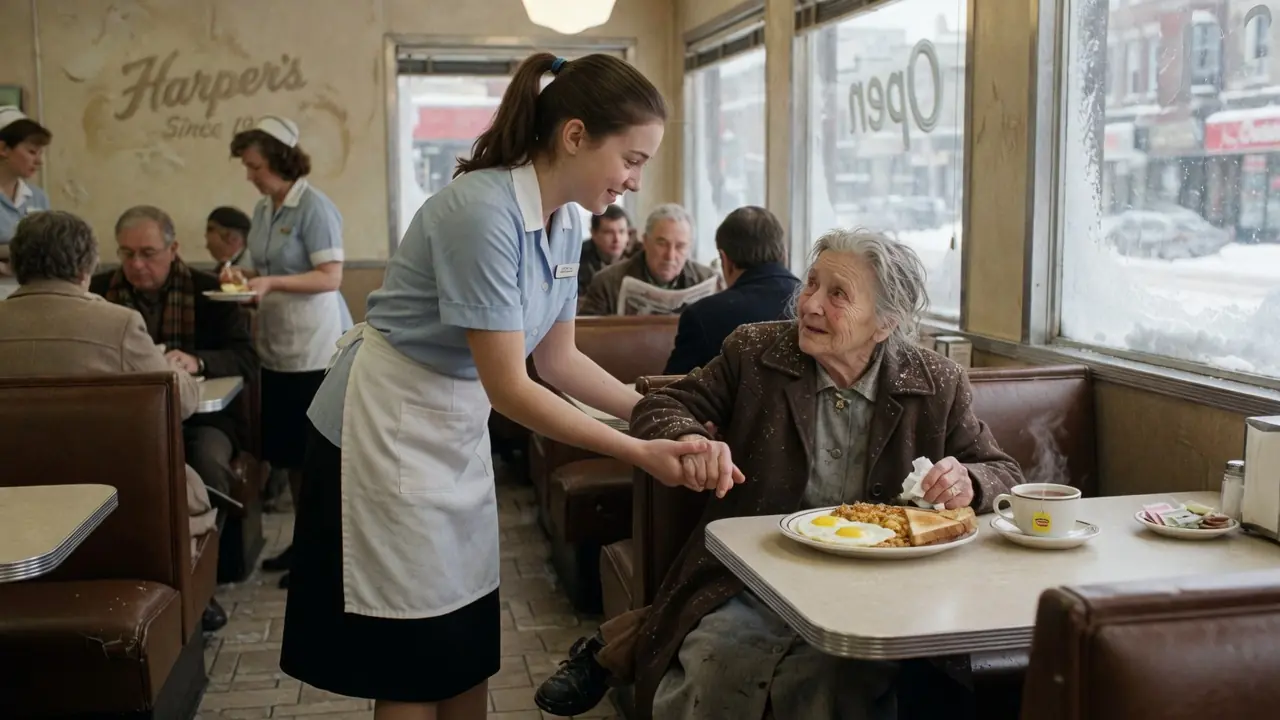
One snowy winter morning, Aaliyah, a young waitress exhausted after three straight hours of work, happened to see an old woman shivering as she shoveled snow on the sidewalk.
The woman wore only a thin coat, her lips turning blue from the cold.
Without hesitation, Aaliyah pulled out a crumpled $5 bill, almost all the money she had left, bought a cup of hot ginger tea, and stepped into the freezing wind to give the old woman the only warmth of that day.
She had no idea that this small act would set off a chain of events where the woman’s true identity would change her life forever.
The diner’s door chimed for the hundredth time that morning.
Aaliyah Carter barely looked up. Her hands moved on autopilot, pot in one hand, mug in the other.
Pour. Smile. Move on.
The routine had become muscle memory after three years at Harper’s Diner.
Outside, Chicago was drowning in snow. Fat flakes fell thick and fast, piling up on the sidewalks, on car hoods, on everything.
The streetlights glowed dim and yellow through the white chaos.
Inside the diner was warm, but that warmth didn’t reach Aaliyah. Not really.
Her fingers were cracked and raw from the cold.
The walk here, three neighborhoods on foot at four in the morning, had been brutal, but rent didn’t pay itself, and the bus fare added up.
“Excuse me, hello.”
A sharp voice cut through her thoughts.
Aaliyah turned. Table six.
A woman in an expensive coat sat with a phone in one hand, barely looking at her.
“This coffee is cold,” the woman said, pushing the mug forward like it personally offended her. “What kind of place is this?”
Aaliyah’s chest tightened. The coffee wasn’t cold. She’d poured it two minutes ago.
But she smiled anyway, that thin practiced smile that said, “I’m sorry,” without actually apologizing.
“I’ll get you a fresh one right away, ma’am.”
“Make it fast. I don’t have all day.”
Aaliyah took the mug and walked back to the counter.
Her reflection caught in the metal coffee dispenser: tired eyes, hair pulled back tight, and that worn scarf around her neck.
Her mother’s scarf.
The edges were frayed now, but it was all she had left of her.
“You can be poor, baby,” her mother used to say, “but don’t ever let your kindness freeze up inside you.”
She poured the new coffee and added cream without being asked.
She remembered this woman from last week. Same order, same attitude.
When she set it down, the woman didn’t even look up from her phone.
“Finally.”
No thank you. No eye contact. Nothing.
Aaliyah stepped back, that familiar feeling settling in her stomach.
Invisible.
That was what she was to most people here.
A waitress. A body that brought food and took plates away.
Not a person with a name, with a life, with a mother she’d buried two years ago.
“Aaliyah.”
Harper’s voice boomed from the kitchen pass-through.
He was a big man with a bigger voice, but he wasn’t mean, just always rushing.
“We’ve got a lunch rush coming. Need you sharp, girl.”
“I’m on it,” she called back, forcing brightness into her voice.
She wiped down table three, cleared table seven, and refilled coffee at table nine.
Her legs ached. Her back ached.
But she kept moving because stopping meant thinking.
And thinking meant remembering how small her bank account was, how the landlord’s last warning had been three days ago.
The door chimed again.
More cold air rushed in, carrying snow and noise.
A group of businessmen came in laughing loudly, shaking off their coats like they owned the place.
“Sweetheart, can we get some service over here?” one of them called out, not bothering to wait for a host.
Aaliyah grabbed menus and headed over.
“Good afternoon, gentlemen. What can I—”
“Just coffee for now. Black. All of us.”
He didn’t look at her face. Just her name tag.
“Coming right up.”
As she walked away, she heard one of them mutter, “Service is slow here.”
She’d been there for ten seconds.
Her hands shook slightly as she grabbed the coffee pot.
Not from anger. She couldn’t afford anger.
From exhaustion, from being seen, but not really seen.
From existing in a space where she was useful but never visible.
Through the window, the snow kept falling.
People rushed past, heads down, collars up, everyone trying to escape the cold, everyone in their own world.
And Aaliyah kept pouring coffee, kept smiling, kept being the invisible girl in the corner of their busy lives.
The lunch rush blurred together.
Aaliyah moved between tables on autopilot, refilling coffee, taking orders, and clearing plates.
Her mind was somewhere else, stuck on bills, on the landlord’s last warning, on how much was left in her account after buying groceries yesterday.
$43.
That was it until Friday.
She wiped down a table, her hands moving while her thoughts spiraled.
The electric bill was due.
If she paid it, she couldn’t pay rent. If she paid rent, they’d shut off her power.
Her eyes drifted to the window without really seeing, just staring out at the white blur of falling snow, the gray shapes of people passing by.
Then she saw her.
An old woman stood on the sidewalk across the street, bent over a snow shovel.
Her coat was thin, too thin, the kind you’d wear on a cool autumn day, not in the middle of a Chicago blizzard.
She moved slowly, scraping snow from the sidewalk in front of a closed shop.
Snow kept falling.
The pile she’d cleared was already filling in again.
Aaliyah watched a man in a business suit approach.
He saw the old woman and stepped wide around her.
He didn’t slow down.
Then a young couple passed.
They laughed at something on a phone, nearly bumped into the woman, and the guy said something sharp.
The old woman stumbled back.
They kept walking.
“Aaliyah, order’s up.”
She blinked and pulled herself back.
“Coming.”
But her eyes drifted to the window again as she picked up plates.
The old woman was still there, still shoveling.
A gust of wind hit, and she staggered, catching herself on the shovel handle.
Nobody stopped.
A teenager walked past with earbuds in and eyes on his phone.
An older man crossed the street to avoid her completely.
A woman with shopping bags actually said something. Aaliyah couldn’t hear it, but the dismissive wave of her hand said enough.
Get out of my way.
The old woman bent down to pick up something, a scarf that had fallen.
Before she could grab it, someone’s boot landed right on it.
They didn’t notice, just kept walking, grinding it into the slush.
“Aaliyah, you good?”
She turned.
Harper stood at the counter, looking at her with raised eyebrows.
“Yeah, I just…”
She gestured toward the window.
“That woman out there. She’s been shoveling in this cold for—”
“Not our problem, kid.”
Harper’s voice wasn’t mean, just practical.
He’d seen too much to get involved in everything.
“You’ve got tables.”
“I know, but—”
“Table six wants their check. Table nine needs ketchup.”
Aaliyah nodded.
She grabbed the ketchup bottle and delivered it with a smile she didn’t feel, then printed the check for table six.
But she kept looking out that window.
The old woman had moved farther down the sidewalk now, still shoveling, still alone.
A delivery truck rumbled past, spraying slush.
It hit her.
She turned away, wiping her face with her sleeve.
Not one person stopped to ask if she was okay.
Snow could be cold, Aaliyah thought, but people were colder.
She remembered her mother working as a custodian at that office building downtown, coming home with stories about how people talked over her, walked past her, and treated her like furniture.
“They don’t see us, baby,” her mother had said once, sitting at their kitchen table with swollen feet. “To them, we’re just part of the scenery.”
That old woman outside was scenery, too.
Something to step around. Something in the way.
Aaliyah’s hands clenched around the coffee pot.
A businessman pushed through the diner door, shaking snow from his coat.
“Jesus, it’s brutal out there. They really should clear these sidewalks. I almost tripped over some old bag with a shovel.”
He laughed.
Actually laughed.
Aaliyah’s stomach twisted.
She wanted to say something.
She wanted to tell him that “old bag” was a human being, freezing and struggling while he complained about almost tripping.
But she just smiled.
“Sit anywhere you’d like, sir.”
He took table five, ordered coffee, and complained it was too hot.
Through the window, the old woman’s scarf, the one that had fallen, was now just a dirty rag in the snow, trampled and forgotten.
Just one person, Aaliyah thought.
One person could stop and help.
One person could change this.
She looked around the diner, warm and full of people eating, laughing, scrolling through phones.
Outside, an old woman worked alone in the freezing cold.
And the world just kept moving.
Aaliyah set down the coffee pot.
Her hand went to the scarf around her own neck.
Her mother’s scarf.
The last thing she had to remember her by.
Her mother would have stopped. Her mother would have done something.
“Harper.”
“I need to take five minutes.”
He looked up from the grill.
“Now? We’re slammed.”
“Five minutes, please.”
Something in her face made him pause.
Then he sighed.
“Five. That’s it.”
Aaliyah nodded.
She was already reaching for the hot water kettle because someone had to stop.
And if no one else would, then it had to be her.
Aaliyah’s last $5 sat on the counter in front of her.
Rent money. Bus fare. Dinner for the next two days.
All of it was right there in one crumpled bill.
She stared at it for three seconds.
Then she picked it up.
“One ginger tea to go.”
Harper glanced up from the grill.
“You buying?”
“Yeah.”
He didn’t ask why.
He just made the tea.
Hot water. Fresh ginger. A squeeze of lemon. Honey.
The kind of drink that warmed you from the inside out.
Aaliyah wrapped her hands around the paper cup.
Heat seeped through to her cold fingers.
She grabbed her thin jacket from the hook.
“You’re going out there?”
Harper stared at her like she’d lost her mind.
“In this?”
“Five minutes, you said.”
“Aaliyah.”
But she was already pushing through the door.
The cold hit her like a fist.
Wind tore through her jacket, cutting straight through to her bones.
Snow stung her face. Her breath came out in white clouds.
God, it was freezing.
Across the street, the old woman had stopped shoveling.
She leaned against the building wall, shoulders hunched, trying to catch her breath.
Aaliyah’s feet crunched through the snow.
Each step felt harder than the last.
The wind pushed against her. Her fingers were already going numb around the cup.
Just keep walking. Just get there.
A car rushed past, spraying slush.
Some of it hit her jeans.
The cold soaked through immediately.
She kept going.
The old woman looked up as Aaliyah approached.
Her face was weathered, lined with age and exhaustion.
Her lips had a blue tint.
Her hands shook even though they were wrapped around the shovel handle.
“Ma’am.”
The woman blinked, confused.
People didn’t stop. People didn’t talk to her.
“I brought you this.”
Aaliyah held out the cup.
“It’s ginger tea. Still hot. Please drink it.”
The old woman stared at the cup like it might disappear if she reached for it.
“I… I don’t have money to—”
“It’s not for sale.”
Aaliyah pressed it into her hands.
“It’s a gift. It’s cold out here. Dangerous cold. You need to warm up.”
The woman’s fingers wrapped around the cup.
Her whole body seemed to relax at the heat.
“Why would you…”
Her voice cracked.
“Nobody ever…”
“Everyone deserves to be seen,” Aaliyah said quietly. “Everyone deserves to be cared for.”
The old woman’s eyes filled with tears.
She brought the cup to her lips with trembling hands and took a sip.
Then another.
Steam rose between them, a small cloud of warmth in the frozen air.
“Thank you,” the woman whispered. “So few people… they just walk past like I’m not even here.”
Aaliyah knew that feeling.
She lived it every single day in that diner.
“I see you,” she said simply.
The wind howled around them.
Snow swirled.
Aaliyah’s teeth were starting to chatter, but she didn’t move. Not yet.
The old woman looked at her.
Really looked at her.
Something shifted in her expression. Recognition, maybe, or understanding.
“What’s your name, child?”
“Aaliyah. Aaliyah Carter.”
“That’s a beautiful name.”
The woman took another sip, holding the cup close like it was the most precious thing in the world.
“Thank you, Aaliyah. Not just for the tea. For stopping. For seeing an old woman who everyone else walks right past.”
“Are you okay out here? Do you need—”
“I’ll be fine now, thanks to you.”
The woman smiled, and despite the cold, despite the exhaustion, it was genuine and warm.
“You have a kind heart. Don’t ever lose that.”
Aaliyah felt something catch in her throat.
Her mother used to say the same thing.
If Mom could see me now, she’d be proud.
“Stay warm, okay?” Aaliyah touched the woman’s shoulder gently. “Please.”
“I will. And you too, dear. Get back inside before you freeze.”
Aaliyah nodded.
She turned to go, her jacket already soaked through, her body shaking from the cold.
“Aaliyah.”
She looked back.
The old woman was still holding the cup with both hands, steam rising around her face like a halo.
“Kindness like yours is rare. Rarer than you know.”
Aaliyah managed a small smile, then hurried back across the street.
The diner door felt like it weighed a thousand pounds.
She pushed through it, and the warmth hit her all at once.
Her fingers burned as feeling came back.
Harper looked up.
“You’re insane. You know that?”
“Maybe.”
She was shivering so hard she could barely talk.
“But I couldn’t just watch.”
“That tea was five bucks.”
“I know.”
“That was all you had.”
“I know.”
Harper shook his head, but something softened in his face.
He grabbed a towel.
“Dry off, then get back to work before I regret being nice.”
Aaliyah took the towel, rubbing her wet hair.
Through the window, she could see the old woman still standing there, holding the cup and drinking slowly.
For just a moment, their eyes met across the distance.
The woman raised the cup slightly, a gesture, a thank you.
Aaliyah raised her hand in return.
Then she turned away, tied her apron back on, and went back to work.
She was broke, freezing, and exhausted.
But something in her chest felt warm.
For the first time in a long time, she felt like she’d done something that mattered.
Maybe kindness is never wrong, she thought.
Maybe it just takes courage to hold on to it.
Outside, the snow kept falling.
But in that moment, the world felt a little less cold.
The shift ended at nine.
Aaliyah’s feet screamed with every step as she walked home.
The snow had stopped, but the cold hadn’t.
It pressed down on the city like a weight.
Her breath came out in short white puffs.
Her fingers were numb inside her thin gloves.
Southside looked different at night, darker and emptier.
The streetlights threw long shadows across the snow-covered sidewalks.
Most of the shops were closed, metal gates pulled down and graffiti tags sprayed across them.
She passed a group of guys on a corner.
They didn’t bother her.
She was a regular face here, just another tired worker walking home.
Her building stood at the end of the block, a three-story brick structure with cracked windows and a front door that didn’t lock properly.
The hallway smelled like old cooking oil and mildew.
The stairs creaked under her weight as she climbed to the second floor.
Apartment 2C.
Home.
She unlocked the door and stepped inside.
The cold hit her immediately.
No heat.
The radiator had been broken for a week, and the landlord kept saying he’d fix it tomorrow.
Tomorrow never came.
“That you, Leah?”
Her roommate Maya sat on the couch wrapped in two blankets, breath visible in the cold air.
The only light came from a small lamp in the corner.
They were trying to keep the electric bill down.
“Yeah, it’s me.”
Aaliyah dropped her bag by the door.
Her whole body ached.
“Rough day?”
“Aren’t they all?”
Maya pulled the blanket tighter.
“There’s half a sandwich in the fridge if you’re hungry. Turkey. I saved it for you.”
Aaliyah’s stomach clenched.
She was starving. Had been since lunch.
“You didn’t eat dinner.”
“I ate. This is extra.”
It wasn’t extra.
Maya was lying.
They both knew it.
But Aaliyah was too tired to argue.
She went to the tiny kitchen, more of a closet with a hot plate and mini fridge.
She opened the fridge.
The sandwich sat on a paper towel, carefully wrapped.
Next to it were three eggs, a quarter gallon of milk, and some wilted lettuce.
That was it.
That was everything they had until Friday’s paycheck.
Aaliyah took the sandwich, cut it in half, and brought both pieces to the couch.
“We’re sharing.”
“Leah, I told you—”
“We’re sharing.”
Maya took the half sandwich without another word.
They ate in silence, sitting side by side under the blankets.
The cold seeped through everything: the walls, the floor, their clothes.
“The electric bill came today,” Maya said quietly.
Aaliyah stopped chewing.
“How much?”
“One hundred forty-seven dollars. Due in five days, or they shut it off.”
$147.
Aaliyah had $32 in her bank account.
Maya probably had less.
“We’ll figure it out,” Aaliyah said, but her voice sounded hollow even to herself.
“Yeah.”
Maya didn’t sound convinced.
“We always do.”
They finished eating.
Maya went to bed.
The bedroom was slightly warmer with the door closed and both of them sharing body heat.
But Aaliyah stayed up.
She couldn’t sleep yet. Too much was spinning in her head.
She pulled out her notebook, a small spiral-bound thing she’d had since high school.
Inside, she kept track of everything: every dollar, every bill, every shift.
Rent: $650, due in twelve days.
Electric: $147, due in five.
Phone: $45, due in eight.
She had $32 and would make maybe another $120 by Friday if she picked up an extra shift.
The math didn’t work.
It never worked.
Aaliyah’s pen hovered over the page.
Her hand was shaking, not from cold this time, but from something else.
Fear, maybe. Or exhaustion. Or both.
$5 for that tea.
$5 she didn’t have.
She closed her eyes and saw the old woman’s face.
She heard her voice.
“Thank you, Aaliyah.”
Was it worth it?
Her mother’s voice answered in her head.
Kindness is always worth it, baby. Always.
But kindness didn’t pay bills.
It didn’t keep the lights on.
It didn’t put food on the table.
Aaliyah set down the pen and rubbed her face.
God, she was tired.
So bone-deep tired that thinking hurt.
She lay down on the couch, pulling the thin blanket over herself.
The springs dug into her back.
She’d gotten used to them years ago.
Outside, wind rattled the window.
Somewhere down the hall, a baby cried.
“Just get through tomorrow,” she told herself. “Then the day after that. Just keep going.”
Sleep came slowly, dragging her down into restless dreams of snow and cold and empty pockets.
A sound woke her.
Something slid under the door with a soft scraping noise.
Aaliyah’s eyes opened.
The room was dim, early morning light filtering through the dirty window.
She checked her phone.
5:47 a.m.
She sat up, confused.
Footsteps moved in the hallway, heavy and deliberate, heading away down the stairs.
Then they were gone.
Aaliyah threw off the blanket and stood shivering in the cold.
She walked to the door and looked down.
A white envelope lay on the floor.
Her heart started beating faster.
She picked it up and turned it over.
Thick paper, expensive, the kind used for a wedding invitation or something official.
Her name was written on the front in elegant script.
Miss Aaliyah Carter.
No return address. No stamp.
Hand-delivered at dawn.
“What the hell?” she whispered.
Her fingers trembled as she opened it.
Inside was a single card, heavy card stock, with more elegant handwriting.
Miss Carter,
Your kindness yesterday did not go unnoticed. I would like to meet with you today at noon. Come to the address below. This meeting may change your life if you’re brave enough to attend.
The choice is yours.
E.W.
Below that was an address downtown near Millennium Park, the fancy part of the city where Aaliyah never went because everything cost too much.
She read it twice, then three times.
The words didn’t change.
This meeting may change your life.
Aaliyah’s hand shook.
Who was E.W.?
How did they know her name?
How did they know where she lived?
The old woman.
It had to be.
But that didn’t make sense.
That woman had been shoveling snow in threadbare clothes.
She’d looked like she had nothing.
Unless.
“No way,” Aaliyah breathed. “That’s crazy.”
But what else could it be?
“Leah?”
Maya appeared in the bedroom doorway, squinting.
“Why are you up so early?”
Aaliyah held up the card.
“Someone just slid this under our door.”
“What?”
Maya was awake now.
She crossed the room, took the card, and read it.
Her eyes went wide.
“Holy hell. What is this?”
“I don’t know.”
“This address. This is downtown. Like expensive downtown.”
Maya looked at her.
“Who do you know with this kind of money?”
“Nobody.”
“Then who’s E.W.?”
“I think… I think it might be that woman. The one I gave the tea to yesterday.”
Maya stared at her.
“The homeless lady shoveling snow?”
“She wasn’t homeless, I don’t think. I mean, maybe she was testing people or something.”
Aaliyah knew how it sounded.
Insane.
Like something from a bad movie.
“Testing people?” Maya’s voice was flat. “Leah, this is Chicago. People don’t test other people with kindness experiments. They scam them.”
“But what if it’s real?”
“What if it’s not?”
Maya grabbed her shoulders.
“What if you show up and it’s some creep? Or a human trafficking thing? Or—”
“I know. I know it sounds crazy.”
“It doesn’t sound crazy. It sounds dangerous.”
Maya’s grip tightened.
“Please don’t go.”
Aaliyah looked at the card again.
The handwriting was beautiful, careful.
The paper felt real, solid, not some cheap printout.
This meeting may change your life.
God, she wanted her life to change.
She wanted it so badly it physically hurt.
She wanted to stop counting pennies.
Stop choosing between food and heat.
Stop being invisible.
But Maya was right.
This could be anything.
A trap. A scam. Something worse.
“I need to think about it,” Aaliyah said finally.
“There’s nothing to think about. Don’t go. Maya, promise me you won’t go.”
Aaliyah pulled away gently.
“I have to get ready for work.”
“Leah.”
“I’ll be careful. I promise.”
She went to the bathroom, closed the door, and leaned against it.
Her reflection stared back from the cracked mirror.
Tired eyes. Worry lines too deep for 27.
The card sat on the sink edge, white and pristine against the stained porcelain.
If you’re brave enough to attend.
Her mother’s voice whispered in her memory.
Miracles only come to people brave enough to believe in them, baby. But you’ve got to be smart, too. Brave and smart.
Brave and smart.
Could she be both?
Aaliyah splashed cold water on her face.
She had seven hours to decide.
Seven hours to choose between playing it safe and taking the biggest risk of her life.
Outside, the city was waking up.
Car engines. Distant sirens. The rumble of the train.
And somewhere out there, someone was waiting to see if Aaliyah Carter would show up.
If she was brave enough.
If she was desperate enough.
If she still believed that kindness could matter in a world that had given her every reason not to.
Aaliyah stood in front of the building at 11:53 a.m.
Her heart hammered so hard she could feel it in her throat.
The address had led her here, to a glass tower in the Loop, all steel and shine, the kind of building she’d only ever seen from bus windows.
Wells Foundation was etched into the marble entrance in gold letters.
She’d almost turned back three times on the train ride over.
Maya’s warning still rang in her ears, but something stronger pulled her forward.
Curiosity. Hope. Desperation.
Maybe all three.
The lobby was enormous.
Marble floors so polished she could see her reflection.
A massive chandelier hung from the ceiling like frozen light.
Everything smelled like money and leather and something floral she couldn’t name.
A security guard sat behind a desk.
He looked up as she approached, taking in her worn coat and secondhand boots.
“Can I help you?”
His tone said she didn’t belong here.
“I’m here to see…”
Aaliyah pulled out the card.
“E.W. I have an appointment at noon.”
The guard’s expression changed immediately.
He straightened.
“Miss Carter?”
“Yes.”
“Miss Wells is expecting you. Take the elevator to the eighteenth floor. Someone will meet you there.”
Miss Wells.
So E.W. was a woman.
That confirmed it.
The old woman from yesterday.
It had to be.
Aaliyah’s hands were sweating as she crossed to the elevator.
The doors opened with a soft chime.
She stepped inside and pressed eighteen.
The doors closed, and the floor dropped out from under her.
The elevator was so smooth she barely felt it move.
Soft music played.
The walls were mirrored.
She caught sight of herself: nervous eyes, cheap clothes, and that scarf around her neck.
She didn’t belong here.
The doors opened on the eighteenth floor.
A woman waited there, mid-50s, perfectly tailored suit, sharp eyes behind designer glasses.
“Miss Carter, I’m Patricia, Miss Wells’s executive assistant. Please follow me.”
They walked down a hallway lined with abstract art.
Everything was white and gray and expensive.
Their footsteps were silent on the thick carpet.
Patricia stopped at a set of double doors.
“Miss Wells will see you now.”
She opened the doors.
The office was huge.
Floor-to-ceiling windows showed the entire city.
Lake Michigan stretched out like a sheet of gray glass, buildings rising like fingers toward the sky.
The furniture was minimal but elegant: a desk, two chairs, a small sitting area.
And by the window, standing with her back to the door, was the old woman from yesterday.
Except she didn’t look old anymore.
She turned around.
The woman wore a cream-colored dress that probably cost more than Aaliyah’s entire wardrobe.
Her silver hair was styled perfectly.
Her posture was straight, commanding.
She looked like she belonged on magazine covers, in boardrooms, at galas.
But her eyes were the same.
Kind, sharp, knowing.
“Hello, Aaliyah.”
Her voice was warm.
“Thank you for coming. I wasn’t sure you would.”
Aaliyah stood frozen in the doorway.
“You’re… You were shoveling snow in the cold.”
The woman smiled.
“Yes, that was me.”
“But why? You’re clearly not…”
Aaliyah gestured vaguely at everything: the office, the view, the wealth dripping from every surface.
“Not poor. Not homeless.”
The woman walked closer.
“No, I’m not. My name is Eleanor Wells. I’m the founder and CEO of Wells Foundation. We manage charitable giving across the Midwest. Assets worth about $400 million.”
Aaliyah felt dizzy.
$400 million.
She couldn’t even imagine that kind of money.
“Please sit.”
Eleanor gestured to the chairs by her desk.
Aaliyah sat.
Her legs felt shaky.
Eleanor sat across from her, crossing her legs elegantly.
“I imagine you have questions.”
“Why?”
The word burst out.
“Why were you out there? Why did you test me?”
“Test is a harsh word.”
Eleanor’s expression softened.
“But not entirely inaccurate.”
She stood and walked to the window.
The city spread out below them.
“Let me tell you a story, Aaliyah, about a woman who built an empire but lost herself in the process.”
“I started this foundation thirty years ago. My husband had just died. Cancer. Very sudden. We had no children. He left me everything, a fortune neither of us had expected.”
Eleanor’s voice was steady, but something painful lived underneath.
“I threw myself into work, into giving money away properly, into making a difference.”
“That sounds good,” Aaliyah said quietly.
“It was good. It is good. But somewhere along the way, I forgot something important.”
Eleanor turned to face her.
“I forgot what it felt like to be human. To be vulnerable. To need help and not receive it.”
She walked back and sat down again.
“I have everything, Aaliyah. Money, power, respect. People line up to meet with me, to ask for funding, to kiss up and flatter and pretend to care about me personally.”
Her jaw tightened.
“But they don’t see me. They see my bank account, my influence, my ability to make their problems disappear with a checkbook.”
Aaliyah thought about the diner, about being invisible to customers who only saw a waitress.
“I have spent three decades meeting with people who claim to care about helping others,” Eleanor continued.
“They come with presentations and proposals and promises. They wear expensive suits and use impressive words. They tell me exactly what I want to hear.”
She leaned forward.
“But I never know if they mean it. I never know if their kindness is real or if it’s just another performance for my money.”
“So you went out there to find out,” Aaliyah said slowly. “To see who would help someone who couldn’t do anything for them in return.”
“Exactly.”
Eleanor’s eyes locked on hers.
“I spent three hours out there yesterday, Aaliyah. Three hours in the freezing cold, shoveling snow, struggling, clearly in need. Do you know how many people stopped to help?”
Aaliyah shook her head.
“One.”
Eleanor’s voice broke slightly.
“In three hours, in a city of millions, you were the only person who stopped. The only one who saw a human being instead of an inconvenience. The only one who gave up something, money you clearly didn’t have, to help a stranger.”
Aaliyah’s throat felt tight.
“I just… I couldn’t watch anymore. Everyone was ignoring you.”
“They ignore people like that every day. People like your mother was, I imagine.”
Aaliyah’s head snapped up.
“How do you know about my mother?”
“After you gave me that tea, I had someone look into you. I hope you don’t mind.”
Eleanor’s voice was gentle.
“Your mother, Grace Carter, worked as a custodian for fifteen years. She died two years ago from a heart condition she couldn’t afford to treat properly. She raised you alone after your father left. She taught you to be kind despite how hard life was.”
Tears burned Aaliyah’s eyes.
Hearing someone say her mother’s name, acknowledge her existence, and treat her like she’d mattered hurt in a way she hadn’t expected.
“She sounds like she was an extraordinary woman,” Eleanor said softly.
“She was.”
Aaliyah’s voice cracked.
“She was invisible, too. Just like me. Just like you were yesterday.”
“But you saw me, just like you saw your mother. Just like you see everyone.”
Eleanor stood and walked to a cabinet.
She pulled out a leather folder, brought it back to the desk, and opened it.
Inside were documents, papers with official-looking seals.
“I’ve spent thirty years looking for someone to help me run this foundation. Someone who understands what it means to struggle. Someone whose kindness isn’t a strategy or a performance. Someone real.”
She looked at Aaliyah directly.
“I’m 72 years old, Aaliyah. I don’t have forever, and I refuse to leave my life’s work to someone who only sees dollar signs.”
She pushed the folder toward her.
“I want to offer you a position. Assistant to the CEO. You’ll work directly with me. Learn how we operate. Help decide where our money goes and who we help.”
Aaliyah’s mouth went dry.
“I don’t understand. I’m a waitress. I don’t have a degree. I don’t know anything about—”
“You know the most important thing.”
Eleanor’s voice was firm.
“You know what it’s like to need help. You know what it feels like to be overlooked, and you still chose to be kind when you had every reason not to be.”
“But there must be hundreds of people more qualified.”
“Qualified?”
Eleanor’s laugh was sharp.
“I’ve hired qualified people for thirty years. They know spreadsheets and tax codes and grant proposals, but they’ve never had to choose between buying food or paying rent. They’ve never been invisible. They don’t understand the people we’re supposed to help.”
She pushed the folder closer.
“This foundation gives away millions of dollars every year to homeless shelters, food banks, community programs, and medical clinics. We’re supposed to help people who need it most. Don’t you think someone who’s lived that life should have a say in how we do it?”
Aaliyah stared at the folder.
Her hands trembled.
“I know this is overwhelming,” Eleanor said gently. “Take your time. Read the offer. Think about it.”
“But know this, Aaliyah. Yesterday, you gave me something I haven’t had in years. You gave me hope that good people still exist, that kindness isn’t extinct, that someone out there still cares about strangers in the cold.”
She reached across the desk and placed her hand over Aaliyah’s.
“You reminded me why I started this work in the first place. And I want you to help me remember every single day going forward.”
Aaliyah looked up.
Eleanor’s eyes were wet.
“I’m not offering you a job,” Eleanor said quietly. “I’m offering you a purpose. A chance to help thousands of people who are exactly where you were yesterday, who are scared and struggling and wondering if anyone sees them.”
The words hit Aaliyah like a wave.
She thought about her mother, about every shift at the diner, about every time she’d been treated like furniture, about Maya shivering under blankets because they couldn’t afford heat.
“If Mom could see this,” she whispered.
“She can,” Eleanor said. “I believe that. And I think she’d be incredibly proud of the woman you’ve become.”
Aaliyah wiped her eyes.
“Can I really do this? I don’t want to mess it up. I don’t want to let you down.”
“The fact that you’re worried about that tells me everything I need to know.”
Eleanor smiled.
“You’ll learn. I’ll teach you. And more importantly, you’ll bring something to this work that no amount of education can provide. You’ll bring heart.”
Aaliyah pulled the folder toward her and opened it.
The top page showed a salary number that made her dizzy.
$65,000 per year.
More than double what she made at the diner.
More than she’d ever imagined earning.
“That’s just starting,” Eleanor said. “With benefits, health insurance, retirement, everything you need.”
Health insurance.
Aaliyah thought about her mother dying because treatment cost too much.
“I…”
She couldn’t form words.
Emotions crashed through her: disbelief, hope, fear, joy, everything at once.
“You don’t have to answer today,” Eleanor said. “Take the weekend, think it over, talk to people you trust, then let me know Monday.”
But Aaliyah was already shaking her head.
“I don’t need time.”
Eleanor raised an eyebrow.
“Yes.”
Aaliyah’s voice grew stronger.
“Yes, I’ll do it. I want to do this. I want to help. I want to matter.”
Eleanor’s smile transformed her entire face.
She stood, came around the desk, and pulled Aaliyah into a hug.
“You already matter,” she whispered. “You always have. Now the world is going to know it, too.”
Aaliyah hugged her back, tears streaming down her face.
All the exhaustion and fear and struggle of the past two years poured out in that embrace.
When they pulled apart, Eleanor wiped her own eyes, laughing.
“Look at us. Two women crying in a corner office. Very professional.”
Aaliyah laughed, too.
A real laugh.
The first genuine one she’d had in months.
“When do I start?” she asked.
“Monday. Nine a.m. Patricia will have everything ready for you.”
“I need to give notice at the diner.”
“Already taken care of. I’ll make sure Harper is compensated for the inconvenience. And I’ll send something extra for your regular customers, the ones who were kind to you.”
Aaliyah thought of the few regulars who’d learned her name, who’d left decent tips, who’d treated her like a person.
“Thank you,” she breathed.
“No.”
Eleanor’s voice was firm.
“Thank you for stopping. For caring. For reminding me that kindness still exists in this world.”
She walked Aaliyah to the door.
“One more thing,” Eleanor said. “That scarf you wear, your mother’s?”
Aaliyah’s hand went to it automatically.
“Yes.”
“Never take it off. Not here, not anywhere. It reminds you where you came from, and that matters more than any degree or qualification.”
Eleanor’s eyes shone.
“Your mother raised you right, Aaliyah. She gave you something rare and precious: a kind heart in a cruel world. Don’t ever lose that.”
“I won’t,” Aaliyah promised.
She left the office in a daze, rode the elevator down, and walked out into the cold Chicago afternoon.
The city looked different.
The same buildings. The same streets. The same snow.
But different somehow.
Full of possibility instead of threat.
She pulled out her phone and called Maya.
“Leah, are you okay? Where are you?”
“I’m downtown. I went to the meeting.”
“What? I told you—”
“Maya.”
Aaliyah’s voice was steady, calm, happy.
“It was real. It was all real. I got a job, a real job at a foundation, with salary and benefits.”
“Wait, what? Slow down.”
“We can pay the electric bill,” Aaliyah said, and started laughing. “We can pay rent. We can buy groceries. Real groceries. We can fix the radiator.”
Maya was silent for a long moment.
Then she said, “Are you serious?”
“Completely.”
“Oh my God. Oh my God, Leah.”
They both started laughing, crying, talking over each other.
People on the street stared at Aaliyah, this young woman standing in the snow, phone to her ear, tears streaming down her face, laughing like she’d won the lottery.
In a way, she had.
She’d won something better than money.
She’d won the chance to matter, to help, to turn her own pain into purpose.
As she walked to the train station, Aaliyah looked up at the gray sky.
Snow was starting to fall again, light flakes drifting down like blessings.
“I hope you’re watching, Mom,” she whispered. “I hope you’re proud.”
The wind picked up, cold but not cruel.
And somewhere in that wind, Aaliyah felt her answer.
“I am, baby. I always was.”
Monday morning, 8:47 a.m.
Aaliyah stood in front of Wells Foundation again, but this time everything was different.
This time, she wasn’t a visitor.
She was walking into her new life.
She’d spent the weekend in a blur.
She told Harper she was leaving. He’d been shocked but happy for her.
She cried with Maya.
She called the electric company and paid the bill in full.
She bought real groceries: milk, eggs, fresh vegetables, meat that wasn’t discounted because it was about to expire.
It felt like breathing after being underwater for years.
Now she wore the best outfit she owned: black pants from Goodwill, a white blouse Maya had helped her iron, and her mother’s scarf tucked carefully around her neck.
Her hands shook as she pushed through the revolving door.
The security guard from Friday looked up and smiled.
“Morning, Miss Carter. Welcome to Wells Foundation.”
“Thank you.”
Her voice came out smaller than she intended.
The elevator ride to eighteen felt longer this time.
She watched the numbers climb, her reflection in the mirrored walls.
You belong here, she told herself. Eleanor chose you. You belong.
The doors opened.
Patricia waited, perfectly put together as before.
“Good morning, Aaliyah. Ready for your first day?”
“I think so.”
“You’ll be fine.”
Patricia’s smile was genuine.
“Follow me.”
They walked past Eleanor’s office to a smaller room down the hall.
It had a window, not as big as Eleanor’s, but real and filled with natural light.
There was a desk with a computer, a bookshelf, and a small plant in the corner.
“This is your office,” Patricia said.
Aaliyah stopped breathing.
“My office?”
“Of course. You’re assistant to the CEO. That comes with an office.”
Patricia gestured inside.
“Computer’s all set up. Login credentials are in that envelope on the desk. Eleanor wants to see you at 9:30 for orientation.”
“Okay.”
Aaliyah stepped inside.
It was the size of her entire apartment, maybe bigger.
“Coffee is in the break room, two doors down on the right. Bathrooms are across the hall. If you need anything, my extension is 201. Just pick up your phone and dial it.”
Patricia left.
Aaliyah stood alone in her office.
Her office.
She walked to the window.
The view showed buildings and streets, the morning rush of people heading to work.
Forty-eight hours ago, she’d been one of them, invisible and struggling.
Now she was up here looking down.
She sat at the desk.
The chair was soft, ergonomic, probably cost more than her couch.
The computer was new, a sleek monitor with a wireless keyboard.
She opened the envelope.
Inside were login credentials, an employee ID badge with her name and photo, and a welcome packet.
The badge made it real.
Aaliyah Carter.
Assistant to the CEO.
She pinned it to her shirt.
At 9:30, she knocked on Eleanor’s door.
“Come in.”
Eleanor sat at her desk, reading glasses perched on her nose, papers spread everywhere.
She looked up and smiled warmly.
“There she is. How does it feel?”
“Surreal,” Aaliyah admitted.
“Good. That means you’re paying attention.”
Eleanor gestured to the chair.
“Sit. Let’s talk about what comes next.”
Aaliyah sat.
“Here’s how this works,” Eleanor began. “You’ll spend the first month learning, observing, asking questions. I want you in every meeting I take, every grant review, every site visit. You’ll see how we operate, the good, the bad, and the ugly.”
“Okay.”
“People here will underestimate you. They’ll see your age, your background, your lack of formal education. They’ll assume I made a mistake hiring you.”
Eleanor’s voice hardened.
“Let them think that, then prove them wrong.”
Aaliyah nodded, her jaw tightening.
“I didn’t choose you because you’re qualified by traditional standards. I chose you because you understand something they never will: what it means to need help and not receive it. That perspective is worth more than any MBA.”
“What if I mess up?”
“You will.”
Eleanor’s bluntness was refreshing.
“Everyone does. The question is whether you learn from it, whether you stay humble and hungry and willing to grow.”
“I will,” Aaliyah promised.
“Good. Now, let’s meet your team.”
Eleanor stood.
Aaliyah followed her down the hall to a conference room.
Inside, five people sat around a table.
Three women, two men, all dressed professionally, all looking successful and accomplished.
They looked up as Eleanor entered.
Their eyes slid to Aaliyah with thinly veiled curiosity and judgment.
“Everyone, this is Aaliyah Carter. She’s my new assistant and will be working closely with me on all foundation business.”
Aaliyah, meet the team.
Eleanor went around the table.
Marcus, director of grant programs.
Lisa, chief financial officer.
Jennifer, communications director.
David, operations manager.
Rachel, director of community outreach.
They each nodded with polite smiles that didn’t reach their eyes.
“Aaliyah comes from a different background than most of you,” Eleanor continued. “She’s going to bring a fresh perspective to our work. I expect all of you to support her as she learns.”
“Of course,” Marcus said smoothly.
He was mid-40s, with an expensive suit and slicked-back hair.
“We’re happy to help, though I’m curious. What’s your educational background, Aaliyah?”
The question was a test.
Everyone in the room knew it.
“High school diploma,” Aaliyah said clearly. “I’ve been working in the service industry for the past nine years.”
A flicker of surprise, maybe disdain, crossed Marcus’s face.
“Interesting choice, Eleanor. Unconventional.”
“The best choices usually are.”
Eleanor’s tone left no room for argument.
“All right, everyone. Back to work. Aaliyah and I have a busy day.”
As they left the conference room, Aaliyah heard whispers behind them.
She couldn’t make out words, but the tone was clear.
Who does she think she is?
Why did Eleanor hire her?
She doesn’t belong here.
“Ignore them,” Eleanor said quietly as they walked. “Their opinions don’t matter. Results do.”
But as the day progressed, Aaliyah realized ignoring them wouldn’t be easy.
She sat in on a grant review meeting.
Marcus presented proposals from various organizations requesting funding.
His language was technical, full of jargon and acronyms Aaliyah didn’t understand.
“The ROI on this youth mentorship program is questionable,” Marcus said, flipping through papers. “Their overhead costs are at 32%. Industry standard is 25 or below. I recommend we pass.”
“What about outcomes?” Aaliyah asked quietly.
Everyone turned to look at her.
“I’m sorry?”
Marcus’s tone was icy.
“You mentioned costs, but what about outcomes? What results have they achieved?”
“That’s factored into ROI, return on investment.”
“I know what ROI means.”
Aaliyah’s voice stayed level.
“But sometimes numbers don’t tell the whole story. What are they actually doing for the kids in the program?”
Marcus’s jaw tightened.
“According to their metrics, graduation rates improved by 15%. College enrollment by 12%. Recidivism down 8%.”
“That sounds good,” Aaliyah said.
“The costs are still too high.”
“Maybe the costs are high because they’re doing it right. Because they actually care about the kids instead of just checking boxes.”
Silence fell over the room.
Marcus stared at her like she’d slapped him.
Eleanor leaned back in her chair, a small smile playing at her lips.
“Interesting point, Aaliyah. Marcus, pull more detailed outcome data. Let’s review it again next week before we decide.”
Marcus’s face flushed red.
“Of course.”
After the meeting, as people filed out, Marcus stopped next to Aaliyah’s chair.
“A word of advice,” he said quietly. “You might want to learn how things work here before questioning processes that have been in place for years.”
“I’m not questioning the process. I’m questioning whether we’re measuring the right things.”
His eyes went cold.
“You’ve been here for four hours.”
“I’ve been poor for twenty-seven years. That’s a different kind of education.”
He walked away without another word.
Aaliyah sat alone in the conference room, her heart pounding.
She had just made an enemy on her first day.
Maybe that was stupid.
Maybe she should have kept quiet and learned the ropes first.
But she thought about those kids in the mentorship program.
Kids like she’d been, kids who needed someone to fight for them, not just calculate their cost-benefit ratio.
Eleanor appeared in the doorway.
“That was ballsy,” she said.
“Was it wrong?”
“No. It was honest and necessary.”
Eleanor sat down next to her.
“Marcus is good at his job, but he’s been here too long. He’s forgotten that numbers represent human lives. You just reminded him.”
“He hates me now.”
“He’ll get over it, or he won’t. Either way, you were right to speak up.”
Eleanor’s hand rested on Aaliyah’s shoulder.
“This work isn’t about being liked. It’s about being effective, about making sure money goes to the right places for the right reasons. Sometimes that means asking uncomfortable questions.”
“I don’t want to be the troublemaker.”
“You’re not the troublemaker. You’re the truth teller. There’s a difference.”
Eleanor stood.
“Come on. I want to show you something.”
They took the elevator down to the parking garage.
Eleanor’s car was a modest sedan.
Aaliyah had expected something flashier.
“Where are we going?”
“You’ll see.”
They drove through downtown, then south.
The buildings got shorter, older.
The neighborhoods got rougher.
Graffiti appeared on walls. Windows were boarded up. People huddled on corners despite the cold.
Aaliyah recognized this area.
It looked like where she’d grown up.
Eleanor pulled up in front of a community center, a squat brick building with bars on the windows but fresh paint on the doors.
“This is Southside Youth Center,” Eleanor said as they got out. “We funded their renovation three years ago. They run after-school programs, job training, counseling, everything these kids need.”
Inside, the center buzzed with life.
Kids were everywhere: playing basketball in the gym, doing homework at tables, talking with counselors.
The walls were covered with bright murals and motivational posters.
A woman approached, mid-30s, warm smile, tired eyes.
“Eleanor, you didn’t tell me you were coming.”
“Surprise visit, Kesha. This is Aaliyah, my new assistant. Aaliyah, meet Kesha Monroe. She runs this place.”
They shook hands.
Kesha’s grip was firm, her palms calloused.
“Welcome to the chaos,” Kesha laughed. “We’ve got forty-two kids here today, double what we had last year.”
“That’s wonderful,” Eleanor said.
“It’s overwhelming. We’re bursting at the seams. Already turned away twelve kids this week because we don’t have space or staff.”
Kesha’s smile faltered.
“We applied for expansion funding, but heard it might not come through. Something about overhead costs being too high.”
Aaliyah and Eleanor exchanged glances.
“We’re reviewing that decision,” Eleanor said carefully. “Can you show Aaliyah around?”
Kesha led them through the center.
Each room told a story.
Kids learning to code.
Students practicing for GED tests.
Teenagers talking to therapists and preparing for job interviews.
The staff looked exhausted but passionate.
The kids looked engaged, hopeful, alive.
In one corner, a teenage girl sat alone, crying quietly.
A counselor sat with her, talking softly, holding her hand.
“That’s Maya,” Kesha said quietly. “Her mom’s boyfriend beats her. We’re working with CPS, but the system moves slow. Meanwhile, this is the only safe place she has.”
“Four days a week, she comes here straight after school and stays until we close at nine.”
Aaliyah’s throat went tight.
She saw herself in that girl.
She saw all the kids she’d grown up with, the ones who’d made it and the ones who hadn’t.
“If we had more funding,” Kesha continued, “we could stay open seven days a week, hire more counselors, add more programs, reach more kids like Maya who desperately need somewhere to go.”
They finished the tour, said goodbye, and drove back to the foundation in silence.
Back in Eleanor’s office, Aaliyah finally spoke.
“That’s what Marcus wanted to cut. That center. Those kids.”
“Yes.”
“Because overhead costs are too high.”
“Yes.”
“But Kesha’s only asking for enough to keep the lights on and staff paid. That’s not overhead. That’s the bare minimum to function.”
Eleanor smiled.
“Now you’re beginning to understand the problem.”
“People like Marcus look at spreadsheets. You look at Maya crying in the corner with nowhere else to go. Both perspectives matter, but yours matters more.”
“Why?”
“Because you remember what it’s like to be Maya. Marcus never will.”
Aaliyah thought about the grant review meeting, about Marcus dismissing the program because the numbers didn’t align perfectly.
“I want to fight for that funding,” she said.
“Then fight for it. Build your case. Gather evidence. Present it at next week’s meeting. Show Marcus. Show everyone why this matters.”
“What if I fail?”
“Then you learn and try again. But my money’s on you succeeding.”
Eleanor’s eyes sparkled.
“You’ve got something Marcus and the others don’t. You’ve got fire. Use it.”
That night, Aaliyah stayed late in her office.
She read through Southside Youth Center’s proposal three times.
She pulled outcome data, looked at testimonials from kids and families, and built a presentation that told the story behind the numbers.
Patricia poked her head in at seven.
“You’re still here?”
“Yeah. Working on something.”
“Eleanor told me you went to Southside today. That place does good work.”
“It does, and it might not get funded.”
Patricia leaned against the door frame.
“Can I give you some advice?”
“Please.”
“Marcus has been here for twelve years. He’s smart, connected, and used to getting his way. If you go up against him, it won’t be easy.”
“I know, but—”
Patricia smiled slightly.
“Eleanor didn’t hire you to be easy. She hired you to shake things up. So shake them up. Just be ready for the consequences.”
“What kind of consequences?”
“The kind where people either respect you or try to push you out. There’s usually not much middle ground.”
After Patricia left, Aaliyah sat in the quiet office looking out at the city lights.
She thought about her first day, about Marcus’s hostility, about Maya crying in that community center, about her mother working herself to death while people looked through her like glass.
She pulled out her phone and texted Maya.
First day was intense. Made some enemies, but I think I’m doing the right thing.
Maya responded immediately.
You always do the right thing. That’s who you are. Proud of you, Leah.
Aaliyah smiled.
She looked at her computer screen, the presentation half-finished, data scattered across multiple windows.
All right, Mom, she thought. Let’s show them what kindness with backbone looks like.
And she got back to work.
The week passed in a blur of learning and challenges.
Aaliyah attended meetings where people spoke in acronyms and assumed everyone understood complex financial structures.
She sat through budget reviews that made her head spin.
She read grant proposals until her eyes burned.
But she also visited three more community organizations, met families who relied on Wells Foundation funding, heard stories that broke her heart and fueled her determination.
And she finished her presentation for Southside Youth Center.
Friday morning, the grant review meeting.
Aaliyah arrived early, her printed materials organized in a folder, her hands sweating despite the cold.
Marcus was already there, of course.
He barely glanced at her.
“Still here, I see.”
“Where else would I be?”
“Most people who challenge me on day one usually realize they’re in over their heads. They quit within a month.”
“I’m not most people.”
“Clearly.”
His tone suggested that wasn’t a compliment.
The others filtered in.
Lisa, Jennifer, David, Rachel, then Eleanor, carrying her coffee, looking refreshed and ready.
“All right, let’s get started. Marcus, where are we?”
“We have final recommendations on twelve proposals. Nine approvals, three denials. Southside Youth Center remains in the denial column due to overhead concerns.”
“Aaliyah has something to present on that one,” Eleanor said calmly. “Aaliyah.”
Every pair of eyes turned to her.
Marcus’s expression could have frozen water.
Aaliyah stood.
Her legs felt shaky, but she locked her knees and kept her voice steady.
“I visited Southside Youth Center on Monday. I met the director, the staff, and the kids they serve. I’ve also reviewed their proposal, outcome data, and comparable programs in the area.”
She distributed her handouts.
“What I found was that calling their costs overhead misrepresents what they’re actually doing.”
Marcus leaned back.
“The numbers speak for themselves.”
“Let me speak for the numbers, then.”
Aaliyah pulled up her first slide on the screen.
“Yes, 32% of their budget goes to operational costs, but let’s break that down. Twelve percent is staffing. They employ counselors, teachers, and security. Kids in this neighborhood need all three.”
“Ten percent is facility maintenance. Keeping a building safe and heated in Chicago winters isn’t cheap. The remaining ten percent covers utilities, insurance, and supplies.”
She clicked to the next slide.
“Now let’s look at outcomes. Last year, Southside served eighty-seven kids regularly. Of those, 94% stayed in school. Seventy-eight percent improved their grades. Forty-one graduated high school in a neighborhood where the dropout rate is 60%. Twenty-two enrolled in college or trade programs. Eight got full-time jobs with livable wages.”
Jennifer leaned forward.
“Those are strong numbers.”
“They are. But here’s what matters more.”
Aaliyah’s voice grew stronger.
“I met a girl named Maya. She’s fifteen. Her home life is dangerous. Southside is the only safe place she has four days a week. If we don’t fund them, they can’t stay open seven days. Maya and kids like her have nowhere to go on the days the center is closed.”
“That’s anecdotal,” Marcus said dismissively. “We can’t make funding decisions based on individual stories.”
“Why not?”
Aaliyah turned to him.
“Aren’t individual stories exactly what we’re supposed to be impacting? Isn’t that the point of all this?”
“The point is sustainable, scalable impact. One girl’s story doesn’t—”
“One girl’s story is forty-two kids’ stories. Forty-two kids who came to that center this week alone. That’s not anecdotal. That’s a pattern. That’s data with faces attached.”
The room was silent.
Aaliyah clicked to her final slide, a simple comparison chart.
“Here are three other programs we funded this year. All have overhead costs between 28% and 35%. None were questioned. None were denied.”
“The only difference between them and Southside is that Southside serves a poorer neighborhood and doesn’t have fancy presentations or board members with connections.”
Marcus’s face went red.
“That’s not—”
“Isn’t it?”
Aaliyah kept her voice level.
“Look at the data. Same cost structures, similar outcomes, different neighborhoods, different decisions.”
Eleanor spoke for the first time.
“Marcus, do you have a response?”
He shuffled papers, jaw tight.
“The comparison isn’t entirely fair. Those other programs have different scopes.”
“They all serve youth. They all provide mentorship and education. The scope is identical.”
Aaliyah wasn’t backing down.
“The only difference is perception.”
“This is exactly the problem with hiring someone with no experience.”
Marcus’s composure cracked.
“You don’t understand how careful we have to be with funding decisions, how much scrutiny we face, how one bad investment can damage our reputation.”
“I understand that kids are dying in the streets while we worry about reputation.”
Aaliyah’s voice rose.
“I understand that Maya has three more years until she’s eighteen and can escape her situation if she survives that long. I understand that this foundation exists to help people like her, not to protect our image.”
“Enough.”
Eleanor’s single word cut through the tension.
“Both of you sit down.”
Aaliyah sat, her heart hammering.
She’d gone too far.
She’d lost her temper, proven Marcus right about her inexperience.
Eleanor looked around the table.
“Show of hands. Who votes to approve Southside’s funding?”
Jennifer’s hand went up immediately.
Then David’s.
Rachel hesitated, then raised hers.
Lisa stayed neutral, waiting.
Three votes. That was the majority from the directors.
Eleanor’s hand went up.
“I vote yes as well. Motion passes. Southside gets their funding. Full amount requested, plus a 10% increase to expand hours.”
Marcus stood abruptly.
“This is a mistake.”
“Noted. Anything else?”
He grabbed his materials and left without another word.
After he was gone, Eleanor looked at Aaliyah.
“That was intense.”
“I’m sorry. I shouldn’t have—”
“You did exactly what needed doing. You challenged our assumptions. You brought human perspective to a numbers game. You fought for kids who can’t fight for themselves.”
Eleanor’s expression softened.
“That’s why you’re here.”
Jennifer spoke up.
“For what it’s worth, I thought your presentation was solid. You made a good case.”
“Thank you.”
“But Marcus isn’t going to forget this. He doesn’t handle being challenged well.”
“I figured.”
After the meeting ended and everyone left, Eleanor gestured for Aaliyah to stay.
“Close the door.”
Aaliyah did.
Her stomach churned.
Eleanor studied her for a long moment.
“How do you feel?”
“Honestly? Terrified. I just made a powerful enemy in my first week.”
“Yes, you did. But you also just saved a program that helps dozens of kids. You proved you have backbone, and you showed the other directors that new perspectives matter.”
Eleanor smiled.
“I’d say that’s a successful first week.”
“Marcus hates me.”
“Marcus is threatened by you. There’s a difference. He’s been the smartest person in the room for a long time. Now someone’s questioning him, and he doesn’t know how to handle it.”
“What if he tries to push me out?”
“Let him try.”
Eleanor’s voice turned to steel.
“I hired you, Aaliyah. I believe in you. And as long as you keep doing what you did today, bringing heart and truth to this work, you have my full support.”
Aaliyah felt tears prick her eyes.
“Thank you.”
“Don’t thank me yet. This job is going to be hard. People will underestimate you, judge you, try to make you feel like you don’t belong. You’ll have to prove yourself over and over.”
“I know.”
“But if you stay true to why you’re here, if you remember that kid crying in the corner, that mother working herself to death, that old woman shoveling snow while people walk past, you’ll be fine.”
Aaliyah nodded, throat too tight to speak.
“Go home. Rest this weekend. Monday, we start round two.”
Aaliyah left the office exhausted, but oddly energized.
She’d survived her first week.
She’d made waves and made enemies, but she had also made a difference.
In the elevator down, she caught her reflection in the mirrored walls.
She looked tired, but also alive.
Purposeful.
Her phone buzzed.
A text from Kesha at Southside.
Eleanor just called. We got the funding. Full amount plus more. Thank you for fighting for us, for these kids. You’re an angel.
Aaliyah leaned against the elevator wall, reading the message three times.
She thought about Maya, about having somewhere safe to go seven days a week now.
About forty-two kids who would keep having a refuge.
Not an angel, she texted back. Just someone who remembers what it’s like.
Outside, snow was falling again.
But this time, when Aaliyah stepped into it, she didn’t feel the cold as sharply.
She had a purpose now, a place where her voice mattered, where her past wasn’t baggage but perspective.
She pulled her mother’s scarf tighter and walked toward the train station, a small smile on her face despite everything.
One week down.
A lifetime of work ahead.
But for the first time in years, Aaliyah Carter felt like she was exactly where she belonged.
Six months passed.
Aaliyah learned fast.
She attended workshops on nonprofit management, read books on philanthropy and social impact, and shadowed each department head to understand how the foundation operated.
But more importantly, she kept visiting communities.
She kept meeting the people Wells Foundation served.
She kept bringing their stories back to the boardroom.
Marcus continued to resist her.
Their meetings often became battlegrounds.
Him armed with data and precedent.
Her armed with stories and moral clarity.
Sometimes he won. Sometimes she did.
Eleanor let them fight it out, intervening only when necessary.
“You balance each other,” Eleanor told them once after a particularly heated debate. “Marcus keeps us financially sound. Aaliyah keeps us human. I need both.”
It was grudging respect at best, but it was something.
The other directors gradually warmed to her.
Jennifer started copying her on key communications.
David invited her to operations meetings.
Rachel asked her opinion on community outreach strategies.
Lisa remained professionally distant but fair.
Aaliyah settled into the rhythm of the work.
She started feeling less like an impostor and more like she belonged.
But something still nagged at her.
One evening in late autumn, she sat in Eleanor’s office after everyone else had gone home.
“What’s on your mind?” Eleanor asked, looking up from her paperwork.
“I’ve been thinking about last winter. About how you went out in the cold to test people’s kindness.”
“What about it?”
“You found one person in three hours. One out of hundreds who walked past.”
Aaliyah leaned forward.
“That’s not okay. That’s not how it should be.”
“No, it’s not. But that’s the world we live in.”
“What if we could change it?”
The idea had been forming for weeks, growing stronger.
“What if we could create a program that encouraged people to help each other, especially during winter when it’s most dangerous?”
Eleanor set down her pen, interested.
“What kind of program?”
Aaliyah pulled out her notebook.
She’d been sketching ideas, doing research, building a framework.
“It’s winter again. In two months, it’ll be brutally cold, just like last year. Homeless populations are growing. Elderly people are living alone. Day laborers are working outside. They’re all at risk.”
She flipped pages.
“What if Wells Foundation launched a winter kindness initiative? We distribute warm drinks, blankets, hand warmers, and basic supplies to people who need them. But we don’t just do it ourselves. We recruit volunteers, businesses, schools, community groups. We make it a movement.”
Eleanor listened, her expression unreadable.
Aaliyah continued, words tumbling out faster now.
“We set up distribution points in high-need areas, train volunteers, partner with shelters and community centers, create an app where people can report someone who needs help, and we dispatch volunteers. We make it easy for people to do what I did. Stop and help.”
“That’s ambitious.”
“I know. Maybe too ambitious for my first major project, but—”
“I didn’t say it was too ambitious. I said it was ambitious. There’s a difference.”
Eleanor smiled.
“Keep going.”
“We call it Warm Hearts Initiative. Focus on Chicago this winter as a pilot. If it works, expand to other cities next year. The goal isn’t just to distribute supplies. It’s to rebuild the idea that we look out for each other. That kindness matters. That no one should be invisible.”
Aaliyah stopped, suddenly self-conscious.
“Is that stupid? Too idealistic?”
“It’s exactly right.”
Eleanor’s voice was thick with emotion.
“It’s what I hoped you’d bring to this foundation. Not just helping people, but changing how we think about helping. Making it normal again. Expected.”
“So you think it could work?”
“I think it’s brilliant. And I think you should lead it.”
Aaliyah’s heart leaped.
“Really?”
“Really. You conceived it. You understand why it matters. You’ll fight for it when things get hard.”
Eleanor opened her laptop.
“Let’s look at budget. What do you need?”
They spent the next two hours planning.
Eleanor asked sharp questions, poked holes in the logistics, pushed Aaliyah to think bigger and more strategically.
But her enthusiasm never wavered.
“Present this to the board next week,” Eleanor said finally. “Full proposal, budget breakdown, implementation timeline. If they approve it, we launch December 1st.”
“That’s only six weeks away.”
“Then you’d better get moving.”
Aaliyah worked like she’d never worked before.
She built partnerships with homeless shelters, soup kitchens, and community centers.
She recruited volunteers from colleges and corporations.
She designed the supply distribution system and created the app with help from a tech company that donated the development.
Marcus predictably opposed it.
“This is outside our normal scope,” he argued at the board meeting. “We fund existing organizations. We don’t run programs directly.”
“We should,” Aaliyah countered. “Sometimes the program you need doesn’t exist yet. Sometimes you have to create it.”
“The overhead costs—”
“Are minimal compared to impact. We’re leveraging volunteers and donations. Foundation cost is primarily coordination and supplies. The return, in terms of lives potentially saved and community engagement, is enormous.”
Jennifer spoke up.
“I think it’s worth trying. Winter’s coming. People will die without help. If we can prevent even a few deaths, isn’t it worth the investment?”
The vote was close.
Four in favor. Three against.
But it passed.
Warm Hearts Initiative was happening.
The next five weeks were chaos.
Aaliyah barely slept.
She coordinated volunteers, managed supply deliveries, troubleshot problems, did media interviews, and trained team leaders.
Eleanor gave her two staff members to help, young, energetic people who believed in the mission.
Maya, her roommate, volunteered to help with social media.
Word spread.
The Chicago Tribune ran a feature.
Local TV covered it.
Donations poured in: blankets, coats, hand warmers, thermoses.
People wanted to help.
They just needed someone to show them how.
December 1st arrived.
Launch day.
Six distribution points across the city.
Fifty volunteers at each location.
Vans loaded with supplies.
The app went live.
Aaliyah stood at the Southside location, deliberately chosen as the flagship site.
This was where she’d grown up, where people like her mother had struggled and been overlooked.
Not anymore.
The first person approached at 7:15 a.m.
An elderly man, coat thin and torn, shivering violently.
A volunteer greeted him warmly.
“Good morning, sir. We’re here to help. Can we offer you some hot cocoa and a warm coat?”
The man stared, confused.
“Is this free?”
“Completely free. No strings. Just people helping people.”
They gave him cocoa in a thermal mug he could keep, a thick winter coat, hand warmers, a blanket, and information about shelters and meal programs.
The man’s eyes filled with tears.
“Why are you doing this?”
The volunteer, a college student who’d given up her Saturday morning, smiled.
“Because everyone deserves to be warm. Because you matter.”
Aaliyah watched from a few feet away, her own eyes burning.
This was why she’d fought so hard.
Throughout the day, people kept coming.
Homeless individuals, day laborers, elderly folks living alone.
A single mother with three kids in a car with no heat.
Each one was greeted with warmth and dignity.
Each one was given supplies and kindness.
The app lit up with requests from across the city.
Volunteers dispatched like first responders.
Someone spotted an elderly woman waiting for a bus in inadequate clothing.
A homeless man was sleeping in a doorway.
A group of day laborers were huddling for warmth.
By evening, they’d helped over 400 people.
And that was just day one.
Eleanor showed up around 6:00 p.m., just as volunteers were packing up.
She walked through the site, talking to volunteers and looking at the remaining supplies.
Then she found Aaliyah, who was coordinating the next day’s schedule.
“How do you feel?” Eleanor asked.
“Exhausted. Overwhelmed. Happy.”
Aaliyah gestured at the scene around them.
“Look at this. All these people who chose to spend their Saturday helping strangers.”
“You built this. You made it happen.”
“We made it happen. You believed in it. Funded it. Supported it when Marcus tried to kill it.”
Eleanor’s smile was soft.
“Remember last winter when I stood in the cold and only one person stopped?”
“Yeah.”
“Today, three hundred people stopped. Three hundred volunteers gave their time. Businesses donated supplies. The whole city is paying attention.”
Eleanor’s voice cracked.
“You didn’t just help people today, Aaliyah. You reminded everyone that kindness still exists, that we’re not alone, that we can take care of each other.”
Aaliyah hugged her.
Both of them cried right there on the Southside street while volunteers packed up around them.
“Thank you,” Aaliyah whispered. “For seeing me. For giving me this chance.”
“Thank you for being worth seeing. For proving me right.”
Eleanor pulled back, wiping her eyes.
“Your mother would be so proud.”
“I hope so.”
“I know so.”
Winter deepened.
Warm Hearts Initiative ran seven days a week through February.
They helped over 8,000 people, distributed 15,000 coats, 20,000 blankets, and uncounted hot drinks and meals.
They connected hundreds to permanent housing and services.
But the numbers weren’t what mattered most.
What mattered was the shift in culture.
People started noticing those in need instead of looking away.
The app had a feature where anyone could report someone who needed help, and people used it.
Strangers checking on strangers.
The idea spread like warmth through a cold city.
Marcus never fully came around, but even he had to admit the program was successful.
And when budget time came, he didn’t oppose continued funding.
Media coverage brought national attention.
Other cities reached out.
Could they replicate the program?
Would Wells Foundation help them start their own chapters?
Eleanor tasked Aaliyah with expansion planning.
By next winter, Warm Hearts would be in five cities.
Within three years, twenty.
One night in late February, Aaliyah sat in her office, still surreal to think of it as her office, looking out at the snowy city.
She’d come so far in one year.
From invisible waitress to nonprofit leader.
From struggling to survive to helping thousands survive.
Her phone buzzed.
A text from an unknown number.
This is Kesha from Southside Youth Center. Maya, the girl you met, just got accepted to Northwestern on a full scholarship. She wanted you to know you helped make that possible.
Aaliyah stared at the message, tears streaming down her face.
She thought about chain reactions.
About how one cup of warm tea had led to all of this.
How stopping for one old woman had changed hundreds of lives, thousands, if you counted all the people helped by Warm Hearts.
Her mother’s voice echoed.
Kindness costs nothing, baby, but it changes everything.
She’d been right.
One small act.
One moment of choosing to see instead of ignore.
That was all it took.
Aaliyah pulled out her notebook and started writing ideas for the next initiative.
Because this was just the beginning.
There was so much more to do, so many more people to help.
But tonight, she let herself feel proud.
She let herself feel successful.
She let herself feel like she’d honored her mother’s memory in the best way possible by proving that kindness wasn’t weakness.
It was power.
The power to change the world one warm heart at a time.
One year later, December again.
Snow fell on Chicago, thick and heavy, just like it had two years ago.
But this time, Aaliyah didn’t trudge through it exhausted and freezing.
She drove through it in a modest car.
Nothing fancy, but reliable and warm.
So much had changed.
Warm Hearts Initiative was in twelve cities now, helping tens of thousands.
Wells Foundation had doubled its community programs.
Aaliyah had been promoted to director of community impact, the youngest director in the foundation’s history.
She’d moved to a small apartment in a better neighborhood.
Nothing luxurious, but safe and heated.
Maya still lived with her.
Aaliyah had paid off their old debts and helped her roommate enroll in nursing school.
Eleanor had become like family, a mentor, a friend, a second mother.
They had dinner together every week and talked about work and life and everything in between.
But today was special.
Today was the two-year anniversary of that moment when Aaliyah had stopped to help a stranger in the snow.
She’d planned something, a surprise for Eleanor.
At noon, she picked Eleanor up from the office.
“Where are we going?” Eleanor asked as they drove south.
“You’ll see.”
They ended up at Southside Youth Center.
It looked different now.
Expanded, renovated, thriving.
Wells Foundation had funded a major upgrade.
The building practically glowed with fresh paint and new windows.
Inside, the place was packed.
Kids everywhere. Volunteers helping them. Staff coordinating programs.
Kesha met them at the door, grinning.
“Right on time.”
“What’s going on?” Eleanor asked.
“Come see.”
They walked to the main assembly hall.
Inside, it was decorated with banners and balloons, folding chairs set up theater-style.
And sitting in those chairs were dozens of people.
Kids, parents, staff, volunteers, people whose lives had been touched by Wells Foundation, by Warm Hearts Initiative, by the ripple effects of one kind act two years ago.
“What is this?” Eleanor whispered.
Aaliyah guided her to a seat in the front row.
Then she walked to the small stage.
“Thank you all for coming,” she said into the microphone.
Her voice only shook slightly.
“Two years ago today, I was a waitress, barely scraping by. I saw an old woman struggling in the snow, and I did something simple. I gave her a cup of warm tea.”
She looked at Eleanor.
“That woman was Eleanor Wells. She’d gone out into the cold to test whether kindness still existed, whether anyone would help a stranger who couldn’t help them back.”
Murmurs of understanding rippled through the crowd.
“That one small act changed my life. Eleanor gave me a job, a purpose, a chance to matter. But more importantly, she taught me that kindness isn’t just about individual moments. It’s about creating systems that make kindness possible, that make caring for each other the norm instead of the exception.”
Aaliyah gestured to the crowd.
“Everyone in this room has been touched by that philosophy, by the programs we’ve built together. And today, we want to say thank you.”
One by one, people came to the microphone.
Maya, the teenager from Southside, now a college freshman, talked about how the center saved her life, how having somewhere safe to go kept her alive until she could escape her situation.
A homeless veteran described receiving a coat and blanket from Warm Hearts, then being connected to housing services.
He had an apartment now, a job, stability.
A single mother talked about the winter assistance program that kept her family fed and warm during her hardest months.
An elderly man spoke about the volunteer who checked on him weekly after he was spotted struggling to shovel his walk.
That volunteer became a friend.
He wasn’t alone anymore.
Story after story.
Life after life.
Each one connected back to that moment two years ago.
To one cup of warm tea.
To one woman’s test and one girl’s compassion.
By the time they finished, Eleanor was openly crying.
So was Aaliyah.
So were half the people in the room.
Then Kesha brought out a large covered frame.
She pulled off the cloth, revealing a plaque.
The Eleanor Wells and Aaliyah Carter Community Center.
Built on the belief that everyone deserves to be seen, to be helped, to be valued.
Dedicated December 2027.
“This building, this place that’s helped hundreds of kids, exists because of both of you,” Kesha said.
“Because Eleanor tested the world’s kindness, because Aaliyah answered that test, and because together you built something that makes kindness sustainable.”
The room erupted in applause.
After the ceremony, after hugs and thank-yous and photos, Eleanor and Aaliyah sat alone in Kesha’s office.
“You did all this?” Eleanor asked.
“We did all this.”
“You started it by taking that risk, by going out in the snow.”
“I found one kind person. You turned that into a movement.”
“No.”
Aaliyah’s voice was firm.
“You turned it into a movement by investing in me. By believing that my perspective mattered. By giving me the tools and platform to make change.”
They sat in comfortable silence for a moment.
“I’m stepping down next year,” Eleanor said suddenly.
Aaliyah’s head snapped up.
“What?”
“I’m 74. I’ve been doing this for thirty years. It’s time.”
Eleanor’s smile was peaceful.
“And I know exactly who should take over as CEO.”
“Eleanor, you—”
“It should be you.”
“I’m not ready. I’m too young, too inexperienced.”
“You’re exactly ready. You’ve proven yourself a thousand times over. You understand this work in ways I never could. And you have the vision to take the foundation into the future.”
Aaliyah felt tears building again.
“I don’t know if I can.”
“You can because you remember where you came from. Because you’ll never stop seeing the people others ignore. Because kindness isn’t a strategy for you. It’s who you are.”
They hugged, both of them crying and laughing at the same time.
Later that evening, Aaliyah drove through the city alone.
Snow was really coming down now, blanketing everything in white.
She thought about everything that had happened, about how randomly life could change, how one decision to stop, to help, to care, could redirect an entire existence.
On impulse, she pulled over on a quiet street.
She got out of her car and reached into the back seat for the thermos she always kept there, now filled with hot cocoa.
She walked down the sidewalk until she saw him.
An elderly man sat against a building, huddled under a thin blanket, trying to escape the wind.
Aaliyah knelt down beside him.
“Hi, I’m Aaliyah. It’s really cold out here. Can I offer you some hot cocoa?”
The man looked up, surprised and suspicious.
“Why?”
“Because everyone deserves to be warm. Because you matter.”
She poured cocoa into the thermos cup and handed it to him.
The man took it with shaking hands and brought it to his lips.
Steam rose around his face.
“Thank you,” he whispered.
“You’re welcome. There’s a shelter two blocks that way. They have beds tonight, and it’s heated. Can I call you a ride?”
“I… I don’t have money.”
“It’s free. Just people helping people.”
She made the call, waited with him until the van arrived, gave him her card with information about services, and told him to reach out if he needed anything.
As the van drove away, the man looked back through the window.
He raised his hand, a small wave, a gesture of gratitude.
Aaliyah waved back.
She stood on the snowy sidewalk, the cold biting at her face, and felt completely warm inside.
This was it.
This was why she did everything.
Not for the title or the salary or the recognition.
For this moment.
For the chance to see someone, to help someone, to remind them they weren’t alone.
Her phone buzzed.
A text from Eleanor.
Thank you for today, for everything. You’ve given me something I’d lost: hope that the world can be kind again.
Aaliyah smiled and texted back.
You gave me that hope first. I’m just passing it forward.
She got back in her car and continued driving.
Past community centers and shelters.
Past Warm Hearts distribution points.
Past buildings that held programs and services that helped thousands.
But also past individuals.
People on street corners, waiting for buses, shoveling walks, struggling through the cold.
Each one visible to her now.
Each one mattered.
She thought about chain reactions.
About how her mother’s kindness had shaped her.
About how Eleanor’s test had found her.
About how one cup of tea had grown into a foundation of caring that now reached across cities.
Kindness costs nothing, her mother had said, but it changes everything.
She’d been right.
One cup at a time.
One person at a time.
One moment of choosing to see instead of looking away.
That was how you changed the world.
Not with grand gestures or massive donations, though those helped, but with small, consistent acts of caring.
With refusing to let people be invisible.
With stopping when everyone else walked past.
Snow continued to fall on Chicago.
The city lights glowed warm against the darkness.
And somewhere in that vast urban landscape, thousands of people were a little warmer, a little safer, a little more seen, because kindness had become contagious.
Because one waitress had stopped to help one old woman in the snow.
And everything had changed.
Aaliyah drove home through the winter night, her mother’s scarf around her neck, Eleanor’s words in her heart, and the knowledge that tomorrow she’d wake up and do it all again.
Because that’s what love looks like in action.
That’s what kindness looks like when it refuses to freeze.
That’s what happens when someone, anyone, decides that people matter more than convenience.
That compassion is worth the cost.
That everyone deserves to be warm.
One cup of warm water at a time, one heart at a time, until the whole world glows with the heat of human connection, until no one is invisible anymore, until kindness is no longer rare.
It is just how we live.