After an exhausting evening working two back-to-back jobs, Lena Carter, a 22-year-old woman, dragged herself home when she was suddenly harassed by a group of young men, forcing her to rush into a nearby grocery store to escape the danger.
And right there, she witnessed a blind old man trembling as a group of youths mocked him and filmed him simply because he could not tell different fruits apart.
When the ridicule went too far, Lena could no longer stay silent and stepped in to stop them.
The video quickly went viral, pulling her already struggling life into the center of a public storm.
But what Lena did not know was that the old man she had just helped was not an ordinary person.
And that small act was about to change both of their lives forever.
The bus smelled like old coffee and somebody’s fast food dinner.
Lena Carter pressed her forehead against the cold window, watching the city blur past in streaks of neon and shadow.
Her reflection stared back with hollow eyes, hair still damp from the restaurant’s greasy kitchen air, and a ketchup stain on her collar she had only just noticed.
Twenty-two years old, and she looked forty.
Her phone buzzed.
Another text from her manager at the warehouse.
Can you cover the 6:00 a.m. shift tomorrow? Danny called out again.
She did not answer.
She could not.
If she said yes, that would be sixteen hours between jobs, with maybe three hours of sleep squeezed in between.
If she said no, that was sixty dollars she desperately needed.
The bus lurched to a stop.
Lena grabbed her backpack, the one with the broken zipper she kept meaning to fix, and stepped onto the sidewalk.
The night air hit her face, sharp and cold.
March in the city never knew if it wanted to be winter or spring, so it just stayed miserable.
She started walking.
Her apartment was twelve blocks away.
She could have taken another bus, but that was two dollars she could save.
Two dollars meant a carton of eggs, or half a loaf of bread, or one of her mom’s blood pressure pills if the insurance did not come through again.
The street was quiet.
Too quiet.
Lena clutched her backpack strap tighter and walked faster.
At this hour, quiet meant danger.
It meant the kind of people who had nothing to lose and everything to prove were the only ones still awake.
She heard them before she saw them.
“Yo, yo, check it out.”
Three guys, maybe eighteen or nineteen, leaned against a closed liquor store.
One of them flicked a cigarette onto the sidewalk.
Another one whistled.
“Hey, sweetheart, where are you going so fast?”
Lena kept her head down and kept walking.
“I’m talking to you.”
Her heart pounded.
She could feel their eyes on her back, feel the weight of their attention like hands grabbing at her clothes.
“Stuck-up bitch,” one of them muttered, but it was loud enough for her to hear.
Loud enough to make her flinch.
She turned the corner and broke into a half-jog, half-run.
Her sneakers slapped against the pavement.
Behind her, she heard laughter.
A grocery store appeared on her right, windows bright, automatic doors still open.
She did not think.
She just pushed through and stumbled inside, chest heaving.
The fluorescent lights were too harsh.
Everything was too bright, too sharp.
A security guard by the entrance glanced at her, then looked away.
Nobody cared.
Nobody ever cared.
Lena forced herself to breathe.
In through the nose, out through the mouth, just like her mom taught her when she was little and scared of thunderstorms.
She walked deeper into the store, past the aisles of cereal and canned soup, trying to look normal, trying to blend in.
Her hands were still shaking.
That was when she heard it.
Laughter.
Not the kind that came from something funny.
The kind that came from something cruel.
Lena stopped near the produce section.
A small crowd had gathered.
Four, maybe five people, all holding up their phones, recording.
A couple of them were grinning.
One guy was full-on laughing, the kind that made his whole body shake.
“Dude, this is gold,” someone said. “I’m posting this. This is going to blow up.”
Lena’s stomach turned.
She stepped closer, weaving between the shelves of apples and bananas.
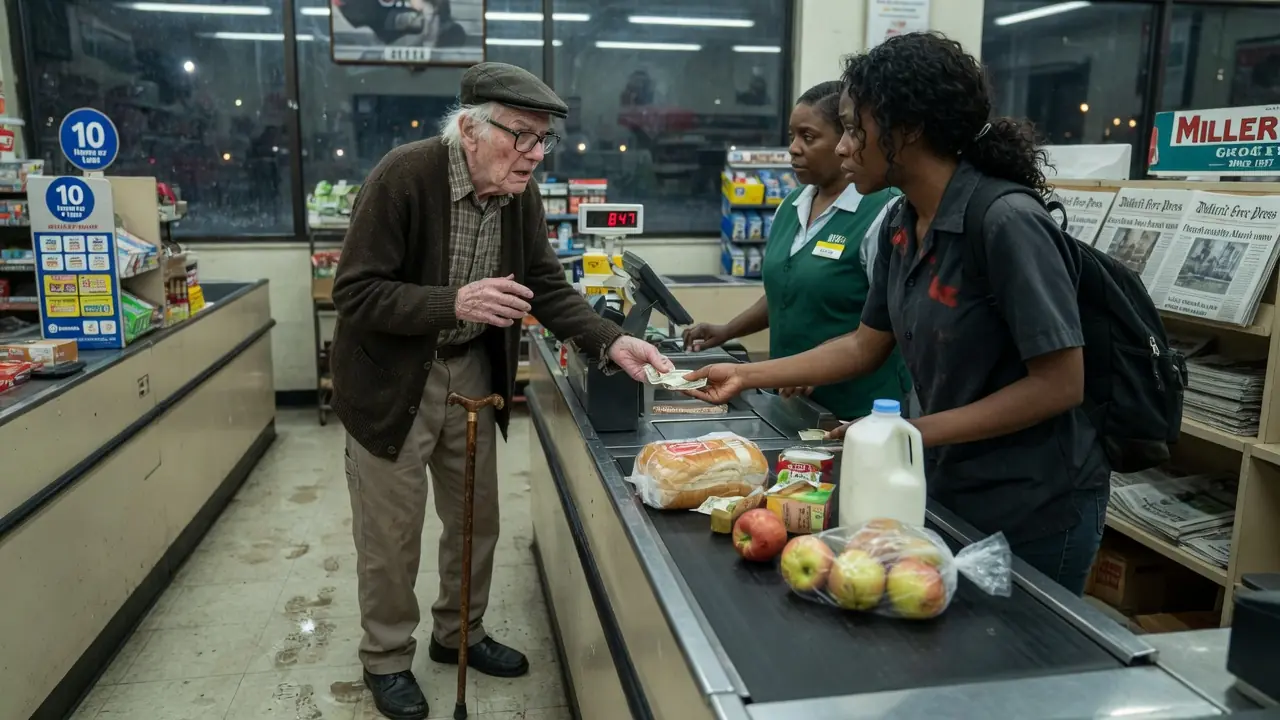
And then she saw him.
An old man, probably in his seventies, thin and fragile-looking, with white hair that stuck up in uneven tufts.
He wore a cardigan that had seen better days and glasses so thick they magnified his eyes.
He was holding an orange in one hand and a grapefruit in the other.
His face twisted in confusion.
“I just... I can’t tell which is which anymore,” he said softly, almost to himself.
One of the guys recording laughed louder.
“Yo, Grandpa’s lost it.”
“Someone get him a GPS for the fruit aisle,” another one added.
The old man’s hands trembled.
He put the fruit down, reached for something else, and knocked over a display of limes.
They scattered across the floor, rolling in every direction.
“Oh, man, he’s making it worse.”
“This is embarrassing.”
Nobody helped.
Nobody moved.
They just stood there, phones up, recording his humiliation like it was a circus act.
Lena felt something sharp and hot rise in her chest.
She knew she should walk away.
She knew she should mind her own business, get home, collapse into bed, and forget this whole miserable night ever happened.
But she could not.
Because she knew exactly what it felt like to be invisible.
To be laughed at.
To be the joke everyone else got to feel superior about.
She stepped forward.
“Hey,” she said.
Her voice came out rougher than she meant it to.
“Back off.”
The guy closest to her, baseball cap, hoodie, smirk plastered across his face, turned.
“Excuse me?”
“I said, back off.”
Lena moved between them and the old man, her body a wall.
“Show’s over. Delete the videos.”
The guy laughed.
“Who the hell are you?”
“Someone who’s not going to stand here and watch you humiliate an old man for internet points.”
“Relax, Karen. We’re just having fun.”
“Yeah, well, your fun’s done. Leave.”
For a second, nobody moved.
The air felt thick.
Tense.
Lena could feel her pulse in her throat.
She could feel the exhaustion in her bones, screaming at her to just shut up and walk away.
But she did not.
One of the girls in the group rolled her eyes.
“Whatever. This is boring anyway.”
She lowered her phone and walked off.
The others followed, muttering under their breath.
Lena waited until they were gone before she turned around.
The old man was still standing there frozen.
His hands were clutching the edge of the produce shelf like it was the only thing keeping him upright.
“Are you okay?” Lena asked, her voice gentler now.
He did not answer right away.
He just blinked his cloudy eyes, trying to focus on her.
“I... yes, I think so.”
His voice was quiet and shaky.
“Thank you. You didn’t have to do that.”
“Yeah, I did.”
Lena crouched down and started picking up the limes.
One by one, she placed them back on the display.
The old man bent down too, his movement slow and unsteady.
“You don’t have to help,” Lena said quickly. “I got it.”
“I made the mess.”
“It wasn’t your fault.”
He paused, a lime still in his hand.
“Feels like it was.”
Lena looked at him.
Really looked at him.
Up close, she could see the way his eyes did not quite focus.
The way he squinted at everything like he was trying to see through fog.
“You can’t see very well, can you?” she asked.
He smiled sadly.
“Not for a few years now. Macular degeneration. Doctors say it’ll only get worse.”
“I’m sorry.”
“Don’t be. I’ve seen enough in my life.”
He placed the lime back carefully.
“But grocery shopping has become complicated.”
Lena stood up, brushing her hands on her jeans.
“What do you need?”
“Oh, I couldn’t.”
“What do you need?” she repeated, firmer this time.
The old man hesitated.
Then, quietly, he said, “Bread, milk, maybe some fruit if I can figure out which is which.”
Lena grabbed a basket.
“Come on.”
They walked through the aisles together.
Lena described everything the way her mom used to when she was little.
Not just what things looked like, but what they felt like, smelled like, sounded like.
“This one’s softer,” she said, pressing a peach gently. “Smells sweet. Probably ripe.”
“And this one?”
“Too firm. Give it another day.”
The old man smiled.
A real smile this time.
“You’re very kind.”
“I’m just tired of people being cruel.”
They moved to the bakery section.
Lena picked up a loaf of wheat bread, checked the date, and placed it in the basket.
“I’m Alden, by the way,” he said. “Alden Hail.”
“Lena. Lena Carter.”
“Well, Lena Carter, I owe you more than a thank you.”
“You don’t owe me anything.”
They reached the register.
The cashier, a kid who looked barely sixteen, barely glanced at them as he scanned the items.
Alden handed over cash, his fingers shaking slightly.
As they walked toward the exit, Alden stopped.
He turned to Lena, his eyes watery.
“You helped me feel less invisible,” he said softly.
Lena’s throat tightened.
She wanted to say something.
Anything.
But the words would not come because that was exactly what she had been feeling for years.
Invisible.
“Take care of yourself,” she finally managed.
Alden nodded.
“You too.”
Lena watched him shuffle toward the door, his cane tapping softly against the linoleum.
Then she turned and walked the other way.
Back into the cold night.
Back toward her twelve-block walk home.
She did not know it yet, but everything was about to change.
Lena did not sleep that night.
She lay in her narrow bed, staring at the water stain on the ceiling that looked like a bird with broken wings.
The apartment was cold.
The radiator had not worked in three weeks, and the landlord kept promising to fix it soon.
Her mom was asleep in the next room, snoring softly.
At least the new medication was helping with that.
Small victories.
Lena rolled onto her side and checked her phone.
4:47 a.m.
In an hour and thirteen minutes, she would have to get up for the warehouse shift.
Her body ached just thinking about it, but her mind kept going back to the grocery store.
To the old man.
To the way his hand shook when he tried to tell an orange from a grapefruit.
To the way those boys laughed.
She had seen that look before.
That casual cruelty people wore when they thought someone was beneath them.
She had seen it on the faces of customers who snapped their fingers at her like she was a dog.
On the faces of her high school teachers who looked at her like she had already failed before she even tried.
Invisible.
That was what Alden had said.
He felt invisible.
Lena knew that feeling in her bones.
She must have dozed off at some point because the next thing she knew, her alarm was screaming and sunlight was bleeding through the thin curtains.
The warehouse was freezing.
Lena pulled her jacket tighter and started scanning boxes.
The same boxes she had scanned yesterday and the day before and the day before that.
Her supervisor, Marcus, walked past without looking at her.
“Carter, you’re on aisle seven today. Johnson called out sick again. You got a problem with that?”
Lena bit her tongue.
“No, sir.”
Marcus was the kind of man who wore his authority like a weapon.
Short, stocky, with a mustache that looked like it had been drawn on with a Sharpie.
He had been riding her since she started three months ago, always finding something wrong.
Always threatening to dock her pay for imaginary infractions.
She grabbed the scanner and headed to aisle seven.
The fluorescent lights buzzed overhead, making her head pound.
She had skipped breakfast again.
Could not afford it.
Two hours in, her back was screaming.
Four hours in, she was pretty sure she had lost feeling in her left foot.
Six hours in, she heard voices near the break room.
“Did you see that video?”
“Which one?”
“The girl and the old guy at Miller’s Grocery. It’s everywhere.”
Lena froze mid-scan.
“Oh, hell.”
“Yeah, I saw that. Some random girl defended this old dude who couldn’t figure out what fruit was what.”
“People are trying to figure out who she is. Someone said she works two jobs and lives in the Southside projects.”
“Damn, that’s rough.”
“Yeah, but like, why get involved? Those kids were just messing around.”
“I don’t know, man. Seemed pretty messed up to me.”
Lena’s stomach dropped.
She put the scanner down carefully, as if it might explode if she moved too fast.
She walked toward the bathroom, trying to look casual, trying not to run.
Once inside, she locked the stall door and pulled out her phone with shaking hands.
She typed her name into the search bar.
Nothing.
She typed Miller’s Grocery old man video.
Everything.
The video had over two million views.
Two million.
The thumbnail showed her standing between the crowd and Alden.
Her face twisted in anger.
She looked wild.
Desperate.
Nothing like herself.
She clicked on it.
The video started mid-confrontation, her voice sharp and defensive.
“I said, back off.”
The guy with the baseball cap said, “Who the hell are you?”
“Someone who’s not going to stand here and watch you humiliate an old man for internet points.”
The camera zoomed in on her face.
On the ketchup stain on her collar.
On the dark circles under her eyes.
The comments flooded the screen.
Who is this girl?
We need to find her.
Respect. She stood up when nobody else would.
Plot twist: the old guy is actually rich and she’s going to get a reward, lol.
She’s probably doing it for clout. Nobody’s that nice for free.
Why does she look like she just rolled out of a dumpster, though?
Poor people always trying to be heroes. Just go home and sleep.
Lena felt sick.
She scrolled further.
Someone had posted a screenshot from her Facebook, a photo from two years ago at her high school graduation.
She was smiling, holding her diploma, looking young and hopeful.
The caption read:
Found her. Lena Carter, 22, works at Jimmy’s Diner and some warehouse. This is her.
Below that, more comments appeared.
She’s pretty when she’s not exhausted, lol.
Two jobs at 22. Damn, America really failed her.
Or she’s just lazy and can’t get a real job.
I bet she knew who the old guy was. This was totally staged.
Lena deleted the search and shoved her phone back in her pocket.
Her hands were still shaking.
She leaned against the stall door and tried to breathe.
In through the nose, out through the mouth.
But the air felt too thick, too heavy.
She heard the bathroom door open.
Footsteps.
A voice.
“Carter, you in here?”
It was Marcus.
“Yeah,” she called out, trying to sound normal.
“Your break ended ten minutes ago. Get back to work.”
“I’m coming.”
She flushed the toilet for show, washed her hands, and walked out.
Marcus was waiting by the door, arms crossed.
“You feeling okay?”
“I’m fine.”
“You don’t look fine. You look like you’re about to pass out.”
“I said I’m fine.”
He studied her for a moment, then shrugged.
“Whatever. Just get back to seven. We’re behind schedule.”
Lena nodded and walked past him.
The rest of the shift dragged on forever.
Every time someone walked past her, she felt their eyes.
Every time someone whispered, she was sure they were talking about her.
By the time she clocked out, her nerves were shot.
She grabbed her bag and headed for the exit.
Marcus was standing by the time clock, talking to another supervisor.
He glanced at her as she passed.
“Hey, Carter.”
She stopped.
“Yeah?”
“That video everyone’s talking about. That you?”
Her heart stopped.
“I don’t know what you’re talking about.”
He smirked.
“Sure you don’t.”
She walked out before he could say anything else.
The bus ride home felt like it took hours.
Lena sat in the back, hood up, trying to disappear.
But she could not stop checking her phone.
Could not stop scrolling through the comments.
Some people were kind.
Most were not.
By the time she got to her stop, she felt hollow.
She walked the twelve blocks home on autopilot.
Her feet hurt.
Her back hurt.
Everything hurt.
But her mind was somewhere else entirely.
What if someone recognized her?
What if they approached her?
What if they started filming?
She walked faster.
When she finally reached her building, she stopped at the entrance and looked around.
No one was watching.
No cameras.
No reporters.
Just her.
She climbed the stairs to the third floor and unlocked the apartment door.
Her mom was in the kitchen stirring a pot of soup.
She looked up when Lena walked in.
“You’re late.”
“Sorry. Long day.”
“You look exhausted.”
“I am.”
Her mom ladled soup into a bowl and handed it to her.
“Eat. You need the energy for your shift tonight.”
Lena took the bowl and sat at the small kitchen table.
The soup was thin, mostly broth with a few sad vegetables floating in it, but it was warm.
“Mom.”
“Yeah?”
“If something happened, something weird, would you be okay?”
Her mom frowned.
“What kind of weird?”
“I don’t know. Just hypothetically.”
“Lena, what’s going on?”
“Nothing. Never mind.”
Her mom did not push.
She just went back to stirring the pot.
Lena finished the soup in silence, then went to her room to change for her shift at the diner.
Jimmy’s Diner was packed.
Friday nights always were.
College kids celebrating the end of the week.
Families grabbing cheap meals.
Regulars who came in for the coffee and stayed for hours.
Lena tied on her apron and got to work.
Table three wanted refills.
Table five wanted their check.
Table seven wanted to know if the meatloaf was any good.
“It’s meatloaf,” Lena said with a tired smile. “It is what it is.”
The guy at table seven laughed.
“Fair enough. I’ll take it.”
She scribbled down the order and handed it to the cook.
The shift blurred together.
Orders.
Refills.
Plates.
Tips.
Around nine p.m., two girls walked in and sat at the counter.
College-aged, phones out, giggling about something.
Lena grabbed menus and walked over.
“What can I get you?”
One of the girls looked up, her eyes widened.
“Oh my God,” she whispered to her friend. “It’s her.”
Lena’s stomach dropped.
“What?” the other girl said.
“The girl from the video. The grocery store one.”
Both girls stared at her.
Lena forced a smile.
“Can I get you something to drink?”
“Are you... are you the girl who helped that old man?”
“I don’t know what you’re talking about.”
“Yes, you are. I recognize you.”
The girl pulled out her phone.
“Can I get a picture?”
“No.”
“Come on. Just one.”
“I said no.”
Lena’s voice came out sharper than she meant.
“Do you want to order or not?”
The girls exchanged looks.
“Rude,” one of them muttered.
They ordered waters and sat there for twenty minutes without ordering food, just scrolling on their phones and whispering.
Lena avoided their table for the rest of the night.
By the time her shift ended at midnight, she was running on fumes.
She clocked out, grabbed her bag, and walked out into the cold night air.
The streets were quieter now.
Safer in a way, but also lonelier.
She started the twelve-block walk home.
Halfway there, she heard footsteps behind her.
She glanced back.
A man in a hoodie was walking the same direction.
She walked faster.
So did he.
Her heart started pounding.
She crossed the street.
He crossed too.
She broke into a jog.
Behind her, she heard him laugh.
“Relax. I’m not following you.”
But he was.
She turned a corner and ducked into an alley, pressing herself against the wall.
Her breath came in short panic gasps.
The footsteps passed by and kept going.
She waited five minutes before moving.
When she finally got home, she locked the door behind her and slid down to the floor, her whole body shaking.
She could not do this anymore.
The next morning, Lena called in sick to both jobs.
Her mom did not ask questions.
She just handed her a cup of tea and left her alone.
Lena spent the day in bed, scrolling through her phone, reading comments, watching the view count climb higher and higher.
Three million views now.
Then four.
Her face was everywhere.
Someone had made a TikTok montage set to inspirational music.
Someone else had created a Twitter thread analyzing her body language.
A Reddit forum was dedicated to finding out more about the mystery grocery store girl.
She turned off her phone and shoved it under her pillow.
But she could not escape it.
Because even with her phone off, even with the curtains drawn, even with the world locked out, she could still feel it.
The weight of a million eyes all watching her.
All waiting to see what she would do next.
On Sunday, she went to the park.
She did not know why.
Maybe because it was the only place that felt neutral, the only place where she was not the girl from the video.
She sat on a bench near the fountain and watched pigeons fight over crumbs.
The air was cold but clear, the kind of cold that made everything feel sharper.
She pulled out her old voice recorder, a habit from childhood.
She had started recording sounds when she was little.
Her mom’s laugh.
Rain on the windows.
The hum of the refrigerator.
Little moments she was afraid of forgetting.
She pressed record.
“It’s been four days since the video went viral,” she said quietly. “I don’t know what to do. People keep recognizing me, keep asking questions, keep judging me for helping someone.”
She paused.
“I just wanted to do the right thing. And now I feel like I’m being punished for it.”
She stopped recording and shoved the device back in her pocket.
“Talking to yourself?”
She looked up.
Alden was standing there, leaning on his cane.
Lena’s breath caught.
“What are you doing here?”
“I walk here on Sundays. Helps me think.”
He tilted his head.
“May I sit?”
She hesitated, then nodded.
“Yeah, sure.”
He sat down carefully, his movements slow and deliberate.
For a moment, neither of them spoke.
“I saw the video,” Alden said finally.
“Everyone did.”
“I’m sorry. I didn’t mean for any of this to happen.”
“It’s not your fault.”
“Isn’t it?”
He turned toward her, his cloudy eyes searching.
“If I hadn’t been there, if I hadn’t needed help—”
“Then those boys would have found someone else to mock.”
Lena pulled her jacket tighter.
“You didn’t do anything wrong.”
“Neither did you. But somehow, we’re both paying for it.”
Alden nodded slowly.
“The internet is a strange beast. It turns kindness into spectacle.”
“Yeah, well, spectacle sucks.”
He smiled sadly.
“It does.”
They sat in silence for a while.
The fountain gurgled softly.
A dog barked somewhere in the distance.
“Can I ask you something?” Alden said.
“Sure.”
“Why did you help me? Really?”
Lena thought about it.
“Because I couldn’t walk away. I know what it feels like to be laughed at, to be invisible, and I didn’t want you to feel that way.”
“Even though helping me made your life harder.”
“I didn’t know it would.”
“But if you had known, would you still have helped?”
Lena looked at him, at this fragile old man who had somehow turned her life upside down without meaning to.
“Yeah,” she said quietly. “I think I would have.”
Alden’s face softened.
“You’re a rare person, Lena Carter.”
“I’m just tired.”
“You’re both.”
They sat there until the sun started to set, painting the sky in shades of orange and pink.
Before he left, Alden reached into his coat pocket and pulled out a card.
“If you ever need anything,” he said, “anything at all, call me.”
Lena took the card.
It was simple.
White, just a name and a phone number.
“Why?” she asked.
“Because you helped me feel less invisible, and I’d like to return the favor.”
He stood and walked away slowly, his cane tapping against the pavement.
Lena watched him go.
Then she looked down at the card in her hand, and for the first time in days, she felt something that was not fear or exhaustion.
She felt hope.
The car showed up on Thursday.
Lena was walking home from her shift at the diner, feet aching, grease in her hair, tips barely enough to cover bus fare, when she saw it.
A sleek sedan parked outside Miller’s Grocery, the same store from that night.
She slowed down.
Two men in suits stepped out.
They looked like they had walked off the set of some corporate drama.
Clean-cut.
Expensive watches.
Bluetooth earpieces.
The kind of people who did not shop at Miller’s.
One of them opened the back door.
Alden stepped out.
Lena stopped walking entirely.
He was not wearing the old cardigan anymore.
He wore a tailored coat, dark slacks, and shoes that probably cost more than her rent.
His cane was different too.
Sleek, modern, made of polished chrome instead of worn wood.
A woman in a blazer appeared beside him, speaking rapidly.
Alden nodded at whatever she was saying.
A small crowd had already started to gather.
People with phones out, whispering and recording.
“Is that him?”
“Holy hell, it is the guy from the video.”
“Who is he?”
One of the suited men noticed Lena standing there.
He leaned toward Alden and said something.
Alden’s head turned in her direction.
“Lena,” he called out.
Every phone in the crowd swiveled toward her.
She felt her stomach drop.
“No,” she whispered. “No, no, no.”
She turned and walked quickly in the opposite direction, her heart hammering.
Behind her, she heard Alden’s voice calling her name again, but she did not stop.
Could not stop.
She made it two blocks before she had to duck into an alley and catch her breath.
Her phone buzzed in her pocket.
She pulled it out with shaking hands.
A text from an unknown number.
Lena, it’s Alden. Please don’t run. I need to explain.
She stared at the screen, her mind racing.
Another text.
I’m sorry. I should have told you.
Told her what?
She opened Twitter with trembling fingers.
Typed Alden Hail into the search bar.
The results made her knees weak.
Billionaire tech founder Alden Hail spotted at local grocery store, same place where viral video was filmed.
Alden Hail, the man behind Optivision Technologies. Net worth $4.2 billion.
Who is the mystery woman who helped Alden Hail? Internet detectives are closing in.
Lena scrolled through article after article, each one more surreal than the last.
Photos of Alden from years ago, sharper and younger, standing in front of massive office buildings.
Articles about his company, his innovations, his fortune, his late wife Helen, a philanthropist who died six years ago.
And now photos of her.
Grainy screenshots from the grocery store video.
Someone had tracked down her high school yearbook photo, her Facebook page, which she thought was private, pictures of the diner where she worked, the warehouse, even her apartment building.
The comments were brutal.
She knew who he was. This was 100% a setup.
Gold digger alert.
She probably researched him before going to that store.
Nobody helps a stranger for free.
She’s after his money.
She works at Jimmy’s Diner, LMAO. Bet she’s already planning her payday.
Why does she look homeless though?
Girl needs to invest in a shower.
This is what desperation looks like.
But mixed in with the hate were defenders.
Y’all are disgusting. She didn’t know who he was.
Even if she did, so what? She still helped him when no one else would.
Poor people can’t win. If she ignored him, she’d be heartless. She helps him, she’s a gold digger.
Lena felt like she was going to throw up.
She stumbled out of the alley and kept walking, head down, trying to disappear into the crowd.
But people were looking at her.
She could feel it.
A woman walking past her slowed down, staring.
She pulled out her phone.
Lena walked faster.
A teenager on a skateboard rode past, then circled back.
“Hey, you’re that girl from the video.”
“No, I’m not.”
“Yeah, you are. Can I get a picture?”
“Leave me alone.”
She broke into a jog.
By the time she got home, her lungs were burning and her vision was blurry with tears she refused to let fall.
But when she turned the corner to her building, her stomach dropped.
Two news vans were parked outside.
Reporters with cameras.
People milling around with phones.
“Damn it,” she breathed.
A reporter spotted her immediately.
“Lena! Lena Carter, can we talk to you for a moment?”
She broke into a run, shoving through the building’s front door and slamming it behind her.
The reporters did not follow.
Building security would not let them, but she could see them through the window.
Cameras pointed at the entrance like wolves waiting for prey.
She climbed the stairs two at a time, her breath coming in ragged gasps.
When she burst into the apartment, her mom was standing in the kitchen, her face pale, the TV remote clutched in her hand.
“Lena,” she said quietly. “What the hell is going on?”
The TV was on the news.
And there, filling the entire screen, was Lena’s face.
Mystery woman who helped billionaire Alden Hail identified as 22-year-old Lena Carter, a server at Jimmy’s Diner and warehouse employee.
The screen cut to footage of Alden stepping out of the sedan, then to the original grocery store video, then to a grainy photo of Lena walking down the street taken from someone’s phone just minutes ago.
The news anchor spoke in that practiced neutral tone.
“Questions are swirling about the nature of the relationship between Hail and Carter. While some are calling Carter a good Samaritan, others are questioning her motives.”
Lena’s knees buckled.
She grabbed the edge of the table to steady herself.
“Mom—”
“They’ve been calling all day,” her mom said, her voice shaking. “Reporters. Random people. Someone tried to get into the building claiming they were your cousin from Ohio. Lena, what did you do?”
“I didn’t do anything.”
Lena’s voice cracked.
“I just... I helped an old man at the grocery store. That’s it. I swear. I didn’t know who he was. I didn’t know any of this would happen.”
Her mom set down the remote and gripped Lena’s shoulders.
“You need to stay away from him. From all of this. Do you understand? People like him, people with that kind of money, they ruin people like us just by existing near them.”
“I’m not trying to—”
“I don’t care what you’re trying to do. This is dangerous.”
She gestured at the TV, where a commentator was now speculating about whether Lena had orchestrated the encounter for financial gain.
“Look at what’s already happening. They’re turning you into a villain, or worse, a punchline.”
“I didn’t ask for any of this.”
“Well, you’ve got it now.”
Her mom’s voice softened slightly.
“Baby, I know you were trying to help, but rich people, they’re different. Their problems become our problems. Their lives swallow ours.”
“He’s not like that.”
“You don’t know him.”
“I know he was kind to me. I know he thanked me. I know he gave me his number in case I needed help.”
Her mom’s eyes widened.
“He gave you his number?”
“Not like that. Just in case.”
“Lena.”
Her mom’s grip tightened.
“Promise me you won’t call him. Promise me you’ll let this die down and go back to your life.”
Lena wanted to promise.
Wanted to make her mom feel better.
But she could not because part of her, a small, stubborn part, did not want to let this go.
“I’ll think about it,” she said quietly.
Her mom’s face fell.
“That’s not a promise.”
“It’s the best I can do right now.”
Lena pulled away and locked herself in her room.
She sat on the floor with her back against the door, her phone clutched in her hands.
The screen was lit up with notifications, messages, emails, friend requests, DMs from complete strangers.
She scrolled through them, her heart sinking with each one.
You’re an inspiration. Don’t let them tear you down.
Gold digging bitch.
I sent you a DM. I’m a producer and I’d love to talk about your story.
You don’t deserve the hate. Stay strong.
People like you make me sick. You knew exactly what you were doing.
And then one message made her blood run cold.
You don’t know me, but I know you. I know where you work. I know where you live. I know you take the 42 bus home at night. Stop pretending to be a hero. You’re just another leech trying to get rich off someone else’s money. People like you deserve what’s coming.
Lena dropped the phone like it had burned her.
Her hands were shaking.
Her whole body was shaking.
She pulled her knees to her chest and pressed her face against them, trying to breathe, trying to think.
She had not done anything wrong.
So why did it feel like the whole world was turning her into a criminal?
That night, Lena barely slept.
Every sound made her jump.
Every car that passed outside made her heart race.
When she finally dozed off around four a.m., she dreamed of cameras, of people pointing and laughing, of Alden standing in the distance, unreachable, while the world pulled them further and further apart.
She woke up at six a.m. to her phone buzzing.
Twenty-three missed calls.
Forty-seven text messages.
Her Instagram had gained over fifteen hundred followers overnight.
She turned off her phone and shoved it under her pillow, but she could still feel it.
The weight of it.
The pull of it.
She got dressed and went to the kitchen.
Her mom was already up making coffee.
“I’m calling in sick today,” Lena said.
“To both jobs?”
“Yeah.”
Her mom did not argue.
She just handed her a cup of coffee and kissed her forehead.
“We’ll get through this,” she said quietly.
Lena wanted to believe her, but deep down, she was not sure.
Three days passed.
Three days of Lena staying inside the apartment, only leaving to throw out the trash late at night when she was sure no one would see her.
Three days of her mom answering the door to reporters, telemarketers, and random people claiming to know Lena.
Three days of the internet dissecting every detail of her life.
Someone found her old MySpace page from when she was fifteen.
Another person tracked down her high school attendance records and started speculating about why she had missed so many days junior year.
The answer was that her mom had been in the hospital, but nobody cared about context.
A forum on Reddit had dedicated an entire thread to Is Lena Carter a Scammer or a Saint? with over three thousand comments arguing both sides.
Lena stopped reading after the first hundred.
She spent most of her time in her room, lying in bed, staring at the ceiling.
Her mom brought her food.
Soup.
Toast.
Things that did not require much effort.
“You need to eat,” her mom said, setting a bowl on the nightstand.
“I’m not hungry.”
“Eat anyway.”
Lena forced down a few bites, then pushed the bowl away.
Her mom sat on the edge of the bed.
“This can’t go on forever.”
“I know.”
“You’re going to have to face the world eventually.”
“I know.”
“Lena.”
“Mom, I know. I just... I need time.”
Her mom sighed.
“Okay. But not too much time. You’ve got bills to pay, jobs to get back to.”
“I’ll go back Monday.”
“Promise?”
“Promise.”
Her mom squeezed her hand and left the room.
Lena rolled over and closed her eyes.
Saturday morning, the knock came.
Three sharp wraps on the apartment door.
Lena was in the kitchen pouring herself a glass of water when she heard her mom’s voice from the living room.
“Who is it?”
A pause.
Then a man’s voice, calm and steady.
“My name is Alden Hail. I’m here to see Lena.”
Lena’s heart stopped.
She set down the glass and crept to the edge of the hallway, peeking around the corner.
Her mom had opened the door but stood blocking the entrance.
Beyond her, Lena could see Alden standing in the hallway, flanked by one of his suited assistants, a younger man with slicked-back hair and an expression that said he would rather be anywhere else.
Alden looked smaller without the tailored coat.
He wore a simple sweater and slacks.
His cane rested lightly in his hand.
“You’ve got some nerve showing up here,” her mom said, her voice tight.
“I understand,” Alden replied. “And I’m sorry, but I need to speak with your daughter. I owe her an explanation.”
“You don’t owe her anything except distance.”
“Mrs. Carter—”
“It’s Miss Carter. And no, you don’t get to walk into our home just because you’ve got money.”
Alden’s face softened.
“You’re right. I don’t. But I’m not here because of money. I’m here because your daughter helped me when no one else would, and now she’s suffering because of it.”
“Damn right she is.”
Her mom’s voice rose.
“Do you have any idea what the last three days have been like for her? The reporters outside, the threats, the people on the internet tearing her apart?”
“I do. And I hate it. That’s why I’m here.”
“To do what? Throw money at the problem? Make her your charity case?”
“No. To apologize. To try to make it right.”
Her mom laughed, a sharp, bitter sound.
“Make it right? You can’t make this right. Your apology doesn’t fix the reporters outside. It doesn’t fix the strangers sending my daughter death threats. It doesn’t fix the fact that her life has been turned inside out because she was kind to you.”
“I know.”
Alden’s voice cracked slightly.
“And I hate that. I hate that my presence in her life has caused her pain. But please, let me try.”
“How? How are you going to fix this?”
“By telling the truth. By standing with her instead of letting the world tear her apart alone.”
Her mom stared at him for a long moment.
Lena could see the war happening on her face.
The urge to slam the door.
The urge to protect.
The urge to make this man, this rich, powerful man, disappear from their lives forever.
But there was something else too.
Uncertainty.
Her mom turned and saw Lena standing in the hallway.
“It’s your choice,” she said quietly. “But think hard before you let him in.”
Lena stepped forward, her heart pounding.
Alden’s face turned toward her, his cloudy eyes searching.
“Lena,” he said softly. “I’m so sorry.”
She crossed her arms.
“You should be.”
“May I come in?”
Lena glanced at her mom, who looked like she wanted to physically block the door.
But after a moment, she stepped aside.
Alden walked in carefully, his cane tapping against the worn linoleum.
His assistant stayed in the hallway, hands folded behind his back.
The apartment was small and cramped, the kind of place that made it obvious the people living there were barely holding on.
There was a crack in the ceiling above the couch.
The carpet was threadbare in spots.
The kitchen table had one leg shorter than the others, propped up with a folded napkin.
Alden did not comment on any of it.
He did not look around like he was cataloging their poverty.
He just stood there, waiting.
“Sit,” Lena said, gesturing to the couch.
He did, moving slowly, carefully lowering himself onto the cushions.
Her mom stayed standing by the door, arms crossed, face hard.
Lena sat in the chair across from him.
“Why didn’t you tell me?”
“Tell you what?”
“Who you are. What you are.”
Alden sighed.
“Because for the first time in years, someone saw me as just a person. Not a name, not a fortune, not a company. Just an old man who needed help.”
He paused.
“I didn’t want to ruin that.”
“Well, it’s ruined now.”
“I know. And that’s my fault.”
“Yeah, it is.”
He flinched at that.
Lena leaned forward.
“Do you have any idea what it’s been like? People are calling me a gold digger, a scammer, a publicity stunt. Someone sent me a message saying they know where I live and that I deserve what’s coming. I can’t go to work. I can’t leave my apartment. My entire life is on the internet for people to pick apart.”
“I know,” Alden said quietly. “I’ve seen it. And I’m horrified.”
“Then why are you here? What do you think you can do?”
“I don’t know. But I had to try.”
He leaned forward, gripping the top of his cane with both hands.
“Lena, I’ve spent the last three days trying to undo the damage. I’ve had my legal team contact the platforms, tried to take down some of the worst posts. But the internet... it’s a beast I can’t control. Nobody can. That doesn’t mean I shouldn’t try.”
Her mom spoke up from the doorway, her voice sharp.
“Why are you really here?”
Alden turned toward her voice.
“Because your daughter saved a man who is losing pieces of his world, and I won’t let her lose pieces of hers because of it.”
“What does that mean?”
“It means I want to help however I can.”
“We don’t need your money.”
“I’m not offering money. I’m offering support, protection, a way to make this right.”
Her mom laughed bitterly.
“Right. And what does that look like? You hire some PR firm to spin the story? You pay off reporters? You make Lena your pet project?”
“No.”
Alden’s voice was firm.
“I tell the truth publicly. I explain exactly what happened. I make it clear that Lena didn’t know who I was, that she asked for nothing, that she simply helped a stranger in need.”
“And you think people will believe you?”
“Some will. Some won’t. But it’s better than staying silent.”
Her mom took a step forward.
“Let me tell you something about rich people, Mr. Hail. Rich men don’t need to take anything from people like us. Your shadow alone is enough. You walk into our world and everything changes. Everything gets harder. Even if you mean well, especially if you mean well, you make things worse just by being here.”
Alden’s face crumpled.
“You’re right. My shadow is heavy, and I can’t change that.”
He paused.
“But I can choose what I do with it. I can use it to shield her, or I can walk away and let her face this alone.”
His voice broke slightly.
“I don’t want to walk away.”
The room fell silent.
Lena looked at her mom.
Her mom looked back, her jaw tight.
“Five minutes are up,” her mom said finally.
Alden nodded.
He stood slowly, steadying himself on his cane.
“Thank you for hearing me out.”
Lena walked him to the door.
As he stepped into the hallway, he turned back.
His hand reached into his pocket, and he pulled out a business card different from the last one.
This one had more information.
An email.
An office address.
“If you change your mind,” he said quietly, “if you want my help, or if you just want to talk, please call.”
Lena took the card.
“What if I don’t want your help?”
“Then I’ll respect that. But I’ll still do what I can to fix this mess.”
“It’s not your mess to fix.”
“Yes, it is. Because I’m the one who brought it into your life.”
He turned to leave.
“Alden.”
He stopped.
“I believe you,” Lena said. “About not meaning for this to happen.”
He smiled sadly.
“Thank you. That means more than you know.”
He walked down the hallway, his cane tapping softly, his assistant following behind.
Lena closed the door and leaned against it.
Her mom was standing in the middle of the living room, arms still crossed.
“Do you trust him?” she asked.
“I don’t know.”
“Do you want to?”
Lena looked down at the card in her hand.
“Yeah. I think I do.”
Her mom sighed.
“Then I hope you’re right about him. Because if you’re not—”
“I know, Mom.”
“Good. Because I’m not letting anyone hurt my daughter. Not even a billionaire.”
Lena smiled despite everything.
“I know.”
That night, Lena could not sleep again.
She lay in bed staring at the business card on her nightstand.
She kept thinking about what her mom said.
About shadows.
About how rich people made everything harder just by existing.
But she also thought about Alden, about the way he had looked sitting on her couch, small, fragile, genuinely sorry.
About the way he had said, “I don’t want to walk away.”
Around two a.m., she picked up the card and typed the number into her phone.
She did not call.
But she saved it.
Just in case.
Two weeks later, Lena went back to the park.
She did not tell her mom.
She did not tell anyone.
She just woke up on a Tuesday morning, put on her jacket, and walked the fifteen blocks to the place where it had all started to shift.
The fountain was running again.
The water caught the late morning sunlight, scattering it in a thousand tiny rainbows.
Lena sat on the bench, their bench, and pulled out her voice recorder.
She pressed record.
“It’s been two weeks since Alden came to the apartment,” she said quietly, her voice barely audible over the sound of the fountain. “The reporters are mostly gone now. The internet’s moved on to the next thing. But I haven’t. I keep thinking about what he said about wanting to help, about not walking away.”
She paused.
“I don’t know if I can trust that. Trust him. Trust any of this.”
She stopped recording and shoved the device back in her pocket.
“Still talking to yourself?”
Her head snapped up.
Alden was standing a few feet away, leaning on his cane, a small smile on his face.
“Jesus Christ,” Lena muttered. “Do you just materialize out of thin air?”
“My driver drops me off on Tuesdays and Thursdays. I like to walk here. The fresh air helps me think.”
He tilted his head.
“May I?”
“It’s a free country.”
He sat down beside her the same way he had before.
The same careful movements.
The same quiet presence.
For a moment, neither of them spoke.
“I didn’t think you’d come back,” Alden said finally.
“I wasn’t sure I would either.”
“What changed your mind?”
Lena shrugged.
“Curiosity, I guess. Or stupidity. Haven’t decided which yet.”
Alden smiled.
“I’ll take either.”
They sat in silence, listening to the fountain, watching people walk by with their dogs and their coffee cups and their seemingly uncomplicated lives.
“I saw your statement,” Lena said after a while. “The one your company released.”
Alden had issued a public statement three days after showing up at her apartment.
It had been professional, carefully worded, and completely honest.
He had explained exactly what happened in the grocery store, made it clear Lena had no knowledge of his identity, emphasized that she had asked for nothing and expected nothing.
It had helped a little.
Some people still called her a gold digger, but now there was a counternarrative.
A defense.
“Did it make things better?” Alden asked.
“A little. Some people still think I’m lying, but at least now there’s another side to the story.”
“I wish I could do more.”
“You can’t control the internet.”
“No. But I can try to give you some peace.”
Lena looked at him.
“Why do you care so much?”
He was quiet for a moment.
Then he said, “Because you reminded me what it feels like to be human. Not a brand, not a company, not a net worth. Just a person who needed help.”
He paused.
“And because I know what it’s like to feel invisible, even when everyone’s looking at you.”
“That doesn’t make sense.”
“Doesn’t it?”
He turned toward her, his cloudy eyes searching.
“When you’re known for what you have instead of who you are, you become invisible in a different way. People see the fortune, the power, the influence. But they don’t see you.”
Lena leaned back against the bench.
“I’m twenty-two. I work two jobs. Or I did before all this. I’m nobody.”
“You’re not nobody to me.”
She did not know what to say to that.
They sat in silence for a while.
A jogger passed by.
A couple walked past holding hands.
Life kept moving around them.
“Can I ask you something?” Alden said.
“Sure.”
“What do you dream about when you’re not exhausted? When you’re not just surviving. What do you actually want?”
Lena frowned.
“I told you before. I don’t really dream about stuff.”
“But if you could, if money and circumstances weren’t an issue, what would you want?”
She thought about it.
Really thought about it.
“I think...”
She paused.
“I think I’d want to matter. Not in a famous way. Just... I’d want someone to look at me and think I’m capable. That I have something to offer. That I’m not just...”
She stopped, her throat tight.
“Not just what?”
“Not just poor. Not just struggling. Not just the girl who couldn’t make it.”
Alden was quiet for a moment.
Then he said, “You already matter, Lena. You already have something to offer.”
“Not to most people.”
“Then they’re not looking hard enough.”
She wanted to believe him.
God, she wanted to.
But belief was expensive, and she had learned a long time ago not to invest in things she could not afford.
“Can I ask you something?” she said.
“Of course.”
“What do you dream about?”
He smiled sadly.
“I dream about seeing again.”
“Really seeing?”
“Not just shapes and shadows, but colors, faces, details. The way light hits water. The way people’s expressions change when they smile.”
“I’m sorry.”
“Don’t be. I’ve seen a lot in my life. More than most. Maybe this is just the universe’s way of making me slow down. Pay attention to other things.”
“Like what?”
“Like sounds. Textures. The way people’s voices change when they’re happy or sad. The way the world smells after rain.”
He paused.
“The way you describe things to me.”
Lena blinked.
“What?”
“In the grocery store, you didn’t just tell me what things were. You told me what they felt like, smelled like. That peach, you said it was soft, sweet-smelling, ready to eat. You gave me more than information. You gave me experience.”
“I just... that’s how I’ve always thought about stuff.”
“It’s a gift.”
“It’s weird.”
“It’s both.”
They sat there for another hour, talking about everything and nothing.
About the weather.
About the weird way pigeons walked.
About how the fountain sounded different depending on where you sat.
When Lena finally stood to leave, Alden stayed seated.
“Will you come back?” he asked.
“To the park?”
“Yes.”
She hesitated.
“Maybe.”
“Thursday?”
“I have work.”
“After work.”
She looked at him.
This strange, wealthy, kind old man who had somehow become part of her life.
“Yeah,” she said. “After work.”
His face lit up.
“Good.”
Thursday came.
Lena finished her shift at the diner at four and went straight to the park.
Alden was already there, sitting on their bench, face turned toward the sun.
“You came,” he said when he heard her footsteps.
“I said I would.”
“People don’t always mean what they say.”
“I do.”
They sat together as the afternoon bled into evening.
Lena told him about her shift.
The rude customer who had left a quarter as a tip.
The college kid who had accidentally knocked over an entire tray of glasses.
Alden told her about his day.
A meeting with his board.
A conversation with his son that had gone poorly.
The way his assistant had described the sunset that morning.
“Your son,” Lena said. “You don’t talk about him much.”
“No.”
“Why?”
Alden sighed.
“Because it’s complicated. He’s angry with me. Has been for years.”
“Why?”
“Because I worked too much when he was young. Missed too many moments. And then when I finally had time, when Helen died and I wanted to rebuild our relationship, he had already moved on. Built a life without me.”
His voice was heavy.
“I don’t blame him. But it hurts.”
“Have you told him that?”
“Many times.”
“He doesn’t want to hear it?”
“Maybe he needs to hear it more.”
Alden smiled sadly.
“Maybe.”
They sat in silence for a while.
Then Alden said, “Tell me about your mom.”
“What about her?”
“She’s protective of you. Fierce, even.”
“Yeah, she is.”
“What’s her story?”
Lena thought about it.
About her mom’s rough hands from cleaning houses.
About the way she hummed when she cooked.
About the time she had worked three jobs for six months to keep them from getting evicted.
“She’s the strongest person I know,” Lena said finally. “She’s had a hard life. My dad left when I was five. She raised me alone. Worked herself half to death to keep us afloat. And she never once made me feel like I was a burden.”
“You’re lucky to have her.”
“I know.”
“Does she know you’re here?”
“No.”
“Will you tell her?”
“Eventually.”
Alden nodded.
“For what it’s worth, I think she’s right to be protective. The world can be cruel.”
“Yeah, but it can also be kind. You taught me that.”
“No,” he said softly. “You taught me that.”
The weeks passed.
Tuesday and Thursday became routine.
Lena would finish work and go to the park.
Alden would be there waiting.
They talked about everything.
Her dreams.
His regrets.
The state of the world.
The stupid things people did on reality TV.
Slowly, carefully, something fragile began to grow between them.
It was not romance.
It was not even quite friendship.
It was something else.
Something harder to name.
Understanding, maybe.
Or hope.
One Thursday, Alden asked her about the voice recorder.
“What do you record?” he said.
“Sounds. Moments. Things I don’t want to forget.”
“Like what?”
She pulled it out and scrolled through the files.
“My mom laughing. Rain on the window. The way the bus sounds at night. Stuff like that.”
“Can I hear one?”
She hesitated, then selected a file from two years ago.
Her mom’s voice filled the air, warm and tired.
“Lena, baby, come eat. I made your favorite.”
Then Lena’s younger voice, lighter somehow.
“You made mac and cheese?”
“I made mac and cheese.”
“You’re the best.”
The recording ended.
Alden’s eyes were wet.
“That’s beautiful.”
“It’s just my mom.”
“Exactly.”
Lena put the recorder away.
“Do you have recordings of your wife?”
“A few. Mostly videos from events. Nothing like that. Nothing real.”
“I’m sorry.”
“Me too.”
They sat quietly as the sun set, painting the sky in shades of orange and red.
“Lena,” Alden said after a while.
“Yeah?”
“Thank you.”
“For what?”
“For seeing me. For coming back. For not giving up on this... whatever this is.”
She smiled.
“You’re welcome.”
But not everyone was happy about their growing friendship.
At the diner, her coworkers whispered.
“She’s still meeting him, you know.”
“No way.”
“Yeah. Saw her leaving early on Thursday again.”
“Think she’s getting paid?”
“Probably.”
Lena overheard and kept her head down.
At the warehouse, Marcus cornered her by the loading dock.
“Carter.”
“Yeah?”
“You still hanging out with that old billionaire?”
“That’s none of your business.”
“It is if it affects your work.”
“It doesn’t.”
“You sure? Because you’ve been leaving early a lot lately.”
“I’m taking my legally mandated breaks.”
“Uh-huh.”
He stepped closer.
“Just be careful, Carter. People like him don’t do favors for free.”
“Good thing I’m not asking for favors.”
She walked away before he could respond.
Then came the day everything shifted again.
Lena was at the diner refilling coffee when two of her coworkers walked past, whispering loud enough for her to hear.
“Did you see it?”
“See what?”
“The new video. Someone posted it this morning.”
Lena’s stomach dropped.
She finished pouring the coffee somehow and walked quickly to the break room.
She pulled out her phone.
The video was already trending on Twitter.
Someone had filmed her and Alden at the park, sitting on the bench, talking and laughing.
The caption read:
Gold digger staying close to the money. Look how cozy they are.
The comments were vicious.
She’s playing the long game.
This is so fake.
Nobody’s that nice.
He’s literally old enough to be her grandfather. Gross.
She’s using him. It’s so obvious.
Lena felt the walls closing in.
She texted Alden.
We can’t meet anymore. I’m sorry.
His response came immediately.
What happened?
Someone filmed us. It’s online. People think I’m using you.
I don’t care what people think.
Well, I do.
Her phone rang.
Alden’s name flashed on the screen.
She did not answer.
Instead, she grabbed her bag, clocked out early, and walked out of the diner.
Behind her, she heard her coworkers laughing.
That night, Lena was lying in bed when she heard shouting outside.
She got up and looked out the window.
A small crowd had gathered near the building entrance.
People with signs.
People with cameras.
One sign read: Leech.
Another read: Exploiting the Elderly.
Lena’s mom burst into her room.
“Pack a bag now.”
“What?”
“We’re leaving. Staying with your aunt for a few days.”
“Mom—”
“Now, Lena.”
They left through the back exit, moving quickly through the alley.
Lena’s mom gripped her hand so tightly it hurt.
As they climbed into a taxi, Lena looked back at the building.
The crowd was still there.
Still shouting.
Still holding their signs.
She closed her eyes and tried not to cry.
The next morning, her phone rang.
Alden.
She answered.
“Where are you?” he said, his voice tight and worried.
“Somewhere safe.”
“Lena, I went to your building. There were people outside with signs.”
“I know.”
“This has to stop.”
“You can’t stop it. Nobody can.”
“I can try.”
He paused.
“I’m holding a press conference tomorrow. I’m going to set the record straight.”
“That’ll make it worse.”
“It can’t get worse than this.”
She wanted to argue, but she was too tired.
“Okay,” she said quietly.
“Will you be there?”
“I don’t know.”
“Please. I need you there. Not for me. For you. So you can tell your side.”
“I don’t have a side. I just helped an old man.”
“Then tell them that. Please.”
Lena closed her eyes.
“I’ll think about it.”
“That’s all I ask.”
The press conference was held at Optivision’s headquarters on a gray Wednesday morning.
Lena stood backstage, her hands shaking so badly she had to shove them in her pockets.
She had never been in a building like this.
All glass and steel and sharp angles.
The kind of place that made her feel small just by existing in it.
Alden was beside her, wearing a dark suit that probably cost more than her yearly rent.
But his hands were shaking too.
“You don’t have to do this,” he said for the third time.
“Yes, I do.”
“If you want to leave right now, we leave. I’ll handle it alone.”
“I’m not a child, Alden.”
“I know. But I’m an old man who worries.”
Despite everything, the fear, the exhaustion, the crushing weight of what was about to happen, Lena smiled.
A woman in a sharp blazer approached.
She had a headset and a clipboard and the kind of no-nonsense energy that suggested she could organize an invasion if needed.
“Mr. Hail, we’re ready.”
Alden nodded.
He turned to Lena.
“Stay close to me. If it gets overwhelming, squeeze my hand. I’ll end it immediately.”
“Okay.”
“I mean it, Lena. One squeeze and we’re done.”
“I know.”
They walked toward the stage entrance.
Lena could hear the murmur of voices beyond the curtain, the rustle of papers, the click and whir of cameras being adjusted.
Her heart was pounding so hard she thought everyone could hear it.
“Ready?” Alden asked.
“No.”
“Me neither.”
They stepped onto the stage together.
The room exploded.
Camera flashes went off like lightning.
Voices overlapped in a cacophony of shouted questions.
“Mr. Hail, is it true you’ve been paying Lena Carter?”
“Lena, how long have you known about his fortune?”
“Is this a publicity stunt?”
“Are you two in a relationship?”
“How much has he given you?”
“Mr. Hail, is this about your late wife?”
The questions came so fast, so aggressively, that Lena could not process them.
She just stood there frozen, her whole body screaming at her to run.
Alden raised one hand.
The room quieted.
Not completely.
There were still whispers, still camera shutters clicking.
But enough.
“Thank you all for coming,” Alden said.
His voice was steady despite everything.
Calm.
“I’m here today to address the rumors and speculation surrounding myself and Miss Lena Carter.”
He paused, letting the silence stretch.
“Three weeks ago, I was shopping at Miller’s Grocery. As many of you know, I have macular degeneration. My vision is severely limited. I was struggling to identify produce when a group of young people began filming me. They were laughing, mocking me, making a spectacle of my disability.”
The room was dead silent now.
“Lena Carter stepped in,” Alden continued. “She didn’t know who I was. She didn’t ask for anything. She didn’t expect anything. She simply helped a stranger who was being humiliated.”
His voice cracked slightly.
“She treated me with dignity when no one else would.”
A reporter in the front row raised her hand.
“Mr. Hail, are you saying this encounter wasn’t staged?”
“I’m saying Lena Carter is not a gold digger. She’s not a fraud. She’s not an opportunist. She’s a young woman who works two jobs to support her family and still found it in herself to help someone she didn’t know.”
Another reporter spoke up.
“But you’ve been meeting with her regularly since then.”
“Because she’s my friend.”
Alden’s voice was firm now.
Steel underneath the gentleness.
“I’m seventy-four years old. I’m losing my sight. My wife passed away six years ago. My son and I barely speak. For years, I’ve felt invisible despite being surrounded by people every single day. And then Lena saw me. Really saw me. Not my money, not my company, not my name. Just me.”
A male reporter in the back shouted, “How much money have you given her?”
“Nothing. Not a single dollar.”
“So why the ongoing relationship?”
“Because loneliness is universal. Because kindness is rare. Because for the first time in years, someone treated me like a human being instead of a walking bank account.”
The room erupted with more questions.
Alden raised his hand again.
“Miss Carter would like to say something.”
Every eye in the room turned to Lena.
She felt her throat close up.
She had not prepared anything.
Had not practiced.
She had just shown up.
She stepped forward to the microphone, her legs shaking.
“I...”
Her voice came out as a whisper.
She cleared her throat and tried again.
“I didn’t help Mr. Hail because of who he is. I helped him because I couldn’t walk away.”
Someone shouted, “Why not?”
“Because...”
She stopped and took a breath.
“Because I know what it feels like to be laughed at. To be invisible. To be the joke everyone else gets to feel superior about. And I didn’t want him to feel that way.”
A reporter near the front spoke up, her voice sharp.
“But you continued to meet with him after finding out his identity. Doesn’t that suggest—”
“Suggest what?” Lena cut her off. “That I’m a gold digger? That I had some master plan? I work at a diner and a warehouse. I take the bus everywhere. I live in a one-bedroom apartment with my mom. If I was after money, don’t you think I’d have asked for it by now?”
The room went quiet.
Lena’s hands gripped the edge of the podium.
“You want to paint me as a villain? Fine. You want to say I’m using him? Go ahead. But all I did was help an old man pick out fruit. And somehow, that became a crime.”
Her voice broke on the last word.
A different reporter, older, with kind eyes, spoke up.
“What would you say to people who still don’t believe you?”
Lena looked directly at the camera.
“I’d say I don’t care anymore. I can’t control what people think. I can’t make you believe me. But I know the truth, and so does he. And that’s enough.”
The room erupted again.
Questions flew from every direction.
Alden raised his hand one more time.
“One final thing before we go. I’m establishing a foundation, the New Light Program. It will provide scholarships, mentorship, and financial support for young adults who have been overlooked by traditional systems. People who work multiple jobs. People who have been told they don’t matter. People like Lena.”
He turned toward her.
“And Lena Carter will be the first recipient.”
Lena’s breath caught.
“I didn’t ask for that.”
“I know.”
“But you deserve it.”
“Alden—”
“You deserve it,” he repeated, louder this time, so everyone could hear.
The press conference dissolved into chaos after that.
More questions.
More flashes.
More noise.
The woman with the clipboard ushered them backstage, where it was quieter but not quite silent.
Lena collapsed into a chair, her whole body shaking.
“I can’t believe I just did that,” she whispered.
Alden sat beside her, his own hands trembling.
“You were remarkable.”
“I was terrified.”
“That’s what made it remarkable.”
Lena laughed, a shaky, breathless sound.
“Do you think it’ll help?”
“I don’t know. But at least now the truth is out there.”
She nodded, too exhausted to speak.
For the first time in weeks, she felt like she could breathe.
The press conference went viral within hours.
But this time, the narrative was different.
Lena Carter speaks out: “All I did was help someone.”
Billionaire Alden Hail defends friendship with grocery store Good Samaritan.
New Light Program to support overlooked young adults.
The comments were still mixed.
Some people believed her.
Some did not.
But the tide was turning.
The press conference helped for exactly forty-eight hours.
Then the backlash started.
It came in waves.
First on Twitter, where a hashtag started trending.
#NewLightScam.
Someone had dug up an old photo of Lena from high school, one where she was standing next to a nice car that belonged to a friend’s parent, and claimed it proved she had been faking poverty all along.
Then Reddit picked it up.
A thread with over five thousand comments dissected every word she had said at the press conference, looking for inconsistencies, analyzing her body language for signs of deception.
Then came the YouTube videos, commentary channels with hundreds of thousands of subscribers making twenty-minute deep dives into the Lena Carter con.
Lena stopped reading after the first day, but she could not escape it entirely.
At the diner, customers whispered while she refilled their coffee.
At the warehouse, Marcus made pointed comments about people who thought they were above their station.
One afternoon at the diner, a middle-aged woman grabbed Lena’s wrist as she walked past.
“I know what you’re doing,” the woman hissed. “You’re using that poor old man.”
Lena pulled her arm back.
“Let go of me.”
“You should be ashamed.”
“Let go.”
The woman released her, but not before giving her a look of pure disgust.
Lena finished her shift with shaking hands and left without collecting her tips.
On her way home, she stopped at a convenience store to buy milk.
She was standing in line when she heard it.
“Hey, you’re that girl.”
She turned.
A guy in his early twenties stood there wearing a stained hoodie and a smirk that made her skin crawl.
“I don’t know what you’re talking about,” Lena said.
“Yeah, you do. The one who’s screwing over that blind rich dude.”
“He’s not blind, and I’m not screwing anyone over.”
“Sure you’re not.”
He pulled out his phone.
“Smile for the camera.”
“Don’t.”
Flash.
He was already walking away, laughing.
“This is going on Twitter. Lena Carter caught lying again.”
Lena paid for the milk and left quickly, her heart pounding.
By the time she got home, the photo was online.
The caption read:
Ran into Lena Carter at 7-Eleven. Asked her about the old guy. She got super defensive. What’s she hiding?
The comments came fast.
She looks guilty.
Why is she so aggressive?
Innocent people don’t act like that.
Someone needs to investigate her. This whole thing stinks.
Lena threw her phone across the room.
That night, the knock came.
Her mom answered the door.
Lena heard voices from her room.
Low.
Tense.
She got up and walked to the hallway.
Three men stood in the doorway.
They were not reporters.
They did not have cameras.
They just stood there too still, too calm.
“Can I help you?” her mom asked, her voice tight with barely controlled fear.
“We’re looking for Lena Carter.”
“She’s not here.”
“We’ll wait.”
“Like hell you will.”
Her mom started to close the door.
One of the men put his foot in the doorway.
“We just want to talk.”
“Get your foot out of my door before I call the police.”
“Mrs. Carter, we’re not here to hurt anyone. We just think your daughter should stop making waves for her own safety.”
Lena stepped into view.
“Who are you?”
The man in front, tall, broad-shouldered, with dead eyes, smiled.
It did not reach anywhere near his face.
“Friends of someone who doesn’t appreciate the attention you’ve been bringing to Mr. Hail.”
“What does that mean?”
“It means you should stop talking to the press. Stop meeting with Alden Hail. Stop making yourself a problem.”
Lena’s mom stepped between them.
“Get the hell out of my building before I scream loud enough to wake up the entire floor.”
The man shrugged.
“Sure. But think about what we said.”
He looked directly at Lena.
“You’re making enemies you don’t want. People with resources. People who don’t like complications.”
“Is that a threat?”
“It’s advice.”
They turned and left.
Lena’s mom slammed the door and locked it.
Deadbolt.
Chain.
Everything.
Her hands were shaking.
“We’re calling the police.”
“And tell them what? They didn’t actually do anything.”
“They threatened you.”
“They implied. That’s not the same thing.”
“Lena.”
“They were careful, Mom. They know exactly how far they can push without crossing a legal line.”
Her mom grabbed her phone anyway and dialed 911.
Two officers showed up thirty minutes later.
They took statements, asked questions, wrote things down in little notebooks.
“We’ll increase patrols in the area,” one of them said. “But without a direct threat or evidence of intent, there’s not much we can do.”
“So we just wait for them to come back?” Lena’s mom said.
“We’ll do our best to keep you safe, ma’am.”
After they left, Lena and her mom sat on the couch in silence.
“This is getting dangerous,” her mom said finally.
“I know.”
“You need to call Alden.”
“What?”
“You need to call him and tell him what happened. If he’s really your friend, he needs to know.”
Lena pulled out her phone.
Alden answered on the first ring.
“Lena?”
“Someone came to my door.”
“What?”
“Three men. They told me to stop meeting with you. Said I was making enemies.”
There was a long, terrible silence.
“I’m sending security to your building now.”
“Alden—”
“No arguments. I’m also having my team investigate. This is unacceptable.”
“Do you know who sent them?”
Another pause.
“I have a suspicion.”
“Who?”
“My VP of operations, Richard Moss. He’s been unhappy with the publicity. Thinks I’m damaging the company’s reputation by associating with you.”
“So he sends thugs to my door?”
“I don’t have proof yet. But I will.”
“Alden, this is serious.”
“I know, which is why I’m handling it tonight.”
“What are you going to do?”
“Whatever it takes to keep you safe.”
He hung up.
Lena stared at her phone.
“What did he say?” her mom asked.
“He’s sending security and investigating.”
“Do you trust him?”
“I don’t know. But I don’t have a choice.”
By morning, two security guards were stationed outside their building.
By noon, the story broke.
Optivision VP Richard Moss under investigation for intimidation tactics targeting Lena Carter.
The article detailed everything.
Emails from Moss to subordinates expressing frustration with the Lena situation.
Text messages to a security consultant who turned out to be connected to the men who had shown up at Lena’s door.
Even financial records showing payments to a private investigation firm tasked with gathering information on LC.
Alden had moved fast.
The company released a statement within hours.
Optivision Technologies does not condone intimidation, threats, or harassment of any kind. Richard Moss has been placed on administrative leave pending a full investigation. We are cooperating with law enforcement.
By evening, Richard Moss was fired.
The story exploded.
Suddenly, Lena was not the villain anymore.
She was the victim.
News outlets that had spent weeks tearing her apart now rushed to defend her.
Lena Carter, victim of corporate intimidation.
The darker side of going viral.
One woman’s fight against powerful enemies.
Alden Hail takes swift action to protect friend from internal company threat.
The comments changed too.
I was wrong about her. I’m sorry.
This poor girl. She just tried to help someone.
Alden Hail is a real one for standing by her.
Lena did not know how to feel about any of it.
That evening, she met Alden at the park.
He was already there, sitting on their bench, his face turned toward the setting sun.
“You didn’t have to do that,” she said, sitting beside him.
“Yes, I did.”
“You could have just let it go. Ignored it.”
“Lena, he sent people to your door. He tried to scare you into silence.”
Alden’s voice was hard, a steel edge she had never heard before.
“That’s not something I can ignore.”
“You ruined his career.”
“He ruined his own career. I just made sure there were consequences.”
“Alden—”
“If they want to silence you, they will face me first.”
He turned toward her, his cloudy eyes fierce.
“I meant what I said at the press conference. You’re my friend, and I protect my friends.”
Lena felt her throat tighten.
“Thank you.”
“You don’t need to thank me.”
“Yeah, I do.”
They sat in silence as the sun dipped below the horizon, painting the sky in shades of purple and gold.
“It’s not over, is it?” Lena said finally.
“Probably not. The internet has a long memory.”
“Great.”
“But it’s better than it was. And it’ll keep getting better.”
“You sound sure of that.”
“I am. Because you’re stronger than you think. And because you have people who believe in you.”
Lena looked at him.
“People like you?”
“People like me.”
She smiled despite everything.
“You’re a stubborn old man. You know that?”
“I’ve been told.”
Over the next few weeks, things slowly began to normalize.
The reporters left.
The protesters moved on to the next controversy.
The internet found new things to be outraged about.
Lena went back to work both jobs.
Her coworkers still whispered sometimes, but it was manageable now.
She and Alden kept meeting at the park on Tuesday and Thursday afternoons.
Their routine.
And slowly, carefully, something fragile began to feel solid.
The auditorium was packed.
Lena stood backstage, smoothing down her dress for what felt like the hundredth time.
It was simple.
Nothing fancy.
Navy blue with three-quarter sleeves.
But it was new.
The first new piece of clothing she had bought in over a year.
Her mom was in the front row, third seat from the left.
Lena could see her through the gap in the curtain.
She had already cried twice, and the ceremony had not even started.
“You ready?” Alden asked.
He was beside her, dressed in a sharp gray suit, his cane resting against his chair.
He looked good, healthier than he had a year ago, like having purpose had given him new life.
“No,” Lena admitted. “I’m terrified.”
“Good. That means it matters.”
“That’s a terrible pep talk.”
He smiled.
“I never claimed to be good at those.”
The lights in the auditorium dimmed.
Music played, something orchestral and uplifting.
A woman in a burgundy blazer walked onto the stage and tapped the microphone.
“Ladies and gentlemen, welcome to the inaugural graduation ceremony for the New Light Program.”
Lena’s heart was pounding so loud she could barely hear the words.
“A program dedicated to providing opportunity, support, and education to young adults who have been overlooked by traditional systems. Young people who work multiple jobs, who have been told they don’t matter, who deserve a chance to build better futures.”
The woman gestured toward the wings.
“Please welcome our first graduating class.”
Lena walked onto the stage with nine other students.
They were all like her in different ways.
People who had been told they were not good enough.
Smart enough.
Connected enough.
Now they were here.
The applause was deafening.
Lena found her mom in the crowd.
She was crying again, clutching a tissue.
Her face lit up with pride.
Lena smiled so hard her cheeks hurt.
“And now,” the woman continued, “please welcome the founder of the New Light Program, Mr. Alden Hail.”
The audience rose to their feet.
Alden stood slowly, aided by one of his assistants, a kind young woman named Patricia who had been with him for six months.
He walked carefully to the podium, his cane tapping against the stage floor with steady rhythm.
The applause continued for a full minute before fading.
Alden gripped the edge of the podium with both hands.
For a moment, he just stood there, his cloudy eyes scanning the crowd as if he could see every face.
When he spoke, his voice was clear and strong.
“A year ago, I was lost.”
The room went silent.
“Not physically, though that is certainly a daily challenge.”
Soft laughter rippled through the crowd.
“But emotionally. Spiritually. I felt invisible. Like I no longer mattered. Like my best days were behind me and all that was left was existing.”
He paused.
“And then a young woman named Lena Carter saw me.”
He turned slightly toward where she stood.
“She didn’t see my company. She didn’t see my bank account. She didn’t see my net worth or my influence or any of the things people usually see when they look at me. She saw an old man struggling in a grocery store, being mocked, being humiliated. And she stepped in.”
His voice wavered.
“She didn’t have to. She had every reason not to. She was exhausted, overworked, struggling with her own burdens. But she helped me anyway because that’s who she is.”
Alden’s hands tightened on the podium.
“This program exists because of her. Because she reminded me that there are still people in this world who care, who fight, who refuse to let others be invisible. And because she made me realize that if one person could make that much difference in my life, then maybe I could make a difference in someone else’s.”
The audience burst into applause.
Alden stepped back, and the woman in the burgundy blazer gestured for Lena to approach the microphone.
Lena’s legs felt shaky.
Her throat was tight.
But she walked forward anyway.
The applause faded.
She looked out at the crowd.
At her mom crying in the third seat.
At the nine other graduates standing behind her.
At Alden, whose face was full of pride and something that looked like hope.
“I didn’t think I’d be here,” she said quietly.
Her voice cracked.
She cleared her throat and tried again.
“A year ago, I was working two jobs and barely sleeping. I was exhausted, broke, invisible. I didn’t dream about the future because I didn’t think I had one.”
She paused.
“And then I helped an old man in a grocery store, and everything changed.”
The room was completely silent now.
“Not because of money,” Lena continued. “Not because of fame. But because he saw me. Really saw me. And that made me believe I was worth something.”
Tears were streaming down her face now.
She did not bother wiping them away.
“This program gave me a chance. But more than that, it gave me hope. It gave me a community. It gave me proof that kindness still matters.”
She looked directly at Alden.
“He didn’t need sight to see me. He just needed kindness. And that’s what saved us both.”
The applause was so loud it shook the floor.
Lena stepped back, her whole body trembling.
Alden reached for her hand, and she took it.
“Thank you,” he whispered.
“No,” she said through her tears. “Thank you.”
After the ceremony, there was a reception in the lobby.
Lena’s mom found her immediately, pulling her into a hug so tight it hurt.
“I’m so proud of you,” she whispered. “So, so proud.”
“Thanks, Mom.”
“You did good, baby. You did so good.”
They stood there for a long moment, just holding each other.
When they finally pulled apart, Alden was waiting nearby.
“Miss Carter,” he said, extending his hand toward Lena’s mom. “It’s good to see you again.”
Her mom hesitated, then took his hand.
“Mr. Hail.”
“Thank you for sharing your daughter with us this year. I know it wasn’t easy.”
“No, it wasn’t.”
“She’s remarkable.”
“I know.”
They looked at each other, these two people from completely different worlds connected by one stubborn young woman who had refused to walk away when it would have been easier.
“Take care of her,” Lena’s mom said finally.
“I will. I promise.”
Later, after the crowd had thinned and the reception was winding down, Lena and Alden stood outside in the courtyard.
The sun was setting, painting the sky in shades of orange and pink.
“How does it feel?” Alden asked.
“Terrifying,” Lena admitted. “But good.”
“You’re going to do incredible things.”
“I don’t know about that.”
“I do.”
Lena smiled.
“You’re biased.”
“Perhaps. But I’m also right.”
They stood in comfortable silence, watching the sky change colors.
“What’s next for you?” Alden asked.
“I don’t know. I’ve been accepted to community college. Thinking about studying social work. Maybe help other people like me.”
“That sounds perfect.”
“What about you?”
“Me?” Alden laughed softly. “I’m old. I’ll probably just keep coming to the park. Keep trying to rebuild my relationship with my son. Keep running the foundation.”
“That’s not nothing.”
“No, I suppose it’s not.”
They stayed there until the stars came out.
Two people who had found each other in the most unlikely place, proving that sometimes the smallest act of kindness can change everything.
“Lena,” Alden said finally.
“Yeah?”
“I’m proud of you.”
Her throat tightened.
“I’m proud of you too.”
He smiled.
They stayed there a little longer, watching the stars appear one by one, knowing that no matter what came next, they would face it together.