The Police Officer froze beside the open window of the black luxury SUV, his fingers still wrapped around the exterior door handle. A moment earlier, his face had been twisted with anger as he shouted at the driver from only inches away, but now his eyes were fixed on the gold badge held between them. Passing vehicles rushed along the desert highway while hot wind swept dust across the shoulder. Neither man moved, and the confrontation felt one wrong breath away from becoming physical.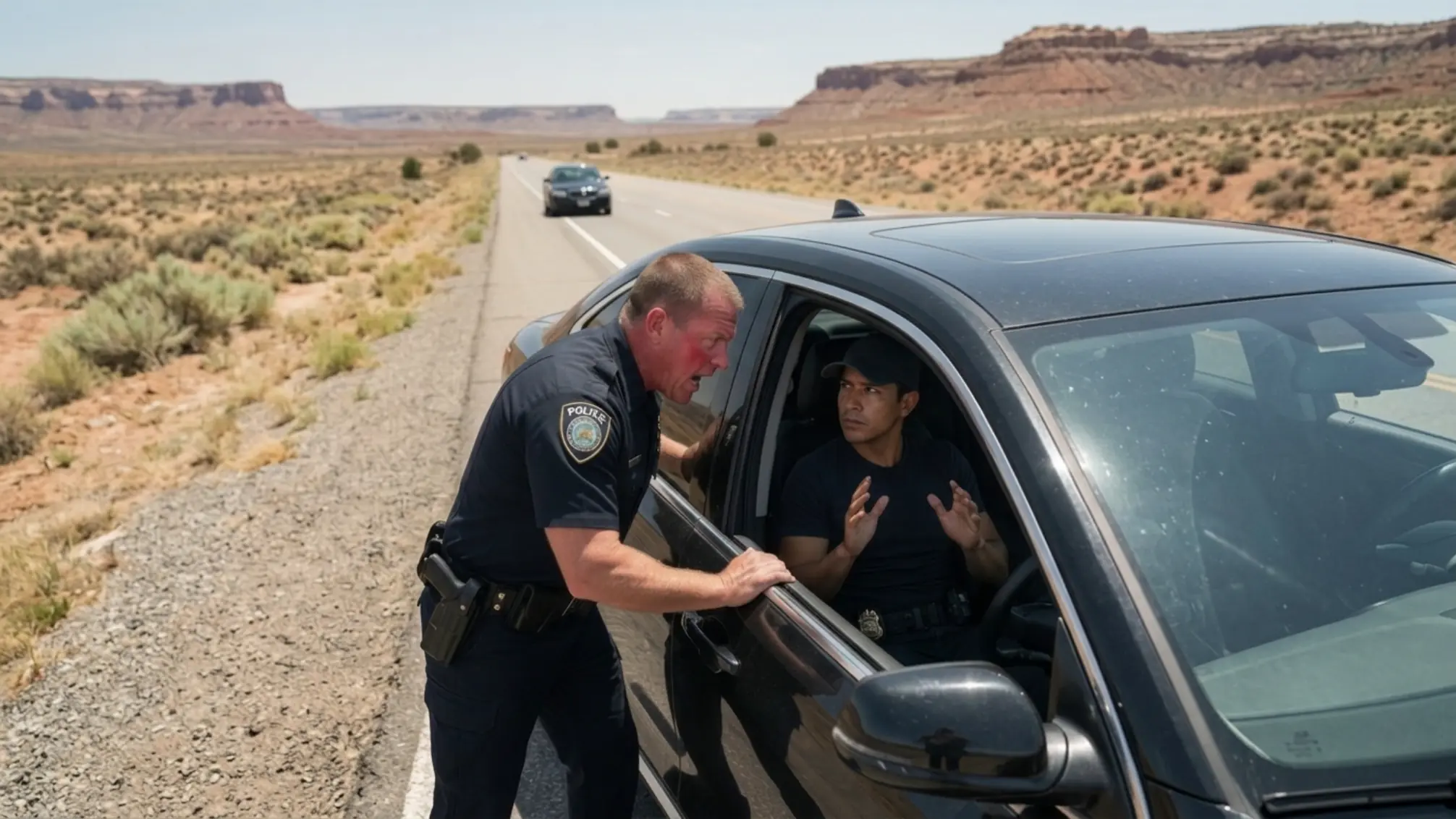
Inside the SUV sat a handsome forty-two-year-old American Undercover FBI Agent with tanned skin, sharp brown eyes, short black hair beneath a dark baseball cap, and a strong athletic build. He wore a fitted black T-shirt and dark pants, appearing more like an ordinary traveler than a federal investigator. Both of his hands remained visible, one holding the badge and the other resting near the steering wheel. A hidden recording device beneath his shirt transmitted every word to a surveillance team parked several miles away.
The aggressive forty-five-year-old white American Police Officer had closely cropped light-brown hair, flushed fair skin, and a thick muscular frame filling his dark patrol uniform. He wore a black duty belt, heavy boots, and a black wristwatch, but held no weapon in his hands. His body camera pointed toward the ground, deliberately angled away from the driver’s window. The Agent had noticed that detail before the officer said his first word.
The stop had not happened by accident. For almost six months, federal investigators had been studying complaints from motorists traveling through the remote county highway. Drivers described being pulled over for vague violations, ordered from their vehicles, and threatened with arrest unless they agreed to pay immediate “administrative fees.” Those who refused often watched private tow trucks remove their vehicles before any citation was written.
The Police Officer appeared in more complaints than anyone else. His reports repeatedly claimed motorists were weaving, speeding, or behaving suspiciously, yet traffic-camera footage rarely supported the allegations. Several drivers had been forced to remain on the roadside for hours while their vehicles were taken to an isolated towing yard. To recover them, families paid thousands of dollars in storage, inspection, and release fees.
The FBI became involved after a military widow lost the SUV her late husband had purchased shortly before his death. She had been driving home from a medical appointment when the Police Officer stopped her for allegedly crossing the center line. He claimed the vehicle’s registration looked fraudulent, called a private towing company, and refused to let her retrieve medication from the back seat. By the time the state confirmed that every document was valid, the towing company demanded more than seven thousand dollars.
She could not pay.
The SUV was sold at auction thirty-one days later.
The widow filed complaints with the department, county government, and state transportation office. Each complaint returned to the Police Officer’s supervisor, who declared the seizure lawful and closed the matter without interviewing witnesses. The towing company later sold the SUV to a dealership controlled by the supervisor’s brother.
That connection changed the case.
Federal analysts reviewed hundreds of traffic stops and discovered that the officer’s preferred targets shared several characteristics. Many were driving expensive vehicles through the county but lived elsewhere, making it difficult to return for hearings. Others were elderly, recently widowed, traveling alone, or unfamiliar with local procedures. The officer selected people least likely to fight quickly.
The towing company appeared at most disputed stops within minutes, sometimes arriving before the officer officially requested assistance. Phone records showed calls between the Police Officer and the Tow Operator before several motorists were detained. Financial records revealed monthly deposits from the towing business into an account controlled by the officer’s former wife. The deposits were disguised as payments for equipment rental, although she owned no equipment company.
Investigators needed direct evidence showing that the officer initiated stops without legal cause and coordinated vehicle seizures for profit. They could not simply arrest him based on patterns, because his attorney would claim every decision involved independent judgment during dangerous roadside encounters. The federal team designed an operation around a vehicle valuable enough to attract him and a driver calm enough to preserve evidence under pressure.
The black SUV was registered to a federal cover company. Its windows, mirrors, dashboard, and interior panels contained multiple cameras, while a secure compartment beneath the rear floor held marked cash and tracking devices. The Agent’s route had been planned to pass through the officer’s usual patrol area during the final hour of his shift. Another agent drove behind him at a distance, recording his lane position continuously.
For twenty-eight miles, the Agent obeyed every traffic law. He remained inside his lane, used turn signals, maintained a legal speed, and kept both hands on the wheel whenever another vehicle approached. The Police Officer began following him near a deserted gas station. Dash cameras recorded the patrol car accelerating, closing the distance, and remaining only a few feet behind the SUV.
The Agent did not react.
The officer followed for almost six minutes before activating his emergency lights. The federal surveillance driver confirmed that the SUV had never crossed a lane marker. The Agent slowed carefully, moved onto the wide shoulder, lowered the driver’s window, and waited. He expected the officer to request documents and search for a reason to escalate.
Instead, the officer marched directly to the window and shouted.
“You’re weaving lanes—step out NOW!”
The Agent calmly asked him to identify the violation. The officer offered no location, speed, or observed movement, only repeated that he had seen reckless driving. When the Agent requested a supervisor, the officer reached toward the door and said no supervisor would arrive until the driver obeyed.
The Agent noticed the body camera facing downward.
“Is your camera recording?” he asked.
The officer leaned closer. “You don’t ask questions during my stop.”
“I’m asking whether the camera is recording.”
“You’re starting to sound impaired.”
“I haven’t consumed alcohol.”
“Then you won’t mind taking a roadside test.”
The officer had already shifted from weaving to possible impairment without observing any supporting evidence. His radio remained silent because he had not informed dispatch of the license plate, location, or reason for the stop. The Agent knew the omission mattered. An undocumented stop gave the officer freedom to decide later whether it had officially happened.
The Agent provided his driver’s license and vehicle registration. Both were valid under the cover identity, and neither revealed his federal role. The officer glanced at the documents for less than three seconds before claiming the company registration appeared suspicious. He demanded permission to search the SUV.
The Agent refused.
That refusal triggered the confrontation.
The officer struck the door with his palm and ordered him out. When the Agent asked whether he was under arrest, the officer said he did not need to explain himself. He grabbed the handle, pulled twice against the locked door, and threatened to smash the window if the driver did not unlock it.
The Agent remained seated.
The officer’s voice became louder as several passing motorists slowed. He told the Agent that an expensive SUV and confident attitude did not place him above local authority. Then he accused him of transporting illegal money, although nothing visible inside the vehicle supported the claim. That accusation matched language used in three earlier complaints.
The Agent waited until the officer reached through the open window and touched his shoulder.
Then he raised the gold badge.
For several seconds, the officer appeared unable to process what he saw. He looked from the badge to the Agent’s face and back again, searching for signs that it was fake. His grip loosened, but he did not step away from the vehicle.
“You’re FBI?” he finally asked.
The Agent’s voice remained cold. “Remove your hand.”
The officer withdrew it.
Then his fear turned into anger.
“Federal agents still follow traffic laws.”
“They do.”
“You were weaving.”
“No, I wasn’t.”
“I have dash-camera footage.”
“So do we.”
The word we changed everything.
The officer looked toward the highway, scanning distant vehicles and low desert hills. He could not identify the surveillance units because they had stopped beyond the next rise. He reached for his radio, but the Agent warned him not to contact anyone until instructed.
“You don’t command me on my highway,” the officer said.
“This is not your highway.”
The officer stepped backward and attempted to activate his body camera properly. The Agent pointed toward it and told him the device had already recorded audio from its downward position. Federal technicians had also intercepted the camera’s activation signal through a warrant covering department equipment. Correcting the angle now would only document that he knew it had been misplaced.
The officer’s expression hardened.
“You set me up.”
“I drove legally through your patrol zone.”
“You knew I’d stop you.”
“We believed you might.”
“That’s entrapment.”
“No one forced you to invent a violation or grab my door.”
Two dark vehicles appeared from beyond the rise and approached along the shoulder. A marked state investigative unit followed them. Doors opened as federal agents and state officers stepped out wearing visible credentials. The Police Officer looked toward his patrol car, calculating whether he could leave before they reached him.
The Undercover FBI Agent opened the SUV door slowly and stepped outside.
“Don’t run,” he said.
“I’m not running.”
“Then keep your hands visible.”
The officer laughed bitterly. “Now you’re treating me like a criminal.”
“You treated me like one before asking my name.”
The federal team leader approached and instructed the Police Officer to move away from the patrol vehicle. He complied reluctantly, then demanded to call his supervisor. The team leader informed him that the supervisor was currently being interviewed by another federal team.
The officer stopped arguing.
At that exact moment, three search warrants were being executed. Federal agents entered the sheriff’s substation where traffic-stop reports and body-camera records were stored. State investigators searched the towing yard, while a financial-crimes team entered the supervisor’s home and seized computers, phones, and banking records. The operation had been timed to begin only after the undercover stop established fresh evidence.
The Tow Operator was found inside his office shredding vehicle-release forms.
Investigators stopped the machine and recovered partially destroyed documents from the bin. Several forms carried signatures from motorists who insisted they had never signed anything. Others listed vehicles as abandoned even though their owners had filed written demands for release.
Behind the towing office stood a locked warehouse absent from county licensing records. Inside were motorcycles, luxury SUVs, work trucks, construction equipment, and personal belongings removed from seized vehicles. Some license plates had been replaced, while vehicle identification numbers were partially covered by aftermarket parts.
The military widow’s SUV sat near the back.
It had not been sold through a legitimate auction after all. The Tow Operator had falsified the sale record and hidden the vehicle while waiting to transfer it out of state. Her husband’s military identification card remained inside the center console beside the medication she had asked to retrieve.
At the substation, federal agents uncovered a cabinet filled with handwritten traffic-stop logs. The Police Officer kept the unofficial records separate from department systems, noting vehicle value, driver vulnerability, and estimated towing profit. Beside some names, he had written descriptions such as alone, out of state, elderly, or won’t fight.
The Agent read the photographs of those pages from the roadside.
The officer stood several feet away while a state investigator removed his badge and duty belt as evidence. He had not yet been formally arrested, but the confidence in his posture had disappeared. Dust gathered around his boots as traffic continued passing, indifferent to the collapse of the authority he had abused.
“You found a list,” the officer said quietly.
The Agent looked at him. “Your list.”
“It doesn’t prove anything.”
“It proves you classified drivers by how easily they could be exploited.”
“I kept notes for officer safety.”
“Was the widow dangerous?”
The officer said nothing.
The federal team searched the patrol car under the warrant. They found blank vehicle-seizure forms already signed by the supervisor, a second mobile phone, and several envelopes of cash hidden beneath emergency equipment. One envelope contained a towing-yard receipt from that morning, although no related seizure had been entered into the department database.
The officer claimed the money came from personal savings.
A forensic examiner tested the bills.
Several carried serial numbers connected to a previous undercover operation conducted by state investigators. Months earlier, an investigator posing as a traveling contractor paid an illegal roadside “release fee” after being threatened with arrest. The marked bills had now been found inside the officer’s patrol vehicle.
The team leader placed the officer under arrest.
When the handcuffs closed, he shouted that every local officer used discretion and that outsiders could not understand the dangers of highway policing. He accused the FBI of humiliating him in front of motorists. The Undercover Agent reminded him that humiliation had been one of his preferred tools.
“You wanted me scared enough to surrender the SUV,” the Agent said.
“I was enforcing the law.”
“You never called dispatch.”
The officer looked toward his patrol car.
“You never checked the registration properly,” the Agent continued. “You never documented the stop, and your tow partner was already driving this way before you pulled me over.”
The team had tracked the tow truck through a warrant on its dispatch system. It had left the yard nine minutes before the traffic stop began. The Police Officer had sent the Tow Operator a message after first seeing the black SUV near the gas station: Possible premium pickup. Start moving.
The officer’s attorney later tried to explain that phrase as a request for emergency support.
The towing truck contained no emergency equipment.
It contained vehicle-entry tools, ownership-transfer forms, and a portable card reader used to collect roadside payments.
The supervisor was arrested that evening after financial investigators traced towing revenue into several personal accounts. He had received a fixed percentage from every contested seizure and approved false reports whenever motorists complained. In exchange, he ensured that honest officers were assigned away from the highway corridor.
One young Deputy had questioned why the same towing company received nearly every call. The supervisor transferred her to courthouse duty and wrote a negative performance review claiming she lacked roadside confidence. During the federal investigation, she provided messages showing the supervisor instructing officers never to request competing towing companies.
Her evidence helped reveal the structure of the scheme.
The Police Officer identified vehicles and created reasons for stops. The Tow Operator removed them and inflated release fees. The supervisor protected reports, rejected complaints, and directed profitable vehicles toward private buyers. A county clerk altered auction notices so owners received them after deadlines had passed.
The operation had continued for almost seven years.
More than one hundred forty vehicle seizures required review.
Some had been lawful responses to crashes, arrests, or abandoned vehicles, but dozens showed the same warning signs. No dispatch call, missing camera footage, vague lane violations, immediate towing requests, and release fees exceeding the value of ordinary citations. The FBI contacted each driver individually.
Many had stopped believing anyone would listen.
A retired teacher described being left beside the highway while officers towed the minivan containing her late daughter’s belongings. A construction worker lost his truck and every tool inside it after refusing to pay two thousand dollars in cash. A college student accepted a false reckless-driving plea because the towing fees increased every day her car remained impounded.
The military widow cried when agents returned her SUV.
She walked around it slowly, touching the hood and passenger door as though confirming it was real. The Agent handed her the small box of personal items recovered from the warehouse. Inside was her husband’s identification card, a photograph from his final deployment, and a handwritten note he had once left in the glove compartment.
She held the note against her chest.
The vehicle mattered, but the recovered memories mattered more.
Federal prosecutors charged the Police Officer, supervisor, Tow Operator, and county clerk with conspiracy, extortion, wire fraud, theft, falsifying records, obstruction, and civil-rights violations. Additional state charges involved fraudulent vehicle transfers and illegal towing practices. The former wife whose account received payments also faced charges after investigators proved she had created false invoices.
The Police Officer refused to cooperate.
He insisted every stop involved legitimate suspicion and that motorists had exaggerated because they disliked paying lawful fees. His attorney argued the undercover operation had manipulated an experienced officer into reacting firmly to a difficult driver. Prosecutors played the complete roadside recording.
The jury heard the Agent ask calmly what law he had broken.
They heard the officer answer, “I don’t need a reason.”
Those six words destroyed the defense more effectively than hours of financial testimony. They revealed a man who believed authority itself replaced legal justification. His attempt to grab the door, threats to drag the Agent out, and false claim of lane weaving appeared clearly across multiple camera angles.
The defense questioned why the Agent had not immediately identified himself as FBI.
The Agent explained that ordinary drivers did not carry federal badges and still deserved lawful treatment. Revealing his identity at the beginning would have prevented the jury from seeing how the officer acted toward people he believed had no protection.
The marked cash, secret logs, vehicle records, and towing messages confirmed the larger conspiracy. The Police Officer was convicted on nearly every charge. The supervisor and Tow Operator received even longer sentences because they had managed the financial operation and continued destroying evidence after learning about the federal investigation.
Restitution came from seized property, frozen accounts, insurance claims, and a court-approved county compensation fund. Some families recovered vehicles, while others received payment for losses that could not be reversed. False traffic convictions were reopened, and driver records were corrected where evidence showed fabricated violations.
The young Deputy who had questioned the towing pattern was returned to patrol with her record cleared. She later helped design a system requiring rotating towing assignments, automatic dispatch records, and supervisor approval from a separate division before a vehicle could be held for administrative reasons. Body-camera angle and activation data were also reviewed automatically after every roadside seizure.
No policy could guarantee that authority would never be abused again.
But silence was no longer built into the process.
Months after the trial, the Undercover FBI Agent returned to the desert highway in an ordinary sedan. The shoulder looked unchanged beneath the wide sky, and vehicles passed the location without knowing a federal operation had begun there. He parked near the same gas station where the Police Officer first noticed the black SUV.
A marked patrol vehicle pulled in behind him.
For a moment, the memory of the officer pounding the door returned. Then the young Deputy stepped out, approached calmly, and explained that one of his rear lights appeared loose. She asked whether he wanted assistance securing it before continuing.
The Agent thanked her.
She did not know who he was.
That was what made the interaction matter.
Later, he attended a community hearing where victims described the cost of the scheme. Many spoke about money, vehicles, or lost employment, but nearly all mentioned the same emotional wound. The officers had made them feel powerless on a public road, then used that fear to take something from them.
The military widow spoke last.
She said the worst moment was not watching the tow truck leave with her SUV. It was hearing the Police Officer laugh when she asked for her husband’s identification card. That laughter convinced her he did not see her as a citizen with rights, only as someone too weak to stop him.
The Agent looked toward the front row where department leaders, prosecutors, and county officials listened.
“That is where corruption begins,” he said when invited to speak. “Not when money changes hands, but when someone with authority decides another person’s dignity no longer matters.”
The gold FBI badge became the detail newspapers remembered. Headlines described how a power-tripping officer reached for an SUV door and discovered the driver was a federal agent. The moment was satisfying, but the Agent repeatedly corrected the story.
The badge had not created the case.
The widow’s complaint created it.
So did the worker who saved his towing receipt, the student who photographed the officer’s patrol car, the young Deputy who preserved messages, and every motorist who reported abuse after being told nothing would change.
The Agent had simply been the final driver.
The Police Officer saw a black luxury SUV, an unfamiliar face, and a remote stretch of highway where no witnesses seemed close enough to interfere. He believed the vehicle could become another profitable seizure and the driver another frightened stranger. He invented a lane violation, angled his camera toward the ground, and reached for the door.
This time, the man behind the wheel did not panic.
He asked for the law.
The officer answered with force.
Then the gold badge came out, federal vehicles appeared over the hill, and the highway empire he considered untouchable collapsed beside the very SUV he intended to steal.