There is a particular kind of loneliness that belongs exclusively to men who have everything.
Not the loneliness of empty rooms or absent company.
Arthur Blackstone had staff enough to fill every corridor of Blackstone Hall, and invitations enough to occupy every evening of the social calendar until he died.
His loneliness was of a different and more specific variety.
The loneliness of a man who has spent forty years accumulating things that other people wanted, and who has arrived somewhere in the middle of a Tuesday morning at the quiet and devastating understanding that he does not want any of them.
He was thirty-eight years old.
He was the fifth Duke of Blackstone.
He held twelve thousand acres in Derbyshire, a townhouse in Mayfair, a hunting lodge in Scotland, and a seat in the House of Lords that he occupied with diminishing enthusiasm and increasing frequency of abstention.
He had been told consistently and from an early age that these things constituted a life worth living.
He had believed this for most of his adult years, with a conviction that required less and less effort to maintain as time passed, which should have told him something, but did not.
Not immediately.
What finally told him was a Wednesday in late October, when he rode alone across the eastern edge of his Derbyshire estate at dawn.
He stopped his horse at the top of a hill and looked down at three hundred acres of unused land lying in the morning mist.
Land that had not been farmed in eleven years, since the last tenant family had left for the factories in Manchester and no suitable replacement had been found.
Land that produced nothing.
No income.
No food.
No purpose.
But he had continued to hold it because releasing it would have felt, in some way he could not quite articulate, like losing something.
He sat on the hill for forty-five minutes and thought.
Then he turned the horse and rode back to the hall.
He wrote a letter to his solicitor.
The letter was four sentences long.
It said, in essence:
"I intend to donate the eastern parcel to the county for educational purposes."
"I want a school built."
"I want it built properly."
"Tell me what needs to happen, and I will make it happen."
His solicitor, a measured man of thirty years' professional practice, who had seen most things and was surprised by very few, read the letter twice.
Then he wrote back a single line.
"Your Grace, may I ask what has brought this about?"
Arthur's response was equally brief.
"Nothing in particular. Everything in general. Please proceed."
Part One: The Donation
The announcement reached London three weeks later, and society's response was immediate and entirely predictable.
At his club, Arthur was treated to a succession of conversations that followed a remarkably consistent pattern.
An initial expression of admiration.
A carefully worded inquiry as to whether he was quite well.
Then, if he did not provide sufficient reassurance, a more direct suggestion that perhaps he had been working too hard and ought to consider a period of rest in the country.
The possibility that he had simply decided to do something useful with land that was already doing nothing was not apparently a satisfying explanation.
People preferred to attribute unusual generosity to illness, grief, or romantic disappointment, because these were comprehensible.
Deliberate choice was harder to process.
His mother, Lady Margaret Blackstone, received the news at her house in Bath and sent a letter that required two full pages to express, in the most loving possible terms, that she considered the decision entirely uncharacteristic.
She was concerned that her son had perhaps been unduly influenced by some reformist acquaintance of dubious intellectual credentials.
She concluded by noting that land once given could not be ungiven, and that she hoped he had considered this carefully.
He wrote back:
"Dear Mother, I have considered it carefully."
"I hope you are well."
"The roses in the park should be finishing by now."
"Your affectionate son, Arthur."
His cousin Edmund, who stood to inherit the dukedom in the absence of Arthur's own children, had always regarded Arthur's land holdings with the focused appreciation of a man doing long-term calculations.
He paid a visit in person.
He arrived on a Thursday, accepted a glass of brandy, expressed his personal admiration for Arthur's philanthropy, and then spent forty minutes explaining, with the patience of someone who believes they are speaking to a child, the various ways in which the donation could be restructured.
The land, Edmund suggested, could remain technically within the estate while still permitting construction of the school, thereby preserving the asset while achieving the charitable aim.
Arthur listened to all of this with the courtesy he had been trained from birth to extend to everyone, regardless of what they were saying.
Then he said:
"Thank you, Edmund. I appreciate the thought."
"The donation proceeds as planned."
Edmund left looking the way men look when they have encountered something they cannot argue with and have not yet decided what to do about it.
What none of them understood, what Arthur found himself unable to explain in a way that satisfied people who were listening for a rational accounting of material benefit, was that the decision had not been made for any reason that could be expressed in pounds and acres.
It had been made because he had sat on a hill on a Wednesday morning and understood, in the way that certain understandings arrive, suddenly and completely, and without the courtesy of a preparatory period, that his life had become a series of activities performed for the preservation of things he did not need.
Something had to change.
And the three hundred acres lying in the morning mist were the most immediate and most concrete opportunity to change it.
He was not, he wanted to make clear to anyone who asked, undergoing a religious conversion.
He was not experiencing a moral crisis.
He was not attempting to purchase redemption for sins he had not committed.
He was simply a man who had looked at something he owned and understood that he was not, in any meaningful sense, using it.
Somewhere in the county, there were children who had no access to any education at all.
These two facts, placed beside each other, suggested an obvious course of action.
The school, he told his solicitor, was to be built to last.
Stone, not timber.
A proper library.
Science equipment.
A building that communicated through its materials and its proportions that the education happening within it was a serious matter deserving of serious investment.
"It will be expensive," his solicitor said.
"Good," Arthur said.
"Expensive things tend to last."
He also specified, and this more than the donation itself seemed to trouble the people around him, that he did not want his name on the building.
No Blackstone School.
A name that belonged to the place itself, to the county, to the community it was meant to serve.
"People will find that eccentric," his solicitor said.
"People will survive the eccentricity," Arthur said.
The school was named the Thornfield County School, for the village nearest the land.
Construction began in the spring.
Part Two: What Grows in Donated Ground
Arthur did not visit the construction site during the building phase.
He had made his decision, provided his resources, and considered that sufficient involvement for the time being.
He had, in any case, other things to attend to.
The House of Lords.
The management of the remaining estate.
The social calendar that continued to generate obligations with the reliable productivity of an agricultural concern.
But he followed the progress through the reports his solicitor forwarded from the construction overseer.
He found, somewhat to his surprise, since he had not expected to care about the details, that he read these reports with more attention than he gave to most documents that crossed his desk.
He noted the completion of the foundation with something that might, in a less rigorously unsentimental man, have been called satisfaction.
He noted the raising of the roof with something closer to actual pleasure.
When the report arrived stating that the library shelving had been installed and that the first shipment of books had been delivered from London, he read it twice.
The question of staffing he had left largely to the county education committee, a body of local worthies who had received his donation with gratifying enthusiasm and had established a small committee to oversee the school's establishment.
He had specified only that he wanted qualified teachers who actually cared about their work, rather than people who had taken up teaching as a last resort after more preferred options had failed to materialize.
"How do we assess that?" asked the chairman of the committee, a well-meaning solicitor from Derby, who had the look of a man who had not expected philanthropy to be this complicated.
"Ask them why they want the position," Arthur said.
"The answer will tell you everything."
He did not attend the interviews.
He did not attend the initial appointment of staff.
When the committee wrote to inform him that they had appointed a headteacher, a Miss Jennifer Rosewood, recently of a school in York, where she had taught for four years and had, by all accounts, distinguished herself considerably, he read the letter, noted the name, and set it aside.
He had other things to attend to.
The school opened on a morning in September, eleven months after he had written his four-sentence letter to his solicitor, with forty-three children enrolled from across the village and the surrounding farms.
The committee wrote to tell him so.
He wrote back to congratulate them.
He did not visit.
Not until March.
The visit was not, strictly speaking, planned.
He had ridden out to the eastern part of the estate, the remaining sections which were still his, on a clear morning in mid-March.
He found himself, without quite deciding to, approaching the school building from the hill above it.
He pulled his horse to a stop and looked at it.
It was a good building.
Better than good.
It was exactly what he had asked for.
Solid stone, well proportioned, with windows large enough to let in adequate light, and a roofline that said permanence without saying pretension.
The grounds around it had been planted with young trees that would, in twenty years, make the approach to the building beautiful.
Someone had thought about the twenty years.
He found this pleasing.
He rode down.
He had not sent word ahead, which he acknowledged as he dismounted in the yard was not entirely considerate.
The school was in session.
He could hear it.
Not the silence of enforced quiet or the murmur of rote recitation, but actual noise.
The particular productive noise of people engaged in something that interested them.
Questions being asked and answered.
The occasional burst of genuine laughter from one of the classrooms.
The sound of chalk on a board.
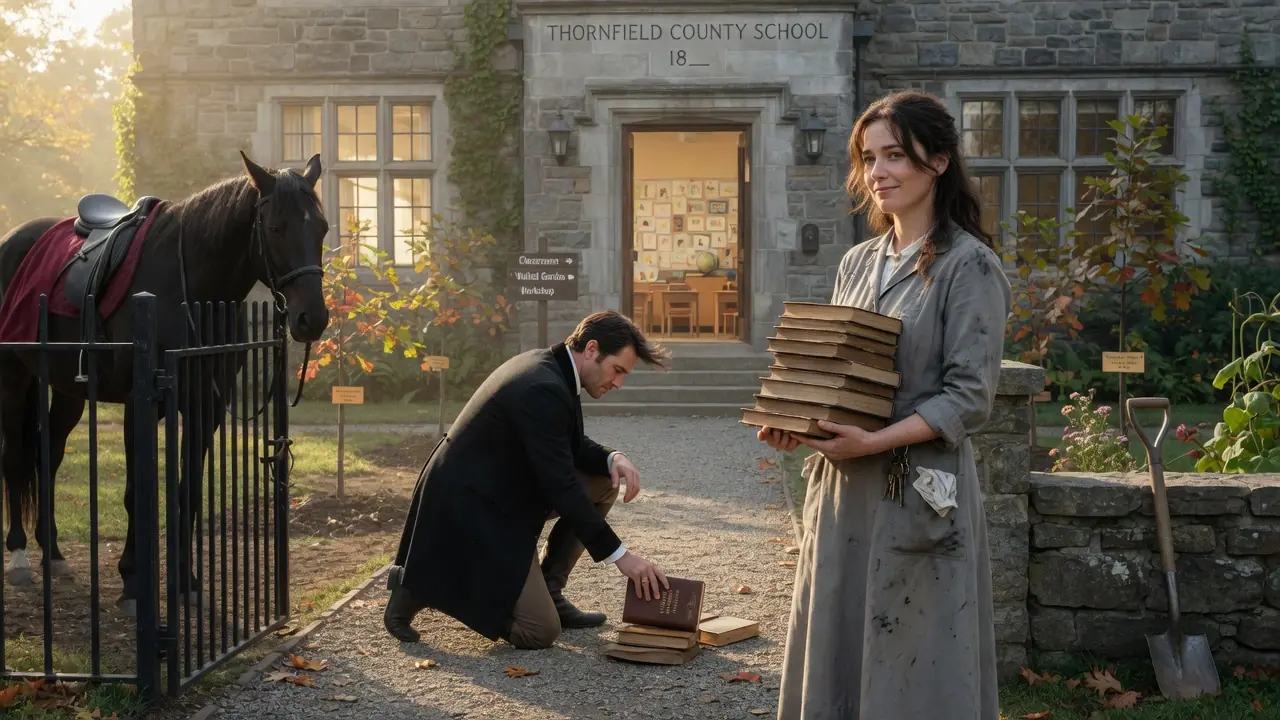
He was tying his horse to the post by the gate when the school's front door opened and a young woman came out carrying a stack of books so tall that she was navigating primarily by the memory of where the steps were rather than by actual sight.
She did not see him.
The top three books declared their independence from the stack approximately four feet from the bottom of the steps, achieving a brief and enthusiastic freedom before landing on the path with a sound that caused a small starling nearby to evacuate its position with considerable alarm.
The young woman stopped.
She looked at the books on the path.
Then she looked up at the sky with the expression of someone appealing to a higher authority who had consistently failed to deliver.
Then she noticed Arthur.
She was, he assessed this with the automatic value-neutral attention he gave to everything he encountered, perhaps twenty-six or twenty-seven years old.
She had dark hair that had made a partial escape from its pins during whatever energetic activity had preceded the book-carrying, and eyes of a brown so warm they were almost amber.
She was wearing a plain gray working dress with ink on the left cuff.
She was looking at him with an expression that managed to convey, simultaneously, recognition that he was not someone she had been expecting, assessment of who he probably was, and a complete absence of the social anxiety that his arrival unannounced at someone's place of work might reasonably have produced.
"Your Grace," she said, with a composure that suggested the books on the path were, from a priority standpoint, currently occupying a higher position in her attention than his arrival.
"I apologize for not greeting you properly. I appear to have..."
She gestured at the books.
"Allow me," Arthur said.
He crouched and gathered the fallen books before she could redirect her attention to them.
He stood and held them out to her.
She took them, added them to the stack with the practiced efficiency of someone who had been carrying too many books for long enough to have developed a system, and then looked at him with the full attention she had previously been distributing between him and the literary disaster on the path.
"We were not expecting you," she said.
It was not a criticism.
Simply a statement of fact.
"I was in the area," he said.
It was true, and both of them understood it to be a partial explanation at best.
"Would you like to see the school?" she asked.
"I am Jenny Rosewood. I run it."
"I know," he said.
"I read your appointment letter."
She looked at him for a moment with an expression that he found, for reasons he did not immediately analyze, interesting.
Not the deference he was accustomed to.
Not the performance of enthusiasm.
Not the careful social calibration of someone managing their response to a powerful person.
Simply a direct and frank assessment.
The look of someone deciding whether the person in front of them was worth the time that showing them around would require.
"Come in, then," she said.
Part Three: The School in March
She showed him everything.
She showed it to him honestly, without the promotional enthusiasm of someone presenting their work to a benefactor whose continued support they required, but with the direct pride of someone who had built something good and was comfortable saying so.
The first classroom held the youngest students, children between five and eight, twenty of them, presently engaged in a lesson about numbers that their teacher was conducting with the assistance of small smooth stones arranged in patterns on the desks.
The children looked up when Arthur appeared in the doorway, assessed him with the frank curiosity of the very young, and returned to their stones.
He found this refreshing.
"The younger ones are taught by Mrs. Alden," Jenny said.
"She was a governess for fifteen years before she came here. She is quite possibly the most gifted teacher I have ever observed."
"She has a particular ability to make abstract things concrete."
She paused.
"I learn from her regularly."
This, Arthur noted, was not the kind of thing that institutional heads typically said about their staff.
He filed it.
The second classroom held the older students, twelve to fifteen years old, a mixed group that was engaged, when they entered, in what appeared to be a vigorous debate about the causes of the English Civil War.
A boy of about thirteen was on his feet, making a point with an energy that suggested genuine conviction rather than performed participation.
His classmates were listening with the focused attention of people who intended to respond.
Their teacher, a young man of perhaps twenty-five, was standing to the side watching with the expression of someone who had set something in motion and was monitoring its direction without interrupting its momentum.
"Mr. Davies," Jenny said quietly to Arthur by way of explanation.
"He believes that students learn more from arguing with each other than from listening to him."
"The results have been consistently interesting and consistently loud," Arthur observed.
"That is how you know it is working," she said.
He smiled.
He was not entirely sure afterward when, exactly, during these words, the smile had arrived, but it had been unplanned.
The library was the room that stopped him.
He stood in the doorway and looked at it.
The shelves ran floor to ceiling on three walls.
A long oak table stood down the center.
The afternoon light fell through the tall windows onto the spines of the books.
He felt something that took him a moment to identify, because it had been some time since he had felt it.
The particular satisfaction of having done something that was exactly what it needed to be.
"You specified the library," Jenny said.
She was watching him, he realized, with the same attention she had given him in the yard.
Assessing.
Direct.
Neither deferential nor defensive.
"I did."
"Why?"
"Most donors specify the facade, the entrance, the things people see first."
"The library is the point," he said.
"The rest is just a building around it."
She was quiet for a moment.
"That is precisely what I told the committee when they wanted to reduce the library budget to extend the yard."
He looked at her.
"What happened?"
"I told them that a larger yard was a good idea, and that I would pursue it once the library was complete and properly stocked."
She paused.
"The yard is being extended in May."
"You won," he said.
"I made the better argument," she said.
It was not quite the same thing, and she apparently considered the distinction relevant.
They walked the grounds after the rooms.
The walled garden, she explained, was used for natural science instruction in the warmer months.
The small outbuilding served as a workshop for older students learning practical skills.
The young trees along the path were planted with the twenty-year future in mind.
"Who planted the trees?" he asked.
"I did," she said.
"With the students. We planted them in October on the last day before the first frost. Each child chose the position of one tree."
She gestured at a young oak set slightly off the line of the others, positioned with the particular autonomy of a child's choice.
"That one is Thomas Whitfield's. He wanted it where he could see it from his classroom window."
Arthur looked at the tree and then at the window she indicated.
The tree was, in fact, positioned precisely in the window's sightline.
"And does he look at it?" he asked.
"Every morning," she said.
"He told me it helps him remember that things grow slowly, and that slow growth is still growth."
Arthur was quiet for a moment.
"How old is Thomas Whitfield?"
"Nine," she said.
He looked at the tree again.
Then at Jenny.
She was watching the tree too, with the expression of someone for whom this, a nine-year-old boy's daily relationship with a young oak he had planted himself, was among the most significant things she had encountered in her working life.
And she was not embarrassed by that.
"I would like to come back," Arthur said.
"If that would be acceptable."
She turned to look at him.
"The school is open to visitors," she said.
"Particularly those who have reason to be interested in its progress."
"I meant more regularly than a single visit," he said.
"I meant I would like to see how it develops, how the students develop."
"I understand that may seem unusual."
"Yes," she supplied, without making it sound like a problem.
"Most donors prefer to be informed by letter."
She considered him for a moment with that frank, assessing look.
"You may come whenever you like. I would ask only that you come as a visitor who is genuinely interested in the school, rather than as a patron conducting an inspection."
"What is the difference?" he asked.
"Inspectors ask questions to confirm what they already believe," she said.
"Visitors ask questions because they do not know the answers yet."
He looked at her.
"I will come as a visitor," he said.
Part Four: Regular Visits
He came back the following Thursday, and the Thursday after that.
By the fifth visit, his arrival in the schoolyard had stopped producing the slight adjustment in behavior that institutional visits typically generate.
That subtle stiffening of posture.
That incremental performance of excellence.
It had begun to produce instead a simple acknowledgment of his presence as part of the school's ordinary pattern.
Mrs. Alden nodded at him when he appeared in her doorway.
Mr. Davies occasionally pulled him into whatever debate was currently occupying the older students, apparently having decided that a duke's perspective on the English Civil War or the ethics of enclosure was a useful addition to the available range of opinion.
Thomas Whitfield had appointed himself, without any formal discussion, as the person responsible for showing Arthur his oak tree each visit and reporting on its status.
The reports were brief and factual.
The tree was growing.
It had acquired two new branches since last time.
A bird had investigated it and departed without committing to anything.
These reports were delivered with the seriousness of significant updates, and Arthur received them with corresponding gravity.
He and Jenny talked.
They talked in the way that people talk when they have discovered, with some surprise, that the other person's mind is one they want to spend time in.
Not the polite conversational exchange of social necessity, but the kind of exchange that continues in one's own thoughts after the conversation has ended.
The kind that generates questions to bring to the next encounter.
The kind that makes the time between visits feel like an interruption.
She told him about her childhood in a small village in Somerset, the daughter of a schoolmaster who had believed, with a conviction he had passed on entirely intact, that education was not a privilege or an enhancement, but a fundamental human necessity.
As essential as food.
As transformative as anything the world had to offer.
She had grown up in a schoolroom.
She had learned to read before she could reliably remember learning.
She had understood from an early age that the difference between a child who had access to books and a child who did not was a difference that ramified outward through entire lives.
It shaped what was possible and what was not.
It determined, in ways that were not inevitable but required deliberate effort to prevent, who flourished and who did not.
She had gone to York because York had a school that was doing interesting work.
It was trying, under the direction of a reforming headteacher, to provide education that engaged the whole student rather than simply filling the available container with the approved curriculum.
She had learned there.
She had also pushed back against it.
She had disagreed with the headteacher on three specific methodological points, had been told she was wrong on one of them, and had subsequently concluded that she had been right on the other two.
"Which one were you wrong about?" Arthur asked.
She considered this with the evident seriousness of someone who does not retreat from the question of their own mistakes.
"I believed that competition between students was a useful motivating force," she said.
"I thought that if students could see their position relative to each other, it would drive improvement."
"What I observed over two years of watching it operate was that it improved the performance of students who were already performing well and reduced the engagement of students who were already struggling, precisely the students for whom improvement mattered most."
She paused.
"The headteacher was right. I was wrong. I changed my approach."
"And the two you were right about?"
"Rote recitation as the primary mode of assessment," she said.
"And the exclusion of girls from the science curriculum on the grounds that it would not be relevant to their future lives."
The particular quality of her expression on the second point communicated, without elaborating, a comprehensive assessment of that argument's intellectual merits.
Arthur thought about this.
"When you say the headteacher was wrong about those two things," he said, "did you tell him so?"
"Repeatedly," she said.
"And with documentation."
"What happened?"
"He disagreed politely and continued as before."
She was quiet for a moment.
"Which is partly why I left York when the opportunity to come here arose."
"Here, I can make the decisions I believe are correct, and accept the consequences if I am wrong."
"And if you are right?"
"Then the students benefit," she said.
"Which is the point."
He told her in return things he had not expected to say.
About his father, who had been a man of considerable intelligence and minimal warmth.
A man who had transmitted the management of the Blackstone estate to Arthur with the thoroughness of a technical briefing and the emotional engagement of a property transfer.
He told her about the years of learning to be a duke in the way one learns a profession.
The land management.
The parliamentary business.
The social obligations.
And the gradual, quiet discovery that he had learned the role without ever quite deciding whether he wanted to play it.
He told her about the Wednesday morning on the hill.
The fallow land in the mist.
The forty-five minutes of thinking that had produced four sentences, and eventually everything that followed.
"Do you regret it?" she asked.
"The donation."
He looked at Thomas Whitfield's oak tree, visible through the library window, bending slightly in the March wind.
"No," he said.
"It is the least regrettable thing I have done in years."
"Why that piece of land?" she asked.
"You have twelve thousand acres. Why that three hundred?"
He thought about this honestly.
"Because it was doing nothing," he said.
"Because the argument for keeping it was entirely about what I might theoretically want in the future, and the argument for giving it away was about what forty-three children actually need right now."
He paused.
"The future argument is always available. The present argument has a deadline."
She looked at him with an expression that he had come to recognize as a response to something she found genuinely worth thinking about.
A slight stillness.
A quality of internal engagement.
"My father used to say something similar," she said.
"He said that the most dangerous sentence in the English language was, 'We could do that later.'"
"He sounds like a man worth knowing," Arthur said.
"He died four years ago," she said.
"I miss him every day."
She said it simply, without the apologetic hedging that people typically deploy around grief in social settings, and the simplicity of it hit Arthur with the particular force that undefended honesty sometimes carries.
"I am sorry," he said.
"Thank you," she said.
And meant it.
Part Five: What Society Made of It
By May, the regularity of Arthur's visits to the Thornfield School had become known in the circles where such things were tracked and discussed, which in Derbyshire's small world of county society was most of them.
The initial interpretation was charitable.
The Duke of Blackstone, it was agreed, was maintaining a conscientious oversight of his philanthropic investment, which was both responsible and appropriate.
This interpretation lasted approximately three weeks.
After that, it became clear that the duke was visiting far more frequently than philanthropic oversight could reasonably require, and that the headteacher of the school was a young, unmarried woman of no particular social standing.
The second interpretation was less charitable and considerably more specific.
Arthur was aware of what people were saying.
He had lived in county society long enough to understand its mechanisms, and he was under no illusion that his visits were unobserved or unanalyzed.
What he found, somewhat to his own surprise, was that this awareness produced in him something considerably less than the social concern it might reasonably have been expected to produce.
He was not, he told himself with the clarity of a man doing an honest accounting, doing anything improper.
He was visiting a school he had funded.
He was speaking with its headteacher about its progress.
He was observing its students.
That these activities had become the most genuinely engaging part of his week was a private matter.
That he had begun over the previous two months to spend the days between Thursday visits in a state of low-level impatience, which he recognized with the self-knowledge of a man who had not felt this particular thing in some years as anticipation, was also a private matter.
Jenny herself appeared entirely unconcerned by the social commentary.
When he raised the subject carefully, feeling his way toward it in a conversation about something else entirely, she looked at him with an expression that suggested she had been aware of the gossip for some time and had made her assessment of it.
"People will say what they say," she told him.
"I find that the most useful response is to continue doing the work correctly and let the results speak for themselves."
She paused.
"The school had forty-three students in September and has sixty-one in May."
"Sixty-one families have decided that what is happening here is worth sending their children to. I find that a more reliable measure of my conduct than county gossip."
"You are not concerned about your reputation?" he asked.
She considered this with the honest attention she gave to most questions.
"I am concerned about my character," she said.
"That, I can influence. Reputation is what other people decide to believe about you, and their decision is based on their own needs and assumptions as much as on your actual conduct."
"I have found it a poor investment of energy."
Arthur looked at her for a moment.
"That is either very wise or very naive," he said.
"I am reliably informed it is the former," she said with a dryness that was entirely new in their conversations, and that he found unexpectedly delightful.
He laughed fully, without the management that laughter in social settings typically required.
She looked at him with a slight expression of surprise, as if his laughter was something she had not anticipated, had not put into her calculations, and was now revising those calculations to accommodate.
His mother arrived from Bath at the end of May.
Lady Margaret Blackstone was a woman of sixty-two who had navigated four decades of aristocratic life with a combination of genuine intelligence and considerable social skill.
Over the course of those decades, she had developed a finely calibrated understanding of her son's various states of mind.
She had recognized from his letters that something was happening that she did not yet have sufficient information to assess.
So she had come to Blackstone Hall to assess it in person.
She did not raise the subject immediately.
She arrived, settled herself in the drawing room with the proprietary ease of someone who had spent many years of her own life in this house, and spent two days in conversation with Arthur about the estate, parliament, family news from various cousins, and the general state of the county.
She was patient and thorough.
Arthur, who knew exactly what she was doing, respected her methodology, even while finding it slightly exhausting.
On the third morning over breakfast, she set down her teacup and said:
"Tell me about the school."
He told her.
He told her about the library, about Mrs. Alden and Mr. Davies, about Thomas Whitfield and his oak tree.
He told her about the sixty-one students and the waiting list that Jenny had mentioned last Thursday.
He was aware, as he spoke, that he was talking about the school with an enthusiasm that would not have been there twelve months ago, and that this enthusiasm was not entirely about the school.
His mother listened with her full attention.
When he finished, she was quiet for a moment.
"This Miss Rosewood," she said.
"She is the headteacher."
"Yes."
"And she is how old?"
"Twenty-seven," he said.
"I believe."
Another pause.
"Arthur," his mother said with the particular combination of love and directness that had always characterized her communication with him.
"I am going to ask you something, and I would like you to answer it honestly."
"When have I not?" he said.
"When you were twenty-two and believed you were in love with the Earl of Westmere's daughter," she said.
"You were considerably less than honest on that occasion."
He acknowledged this with the slight tilt of his head that had served between them as an admission of fair point for thirty years.
"I am fond of her," he said.
"I think I am not certain what I am."
"I am certain that Thursdays have become the most significant days of my week, and that this is not primarily about the school."
"And I have been honest with myself about this but have not yet done anything about it because..."
He stopped.
"Because?" his mother said.
"Because she is not interested in my title or my estate," he said.
"And I am not certain that she is interested in me."
"And I find that I care about this more than I would have expected."
His mother looked at him for a long moment.
"That," she said, "is the most honest thing you have said to me in ten years."
She picked up her teacup.
"I would like to meet her."
Part Six: Lady Margaret at the School
His mother's visit to the Thornfield School was arranged for the following Thursday.
Arthur arrived first, as usual, and found Jenny in the library rearranging the botany section with the focused energy she brought to any task she considered important.
"My mother would like to see the school," he said from the doorway.
"She is coming this afternoon."
Jenny looked at him, then at the book in her hand, then back at him.
"Your mother?"
"Lady Margaret Blackstone," he said.
"She is visiting from Bath. She has expressed a genuine interest in..."
He paused, because this was only partially true.
"She would like to see the school," he said, which was simpler.
"When will she arrive?"
"Two o'clock."
Jenny looked at the clock on the library wall, which said eleven forty.
"Good," she said.
"That gives me time."
She returned the botany book to its new position.
"What is she like?"
"Intelligent," he said.
"Direct. She will say what she thinks."
"I prefer that," Jenny said.
"I know you do," he said.
"It is partly why I told her to come."
She looked at him with the slight expression of reassessment that he had come to associate with moments when he said something she had not anticipated.
Lady Margaret arrived at two o'clock precisely, which Arthur had predicted, because his mother considered punctuality a form of respect and had maintained it for six decades without exception.
She came in a carriage rather than on horseback, which meant she had dressed for an impression rather than a ride.
Arthur noted this and interpreted it.
Jenny met her in the yard.
They were, Arthur observed from the slight distance at which he had positioned himself with the deliberate intention of watching, an interesting study in contrasts.
His mother wore a traveling dress of deep blue, every detail of her appearance the product of sixty years of social training.
She carried the particular authority of a woman who had been significant in every room she had entered for a very long time.
Jenny wore her gray working dress, ink still on the left cuff because she had been working until two o'clock and had apparently decided that changing her dress for a visitor was not the correct priority.
Her dark hair was secured with a competence that prioritized function over appearance.
They shook hands.
He could not hear what they said.
He watched his mother's face.
He had learned over many years to read his mother's face with some precision.
The particular qualities that distinguished genuine interest from performed attention.
Real amusement from social laughter.
Honest approval from the polished surface of it.
What he saw now was none of the above, because what he saw was his mother's face in the first thirty seconds of encountering someone she had not expected.
The brief, unguarded recalibration that preceded any settled response.
She had not expected Jenny.
He was not sure what she had expected.
Someone younger, perhaps.
Or more obviously deferential.
Or more visibly conscious of the social significance of the Duchess of Blackstone's attention.
She had not expected, he suspected, someone who shook her hand firmly and said something that made Lady Margaret's head tilt slightly to the left, the gesture that in his mother indicated that she had heard something worth thinking about.
The tour took ninety minutes.
Arthur followed at a respectful distance, not participating, only watching.
By the time they reached the library, his mother was asking questions with the forward-leaning attention of genuine curiosity rather than social obligation.
By the time Jenny showed her the walled garden, explaining the connection between the natural science curriculum and the direct observation of growing things, Lady Margaret was nodding with the particular quality of nod that meant she was not just agreeing but actively incorporating.
Jenny explained that children who planted seeds and watched them emerge developed a relationship to the physical world that classroom instruction alone could not provide.
Thomas Whitfield appeared on schedule to report on his oak tree.
He addressed these reports to Arthur as usual, but his mother intercepted gently.
"Which tree is yours?" she asked.
Thomas pointed to the oak slightly off the line, positioned where he could see it from his classroom window.
"Why that spot?" Lady Margaret asked.
"So I can see it," Thomas said.
"When I am doing sums and it gets difficult, I look at it."
"It is small, but it keeps growing."
Lady Margaret looked at the tree for a moment, then at Thomas, then briefly at Arthur.
She said nothing, but the look communicated a great deal.
Over tea in the school's small meeting room afterward, Arthur's mother and Jenny had the conversation that he had been, without quite admitting it, hoping would happen.
"What made you choose this?" Lady Margaret asked.
Meaning, he understood, not the specific school, but the life.
The teaching.
The work.
The daily investment in other people's children.
Jenny considered the question with the honest attention she gave to all questions worth answering.
"My father believed that every person contains potential that is either developed or wasted," she said.
"And that the difference between those two outcomes is almost never the person themselves."
"It is almost always the circumstances they were born into and the opportunities they were or were not given."
"I have taught children who were capable of extraordinary things and who will not achieve those things because no one invested in them at the right moment."
She paused.
"I am at the right moment. I can invest. It seems to me that the choice is therefore simple."
Lady Margaret looked at her.
"My son said something similar when I asked him about the donation," she said.
"He said the future argument was always available and the present argument had a deadline."
"That is a good formulation," Jenny said.
"He has his moments," Lady Margaret said with the particular tone of maternal pride that attempts to disguise itself and does not entirely succeed.
They looked at each other.
Then Jenny looked at Arthur, who was sitting across the table with the expression of a man who was pretending to be more relaxed than he was.
"Your Grace," she said to him, with a directness that his mother appreciated, "your mother is considerably more interesting than you prepared me for."
Lady Margaret laughed genuinely, without any social management.
Arthur understood, in the particular way that certain understandings arrive, that something had shifted.
Part Seven: Summer
The summer brought longer days and an expanded school.
Jenny had opened a Saturday morning class for children whose families could not release them during the week.
Children who worked alongside their parents on farms or in workshops came to school on Saturday mornings with the focused urgency of people who understood that time was limited and should not be wasted.
Arthur attended several of these Saturday sessions.
He sat in the back of the room and watched Jenny teach, which was an experience he had begun to consider one of the most instructive available to him.
She did not perform teaching.
She did not manage a classroom.
She was simply entirely present in what she was doing, responding to each student as a specific person with a specific question, rather than a generic student requiring generic instruction.
She adjusted her approach not by formula, but by direct observation of what each child actually needed in each moment.
He had been educated by tutors, at school, at Oxford, in the careful progression of an aristocratic education designed to produce a man capable of managing a large estate and participating in the governance of the country.
He had been well taught by people who knew their subjects.
He had not, he understood now, been taught by anyone who looked at him the way Jenny looked at Thomas Whitfield, or the way she looked at any of her students.
With the full force of genuine attention.
As if the particular shape of this particular person's understanding was a thing worth knowing for its own sake.
He told her this on a Saturday afternoon in July, when the last student had left and she was sitting in the empty classroom with her record books.
"You watch the students with a specific quality of attention," he said.
"As if each of them is individually significant. It is not something I have seen commonly in teaching."
She looked up from the record book.
"They are individually significant," she said.
"That is not a methodology. It is simply true."
"Most teachers do not treat it as simply true," he said.
"Most teachers are managing too many students with insufficient resources and inadequate support," she said.
"I have been given good conditions here. Good conditions make good teaching possible."
She paused.
"You created the good conditions."
He was quiet for a moment.
"You created the teaching," he said.
She looked at him steadily.
"We are both trying to give the other person credit for something that required both of us," she said.
He smiled.
She smiled.
Outside, Thomas Whitfield's oak tree was in its full summer growth.
The afternoon light fell through its leaves in the particular way that July light falls through young oak leaves, dappled and green and exactly right.
It was in this moment, and he would be honest about this afterward because he had committed to honesty with himself as a matter of principle, that Arthur understood with complete clarity that what he felt for Jenny Rosewood was not fondness.
It was not admiration.
It was not the intellectual pleasure of a person whose company he enjoyed.
It was love.
Specific.
Irreversible.
Entirely unanticipated love, arrived at through the accumulation of Thursdays and Saturday mornings and oak tree reports and conversations about the English Civil War and the sound of her voice explaining things she genuinely cared about.
He sat with this understanding quietly, in the way that he had sat on the hill on the Wednesday morning that had started all of this, and thought about what it required of him.
It required honesty.
It required him to say something that would either change everything or require him to accept a refusal gracefully.
It required him to continue being present in this school, in the capacity he currently occupied, without allowing the refusal to diminish the thing they had built together here.
It required courage of the kind that being a duke had never actually required of him before, because the risks he had been trained to manage were primarily financial and political.
This was neither.
He did not say anything that afternoon.
He helped her stack the chairs because she was stacking chairs, and he was there, and it was the obvious thing to do.
Then he walked to his horse and rode back to the hall.
He thought about it for three more days.
Then, on Tuesday morning, he rode back.
Part Eight: Tuesday Morning
She was in the garden with three of the Saturday students, two girls and a boy, none of them older than twelve.
They were conducting some form of investigation involving a measuring stick, a piece of string, and a large quantity of apparent disagreement about the correct methodology for determining the circumference of the walled garden.
The disagreement was productive and entirely unresolved.
When he arrived at the gate, she saw him, registered the unusual day, and finished her explanation to the students before coming to meet him.
"It is Tuesday," she said.
"I am aware," he said.
She waited.
He had thought about how to say this for three days and had arrived at the conclusion that the only approach consistent with everything he had come to believe about the value of honesty was to say it directly.
"I am in love with you," he said.
"I have been, I think, since approximately the day you told me that inspectors ask questions to confirm what they already believe."
"And I have been honest with myself about it for two months and dishonest with you about it for the same period, which is inconsistent with my general principles and which I am now correcting."
Jenny looked at him.
She did not speak immediately, which he had expected, because she did not respond to significant things quickly.
She responded to them honestly, after the period of consideration they required.
"That is a very direct declaration," she said after a moment.
"I have found that indirect declarations tend to generate more confusion than they resolve," he said.
"I prefer the direct approach, even when it is uncomfortable."
"It is somewhat uncomfortable," she agreed.
"Yes," he said.
"I am aware. I am prepared to be uncomfortable if it means we are having the actual conversation rather than the one around the edges of it."
She was quiet for a moment.
The three students had abandoned the methodological dispute and were watching with the frank curiosity of children observing an event they do not fully understand but instinctively recognize as significant.
"Would you walk with me?" she said.
They walked the perimeter of the school grounds, the same path they had walked in March when she showed him the building for the first time.
But it was different now in all the ways that seven months of Thursdays and Saturday mornings make things different.
"I need to tell you something," she said as they reached the far corner of the walled garden, where the fruit trees were beginning to show the first signs of autumn.
"Something that may change the nature of what you have just said."
"Tell me," he said.
"I am not going to leave this school," she said.
"It is not a place I hold temporarily while I wait for my life to take a different shape."
"It is the shape my life has taken."
"If I were to, if anything were to change between us, it would not change that."
"This school, these students, this work. It is what I am."
"Anyone who is part of my life must understand that it is not something I do alongside my life. It is my life."
He listened to this with the full attention it deserved.
"I built this school," he said, "because I was looking for something worth doing."
"You are the reason I understand what worth doing actually means."
He paused.
"I am not asking you to leave this school. I would not ask you to leave this school."
"The school is the reason I am here at all. The school is the reason I know you."
"The school is, if I am being entirely honest, probably the best thing I have ever been involved with, and I was involved with it for four sentences and a donation."
"You are involved with it every day."
He looked at her directly.
"I am not asking you to choose between your work and anything else. I am asking whether what I feel is something you feel too."
The silence that followed was long enough that he became aware of the individual sounds within it.
The wind in the fruit trees.
The distant sound of the three students resuming their methodological dispute.
A bird somewhere beyond the wall.
"Since March," she said finally.
"Since the day you helped me pick up the books?"
He looked at her.
"Since before that, perhaps," she said with the precise honesty of someone correcting her own testimony.
"Since the appointment letter, when the committee chairman told me the duke had read it and had said only that he hoped I cared about the work."
"I thought, that is an unusual thing for a duke to care about."
"It was the only thing worth caring about," he said.
"Yes," she said.
"That is what I thought."
She met his eyes.
"I have been managing it as you have. I thought it was not..."
"I thought the distance between our positions..."
"The distance between our positions," he said with a clarity that came from having thought about this very carefully, "is the distance I choose to put between us or not."
"It is not a law. It is a convention."
"And I have demonstrated over the past year a willingness to act against convention when the alternative is allowing something good to be wasted for no better reason than habit and expectation."
She looked at him for a long moment.
Then she smiled, the full unmanaged smile that he had seen occasionally and that transformed her face in the particular way genuine unguarded expressions transform a face.
"That is a very good argument," she said.
"I had three days to prepare it," he said.
She laughed.
He laughed.
The three students observing from a distance exchanged a look of the satisfied comprehension of children who have correctly identified what type of event they have just witnessed.
Thomas Whitfield was not among them, but his oak tree stood at the edge of the grounds in the September light, growing steadily and exactly on schedule.
Part Nine: What Followed
The engagement was announced in October, and society's response was, as it had been to every unconventional decision Arthur had made in the past twelve months, immediate, varied, and ultimately irrelevant.
The charitable interpretation was that the duke had fallen in love with a remarkable woman who was transforming the lives of dozens of children in the county, and that this was, in its way, a rather good story.
The less charitable interpretation focused on the difference in their positions and the improbability of the match, and provided material for considerable discussion in drawing rooms that Arthur no longer frequented and did not particularly miss.
Edmund wrote a letter that was long and carefully worded and communicated between every line his opinion that Arthur had now entirely lost his mind.
Arthur wrote back a short and warm response that did not address this opinion.
His mother wrote a letter that contained two sentences.
"She is exactly what you need."
"Do not be an idiot about the wedding."
Jenny, when shown this letter, laughed for thirty seconds, the genuine full laughter that he had decided was one of the most valuable sounds in his life.
Then she said:
"I like your mother enormously."
"She likes you," he said.
"She told me you were the most interesting person she had met in Derbyshire in twenty years."
"I am the only interesting person she has met in Derbyshire in twenty years," Jenny said.
"Also true," he agreed.
The wedding was in December at the village church in Thornfield, the church closest to the school, at Jenny's request.
The school was where the story had its center of gravity, and she wanted the wedding to acknowledge that.
The students made decorations, which Mrs. Alden organized with the efficient creativity she brought to all projects.
The result was the interior of the church being festooned with paper stars and hand-painted garlands that were unlike anything a duke had ever been married under in the history of the Blackstone family.
Arthur stood at the altar and looked at the decorations.
He thought about how different this was from everything his life had contained before a Wednesday morning in October and a four-sentence letter to his solicitor.
Then Jenny came through the church doors, and he stopped thinking about anything else.
Part Ten: The School at Five Years
The Thornfield County School was five years old on a September morning and sixty-seven miles from where it had been at the beginning.
Not physically.
It stood on the same donated ground, its stone facade warm in the early autumn light, the oak trees along the path now noticeably taller.
Young Thomas Whitfield's tree was visible from the classroom window, exactly as intended.
But sixty-seven miles in every other direction, in the way that something grows when it has been properly built and properly tended and given five years of consistent, passionate attention.
There were one hundred and twelve students now.
A second building had been constructed with a further donation from Arthur and two others he had persuaded, through the combination of evidence and argument that Jenny had always known would eventually be persuasive.
There were three full-time teachers.
Two part-time teachers.
A groundskeeper who was also qualified to teach practical skills to the older students.
A library that had doubled in size since the first day Arthur walked into it and understood that it was the point of everything.
The Saturday classes had expanded into a full six-day schedule.
The waiting list was thirty-one names long.
Jenny sat in the library on the morning of the fifth anniversary before the students arrived, with a cup of tea and the school's original enrollment records.
The forty-three names were written in her own hand on the first day of September five years before, in the careful script of someone inaugurating something they intended to last.
She ran her finger down the list.
Forty-three names.
She knew where most of them were now, could follow the thread of each one forward from that first September into the present.
The children who had gone on to apprenticeships they would not have been considered for without the school's preparation.
The girls, and there had been six of them in those first forty-three, who were now variously a junior teacher's assistant in Derby, a bookkeeper for a mill in Manchester, and a young woman who had written to Jenny the previous month to say that she had passed the entrance examination for a school of nursing in London.
Would Jenny please know that she could not have done it without what she had been given at Thornfield?
Jenny knew.
She kept every letter.
Arthur came in at seven thirty, as he had come in on every working day for four years.
Not as a visitor.
Not as a patron.
But as someone who lived here in the fullest sense of the word.
Because the school was where his wife worked, and because he had long since understood that the school was not separate from his life, but continuous with it.
The most significant thing he had ever been adjacent to.
He brought a second cup of tea and sat across from her at the long library table, which was where they had their best conversations.
They had always had their best conversations there, because this room was the center of everything, and sitting in it together felt like being in the right place.
"What are you looking at?" he said.
"The first enrollment list," she said, and turned it so he could see.
He looked at the forty-three names, then at her.
"Thomas Whitfield," he said, finding the name on the list.
"Second row, fourth name," she said.
Thomas Whitfield was fourteen now and in his last year at the school.
He had been identified by Mr. Davies, who had a reliable eye for this, as one of the most capable students the school had produced in five years.
He was going to an apprenticeship with a surveyor in Derby in January.
It was a position arranged through a connection that Arthur had spent six months carefully cultivating because Thomas had expressed, in one of the Tuesday conversations that had become a regular feature of his time at the school, that he wanted to work with land and mathematics.
The surveyor position was precisely and specifically the right opportunity for someone who wanted to work with land and mathematics and who had been given five years of good preparation.
The oak tree was at this point approximately fifteen feet tall.
"He came to see me yesterday," Jenny said.
"To tell me about the surveyor position."
"He was..."
She stopped because she was not by nature sentimental about these things.
But Thomas Whitfield had been nine years old when he planted that tree.
He was fourteen now.
The distance between those two points was five years of watching something grow.
"I know," Arthur said.
He had been there for part of the conversation, quietly present in the way he was quietly present in the school, contributing without dominating, offering without insisting.
"He told me he was going to write to us from Derby," she said.
"Every month, to tell us how the surveyor work was going. He said he wanted us to know."
Arthur was quiet for a moment.
"What did you say?"
"I said I would write back," she said.
"Every month, and I would tell him how the tree was doing."
They looked at each other across the library table.
Across the forty-three names on the enrollment list.
Across five years of Thursdays and Saturday mornings and oak tree reports and the particular productive noise of people learning things.
"It was the right thing," Arthur said.
He did not mean the school specifically or the donation specifically or any single decision.
He meant all of it.
The Wednesday morning.
The four sentences.
The visit in March.
The conversation in September.
Everything that had come after.
"Yes," Jenny said.
"It was."
Outside, through the library window, the morning light was falling on the school grounds in the particular way of early autumn, clear and carrying within it the faint announcement of the season's change.
The oak trees along the path stood in this light, their leaves beginning the slow turn from green to gold.
Thomas Whitfield's tree stood slightly off the line, exactly where a nine-year-old boy had wanted it, precisely where it had always been and would continue to be.
The first students were beginning to arrive.
Their voices came through the library window, the sound of children moving toward a building that had been built for them, on land that had been given for them, by a man who had sat on a hill one Wednesday morning and decided that the present argument had a deadline.
Jenny closed the enrollment book and stood.
"Ready?" Arthur said.
"Always," she said.
And she went to teach.
Epilogue: What Generosity Returns
There is a letter framed and hanging on the wall of the Thornfield County School Library, written on a January morning in Derby by a young man who had been a nine-year-old boy when he planted an oak tree in the school grounds.
He had been told by a woman who meant it that slow growth was still growth.
The letter is not long.
It describes his first week as an apprentice surveyor.
It describes the particular satisfaction of measuring land with precision.
It describes the way mathematics, which he had once found difficult before a teacher showed him that difficulty and impossibility were different things, had become the primary language of his work.
It says that Derby is cold in January, but that the work is warm, and that he thinks about the school every day.
At the end, before his signature, it says:
"Please tell me the tree is still growing."
Beside the framed letter, written in Jenny Rosewood Blackstone's hand on a card that has been there for thirty years, is the reply she sent.
"The tree is still growing."
"So are you."
"So is everything."
The school that Arthur built with four sentences and three hundred fallow acres had, by the time these words were written, educated over eight hundred children.
Some of them went on to things that would have astonished their parents.
Apprenticeships.
Professions.
One extraordinary girl became a surgeon in London and sent a donation every year on the school's anniversary with a note that said:
"Only because of you."
Most of them went on to ordinary lives by the world's definition.
Farming and shopkeeping and mill work, and the thousand forms of daily labor that keep a county running.
But ordinary lives conducted with the particular quality that comes from having been given, at the right moment, genuine attention and the tools to think.
Arthur Blackstone died at seventy-one in the spring, in the same Derbyshire county where he had been born.
He died having built something that would outlast him.
Not the hall or the estate, both of which continued in the ordinary way of such things.
But the school, which had by then been the project of two generations of teachers and had long since become something that did not require him for its continuation.
Jenny continued teaching until she was sixty-three.
At that point, her students, by then the third generation of children in families that had sent their first children to Thornfield, presented her with a chair for the library.
They regarded the school with the particular pride of those who know its history personally.
The chair was carved by the grandson of the groundskeeper who had been there on the first day.
It was inscribed simply:
"For the woman who understood that some choices return."
She accepted the chair with the composure she had always brought to things that mattered.
Then, alone in the library afterward, she sat in it, looked at the framed letter and the card beside it, and was quiet for a long time.
The school was founded on donated land.
It grew in donated time and donated attention, and in the particular donated energy of people who understood that what they were doing mattered beyond the immediate horizon of their own lives.
It grew because two people, a duke who had looked at fallow land and understood that he was not using it, and a teacher who had looked at children and understood that she could, had each brought the best of what they were capable of to the same work, at the same moment, on the same piece of English ground.
Arthur had been right that Wednesday morning on the hill.
The present argument had a deadline.
But the school he built in response to that argument would be making its present arguments for generations to come on ground that had been given freely for children who had not yet been born.
It had been given by a man who wanted to leave something that actually transformed lives, and who had not imagined, when he wrote four sentences to his solicitor on an October morning, that the most transformative thing the school would give him was not legacy or purpose or the satisfaction of philanthropy well executed.
It was Jenny, carrying too many books down a flight of stone steps, navigating by memory, looking up at the sky.
It was always going to be Jenny.
Some choices look like sacrifice from the outside and feel like arrival from the inside.
Some donations return in forms that no accountant can measure.
And some fallow ground, given at the right moment to the right purpose, grows into something that outlasts everyone who planted it and continues growing long after they are gone.
The present argument always has a deadline.
The question is only whether you act before it arrives.