Grant Halverson kicked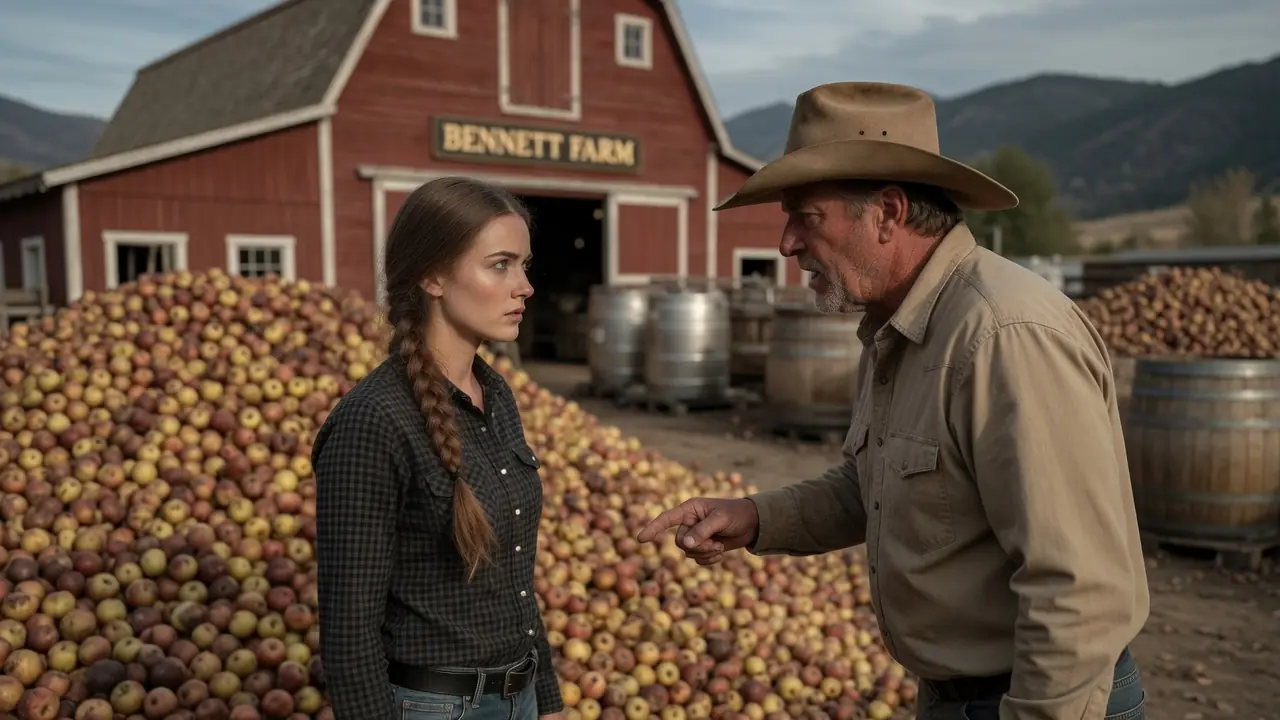 a rotten apple across the cracked dirt and watched it burst against Emily Bennett’s dusty boot. “Your grandmother left you a farm, and you turned it into my orchard’s garbage pit,” he sneered, pointing toward the enormous pile of bruised fruit rotting beside her barn. Emily stood perfectly still beneath the same black cowboy hat she wore every day, her long light-brown braid resting over one shoulder, her blue-green eyes cold beneath the brim. “Keep talking,” she replied. “You’re standing on the waste that’s about to make me richer than your orchard.”
Grant laughed loudly enough for his two truck drivers to hear. At sixty-one, he had spent most of his life controlling nearly every apple contract in Millbrook County, and he enjoyed reminding smaller farmers that their survival often depended on his approval. He picked up one of the plain glass bottles sitting on Emily’s fence, looked at the amber liquid inside, and shook his head. “This homemade trash will never sell.”
Emily took the bottle from his hand before he could drop it. “Then explain why three states just ordered six figures’ worth of it.” Grant’s smile vanished for half a second, but he recovered quickly and pointed toward the line of trucks waiting beyond her gate. “Those apples came from my orchard. Without me, you have nothing.”
Emily turned toward the restored barn behind her. Through the open doors, stainless-steel fermentation tanks stood where rusted tractors and broken tools had once collected dust. Workers moved carefully between rows of labeled barrels, while cases bearing the name Bennett Reserve Vinegar waited beside a loading dock. “You gave me what you believed was worthless,” she said. “What I built from it belongs to me.”
Eighteen months earlier, the barn had looked very different.
Emily was twenty-four when her grandmother Ruth died and left her Bennett Farm, eleven neglected acres outside Millbrook, New York. The farmhouse leaned slightly toward the west, the porch steps had softened with rot, and weeds had swallowed most of the old orchard rows. Emily had no formal agricultural training, no savings large enough to restore the property, and no clear reason to leave her marketing job in Rochester.
Yet she left anyway.
Her apartment had been clean, modern, and emotionally empty. Every weekday, Emily wrote advertisements for products she did not care about, then returned home too exhausted to imagine a life that felt like her own. She was good at the job, which made leaving more frightening because people understood escaping failure but rarely understood walking away from success.
Ruth’s funeral brought Emily back to the farm for the first time in three years. She stayed after the relatives left, sleeping in her childhood room beneath a faded quilt her grandmother had made by hand. On the second morning, she walked through the abandoned orchard wearing Ruth’s old black cowboy hat, which had hung beside the kitchen door for as long as Emily could remember.
The hat was too large at first.
Emily adjusted the leather band until it fit and wore it while repairing the porch, clearing vines, and opening windows that had been closed for months. She found Ruth’s handwritten recipe cards inside a kitchen drawer and several notebooks filled with planting dates, rainfall measurements, and short observations about soil. One sentence appeared repeatedly in different forms.
Nothing grown by the earth becomes worthless merely because people stop wanting it.
Emily remembered hearing a simpler version when she was a child. Ruth had always bought bruised apples at the farmers market because they were cheaper and tasted the same beneath the damaged skin. She turned them into pies, dried rings, sauce, preserves, and vinegar.
“The fruit doesn’t know people decided it was ugly,” Ruth once told her. “Nature never lowered its value. People did.”
Three days after the funeral, Emily returned to Rochester and resigned.
Her manager tried to persuade her to take unpaid leave instead. Friends called the decision reckless, while her uncle warned that the farm would drain every dollar she had. Emily packed four boxes, sold most of her furniture, and returned to Millbrook before she could become frightened enough to change her mind.
The first months were harder than she expected.
The porch consumed nearly all the money she had budgeted for repairs. The well pump failed during the first cold week, and a storm tore loose several sections of the barn roof. Emily learned to use tools by watching tutorials on an old laptop balanced on overturned buckets, often making the same repair twice because she had done it incorrectly the first time.
People in town watched with interest.
Some admired her determination, but many assumed she would last only until winter. They had seen young people inherit rural property before, arrive with romantic ideas, and leave once the work became repetitive and expensive. Emily heard the jokes but kept wearing Ruth’s black hat and returning to the fields every morning.
Three miles down the county road stood Halverson Orchards, a commercial operation covering hundreds of acres. Grant Halverson supplied supermarkets, juice processors, bakeries, and distributors throughout the Northeast. His orchard generated enormous amounts of fruit, but not every apple met commercial standards.
Some were bruised during harvesting.
Others were damaged by insects, hail, or heat. Apples that fell before picking often became too soft for supermarkets and too inconsistent for juice companies. Halverson Orchards spent thousands of dollars each season hauling rejected fruit to a commercial composting facility two counties away.
Grant first visited Bennett Farm because he believed Emily might accept a small amount of waste for livestock feed or compost. He arrived in a polished pickup, stepped onto the damaged porch, and looked around with open disappointment. Emily wore her black cowboy hat, dark checkered shirt, faded jeans, and dusty boots.
“You’re Ruth’s granddaughter?” he asked.
“I am.”
Grant looked toward the overgrown fields. “You planning to farm this?”
“I already am.”
He smiled as though she had made a charming joke. Then he explained the orchard’s disposal problem and offered to provide apples without charging her. Emily immediately asked how many truckloads he could deliver.
Grant stared at her. “You understand these aren’t market apples.”
“I don’t need them to look pretty.”
“They’re damaged, soft, sometimes partly fermented.”
“How much?”
“Several tons a week during peak season.”
Emily smiled beneath the hat. “Send all of it.”
Grant expected her to reconsider after the first delivery.
Two flatbed trucks arrived the following Tuesday just after sunrise. They backed onto the grass behind the barn and released thousands of apples in a heavy avalanche of dull thuds. Sweet, sour air spread across the farm as bruised red and yellow fruit formed a pile nearly as tall as Emily.
Cars slowed along the road.
One driver stopped and photographed her standing beside the fruit. By evening, the picture appeared online with a caption asking whether the “Bennett girl” had started the county’s largest compost heap. People added laughing comments, and Grant’s employees privately placed bets on how long she would continue accepting deliveries.
Emily ignored them.
Her plan was to produce apple cider vinegar, a product that required sugar rather than perfect appearance. Overripe apples often contained more accessible sugar than firm supermarket fruit. If the damaged portions were sorted carefully and unsafe rot discarded, much of what remained could still ferment successfully.
The theory sounded simple.
The first batch failed within five days.
Emily cleaned the old cider press but did not sanitize it thoroughly. Wild mold spread across the surface of the crushed apples before useful yeast could establish itself. The smell became so unpleasant that she opened every barn door and stayed outside for two days.
She buried the ruined material and began again.
The second batch reached alcoholic fermentation, bubbling actively for nearly two weeks. Emily sealed the containers tightly because she feared contamination, but acetic acid bacteria needed oxygen to convert alcohol into vinegar. The process stopped completely.
Batch three built pressure inside a forgotten container and launched its lid across the barn at eleven o’clock one night. The sound made Emily fall backward over a bucket and bruise her hip. She sat on the floor laughing and crying at the same time because she had spent four months producing nothing she could sell.
Her uncle visited the next morning.
He looked at the barrels, smelled the sharp air, and advised her to stop before she lost the farm. “You tried, Emily. There’s no shame in admitting this isn’t working.”
She adjusted the brim of her black hat. “It isn’t working yet.”
“That pile outside is getting bigger.”
“So is what I know.”
He left unconvinced.
Emily began reading every reliable book and technical guide she could find on cider and vinegar production. She studied yeast activity, sugar concentration, sanitation, temperature control, oxygen exposure, acidity, and the cellulose culture known as the mother. She spent evenings recording pH values and fermentation times in Ruth’s old notebooks.
A retired winemaker named Milo Sandquist eventually answered a question Emily posted in a fermentation forum. He lived nearly two counties away and spoke with the impatient directness of someone who disliked watching people repeat preventable mistakes. After listening to her process, he identified six problems in less than ten minutes.
“You’re treating every apple like it’s the same,” Milo told her. “Variety matters. Ripeness matters. Temperature matters. Cleanliness matters most.”
Emily invited him to the farm.
Milo arrived wearing rubber boots and inspected the barn without offering praise. He tasted one failed batch, immediately spit it into a drain, and told Emily she had created something useful only for cleaning metal. Then he spent six hours teaching her how to classify fruit, maintain consistent ratios, preserve the vinegar mother, and allow sufficient airflow without exposing the liquid to insects.
“You have determination,” he said before leaving. “That’s common. Discipline is rarer.”
Emily wrote the sentence in her notebook.
Batch four became vinegar, but it was harsh, thin, and inconsistent. Batch five improved after she separated tart apples from sweeter varieties. The sixth batch took almost three months and required daily monitoring.
On a cold October evening, Emily dipped a clean spoon into the barrel.
The vinegar was bright and sharp, with a faint sweetness beneath the acidity. It carried a deeper apple character than commercial vinegar because she had used older varieties from the rejected loads. Emily tasted it again, then sat on an overturned bucket with tears gathering behind her glasses.
She had finally made something worth selling.
Her first bottles were gifts.
Emily gave one to her aunt, one to Milo, and several to neighbors who had shown kindness during the months of public mockery. She asked for honest opinions and prepared herself for polite encouragement. Instead, people returned asking for more.
A local chef named Owen Pruitt received a bottle from a customer and called Emily directly. His restaurant specialized in regional ingredients, pickled vegetables, and seasonal dishes. Owen wanted twelve bottles for testing.
Emily delivered them personally.
He used the vinegar in salad dressings, marinades, and pickling brine. Two weeks later, he ordered four cases and asked whether she could guarantee a regular supply. Emily nearly said yes immediately, then remembered Milo’s lesson about discipline.
“I can guarantee two cases a month until I expand,” she said.
Owen respected the honesty.
His order pushed Emily to formalize the business. She registered the name Bennett Reserve Vinegar, applied for food-production licenses, scheduled inspections, and converted one section of the barn into a cleaner processing room. She used the last of her savings to purchase food-grade barrels and basic bottling equipment.
Grant continued sending rejected apples every Tuesday.
At first, he considered Emily’s project harmless. Hauling the fruit to her farm saved his company money, and her small operation posed no threat to Halverson Orchards. He occasionally asked whether her “little vinegar experiment” was still continuing.
Emily always answered yes.
The first serious conflict began when a specialty grocer agreed to stock Bennett Reserve Vinegar. The owner wanted consistent labels, traceable batches, and reliable acidity levels. Emily met every requirement, and the first shipment sold out in eleven days.
A regional food magazine published a short article about the young farmer transforming discarded apples into premium vinegar. The story included a photograph of Emily standing beside the barn in her black cowboy hat, holding a bottle against the backdrop of the enormous apple pile. Suddenly, tourists began stopping at the farm.
Grant noticed.
He visited one afternoon and found customers purchasing bottles from a small table near the porch. His expression hardened when he saw the price. Emily charged considerably more than standard supermarket vinegar because her product was raw, small-batch, and made from regional heritage varieties.
“You’re using my apples,” Grant said.
“I’m using fruit you paid to discard.”
“You’re advertising them as local orchard apples.”
“They are local orchard apples.”
“My orchard’s name isn’t on the label.”
“Because you never wanted your name associated with rotten fruit.”
Grant moved closer. “Perhaps our arrangement needs to change.”
Emily understood the threat immediately.
The following Tuesday, the trucks did not arrive.
Neither did they come the week after that.
Emily called the orchard and was told Grant had ended the disposal arrangement. He had also contacted other farms and instructed them not to provide her with waste fruit because he intended to launch his own vinegar line.
Grant expected the supply cutoff to destroy her.
For three days, Emily panicked privately. She had orders to fulfill, employees depending on her, and barrels that required a continuous flow of fruit. Then she opened Ruth’s notebooks and found a list of abandoned heritage apple trees growing on small properties throughout the county.
Emily contacted every owner.
She offered to collect damaged fruit at no charge and pay for usable quantities once the business stabilized. Small growers welcomed the arrangement because they had little market access and often allowed fallen apples to rot beneath their trees. Within two weeks, Emily had agreements with fourteen farms.
The mixed heritage fruit improved her vinegar.
Some varieties were sharper, others sweeter, and several produced flavors Halverson’s modern commercial apples could not match. Emily began labeling limited batches by farm and harvest year, giving each small grower recognition on the bottle.
Customers loved the transparency.
Grant’s own vinegar entered stores several months later. It was professionally bottled but produced quickly from standard apple concentrate rather than slow-fermented orchard rejects. The product lacked character, and customers compared it unfavorably with Bennett Reserve.
Grant blamed Emily.
He appeared at Bennett Farm during a busy delivery morning and found a large shipment being loaded for stores in New York, Vermont, and Pennsylvania. Emily stood near the fence in her black cowboy hat, checking invoices.
Grant kicked an apple toward her boots.
“Your grandmother left you a farm, and you turned it into my orchard’s garbage pit.”
Several workers stopped moving.
Emily looked at him without flinching. “You dumped fruit because you were too blind to see what it could become.”
Grant snatched a bottle from a case. “This homemade trash will never outsell a real orchard.”
Emily took the bottle back. “Three states just ordered more than your vinegar sold all year.”
His face reddened. “Those apples came from me.”
“Not anymore.”
“You wouldn’t have a business without Halverson Orchards.”
“I wouldn’t have started without you,” Emily said. “That doesn’t mean you built it.”
Grant pointed at the barn. “I can shut this operation down with one phone call.”
Emily removed a document from her clipboard and held it toward him. It was a supply agreement signed by the fourteen local growers now working with Bennett Reserve. Beneath it rested a distributor’s purchase order large enough to push annual revenue beyond six figures.
“You already made that phone call,” she said. “It forced me to build a supply network you can’t control.”
Grant reached for the papers, but Emily pulled them away.
“This isn’t over.”
“No,” she replied. “Your delivery is waiting at the grocer. They returned three pallets.”
He left without another word.
Bennett Reserve crossed six figures in annual revenue before the end of its third year. Emily converted the old equipment shed into a proper fermentation facility, installed temperature-controlled tanks, and hired four employees from neighboring farms. Owen Pruitt remained her first restaurant customer and eventually helped introduce her products to chefs throughout the region.
Milo visited during the expansion.
He walked through the spotless production room, examined the batch logs, and tasted a heritage blend aged in oak. His face remained unreadable while Emily waited beneath her black hat.
“Disciplined,” he finally said.
It was the greatest compliment he had ever given her.
Grant’s business did not collapse. Halverson Orchards remained large, profitable, and powerful, but it lost something more important than money. Small growers who once feared him discovered they could work together through Emily’s network.
She paid them fairly for fruit he had called worthless.
The former classmate who posted the mocking photograph eventually arrived at the farm shop with her daughter. She apologized awkwardly and purchased a case for wedding favors. Emily accepted the apology but did not need it.
The bottles on the shelves had already answered every joke.
Years later, visitors still asked about the black cowboy hat. Emily explained that it belonged to Ruth and that she had worn it on the first morning she decided not to return to Rochester. The felt had softened, the band had darkened with age, and rain had slightly reshaped the brim.
She never replaced it.
Every Tuesday, trucks still arrived at Bennett Farm, though they now came from many orchards instead of one. Apples spilled beside the barn in red, yellow, and green waves, bruised and imperfect but carefully sorted by workers who understood their value.
Cars continued slowing along the county road.
Now people stopped to buy bottles.
Emily often stood near the pile at sunrise, one hand resting on the fence, her long braid hanging over her dark checkered shirt. Beyond her, the fields Ruth left behind were productive again, the barn roof stood straight, and Bennett Reserve Vinegar waited inside thousands of labeled bottles.
Grant had once believed those apples proved Emily was not a real farmer.
Emily learned that farming was never simply about growing something beautiful enough to sell. Sometimes it meant recognizing what others had overlooked, creating the conditions for transformation, and refusing to let someone else define value.
Ruth had understood that all along.
Nature had never declared bruised fruit worthless.
Grant had.
And Emily built a six-figure business by proving him wrong.