The metal cup tilted slowly above Sergeant Emily Carter’s head, and cold water spilled down through her dark auburn hair, across her face, and over the front of her olive-green shirt. Two soldiers held her arms because Sergeant First Class Ryan Mitchell had ordered them to keep her still, and nearly fifty people inside Camp Tidewater’s mess hall watched the humiliation without moving. Mitchell lowered the empty cup with a satisfied grin, expecting tears, anger, or at least some desperate attempt to defend herself. Emily simply raised her eyes and stared at him.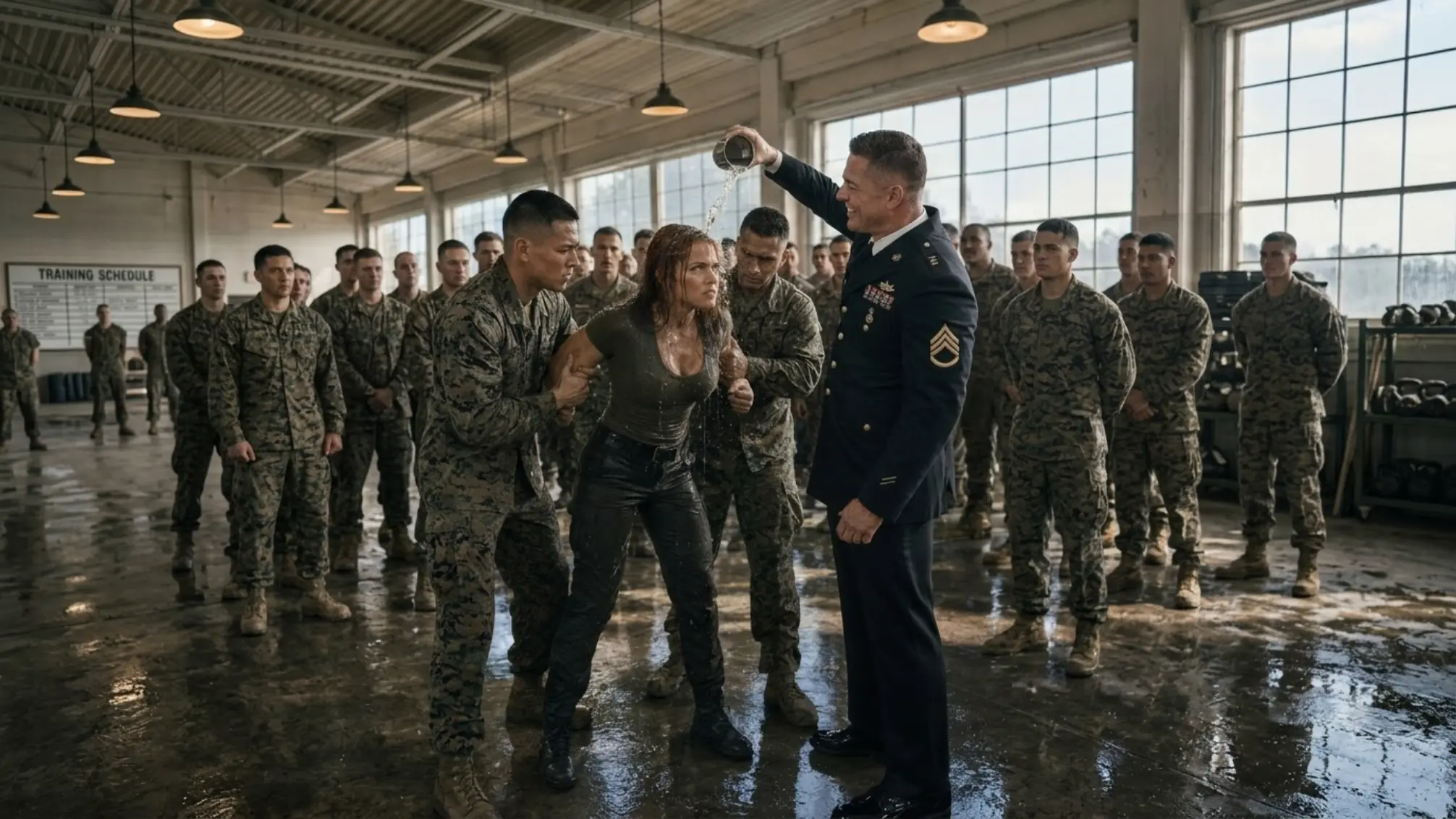
“Still calm, paperwork girl?” Mitchell asked. “Let’s see how tough you are now.” Water ran from Emily’s jaw and dripped onto the floor while her fists remained closed at her sides. “Take your hands off me before I decide you’ve crossed enough lines,” she said quietly. Mitchell stepped closer and replied, “You think that stare scares me? You’ve never survived what I have.”
Emily’s expression did not change. “Then keep pushing. You’re about to learn what my file doesn’t say.” The sentence silenced even the men who had been laughing seconds earlier, but Mitchell dismissed it as another attempt to sound intimidating. What he could not know was that Emily’s ordinary personnel file had been constructed precisely so men like him would stop reading after the first page.
Nine days earlier, Emily had arrived at Camp Tidewater in an old gray sedan carrying one canvas duffel bag. Her transfer paperwork identified her as a thirty-four-year-old logistics specialist with six years of service and an excellent but completely unremarkable record. She signed the required forms, found her quarters without asking for directions, and reported to the supply office before most people had even learned her name. By lunchtime, she had already identified the first serious weakness in the base’s logistics system.
Supply orders were being duplicated. Fuel records from different departments did not reconcile. Vehicle maintenance schedules were based on information nearly eighteen months out of date, and nobody had noticed because the base had survived by compensating for the problems rather than fixing them. Emily noticed all of it within forty-eight hours.
She did not announce a reform project or schedule meetings. She stayed late, rebuilt the supply-tracking framework, and left a clean summary for Captain Maria Torres. By Friday, projected vehicle downtime had fallen dramatically on paper simply because Emily had corrected the information being used to schedule repairs. Torres summoned her to the office and stared at the new system on her computer.
“You did this in three days?” Torres asked. Emily nodded. “The errors were already there, ma’am. I only made them visible.” Torres asked if she needed additional staff, but Emily requested only wider database access. That answer stayed with Torres long after Emily returned to work.
Ryan Mitchell heard about the improvements and immediately disliked the attention Emily was receiving. He had spent twenty years building a reputation as one of Camp Tidewater’s hardest senior enlisted leaders. Three deployments, multiple commendations, and years of running demanding crews had taught him to respect people who proved themselves under visible pressure. A quiet logistics specialist who fixed systems from behind a desk did not fit his definition of strength.
He started calling her the “paper warrior” when she was not around. Then he began saying it when she was. Emily never responded, and her silence irritated him more than an argument would have. Mitchell was accustomed to dominating the emotional temperature of a room, but Emily seemed completely uninterested in surrendering hers.
The mess hall confrontation started because Mitchell wanted a reaction. He sat across from Emily without being invited and asked what someone with her background could possibly contribute if things became dangerous. Emily closed the book she had been reading and answered, “Whatever the situation requires.” Mitchell laughed and accused her of hiding behind mysterious confidence.
When Emily picked up her book again, he snapped. Mitchell seized her water cup and ordered two nearby soldiers to hold her arms after she stood. Before anyone fully understood what was happening, he emptied the water over her head. The act was childish, public, and impossible to mistake for professional discipline.
After Emily delivered her warning, she looked toward the two soldiers gripping her. “Release me.” Something in her voice made both men obey before Mitchell could object. Emily picked up a napkin, wiped water from her face, collected her book, and walked out of the mess hall without another word.
Mitchell tried to laugh afterward. Nobody joined him. The atmosphere had shifted because everyone had seen the same thing: Emily had not looked frightened, embarrassed, or even surprised. She had looked like a woman rapidly calculating whether the man in front of her was relevant to a much larger problem.
Lieutenant Colonel David Reynolds heard about the incident within twenty minutes. Three different people contacted his office independently, which told him the event had unsettled the base far beyond an ordinary argument. Reynolds pulled Emily’s personnel file that evening and read it twice. Everything in it was technically complete, yet it somehow told him almost nothing.
He called an old contact connected to a specialized federal oversight network and described Emily without using her name. The man on the other end became cautious immediately. “If someone matching that description has a file that feels too ordinary,” he said, “assume the ordinary part was intentional.”
Reynolds stared at Emily’s file after the call ended. “Why?” he asked. His contact paused. “Because some people work best when everyone around them underestimates them.”
The following morning, Emily was running alone along the perimeter road before sunrise. Corporal Nathan Watts saw her from the motor pool and stopped working long enough to watch. She did not run like someone trying to pass a fitness test. She ran with the controlled rhythm of someone whose body had been trained for years to function under exhaustion.
Mitchell continued provoking her. He made sarcastic comments outside the supply office and appeared during work hours to mock the “spreadsheet rescue operation.” Emily never took the bait. She simply kept improving the systems around him.
Then her database access disappeared.
Emily tried logging into the archived vehicle records on Saturday morning and received an authorization error. A check with administration showed that someone had requested the cancellation through the motor pool office. The request was irregular because the motor pool did not control that access.
Emily called Torres. “Someone revoked my archive credentials overnight.” Torres immediately asked who had authorized it. When Emily explained, Torres became angry and restored the access within an hour.
Emily did not accuse Mitchell, even though his office appeared on the request trail. She knew something did not fit. Mitchell was aggressive enough to confront her directly, yet revoking database permissions secretly did not match the way he operated.
She began watching the people around him instead.
On Monday morning, a supply convoy carrying critical equipment for an upcoming joint exercise disappeared into a routing failure. Three vehicles were stranded at a secondary waypoint, and staff estimated that resolving the paperwork would take six hours. Emily had the convoy moving again in ninety-three minutes.
She coordinated road clearances, receiving-unit confirmation, and updated documentation simultaneously. Private Daniel Chen watched from the next workstation in disbelief as Emily moved through the problem without appearing rushed. When it was over, he told her he had never seen anyone solve something that complicated so quickly.
“The convoy crew has families,” Emily replied. “The exercise matters. You take the time the situation requires, not the time the system expects.” Chen wrote that sentence down later.
Mitchell watched part of the recovery from the hallway. He said nothing. That evening, one of his longtime colleagues, Sergeant First Class Brewer, told him that people were beginning to see Emily differently.
“She’s good,” Brewer said. Mitchell wiped grease from his hands. “She fixed a convoy problem.” Brewer shook his head. “No. She keeps fixing everything she touches.”
Mitchell did not answer. For the first time, his contempt had been replaced by uncertainty.
Two days later, he walked into Emily’s office and closed the door. “I’m not here to apologize,” he said. Emily kept typing until she finished the line on her screen. “I didn’t ask you to.”
Mitchell sat down. “You could’ve reported me. Why didn’t you?” Emily studied him for a moment before answering. “Because a complaint would have made the incident about the water.”
“What was it about?”
“You.”
Mitchell’s expression hardened, but Emily continued. “Not you personally. Your pattern. You were already frustrated before I arrived. Someone like me gave you somewhere to put it.” Mitchell stared at her as though she had opened a door he had spent years pretending was not there.
Emily leaned back. “Anger is expensive. I’ve spent enough time in situations where I couldn’t afford it.” Mitchell looked at his hands. “Where do you put it?” She answered, “Into the work.”
He stood slowly. Before leaving, he admitted he had been involved in requesting the database restriction after another sergeant suggested Emily was exceeding her authority. “Bad call,” Mitchell said. “It won’t happen again.”
Emily’s attention sharpened. “Who suggested it?” Mitchell hesitated. “Sergeant Callaway.” Then he left.
Emily wrote the name down.
Three days earlier, while reviewing archived fuel allocation records, she had discovered a pattern hidden beneath thousands of ordinary transactions. Individual discrepancies were tiny. Several thousand dollars here, slightly inflated delivery quantities there. Taken separately, they resembled clerical mistakes.
Across eight fiscal quarters, they formed a consistent pattern.
Payments had been made for fuel quantities that the base never received. The difference approached two hundred thousand dollars. More troublingly, the irregularities aligned with specific vehicle deployment schedules, meaning whoever maintained the scheme understood when fuel movements would be difficult to verify.
Emily had not been transferred to Camp Tidewater only to repair logistics.
Eight weeks earlier, a confidential tip had suggested a long-running financial irregularity somewhere inside the installation’s supply network. The allegation was too weak for a formal investigation, so Emily had been placed inside the system under an ordinary assignment. Her job was to determine whether a genuine pattern existed without alerting whoever might be responsible.
Her personnel file was accurate. It simply was not complete.
Emily had spent years conducting specialized investigative and operational work before returning to a deliberately ordinary logistics role. The people who assigned her knew that if corruption existed, an obvious investigator would make everyone cautious. A quiet sergeant fixing spreadsheets would be ignored.
Mitchell had certainly ignored her.
Someone else had not.
The archived records showed repeated communications between former logistics officer Major Dennis Harlo and a current Camp Tidewater account. Emily accessed only metadata she was authorized to view, refusing to open protected message contents because doing so could compromise any future investigation. The current account belonged to Sergeant First Class Aaron Callaway.
Callaway was one of Mitchell’s closest professional friends.
Suddenly the revoked database access made sense.
Callaway had encouraged Mitchell’s hostility, then used Mitchell’s office to interfere with Emily’s records access. He had chosen the perfect shield: a loud senior sergeant who had publicly antagonized Emily and possessed broad motor pool privileges.
If investigators later found suspicious system activity, Mitchell would appear guilty.
Emily went to Reynolds.
The lieutenant colonel listened while she laid eleven pages of evidence across his desk. He became quieter with every page. When he reached the total discrepancy, he removed his glasses.
“Just under two hundred thousand?” he asked.
“Yes, sir.”
“And Harlo?”
“Primary historical access.”
“Who is current?”
Emily slid over the communication log.
Reynolds looked at Callaway’s name.
He closed his eyes for one second.
“How certain are you?”
“The metadata proves communication, not intent.” Emily met his gaze. “But yes, sir. I’m certain enough to bring it here.”
Reynolds immediately contacted the Inspector General’s office. He also ordered that nobody approach Callaway before investigators arrived. Emily warned him there was another danger.
“Callaway knows someone is looking.”
“Why?”
“He visited the supply office twice asking what years I was reviewing.”
Reynolds understood.
“And Mitchell?”
“I don’t think Mitchell knows anything.”
“You’re protecting him.”
“I’m protecting the investigation.”
Reynolds looked at her. “Those are becoming the same thing.”
The following morning Brewer arrived at Emily’s quarters before seven. His expression told her something had happened. “Callaway came to me last night,” he said. “He started talking about an upcoming audit and how Mitchell’s motor pool access might make him look bad.”
Emily stood immediately.
Callaway was preparing the frame.
“Find Mitchell,” she said. “Keep him somewhere predictable. Don’t explain why.” Brewer nodded.
“Where are you going?”
“Reynolds.”
By 7:20, Reynolds had the Inspector General on a secure call. The team could reach Camp Tidewater by early afternoon. Until then, normal operations had to continue.
At nine o’clock, Callaway walked directly into Emily’s office.
Private Chen was sitting nearby.
“Database project finished?” Callaway asked casually.
“Almost.”
Callaway smiled. “Good. There might be an administrative audit coming. Some old fuel data can look strange without context.” Emily pretended concern. “Really?”
“Harlo had some reconciliation problems.”
“I noticed.”
Callaway’s smile tightened.
Emily continued, “I actually gave everything to Colonel Reynolds last night.”
For one fraction of a second, Callaway’s face became completely blank.
That was enough.
“Oh,” he said. “Good. He’ll know how to interpret it.”
Emily nodded. “That’s what I thought.”
Callaway left.
Chen waited until the footsteps disappeared. “Sergeant Carter?”
“Yes?”
“That was terrifying.”
“You did fine.”
“What was that?”
Emily looked at him. “You’re going to write down exactly what you heard. Nothing more.”
At 10:15, Reynolds summoned Callaway.
The conversation lasted less than twenty minutes before Reynolds mentioned the archived communication logs. Callaway’s composure finally cracked.
“I think I need counsel,” he said.
“That would be wise.”
Reynolds informed him that his system access had been frozen and he would remain supervised until investigators arrived. Then he leaned forward.
“One more thing. Whatever you planned to put on Mitchell, stop thinking about it. He has been accounted for since this morning.”
Callaway stared at him.
“How long has Carter been investigating this?”
Reynolds’s expression hardened.
“Long enough.”
The Inspector General team arrived at 1:52 p.m. Emily briefed them in twenty-two minutes, explaining the vendor discrepancies, deployment correlations, access trail, Harlo connection, Callaway metadata, Mitchell manipulation, and Callaway’s attempt that morning to influence her interpretation of the records. Lead investigator Sofia Diaz listened without interrupting.
When Emily finished, Diaz looked at the evidence.
“You built this alone?”
“Yes.”
“How long?”
“Eighteen days.”
Diaz stared at her. “Your file says logistics specialist.”
Emily answered, “My file is accurate.”
Diaz almost smiled. “Of course it is.”
The investigation continued overnight.
By the next day, investigators confirmed another quarter of suspicious activity that Emily had not originally identified. The total rose above two hundred thousand dollars. Harlo had apparently initiated the scheme before transferring, while Callaway maintained access, communications, and cover after he left.
Mitchell learned the truth from Brewer.
For several minutes he said nothing.
“He used me.”
“He used behavior you were already giving him,” Brewer answered.
Mitchell lowered his eyes.
“That’s worse.”
Brewer did not disagree.
Mitchell realized his public hostility toward Emily had created exactly the narrative Callaway needed. The drink in the mess hall, the mocking comments, and the database interference made Mitchell look like a man with motive and access. Worse, Emily had recognized the setup before he did and still allowed him to help retrieve archive records once she concluded he was not part of the fraud.
“She protected me,” Mitchell said.
Brewer answered carefully. “She protected the truth.”
Mitchell requested a formal review of his own conduct.
Reynolds warned that the request could remain permanently in his record. Mitchell said that was the point.
“I’ve spent twenty years telling people accountability matters,” he said. “It can’t suddenly stop mattering when it costs me something.”
Later that afternoon Mitchell found Emily in the vehicle bay.
For once, he was sitting instead of working.
“I was wrong about you,” he said. “Immediately, consistently, publicly.”
Emily remained silent.
“I made myself useful to someone who was hurting this place.”
“You didn’t know.”
“I still chose how I treated you.”
Emily nodded. “Yes.”
Mitchell looked at the floor. “The mess hall wasn’t really about you.”
“I know.”
“That doesn’t make it better.”
“No.”
He finally looked at her. “I’ve spent twenty years believing being the hardest person in the room was the same as being the strongest. Then you showed up and didn’t need anyone to know what you could do.”
Emily leaned against the workbench.
“I lost people years ago,” she said quietly. “After that, proving I was tougher than someone else stopped feeling important.”
Mitchell absorbed the admission.
“I want to keep working with you, if that’s possible.”
Emily studied him. “The problem wasn’t that you underestimated me. People misjudge each other every day. The problem was using your position to punish someone because they didn’t fit the category you expected.”
Mitchell nodded. “I understand.”
“Then don’t repeat it.”
“I won’t.”
Emily straightened.
“Then we keep working.”
The investigation formally moved beyond Camp Tidewater over the next several days. Callaway was suspended pending disciplinary and criminal proceedings, while federal and departmental investigators coordinated with Harlo’s new installation. Records confirmed that vendors had been overpaid through manipulated reconciliation reports and carefully distributed discrepancies.
Emily’s evidence had not solved everything.
It had shown investigators exactly where to look.
Captain Torres implemented the logistics framework permanently. Chen received expanded database access and responsibility for quarterly reconciliation reviews. The system Emily built would remain long after she left.
That mattered more to her than the commendation Torres placed into her official record.
Emily already knew she was leaving.
During the investigation, she had received a call from Commander Walsh, one of the few people who knew the complete version of her professional history. Another assignment required someone who could enter an organization quietly, identify what was hidden beneath ordinary procedures, and leave behind evidence strong enough to survive scrutiny.
He gave her seven days.
She asked for fourteen.
She stayed long enough to finish Camp Tidewater properly.
On her final evening, Mitchell walked the perimeter road with her. For several minutes neither spoke.
“I gave Diaz everything,” he finally said.
“I heard.”
“Two hours and forty minutes.”
“That means you were thorough.”
Mitchell looked toward the road. “I keep thinking about what I did.”
Emily stopped walking.
“Ryan.”
He turned. It was the first time she had used his first name.
“Accuracy is useful,” she said. “Punishment is just accuracy that refuses to stop after the lesson has already been learned.”
Mitchell stared at her.
“So I just move on?”
“I didn’t say it would be easy.”
“Move where?”
Emily thought for a moment.
“You’re good at building teams. You’re good under pressure. People trust you when things get dangerous.” She paused. “Now learn how to stay curious when someone doesn’t fit your expectations instead of treating difference like a threat.”
Mitchell nodded slowly.
“That’s where you go.”
Friday morning, Emily packed the same canvas duffel bag she had carried through the gate three weeks earlier.
Chen was already working when she entered the supply office.
“The vendor reconciliation?” she asked.
“Cross-referenced every quarter.”
“Maintenance flags?”
“Linked.”
“Access upgrade?”
“Torres approved it yesterday.”
Emily nodded.
“You’re ready.”
Chen smiled slightly. “I know.”
Emily almost smiled back.
At the main gate, Mitchell was waiting in civilian clothes.
“You took a morning off?” Emily asked.
“Don’t tell anyone.”
She stopped beside him.
Mitchell looked at the gray sedan parked beyond the checkpoint. “Wherever you’re going, I assume nobody there is going to know what you really do.”
“That usually works best.”
He nodded.
Then his expression became serious.
“I’ve served with brave people. Smart people. People who function perfectly when everything goes bad.” He paused. “I’ve never met someone who could be all those things and still leave enough room inside themselves to treat someone decently when that person gave them every reason not to.”
Emily held his gaze.
“You were never the investigation, Ryan.”
“No.”
“You were a man carrying something you hadn’t learned where to put.”
“I put it on you.”
“Yes.”
Mitchell swallowed.
“I’m sorry.”
Emily looked toward the gate where she had entered twenty-two days earlier as an invisible logistics specialist.
“Ancient history.”
“Really?”
“What comes after is what matters.”
She extended her hand.
Mitchell shook it.
Emily walked through the gate, placed the duffel in her trunk, and drove away.
Forty minutes later, she pulled onto the shoulder of a quiet coastal road.
Inside her jacket pocket was a folded piece of paper Reynolds had given her during their final meeting. The first line contained three words he had written shortly after she arrived:
She’s been trained.
They had been crossed out.
Below them were three different words.
She knows herself.
Emily read the sentence again.
For six years she had moved from assignment to assignment, always becoming exactly what the next mission required. She knew how to arrive quietly, identify what was broken, fix what she could, expose what needed exposing, and disappear before anyone fully understood what she had done.
She had become extremely good at leaving.
For the first time, she wondered whether that was another problem worth fixing.
Emily folded the paper and returned it to her pocket. The next assignment was waiting, and she had already decided to accept it. There was work ahead that mattered, and she knew she was the right person to do it.
But after that?
For once, Emily allowed the question to remain unanswered.
She pulled back onto the highway and headed south.
Behind her, Camp Tidewater was already changing. Chen was checking the numbers. Torres was enforcing the new systems. Mitchell was carrying a permanent review in his file because he had chosen accountability rather than excuses, and investigators were following the trail Callaway believed he had hidden beneath years of ordinary paperwork.
Three weeks earlier, Ryan Mitchell had looked at Emily Carter and seen a woman who moved supplies and corrected spreadsheets.
He poured water over her because he believed humiliation would reveal weakness.
Instead, the moment exposed something else.
Not that Emily was secretly the most dangerous person in the room.
Not that she possessed some hidden ability to destroy everyone who underestimated her.
It revealed that she understood power better than the man trying to prove he had it.
Mitchell used his power to embarrass someone beneath him.
Callaway used his power to manipulate people around him.
Emily used hers to find the truth, protect someone who had treated her badly when the evidence showed he was innocent, and build a system strong enough to keep working after she disappeared.
That was the part her personnel file never explained.
And it was the part nobody at Camp Tidewater would ever underestimate again.