“Wait, who are you?”
Principal Arthur Halloway raised both hands as Daniel Mercer entered the office carrying his eight-year-old daughter against his chest. Daniel’s black suit was wrinkled from kneeling on the hallway floor beside the equipment closet where he had found Lily crying in darkness. His phone remained raised in his right hand, its camera pointed directly at the principal’s desk.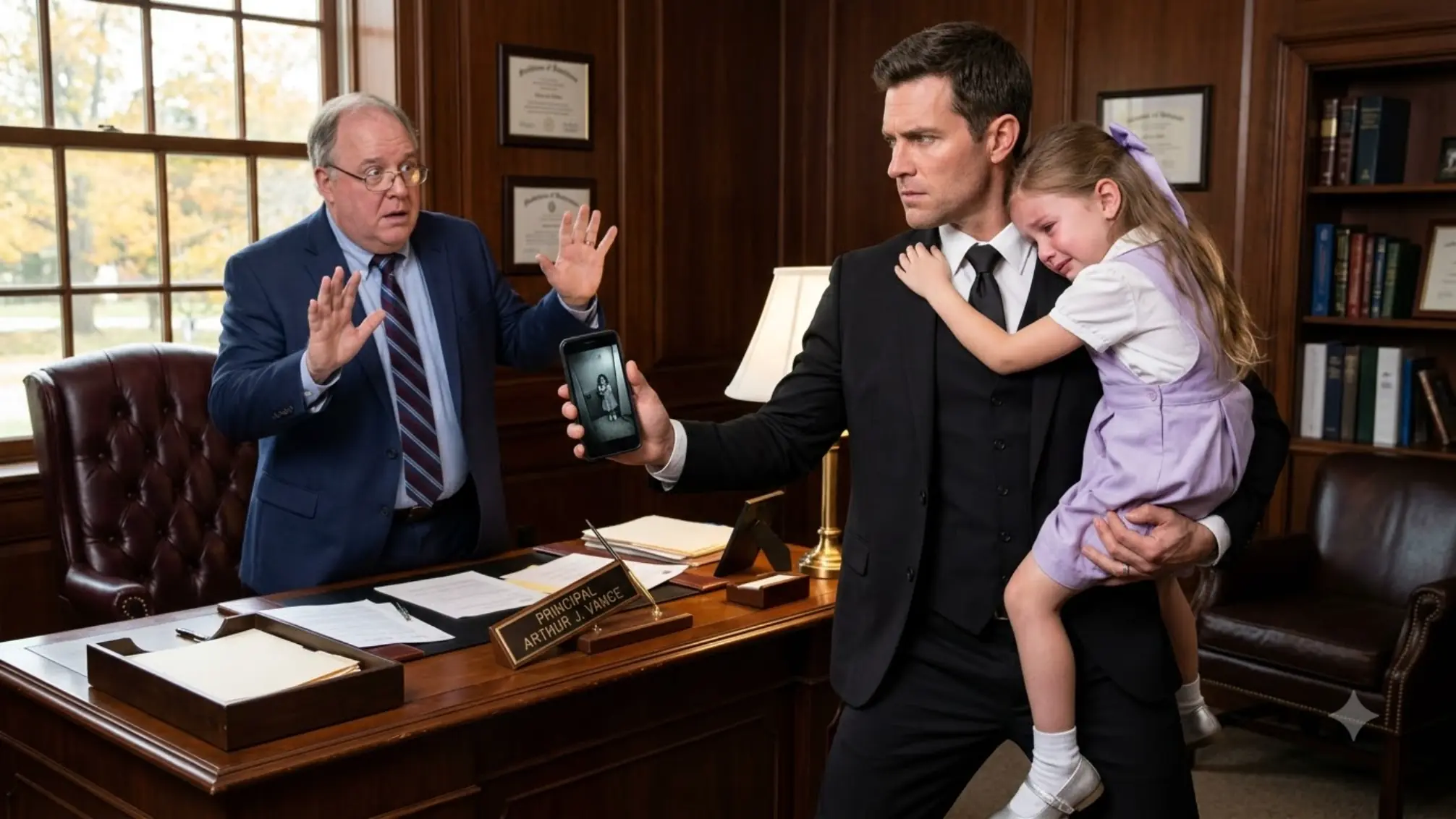
“The father whose daughter you locked away,” Daniel said, “and the man recording your confession.”
Halloway’s frightened expression hardened into anger. He slammed one palm against the desk, making his silver nameplate fall sideways.
“Delete it, or I’ll destroy her future.”
Daniel stepped closer.
“Try it. The school board is watching you live.”
For the first time since Daniel entered the building, Halloway stopped speaking.
The office became so quiet that the faint clicking of the wall clock sounded unnaturally loud. Behind Daniel, Lily kept both arms wrapped around his neck, her face hidden against his shoulder. Her lavender hair ribbon had loosened, and one silver shoe was missing.
Halloway stared at the phone.
A small red icon glowed at the top of the screen.
Below it, the number of viewers continued rising.
Daniel had not planned to livestream anything that morning. He had driven to Hawthorne Preparatory Academy expecting a quiet meeting about his daughter’s sudden behavior changes. For nearly three weeks, Lily had begged not to attend school, awakened from nightmares, and stopped speaking whenever her teacher’s name was mentioned.
Her teacher, Margaret Voss, had told Daniel that Lily was becoming defiant.
“She refuses to follow instructions,” Voss had said during a phone call. “She needs stronger boundaries at home.”
Daniel had believed her at first.
He was a single father raising Lily after his wife, Rebecca, died from an aneurysm four years earlier. He worried constantly about overprotecting their daughter. Whenever a teacher raised a concern, he listened because he did not want grief or guilt to prevent him from seeing Lily’s mistakes clearly.
But Lily had never been a difficult child.
She apologized when she interrupted adults. She organized her pencils by color and gave half her lunch to classmates who forgot theirs. Her previous teachers described her as quiet, observant, and unusually compassionate.
Then something changed.
Lily began checking locks before entering rooms. She cried when Daniel turned off the basement light. Twice, he found granola bars hidden beneath her pillow.
When he asked why she was keeping food in her bedroom, she whispered, “In case I have to wait somewhere.”
Daniel scheduled a meeting with Voss and Halloway.
The school offered him an appointment at 10:30 on Friday morning. Daniel arrived fifteen minutes early and found the main office unusually empty. A receptionist told him Halloway was finishing a conference call and suggested he wait near the elementary wing.
As Daniel walked through the corridor, he heard a faint sound.
At first, he thought it came from a ventilation grate.
Then he heard his daughter’s voice.
“Daddy?”
Daniel stopped.
The hallway contained classrooms, a science room, and an equipment storage closet used for sports cones, cleaning supplies, and folding chairs. The sound came from behind its metal door.
Daniel hurried toward it.
“Lily?”
A small hand struck the other side.
“Daddy, please open it.”
The door had no window.
Daniel pulled the handle, but the deadbolt held.
“Who put you in there?”
Lily began crying harder.
“Mrs. Voss said I was making everyone uncomfortable.”
“What did you do?”
“I told Emma she didn’t have to let Mrs. Voss search her backpack.”
Daniel felt his hands go cold.
“How long have you been inside?”
“I don’t know.”
“Is there a light?”
“No.”
Daniel pulled harder until the handle rattled.
The closet remained locked.
He took out his phone and began recording before running toward the nearest classroom. A teaching assistant looked into the hallway, saw the locked door, and immediately stepped backward.
“Get the key,” Daniel ordered.
“I’m not authorized.”
“My daughter is trapped inside.”
“I need to contact administration.”
Daniel moved closer.
“Then contact them while you find the key.”
The assistant disappeared.
Daniel returned to the closet and continued filming. He documented the deadbolt, the absence of a window, and Lily’s frightened voice coming through the metal. He asked her to keep talking while he searched the wall for an emergency release.
Two minutes later, Margaret Voss appeared.
She was forty-five, sharply dressed, with blond hair pinned behind her head and a smile so calm that Daniel found it more disturbing than anger.
“Mr. Mercer,” she said. “You were asked to wait.”
“You locked my daughter in this room.”
Voss glanced at the phone.
“Please stop recording.”
“Open the door.”
“Lily is completing a reflection exercise.”
Daniel stared at her.
“In a dark equipment closet?”
“She was given multiple opportunities to correct her behavior.”
“Open it.”
Voss folded her arms.
“You are disrupting the school.”
Daniel raised his voice.
“My daughter is crying behind a deadbolt. Open the door now.”
Several classroom doors cracked open.
Students and staff looked into the hallway.
Voss’s composure slipped.
“She needs to understand that actions have consequences.”
Daniel stepped close enough that she finally moved backward.
“If you do not unlock that door in the next five seconds, I will break it down.”
“You will be charged for the damage.”
“One.”
“Mr. Mercer, calm yourself.”
“Two.”
Voss removed a key ring from her pocket.
Daniel filmed her unlocking the deadbolt.
When the door opened, Lily sat on the concrete floor between stacked folding chairs and plastic storage bins. The room was narrow, windowless, and filled with the smell of rubber balls and cleaning chemicals. Her face was wet with tears, and she had pressed herself into the farthest corner.
Daniel dropped to his knees.
Lily ran into him.
He picked her up, held her against his chest, and felt her entire body trembling.
Her missing shoe lay beside a stack of cones.
“How long was she in there?” Daniel demanded.
Voss remained near the doorway.
“Approximately twenty minutes.”
Lily shook her head.
“It was before morning snack.”
Daniel looked at the clock.
Morning snack ended more than an hour earlier.
He turned the camera toward Voss.
“She says you locked her inside before snack.”
“Children have unreliable perceptions of time.”
“Did you provide water?”
“No.”
“Did you check on her?”
“She was safe.”
Daniel pointed the phone toward the dark interior.
“This is not safe.”
Voss’s face sharpened.
“You do not understand the pressures of managing a classroom.”
“And you do not understand what happens when an adult imprisons a child.”
The word brought sudden fear into her eyes.
Voss looked toward the open classrooms.
“She was not imprisoned.”
“The door was deadbolted.”
“It was a temporary behavioral intervention.”
Daniel carried Lily away from the closet.
“Show me the written school policy authorizing it.”
Voss followed them down the hallway.
“That information must come from administration.”
“Good. Let’s go find administration.”
Principal Halloway entered before they reached the office.
He was sixty-one, heavyset, with silver hair and a dark navy suit. He looked first at Voss, then at the phone, then at Lily clinging to Daniel.
“What is going on here?”
Daniel held the camera between them.
“Your teacher locked my daughter in a dark equipment closet for more than an hour.”
Halloway did not look surprised.
He looked irritated.
“Mr. Mercer, recording inside the school violates our privacy policy.”
“Your privacy policy does not erase what happened.”
“Turn off the camera, and we will discuss the situation professionally.”
“Unlocking a child from a deadbolted closet was the professional discussion.”
Halloway glanced toward Voss.
“Was Lily placed in reflection?”
“Yes,” Voss answered.
“Then this appears to be a misunderstanding.”
Daniel stared at them both.
“You have a name for it?”
“Reflection spaces are used when students become disruptive.”
“That closet contains chemicals, equipment, and no light.”
Halloway lowered his voice.
“You need to control your emotions.”
Daniel felt Lily’s grip tighten.
He looked at his daughter.
She was watching the adults with the frozen expression of a child who had learned that speaking could make things worse.
Daniel’s anger became quieter.
More focused.
He shifted Lily higher against his shoulder and opened the school’s parent communication application. The board members’ emergency contact list had been included in a fundraising email months earlier. Daniel selected three names, activated livestreaming, and sent the private link without announcing what he had done.
Then he looked at Halloway.
“I want the police called.”
Halloway’s face changed.
“That is unnecessary.”
“A child was locked inside a room against her will.”
“We can handle this internally.”
“No.”
“You signed an enrollment agreement requiring disputes to begin through administrative review.”
“An enrollment agreement does not replace the law.”
Halloway gestured toward his office.
“Come inside.”
Daniel followed because he wanted every threat spoken clearly.
Once the door closed, Halloway sat behind his desk while Voss remained near a bookcase. Daniel refused the chair and continued holding Lily.
Halloway folded his hands.
“Mr. Mercer, Hawthorne has served this community for eighty years. We take student welfare seriously.”
“Then suspend her.”
Voss stepped forward.
“For enforcing discipline?”
“For locking my daughter in a closet.”
“She challenged my authority in front of the class.”
“She defended another child.”
“She interfered with a backpack inspection.”
Daniel turned toward Voss.
“Why were you searching a student’s backpack?”
Voss hesitated.
“Classroom safety.”
“Did you have the parents’ permission?”
“That is irrelevant.”
“No, it is not.”
Halloway lifted one hand.
“This conversation is becoming hostile.”
Daniel looked at him.
“Call the police.”
“We will not expose children and staff to an unnecessary investigation.”
“You are protecting her.”
“I am protecting the institution.”
The sentence stayed in the air.
Daniel adjusted the phone so the microphone pointed directly toward Halloway.
“What does protecting the institution mean?”
“It means preventing one emotional parent from creating a public scandal before all facts are reviewed.”
“The facts are on my phone.”
“Video can be misleading.”
“The lock is misleading?”
“Context matters.”
“What context makes it acceptable to deadbolt an eight-year-old inside a dark room?”
Halloway leaned back.
“Your daughter has demonstrated a pattern of defiance.”
Lily lifted her face.
“I asked to call my dad.”
Voss’s eyes flashed.
“You were told to remain silent.”
Daniel immediately turned toward her.
“Do not speak to my daughter.”
Voss opened her mouth, then stopped.
Halloway’s tone became colder.
“Mr. Mercer, this school has considerable discretion regarding continued enrollment.”
Daniel understood the direction of the conversation.
“Say it clearly.”
“If you circulate that recording without authorization, Lily’s place at Hawthorne will be terminated.”
Daniel held his gaze.
“You will expel her because I documented what your teacher did?”
“We will remove her because your conduct makes a productive relationship impossible.”
“And after that?”
Halloway’s expression became confident again.
“Hawthorne belongs to a consortium of respected private academies. We provide references for transferring students.”
Daniel felt something inside him settle into absolute stillness.
“You would blacklist an eight-year-old.”
“We would provide an honest assessment of the family.”
Voss smiled faintly.
Halloway continued.
“If that recording leaves your phone, your daughter will be expelled. We will make sure every respected private school knows why she should not be admitted.”
The viewer count on Daniel’s screen jumped.
One of the board members had shared the link with the rest of the trustees.
Daniel moved closer to the desk.
“That sounded practiced.”
Halloway frowned.
“What?”
“How many parents have heard that threat?”
Halloway stood.
“Delete the recording.”
“No.”
“You are trespassing in my office.”
“You invited me inside.”
“I am ordering you to leave school property.”
“After you call the police.”
Halloway reached toward the phone.
Daniel pulled it away.
“Touch me, and the board watches you add assault to the cover-up.”
Halloway froze.
“Wait,” he said, suddenly noticing the names appearing in the livestream window. “Who are you?”
Daniel answered him.
Then Halloway threatened Lily’s future.
Daniel stepped closer and revealed that the board was watching live.
Within seconds, Halloway’s office phone began ringing.
He ignored it.
The second line rang.
Then his mobile phone vibrated across the desk.
Voss looked toward the door.
“What did you do?”
Daniel did not answer her.
The office door opened before anyone could move.
Board Chairwoman Catherine Bell entered with two trustees, the school’s attorney, and the head of campus security. Bell was fifty-six, dressed in a charcoal business suit, and carried a tablet displaying Daniel’s livestream.
Halloway sat down slowly.
“Catherine, this is not what it appears to be.”
Bell looked at Lily.
The child still had only one shoe.
Then Bell turned toward Voss.
“Where was she confined?”
Voss said nothing.
Bell addressed security.
“Seal the equipment closet. No one enters until law enforcement arrives.”
Halloway stood again.
“We do not need police.”
Bell looked at him.
“You threatened a child’s education to suppress evidence.”
“I was attempting to prevent reputational damage.”
“To whom?”
“The school.”
Bell’s voice dropped.
“You are the reputational damage.”
Voss attempted to leave.
The security officer blocked the doorway.
“You are not being detained,” he said, “but the board requests that you remain available.”
“I need to return to my students.”
“No,” Bell said. “You do not.”
The school attorney asked Daniel to preserve the original video and send a copy directly to him. Daniel refused until police created an evidence record.
“That is reasonable,” the attorney said.
Halloway stared at him.
“You work for the school.”
“I work for the institution, Arthur. At this moment, protecting it requires preserving evidence against you.”
The police arrived twelve minutes later.
Officers photographed the closet, measured the interior, collected the key ring, and interviewed staff members separately. A fire inspector discovered that the room had no approved occupancy designation, no emergency release, and stored cleaning chemicals within reach of children.
The deadbolt could only be opened from the hallway.
Voss insisted Lily had been inside for twenty minutes.
Security-camera footage showed otherwise.
Voss placed Lily in the closet at 8:42 that morning.
Daniel opened it at 10:19.
For ninety-seven minutes, no adult checked on her.
The footage also showed Voss bringing three other students toward the same closet during the previous month. Two entered. One resisted until another teacher intervened.
That teacher, Emily Hart, had reported the practice to Halloway.
Her complaint disappeared from the school’s internal system.
Hart had resigned one week later after being told her contract would not be renewed.
The investigation expanded quickly.
Police found emails in which Voss described the closet as “the box” and complained that children behaved better after “a period without stimulation.” Halloway’s responses never instructed her to stop.
Instead, he warned her to avoid hallways covered by newer cameras.
Daniel read that email three days later in the district attorney’s office.
His hands shook with anger.
Lily sat in another room with a child psychologist and drew pictures using purple crayons. In every picture, doors appeared without handles.
Daniel wanted Voss and Halloway punished immediately.
The prosecutor explained that evidence had to be preserved carefully. Criminal charges required timelines, witness statements, policies, and proof that administrators knowingly placed children at risk.
Daniel listened.
He had learned from the livestream that anger could expose truth, but process was what prevented powerful people from rewriting it later.
Hawthorne suspended Halloway and Voss that afternoon.
By Monday, both had been terminated.
The board sent letters to every current and former family asking whether their children had experienced isolation, threats, unauthorized searches, or retaliatory discipline.
Thirty-seven families responded.
Eleven children described being confined in closets, supply rooms, or empty offices. Several had been warned that speaking would affect recommendations or scholarships.
One former student had transferred after developing panic attacks.
His parents believed he had refused to explain why.
Another child reported that Voss regularly searched backpacks for notes about classroom incidents. Students who objected were labeled disruptive.
Halloway maintained control by threatening families with the school’s influence.
Hawthorne’s reputation had become his weapon.
A respected academy could open doors to selective secondary schools, competitive programs, and powerful social networks. Halloway understood that parents feared losing those opportunities.
He used that fear to silence them.
Daniel’s livestream broke the system because it moved the threat outside Halloway’s control before he realized an audience existed.
The board could not bury words thousands of people had heard.
Two months later, Margaret Voss was charged with unlawful restraint, child endangerment, and evidence tampering after investigators discovered she deleted messages during the first hours of the inquiry.
Arthur Halloway faced charges for conspiracy, falsifying school records, retaliation against witnesses, and obstruction.
His attorney called the case an overreaction to “unconventional discipline.”
The prosecutor played Lily’s voice from behind the locked door.
The courtroom became silent.
At the preliminary hearing, Halloway looked smaller than he had behind his desk. He avoided Daniel’s eyes until the judge ordered him to stand.
The judge rejected his request to contact Hawthorne employees directly.
“You spent years controlling what witnesses believed they were permitted to say,” she told him. “You will not continue that practice during this case.”
Outside the courthouse, reporters surrounded Daniel.
He gave only one statement.
“My daughter was not saved because I am powerful. She was saved because evidence reached people who could no longer pretend not to see it.”
He refused interviews after that.
Lily left Hawthorne permanently.
Daniel did not send her to another prestigious private academy. He enrolled her in a smaller community school led by Principal Rosa Alvarez, who invited Lily to tour the building before making any decision.
During the tour, Lily asked whether classroom doors locked.
Alvarez knelt so they were eye level.
“Some doors lock from the inside during emergencies,” she said. “But every room has an exit, and no adult is allowed to use fear as punishment.”
Lily looked at Daniel.
He let her choose.
She started two weeks later.
Recovery was slow.
For months, Lily refused to enter rooms without windows. Daniel installed night-lights throughout their home and never closed her bedroom door unless she requested it. A therapist helped her understand that what happened was not caused by speaking up for another child.
One evening, Lily asked the question Daniel feared most.
“Did I make Mrs. Voss angry because I was bad?”
Daniel sat beside her bed.
“No.”
“But she said I caused trouble.”
“You saw someone being treated unfairly and spoke.”
“Should I have stayed quiet?”
Daniel thought about the closet, the office, and every family Halloway frightened into silence.
“No,” he said. “But you should never have been left alone to carry the consequences.”
Lily rested her head against him.
“Were you scared?”
“Yes.”
“You looked angry.”
“I was both.”
“Did the principal know you were scared?”
Daniel smiled faintly.
“No. He only saw the phone.”
Hawthorne Academy reopened the following year under new leadership. The equipment closet was removed entirely, and the space became part of an open student-support room with glass walls and two exits.
The board established independent reporting channels for students, parents, and employees. No administrator could delete or privately close a welfare complaint. Any physical isolation of a student required immediate parental notification and review by an outside safeguarding officer.
Catherine Bell publicly accepted responsibility for the board’s failure.
“We believed a strong reputation proved strong character,” she said at a community meeting. “Instead, our desire to protect the school’s name protected the people damaging its children.”
Emily Hart, the teacher whose warning had been buried, returned as director of student welfare.
She kept a framed copy of her original complaint in her office.
Not as a trophy.
As a reminder that ignored evidence does not become less true.
Voss eventually pleaded guilty to multiple counts of unlawful restraint and child endangerment. She lost her teaching license and received a sentence that included confinement, probation, and a permanent prohibition from working with children.
Halloway went to trial.
His defense argued that he had never personally locked a child inside the closet. Prosecutors proved that he knew of the practice, concealed complaints, threatened families, and encouraged staff to avoid cameras.
The jury found him guilty.
At sentencing, Daniel spoke for less than two minutes.
“You asked who I was,” he told Halloway. “You thought my identity mattered because you only respect people who can hurt your position.”
Halloway stared down at the defense table.
Daniel continued.
“I was Lily’s father. That should have been enough. She was a frightened child. That should have been enough. The other students were children. That should have been enough.”
He returned to his seat.
The judge sentenced Halloway to prison and ordered restitution for affected families. Civil settlements later funded therapy, educational support, and an independent student-protection foundation.
Three years after the incident, Lily stood on a school stage and received an award for helping create a student kindness program.
She was eleven now.
Her lavender ribbon had been replaced by a purple bracelet she wore whenever she felt nervous. Daniel watched from the second row as she approached the microphone.
Her voice trembled at first.
Then it steadied.
“Speaking up does not always feel brave,” Lily said. “Sometimes it feels like you are about to lose everything.”
She looked toward Daniel.
“But the person doing wrong wants you to believe silence is the only safe choice.”
The audience stood for her.
Daniel did not record the moment.
He simply watched.
Later, as they walked toward the parking lot, Lily slipped her hand into his.
“Dad?”
“Yes?”
“Do you still have the closet video?”
“Yes.”
“Do you watch it?”
“No.”
“Why keep it?”
Daniel looked back at the school’s bright entrance.
“Because powerful people once said it did not happen.”
Lily nodded.
Then she squeezed his hand.
Halloway had threatened to destroy her future.
Instead, his threat revealed the truth he had spent years hiding.
The phone in Daniel’s hand did not make him powerful. It made the evidence impossible to control. The board’s arrival did not rescue Hawthorne’s reputation. It forced the institution to decide whether its name mattered more than its children.
For too long, the adults in charge chose the name.
One frightened girl, one locked door, and one father who refused to delete the truth finally made them choose differently.