The chair struck the floor before Daniel Brooks understood that Andre Knox had kicked it.
Metal legs folded inward with a sharp clap, and the crowded exhibition hall answered with scattered laughter. Daniel caught himself against the edge of the raised wrestling mat. Beside him, his nine-year-old daughter Lily drew both hands against her chest.
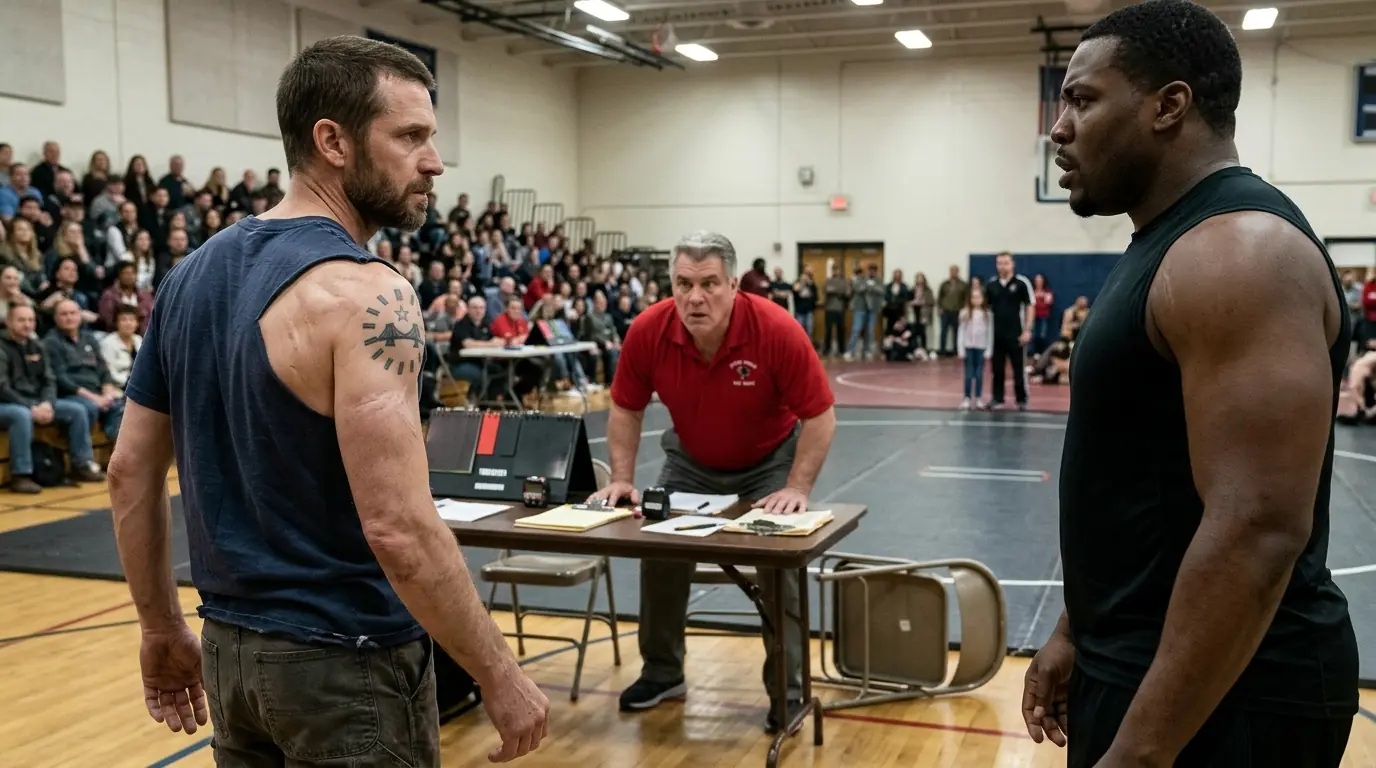
Andre smiled.
At thirty-two, he was the largest man at Hawthorne Wrestling Academy and knew exactly what his size did to a room. His sleeveless black top stretched across shoulders built through fifteen years of training. Gold shorts caught the bright overhead lights. Black knee pads and polished boots made him look ready for the ring even while standing among folding chairs.
Daniel looked ready for the end of a long shift.
He was thirty-nine, lean rather than imposing, with short brown hair, a trimmed beard, and tired eyes. His faded navy shirt carried a pale line of drywall dust near the hem. Black work trousers and worn sneakers completed an outfit that had not been chosen for a public fight.
He had come directly from repairing ventilation ducts at a grocery warehouse because Lily had begged to see the academy’s weekend exhibition.
She loved wrestling.
More precisely, she loved the part before a match when music rose, lights changed, and people entered as larger versions of themselves. She practiced introductions in front of the bathroom mirror and used couch cushions as turnbuckles. For her ninth birthday, Daniel had saved enough for two front-row exhibition tickets and a beginner’s clinic afterward.
Andre Knox had been the name printed largest on the poster.
Now he stood over Daniel’s fallen chair.
“Front row is for people who can handle the show,” Andre said.
The spectators nearest them shifted. Some smiled because they assumed the confrontation was part of the performance. Hawthorne trained professional wrestlers, and manufactured conflict lived in its walls. A camera phone rose near the aisle.
Daniel studied Andre’s expression.
This was not a planned angle.
The trouble had begun when Andre backed into Lily during his entrance and knocked a cup of soda from her hands. Daniel had steadied her and asked Andre to give the child space. Andre, hearing correction from a tired stranger in worn shoes, had decided the room needed to see who mattered.
“Pick up the chair,” Daniel said.
Andre leaned close. “You giving orders in my academy?”
“I’m telling you to fix what you knocked over.”
The audience quieted by degrees.
On the far side of the mat, head coach Samuel Vance remained seated beside the timekeeper’s table. He was fifty-eight, thick through the neck, with iron-gray hair and the patient face of someone who had spent decades watching young men confuse attention with respect.
At first, Samuel appeared amused.
Andre often improvised with spectators. He teased fathers, posed beside embarrassed teenagers, and turned minor accidents into entertainment. Samuel disliked some of it, but Andre sold tickets and drew students. The coach had learned the dangerous habit of treating discomfort as the admission price for charisma.
Lily bent to raise the fallen chair.
Andre stopped it with one boot.