The laughter started before the Black janitor had even touched the chalk. Two hundred university students filled the tiered lecture hall at Whitmore University, many already holding their phones high because everyone understood that Professor Victoria Ashford had not brought Preston Brooks into the room to test his mathematics. She had brought him there to embarrass him. Standing beside a board covered with postgraduate equations, Victoria pointed toward the unfinished problem and said, “You clean this board—you don’t belong solving what’s written on it.”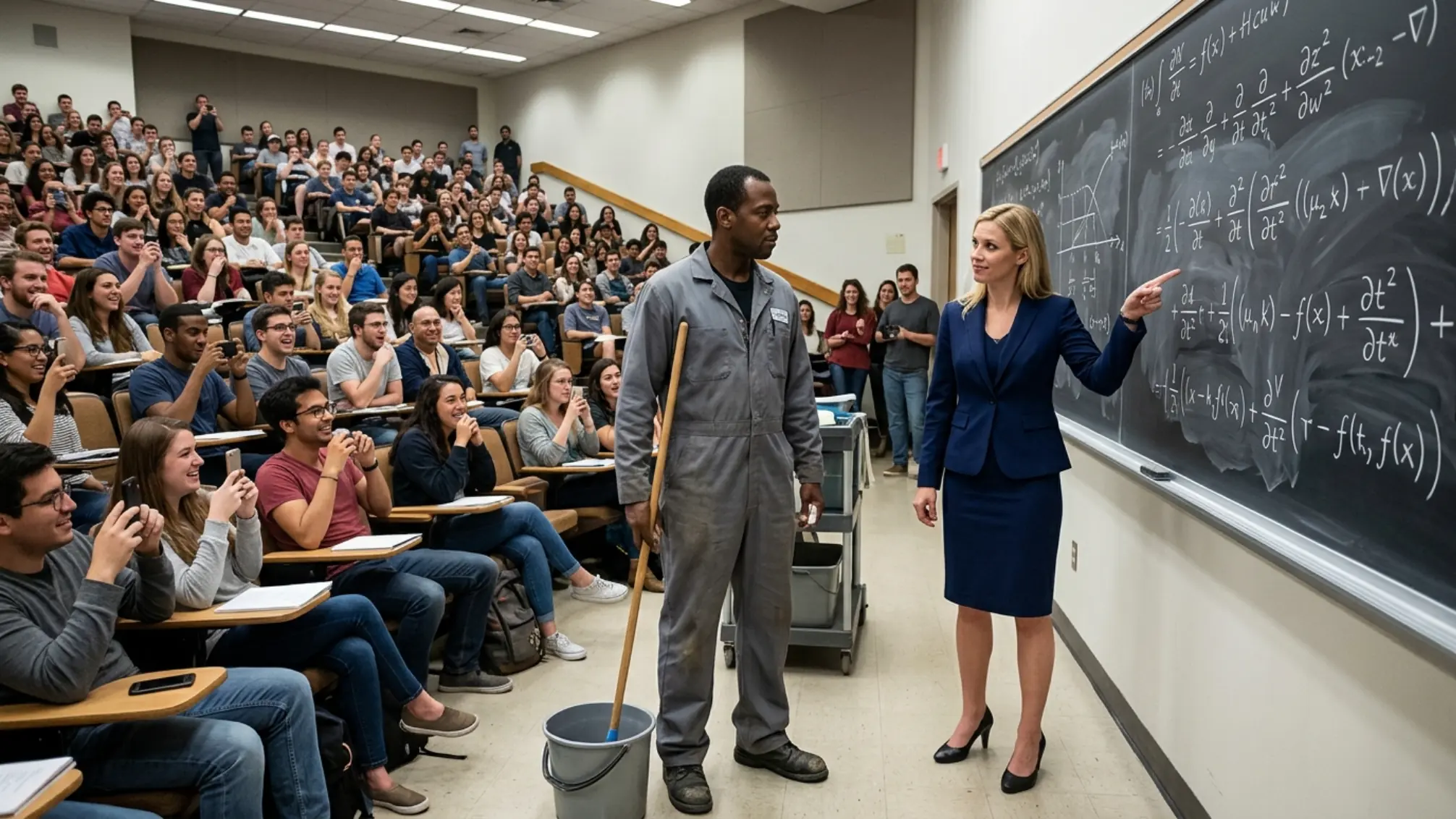
Preston stood beside his mop in a faded gray maintenance uniform, his hands dry and cracked from years of cleaning chemicals. He was forty-two, tall and solidly built, with close-cropped black hair beginning to gray around his temples and the quiet expression of someone accustomed to being overlooked. He glanced at the equation rather than the laughing students. “Then stop talking and give me the chalk.”
The room erupted again.
Victoria’s smile widened. At thirty-two, she was one of the youngest mathematics department chairs in Whitmore’s history, brilliant enough to know exactly how intimidating the equation looked to almost everyone in the room. She stepped aside dramatically and folded her arms. “Solve it, and I’ll marry you.”
More laughter rolled across the auditorium.
Preston finally looked at her.
“Keep laughing,” he said. “Your mistake is on line three.”
The laughter stopped.
For fifteen years, Preston had cleaned the mathematics building after professors and students went home. He polished the marble floors, emptied overflowing trash cans, cleaned coffee stains from desks, and erased equations from boards no one imagined he understood. Faculty members passed him in hallways without learning his name. Graduate students occasionally left food wrappers beside trash bins rather than placing them inside because they knew someone like Preston would collect them later.
What nobody knew was that Preston almost never erased a board immediately.
He studied it first.
Sometimes he copied difficult problems onto discarded printer paper. Other nights he stood alone in the silent lecture hall at two in the morning and worked through equations before cleaning away every trace of his answers. He had done that thousands of times, quietly building an education no university had ever officially given him.
Mathematics had entered Preston’s life through his late wife, Clara. She had been a high school mathematics teacher with a talent for recognizing ability hidden behind insecurity. On their second date, she had scribbled an equation on a restaurant napkin after Preston casually mentioned that he liked puzzles.
He solved it before their coffee arrived.
Clara stared at the napkin and smiled.
“You don’t calculate numbers,” she told him. “You hear them.”
Preston never forgot the sentence.
They married three years later and built an ordinary life in a small apartment outside Hartford. Clara taught school while Preston worked maintenance jobs, and at night she brought home textbooks she no longer needed. She taught him algebra properly, then calculus, discrete mathematics, number theory, and eventually subjects far beyond anything she taught her own students.
He never enrolled in college because tuition was impossible while they were raising their daughter, Lily. But he kept studying. Clara joked that he was the only man she knew who considered advanced topology relaxing.
Then Clara became sick.
Cancer changed their household almost overnight.
Medical appointments replaced weekend trips. Hospital bills replaced plans for a larger home. Preston began working additional shifts while Clara continued teaching longer than her doctors recommended because she wanted to leave something behind for Lily.
She died five years later.
Lily was eight.
Preston never stopped studying.
Clara had left behind a brown leather notebook filled with equations, observations, abandoned approaches, and small notes written in the margins. On the final pages was an unfinished mathematical problem that had fascinated her for years. Preston kept the notebook in a kitchen drawer and opened it whenever grief became too heavy to carry normally.
Numbers became his way of continuing a conversation with his wife.
At Whitmore, Professor Victoria Ashford knew none of that.
She knew only what Preston’s uniform suggested to her.
Victoria had grown up in Greenwich, Connecticut, the daughter of a federal judge and a corporate attorney. Elite private schools had carried her toward an extraordinary academic career. She completed her doctorate before twenty-six, published highly regarded papers before thirty, and arrived at Whitmore with the reputation of someone destined for major academic leadership.
Her intelligence was real.
So was her arrogance.
Victoria had begun her first semester by posting an open problem on the mathematics department board. The challenge was a variant of a long-standing conjecture that had frustrated mathematicians for decades. She offered a $50,000 research grant to anyone who produced a complete verified solution.
Doctoral students worked late into the night.
Faculty members debated approaches.
Nobody solved it.
Then one morning Victoria entered Lecture Hall A and found five unfamiliar lines written beneath the official problem.
She stopped.
The handwriting was neat and economical. Whoever had written it had avoided the standard approach and introduced a combinatorial structure Victoria had not considered. It was unfinished, but it was intelligent enough to bother her.
She checked security footage.
At 2:14 that morning, a man in a maintenance uniform had stood at her board writing.
Preston Brooks.
Victoria watched the footage twice.
Instead of wondering how a janitor had produced sophisticated mathematics, she became offended that he had entered intellectual territory she believed belonged to people with credentials.
She printed the image and brought it into the faculty lounge.
“We have a janitor who thinks he’s John Nash.”
Several professors laughed.
Professor Harold Webb did not.
Webb was sixty-five, white-haired, quiet, and only months from retirement after four decades in mathematics. He studied Preston’s work carefully before asking where the rest of it was.
“There is no rest,” Victoria replied.
Webb handed back the paper.
“That’s unfortunate.”
Victoria interpreted his reaction as irritation.
It was recognition.
Two days later, she arranged the public confrontation.
Now Preston stood at the board with two hundred students watching.
He picked up the chalk.
Victoria’s original framework covered nearly half the board. Preston followed it with his eyes, then circled a transformation on the third line.
“This doesn’t hold.”
Victoria laughed once.
“That transformation appears in every standard reference on the subject.”
“It works under symmetric boundary conditions.”
“They are symmetric.”
Preston shook his head.
“Not after your substitution on line two.”
A graduate student in the first row suddenly stopped smiling.
Preston rewrote the boundary condition.
Then he adjusted the transformation.
Three lines later, the inconsistency disappeared.
Thomas Reed, one of Victoria’s strongest doctoral students, opened his notebook and compared his own calculations. His expression changed.
“He’s right.”
Victoria turned.
“What?”
Thomas pointed toward the board.
“The boundary changes after the second substitution. I kept getting a discontinuity there, but I assumed I was making the mistake.”
Other students began checking.
Whispers spread.
Victoria stepped toward the board.
For nearly fifteen seconds she studied Preston’s correction without speaking.
Then she turned toward the room.
“I placed that error there deliberately.”
Nobody responded.
Even Victoria seemed to hear how weak the explanation sounded.
Preston set the chalk down.
He could have embarrassed her further.
Instead, he picked up his mop.
“One mistake doesn’t make you a mathematician,” Victoria said.
Preston nodded.
“No, ma’am.”
He started toward the door.
Professor Webb stood in the back row.
“Professor Ashford.”
Victoria looked toward him.
Webb spoke calmly.
“I reviewed a version of your framework last year. I flagged the same boundary problem.”
A silence heavier than the earlier laughter settled across the room.
Victoria’s face tightened.
Webb looked toward Preston.
“The janitor didn’t get lucky.”
Preston left.
By lunch, clips from the lecture had spread throughout campus.
Students replayed the moment Victoria challenged Preston to solve the equation. Others focused on Preston calmly identifying her error. The mathematics building, normally among the quietest places at Whitmore, became the center of campus gossip.
Victoria hated every second of it.
She met with Dean Richard Hale that afternoon and demanded formal disciplinary action against Preston for unauthorized use of academic facilities.
Hale stared at her.
“He wrote mathematics on a whiteboard.”
“He accessed material intended for graduate researchers.”
“The problem was publicly posted.”
“He disrupted departmental standards.”
Hale removed his glasses.
“Victoria, what exactly do you want?”
She already knew.
“A formal challenge.”
Hale leaned back.
Victoria proposed giving Preston fourteen days to present a complete solution to the open problem before a faculty committee. If he succeeded, he would receive the same $50,000 research award offered to anyone else. If he refused or failed, the university would review his unauthorized use of lecture facilities.
Hale recognized the cruelty beneath the academic language.
But he also recognized that publicly backing away now could make the university appear afraid of its own challenge.
He approved the presentation.
Preston received the official letter the following morning.
He read it during his break inside the maintenance supply room.
Fourteen days.
Fifty thousand dollars.
A problem mathematicians had struggled with for decades.
He folded the letter and put it into his pocket.
That evening Lily sat across from him doing homework while macaroni cooled on the stove.
She noticed the university letter.
“What’s that?”
“A math challenge.”
“Hard?”
Preston smiled faintly.
“Very.”
Lily returned to her worksheet.
“Mom liked hard ones.”
Preston looked toward Clara’s leather notebook on the shelf.
“Yes, she did.”
Later that night, after Lily fell asleep, Preston opened the notebook.
His chest tightened.
Clara’s final unfinished problem was not merely similar to Victoria’s challenge.
It was the same mathematical structure.
Clara had spent months exploring it years earlier, apparently without realizing how closely it connected to a famous unresolved conjecture.
Her notes approached the problem differently from almost every published attempt.
She started through combinatorics.
Preston began where she had stopped.
The first three days passed quickly.
Preston finished his maintenance shift around five each morning, returned home, prepared Lily for school, slept briefly, then worked at the kitchen table before leaving for Whitmore again.
By day four, paper covered the table.
By day five, he had reached the barrier that had defeated everyone else.
The fourth stage required a bridge between two mathematical structures that resisted standard techniques.
Preston tried the obvious methods.
They failed.
He tried variations.
They failed too.
Professor Webb found him during a midnight break sitting on an overturned cleaning bucket, calculations written across the back of discarded cardboard.
“You reached step four,” Webb said.
Preston looked up.
“How did you know?”
“Everyone reaches step four.”
Webb entered the supply room.
“I spent fourteen months there twenty years ago.”
Preston leaned back.
“You worked on this problem?”
“So did half the people who thought they were going to become famous.”
Webb studied Preston’s notes.
“But none of us started where you started.”
He returned the cardboard.
“You’re following a combinatorial path.”
“My wife did.”
Webb nodded.
“Then keep following her.”
Before leaving, Webb placed a photocopied research article on the shelf. It contained a forgotten result concerning discrete boundary structures.
“This won’t solve it,” Webb said. “But it may help you understand what kind of bridge you need.”
Preston read the article repeatedly.
Something connected with Clara’s work.
Not enough.
But something.
On day eight, Lily woke early and found her father surrounded by papers.
She picked up one page.
“This looks like butterflies.”
Preston followed her finger to an integral symbol.
He laughed.
“Your mother used to call them that.”
Lily carefully returned the page.
“Are you finishing her problem?”
“I’m trying.”
“She’d want you to.”
Those words stayed with him.
Meanwhile, Victoria began monitoring Preston more aggressively.
She requested his employment history and discovered he had no university degree. She learned about Clara and Lily. She reviewed security footage and saw Professor Webb entering Preston’s supply room.
Then she found the research article.
Victoria sent an email accusing Webb of improperly assisting Preston and Preston of academic misconduct.
The university opened an investigation.
On day thirteen, security officers entered Preston’s supply room and photographed his calculations. The university temporarily restricted his access to research spaces. Webb was suspended pending review.
Preston watched staff collect copies of the work he had spent nearly two weeks developing.
For the first time, he considered walking away.
That evening he returned home exhausted.
Lily came through the apartment door crying.
A classmate had seen an online article accusing Preston of cheating and told her that janitors could not understand advanced mathematics.
“He said Mom was probably dumb too.”
Preston went completely still.
Then he pulled Lily into his arms.
“Your mother was the smartest person I ever knew.”
“Then prove them wrong.”
The simplicity of the statement almost hurt.
After Lily went to bed, Preston sat at the kitchen table.
Clara’s notebook remained open.
Near the bottom of the final page she had written:
Almost there. Try flipping the boundary. Mirror image?
Preston had read the note countless times.
That night he finally understood.
Every published approach attempted to create the bridge in the same direction.
What if the proof moved backward?
Instead of carrying the topological structure toward number theory, Preston began with a simple number-theory identity and worked in reverse.
One line.
Then another.
The relationship opened.
He stopped breathing for several seconds.
He continued.
Step four collapsed in eleven lines.
Preston checked them.
Then checked again.
At 2:47 in the morning, he placed his pencil down.
The proof held.
He rested one hand on Clara’s notebook.
“I found your butterfly.”
The following morning, Lecture Hall A filled before eight-thirty.
Students sat on stairways when seats ran out. Faculty members occupied the front row. Local reporters stood near the rear doors after the university reluctantly allowed limited media access.
Victoria sat near the center.
Professor Webb, still under review, took a seat in the last row.
At 8:58, Preston entered.
He wore the same gray maintenance uniform.
Students expected papers, folders, maybe a laptop.
He carried none.
Only one folded page rested inside his shirt pocket.
Preston walked to the board.
He picked up the chalk.
And began.
The first section reproduced the combinatorial framework.
The second expanded it.
By the third, professors stopped taking notes casually and began following every line.
Victoria leaned forward.
Professor Eleanor Shaw, one of the most respected topologists on the committee, uncrossed her arms.
Then Preston reached step four.
He paused.
Victoria’s fingers tightened around her pen.
Preston removed the folded page.
It was not his solution.
It was a photocopy of Clara’s final notebook page.
He looked at her handwriting once.
Then returned it to his pocket.
He turned back toward the board.
The number-theory identity appeared first.
Simple.
Almost disappointingly simple.
Then Preston generalized it.
He reversed the standard direction of the proof.
Dr. Shaw sat forward.
Webb smiled from the back row.
Preston continued.
The bridge appeared.
Not through brute force.
Not through a complicated new theorem.
Through a structural reversal no one had considered because everyone had been trained to approach the problem from the opposite direction.
Eleven lines completed the fourth stage.
Preston moved into the final section.
The room became completely silent.
Forty-two minutes after beginning, Preston drew the final equality.
He stopped.
Placed the chalk on the tray.
Then stepped away.
Nobody applauded.
Not yet.
Dr. Shaw walked toward the board.
She examined the proof line by line.
Another committee member joined her.
Then another.
Victoria remained seated.
Five minutes passed.
Dr. Shaw finally turned.
“It holds.”
Whispers swept through the auditorium.
Dean Hale stood.
“All of it?”
Dr. Shaw nodded.
“Unless someone identifies an error during formal verification, this is a complete proof.”
Thomas Reed began clapping.
The sound echoed through the lecture hall.
Then another student joined.
Within seconds the entire room stood.
Preston remained beside the board.
He did not raise his arms.
He did not look toward Victoria.
He looked instead at the chalk dust covering his fingers.
Dean Hale approached.
“Mr. Brooks, where did you study mathematics?”
Preston looked toward the back of the room.
Professor Webb was standing.
Then Preston thought of Clara.
“At my kitchen table.”
The dean waited.
“My wife taught me.”
The applause returned louder.
Victoria remained seated.
Her pen had fallen onto the floor.
For the first time since meeting Preston, she did not see a janitor standing too close to mathematics.
She saw a mathematician wearing a janitor’s uniform.
The university formally verified the proof over the following weeks.
Independent specialists reviewed every step.
Preston’s result survived.
The $50,000 award was granted to him, but the consequences extended far beyond money.
Whitmore opened an investigation into how Preston had been treated. Professor Webb was cleared of academic misconduct because the article he provided had been publicly available research rather than restricted material. Victoria stepped down as department chair while the university reviewed her conduct.
Preston rejected calls to turn the story into revenge.
When reporters asked whether Victoria should be fired, he gave the same answer repeatedly.
“That’s the university’s decision.”
When asked about her public marriage challenge, he smiled for the first time.
“That wasn’t a proposal.”
The sentence became famous across campus.
More important opportunities followed.
Several universities invited Preston to speak.
A graduate program offered him a pathway built around examination rather than traditional undergraduate credentials. Whitmore itself offered tuition support if he wanted to complete formal degrees while remaining close to Lily.
Preston chose the path that kept his daughter near home.
He also insisted that Clara’s contribution be acknowledged whenever the proof was discussed.
“The idea that opened the solution was hers,” he told the mathematics committee. “She just didn’t live long enough to finish walking through the door.”
Months later, Whitmore held a small ceremony recognizing the proof.
This time Preston wore a dark suit because Lily insisted.
“You’re not going to an award ceremony dressed like you’re about to mop it,” she told him.
He laughed and obeyed.
Professor Webb sat in the front row.
Victoria sat farther back.
She had requested permission to attend.
After the ceremony she approached Preston quietly.
For once, she had no audience surrounding her.
“I owe you an apology.”
Preston waited.
“I saw your uniform before I saw you.”
He nodded.
Victoria looked toward the lecture hall doors.
“I thought intelligence had to arrive through the same doors I used.”
“And now?”
She looked back at him.
“Now I know some people were already inside before the rest of us noticed.”
Preston accepted the apology without pretending it erased what had happened.
Then Lily ran over carrying the award plaque.
“Dad, Professor Webb says there’s cake.”
Preston smiled.
“That sounds more important.”
He walked away with his daughter.
A year earlier, he had cleaned lecture halls after everyone else left.
Now he attended classes inside them.
He still worked part-time because he refused to allow one extraordinary moment to turn his life into something unrecognizable, but his university ID no longer said only Facilities.
It also said Mathematics.
One night, Preston returned to Lecture Hall A after studying late.
The building was empty.
He stood before the same board where Victoria had challenged him publicly.
An unfinished graduate problem remained written in blue marker.
Preston studied it.
He smiled.
Then he noticed a young maintenance worker entering with a cleaning cart.
The man glanced nervously toward the equation.
“You understand any of that?” Preston asked.
The worker shrugged.
“A little.”
Preston handed him the marker.
“Show me.”
The man hesitated.
“I’m supposed to clean the room.”
“So was I.”
The worker looked at him.
Then he walked toward the board.
Preston stepped aside.
Because Clara had taught him something mathematics had eventually confirmed: talent did not always arrive with credentials, titles, expensive clothes, or permission.
Sometimes it arrived after midnight.
Sometimes it carried a mop.
And sometimes all genius needed was one person willing to hand it the chalk.