Officer Bradley Mitchell laughed as he forced Special Agent Derek Hayes against the black Dodge Charger. The steel cuffs were painfully tight, but Derek kept his breathing steady and his eyes fixed on the empty highway ahead. Three police SUVs sat across the shoulder with their emergency lights flashing, painting the dark blue suit on Derek’s back in pulses of red and blue. None of the officers seemed to understand that they had just arrested the man responsible for securing the President’s approaching route.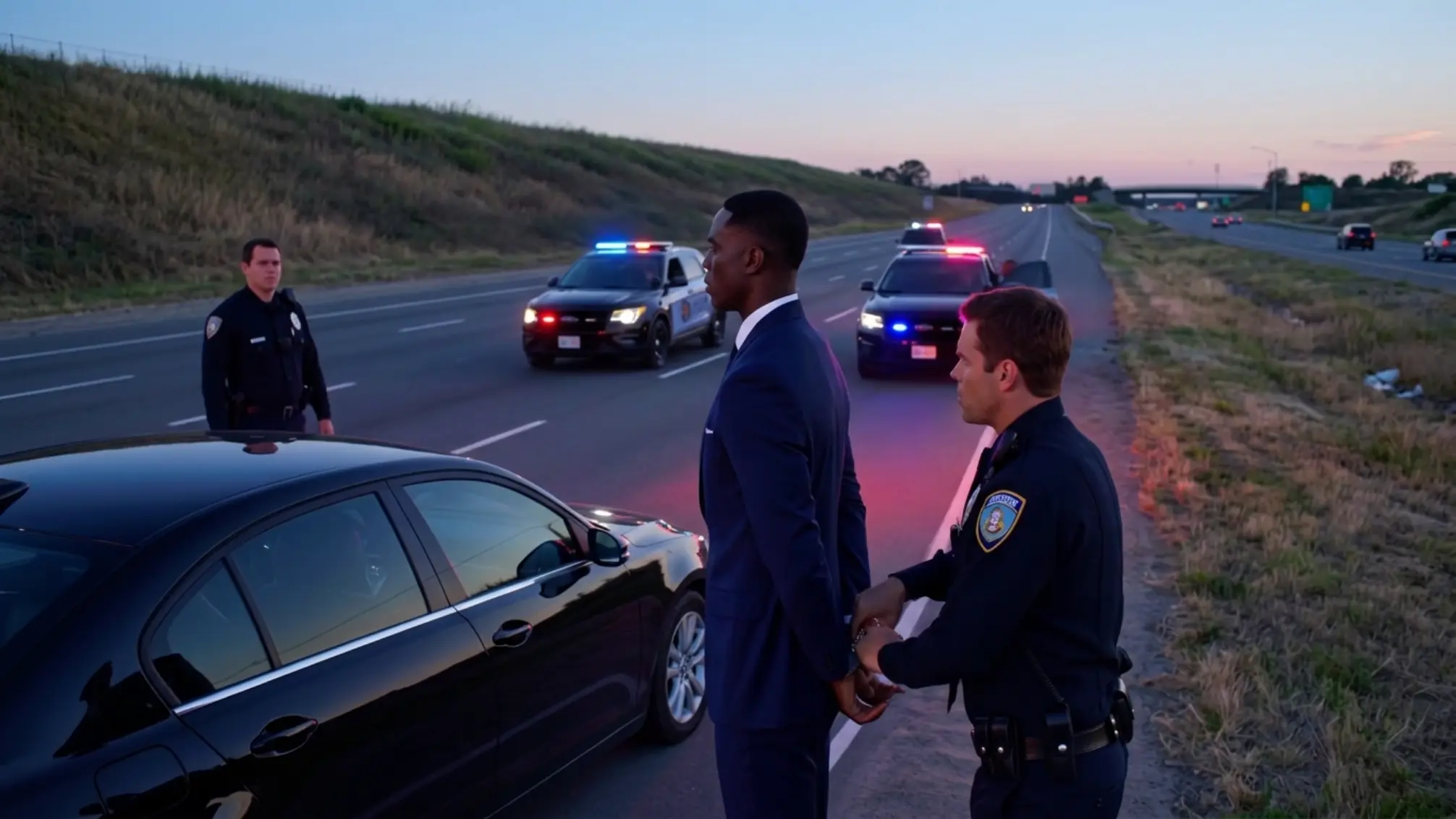
Route 114 cut through the affluent outskirts of Oak Haven, Virginia, where gated neighborhoods stood behind stone walls and rows of old pine trees. At 11:14 that night, the highway had been selected as a secondary route for an unannounced presidential movement following a private national-security fundraiser. Only the local police chief and one shift commander had received limited notification that federal activity might occur. Ordinary patrol officers were expected to remain nearby without entering the secured corridor unless contacted.
Derek had arrived twenty minutes early to inspect the intersection. At thirty-four, he had served ten years in the United States Secret Service and earned a position inside the Presidential Protective Division through discipline, patience, and a reputation for remaining calm under pressure. His tailored navy suit concealed protective equipment, an encrypted radio, and official credentials secured inside an inner pocket. The unmarked Charger carried federal plates disguised through an authorized operational registration.
The road had been empty when Bradley’s cruiser appeared behind him. Derek saw the patrol officer approach with one hand resting near his duty belt and a flashlight aimed directly into the side mirror. He lowered the window, placed both hands on the steering wheel, and identified himself as a federal agent conducting official business. Bradley responded by laughing and demanding to know which wealthy homeowner Derek intended to rob.
Derek asked him to contact the police chief.
Bradley refused.
Instead, he ordered Derek out of the vehicle and accused him of trespassing near a private neighborhood. Derek explained that he was positioned on a public highway and possessed federal authorization to remain there. Bradley told him that men driving dark cars in expensive suits did not sit outside Oak Haven estates for honest reasons.
The language told Derek more than the traffic stop itself.
Bradley had already decided what kind of man sat behind the wheel. The suit, calm voice, and official claim did not fit the story he had created, so he treated every explanation as another lie. When Derek slowly reached toward the interior pocket containing his credentials, Bradley grabbed his arm and dragged him from the Charger.
Two additional patrol units arrived after Bradley radioed that he had detained a suspicious Black male impersonating a federal officer. None of the new officers asked Derek what had happened before helping restrain him. One removed the encrypted earpiece from Derek’s collar and held it up as though it were evidence of criminal surveillance. Another opened the Charger’s rear door without consent and began searching the seats.
Derek warned them once.
“That vehicle is part of an active federal protection operation. Stop searching it and contact your commander.”
Bradley tightened the cuffs.
“You don’t give orders here.”
Derek looked at the digital clock on the dashboard. The presidential motorcade was four minutes away, and secure radio protocol prevented the approaching team from announcing its precise position over an open channel. His failure to provide the scheduled confirmation would trigger an immediate protective response. He knew the agents in the lead vehicle were already attempting to reach him.
Bradley mistook his silence for fear.
He stepped close and told Derek that admitting the truth could prevent additional charges. He suggested the suit had been stolen, the vehicle probably belonged to someone inside the gated neighborhood, and the federal equipment had been purchased online. Every accusation became more reckless because Bradley’s fellow officers continued standing behind him.
One younger patrolman looked uncertain. His nameplate read Officer Collins, and he kept glancing between Derek’s calm expression and the equipment removed from the Charger. The earpiece carried a federal inventory number, while the vehicle’s center console contained a locked communications terminal far more sophisticated than anything an ordinary impersonator could obtain.
“Sergeant,” Collins said quietly, “maybe we should verify this.”
Bradley turned toward him.
“You think every criminal wearing a tie gets to scare you?”
“No, but his credentials may be inside the jacket.”
“He doesn’t have credentials.”
“You haven’t checked.”
The challenge embarrassed Bradley in front of the other officers. He grabbed Derek by the shoulder and pushed him harder against the Charger, then ordered Collins to search the suit. Derek immediately warned that removing items from his clothing without following federal verification protocol could compromise the President’s movement.
Bradley smiled.
“There is no President coming.”
Derek turned his head toward the highway.
“Then why did your chief clear the southbound ramps twenty minutes ago?”
The officers exchanged looks.
Bradley’s confidence flickered, but he quickly covered it with anger. He claimed road closures happened for construction and accused Derek of monitoring police frequencies. Then he reached inside the suit himself and removed the black leather credential wallet.
The gold Secret Service badge reflected the emergency lights.
For one second, nobody spoke.
Bradley stared at the seal, then opened the identification panel. Derek’s photograph appeared beside his full name, agency title, and protective division designation. The younger officer stepped closer and read it twice.
“Sergeant, it’s real.”
Bradley snapped the wallet shut.
“Badges can be forged.”
Derek faced him as much as the cuffs allowed. “Call the verification number printed beneath the seal.”
Bradley refused again.
Instead, he slipped the credential wallet into his own pocket and announced that it would be logged as suspected counterfeit property. Collins protested that federal identification should not be handled that way. Bradley warned him to remain quiet unless he wanted his conduct reviewed.
The first sign of the motorcade appeared as a faint glow beyond the southern rise.
Derek saw it before the officers did. The highway surface began reflecting distant white headlights in an organized formation. A low mechanical rumble followed, deeper and more coordinated than normal traffic.
Bradley heard the sound and looked over his shoulder.
The lights multiplied.
Two police motorcycles crested the hill first, followed by a lead security vehicle and several black SUVs moving in tight formation. Behind them came the armored presidential limousine, communications vehicles, counterassault units, and additional local escorts that had joined the procession farther south.
The motorcade did not slow normally.
It reacted.
The lead vehicle detected the police blockade, the open federal Charger, and Derek standing in handcuffs beside armed local officers. Within seconds, the motorcycles spread across the lanes and stopped traffic in both directions. Black SUVs moved into protective positions around the limousine as agents exited with controlled urgency.
Bradley stepped away from Derek.
“What is this?”
Derek kept his eyes on the approaching team. “The consequence of ignoring four warnings.”
The first Secret Service supervisor reached them at a fast walk. Special Agent in Charge Rebecca Lawson was a forty-eight-year-old Black American woman known throughout the division for making decisions quickly without losing control. Her dark suit remained perfectly fitted as she scanned Derek, the handcuffs, the searched Charger, and the local officers.
“Who detained my advance agent?” she asked.
Bradley raised one hand. “This man was acting suspiciously and presented false credentials.”
Rebecca’s gaze moved toward Derek. “Agent Hayes, are you injured?”
“No, ma’am.”
“Was your identity verified?”
“They refused.”
“Did they search the federal vehicle?”
“Yes.”
Rebecca looked toward the open doors.
Her expression hardened.
The local Police Chief arrived from the rear escort vehicle less than a minute later. Chief Daniel Mercer was a sixty-year-old white American man with silver hair and nearly four decades in law enforcement. He had personally signed the federal coordination notice that Bradley had ignored.
He stared at the cuffs around Derek’s wrists.
“Who authorized this arrest?”
Bradley attempted to explain that Derek had been sitting near a private community and refused commands. The Chief asked whether Derek had committed any traffic violation. Bradley said the vehicle appeared suspicious.
“That was not my question.”
“He could have been planning a burglary.”
“Did you observe burglary tools?”
“No.”
“Did anyone report a burglary?”
“No, but—”
“Did you call the federal verification number?”
Bradley stopped speaking.
The Chief turned toward Collins. “Remove those cuffs.”
Bradley objected immediately. He claimed Derek remained under investigation and releasing him could endanger the motorcade. Rebecca stepped between them with a look that ended the argument.
“The man you arrested designed this checkpoint,” she said. “Your interference created the threat.”
Collins unlocked the cuffs.
Derek rubbed his wrists once, then immediately returned to duty. He did not shout at Bradley or demand revenge. He checked the Charger’s communications system, confirmed that nothing dangerous had been disturbed, and reported the status of the intersection to Rebecca.
The presidential limousine remained protected behind several vehicles.
A senior agent approached the rear door and spoke briefly through an encrypted communication system. Moments later, the motorcade commander informed Rebecca that President Arthur Caldwell wanted a direct explanation for the delay. The President had been told that his advance agent had been detained by local police on the secured route.
Bradley’s face became pale.
The Chief ordered him and the other involved officers to surrender their body cameras and remain beside their vehicles. Collins complied immediately. Another officer looked toward Bradley before reluctantly removing his camera.
Bradley claimed his device had malfunctioned.
Derek looked at the small green light on the unit.
“It’s recording now.”
“It shut off during the struggle.”
“Convenient.”
Rebecca instructed a federal technician to preserve all local recordings, cruiser footage, dispatch transmissions, and highway-camera data. The investigation would not depend on competing memories. Every movement had been captured by the federal Charger, the lead surveillance unit, and the motorcade’s forward cameras.
The President’s limousine door remained closed, but his presence changed the road. Bradley had treated Derek as a man whose word would never outweigh a uniform. Now the highest-protected official in the nation waited fifty yards away because Bradley’s actions had interrupted a classified movement.
Chief Mercer pulled Bradley aside.
“You were told through briefing that federal activity could occur tonight.”
“We weren’t given names.”
“You did not need a name to follow verification procedure.”
“He looked suspicious.”
The Chief’s voice dropped. “Explain precisely what that means.”
Bradley glanced toward Derek.
He had no answer he could defend.
Collins spoke before the silence grew longer. He admitted Derek had remained calm, kept his hands visible, and repeatedly identified himself. He also confirmed that Bradley refused to verify the credentials after finding them. The other two officers looked at him with anger, but Collins continued.
“He told us the President was coming.”
Bradley snapped, “You believed that?”
“No,” Collins answered. “But I believed we should check.”
The motorcade commander received authorization to move after federal agents resecured the intersection. The vehicles began rolling again, but the presidential limousine slowed beside Derek instead of continuing at full speed.
Its rear window lowered several inches.
President Arthur Caldwell sat inside, visible beneath the interior light. He was a fifty-seven-year-old Black American man with a composed face and a reputation for remembering the names of his protective agents. He looked first at Derek’s wrists, where red marks remained, and then toward Bradley.
“Agent Hayes,” the President said, “are you able to continue?”
“Yes, Mr. President.”
“Were you given the opportunity to identify yourself?”
“No, sir.”
The President looked toward Chief Mercer. “I expect an honest investigation, not a convenient one.”
“You will have it, Mr. President.”
Then the President addressed Derek again.
“Secure the route.”
Derek nodded.
The window closed, and the limousine moved forward.
Bradley stood frozen as the motorcade passed. Vehicle after vehicle rolled by, carrying federal agents, communications specialists, medical staff, and senior officials. Each one represented the operation he had dismissed as a fantasy because he could not imagine the Black man in front of him possessing such authority.
After the final vehicle cleared the highway, Rebecca formally placed Bradley’s credentials and duty status under federal and departmental review. He was not immediately arrested because investigators needed to establish the full sequence of events, but he was removed from patrol and ordered not to contact witnesses.
Bradley protested.
“You’re taking his side because he works for the President.”
Rebecca answered coldly. “We are preserving evidence because you detained a federal agent without cause, ignored valid credentials, and compromised a protected movement.”
“He was parked in a suspicious place.”
“A public shoulder on an authorized route.”
“He resisted.”
The Charger’s interior recording captured Derek complying with every instruction until officers attempted to remove classified equipment. Bradley’s own cruiser microphone recorded him making assumptions about Derek before requesting identification.
The evidence grew worse overnight.
Dispatch records showed Bradley never entered the federal badge number for verification. He also falsely reported that Derek reached for a weapon, even though every camera showed both hands visible when the officer pulled him from the vehicle.
The report used language from previous arrests.
Federal investigators reviewed Bradley’s disciplinary history and discovered fourteen civilian complaints over six years. Black motorists described being stopped near affluent neighborhoods and accused of theft without evidence. Several reported that Bradley refused to believe professional identification, vehicle ownership documents, or explanations for their presence.
A Black physician had been detained while entering the home of a patient receiving emergency care. A university professor was handcuffed beside his own vehicle after Bradley claimed the registration looked too expensive for him. A real-estate agent showing a property was held for forty minutes until the homeowner arrived.
Each complaint had been dismissed.
Bradley’s supervisor frequently accepted his claim that motorists became aggressive or failed to cooperate. Body-camera footage was missing from nine of the incidents. In three cases, the recordings began only after the drivers were already in handcuffs.
The pattern transformed the Secret Service incident from a single catastrophic mistake into evidence of repeated abuse.
Chief Mercer placed the supervisor on administrative leave and requested an outside civil-rights investigation. He understood that his department could not credibly examine years of complaints it had already dismissed. The state attorney general and Department of Justice joined the review.
Collins became an important witness.
He provided text messages from a private officer group in which Bradley mocked drivers he stopped near gated communities. Some messages included photographs of handcuffed civilians taken before charges were filed. Bradley described the area as territory that needed protection from “people who didn’t fit.”
The messages confirmed prejudice, but they also exposed institutional failure.
Several officers responded with laughter. Others remained silent. No one reported the photographs or language to command staff.
Collins admitted he had seen similar behavior before the night Derek was arrested. He said Bradley controlled shift recommendations and could make younger officers’ lives difficult. Fear explained his silence, but did not excuse it.
Derek met Collins during a formal interview two weeks later.
“You spoke up eventually,” Derek said.
“Too late.”
“Late is better than never. But the next person may not have a motorcade behind him.”
Collins lowered his eyes. “I know.”
That sentence became central to Derek’s testimony. He did not want the story reduced to a satisfying reveal in which a racist officer learned he had arrested someone powerful. The danger existed precisely because most people stopped by Bradley did not carry Secret Service credentials or stand four minutes ahead of the President.
The badge protected Derek eventually.
Others had only their word.
President Caldwell requested regular updates but avoided interfering with prosecutorial decisions. During a private meeting, he asked Derek whether he wanted reassignment while the case attracted national attention. Derek refused.
“I did my job that night,” he said. “I want to keep doing it.”
The President nodded. “Then do not let anyone turn what happened into a story only about me.”
Derek understood.
Public headlines focused on the motorcade surrounding the police stop, but he used every interview authorized by the agency to mention the previous complainants. The physician, professor, real-estate agent, and other motorists had described the same conduct long before federal vehicles appeared on Route 114.
Their stories had been ignored because no President was waiting.
Bradley was eventually charged with deprivation of rights under color of law, falsifying reports, obstruction, unlawful detention, and interference with federal protective operations. The searching officers faced lesser charges and departmental discipline depending on their actions and cooperation.
Bradley’s supervisor was charged with evidence tampering after technicians recovered messages instructing officers to classify camera failures as technical malfunctions. He had also pressured complainants to withdraw statements by warning that false accusations against police could lead to prosecution.
The criminal trial lasted three weeks.
Bradley’s attorney argued that the officer faced a confusing nighttime situation involving an armed man in an unmarked vehicle. Prosecutors showed that Derek never displayed a weapon, repeatedly requested verification, and provided authentic credentials before Bradley escalated the detention.
The jury watched synchronized footage from four cameras.
It showed Derek’s hands on the steering wheel.
It showed Bradley pulling him from the vehicle.
It showed the gold badge.
It showed Bradley placing the credentials into his own pocket and refusing to verify them.
Then the footage showed the President’s motorcade cresting the hill.
Bradley was convicted.
At sentencing, Derek did not ask for the maximum punishment. He spoke about responsibility instead.
“You did not arrest me because evidence made me dangerous,” he said. “You arrested me because your assumptions made my presence unacceptable. The motorcade exposed your mistake, but the people you treated this way before me had already exposed the pattern.”
Several former complainants sat behind him.
The judge imposed a substantial prison sentence and emphasized that a uniform granted authority to enforce law, not permission to replace evidence with prejudice. The supervisor was convicted separately, while the department entered a federal reform agreement.
Oak Haven changed its stop procedures.
Officers were required to verify government credentials immediately through dispatch. Body-camera interruptions triggered automatic external review, and supervisors could no longer dismiss civil-rights complaints without interviewing witnesses and examining available footage.
Traffic-stop data was reviewed for racial and geographic disparities. Officers who repeatedly used vague descriptions such as “out of place” or “suspicious presence” without documented conduct received mandatory review.
The department also created a duty-to-intervene policy.
Remaining silent while another officer violated someone’s rights became an independent disciplinary offense. Collins helped teach the first training class, beginning each session by admitting that he had once waited too long.
Derek returned to Route 114 nearly a year after the incident. He parked near the same oak tree in another unmarked vehicle while preparing for a presidential movement. The highway looked ordinary beneath the evening sky.
A local patrol car approached.
The officer inside was Collins.
He stopped several yards away, contacted dispatch, confirmed the federal operation, and remained at the perimeter without interfering. Before leaving, he lowered his window.
“Route is clear, Agent Hayes.”
Derek nodded. “Keep it that way.”
Minutes later, the presidential motorcade passed without slowing.
No confrontation occurred.
No headlines followed.
That quiet success represented the change Derek wanted more than public revenge. The system had finally worked because an officer chose verification over assumption and duty over pride.
Bradley had believed the handcuffs proved which man controlled the highway.
Then the distant lights appeared.
The President’s motorcade surrounded the scene, federal agents stepped onto the road, and the badge Bradley called fake became the first piece of evidence in the case that ended his career.
But Derek never considered the President’s arrival the true reversal.
The real reversal came when every ignored driver returned to tell the truth—and this time, the entire country listened.