Gordon Wells read the railroad’s letter twice before folding it into the pocket of his faded work shirt. The message was written in polite corporate language, but Gordon understood exactly what it meant: accept twelve thousand dollars, or watch a new railroad track cut straight through the center of the 220-acre Missouri farm his family had worked for generations. He stood at the kitchen table while his wife Patricia watched his face harden, waiting for the anger she knew he would never show loudly. Gordon said nothing, walked toward the barn, climbed onto his faded red 1952 Farmall M, and started the engine.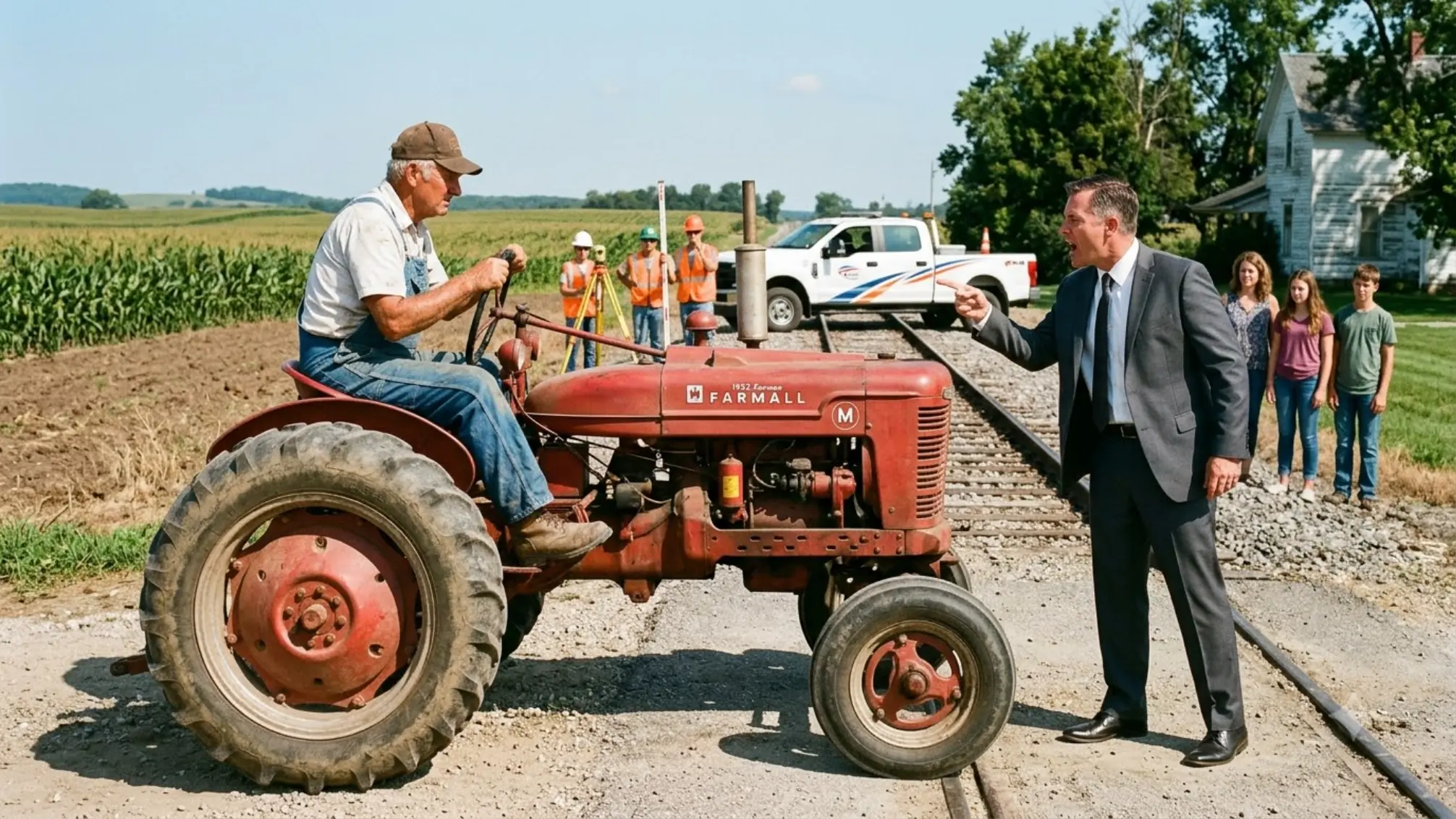
“Gordon, wait!” Patricia shouted as she hurried across the yard. Their adult son Michael stepped from the equipment shed and grabbed the tractor fender, asking where his father thought he was going, but Gordon eased the machine forward without answering. At sixty-eight, he had spent forty-two years farming the same fields, and his family knew that when Gordon became completely silent, a decision had already been made. He turned toward the railroad crossing at the northern edge of the property and never looked back.
The tracks had been part of the Wells farm since long before Gordon was born. A single rail line crossed the northern edge under an old right-of-way recorded in the nineteenth century, and generations of Wells farmers had simply worked around it. Gordon’s grandfather planted corn beside those rails, his father hauled hay across them, and Gordon himself had waved at engineers passing through since he was a child. The railroad had always been a neighbor, inconvenient at times but familiar enough that nobody imagined it would one day threaten the farm itself.
That changed when Meridian Continental Rail announced a regional expansion. The company wanted a second track capable of carrying longer freight trains through Callaway County, but the proposed route did not stay beside the original line. Survey stakes suddenly appeared across Gordon’s south field, cutting diagonally through the richest forty acres on his property. If built as planned, the new track would separate the barn, equipment sheds, and cattle pens from almost half the acreage they served.
Gordon had first assumed someone had made a mistake. Then Steven Cross, Meridian’s regional attorney, arrived at the Wells farm wearing a charcoal suit that looked absurd beside muddy tractors and weathered fencing. Cross spread glossy maps across the hood of Gordon’s pickup and spoke about transportation efficiency, regional commerce, and public necessity. Then he handed Gordon a check for twelve thousand dollars and called it a courtesy payment for inconvenience.
Gordon looked at the number.
Then at the map.
“Twelve thousand?”
Cross smiled. “The railroad already possesses expansion rights associated with the existing corridor. The payment recognizes the disruption to your operations.”
Patricia stared at him.
“You’re splitting our farm in half.”
Cross adjusted his cuff. “The company understands there will be inconvenience.”
Gordon tapped the map with one rough finger. “That field produces more than twelve thousand dollars worth of crops in a good year.”
Cross’s smile disappeared slightly. “Mr. Wells, this isn’t a negotiation over whether the project occurs.”
Gordon looked at him.
“Then why bring me a check?”
The attorney did not answer.
That question stayed with Gordon after Cross left. He took the railroad’s map to agricultural property attorney Carol Marsh, a woman who had spent twenty years representing farmers in easement and condemnation disputes. Carol placed Meridian’s survey beside the historic deed and spent most of an afternoon comparing measurements. Four days later, she called Gordon and told him something that turned his suspicion into certainty.
“The proposed track is outside the original right-of-way.”
“How far?”
“At the closest point, around eleven feet.”
Gordon sat straighter.
“And at the widest?”
“Closer to nineteen.”
Silence followed.
Carol continued. “They may eventually obtain the land through condemnation, but they cannot pretend they already own it.”
Gordon looked through the kitchen window toward the south field.
“So twelve thousand wasn’t compensation.”
“No.”
“What was it?”
Carol paused.
“An attempt to settle before you understood what your land was worth.”
That answer changed everything.
Gordon began collecting documents his father had stored in a steel cabinet inside the farmhouse. Old deeds, farm maps, county records, easement descriptions, photographs of boundary markers, and property-tax records covered the dining-room table. Patricia helped organize them while Michael scanned copies into his laptop. For a week, the Wells family turned their farmhouse into something between a law office and an archive.
The deeper Gordon looked, the angrier he became.
The new track would not merely take a strip of soil. Farm equipment would need alternate routes, cattle movement would become more difficult, drainage patterns could change, and the south field would be physically separated from the barn. A farm was not just a collection of acres with a price per acre; it was a working system, and the railroad’s line would slice directly through that system.
Carol ordered an independent appraisal.
The preliminary numbers shocked Gordon.
The land itself was valuable, but the operational damage was worth even more. Severance costs, reduced efficiency, crop disruption, and access problems pushed the realistic compensation far beyond Meridian’s twelve-thousand-dollar offer. Carol warned Gordon not to communicate further with Cross without documentation.
Then a survey crew arrived anyway.
At 8:50 on a Tuesday morning, Gordon saw trucks parked near the crossing. Six workers in bright orange safety vests unloaded tripods, measuring equipment, stakes, and marking paint. Steven Cross stood beside them holding a leather briefcase and talking into his phone. No one had called Gordon that morning.
He walked into the barn.
The Farmall M sat exactly where his father had parked it decades earlier.
The tractor was faded, scarred, and mechanically simple compared with Gordon’s newer equipment, but it still started every time. He checked the fuel, climbed into the seat, and drove toward the tracks. Patricia saw him from the porch and immediately understood.
“Gordon!”
He kept going.
Michael ran after the tractor.
“Dad, don’t do something stupid.”
Gordon finally looked down at him.
“I’m not.”
“Then what are you doing?”
“Making them stop long enough to read.”
The Farmall reached the crossing at 9:40.
Workers turned as Gordon approached. Cross stepped toward the tractor and raised one hand, but Gordon drove past him without slowing. He aligned the Farmall across the work area, positioned it directly over the disputed section, shut off the engine, and folded his arms across his chest.
Cross stared at him.
“Move the tractor.”
Gordon remained seated.
The attorney walked closer.
“Mr. Wells, this is an active railroad corridor.”
Gordon looked down.
“Then show me where your easement gives you my south field.”
Cross’s face hardened.
“You are interfering with authorized survey operations.”
“On my property.”
“We offered compensation.”
“Twelve thousand.”
“Correct.”
Gordon leaned forward slightly.
“Take it before this gets ugly.”
Cross stared.
Gordon’s voice dropped.
“No.”
Behind them, the survey workers exchanged uncomfortable looks.
Cross pulled out his phone.
“You’re forcing me to call the sheriff.”
Gordon settled deeper into the tractor seat.
“Call whoever reads maps.”
The sheriff arrived first.
Sheriff Ray Coleman had known Gordon most of his life and looked unhappy before he even stepped from his cruiser. He walked toward the tractor, glanced at Cross, then toward the survey stakes running through the Wells field. Patricia and Michael stood near the fence, while several neighbors had already gathered along the road after hearing that Gordon Wells had parked a tractor on the railroad work site.
“Gordon.”
“Morning, Ray.”
“You planning on moving?”
“Eventually.”
“When?”
“When somebody proves they have the right to work where they’re working.”
Cross interrupted. “Sheriff, this man is obstructing a federally regulated transportation project.”
Ray looked toward him. “You have paperwork establishing possession of this ground?”
Cross opened his briefcase.
“I have the railroad’s expansion documentation.”
“That wasn’t my question.”
Cross’s jaw tightened.
Ray rubbed his forehead.
“This is above what I’m deciding standing beside a tractor.”
He called the county commissioner.
Forty minutes later, Diane Fuller arrived personally.
Diane had spent eleven years on the county commission and knew every major rail expansion dispute in Callaway County. She walked onto the gravel without ceremony, stopped beside Gordon’s tractor, and looked from the farmer to the attorney. Cross immediately began explaining federal rail authority.
Diane interrupted him.
“Before anyone touches that tractor, show me the easement.”
The atmosphere changed.
Cross hesitated.
Diane repeated herself.
“The recorded easement.”
He pulled documents from his briefcase and laid them across the hood of the sheriff’s cruiser. Diane examined the historic right-of-way, then Meridian’s proposed survey. Her expression tightened.
“These don’t match.”
Cross replied immediately. “The railroad’s authority permits reasonable expansion necessary for interstate operations.”
“Inside the corridor?”
“Generally.”
Diane pointed toward the proposed route.
“This isn’t inside it.”
Cross began another explanation.
Diane raised one hand.
“County surveyor is coming.”
Gordon remained on the Farmall.
The sun climbed higher.
By noon, more than thirty people had gathered near the crossing. Some farmers brought folding chairs. Others stood beside pickup trucks drinking coffee as though they were watching a county fair event. Patricia eventually carried Gordon a sandwich, but he refused to leave the tractor.
“You’re enjoying this,” she said.
“No.”
“You look like your father.”
“That’s not the same thing.”
She handed him water.
“He would’ve enjoyed it.”
Gordon almost smiled.
The county surveyor arrived with digital equipment and two assistants. Measurements began at known property monuments well outside the disputed area, then moved toward the rails. Cross stood nearby making phone calls while Diane watched every measurement.
The process took nearly an hour.
Finally the surveyor walked toward Diane carrying his tablet.
“The proposed center line is outside the recorded right-of-way.”
Cross stepped closer.
“By how much?”
“At this location, eleven-point-three feet.”
Gordon looked down from the tractor.
“And farther south?”
The surveyor checked.
“Maximum deviation we measured is just over nineteen feet.”
A murmur spread through the crowd.
Cross’s face became red.
He began talking about federal supremacy, engineering requirements, and historic railroad expansion rights. Diane listened until he finished.
Then she asked one question.
“Do you have a condemnation order?”
Cross said nothing.
“Purchase agreement?”
Nothing.
“Recorded easement covering the additional land?”
Silence.
Diane looked toward the survey crew.
“Stop work.”
Cross stepped forward.
“You cannot stop a federally authorized rail project.”
“I’m not stopping the rail project.”
She pointed toward Gordon’s field.
“I’m stopping unauthorized work on property you have not shown you control.”
At 2:17 that afternoon, the order was written.
The survey crew packed the equipment.
Workers loaded tripods into trucks.
Cross stood beside his car making angry calls while Gordon remained on the tractor.
Only after the final railroad truck left did Gordon restart the Farmall.
The old engine coughed twice before settling into a steady rhythm.
He drove back toward the barn.
Neighbors clapped as he passed.
Gordon ignored them.
Patricia walked beside the tractor until he parked.
“You sat there almost five hours.”
“Six.”
“What were you thinking about?”
Gordon climbed down slowly.
“My father.”
Patricia waited.
“He never trusted railroad paperwork.”
She smiled.
“That all?”
Gordon looked toward the south field.
“I kept thinking he would’ve told me to stay until somebody read the deed.”
Three weeks later, Meridian filed formal condemnation proceedings.
Cross probably expected the filing to frighten Gordon.
Instead Carol Marsh called him almost cheerful.
“This is what we needed.”
“How is being condemned good?”
“Because now they have to value the damage.”
The court ordered independent appraisal.
Soil productivity was measured.
Crop history was reviewed.
Operational access was analyzed.
The appraiser evaluated what would happen if machinery had to travel around the new track every day, how the line would affect irrigation and field configuration, and how much value the remaining acreage would lose after being divided.
The numbers climbed quickly.
Forty thousand dollars in estimated severance-related losses alone.
Then land value.
Crop disruption.
Operational costs.
Access modifications.
Carol’s final supported figure reached $114,000.
Gordon stared at the appraisal.
“They offered twelve.”
Carol nodded.
“Because twelve is cheaper than one fourteen.”
Meridian disputed the valuation.
Its attorney argued that Gordon retained useful farmland on both sides of the proposed track. Carol responded that a farm could not be valued as though fences, barns, machinery, labor, and access did not exist. Gordon listened quietly through hearings while professionals argued over soil maps and productivity tables.
Then another problem surfaced.
Diane Fuller had requested review of previous rail expansions in Callaway County.
Fourteen farms had experienced similar projects during the previous six years.
Nine owners had complained about boundaries or compensation.
Three projects showed significant questions concerning work outside existing easements.
Gordon’s tractor protest had opened a much larger file.
One farmer named Walter Jennings discovered he had accepted twenty-two thousand dollars for ground later appraised at nearly seventy thousand. Another family had allowed a maintenance road across land not clearly covered by the railroad’s recorded rights. A third farm showed survey work performed beyond an easement line before formal condemnation began.
Meridian suddenly faced scrutiny it had never expected from one stubborn farmer.
Cross called Carol privately before Gordon’s final hearing.
“Company offers ninety-eight thousand.”
Carol called Gordon.
He was repairing a hydraulic hose.
“Ninety-eight.”
“No.”
“You want to think about it?”
“No.”
“What number?”
Gordon wiped his hands.
“One fourteen.”
“They may refuse.”
“Then court.”
Carol smiled.
“I thought you’d say that.”
The answer came the next morning.
Meridian accepted the $114,000 valuation.
But Gordon surprised everyone afterward.
He still opposed the route.
The money had never been the only issue.
Gordon and Carol presented Meridian with an alternative engineering proposal that kept the second line much closer to the historic northern corridor. The route required additional work, but it avoided splitting the Wells farm and reduced operational damage substantially.
Under increasing county and state scrutiny, Meridian reconsidered.
The final track alignment followed the existing railroad edge rather than cutting directly through Gordon’s south field.
His farm remained whole.
The barn stayed connected to the working acreage.
That autumn Gordon climbed into his combine and harvested the same forty acres Meridian’s original map would have divided. Patricia rode with him for part of the afternoon.
“You realize everyone around here thinks that tractor saved the farm.”
Gordon looked across the field.
“The tractor didn’t save anything.”
“What did?”
“Paperwork.”
Patricia laughed.
“Not as good a story.”
“It’s the true one.”
The Farmall became something of a local attraction anyway.
People stopped to photograph it.
A farm organization asked Gordon to speak about property rights.
He refused the first three invitations.
Then Diane convinced him.
“You don’t have to make a speech.”
“What am I supposed to say?”
“Tell them what happened.”
At the county agricultural meeting, nearly two hundred landowners filled the room.
Gordon stood behind a podium looking uncomfortable.
He held the original railroad letter.
“Twelve thousand dollars.”
The room became quiet.
“That was the first number.”
He placed the letter down.
“The mistake I almost made was thinking the argument was about whether twelve thousand was enough.”
People listened.
“It wasn’t.”
He held up a copy of the historic survey.
“The first question was whether they had the right to take the land at all.”
Several farmers nodded.
Gordon continued.
“Don’t assume a company knows your boundary better than you do because their letter has a logo.”
A few people laughed.
“Read your deed.”
He looked around.
“Get a survey.”
Another pause.
“And when somebody tells you something is already decided, find out whether they’re saying that because it’s true or because they want you to believe fighting is pointless.”
That became the line everyone remembered.
The county investigation eventually forced renegotiation on three other properties.
Not every farmer recovered everything they believed they deserved.
The law was more complicated than a viral story.
Some easements were broad.
Others were unclear.
Every deed differed.
But Gordon’s case created one lasting change.
Before new railroad work began in Callaway County, recorded corridor boundaries had to be verified against current surveys.
Years later, Gordon still farmed.
Slower.
With more help from Michael.
The Farmall remained in the barn beside machines several generations newer.
One afternoon his grandson Caleb, eleven years old and obsessed with the story, climbed into the tractor seat.
“Grandpa?”
“What?”
“Were you scared when the sheriff came?”
Gordon considered the question.
“Yes.”
Caleb looked surprised.
“But everybody says you weren’t afraid of anybody.”
“Everybody wasn’t sitting on the tractor.”
The boy laughed.
Gordon rested one hand on the hood.
“Being sure you’re right doesn’t mean you know what happens next.”
“What if they arrested you?”
“I thought about that.”
“What would you have done?”
“Called Carol.”
Caleb frowned.
“That’s boring.”
“Most useful answers are.”
They walked toward the field.
The second railroad track could be seen along the northern edge, running beside the older rails rather than through the farm’s center.
Freight trains still passed.
Gordon never hated them.
The railroad itself had not been his enemy.
The problem had been people treating convenience as permission.
A company wanted the easiest route.
An attorney wanted the cheapest agreement.
A farmer stood between them and both.
Gordon understood why Meridian tried.
He also understood why he had to refuse.
He stopped near the edge of the south field.
Corn moved gently in the Missouri wind.
His grandfather had worked that ground.
His father had worked it.
Gordon had nearly watched it become two disconnected pieces because twelve thousand dollars arrived attached to official letterhead.
Instead, the field remained intact.
Not because an old farmer was stronger than a railroad.
Not because the Farmall could stop a train forever.
And not because powerful people suddenly became generous.
The farm survived because someone finally opened an old document and measured where one legal right ended and Gordon Wells’s property began.
Caleb looked toward the railroad.
“You think Dad will keep the farm?”
Gordon smiled.
“That’s up to him.”
“And me?”
“That’ll be up to you.”
Caleb looked serious.
“What if somebody tries taking it again?”
Gordon glanced toward the red tractor sitting beside the barn.
Then toward the cabinet inside the farmhouse where every deed, survey, appraisal, and recorded agreement had been carefully organized.
“Start with the papers.”
Caleb grinned.
“And if they don’t read them?”
Gordon finally smiled.
“Then we still have the tractor.”