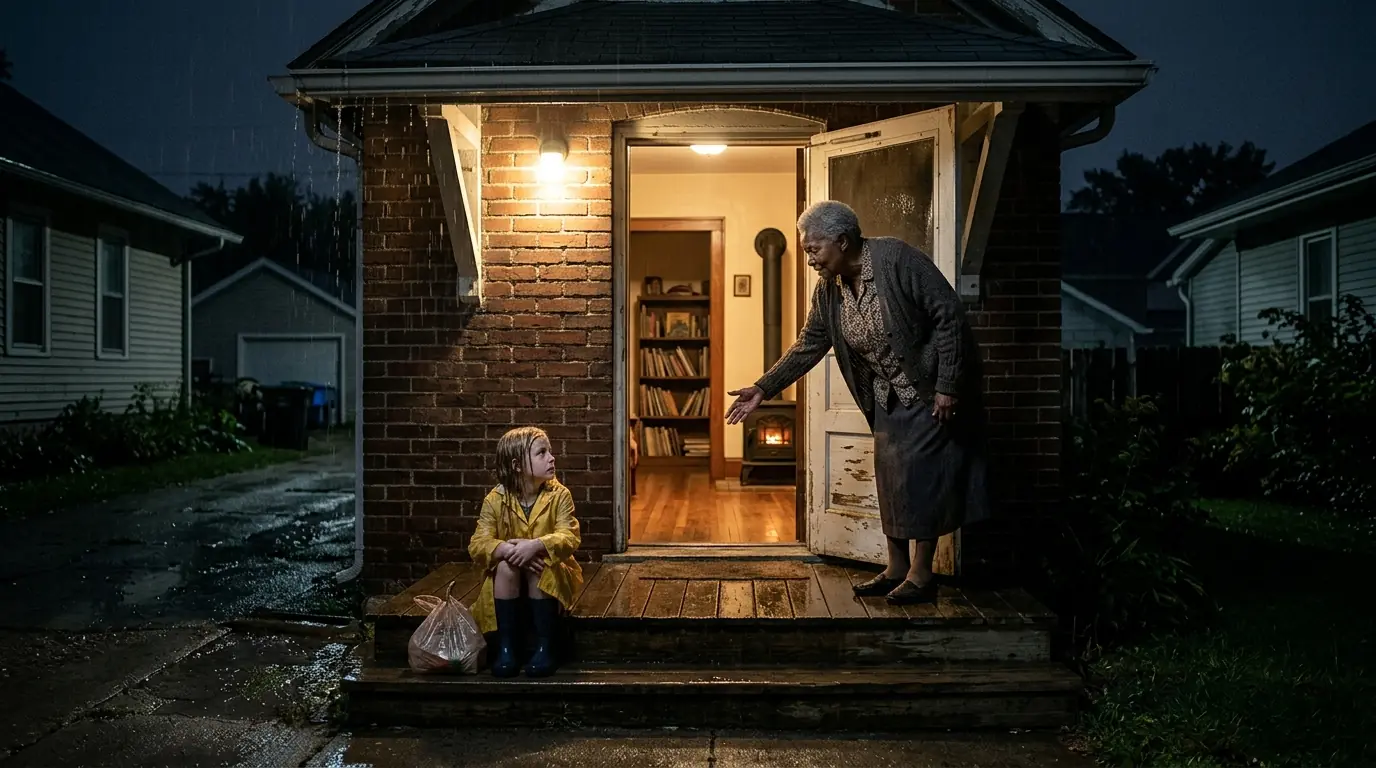
The lights were already off in Helen Parker’s small brick house in Des Moines, Iowa, when a soft thump sounded against her front porch. Helen was seventy-one, a retired elementary school teacher who lived alone with a kettle always ready on the stove and stacks of old children’s books lined neatly in the hallway.
At first, she thought the wind had knocked over one of her flowerpots. But when she opened the curtain, she saw a little girl sitting on the porch steps, hugging her knees beneath a thin yellow raincoat. The child could not have been more than nine. Her dark curls were wet, her sneakers were muddy, and beside her sat a plastic grocery bag with two shirts and a broken blue crayon inside.
Helen opened the door slowly and said, “Sweetheart, are you lost?”
The girl looked up but did not answer. Her lips trembled, yet no words came out. Helen noticed the child’s hands were red from the cold, and her eyes kept darting toward the street as if she expected someone to appear. Helen stepped aside and said, “You don’t have to talk yet. Just come in where it’s warm.”
The little girl hesitated, then walked inside without making a sound. Helen wrapped her in a soft green blanket, gave her warm milk, and placed a plate of buttered toast on the kitchen table. The girl ate in tiny bites, watching Helen with careful, frightened eyes.
Helen found a name written inside the girl’s raincoat: Sophie Miller. When Helen gently asked if that was her name, the girl nodded once. Helen called the police station and child services, but a heavy storm had flooded several roads, and they told her to keep Sophie safe until someone could arrive. Helen had spent thirty years calming frightened children, so she did not push. She set out paper, crayons, and an old stuffed rabbit from a classroom box she had kept in the closet. Sophie did not speak, but after a long while, she began to draw.
The first picture showed a small white house with smoke coming from the chimney. The second showed a woman lying in bed. The third showed Sophie standing outside a locked door while rain fell around her. Helen felt her throat tighten. She asked softly, “Is your mother sick?” Sophie’s eyes filled with tears. She nodded again, then pointed to the drawing of the house and tapped the paper urgently.
Helen called her neighbor, Marcus Hill, a kind Black man in his forties who worked as a delivery driver and knew every side street in town. Together, they studied the drawing. Marcus noticed a church steeple behind the house and a mailbox shaped like a red bird. “I’ve seen that mailbox,” he said. “It’s over near Brookside Avenue.”
Helen did not want to frighten Sophie, but the child was already standing by the door, clutching the stuffed rabbit like it was a lifeline. Helen put on her coat, and Marcus drove them through the rain toward Brookside.
 They found the white house just before dawn. The front door was unlocked. Inside, a woman named Laura Miller was lying on the bedroom floor, barely conscious, one hand reaching toward a phone that had fallen just out of reach. Sophie ran to her mother and finally made a sound, a broken little cry that seemed to tear through the room. Helen called 911 while Marcus covered Laura with a blanket and spoke to her until the ambulance arrived. The paramedics said Laura’s blood sugar had dropped dangerously low, and if Sophie had not gone for help, she might not have survived the night.
The truth came slowly. Laura was a single mother who cleaned offices at night and had been hiding how sick she was because she feared losing custody of Sophie. She had no family nearby, no savings, and no one she trusted enough to ask for help. Sophie had found her mother collapsed, tried to call for help, but the phone was dead. So the little girl walked through the storm, unable to speak from fear, until she saw Helen’s porch light glowing at the end of the block.
Helen could have stepped back once Laura reached the hospital, but she did not. She brought Sophie home, washed her muddy clothes, packed lunches for her, and sat beside her hospital bed when Laura was too weak to stay awake. Marcus fixed the broken lock on Laura’s front door and brought groceries without making a speech about it. For two weeks, Helen’s quiet house became a second home for Sophie. The little girl still spoke rarely, but she smiled when Helen read bedtime stories, and she began leaving drawings on the kitchen table each morning: pancakes, flowers, Marcus carrying grocery bags, Helen holding the green blanket.
When Laura was released from the hospital, she cried in Helen’s living room and said she had no way to repay her. Helen shook her head. “You don’t repay a porch light,” she said. “You just keep it burning for someone else one day.”
But the story did not end there. Months later, Helen received a letter from the local school district. Sophie’s drawings had been shown to the school counselor, who realized the child had a gift far beyond her age. The district offered Sophie a place in a special arts program, and Laura was connected with housing support, medical care, and a daytime job at the school cafeteria.
One year later, Helen attended Sophie’s first student art show. On the wall, beneath bright gallery lights, hung a drawing of a little brick house with one glowing porch lamp, rain falling all around it, and an old woman standing in the doorway with an outstretched hand. The title written under the frame was The Night Someone Opened The Door. Sophie stood beside her mother, wearing a blue dress and a shy smile. When Helen leaned down to hug her, Sophie whispered the first full sentence Helen had ever heard from her: “You heard me even when I couldn’t talk.”
Helen cried then, right there in the school hallway. She had once believed her teaching years were behind her, that her quiet house would only grow quieter with time. But Sophie had brought life back through the front door on the rainiest night of the year. From then on, Helen left her porch light on every evening—not because she expected another child to appear, but because she had learned that sometimes shelter begins long before a person steps inside. Sometimes it begins with a light that says someone is awake, someone is watching, and someone will open the door.