The three older men beside the fence laughed as though the handsome seventeen-year-old American boy had just performed for them. Their voices carried across the dry Arkansas field, over rows of brittle stalks and cracked soil that had not produced a profitable harvest in three seasons. The Boy kept his eyes on the shovel in his hands, refusing to give the Mill Owner the humiliation he wanted. Behind the red mill barn, enormous hills of pale rice husks rose higher than some houses, waste accumulated from years of processing grain from wealthier farms.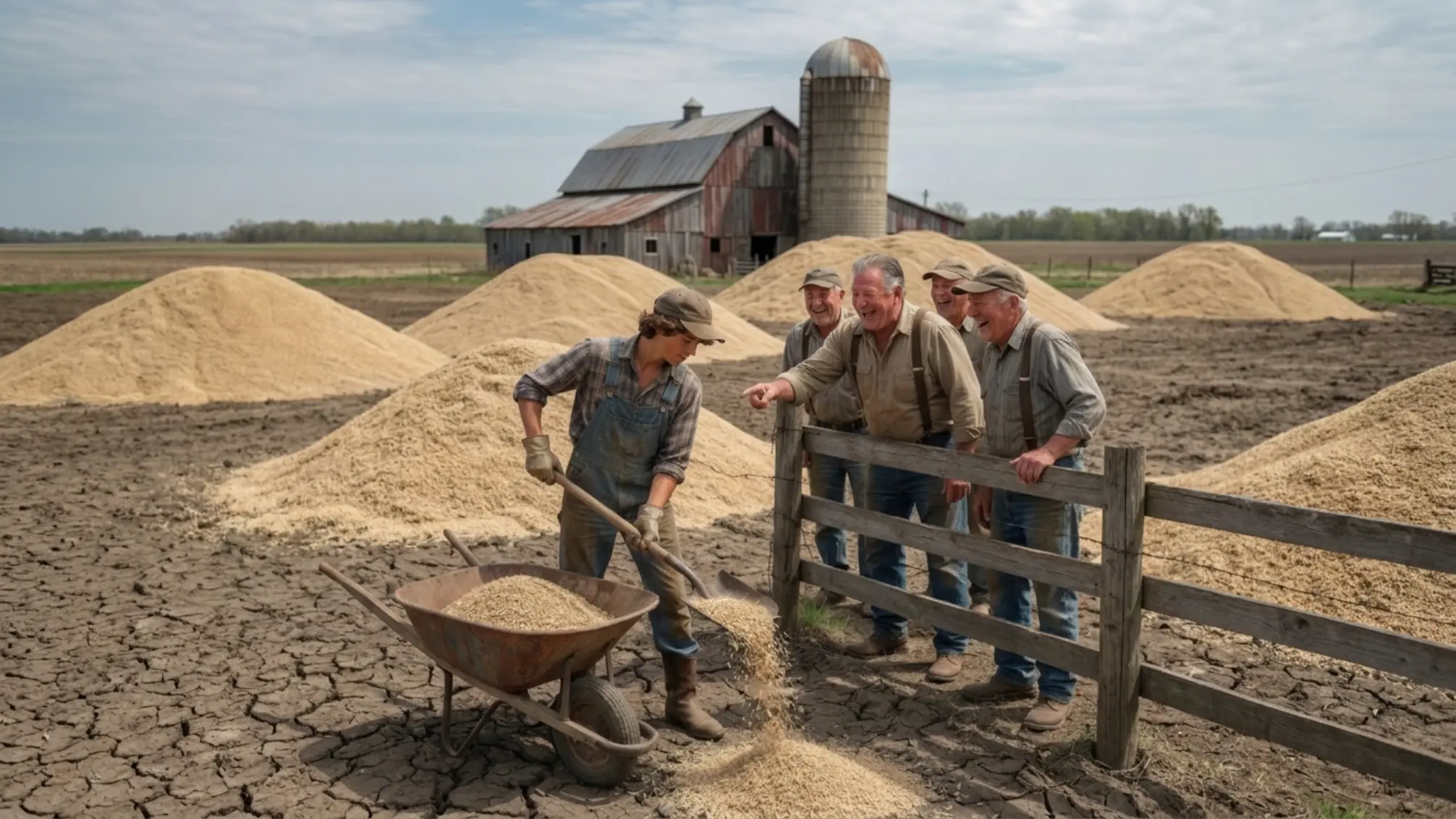
The Mill Owner had dumped those husks beside the Boy’s property since before the Boy was old enough to drive a tractor. When wind blew from the east, the husks drifted across the fence, covered irrigation ditches, clogged equipment, and gathered against the farmhouse porch. The Boy’s late father had complained repeatedly, but the Mill Owner always claimed the waste was harmless. When threatened with legal action, he reminded the family that the mill purchased nearly every farmer’s crop in the county.
The Boy’s father died two years earlier after a sudden illness, leaving the failing farm to his beautiful American wife and their only son. The Mother was thirty-nine, with clear fair skin, gentle green eyes, and long chestnut hair she wore in a practical braid while working. She understood household accounts, livestock, and the endless labor required to keep a farm alive, but the bank had placed the land in her son’s name according to his father’s will. On his eighteenth birthday, the Boy would either inherit the property free of immediate supervision or lose it to foreclosure.
The Mill Owner knew this.
He had already offered to purchase the farm for less than half its assessed value. The land bordered the only paved access road connecting his mill to the highway, and owning it would allow him to expand storage, build new loading bays, and control deliveries from every surrounding farm. He did not want the Boy’s fields to recover. He wanted them to fail so completely that the family would sign whatever paper he placed in front of them.
The Boy had rejected the first offer.
The Mill Owner returned with a lower one.
“You’re losing money every month,” he had said from the farmhouse porch. “Take what I’m offering before the bank takes everything and leaves you with nothing.”
The Boy’s Mother asked for time. The Boy answered immediately.
“No.”
After that, the waste piles grew faster.
Trucks from the mill began unloading husks closer to the boundary fence. Some loads spilled through broken boards and spread across the family’s drainage channel. When the Boy complained, the Mill Owner laughed and said he should be grateful for free ground cover. Everyone in the nearby town knew what was happening, but few were willing to challenge the man who employed dozens of workers and controlled where local rice could be processed.
The Boy spent his evenings studying the problem instead of surrendering to it.
At first, he only wanted to prove that the husks were damaging the farm. He borrowed agricultural books from the county library, read university bulletins, and filled a notebook with observations about soil temperature, moisture, decomposition, and drainage. He discovered that raw rice husks did not break down quickly and could create problems if used carelessly. But mixed correctly with animal manure, grass clippings, and other organic material, they could become part of a useful composting system.
The Boy also learned that burned husks could create a porous carbon material capable of holding moisture and improving damaged soil. He did not have the equipment to produce it on a large industrial scale, but he could experiment carefully with small batches in an old metal drum. He began after midnight so the Mill Owner would not see smoke rising from the farm.
His first attempt failed.
The husks burned to ash.
His second batch remained wet and useless.
On the third attempt, he controlled the airflow long enough to create blackened material that crumbled lightly between his fingers without disappearing into powder. He mixed it with composted manure from a neighboring dairy farm and spread it across a narrow test row behind the equipment shed.
The Mother discovered him there one morning.
“What are you burying?” she asked.
“Maybe our last chance.”
She looked at the black mixture. “And if it poisons the ground?”
“Then we lose one row instead of two hundred acres.”
The Mother knelt and touched the soil. She had spent months watching her son work until his hands cracked, skip school events, and pretend exhaustion was determination. Part of her wanted to stop him before hope hurt him again. Another part saw the same stubborn intelligence that had once convinced his father to buy this land when everyone else called it worthless.
“What do you need?” she asked.
“Time.”
“We have six months before the bank reviews the loan.”
“Then I need six months.”
The Mother stood. “You have them.”
Together, they expanded the experiment.
The Boy collected grass clippings from town, manure from neighboring farms, damaged hay no one could sell, and food scraps from a local diner. He built compost piles behind the barn, measuring heat with a borrowed thermometer and turning them by hand. He mixed small amounts of processed husk material into several test sections while leaving other rows untreated for comparison.
The Mill Owner noticed the wheelbarrows.
That was why he and his friends stood behind the fence laughing while the Boy spread the pale husks over the cracked field. They did not know the raw material would be mixed, layered, composted, and used only according to the Boy’s test results. They saw a desperate teenager covering dead ground with garbage.
The Boy let them believe it.
When the men finally walked away, his Mother stepped from behind the barn carrying a bucket of water.
“You should have told him what you’re doing,” she said.
“No.”
“He thinks you’re a fool.”
“That makes him careless.”
The Mother looked toward the mill. “You sound like your father.”
“He lost every argument with that man.”
“Your father argued before he had proof.”
The Boy nodded toward the test rows. “That’s why I’m waiting.”
The first visible change came after a summer storm.
Most of the farm’s bare soil hardened when the rain stopped, forming a crust that cracked beneath the sun. The treated test row remained darker and softer. When the Boy dug several inches down, he found moisture where nearby ground had already dried.
He planted rice seedlings in both sections.
The untreated row struggled.
The treated row remained green.
The Boy recorded every difference in his notebook—soil moisture, plant height, leaf color, root development, and water use. He refused to rely on memory or excitement. If he wanted the bank, county officials, and surrounding farmers to believe him, he needed numbers no one could dismiss.
A beautiful young American agricultural student from a nearby state university visited the farm after reading an email the Boy sent to her department. She was twenty-three, with bright brown eyes, dark hair tied beneath a field hat, and a confident manner that made the Boy suddenly aware of the dirt on his shirt. She was completing graduate research on improving depleted agricultural soils and had expected to find a farmer conducting a careless home experiment.
Instead, she found labeled plots, moisture records, control rows, and months of observations.
“You designed this yourself?” she asked.
“With books.”
“You separated treated and untreated sections?”
“I needed to know whether it worked or whether I just wanted it to.”
She studied him for a long moment. “That sentence already puts you ahead of half the people who send us miracle-soil claims.”
The Agricultural Student collected samples from several rows. She warned that one successful patch did not guarantee an entire farm could be restored, but the early results were promising. The treated soil held more moisture, showed improved structure, and supported stronger roots.
She asked where the husks came from.
The Boy pointed beyond the fence.
Her expression changed when she saw the mountains of waste.
“The mill owns those piles?”
“They call them worthless.”
“They may not stay worthless after this.”
The Boy immediately understood the danger. If the Mill Owner learned the waste had value, he would stop dumping it and claim every existing pile. Worse, he might take the Boy’s idea, hire experts, and present himself as the innovator.
The Agricultural Student advised the Boy to document everything. Dates, photographs, samples, witness statements, and records proving the mill had treated the material as waste for years. She also suggested filing a provisional application protecting the process he was developing, though the family could barely afford legal help.
The Mother sold her wedding ring.
The Boy found out only after she returned from town with an envelope containing the first legal payment.
“You said that ring was all you had left of Dad.”
“No,” she answered. “I have you.”
“I didn’t ask you to sell it.”
“You didn’t ask your father to leave you a farm buried in debt either. Families inherit burdens and choices together.”
The Boy wanted to refuse the money. Instead, he promised the sacrifice would matter.
The legal filing described a farm-scale process for converting local rice-mill waste into a soil amendment using controlled heating, composting, and precise application rates. It did not claim that rice husks alone were a miracle. The Boy’s system depended on preparation, testing, and balancing the material with nutrients.
The application was submitted quietly.
Then the Mill Owner accelerated his plan.
He contacted the Bank Manager and offered to purchase the family’s debt. The Mill Owner claimed he wanted to protect the bank from a likely default, but the real purpose was obvious. If he controlled the loan, he could force foreclosure before the Boy’s eighteenth birthday.
The Bank Manager visited the farm in a polished sedan.
He was a handsome American man in his mid-forties with neatly styled gray hair, a dark suit, and the careful expression of someone who preferred bad news delivered in polite language. He toured the dry fields, examined the aging equipment, and informed the Mother that the farm’s collateral value had fallen.
“We may require additional security,” he said.
“We have no additional property,” the Mother replied.
“Then selling voluntarily may be preferable.”
The Boy placed his notebook on the kitchen table. “The field is recovering.”
The Bank Manager barely opened it. “One green patch does not change the financial condition of two hundred acres.”
“It will.”
“Banks cannot lend against belief.”
“Then come back at harvest.”
The Bank Manager sighed. “The Mill Owner has made a reasonable offer.”
“He caused part of the damage,” the Boy said.
“That is an accusation.”
“It will become evidence.”
The Bank Manager closed the notebook. “You have ninety days to demonstrate meaningful improvement or the loan will be transferred.”
After he left, the Boy stared at the calendar.
Ninety days was not enough for a full harvest across the entire farm. He needed faster proof.
The Agricultural Student suggested planting a shorter-cycle cover crop in additional treated plots to demonstrate root growth and biomass. They also installed basic moisture sensors, photographed soil changes, and invited two independent farmers to observe the process.
The older farmers arrived skeptical.
One had laughed beside the Mill Owner at the fence.
Now he pushed his fingers into the treated soil and found moisture several inches below the surface.
“That ground was hard as brick last spring,” he muttered.
The Boy handed him two plants, one from each test section.
The root system from the treated row was nearly twice as dense.
The farmer stopped smiling.
“Can you do this on my north field?”
“Not until I know exactly how much material is safe.”
“You’re turning down business?”
“I’m refusing to ruin your land just to prove I can sell something.”
That answer traveled through the county.
Farmers began visiting without telling the Mill Owner. Some brought soil samples. Others asked whether the Boy would buy husks from them if they installed small mills of their own. The Boy repeated that the process remained experimental and that raw husks should not simply be dumped across fields.
The Mill Owner heard the rumors.
He arrived at the farm in a red truck, accompanied by an Attorney and two workers. He announced that every husk beyond the fence remained the mill’s property, including material that had blown or spilled onto the Boy’s land.
The Mother stepped onto the porch. “You called it garbage for twelve years.”
“Ownership does not disappear because something lacks immediate value.”
The Boy approached with his notebook under one arm. “Your trucks dumped it here without permission.”
The Attorney produced old waste-disposal forms. The papers claimed the Boy’s father had accepted mill byproducts for use as fill material.
The signature looked genuine.
The Boy’s face tightened.
His Mother examined the date. “My husband was in the hospital that week.”
The Mill Owner smiled. “Memory becomes unreliable when money appears.”
The Boy requested a copy.
The Attorney refused.
The Agricultural Student had already taught him to expect that. He photographed every visible page before they could stop him.
That night, the Boy compared the signature with his father’s old records. The shape was similar, but the pressure, spacing, and final stroke differed. Someone had traced it.
More importantly, the contract listed a county registration number that had not existed on the alleged signing date.
The Boy took the photograph to the County Clerk.
The Clerk confirmed that the number belonged to a form series introduced three years later. The disposal agreement was false.
The Mill Owner had forged evidence after learning the husks might be valuable.
The Boy did not confront him.
He delivered copies to the bank, county environmental office, and a local newspaper. He also requested testing of groundwater near the waste piles, suspecting years of uncontrolled dumping might have caused additional problems.
The Mill Owner responded by closing the access road between the farm and the mill. He erected a fence extending several feet onto disputed property and positioned equipment to block the family’s tractor.
When the Boy removed one post, the Sheriff arrived.
The Mill Owner accused him of trespassing and theft.
The Boy showed the property survey, but the Sheriff said the boundary dispute had to be settled in court. Until then, the equipment would remain.
The blockage prevented the family from reaching thirty acres already planted.
The Boy stood beside the new fence, fury tightening his chest. For the first time, he understood why his father had shouted during every confrontation with the Mill Owner. Wealth could create delay, and delay could kill a farm as effectively as drought.
His Mother touched his arm.
“Do not give him the angry boy he expects.”
“He’s destroying the crop.”
“He is trying to make you destroy your own case.”
The Boy looked toward the mill workers watching from across the road. Several appeared ashamed.
He lowered the shovel in his hand.
Instead of tearing down the fence, he contacted the Agricultural Student, the newspaper reporter, and every farmer who had visited his test plots. By afternoon, twenty vehicles lined the public road.
The Boy stood before them with maps, photographs, and the forged agreement.
He explained the blocked access, the soil experiment, and the Mill Owner’s attempt to claim waste he had forced onto the family’s property for years. The Reporter photographed the fence. The Agricultural Student presented laboratory results confirming that the Boy’s treatment process improved moisture retention and soil structure in the test plots.
The Bank Manager arrived unexpectedly.
He walked through the treated field himself.
The rice plants reached above his knees, greener and denser than those in the untreated section. The Boy showed him projected yields based on measured plant development. Even under conservative estimates, the treated acreage could produce enough income to prevent immediate foreclosure.
The Bank Manager looked toward the Mill Owner. “You told us this farm was beyond recovery.”
“It is one experimental patch,” the Mill Owner answered.
The Boy opened the gate to a second field.
Rows of healthy plants stretched farther than anyone expected.
He had expanded the treatment quietly at night.
The Mill Owner’s smile disappeared.
Two weeks later, a judge ordered the false fence removed and prohibited the mill from interfering with access. The forged agreement was turned over for criminal investigation. County officials also cited the mill for years of improper waste storage and uncontrolled dumping.
The Mill Owner offered the Boy money.
First, he proposed purchasing the treatment process.
Then he offered a partnership.
Finally, he demanded half of all future profits in exchange for continued access to the husks.
The Boy rejected every proposal.
“You need my waste,” the Mill Owner said inside the farmhouse kitchen.
“I needed what you abandoned.”
“You cannot expand without the mill.”
“There are six other mills in Arkansas.”
“They will not work with a child.”
The Boy leaned forward. “Then come back after my birthday.”
Harvest arrived beneath a clear October sky.
The treated fields produced the strongest crop the farm had seen in years. Not every acre recovered equally, and the Boy refused to exaggerate the results, but the improvement was undeniable. Water use had fallen, plant loss had decreased, and the healthier sections yielded enough to satisfy the bank.
Trucks lined the road.
The Mill Owner expected the Boy to bring his rice to the local mill because no nearby alternative could process the volume quickly. Instead, three farmers had pooled money to transport the harvest to a cooperative mill in another county.
The Boy’s grain left without crossing the Mill Owner’s property.
The bank loan was renewed.
The farm remained in the family.
On the Boy’s eighteenth birthday, his Mother placed the deed in his hands beside the same field where the Mill Owner had laughed at him. The document was not free of debt, but it was secure. The Boy was now legally responsible for the land his father had trusted him to protect.
The Agricultural Student attended the small celebration. She brought confirmation that the Boy’s provisional filing had advanced and that a university research partnership wanted to conduct larger trials. The process would be tested honestly, with limitations recorded as carefully as successes.
The Boy agreed under one condition.
Local farmers would receive affordable access before large corporations.
The research team accepted.
Within a year, the farm opened a small processing facility using husks purchased from several mills under transparent contracts. The operation created jobs for young workers, struggling farmers, and former mill employees who had grown tired of watching one powerful owner control the county.
The old rice mill began losing suppliers.
Farmers disliked its pricing, its intimidation, and the waste fees it suddenly tried to impose after years of careless dumping. Several joined the cooperative supporting the Boy’s facility.
The Mill Owner returned to the fence one final time.
He no longer brought laughing friends.
Behind the Boy, restored fields moved beneath the wind in broad green waves. New storage sheds stood beside the old barn, and trucks waited to collect processed soil material.
“You think you won because of one harvest?” the Mill Owner asked.
The Boy rested both hands on the fence. “No.”
“Then what do you think happened?”
“You spent years teaching everyone that waste had no value, farmers had no choices, and my family had no future.”
The Mill Owner said nothing.
The Boy looked toward the mountain of husks still towering beside the mill.
“I proved you wrong three times.”
The Mill Owner eventually sold the property after investigators confirmed forged documents, illegal dumping, and financial pressure used against multiple farms. The buyer was not another private company.
It was the farmers’ cooperative.
They cleaned the site, rebuilt the storage system, and signed fair processing contracts with surrounding families. The enormous husk piles were gradually tested, sorted, and used through approved methods rather than dumped across property lines.
The Boy’s Mother bought back her wedding ring from the jeweler who had kept it in storage after hearing their story. At supper that night, she placed it beside the farm deed.
“Your father would have been proud,” she said.
The Boy looked through the window toward the fields.
“He would have argued with the Mill Owner too early.”
His Mother smiled. “Yes.”
“I waited for proof.”
“You learned from him without becoming him.”
The Boy slipped the ring back onto her finger.
Years later, people told the story as though the solution had been obvious. They said a clever farm boy discovered that rice husks could help soil, spread them across dying fields, and became successful.
The truth was harder.
He failed repeatedly, recorded everything, asked for help, protected his work, resisted intimidation, and refused to sell a method before proving it was safe. The husks did not rescue the farm by themselves.
The Boy did.
He took what a powerful man had discarded, studied what everyone else mocked, and found possibility beneath years of waste.
The Mill Owner believed the dying farm would bury the Boy.
Instead, the field became the place where his future finally grew.